
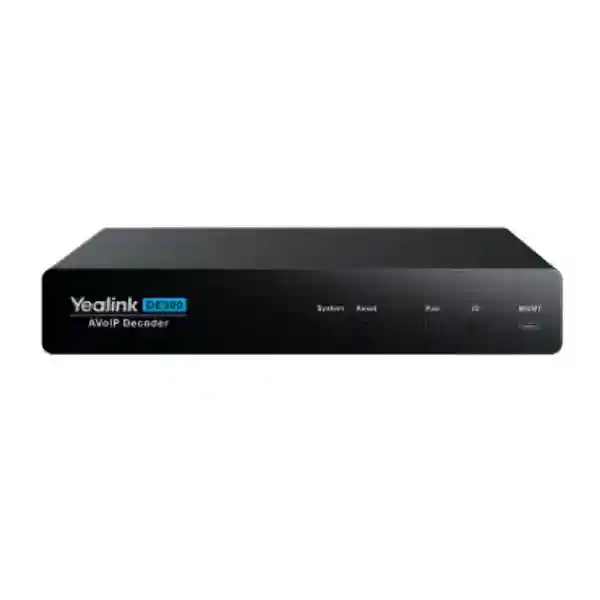
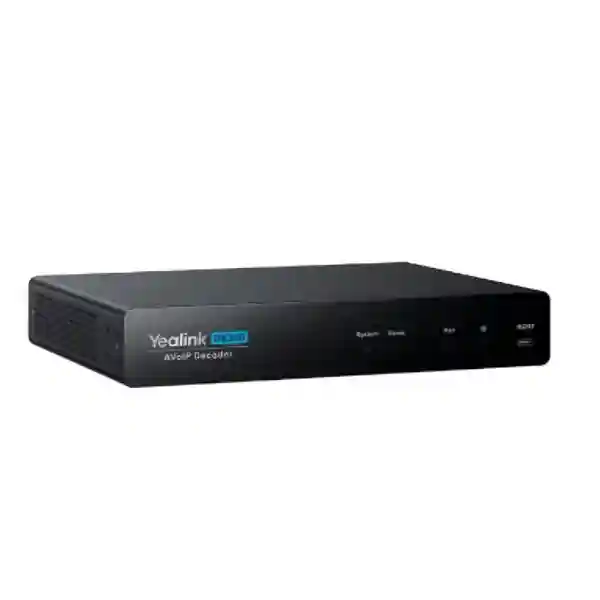
Yealink DE300 AV over IP Decoder
The Yealink DE300 is a high-performance AVoIP decoder built for professional rooms that need dependable 4K video distribution, flexible source routing and practical display control over an IP network. Yealink specifies support for up to 4K@60Hz video with 4:4:4 chroma sampling, 8-bit color depth, HDCP 2.3 and ultra-low latency of less than one frame. The platform is designed around Gigabit Ethernet, making the DE300 suitable for meeting rooms, training facilities, divisible rooms, control environments and other AV spaces where video, audio and USB workflows must move between endpoints without the complexity of conventional point-to-point extension.
Choose the DE300 when your project needs a Yealink AVoIP decoding endpoint that can receive IP video, output to HDMI, provide USB video capture and participate in scalable Yealink AV ONE room designs. Confirm managed-switch requirements, endpoint quantity, firmware alignment, display control method and the room’s signal-routing plan before ordering.
Up to 4K at 60 Hz with 4:4:4 chroma sampling for detailed professional content.
Designed to transport AVoIP streams across Gigabit Ethernet infrastructure.
Supports protected UHD content workflows where source, transport and display are correctly matched.
Integrated capture output can support room-system streaming and conferencing workflows.
What the Yealink DE300 does
In an AV over IP architecture, the decoder sits at the receiving side of the networked signal path. Instead of running a dedicated long HDMI cable from every source to every display, compatible encoders place AV signals onto the Ethernet network and decoders recover those streams where they are needed. The DE300 is Yealink’s decoding endpoint for this workflow. It can take an IP source and make that content available to a local HDMI display, while its USB capture capability gives designers another path for bringing decoded content into a room computer or conferencing core.
This architecture is valuable when rooms need more flexibility than a basic one-source-to-one-screen connection. A meeting environment may have multiple presentation sources, multiple displays, a conferencing computer and a requirement to change routes depending on the meeting mode. A training room may need to distribute the same content to several screens or combine local and network sources. A control room may need to place selected sources on different displays without rewiring. The DE300 is designed for those networked AV scenarios, particularly when used with Yealink EN300 encoders and Yealink room-management components.
The product should not be treated as a generic HDMI extender. AVoIP performance depends on the switching environment, multicast handling, endpoint configuration and the design of the overall signal flow. Yealink’s current guidance states that AVoIP devices should use a Gigabit managed AV switch that supports IGMP. That requirement matters at quotation stage because the decoder may be only one part of the bill of materials. The correct design can also include compatible encoders, room managers, displays, conferencing hardware, cabling, rack accessories and network switching.
Verified Yealink DE300 features
4K60 4:4:4 decoding
Yealink specifies video resolution up to 4K@60Hz with 4:4:4 chroma sampling and 8-bit color depth. This is valuable for detailed shared content, dashboards, spreadsheets, engineering visuals and presentation material where text and fine graphics need to remain clear.
Ultra-low latency
Yealink describes the transport latency as less than one frame and markets the DE300 at approximately 16 ms low latency. Low delay is important for natural source interaction, conferencing, operator displays and room workflows where a noticeable lag between input and display would be distracting.
Flexible local routing
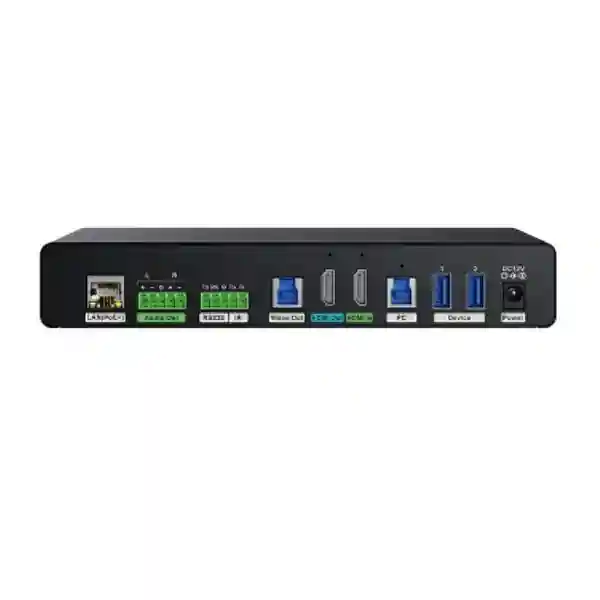
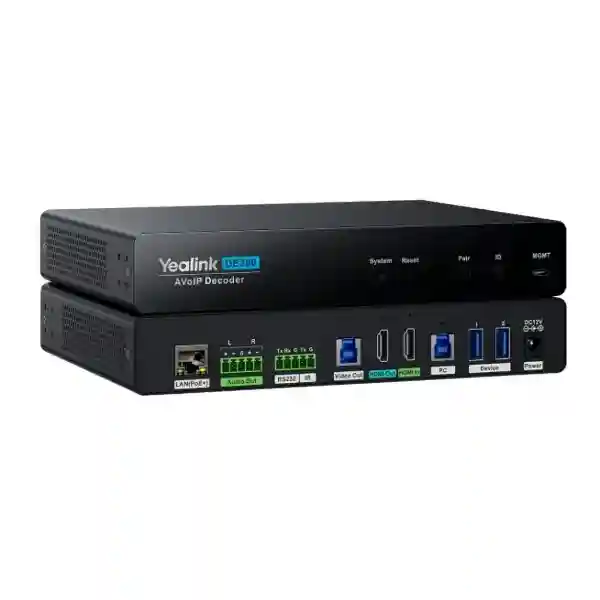
The DE300 includes HDMI input and IP input paths, with HDMI output and video capture output. Yealink also describes a built-in 2×2 video matrix capability, allowing local and network content to be assigned more flexibly than a fixed decoder-only path.
Display control
RS-232, CEC and IR control options help AV designers coordinate display power, source behaviour and room automation. The chosen control method depends on the display model, room design and the command workflow required by the project.
HDCP 2.3
Support for HDCP 2.3 allows the AVoIP path to handle protected UHD content when all devices in the signal chain are compatible and configured appropriately. HDCP compatibility should be checked from source through decoder to display.
Gigabit network architecture
The DE300 is designed for 1Gbps Ethernet. Yealink’s deployment guidance calls for a managed Gigabit AV switch with IGMP support, which means the network must be designed as part of the AV system rather than assumed to be suitable without validation.
Technical specification overview
| Area | Verified DE300 capability | Planning relevance |
|---|---|---|
| Video | Up to 4K@60Hz, 4:4:4, 8-bit, HDR support | Confirm source and display support for the intended format. |
| Latency | Less than one frame; marketed at 16 ms | Appropriate for interactive professional AV workflows. |
| Copy protection | HDCP 2.3 | Check the complete source-to-display chain. |
| Video input | 1 × HDMI input, 1 × IP input | Supports both local and network source workflows. |
| Video output | 1 × HDMI output, 1 × video capture output | Useful for displays and room-system capture scenarios. |
| Network | Gigabit Ethernet; bit rate below 1Gbps | Use managed Gigabit switching and validate multicast design. |
| Control | RS-232, CEC, IR | Allows control integration with suitable displays and room automation. |
| USB | USB connectivity and USB 3.0 capture support | Useful for MTR Core streaming and USB-over-IP-oriented room workflows. |
Compatibility, network and deployment planning
The most important buying question is not simply whether the DE300 supports the desired resolution. A successful AVoIP project needs a complete architecture. Yealink’s solution family pairs the DE300 decoder with EN300 encoders and can use CT200 or CT300 room-device managers depending on the system design. The number of encoders and decoders changes with the number of sources, displays and operating modes. A medium meeting room may need a straightforward one-encoder, one-decoder path, while training rooms and divisible spaces can require several endpoints and more complex routing logic.
Network configuration deserves equal attention. Yealink’s current firmware guidance states that AVoIP devices must be connected through a Gigabit managed AV switch that supports IGMP. This helps control multicast traffic and keeps streams from flooding unrelated switch ports. Buyers should therefore provide details about the existing switch model, available ports, VLAN design, uplink capacity and whether the AV network will be dedicated or shared with other services. Existing Cat5e or better structured cabling may be reusable where it meets the project’s network requirements, but the complete path should be inspected rather than assumed.
Firmware consistency is also important. Yealink advises that EN300 and DE300 devices in the same solution should use the same firmware version and that related components should be updated to compatible versions. For ongoing operation, the project documentation should record endpoint names, IP settings, switch ports, firmware levels, source assignments, display-control method and the intended normal operating modes. That information makes future troubleshooting and expansion much easier.
For organizations building a wider collaboration environment, FourTeck Tanzania’s business technology services page explains how video conferencing, networking, displays and infrastructure are planned as connected systems. Buyers can also review the Tanzania technology shop for adjacent business technology categories and use the FourTeck Tanzania home portal to understand related networking and collaboration options.
Where the DE300 fits best
Meeting rooms
Route shared content to one or more displays, coordinate with Teams-room components and use USB capture where the room design needs decoded AV inside the conferencing workflow.
Training spaces
Distribute instructor sources to multiple displays while keeping routing flexible for different teaching layouts, presentation modes and room configurations.
Divisible rooms
Support rooms that operate separately or merge for larger events, provided the control and endpoint design is engineered for the partition states.
Control environments
Use IP routing to place selected sources on operational displays where direct HDMI cabling would be inflexible or difficult to scale.
Yealink DE300 AV over IP Decoder Tanzania
For organizations in Tanzania, the Yealink DE300 is most relevant when meeting-room or professional AV requirements are becoming too complex for simple point-to-point HDMI extension. Businesses may be redesigning a boardroom, creating a training centre, building a command space, modernising a conference suite or introducing a larger Microsoft Teams Rooms environment. In each case, the value of the DE300 comes from placing AV transport on a managed network so that source-to-display relationships can be changed in software and expanded by adding compatible endpoints rather than by rebuilding long dedicated cable routes.
A Tanzania quotation should therefore start with the room and network architecture. Useful inputs include the number of displays, the number and type of sources, required video resolution, whether USB capture is needed, the location of the conferencing core, the distance between equipment positions, and the expected control method for each display. It is also important to identify the existing switch platform. Yealink specifies Gigabit managed switching with IGMP support for AVoIP deployments, so an unmanaged office switch should not automatically be assumed to be suitable. If the project shares the LAN with voice, data, Wi-Fi and other traffic, VLAN design and uplink capacity should be reviewed.
Tanzania customers should also consider the physical layer. AVoIP reduces reliance on long HDMI runs, but it still depends on stable Ethernet cabling, organised racks, suitable patching and reliable power. Meeting-room displays, conferencing computers and network switches may all require UPS planning where continuity is important. Heat, cabinet ventilation and cable management can affect long-term reliability, particularly in equipment rooms where several AV and network devices are installed together.
For buyers comparing options, focus on system fit rather than the decoder price alone. Ask whether the proposed design includes the required EN300 encoder quantity, management components, compatible switching, display control and commissioning. Confirm firmware alignment before handover and request documentation of stream routing and switch configuration. FourTeck can help structure these questions so the DE300 is purchased as part of a usable AV system instead of as an isolated appliance.
Yealink DE300 AV over IP Decoder Dar es Salaam
In Dar es Salaam, the DE300 can suit corporate headquarters, professional services firms, hotels, training centres, universities, financial organizations and operations teams that need scalable AV distribution inside modern collaboration spaces. Larger offices often have more than one display in a room, several presentation inputs and a mix of local meetings and remote conferencing. A network-based AV architecture can simplify how those sources are routed, especially when equipment racks and screens are separated by longer cable paths.
A practical Dar es Salaam project should begin with a room drawing and a signal-flow plan. Mark every display, presenter input, conferencing core and control point. Then identify which sources must appear on which screens in each operating mode. For a dual-display boardroom, one mode might show remote participants on one screen and shared content on another; another mode might duplicate a presentation across both screens. Because the DE300 provides both an HDMI output and video capture output, it can be incorporated into different workflows, but the exact routing should be engineered rather than improvised during installation.
Network readiness is particularly important where the business LAN already carries heavy cloud, backup, surveillance or Wi-Fi traffic. The DE300 uses Gigabit Ethernet and Yealink requires managed AV switching with IGMP support. IT teams should verify whether existing switching can provide the necessary multicast control and whether AV traffic should have a dedicated VLAN. Uplinks between floors or racks should be checked for aggregate capacity, and endpoint addressing should be documented so AV support does not become a guessing exercise later.
Procurement teams in Dar es Salaam should request a complete bill of materials and define responsibilities for switching, cabling, displays, rack accessories and commissioning. If an existing conference room is being upgraded, note the current display models, HDMI source devices, conferencing platform, cable routes and available rack space. This information helps determine what can be reused and what must change. The objective is a room that is simple for users even though the technology behind it may be sophisticated: start a meeting, select a source and see the expected content without manual rewiring.
Yealink DE300 AV over IP Decoder Mwanza
Mwanza organizations considering the Yealink DE300 may include regional offices, education providers, healthcare administrators, hospitality operators, mining-related businesses and distributed enterprises that want consistent meeting-room standards beyond a primary headquarters. AVoIP can be especially useful where a room needs multiple presentation positions or displays but the organization wants to keep a structured IP-based architecture rather than install separate long-distance video extenders for each path.
For a Mwanza deployment, it is useful to distinguish between local-room requirements and wide-area connectivity. The DE300 moves AV across the local IP network; it does not replace the internet connection used by Microsoft Teams, Zoom or other cloud meeting platforms. The room can therefore have excellent internal 4K signal transport while still suffering poor remote-call quality if WAN connectivity is unstable. A project review should examine both layers separately: local AVoIP switching for source distribution and internet/network quality for external conferencing.
Power planning should also be considered. The decoder, encoder, network switch, conferencing core and displays all depend on stable electrical service. Where short power interruptions would disrupt important meetings or training sessions, the project can evaluate UPS protection for the active network and AV equipment. The required capacity depends on actual load and desired runtime, so it should be calculated rather than selected by guesswork. Equipment racks should provide ventilation and accessible cable management for maintenance.
When requesting a DE300 quotation for Mwanza, provide the number of rooms, expected displays per room, source count, target resolution and whether the project should be standardized for future branch rollouts. Standard endpoint naming, firmware versions, switch configuration and room documentation can make multi-site support easier. If the organization expects future expansion, selecting the network architecture and rack capacity with that growth in mind can reduce later rework. A well-documented AVoIP room is easier for remote IT teams and visiting technicians to understand.
Yealink DE300 AV over IP Decoder Arusha
In Arusha, hospitality, conference, tourism, NGO, education and corporate environments can have distinctive collaboration requirements. Meeting spaces may need to handle executive presentations, remote conferences, workshops and events without changing the physical cabling each time. The Yealink DE300 supports this kind of flexible room design by decoding networked AV streams at the display side while also supporting local HDMI input and USB capture functions.
For hotels and conference venues, the key question is how repeatable the room configuration needs to be. A simple meeting room may require one source and one display, while a training or event space may need several screens and selectable sources. If rooms are reconfigured for different events, AVoIP can make routing more adaptable, but only when the switching and control layer is designed carefully. Project teams should map standard operating modes and decide who will control source selection: end users, room controllers or technical staff.
Arusha buyers should also review display control requirements. The DE300 supports RS-232, CEC and IR, giving integrators options for power and control depending on the connected display. Not every display supports every method equally, so the exact make and model should be checked before the control plan is finalized. Where automatic room start-up and shutdown are desired, the command set and control sequence should be tested as part of commissioning.
The network remains the foundation. Yealink specifies managed Gigabit switching with IGMP for AVoIP. If the same switch stack also handles guest Wi-Fi, office computers, CCTV or phones, IT teams should review segmentation and capacity rather than simply connect the endpoints to any available ports. A quotation should document the proposed switch ports, VLAN, cabling and endpoint placement. That disciplined approach is particularly useful in hospitality and shared facilities, where technical staff may support many rooms and need consistent naming and troubleshooting procedures.
Yealink DE300 AV over IP Decoder Dodoma
Dodoma deployments may include government-facing institutions, administrative offices, education organizations, conference facilities and expanding businesses that need dependable presentation and hybrid-meeting infrastructure. The Yealink DE300 is relevant where AV sources need to move over the LAN to one or more displays with high visual quality and low delay. Its 4K@60Hz 4:4:4 capability can be useful for text-heavy presentations, dashboards and detailed visual content that may lose clarity with lower chroma formats.
A Dodoma project should define what the room must do in normal operation and during special events. For example, an executive room may usually show a conferencing interface and shared content on two displays, but occasionally need a guest laptop or local media source. A training room may require the same presenter content on several screens. The DE300 can participate in these different signal paths, but endpoint quantity and routing logic depend on the actual room modes. Providing these requirements before quotation allows the design to be sized properly.
Infrastructure reviews should include network switching, structured cabling, rack environment and power. AVoIP simplifies long-distance signal transport by using Ethernet, yet that does not remove the need for good cable testing and patching. Managed-switch configuration should support IGMP as specified by Yealink, and firmware should be aligned across compatible EN300 and DE300 endpoints. If the project spans multiple floors or buildings, uplink design should be reviewed so AV traffic does not encounter avoidable bottlenecks.
Procurement teams should also ask for clear acceptance criteria. During handover, test each intended source-to-display route, verify expected resolution, check USB capture if used, validate display power/control commands and record device firmware. Documentation should identify the equipment and network ports associated with each room. These steps reduce dependence on installer memory and help the organization maintain the solution over its useful life.
Yealink DE300 AV over IP Decoder UAE
For projects in the UAE, the Yealink DE300 can support enterprise boardrooms, training facilities, hospitality conference spaces and multi-room collaboration environments that require networked AV distribution. Organizations with offices across the Gulf and East Africa may also use a common Yealink room architecture to reduce variation between sites. A standardized AVoIP design can make support documentation, device naming and operating procedures more consistent, even when each office has a different number of sources and displays.
The DE300’s role remains the same: decode an AVoIP stream close to the display or receiving equipment, provide local HDMI output and support USB capture where required. The broader design can combine EN300 encoders, CT200 or CT300 management components and suitable managed AV switching. Yealink requires Gigabit managed switching with IGMP support, so the switch platform should be validated against the deployment guide before equipment is finalized.
For regional procurement, buyers should confirm model, quantity, part-number expectations and any licensing associated with optional protocols or wider solution components. The DE300 product page identifies Yealink part number 1303135, but commercial quotations should still state the exact included hardware and accessories. Room requirements such as rack mounting, cable lengths, control interfaces and display compatibility can affect the final bill of materials. For UAE-focused technology sourcing, organizations can also review FourTeck UAE technology solutions alongside the Tanzania project requirements.
Where a group is standardizing rooms across countries, create a reference design that defines switch configuration, VLANs, firmware baseline, cabling, display control and test procedures. Local room variations can then be documented as exceptions. This approach makes it easier to compare quotations and maintain consistent user experiences across locations rather than rebuilding every conference room from a blank sheet.
Yealink DE300 AV over IP Decoder Uganda
Uganda organizations evaluating the Yealink DE300 may be upgrading meeting rooms, education facilities, operations centres or multi-site offices. The decoder is best considered when the AV requirement includes multiple displays, flexible source routing or longer distribution distances that are better served by IP networking than by a collection of dedicated HDMI extenders. Because it uses Gigabit Ethernet, the solution can fit within structured network designs when the switching layer is managed appropriately.
The project should begin with signal mapping. List every source, such as conferencing cores, laptops or presentation devices, and every destination display. Then define which combinations are required during normal meetings, presentations, training sessions and special events. This determines the number of encoders and decoders and helps identify whether room-management components are needed. It also reduces the risk of purchasing endpoints without a clear routing plan.
For Uganda deployments, consider how support will be handled after handover. Endpoint firmware, IP addresses, switch ports and room diagrams should be documented. Yealink advises keeping EN300 and DE300 devices on the same firmware version within a solution. A change process for future firmware updates is therefore sensible, particularly where several rooms or branches use the same design. Network backups and configuration records can reduce recovery time if switching equipment is replaced.
Businesses operating in both Tanzania and Uganda may benefit from a shared reference architecture. The FourTeck Uganda technology portal provides a regional path for IT and collaboration requirements, while the Tanzania team can coordinate the product-page requirement and overall design discussion. Buyers should still confirm deployment scope and service availability for each location rather than assuming identical commercial terms across countries.
Yealink DE300 AV over IP Decoder Kampala
Kampala has a wide range of corporate, financial, education, NGO, hospitality and professional-services environments where meeting rooms increasingly combine in-room presentations with remote collaboration. The Yealink DE300 can be appropriate for larger rooms where content needs to reach more than one display or where the AV rack is separated from the screens. Moving the signal across a managed IP network can make future routing changes easier than replacing fixed point-to-point cabling.
A Kampala boardroom project should document the user workflow before hardware selection. If users are expected to walk in and share content without technical assistance, the room-control design matters just as much as the decoder specifications. Source switching should be predictable, and display power should follow the meeting state where possible. The DE300’s RS-232, CEC and IR control options can support those workflows when the connected displays and room controller are compatible.
Network engineering should be coordinated with the IT team. AVoIP traffic is not just ordinary office data. Yealink’s requirement for managed Gigabit switching with IGMP support means switch capability and multicast configuration must be confirmed. Where the AV network shares infrastructure with business applications, it may be helpful to segment the endpoints into a dedicated VLAN and monitor uplinks for congestion. Exact design choices depend on the site and should be documented.
For quotation, provide room count, screen count, source count, conferencing platform, preferred control method and details of existing switching. If the project is replacing conventional HDMI matrix hardware, also provide the current signal diagram so the new IP-based design can reproduce required functions. A strong proposal should explain not only which DE300 units are required but how they interact with encoders, managers, displays and network infrastructure.
Yealink DE300 AV over IP Decoder Arua
For an Arua site, the strongest reason to consider the Yealink DE300 is often standardization. A regional office, education facility, operations site or meeting centre may need the same collaboration-room experience used at a larger headquarters, but with a smaller endpoint count. AVoIP allows organizations to retain a common architecture while adapting the number of encoders and decoders to the actual room size.
Before ordering, assess the existing LAN and cabling rather than assuming that any Ethernet network is sufficient. The DE300 is a Gigabit AVoIP device, and Yealink specifies a managed AV switch with IGMP support. A site with older unmanaged switching may require network upgrades. Cabling should be tested, patch panels labelled and switch ports reserved for the AV endpoints. These practical steps often matter more to reliability than adding unnecessary product features.
Remote support should influence the design as well. If technical staff are not always present on site, use clear endpoint names, consistent IP addressing and documented room modes. Keep firmware aligned across the compatible Yealink AVoIP devices and record the approved firmware baseline. If a decoder is replaced, technicians should be able to identify its switch port, assigned role and expected routes without rediscovering the room from scratch.
Arua procurement teams can speed up quotation preparation by sending photographs of the room, approximate cable distances, rack location, display models and the number of required sources. This allows the designer to identify obvious gaps such as insufficient switch ports, missing rack space or unsupported display-control methods. The final objective should be a straightforward user experience backed by a disciplined network and documentation layer.
Yealink DE300 AV over IP Decoder Mbarara
Mbarara organizations may use the DE300 for training rooms, executive meeting spaces, education environments or branch offices where high-quality shared content must be delivered to professional displays. The product’s 4K@60Hz 4:4:4 capability is particularly useful where fine text and detailed visual material should remain clear. Its low-latency transport also helps maintain a natural response when users change or interact with presentation content.
A design should not be based only on the maximum video specification. Many rooms operate at 1080p, and that can still be entirely appropriate. The main value of the DE300 is the flexibility of IP distribution, not simply the ability to show 4K. Determine the native resolution of existing displays, the output capability of source devices and the conferencing platform requirements. Then choose EDID settings and routing policies that create stable, repeatable operation.
If the room will use USB capture to bring decoded video into a conferencing core, test that complete workflow during commissioning. USB connections, conferencing software and device enumeration can behave differently from a simple HDMI display path. The acceptance test should cover the actual meeting scenario, not only whether the decoder powers on and shows an image. Similarly, display control should be tested with the exact screen model if RS-232, CEC or IR is part of the design.
For Mbarara buyers, request a quotation that separates product quantities from infrastructure dependencies. This makes it clear whether managed switching, cabling, rack accessories, display mounts or commissioning are included. Where the organization intends to replicate the room at other branches, ask for a standard design package with endpoint naming and configuration guidance. That turns the first installation into a repeatable model rather than a one-off technical project.
Yealink DE300 AV over IP Decoder Gulu
Gulu buyers can consider the Yealink DE300 for professional AV deployments that need scalable source distribution without relying on many dedicated long-run video cables. The decoder’s role near the display can reduce the need to extend HDMI directly from a central rack, provided the network path is properly engineered. This can be useful in conference, education and operations environments where rooms may change over time.
A site survey should confirm how far the display locations are from the proposed encoder or equipment rack, what structured cabling already exists and where network switches are installed. If multiple buildings or floors are involved, uplinks should be reviewed for capacity and management. Because Yealink requires managed Gigabit switching with IGMP, each network segment participating in the AVoIP system should be validated. The design should avoid passing multicast AV traffic through unknown unmanaged sections.
Room users should also be considered. A technically flexible system can still be difficult to operate if there is no clear control interface. Define whether staff will choose sources from a room controller, preset scene or technical interface. Limit everyday controls to the actions users actually need. A good AV room hides complexity: users should not need to understand multicast, EDID or firmware to start a presentation.
When preparing a Gulu quotation, include the intended use cases, number of simultaneous sources and display destinations. If only one source will ever feed one screen, a full AVoIP architecture may be unnecessary; if several routes and future expansion are expected, the DE300 becomes more compelling. This requirement-led approach helps ensure the investment matches operational needs rather than being selected simply because the product is technically advanced.
Yealink DE300 AV over IP Decoder Kenya
Kenya-based organizations with regional offices may use the Yealink DE300 to standardize sophisticated meeting-room and training-room designs across multiple sites. A common AVoIP platform can simplify procurement specifications and support procedures because the same endpoint roles, switching requirements and firmware practices can be repeated while endpoint counts vary by room. This is particularly useful for businesses operating across Kenya, Tanzania and Uganda.
The design should still be adapted to each building. Different offices may have different switch vendors, display models, cabling conditions and room-control expectations. The DE300 itself supports 4K@60Hz 4:4:4 decoding, HDCP 2.3, USB capture and display control, but those capabilities only deliver value when the surrounding devices are compatible. Source resolution, EDID, HDCP path and display control should be validated on site.
Network teams should use Yealink’s requirement for managed Gigabit switching with IGMP as a minimum planning principle. Determine whether AV traffic will have its own VLAN, how multicast will be contained and whether uplinks have sufficient capacity. For larger campuses, topology documentation is important because troubleshooting becomes more difficult when AVoIP streams cross several switch layers without a clear map.
For regional sourcing, the FourTeck Kenya technology portal can support Kenya-specific IT and conferencing discussions. Multi-country customers can use a common room schedule and bill-of-material template, then request local commercial terms for each site. The technical standard remains consistent while procurement, logistics and installation scope are confirmed per location.
Yealink DE300 AV over IP Decoder Kuwait
Kuwait projects can use the Yealink DE300 in enterprise boardrooms, training facilities and collaboration spaces where network-based AV routing provides an advantage over fixed video cabling. A common example is a multi-display room with several possible presentation sources. Instead of dedicating one extender path to each source and display relationship, encoders and decoders can be routed over the managed Ethernet network according to the current room mode.
The decoder’s support for 4K@60Hz 4:4:4 helps preserve detail in business presentations, dashboards and high-resolution content. Low latency is useful for interactive presentations and live meeting workflows. USB capture can help feed decoded content into a conferencing system, while RS-232, CEC and IR provide options for controlling connected displays. The exact feature set used in a project should follow room requirements rather than activating complexity that users do not need.
For Kuwait organizations that also operate in Tanzania, the key advantage of a shared design is consistency. Define a baseline switch requirement, firmware policy, endpoint naming convention and room acceptance checklist. Then adapt quantities and display selections by site. This makes it easier for central IT teams to support rooms across countries and compare quotations from different projects.
Commercial planning should include any optional protocol licensing required by the broader AVoIP solution, even if the base room does not need those features. Buyers should ask the supplier to identify included capabilities, optional licenses and future expansion paths clearly. A well-scoped proposal avoids surprises when the organization later wants to add a different audio or AV protocol, additional decoders or more complex control.
Yealink DE300 AV over IP Decoder Ghana
In Ghana, the Yealink DE300 may be considered by corporate offices, education providers, conference facilities and operational teams that want to distribute AV signals across a managed LAN. The system is especially relevant when displays are spread across a room or facility and the project needs flexible source routing. The decoder can receive network video and deliver it to a local HDMI display while also supporting a video-capture output for room-system workflows.
Network planning should be the first technical checkpoint. The DE300 is built for Gigabit Ethernet, and Yealink recommends managed AV switches that support IGMP. Existing office switches should be reviewed for management features, multicast behaviour, port availability and uplink capacity. If the AVoIP system shares switches with ordinary business traffic, segmentation and monitoring can help preserve predictable performance.
Room design should also consider how source selection is performed. A boardroom may need two or three simple presets, while a training or operations room could require more flexible routing. The DE300’s built-in matrix functions can assist within the endpoint, and network-level routing provides broader source-to-destination flexibility. The control experience should present only the necessary choices to end users while keeping engineering settings restricted to administrators.
For procurement, include the required quantity of decoders, encoders, room managers, managed switches and installation accessories. Confirm the desired display-control method and whether USB capture is needed. If the organization plans to expand to additional rooms later, document spare switch capacity and rack space. Designing a small amount of headroom into the infrastructure can make future expansion easier than rebuilding the switching layer when a second room is added.
Yealink DE300 AV over IP Decoder Nigeria
Nigeria enterprises often manage large offices, branch networks and mixed collaboration environments, making standardization an important consideration. The Yealink DE300 can form part of a repeatable professional AV architecture in which encoders distribute sources onto the LAN and decoders deliver selected streams to displays. This allows room designs to scale by endpoint count while preserving the same core operating principles.
For larger deployments, network architecture should be documented at both room and campus levels. Multicast traffic should be intentionally managed through IGMP-capable Gigabit switching as Yealink specifies. Designers should understand where streams enter the network, which switches they traverse and which decoder ports receive them. If multiple AV rooms share the same core network, the aggregate traffic and uplink design should be evaluated rather than considering each endpoint in isolation.
Operational resilience also matters. Maintain configuration backups, firmware records and a clear process for replacing an endpoint. If rooms are mission-critical, organizations may want spare units or a defined replacement plan, but stock levels and service arrangements should be confirmed commercially rather than assumed. Regular testing of room presets and display control can catch configuration drift before a high-profile meeting or event.
Nigeria procurement teams should request the exact Yealink model and part number on proposals, together with the associated encoders, management devices and switch requirements. If optional protocols or licenses are expected later, include them in the design discussion. The strongest DE300 purchase is not simply the lowest unit price; it is the proposal that clearly explains how the decoder fits into the complete source, network, control and display architecture.
Yealink DE300 AV over IP Decoder Seychelles
Seychelles organizations, including hospitality properties, corporate offices and conference environments, may use the Yealink DE300 where flexible AV distribution is needed across meeting and event spaces. Network-based signal transport can reduce dependence on long dedicated HDMI runs and can make future room changes easier, provided the structured cabling and managed switching are designed for AVoIP.
Hospitality and event spaces should pay particular attention to operating modes. The same room may host a corporate presentation in the morning, a remote conference in the afternoon and a function requiring duplicated display content in the evening. AVoIP can accommodate these variations through routing, but each mode should be defined and tested. Staff-facing controls should use clear names such as Presenter, Conference and Duplicate Screens rather than exposing low-level endpoint addresses.
The physical environment deserves planning as well. Network and AV equipment should have adequate ventilation, organized rack mounting and reliable power. In island environments where replacement logistics can take planning, documentation and preventive maintenance become especially valuable. Record the installed firmware, network settings, cable labels and display-control method so troubleshooting can begin from accurate information.
When requesting a Seychelles quotation, provide the room purpose, event patterns, number of display destinations and expected source devices. If the property has multiple function rooms, ask whether one standardized AVoIP design can be adapted across them. Consistency in endpoint naming and network configuration can reduce training and support effort while still allowing individual rooms to have different capacities.
Buying and quotation checklist
Frequently asked questions
Is the Yealink DE300 a 4K AV over IP decoder?
Yes. Yealink specifies decoding up to 4K@60Hz with 4:4:4 chroma sampling and 8-bit color depth. It is designed for professional AVoIP deployments over Gigabit Ethernet.
What latency does the DE300 provide?
Yealink describes latency as less than one frame and markets the DE300 at about 16 ms low-latency transmission. Actual room behaviour also depends on the complete source, network and display chain.
Does the DE300 require a special network switch?
Yealink’s current deployment guidance states that its AVoIP devices should use a Gigabit managed AV switch that supports IGMP. The switch configuration is therefore an important part of the solution design.
Can the DE300 control a connected display?
The DE300 supports RS-232, CEC and IR control methods. Compatibility and command behaviour depend on the connected display and how the room-control system is configured.
Does the DE300 support protected 4K content?
It supports HDCP 2.3. The complete signal path, including source and display, must also be compatible with the required copy-protection standard.
What other Yealink devices are commonly used with the DE300?
Yealink’s AVoIP ecosystem includes the EN300 encoder and CT200/CT300 room-device managers. Exact quantities depend on the number of sources, displays and room modes.
Can FourTeck help size a DE300 project in Tanzania?
FourTeck Tanzania can help buyers structure the room, switching, cabling, display and collaboration requirements needed for quotation. Final scope, availability, commercial terms and deployment services should be confirmed for the specific project.
Decision recap
The Yealink DE300 is a strong fit when a professional room needs high-quality, low-latency AV decoding over a managed Gigabit network, especially when the design includes multiple sources, multiple displays, USB capture or integrated display control. Its value is highest in a planned AVoIP architecture, not as an isolated box. Confirm the number of endpoints, switch requirements, firmware compatibility, display-control method and room operating modes before purchase. If the requirement is only a single short HDMI connection, a full AVoIP design may be unnecessary; if the project needs scalable routing and future expansion, the DE300 can provide a much more flexible foundation.
Consultation panel: what to send for an accurate quote
Send the room dimensions, display quantity and models, source devices, desired conferencing platform, switch make/model, rack location, approximate cable distances and any required room-control behaviour. For existing rooms, photographs and a simple signal diagram are useful. For new rooms, an architectural plan or furniture layout helps define screen positions and cable pathways. This information allows the discussion to focus on the complete AVoIP solution rather than only the decoder quantity.
FourTeck Tanzania can also help connect the decoder requirement to adjacent networking, display and collaboration decisions so the final proposal accounts for the infrastructure the room actually needs.


Reviews
There are no reviews yet.