
Business VoIP Desk Phone • Tanzania
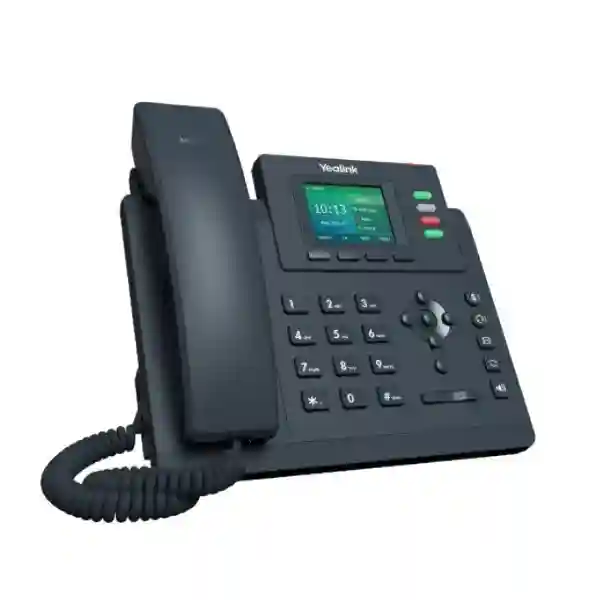
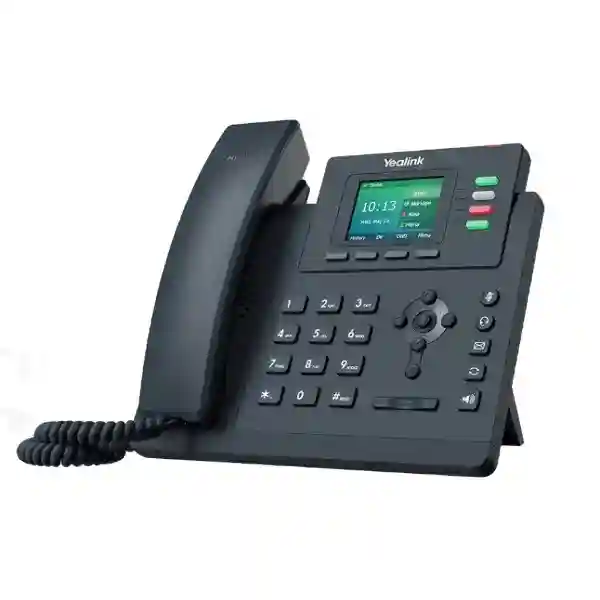
Yealink SIP-T33G
The Yealink SIP-T33G is an entry-level business IP phone built for organizations that want a color display, Gigabit network connectivity, Power over Ethernet and dependable SIP calling without moving into a premium executive-phone class. Yealink specifies a 2.4-inch 320×240-pixel backlit color screen, dual-port Gigabit Ethernet, IEEE 802.3af PoE, up to four SIP accounts, local 5-way conferencing, Yealink HD Voice, Smart Noise Filtering, EHS headset support, unified firmware and centralized management support through Yealink device-management platforms.
For Tanzanian offices, the practical value is straightforward: one desk device can fit into a structured IP-PBX environment, share a Gigabit network connection with a workstation, receive power from a compatible PoE switch and be provisioned consistently across many users. The correct deployment still depends on PBX compatibility, SIP-trunk design, VLANs, QoS, switching, internet stability and power protection, so buyers should evaluate the complete voice environment rather than the handset in isolation.
Why businesses choose the Yealink SIP-T33G
The SIP-T33G sits in a useful middle ground for organizations that need more than a basic monochrome desk phone but do not require a large touchscreen, built-in Wi-Fi or advanced executive features. Its color interface improves everyday navigation, while four SIP accounts allow users to work with multiple line registrations or roles where the chosen PBX supports them. The phone includes local 5-way conferencing, standard call functions such as hold, mute, transfer, forwarding, call waiting and redial, and IP-PBX features such as BLF, voicemail, call park, call pickup and hot-desking where the telephony platform supports those functions.
Color interface
A 2.4-inch, 320×240-pixel backlit color LCD provides a clear interface for caller details, soft keys, menus and line status.
Gigabit + PoE
Dual-port Gigabit Ethernet supports voice and workstation connectivity, while IEEE 802.3af PoE can simplify desk power when a compatible PoE switch is available.
HD audio
Yealink HD Voice, wideband audio and Smart Noise Filtering are designed to improve clarity for routine business conversations.
Managed deployment
Browser, phone and auto-provisioning options help IT teams standardize larger rollouts instead of configuring every handset manually.
Verified Yealink SIP-T33G specifications
| Display | 2.4-inch 320×240-pixel color LCD with backlight |
| SIP accounts | Up to 4 VoIP/SIP accounts |
| Ethernet | Dual-port Gigabit Ethernet |
| Power | IEEE 802.3af PoE, Class 1 on applicable hardware revision; optional external Yealink AC adapter |
| Audio | HD handset and speaker, Smart Noise Filtering, full-duplex speakerphone with AEC, G.722 and supported narrowband codecs |
| Conferencing | Local 5-way audio conferencing |
| Directory | Local phonebook up to 1,000 entries plus XML/LDAP remote phonebook support |
| Headset | RJ9 headset interface and EHS wireless-headset support |
| Security | SRTP, TLS 1.3, HTTPS certificate management, AES-encrypted configuration files, digest authentication, IEEE 802.1X, IPv6 and secure boot |
| Provisioning | Phone/browser setup and auto-provisioning over FTP, TFTP, HTTP and HTTPS, with PnP and TR-069 support |
| Mounting | Two-angle stand and wall-mount capability |
Deployment, PBX compatibility and network planning
A SIP phone works as part of a voice system, not as a standalone replacement for every traditional telephone service. Before ordering the SIP-T33G, confirm that your IP PBX, hosted voice platform or SIP service can register standard SIP endpoints and supports the call features your users expect. Features such as BLF, call recording, visual voicemail, hot-desking or centralized directories can depend on the PBX implementation, provisioning profile and service-provider configuration.
On the LAN, plan voice VLANs, DHCP options, DNS, NTP, QoS and PoE capacity as required by the network design. The dual-port Gigabit interface can be useful at desks where a phone and PC share one wall outlet, but the access switch still needs sufficient port capacity and power budget. For offices with multiple phones, centralized configuration is preferable to manual setup because it creates consistent account templates, firmware policy, time settings, directory behavior and security controls.
FourTeck Tanzania also publishes guidance on integrated IT and telecom planning, where IP phones are treated as part of the wider network. Buyers evaluating a larger rollout can review the FourTeck Tanzania services overview, browse the Tanzania technology shop, understand the company through the FourTeck Tanzania profile, and use the Tanzania contact page to prepare a quotation or deployment discussion.
Yealink SIP-T33G Tanzania
For organizations in Tanzania, the Yealink SIP-T33G is best evaluated as a standardized business endpoint for IP telephony rather than simply as a desk handset. The model is suitable for general office users who need a color display, four SIP registrations, Gigabit Ethernet and PoE while remaining within Yealink’s entry-level T3 family. Typical deployments can include administrative desks, finance teams, sales offices, front-office users, supervisors, branch users and shared workspaces. The phone’s support for common SIP features, local 5-way conferencing and centralized provisioning gives IT teams a practical base for multi-user rollouts.
Tanzania buyers should begin with the voice architecture. Confirm whether the business uses an on-premises IP PBX, a hosted platform or a SIP trunk connected to a PBX. Document the extension count, simultaneous-call requirement, receptionist flows, call queues, voicemail rules, external dialing, emergency-call policy and branch connectivity. The SIP-T33G can serve as an endpoint in that design, but the PBX and service plan determine the actual calling capabilities. A quotation should therefore separate handset quantity from PBX licensing, SIP trunks, installation, configuration, switches, cabling and support.
Network readiness matters across Tanzania because voice quality depends on stable LAN and WAN performance. A properly configured managed switch can place phones in a voice VLAN, prioritize voice traffic and provide PoE. Where offices experience power interruptions, an appropriately sized UPS for the switch, router, firewall and PBX can help keep IP phones operating through shorter disruptions; powering only the handset is not enough if the network path is unavailable. Businesses with branches should also consider secure site connectivity, consistent extension plans and centralized provisioning. This approach makes the SIP-T33G easier to support as the organization grows.
Yealink SIP-T33G Dar es Salaam
Dar es Salaam businesses often need IP telephony that can scale from a small office to multi-floor commercial premises, customer-service teams or branch headquarters. The Yealink SIP-T33G can fit general employee desks where four SIP accounts, a color interface, Gigabit connectivity and PoE are sufficient. Instead of purchasing phones first and designing call flows later, procurement teams should map departments, extensions, reception responsibilities, queues, hunt groups and after-hours routing. This reduces the risk of deploying the same user profile everywhere when some roles need different capabilities.
For a new office fit-out in Dar es Salaam, include voice in the structured-cabling and switching plan. Each SIP-T33G can use a compatible PoE access switch, and its second Gigabit port may allow a workstation to share the same network outlet when the architecture is designed for it. Managed switching helps separate voice and data with VLANs and apply QoS, while DHCP and provisioning services can simplify handset deployment. For larger office floors, check total PoE budget, uplink bandwidth and switch redundancy rather than focusing only on per-port specifications.
Companies with customer-facing teams may also need headsets, call recording, wallboards, reporting or queue analytics. Those capabilities come from the broader telephony platform, not the SIP-T33G alone, so compatibility should be validated during design. Ask whether users need EHS wireless-headset support, BLF monitoring, voicemail, hot-desking or shared line appearances. For a quotation, provide the number of desks, existing PBX brand/version, SIP provider, switch model, available PoE ports, cabling status and desired call features. That information allows a more accurate bill of materials and avoids assumptions about adapters, licensing or integration.
Yealink SIP-T33G Mwanza
In Mwanza, the Yealink SIP-T33G can support offices that want to modernize internal and external calling while maintaining familiar desk-phone operation. Its physical keypad, dedicated call keys, color display and full-duplex speakerphone can be easier for routine business users than relying entirely on software phones. For branch environments, the key decision is whether extensions will register to a local PBX, a central PBX in another location or a hosted service. Each option changes the network, security and resilience requirements.
A branch connected to a central voice platform should be assessed for WAN stability, latency and failover. The SIP-T33G supports standard SIP networking and security functions, but reliable conversations still require an appropriate internet or private-WAN path. If voice is mission-critical, consider how the site behaves when the primary link fails and whether the chosen PBX supports survivability or alternate registration. Local LAN design is equally important: voice VLANs, correct DHCP settings, PoE switch capacity and QoS can help reduce avoidable problems.
Mwanza buyers replacing older analog phones should also distinguish endpoint cost from migration cost. A VoIP migration may require new switching, PBX licensing, gateway interfaces for retained analog lines, SIP trunks, number-porting work, cabling remediation and staff training. The SIP-T33G itself is straightforward to position for general users, but the project succeeds when these dependencies are documented before procurement. For multi-site organizations, use standard naming, extension templates and configuration profiles so phones can be deployed consistently. A detailed request should state user quantity, locations, PBX details, required call features and network conditions so the proposed solution can be validated without inventing service assumptions.
Yealink SIP-T33G Arusha
Arusha organizations in tourism, professional services, education, NGOs, logistics and administration may need desk phones that are simple for users but manageable for IT. The Yealink SIP-T33G is designed for business SIP deployments and provides a useful combination of four accounts, color display, PoE and Gigabit networking. Hotels, offices and service desks should identify which staff are general users and which need more advanced reception or executive endpoints. Standardizing the SIP-T33G for ordinary desks can simplify spares, training and provisioning while allowing other Yealink models to serve specialist roles.
For hospitality or guest-service environments, call routing and uptime requirements can be more important than the handset itself. Integration with an IP PBX can provide extensions, hunt groups, wake-up or front-desk workflows depending on the PBX platform, but those functions must be validated separately. Where phones are deployed across different buildings, ensure each network segment has the required VLAN, PoE and routing configuration. Cabling quality and switch placement should be checked before assuming every desk can receive reliable Gigabit and PoE service.
Arusha procurement teams should also plan user onboarding. Auto-provisioning can reduce manual configuration across dozens or hundreds of endpoints, while centralized directory services can make internal calling easier. Security policies should include strong administrative credentials, HTTPS management, controlled provisioning access and current approved firmware. When requesting a quotation, provide the number of phones, expected growth, headset requirements, existing PBX platform, SIP trunk details and any branch connectivity. This creates a clearer basis for determining whether the SIP-T33G is the right standard phone and what complementary infrastructure is needed.
Yealink SIP-T33G Dodoma
Organizations in Dodoma looking for a structured office-telephony endpoint can consider the Yealink SIP-T33G for administrative users, project teams, shared offices and departments using SIP-based calling. The handset combines a compact color screen with dual Gigabit Ethernet and PoE, helping it fit modern managed LANs. Four SIP accounts can be useful where users need multiple registrations or line identities, although actual account behavior depends on the PBX and service configuration.
Government, institutional and enterprise environments commonly value repeatable configuration and documented deployment. The SIP-T33G supports browser-based configuration and automated provisioning methods, enabling IT teams to standardize firmware, account templates, time settings, phonebooks and security parameters. That is more maintainable than configuring each device independently. For larger sites, create a deployment sheet showing user, extension, MAC address, switch port, VLAN and location. Documentation shortens future troubleshooting and handset replacement.
A Dodoma deployment should also account for network and power resilience. If phones receive PoE from central switches, keeping those switches, the router, firewall and PBX on suitable power protection can be more effective than using individual desk adapters. Voice quality should be tested during busy network periods, especially when the same uplinks carry cloud traffic, backups, video conferencing and other data. QoS can prioritize voice, but it cannot repair an undersized or unstable connection. Before ordering, verify handset quantity, PBX support, PoE availability, network readiness, headset needs and call features. Those details make the procurement process more accurate and help prevent surprise costs after the equipment arrives.
Yealink SIP-T33G UAE
For UAE deployments, the Yealink SIP-T33G can be positioned as a standardized desk endpoint for companies operating offices in Dubai, Abu Dhabi, Sharjah and other emirates, particularly when the organization already uses SIP-based telephony. Its Gigabit ports, PoE, four SIP accounts and color display make it useful for general business users who do not need premium executive features. Companies with both UAE and Tanzania operations can benefit from using consistent endpoint profiles across branches, provided the PBX, telecom and regulatory requirements are handled appropriately in each market.
Cross-border organizations should not assume that SIP trunking, numbering or cloud voice arrangements are identical between countries. Treat the handset as the common endpoint while designing carrier connectivity and PBX policy separately for each location. A central IP PBX or hosted platform may support shared dial plans and extension-to-extension calling, but security, bandwidth and local telecom requirements must be validated. The T33G’s provisioning options can make device standardization easier when the chosen platform supports automated deployment.
For UAE office projects, include headset requirements, reception design, meeting-room voice, switch PoE budgets and business continuity in the scope. If the handset will share a desk network port with a computer, validate VLAN tagging and switch policy. For large fleets, maintain serial/MAC inventory, configuration templates and firmware governance. Procurement should request model-specific quotations rather than assume regional prices or availability. Buyers can also use FourTeck’s wider regional network for related infrastructure planning while keeping the final bill of materials tied to verified requirements and current supply conditions.
Yealink SIP-T33G Uganda
Uganda businesses can deploy the Yealink SIP-T33G as a general-purpose SIP phone within office, branch, hospitality, education and service environments. The combination of four accounts, Gigabit Ethernet, PoE and a color screen makes it suitable where businesses want a consistent desktop experience without paying for features that many users may never use. The handset should be matched to an IP-PBX or hosted-voice platform that supports the required SIP functions.
For multi-site deployments between Uganda and Tanzania, standardization can reduce operational complexity. IT teams can use common extension naming, phone templates, directory settings and security policies while adapting carrier services and network connectivity per country. If branches connect to a central PBX, test call quality across real WAN paths and define what happens during internet outages. Voice VLANs and QoS should be applied consistently on managed switches, and PoE budgets should include all connected phones and other powered devices.
Procurement requests in Uganda should describe the complete environment: number of users, PBX platform, SIP service, branch topology, cabling, managed switches, PoE availability, headset requirements and desired features such as BLF or call recording. Some functions advertised in an IP phone ecosystem depend on the PBX rather than the phone itself, so feature validation matters. A staged rollout can be useful for larger deployments: configure a small pilot, verify registration, codec behavior, transfers, voicemail, caller ID, directories and failover, then use the validated profile for the remaining endpoints. This approach reduces project risk and gives users a predictable transition.
Yealink SIP-T33G Kampala
Kampala offices frequently combine voice, data, Wi-Fi and cloud applications on the same business network. The Yealink SIP-T33G can work well in this environment when the LAN is designed to protect voice quality. Its dual Gigabit ports allow flexible desk connectivity, and integrated PoE can reduce local power adapters. A managed PoE switch with suitable VLAN and QoS configuration gives administrators better control over phone traffic and troubleshooting.
Before deployment, define the user profiles. General employees may need one extension, transfer, hold, voicemail and conferencing. Supervisors may need BLF keys, multiple SIP accounts or headset integration. Receptionists may need higher line density or expansion capability and could be better served by a different phone class. Using the SIP-T33G where it fits rather than forcing it into every role creates a more balanced telephony design.
Kampala buyers should also verify centralized provisioning with their PBX or management platform. Automated provisioning becomes important when devices are spread across several floors or sites, because it reduces inconsistent settings. Security should include TLS/SRTP where supported end to end, restricted administration, secure provisioning and controlled firmware management. When requesting a quote, specify whether AC adapters are required; Yealink lists the external adapter as optional, and PoE may remove that requirement in many managed deployments. The final proposal should therefore include phones, switching and PBX components only where required, rather than adding unnecessary accessories by default.
Yealink SIP-T33G Arua
For branch offices and institutions in Arua, the Yealink SIP-T33G can provide a familiar physical desk-phone experience while connecting into a modern IP telephony platform. The practical advantage for remote or distributed branches is centralized configuration: a handset can be prepared with standard account, directory and security settings, then associated with the branch network design. This can be easier to support than a mixture of unrelated analog and IP devices.
Connectivity planning is important for branch voice. If the PBX is hosted elsewhere, calls may depend on the site’s WAN link. Define primary and backup connectivity according to business importance, and test actual call quality under normal and peak traffic. Local switching should provide correct VLAN tagging, PoE and QoS. A UPS for the networking core can improve continuity during brief power events, but organizations should size backup time according to actual operational needs rather than assuming a generic duration.
Arua procurement teams should verify the number of extensions, departmental call flows, public numbers, headset needs and remote-support expectations before buying endpoints. The SIP-T33G supports standard management and security tools, but configuration should align with the selected PBX. For a small branch, a few phones may be adequate; for a larger institution, directory integration and standardized provisioning become more valuable. Document extension assignments and switch ports so replacement or troubleshooting can be handled without rediscovering the environment. This disciplined approach makes the phone part of a maintainable communications system.
Yealink SIP-T33G Mbarara
Mbarara businesses evaluating IP telephony can use the Yealink SIP-T33G for users who need a dependable desk endpoint with business-grade SIP features and Gigabit connectivity. It is especially relevant for organizations refreshing older phones while upgrading their LAN to managed PoE switching. The handset’s color display and programmable line keys provide a more modern user interface while keeping the physical controls familiar.
A successful migration should start with call-flow discovery. List main numbers, departments, queues, reception groups, voicemail rules, external transfer behavior and after-hours routing. The PBX determines these functions, while the SIP-T33G gives users access to them. If the business retains analog devices such as fax, paging or door phones, those may require gateways or separate interfaces. Do not assume an all-IP handset project automatically addresses every legacy telephony dependency.
Network design should consider PoE capacity, cable quality, uplink utilization and voice segmentation. If PCs connect through the phone’s Gigabit pass-through, ensure the switch port and VLAN policy are planned correctly. For organizations with branches, use consistent naming and provisioning templates so devices can be swapped with minimal manual work. A quotation request should include current PBX information, number of SIP-T33G units, required headsets, power method and installation scope. This creates a clearer separation between endpoint supply, network work, PBX configuration and ongoing support.
Yealink SIP-T33G Gulu
In Gulu, the SIP-T33G can suit professional offices, institutions, project teams and branch operations looking for a manageable SIP handset. Its design is intentionally practical: a small color screen, four SIP accounts, Gigabit Ethernet and PoE, combined with Yealink’s standard business calling features. This makes it a reasonable baseline phone for ordinary users, while organizations can reserve advanced models for executives or reception positions that need more keys, larger screens or wireless connectivity.
Branches should assess WAN dependency before moving completely to IP telephony. If the call server is remote, the local site needs dependable connectivity and a plan for outages. Some PBX platforms offer redundancy or survivability options, but those capabilities must be confirmed for the chosen architecture. The SIP-T33G supports call-server redundancy at the endpoint level, yet overall service continuity depends on how the complete solution is configured.
For rollout efficiency, prepare a standard configuration template and pilot it with a small user group. Confirm inbound and outbound dialing, transfers, conferencing, voicemail, caller ID, directory access, time zone and headset behavior. Once validated, the same profile can be distributed through automated provisioning. Gulu buyers should also check whether they need optional power adapters or whether the planned switches provide PoE. Correctly scoped network and power infrastructure can reduce desk clutter and centralize resilience. Procurement documents should list required quantities and features without assuming stock, warranty terms or delivery times until those are explicitly confirmed in the quotation.
Yealink SIP-T33G Kenya
Kenya has a mature market for business IP telephony, and the Yealink SIP-T33G is commonly positioned by resellers as a four-account Gigabit PoE desk phone. For organizations operating between Kenya and Tanzania, the strongest reason to standardize on the same endpoint is operational consistency rather than regional price differences. IT teams can maintain common configuration templates, user training and spare units while adapting PBX trunks, numbering and support arrangements to each country.
A Nairobi headquarters with satellite offices can use centralized provisioning to reduce manual setup, provided the PBX and security design support remote endpoints. Voice VLANs, DHCP, DNS and QoS should be documented, and internet links should be assessed for latency and congestion. The SIP-T33G includes security mechanisms such as TLS, SRTP and secure configuration options, but they must be enabled and supported by the call platform to provide end-to-end protection.
When comparing Kenyan offers, buyers should separate verified Yealink specifications from reseller-specific claims about pricing, stock, warranty and delivery. Those commercial terms change and should be confirmed directly at purchase time. Procurement teams should request exact model identification, quantity, included accessories, power-adapter requirements and deployment services. If a company already uses PoE switching, individual adapters may be unnecessary. For multi-country rollouts, also define firmware policy and approval procedures so the same model does not drift into different configurations across locations.
Yealink SIP-T33G Kuwait
Kuwait businesses seeking a cost-conscious SIP desk phone can evaluate the Yealink SIP-T33G for general office users, branch staff and shared workstations. The model provides a color LCD, four SIP accounts, dual Gigabit Ethernet and PoE in a straightforward physical design. In organizations with regional offices, using the same handset family can simplify help-desk procedures and reduce the number of endpoint types that administrators must manage.
Telephony design in Kuwait should still be validated against the local service and PBX environment. SIP compatibility is broad at the protocol level, but exact support for features such as BLF, call recording, corporate directories or hot-desking depends on the platform. Before bulk procurement, test a sample phone against the intended PBX version and provisioning method. A pilot should cover registration, codec negotiation, transfers, hold, conferencing, voicemail, caller ID and any headset workflow.
Managed PoE switching is a natural companion to a large SIP-T33G deployment because it centralizes desk power and enables voice VLANs. Calculate switch power budgets and UPS requirements for the full site, not just one handset. If the organization is standardizing telephony across Kuwait, Tanzania and other markets, maintain country-specific documentation for carrier and numbering arrangements while keeping common endpoint profiles where practical. This makes support scalable without assuming identical telecom rules or services in every region.
Yealink SIP-T33G Ghana
Ghanaian businesses modernizing office communications can consider the Yealink SIP-T33G where users need a physical SIP phone with Gigabit networking and PoE. It is well suited to standardized desk deployments because it combines ordinary calling controls with centralized provisioning and security features. The phone itself does not provide a complete phone system; it needs a compatible PBX or hosted voice service, network connectivity and suitable call routing.
For Accra and regional branch deployments, define how voice traffic reaches the call platform and how the network handles congestion. Voice VLANs can separate handsets logically from general data traffic, while QoS can prioritize packets during busy periods. The SIP-T33G’s dual Gigabit interface is useful where a desk phone and computer share an access port path, but the switching design should still preserve segmentation and security. For larger fleets, auto-provisioning and device inventory can materially reduce support effort.
Procurement teams should compare the SIP-T33G with alternative endpoint classes based on user role, not only price. A general user may be satisfied with four accounts and a 2.4-inch display, whereas reception staff may need more programmable keys or an expansion module on another model. Headset users should verify EHS requirements and compatible accessories. A clear Ghana quotation request should state exact quantity, PBX details, required licenses or services, accessories, cabling and installation scope. Supplier-specific price, stock and warranty should be confirmed at the time of order.
Yealink SIP-T33G Nigeria
Nigeria’s large enterprise, SME and multi-branch market creates many situations where a standardized business SIP phone is useful. The Yealink SIP-T33G offers a practical feature set for general users: color screen, four SIP registrations, Gigabit Ethernet, PoE, HD Voice and local conferencing. Organizations with call-intensive teams should still profile users carefully because receptionists and contact-center agents may need more keys, dedicated headset workflows or softphone integration.
For Lagos, Abuja and distributed branches, network resilience is a major design consideration. Voice depends on the complete path between handset and PBX, so plan LAN QoS, internet or WAN capacity, power protection and failover according to business criticality. The phone supports modern security functions, but the PBX, SBC or service provider must also support secure signaling and media for those protections to operate end to end. Avoid exposing phone management interfaces directly to untrusted networks.
A multi-branch rollout can be simplified through centralized provisioning. Standard templates can define account parameters, time zones, directories, line keys and security policy. Document each handset’s location, user and network port. For procurement, distinguish one-time endpoint costs from recurring SIP trunk or hosted-PBX fees and from implementation services. Ask suppliers to state what is included rather than inferring adapters, licenses or support. This produces more comparable quotations and helps IT teams evaluate total deployment requirements instead of handset price alone.
Yealink SIP-T33G Seychelles
Businesses in Seychelles can use the Yealink SIP-T33G as a standardized desk endpoint for offices, hospitality properties, professional services and administrative locations using SIP telephony. For island and multi-site environments, remote manageability can be particularly valuable because it reduces unnecessary manual reconfiguration. The handset supports automated provisioning and common network-management features, making it easier to apply consistent settings when a suitable PBX and provisioning system are in place.
Hospitality and service organizations should first map user roles. Back-office staff may need standard extensions, transfer and voicemail, while front-desk staff may need more visible line status, expanded keys or specific hotel-PBX functions that depend on the broader platform. The SIP-T33G should therefore be selected for roles it fits rather than as a universal endpoint. Its EHS headset support can also be useful for users who spend significant time on calls.
Network and power design are important because every IP phone depends on Ethernet, switching and the call server. Managed PoE switches can simplify desk deployment and centralize power backup. For sites with constrained WAN links, QoS and bandwidth planning should account for concurrent voice and business-data traffic. Before ordering, request exact quantities, PBX compatibility validation, optional accessories, installation and configuration scope. Do not assume stock or delivery terms until confirmed. If Seychelles is part of a wider regional organization, common configuration standards across countries can make support more predictable while keeping local telecom requirements separate.
Buying and quotation checklist
State the number of desks now and expected growth so switch ports, PoE capacity and licensing can be planned.
Provide the PBX or hosted-voice brand/version and confirm SIP endpoint support.
List managed switches, available PoE ports, VLAN design, cabling condition and WAN details.
Identify BLF, voicemail, recording, queues, hot-desking, directory and headset requirements.
Separate device supply from provisioning, PBX configuration, cabling, testing and user handover.
Ask for current price, stock, warranty, lead time and included accessories in the formal quotation.
Frequently asked questions
How many SIP accounts does the Yealink SIP-T33G support?
Yealink’s current support datasheet lists up to four VoIP/SIP accounts for the SIP-T33G. Account availability and line behavior should still be confirmed with the selected PBX or hosted voice platform.
Does the Yealink SIP-T33G support PoE?
Yes. Yealink lists IEEE 802.3af PoE support. This can allow the phone to receive power and network connectivity from a compatible PoE switch, reducing the need for a separate desk power adapter.
Can a computer connect through the phone?
The phone has dual Gigabit Ethernet ports, so it can be integrated into desk designs where the phone and PC share the network path. The switch and VLAN configuration should be planned correctly to preserve performance and segmentation.
Is the SIP-T33G suitable for a receptionist?
It can handle multiple SIP accounts and programmable DSS functions, but reception roles often require more line appearances, expansion keys or richer call-control visibility. Compare the user’s workflow with higher-capacity Yealink models before standardizing it for reception.
Does it support wireless headsets?
Yealink lists EHS wireless-headset support and an RJ9 headset interface. Exact headset compatibility should be checked against the accessory model and intended workflow.
Can the phone be provisioned in bulk?
Yes. Yealink documents browser and phone configuration plus auto-provisioning over FTP, TFTP, HTTP and HTTPS, along with PnP and TR-069 support. The practical workflow depends on the management or PBX platform.
What should I confirm before requesting a quotation?
Provide handset quantity, PBX platform, SIP service, required call features, PoE availability, headset needs, branch topology and installation scope. Ask the supplier to confirm current stock, warranty, lead time and accessories rather than assuming them.
Decision recap
Choose the Yealink SIP-T33G when you need a practical business SIP phone with a color display, four SIP accounts, dual Gigabit Ethernet, PoE, HD Voice, local 5-way conferencing and centralized provisioning capability. Confirm the PBX, SIP service, PoE switching, VLANs, QoS, headset requirements and call features before buying at scale. For large or regional rollouts, standard configuration templates and a pilot deployment can reduce configuration drift and make support easier.
Consult FourTeck Tanzania
For a business quotation, prepare your required quantity, PBX or hosted-voice platform, SIP trunk details, network-switch information, PoE requirements, headset preferences and installation scope. FourTeck can then discuss the phone within the wider telephony and network design rather than treating it as an isolated purchase. Commercial terms such as current availability, warranty and delivery should be confirmed in the quotation.




Reviews
There are no reviews yet.