
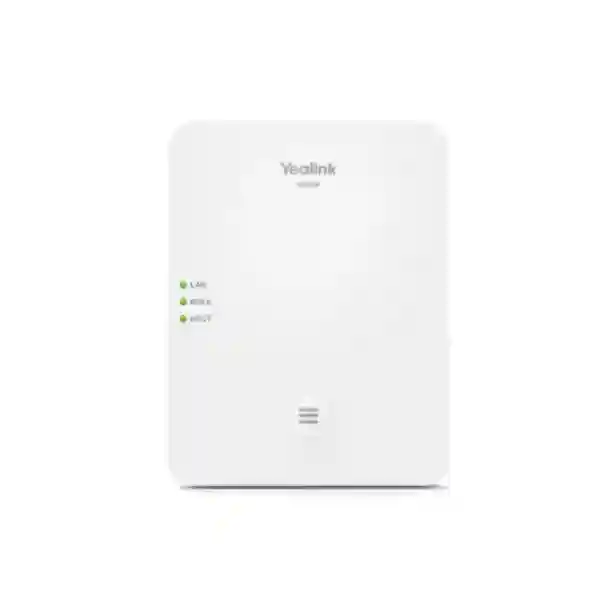
Yealink W80 DECT Multi-Cell System
The Yealink W80 DECT Multi-Cell System is a business-grade cordless VoIP platform built for organizations that need reliable voice mobility across larger premises than a single DECT base can comfortably cover. The architecture uses a Yealink W80DM DECT Manager together with W80B base stations, allowing administrators to create overlapping DECT cells so users can move between coverage zones while remaining on an active call. For Tanzania organizations evaluating cordless IP telephony for offices, hotels, warehouses, healthcare environments, retail locations, education facilities or distributed operational areas, the W80 provides a structured way to combine mobility, SIP connectivity and centralized management.
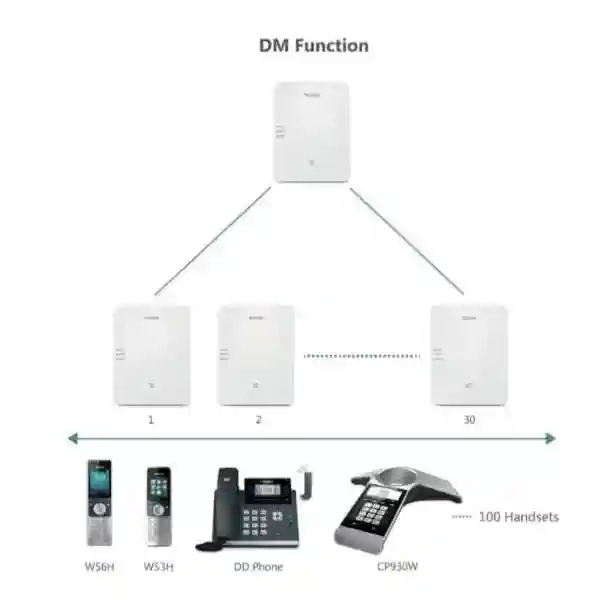
According to Yealink documentation, a W80 deployment can support up to 30 base stations, up to 100 handsets, up to 100 SIP accounts and up to 100 simultaneous calls. It also supports seamless roaming and handover, PoE, IPv6, XML/LDAP/Remote Phonebook access and Xsi directory integration. These capabilities make the system particularly useful when users cannot remain at desks but still need extension-based calling and predictable reachability throughout the workplace.
Up to 30 Base Stations
Expand DECT coverage by placing W80B units where radio planning shows they are needed. Proper cell overlap allows handover between synchronized bases.
Up to 100 Handsets
Support mobile staff with a scalable cordless voice environment built around compatible Yealink DECT endpoints and shared centralized configuration.
Up to 100 Parallel Calls
The system is designed for organizations with substantial concurrent calling requirements while preserving mobility between radio cells.
PoE and Central Management
W80DM and W80B include 10/100 Ethernet and IEEE 802.3af Class 1 PoE support, simplifying power and network placement where suitable PoE switching is available.
What the Yealink W80 Solves
Single-cell cordless systems can become restrictive in multi-floor buildings, warehouses, hotels, clinics and other sites where users move beyond one radio footprint. The W80 addresses that limitation through synchronized multi-cell DECT architecture. As a user walks from one zone to another, the system can hand the call between cells when the deployment has been correctly planned and synchronized. This is different from simply installing unrelated bases: the multi-cell design is intended to preserve mobility as part of one coordinated system.
A practical deployment begins with a site plan, user count, concurrent-call estimate, PBX or SIP-platform compatibility review, PoE availability and radio survey. Building materials, floor layout, shelving, machinery, elevators, stairwells and outdoor boundaries can all affect DECT propagation. Yealink states a DECT radio range of up to 50 metres indoors and up to 300 metres outdoors under suitable conditions, but real projects should be designed from measured coverage rather than theoretical maximums.
Verified W80 Technical Highlights
| Capability | Yealink W80 specification |
|---|---|
| System components | W80DM DECT Manager and W80B base stations |
| Maximum base stations | Up to 30 per W80DM system |
| Maximum handsets | Up to 100 |
| VoIP accounts | Up to 100 |
| Concurrent calls | Up to 100 system-wide; Yealink also documents per-base wideband and narrowband limits |
| Network interface | 1 × RJ45 10/100M Ethernet |
| Power | IEEE 802.3af PoE, Class 1; external adapter supported as documented by Yealink |
| Directories | Local, Remote Phonebook, LDAP, XML and Xsi Directory support |
| Security | DECT encryption plus SIP-side security features including TLS, HTTPS and SRTP; current firmware documentation should be checked for exact supported versions |
| Management | Browser configuration, auto-provisioning, PnP, RPS and OTA handset upgrades as supported |
Compatibility, PBX Integration and Endpoint Planning
The W80 connects DECT mobility to an IP PBX or SIP service. The W80DM manages account registration and central configuration, while W80B bases provide radio cells and media connectivity. This makes PBX compatibility a key buying checkpoint. Before procurement, organizations should confirm SIP platform requirements, extension count, codecs, directory integration, VLAN policy, firewall rules, NAT behavior and provisioning workflow. Where Microsoft Teams calling is part of the requirement, Yealink also presents W80 support for Microsoft SIP Gateway scenarios; project teams should verify current Microsoft and Yealink compatibility documentation for the exact endpoint combination and firmware planned.
Current Yealink support documentation lists compatibility with several Yealink devices, including W56H, W57R, W59R, W71H, W73H, W74H, W78H, CP930W, CP935W and DD Phone combinations, with minimum firmware levels varying by endpoint. Earlier datasheets list a slightly different set of supported devices, so buyers should not assume that every historic handset revision is valid for every firmware train. A good quotation should therefore identify the exact handset models, required quantities and firmware compatibility rather than merely asking for “W80 plus cordless phones.”
Yealink specifically notes that its DECT technology is not compatible with third-party DECT bases or handsets. That matters for organizations hoping to reuse generic DECT endpoints. If an existing site contains mixed cordless brands, the migration plan should identify which devices can remain, which must be replaced and whether phased coexistence on separate systems is operationally acceptable.
Deployment and Radio Planning
A multi-cell system is only as effective as its RF design. Base stations should not simply be placed where network ports happen to be available. The objective is to create reliable coverage where staff actually walk, with enough overlap between adjacent cells to support roaming and handover. Corridors, loading zones, back offices, staircases, kitchens, service areas, warehouse aisles, clinic rooms and external operational spaces can behave very differently from an open office. Concrete, metal shelving, lift shafts and dense equipment can reduce usable radio range, while large open areas may allow much greater reach.
Yealink provides deployment guidance and a DECT deployment toolkit for planning larger systems. During design, document proposed base positions, synchronization relationships, LAN switch ports, PoE budgets and expected simultaneous call loads. After installation, perform walk tests with active calls and verify handover at the boundaries between cells. It is also good practice to check call quality during peak network use rather than only when the LAN is quiet.
For sites with managed switching, voice VLANs and Quality of Service can help keep SIP and RTP traffic organized. The network should also provide reliable DNS, NTP, DHCP or static addressing as required, and firewall rules should be aligned with the selected PBX or SIP service. UPS-backed PoE switching can improve continuity during short power events, but runtime depends on the UPS design and connected load.
Yealink W80 DECT Multi-Cell System Tanzania
Businesses in Tanzania often evaluate the Yealink W80 when a normal desk-phone deployment does not give staff enough mobility. Hotels may need housekeeping, maintenance and supervisors to remain reachable while moving between floors. Warehouses may need managers and picking teams to communicate without returning to a desk. Clinics, schools, factories, retail operations and offices with multiple wings can have similar requirements. In these environments, the practical value of the W80 is not only cordless calling; it is the ability to design one managed DECT system with multiple coordinated radio cells.
For Tanzania procurement, begin with a simple site profile: number of users, number of expected simultaneous calls, building dimensions, number of floors, walls or storage areas that could affect radio propagation, and the existing PBX or SIP platform. Include the current LAN topology and whether PoE is available at proposed base locations. If the site already has Yealink DECT handsets, list exact models and firmware versions so compatibility can be verified. This information helps distinguish a straightforward W80 expansion from a broader voice-network upgrade.
Organizations should also plan for support and lifecycle management. Centralized configuration through the W80DM is useful, but it should be backed by configuration records, firmware policy, administrator credentials, extension documentation and a tested rollback process for significant changes. For multi-site Tanzania businesses, standardizing handset models and naming conventions can make training and troubleshooting easier.
FourTeck Tanzania can help connect the W80 requirement to the rest of the voice environment, including IP PBX, SIP endpoints, PoE switching and network design. Review the broader FourTeck Tanzania IT and telecom solutions portfolio when the project includes more than cordless endpoints. The objective is to build a system where DECT coverage, switching, SIP services and user workflows are planned together rather than purchased as isolated parts.
Yealink W80 DECT Multi-Cell System Dar es Salaam
Dar es Salaam organizations searching for a Yealink W80 DECT Multi-Cell System are often dealing with dense offices, hospitality properties, retail operations, clinics, logistics sites or warehouses where staff movement is continuous. A well-designed W80 deployment can give mobile teams a consistent extension experience across multiple internal zones without tying them to desktop handsets. That is particularly valuable when operational communication must remain immediate while employees move between reception, storage, administration and service areas.
The first design question is coverage, not handset quantity. A site should be divided into practical radio zones and surveyed for obstacles. Reinforced concrete, reflective glass, metal shelving, server rooms, lifts and utility spaces can change DECT behavior substantially. W80B bases should be placed where the LAN and radio design both make sense, with sufficient overlap for seamless handover. If a building spans several floors, synchronization and vertical coverage should be tested rather than assumed.
For a Dar es Salaam quotation, useful information includes floor plans, user roles, expected busy-hour calls, PBX make and version, existing handsets, PoE switch model, available switch ports and any requirement for remote directories such as LDAP. Businesses migrating from analog cordless systems should also map old extension numbers, reception routing, hunt groups and emergency calling processes before cutover. That avoids treating the DECT project as a simple radio replacement when it may also change how calls are routed.
The W80 can scale to significant user counts, but correct sizing still matters at the cell level. High-traffic zones may need more careful base placement than low-use corridors. Hotels, warehouses and clinics should test calls while users follow real movement paths. Recording the final base locations, synchronization relationships and switch ports makes later maintenance faster and reduces uncertainty when a site expands.
Yealink W80 DECT Multi-Cell System Mwanza
In Mwanza, the Yealink W80 can fit businesses that need cordless SIP communication across larger premises without deploying a desk phone in every operational position. Hospitality properties, healthcare locations, education sites, distribution operations and multi-building businesses can all benefit from mobility when users must receive calls while away from fixed workstations. The W80 architecture is most suitable when one or more single-cell bases would leave coverage gaps or create separate user groups that do not hand calls over cleanly.
A Mwanza deployment should account for both physical layout and network readiness. If the site has long corridors, internal courtyards, storage rooms or detached service areas, a drawing of user movement paths can help determine where coverage is genuinely required. Base stations should then be positioned with planned overlap. The stated outdoor range of up to 300 metres is an ideal-condition figure, so outdoor or semi-outdoor coverage must still be tested against walls, vehicles, vegetation, metal structures and other real obstructions.
From a network perspective, W80DM and W80B devices can use PoE, which may simplify installation if managed PoE switching is already available. Check the switch power budget, spare port availability and UPS arrangement before finalizing quantities. Where voice traffic shares the same LAN as business data, cameras or Wi-Fi, VLAN and QoS design can help create a predictable environment. The PBX should also be reviewed for SIP extension capacity and any licensing that may apply at the PBX layer; those licenses are separate from the physical capability of the W80 itself.
For procurement teams, a useful bill of materials should separate the W80DM, W80B quantities, handset models, optional power supplies, PoE requirements and any PBX-side work. This prevents a common mistake: buying the DECT infrastructure without enough compatible handsets or without confirming how extensions will register and route calls.
Yealink W80 DECT Multi-Cell System Arusha
Arusha has a mix of offices, hospitality operations, tourism-related businesses, education environments, clinics and service organizations where staff mobility can be essential. The Yealink W80 is relevant when people need reliable extension-based calling while moving through guest areas, administration zones, stores, maintenance spaces or multiple floors. Instead of relying on Wi-Fi calling for every mobile voice requirement, DECT provides a dedicated cordless voice layer designed around predictable handset roaming and handover.
Hospitality deployments are a good example. A hotel may need mobile communication for housekeeping, engineering, supervisors and front-of-house support, but the property layout can include thick walls, stairwells, outdoor walkways and service corridors. The W80 should be surveyed across these areas using the actual handset models intended for production. Base stations that appear close on a floor plan may behave differently because of wall density or floor construction. Handover tests should be performed during live calls so dead spots are identified before the system is accepted.
The same discipline applies to office and education sites. Count not only registered users but also expected simultaneous calls in busy zones. Yealink documents a system maximum of 100 parallel calls, but each base also has per-cell call limits, so demand should be distributed intelligently across the radio design. Directory requirements matter too: LDAP, remote phonebook or XML phonebook support can help staff find internal contacts, but integration depends on how the organization manages directory data.
For an Arusha W80 proposal, include a basic site survey, PBX details, handset preference, PoE availability and expected growth over the next several years. If there is a reasonable chance that the site will exceed the W80 scale, it is better to assess that before installation than to redesign after the user count or building footprint expands.
Yealink W80 DECT Multi-Cell System Dodoma
Organizations in Dodoma considering the Yealink W80 usually need a dependable cordless extension system that can cover more than one room, floor or operational zone. Government-related offices, education facilities, healthcare environments, administrative campuses and commercial businesses may have staff who move frequently while still needing to answer internal or external calls. The multi-cell approach helps create a coordinated radio environment instead of a collection of separate cordless islands.
Planning should start with who needs mobility and where. Reception staff may remain at fixed SIP phones while supervisors, technicians or service teams use DECT handsets. This mixed architecture can be efficient because not every employee requires cordless service. The PBX can maintain one dialing plan while endpoint types vary by role. When preparing the W80 system, confirm the SIP account count, extension numbering, caller-ID behavior, transfer workflows, voicemail, hunt groups and emergency procedures so the cordless users fit naturally into existing call flows.
Dodoma sites should also assess power and network resilience. PoE reduces dependence on local plug points at base stations, but the PoE switch becomes part of the voice power chain. If continuity is important, UPS capacity should be sized for the switch, router, firewall, PBX and related network devices, not only for the DECT units. Configuration backups and documented administrator access are equally important for recoverability after equipment or network changes.
The W80 is not a substitute for good LAN design. SIP and RTP still depend on the IP network between the DECT system and PBX. Organizations should confirm VLANs, DHCP or static IP policy, DNS, NTP, firewall rules and WAN stability for hosted PBX services. A clean network foundation makes troubleshooting easier and allows the DECT layer to do what it is designed to do: provide mobile voice coverage and handover across the workplace.
Yealink W80 DECT Multi-Cell System UAE
The UAE market has extensive use of SIP telephony across offices, hospitality, retail, logistics and healthcare, making multi-cell DECT relevant where staff need mobility beyond the desk. The Yealink W80 supports a scalable cordless environment with centralized control, and its capacity of up to 30 base stations and 100 handsets can suit medium to larger premises when the design stays within the system limits. For buyers comparing W80 with single-cell Yealink bases, the deciding factor is usually not simply user count; it is whether seamless movement between multiple radio zones is required.
UAE projects commonly involve structured PoE switching and managed networks, which can make W80B placement easier because a single Ethernet cable can provide network and power. However, radio positioning should still take priority over convenience. Warehouses with metal racking, hotels with dense walls, malls with service corridors and offices with partitioned floors all need survey-based placement. A base installed near a data outlet may not be in the best RF position.
When the W80 is being integrated with a hosted PBX or cloud voice provider, confirm SIP requirements, SBC or firewall policies, extension licensing, codec support, directory integration and provisioning. For existing Yealink estates, review handset firmware before assuming reuse. Yealink publishes minimum firmware requirements for supported handset families, and these can differ across product generations.
Customers coordinating projects between East Africa and the Gulf can also use the broader FourTeck UAE IT and telecom platform for regional technology planning. Multi-country procurement benefits from consistent model naming, configuration templates and documented handover, but each site still needs its own RF and PBX validation rather than copying a base-station count from another building.
Yealink W80 DECT Multi-Cell System Uganda
Uganda businesses evaluating the Yealink W80 can use it to extend cordless SIP communication across offices, hotels, schools, clinics, retail environments and warehouses where staff move through multiple coverage zones. The W80 is most valuable when a site needs coordinated multi-cell coverage with handover rather than several independent bases. A properly synchronized deployment lets compatible Yealink DECT users remain reachable on their normal extensions while moving around the premises.
For Uganda procurement, the best starting point is a combined radio and voice requirement. Record building dimensions, floor count, expected user movement, busy-hour call volume and existing PBX. If the system will connect to an on-premises IP PBX, confirm local network paths and SIP registration. If it will connect to a hosted platform, confirm internet stability, firewall requirements and provider compatibility. The W80 supports common SIP networking and provisioning methods, but the complete solution still depends on how the PBX is configured.
Power planning is another practical consideration. PoE can simplify W80B installation by avoiding separate adapters near every base, but a PoE switch should have enough power budget and be protected according to the site’s uptime needs. Network documentation should identify each base, switch port, IP address and synchronization relationship. These records are especially useful when future staff must troubleshoot a system they did not originally install.
For customers operating in Uganda, the FourTeck Uganda technology solutions site provides a regional reference point for IT, telephony and network projects. Whether the W80 is deployed alone or as part of a wider PBX refresh, the design should leave room for handset growth, additional radio cells and future branch requirements without creating unnecessary complexity on day one.
Yealink W80 DECT Multi-Cell System Kampala
Kampala offices, hotels, clinics, schools and logistics operations can have a high concentration of users within multi-floor or partitioned buildings. The Yealink W80 is a practical option when cordless calling must follow users through those spaces. Unlike a basic single-base DECT setup, the W80 is designed around synchronized base stations and centralized management, making it easier to build one coherent mobility system for a larger property.
A Kampala site survey should pay close attention to reinforced concrete, internal staircases, lift cores and densely partitioned office areas. These structures can reduce effective DECT range and create hidden coverage gaps. Base overlap should be tested using live calls, not only idle signal indicators. For busy service environments, test during normal operating conditions because open doors, people density and equipment activity can alter the radio environment.
At the PBX layer, the system should be mapped to departments and call flows. A hotel might use mobile extensions for housekeeping and engineering while keeping reception on fixed SIP consoles. A clinic might assign cordless endpoints to nurses or duty teams while central administration uses desk phones. A warehouse may need ruggedized handset options for certain workers. Yealink supports several W-series handset families, but exact firmware compatibility should be verified before procurement.
When requesting a Kampala quotation, include base-station quantity only after a preliminary coverage assessment. Also specify handset models, user count, desired directories, PoE switch availability, PBX platform and whether configuration or installation services are required. This gives the supplier enough information to build a usable bill of materials instead of quoting only the central manager and leaving essential radio or handset components undefined.
Yealink W80 DECT Multi-Cell System Arua
For organizations in Arua, cordless voice can be especially useful where staff work across compounds, service areas, clinics, education facilities, offices or logistics spaces and cannot stay near fixed desk phones. The Yealink W80 provides a structured multi-cell approach that can scale from a modest number of bases to a larger deployment, provided the system remains within the documented 30-base and 100-handset limits.
The key to a successful Arua installation is to avoid overestimating theoretical range. Yealink publishes up to 50 metres indoors and 300 metres outdoors in suitable conditions, but actual results depend on building construction, terrain and obstructions. If coverage is needed between separate buildings, radio behavior should be tested along the full walking route, including doorways, shaded areas, metal roofs or other structures that could alter signal performance. Where reliable handover cannot be maintained, the design may require additional bases or a different communication approach for that zone.
Network infrastructure should also be considered early. PoE-capable switches can make base installation cleaner, but cable distance, surge protection, rack organization and backup power may be important depending on the site. If the PBX is hosted remotely, WAN availability becomes part of the voice-service chain. Businesses should therefore distinguish between DECT radio availability and overall telephony availability: the handsets may have excellent signal but still lose external calling if the PBX or internet path is unavailable.
A good procurement document will state current users, projected growth, call concurrency, required coverage zones, handset type, PBX details and support expectations. With this information, the W80 can be sized around actual operations rather than headline capacity figures, producing a simpler and more maintainable solution.
Yealink W80 DECT Multi-Cell System Mbarara
Mbarara businesses and institutions may need reliable voice mobility in healthcare, hospitality, education, warehousing, retail or administrative environments. The Yealink W80 is relevant where staff members must keep their normal business extension while moving beyond the range of a single base. Multi-cell handover is the differentiator: with correct synchronization and coverage overlap, a call can remain active as the handset moves between cells.
Before choosing quantities, divide the property into operational areas. Some zones may require strong coverage because users spend significant time there, while others need only transitional coverage for handover. High-priority spaces might include reception back offices, wards, stores, loading areas, maintenance rooms or staff corridors. Base placement should support those workflows and should also reflect Ethernet cabling availability. Where new data outlets are needed, include that work in the project scope rather than forcing base locations to fit existing cabling.
The W80 supports centralized management and provisioning, which is useful when many users are involved. Consistent extension labels, handset names and directory configuration can reduce confusion. IT teams should maintain an inventory mapping each handset to a user or role, along with serial numbers and firmware levels. Replacement and onboarding become easier when this information is documented.
For Mbarara buyers, it is useful to request both equipment and deployment assumptions in the quotation. Ask which items are W80DM managers, which are W80B bases, which handsets are included, whether power adapters are required, what PBX work is included and what is excluded. This level of clarity makes competing quotations easier to compare and reduces the risk of receiving a list of parts that does not yet form a complete working solution.
Yealink W80 DECT Multi-Cell System Gulu
Gulu organizations planning mobile business telephony can use the Yealink W80 where users need to remain reachable across more space than a conventional cordless base can cover. The system is especially appropriate when communication must follow staff between offices, service counters, stores, treatment areas, classrooms or warehouse sections. Because the W80 is SIP-based, it can fit into a wider IP telephony environment rather than operating as an isolated consumer cordless system.
The deployment plan should connect three layers: DECT radio coverage, Ethernet connectivity and PBX configuration. Radio planning decides where W80B bases should be located. Ethernet provides power and connectivity, particularly when PoE is used. The PBX supplies extensions, trunks, routing and user features. A weakness in any layer can affect the user experience, so troubleshooting should be structured rather than assuming every call problem is a DECT issue.
For a Gulu site with multiple buildings or outdoor paths, it may be tempting to rely on maximum outdoor range figures. Instead, survey actual paths and define which transitions must maintain live calls. If users only need service inside separate buildings, independent coverage zones may be acceptable. If active-call handover is essential between them, synchronization and overlap must be validated under real conditions.
Procurement teams should also consider future expansion. The W80 platform allows growth up to its documented limits, but adding users can change call density in individual cells. Keep network diagrams and base-placement records so future expansion can be assessed logically. Standardized handsets and firmware can simplify support, while spare devices can reduce downtime when a mobile endpoint is damaged or unavailable.
Yealink W80 DECT Multi-Cell System Kenya
Kenya has a mature market for SIP telephony, and the Yealink W80 is commonly positioned for offices, hotels, warehouses, clinics and other businesses that need broader cordless coverage. Buyers comparing W80 offers should look beyond price and verify whether the quotation includes the W80DM manager, the required number of W80B bases, compatible handsets and any optional power supplies. A low headline price may represent only one component rather than a complete multi-cell deployment.
In Nairobi and other dense commercial environments, multi-floor buildings can require careful cell design because concrete and lift cores attenuate radio signals. Warehouses add metal racking and changing stock levels, while hotels have numerous walls and service corridors. The same base count will not suit all three environments. Yealink’s deployment resources are therefore valuable for planning, but the final design should be validated with on-site measurements and active-call handover tests.
When integrating with 3CX, Yeastar, Grandstream or another SIP PBX, verify the specific platform and firmware rather than assuming universal feature parity. Basic SIP registration may be straightforward, but remote directories, BLF-related behavior, call transfer conventions, provisioning and hosted-platform security can vary. If Microsoft SIP Gateway is part of the plan, use current Yealink and Microsoft guidance for the exact supported configuration.
Organizations with operations in Kenya can reference the FourTeck Kenya IT, VoIP and networking site when coordinating regional solutions. For cross-border standardization, keep the W80 architecture, handset models and documentation consistent where practical, but conduct a separate site survey at each location because RF conditions, building layouts and local network infrastructure are never identical.
Yealink W80 DECT Multi-Cell System Kuwait
Kuwait businesses considering the Yealink W80 often operate in environments where fixed desk phones are not enough: warehouses, retail back-of-house areas, clinics, hospitality sites, offices with multiple floors and service operations with mobile supervisors. The W80 gives these users SIP-based extension mobility through coordinated DECT cells while centralizing configuration in the W80DM.
For warehouse and logistics use, RF planning should consider tall racking, dense inventory and moving equipment. DECT may travel well through some open aisles yet weaken abruptly behind metal structures. For hospitality, walls and floor slabs are usually the main concern. In either case, the design should create deliberate overlap between neighboring cells, and the installation team should verify handover by walking active calls through transition zones.
Kuwait buyers should also check the wider telephony architecture. W80 is the DECT access system; it does not replace the PBX that provides trunks, dial plans, IVR, voicemail and external call routing. Confirm whether the PBX is on premises or hosted, how SIP registration is secured, what extension licenses are needed and how directory services will be supplied. Where PoE is used, confirm switch class support and power budget, and include UPS runtime requirements if voice continuity is important.
A procurement-ready specification should define user count, expected simultaneous calls, required indoor and outdoor coverage, handset type, PBX details, network requirements and installation responsibilities. This makes it easier to compare supplier proposals on like-for-like scope and prevents misunderstandings about whether quoted quantities were based on a survey or simply estimated from floor area.
Yealink W80 DECT Multi-Cell System Ghana
Ghana organizations can use the Yealink W80 for mobile SIP telephony in hotels, healthcare, education, offices, warehousing and other environments where people move through multiple work zones. The platform’s 30-base, 100-handset and 100-call maximums make it capable of substantial deployments, but the most successful projects focus first on operational requirements rather than maximum specifications.
In Accra and other commercial areas, buildings may combine open offices, reinforced cores, service corridors and outdoor spaces. A survey should identify where users must be able to start, receive and continue calls. Some spaces need full voice service; others only need enough overlap to maintain handover while a user walks between primary zones. This distinction can influence base count and placement significantly.
Businesses should verify handset compatibility before reusing existing Yealink devices. Yealink documentation lists supported W-series models and specific minimum firmware levels, and these lists can evolve with firmware. Third-party DECT handsets and bases should not be assumed compatible. Where procurement includes new handsets, select models according to user environment, display needs, ruggedness and battery expectations rather than standardizing blindly on one device for all roles.
A Ghana deployment should also include PBX integration planning, network addressing, PoE design, firmware policy and configuration backups. These operational details are often more important to long-term reliability than the initial installation alone. If the site expects growth, reserve switch ports and consider where additional W80B bases could be installed later without major recabling.
Yealink W80 DECT Multi-Cell System Nigeria
Nigeria has many business environments where cordless voice must operate across large indoor spaces, including hotels, hospitals, warehouses, manufacturing sites, schools and corporate offices. The Yealink W80 offers a multi-cell DECT architecture that can keep compatible handsets connected as users move between synchronized coverage zones, while the IP side integrates with SIP-based PBX platforms.
For large sites in Lagos, Abuja, Port Harcourt or other commercial centers, base-station planning should reflect both coverage and density. A high-traffic reception or operations zone may need more radio capacity than a lightly used corridor even if both areas are similar in size. Since Yealink documents per-base call limits in addition to the overall 100-call platform maximum, system designers should avoid concentrating too many simultaneous users around a single cell.
Power resilience can be an important design topic. PoE simplifies endpoint powering, but the whole voice path depends on switches, routers, firewall, PBX and WAN connectivity. UPS planning should therefore cover the full communication chain according to the organization’s continuity target. Configuration backups, documented extension assignments and spare handsets can further improve serviceability.
Nigeria buyers should request a transparent scope: W80DM quantity, W80B quantity, handset models, PBX work, cabling, PoE switching, installation, configuration, testing and training. If only hardware is required, that should be stated clearly. For organizations running multiple branches, use a common configuration template where possible while still surveying each physical site independently. The W80 can provide a consistent user experience across branches, but RF design cannot simply be copied from one property to another.
Yealink W80 DECT Multi-Cell System Seychelles
Seychelles hospitality, resorts, healthcare facilities and business properties can benefit from cordless SIP communication because staff may move constantly between guest areas, offices, stores, service corridors and outdoor transition spaces. The Yealink W80 can create a coordinated DECT multi-cell environment where coverage is designed around these movement patterns rather than around the location of desks.
Resort and hospitality layouts deserve careful RF planning. Buildings may be separated by outdoor paths, landscaping or service areas, and construction materials can vary between structures. Although Yealink states an outdoor DECT range of up to 300 metres in ideal conditions, coastal terrain, walls, elevation changes and vegetation can reduce usable coverage. If staff must maintain an active call while walking between buildings, the path should be surveyed and handover tested. If only in-building service is required, separate coverage clusters may be more practical.
The network side should also be planned for distributed properties. W80B bases need Ethernet and suitable power, commonly via PoE. Fiber or long-distance network links may connect buildings, but each base still requires a local copper Ethernet connection within supported distance. PoE switches and UPS systems should be located where they can be maintained and protected from environmental conditions.
For Seychelles procurement, prepare a drawing of the property, identify user groups, list handset quantities and define where live-call continuity is essential. Include the PBX or SIP platform and any directory requirements. This gives the project team enough information to design the DECT system as part of the communications environment rather than treating the W80 as a plug-and-play radio product with guaranteed range everywhere.
Industries and Practical Use Cases
Hotels and resorts: mobile extensions for housekeeping, engineering, supervisors and back-of-house staff, with handover between guest-service and operational zones. Warehouses and logistics: cordless communication for supervisors and team leads moving between aisles, docks and offices. Healthcare: mobility for staff who need to remain reachable across wards, consultation areas and administration. Education: communication for facilities, security, administration and mobile staff across campus buildings. Retail and large stores: rapid voice access between floor staff, stockrooms and management. Corporate offices: cordless extensions for users who frequently move between departments or floors.
These are deployment patterns, not guarantees that one standard base count will fit every property. Each environment has different radio obstacles, call density and user behavior. Correct selection therefore depends on a combination of RF survey, PBX compatibility and network readiness.
W80 Buying and Sizing Checklist
✓ Number of mobile users now and expected growth
✓ Busy-hour simultaneous calls
✓ Required coverage zones and building plans
✓ PBX or hosted SIP platform
✓ Existing Yealink handset models and firmware
✓ PoE switch ports and available power budget
✓ LDAP, XML, remote phonebook or Xsi directory needs
✓ Indoor and outdoor handover requirements
✓ Voice VLAN, QoS and firewall policy
✓ UPS and continuity target
✓ Installation, configuration and testing scope
✓ Documentation, training and support expectations
Frequently Asked Questions
How many base stations does the Yealink W80 support?
Yealink specifies support for up to 30 W80B base stations in a W80 multi-cell system managed by W80DM. Actual deployed quantity depends on RF coverage, synchronization and call-density requirements.
How many handsets and simultaneous calls can the W80 support?
The W80 supports up to 100 handsets, up to 100 VoIP accounts and up to 100 simultaneous calls system-wide. Per-base call limits also apply, so high-density areas should be designed carefully.
Can users walk between base stations during a call?
Yes. Seamless roaming and handover are core W80 functions when base stations are correctly synchronized and coverage overlaps sufficiently. A site survey and live-call walk test are recommended.
Does the Yealink W80 support PoE?
Yes. Yealink documents IEEE 802.3af Class 1 PoE support for the W80DM/W80B Ethernet interface. Optional external power arrangements may also be available depending on package and region.
Can third-party DECT handsets be used with W80?
Yealink states that its DECT technology is not compatible with third-party DECT devices such as bases or handsets. Use supported Yealink models and verify firmware compatibility before deployment.
What indoor and outdoor range should I expect?
Yealink publishes indoor coverage of roughly 20–50 metres, with 50 metres presented as an ideal indoor distance, and up to 300 metres outdoors in ideal conditions. Real range depends on the building and should be measured on site.
Does W80 work with an IP PBX?
Yes. The W80 is designed to connect multiple DECT base stations and handsets to a VoIP PBX using SIP. Exact compatibility and features should be checked for the chosen PBX, firmware and provisioning method.
Decision Recap
Choose the Yealink W80 when a business needs more than single-cell DECT coverage but remains within the platform’s scale of up to 30 bases, 100 handsets and 100 simultaneous calls. It is particularly suited to environments where users move during calls and where centralized configuration, PoE and SIP integration are important. The most important pre-purchase work is to validate PBX compatibility, handset firmware, radio coverage and call density.
If the project is mainly about one small office or a limited number of cordless users in one coverage area, a simpler single-cell DECT system may be more economical. If the site is expected to outgrow W80 capacity, evaluate a larger multi-cell architecture before standardizing. The right system is the one that fits the building, user movement, PBX and growth plan—not simply the model with the highest published capacity.
Quotation Checklist for FourTeck
To request an accurate Yealink W80 quotation, provide the number of cordless users, building or floor plan, current PBX platform, expected simultaneous calls, handset preferences, existing Yealink handset models, PoE switch information and required coverage areas. Note any outdoor zones, staircases, detached buildings, dense warehouse shelving or areas where uninterrupted handover is especially important.
For multi-country organizations, include the target deployment country for each site so procurement, power, logistics and local telecom considerations can be separated correctly. If you are planning voice, switching and wider IT infrastructure together, the regional FourTeck network can help align technology decisions without assuming that every site has identical conditions.
Plan Your Yealink W80 Deployment
A successful W80 project combines the right quantities with proper RF planning, compatible handsets, a supported SIP platform and a stable PoE network. FourTeck can help translate your floor plan, user count and PBX environment into a practical bill of materials and deployment scope for Tanzania and connected regional projects.


Reviews
There are no reviews yet.