
Yeastar TA800 FXS VoIP Gateway Tanzania
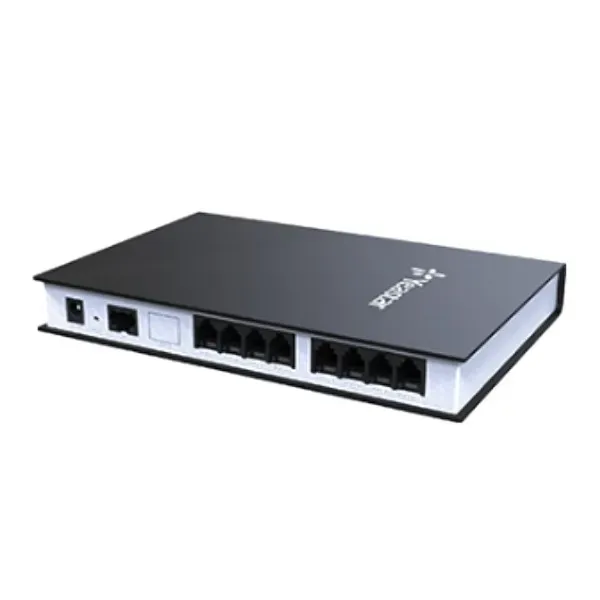
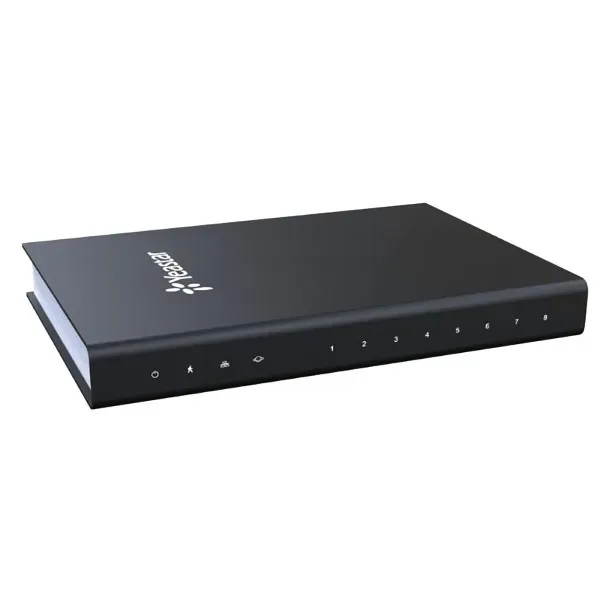
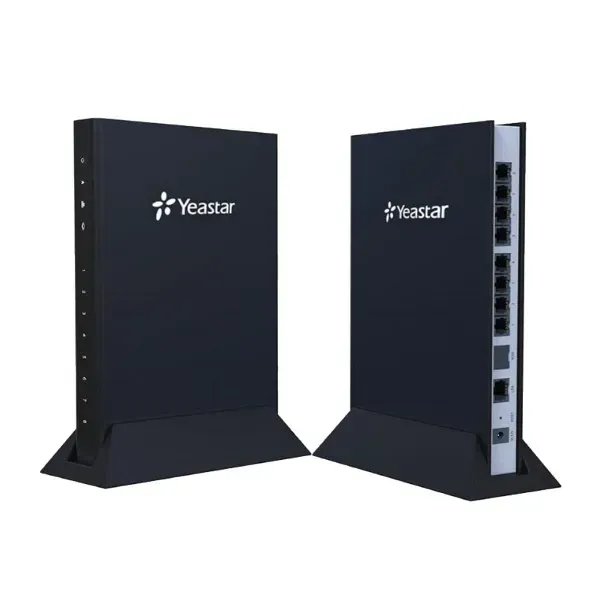
The Yeastar TA800 is a compact FXS VoIP gateway for organizations that want to keep useful analog telephones, fax machines, hotel room phones, door phones or other analog endpoints while migrating the voice core to SIP and IP telephony. With eight RJ11 FXS ports, SIP and IAX2 support, T.38 fax capability, standard voice codecs, VLAN and QoS features, and browser-based administration, it gives IT teams a controlled path between legacy endpoints and modern PBX infrastructure.
FourTeck helps business buyers evaluate the TA800 as part of the wider voice design: PBX compatibility, SIP registration method, numbering plan, LAN settings, voice VLAN, QoS, power protection, fax requirements, remote support approach and future extension growth. The objective is not simply to purchase a gateway, but to make sure the gateway fits the telephony architecture that will operate behind it.
Choose the Yeastar TA800 when you need up to eight FXS interfaces for analog devices that must operate on a SIP-based voice system. It is especially relevant for staged migrations where replacing every analog endpoint is unnecessary, disruptive or uneconomical.
Eight RJ11 FXS ports for analog telephones and compatible analog fax equipment.
SIP RFC3261 and IAX2 support for integration with supported IP-PBX and VoIP platforms.
T.38 and fax pass-through provide options for keeping compatible fax workflows on an IP network.
Browser-based configuration plus logging, backup, firmware and diagnostic functions simplify administration.
What the Yeastar TA800 solves
A complete switch to IP telephony can be attractive, but many sites still have analog equipment that performs its job well. Hotels may have hundreds of simple room handsets, warehouses may have wall phones, offices may retain fax devices, factories may have rugged analog extensions and older PBX installations may still expose analog stations. Replacing all of those endpoints at the same moment can add cost, user retraining and project risk. The TA800 addresses that transition problem by presenting eight FXS ports to analog devices while using IP networking and VoIP protocols toward the telephony platform.
This is different from an FXO gateway. FXS ports provide the station-side interface used by analog phones. If the requirement is to connect analog carrier lines or PSTN trunks into an IP PBX, an FXO model is normally the relevant category. Clarifying that distinction before ordering prevents a common procurement mistake. The TA800 should be selected when the devices to be connected are analog endpoints, not when the requirement is eight analog incoming telephone lines.
The gateway can also make phased migration practical. A business can modernize the PBX, call routing and SIP connectivity first, keep selected analog phones temporarily, and replace endpoints later according to operational priorities. That staged approach can be valuable where extension cabling, user habits, room-by-room replacement or budget cycles make a single cutover undesirable.
Verified technical profile
| FXS interfaces | 8 × RJ11 FXS ports |
| VoIP protocols | SIP (RFC3261), IAX2 |
| Transport | UDP, TCP, TLS, SRTP |
| Voice codecs | G.711 a-law/u-law, G.722, G.723, G.726, G.729A, GSM and ADPCM |
| Voice handling | ITU-T G.168 line echo cancellation, dynamic jitter buffer and packet-loss concealment |
| DTMF | RFC2833, SIP INFO and in-band |
| Fax | T.38 and pass-through |
| QoS and VLAN | DiffServ, ToS and 802.1P/Q VLAN tagging |
| Networking | DHCP, DDNS, OpenVPN, PPPoE, static route and VLAN |
| Network services | FTP, TFTP, HTTP, HTTPS and SSH |
| Management | SNMP, RADIUS and TR-069 support in the TA family, web-based management, logs, backup/restore and packet capture |
| LAN | 1 × 10/100 Mbps Ethernet |
| Operating environment | 0°C to 40°C; 10–90% humidity, non-condensing |
| Form factor | Desktop or wall-mount class enclosure for TA400/TA800 family |
Specifications above are based on Yeastar’s current TA Series FXS gateway information and TA400/TA800 documentation. Exact firmware behavior and PBX interoperability should be validated against the target deployment before production cutover.
Features that matter in a business deployment
Call handling
Functions in the TA platform include call forward, call waiting, attended and blind transfer, three-way conferencing, hotline, speed dial, hunting groups, message-waiting indication and caller ID options. Availability and behavior should be matched with the connected PBX and analog endpoint.
Security and transport
TLS and SRTP transport options, firewall functions, IP blocklist and attack alert features give administrators tools for reducing exposure. The gateway should still sit within a properly designed business network rather than being treated as a security boundary by itself.
Operations
System logs, CDRs, packet capture, configuration backup, firmware upgrade and browser administration are useful for troubleshooting and lifecycle management. Good documentation of port assignments and SIP credentials makes future support easier.
Voice quality
The supported codec set, echo cancellation, jitter buffering and packet-loss concealment help the gateway adapt analog voice to an IP network. LAN design, internet quality, QoS and SIP-provider behavior still have a major impact on the result.
Compatibility, sizing and deployment guidance
Start with port count. The TA800 provides eight FXS interfaces, so it is a good fit where one to eight analog endpoints must remain in service. If the project has only a few analog devices, a lower-port model may be more economical; if it has substantially more, consolidating onto a higher-density FXS gateway may simplify rack space, power and management. Do not size only for today’s active extensions. Consider whether spare ports are useful for future fax, emergency, lobby, warehouse or guest-room devices.
Next, confirm the PBX registration model. Yeastar documentation describes port registration, service-provider and template-registration approaches for different scenarios. In many IP-PBX environments each FXS port maps to an extension account, but the exact configuration depends on the PBX, dial plan and required call routing. For a new implementation, document each physical FXS port, extension number, endpoint location, caller ID policy and outbound permission before configuration begins.
Network design is equally important. Assign the gateway a controlled IP address, place voice traffic in the intended VLAN where appropriate, verify DNS and gateway settings, and protect administration interfaces. QoS policies should be consistent from access switch through router or firewall. If the SIP server is remote or cloud hosted, validate NAT handling and firewall rules without exposing management services unnecessarily.
Fax deserves its own test plan. T.38 support is valuable, but successful fax-over-IP operation also depends on the PBX, SIP trunk and remote fax path. If fax is business critical, test representative inbound and outbound documents before decommissioning the old line. The same principle applies to special analog devices such as door phones, alarm dialers or modems: protocol compatibility must be proven rather than assumed.
Where the TA800 fits
Hotels and hospitality
Hospitality sites often have simple analog room phones that remain perfectly usable. An FXS gateway can help connect those endpoints to an IP-based PBX while preserving room cabling and familiar handsets. Message-waiting behavior, front-desk call flows and emergency requirements should be confirmed in the design.
Offices and branch sites
A branch may keep a small number of analog devices while standardizing the rest of the company on SIP. The TA800 can bridge those endpoints into the corporate PBX and reduce the need to maintain a separate legacy PBX solely for a handful of stations.
Warehouses and industrial areas
Wall-mounted or rugged analog phones are common in operational spaces. Where the existing analog device is suitable, the gateway can retain the endpoint while moving call control to a central IP system, subject to environmental and cabling requirements.
Fax continuity
Organizations that still exchange faxes can use T.38 or pass-through options when the end-to-end telephony environment supports them. This creates a migration path without making fax replacement a prerequisite for PBX modernization.
Related FourTeck resources
A VoIP gateway is only one layer of a functioning voice solution. Review the FourTeck Tanzania technology portfolio for the wider network, voice, security and infrastructure context. For current product discovery, the FourTeck Tanzania shop provides a starting point for related equipment categories.
Deployment projects can also involve LAN readiness, IP addressing, VLAN design, rack organization and support planning. The FourTeck Tanzania services page explains the broader installation and integration approach. Organizations with multi-country projects can review FourTeck Uganda for Uganda requirements and FourTeck Kenya for Kenya-related technology projects.
These links are intended to help buyers connect the TA800 to the wider procurement decision: PBX platform, phones, switching, firewall policy, structured cabling, UPS protection and implementation support.
Yeastar TA800 FXS VoIP Gateway Tanzania
Tanzania organizations evaluating the Yeastar TA800 usually have a practical migration requirement rather than a purely technical interest in FXS ports. A business may already have analog phones in offices, hotel rooms, reception desks, warehouses or shared areas, yet want to move call control to a SIP-based PBX. In that situation, the gateway can preserve the analog endpoints while allowing the telephony core to become easier to manage. The eight-port capacity suits modest analog estates and branch sites where replacing handsets would add cost without delivering proportional benefit.
A good Tanzania deployment begins with an inventory. Record how many analog devices exist, where they are located, whether any are fax machines, which extensions they use, whether caller ID is required and what happens to calls when a user does not answer. That information becomes the basis for port mapping and PBX routing. It also reveals whether eight FXS ports are enough or whether a higher-density design is more appropriate.
Connectivity conditions vary by site, so the voice network should be engineered around the actual internet and LAN environment. Where the PBX is on-premises, the TA800 may communicate entirely inside the local network except for SIP trunks. Where the PBX is hosted, the gateway’s path to the service depends on internet reliability, firewall configuration and NAT behavior. In both cases, stable IP addressing, voice VLAN planning and QoS can reduce avoidable call-quality problems.
For procurement, request a quotation with the target PBX, extension count, number of fax devices, required accessories and installation scope. Avoid assuming stock, delivery schedule or service coverage until confirmed for the project. FourTeck can use this information to help structure a suitable bill of materials and implementation discussion for a Tanzania site.
Yeastar TA800 FXS VoIP Gateway Dar es Salaam
Dar es Salaam buyers often need voice systems that can serve offices, hotels, retail locations, logistics operations and multi-floor commercial premises. In these environments, analog endpoints may remain scattered across a building even after the main PBX has been upgraded. The TA800 gives IT teams an eight-port bridge that can collect those analog devices and present them to a SIP-based platform without forcing a full handset replacement project.
For a busy office, the most important design questions are usually extension mapping, inbound routing and network resilience. Reception may need calls to ring selected analog phones; finance may retain fax; a warehouse may use a wall phone; and a security desk may require a fixed analog extension. Each use case should be assigned to a documented FXS port. During testing, confirm inbound and outbound calls, DTMF, caller ID, transfers and any special PBX feature the user depends on.
Dar es Salaam sites can also have mixed network loads from Wi-Fi, CCTV, cloud applications and voice. Because voice traffic is delay sensitive, the access switch and router should not treat it as an afterthought. VLAN separation and QoS policies can help, but they should be configured consistently across the path. Where internet-based SIP trunks or hosted PBX services are used, capacity should be considered together with business data usage rather than judged only by headline bandwidth.
A quotation request is more useful when it includes the PBX brand or hosted service, the number of analog endpoints, whether T.38 fax is required, existing network details and whether configuration is expected. This reduces back-and-forth and helps distinguish a simple hardware purchase from a managed migration project.
Yeastar TA800 FXS VoIP Gateway Mwanza
In Mwanza, a TA800 project may be driven by a branch-office upgrade, hospitality property, healthcare facility, education site or business that wants to centralize PBX control while retaining analog devices. The gateway’s value is strongest when the analog equipment is still operational and the organization wants to modernize the voice platform around it. Eight ports provide a practical boundary: large enough for a small analog estate but simple enough to document clearly.
Before deployment, verify where the gateway will be mounted and how analog cables reach it. Existing telephone cabling can be useful, but it should be labeled and tested. Port records should identify the room or function served, the associated PBX extension and any special calling permissions. When a fault is reported later, that documentation can save significant troubleshooting time.
Power quality also matters. The gateway, router, switches and PBX infrastructure should be considered as one communication chain. If the gateway is on backup power but the access switch or internet router is not, calls may still fail during an outage. A UPS strategy should therefore cover the devices required to keep the voice path active for the desired duration. This is an operational planning point rather than a promise of uninterrupted service.
For Mwanza procurement, confirm the required model, port count and compatibility before ordering. If a project will grow beyond eight analog ports soon, compare the operational simplicity of a higher-density gateway against deploying multiple smaller units. The right choice depends on endpoint locations, rack space, cabling and future expansion rather than port count alone.
Yeastar TA800 FXS VoIP Gateway Arusha
Arusha businesses in tourism, hospitality, professional services and institutional environments can encounter a familiar telephony challenge: the PBX needs modernization, but the analog handsets and room cabling are still serviceable. The TA800 supports a phased approach by allowing up to eight analog endpoints to participate in an IP-based voice environment. That can make migration less disruptive while still giving the IT team access to centralized call routing and SIP-based architecture.
Hospitality deployments deserve specific planning. Guest-room phones may be simple devices with limited features, yet their numbering, front-desk routing and message-waiting behavior can be operationally important. A gateway should therefore be tested with the intended PBX feature set before broad rollout. If the hotel uses property-management integration, do not assume the FXS gateway alone provides that integration; the PBX and PMS relationship must be evaluated separately.
For offices and mixed-use properties, network segregation can help keep voice traffic predictable. The TA800 supports VLAN-related capabilities, but the surrounding switch and router must be configured to match. Administrators should also use strong management credentials, restrict web access to trusted networks and maintain configuration backups. Remote administration is useful only when it is implemented securely.
When requesting an Arusha quotation, include the number and type of analog devices, the PBX platform, desired call features and whether onsite installation or remote configuration assistance is required. If fax is involved, specify the expected fax path so T.38 or pass-through behavior can be tested as part of acceptance.
Yeastar TA800 FXS VoIP Gateway Dodoma
Dodoma organizations may use the TA800 in administrative offices, institutions, branch locations or facilities where legacy analog phones remain embedded in day-to-day operations. The gateway can connect those endpoints to SIP-based communications without demanding a full rewrite of the physical endpoint layer. That is useful where the priority is to improve PBX management and routing first while scheduling endpoint replacement later.
Planning should start with the existing call flow rather than with hardware. Identify reception groups, direct extensions, hunt groups, after-hours routing and any emergency or public-area phones. Once these requirements are documented, each FXS port can be mapped to the correct SIP account and calling policy. This method reduces surprises after cutover because the technical configuration reflects real user behavior.
If the site has a hosted PBX, internet resilience becomes a key dependency. Consider what happens when the primary connection is unavailable, whether a backup connection exists and how SIP sessions behave through the firewall. The TA800 can participate in a resilient design, but it cannot by itself compensate for loss of all upstream connectivity. A complete voice-continuity plan should therefore include LAN, WAN, power and PBX availability.
For Dodoma procurement, provide a clear scope: gateway only, pre-configuration, PBX integration, network changes, testing and user handover are different levels of service. A precise scope makes quotations easier to compare and helps avoid the assumption that all deployment tasks are automatically included with the hardware.
Yeastar TA800 FXS VoIP Gateway UAE
UAE organizations commonly operate mixed telephony estates across offices, hotels, warehouses and branches. The Yeastar TA800 can be useful where a SIP-based PBX is being introduced but a small set of analog endpoints must remain. Instead of maintaining an entire legacy PBX for a handful of devices, the gateway can move those stations into the IP architecture through eight FXS ports.
Multi-site businesses should think about standardization. If several branches each have a small analog requirement, using a consistent gateway family can make configuration templates, spares and support procedures easier to manage. However, every site should still be assessed independently for port count, PBX reachability, SIP-provider rules and network security. A standard product does not mean identical configuration.
The UAE deployment model may also involve hosted PBX services or centralized data-center call control. In that case, test latency, NAT traversal and security policies from the branch to the PBX. Do not expose the administration interface directly to the public internet simply for convenience. Use controlled remote-access methods and keep firmware and backups under change management.
For cross-border procurement involving Tanzania and the UAE, quote requests should separate quantities and deployment requirements by country. Import, delivery, warranty and support conditions can differ. The technical bill of materials can still be standardized where practical, but commercial terms should be confirmed per destination.
Yeastar TA800 FXS VoIP Gateway Uganda
Uganda businesses can use the TA800 as a bridge during migration from analog extensions to IP telephony. The common objective is to keep useful phones or fax devices while gaining the call-routing flexibility of a SIP PBX. For a branch with fewer than eight analog endpoints, the gateway offers a manageable amount of capacity without introducing a large chassis.
The procurement conversation should include both the analog side and the IP side. On the analog side, confirm the endpoint type, cabling and caller-ID expectations. On the IP side, confirm the PBX address, extension credentials, codec policy, voice VLAN, firewall path and whether the PBX is local or hosted. Problems often arise when only one side is tested.
For branch networking, avoid placing voice traffic into an unmanaged environment if the site also carries heavy data or camera traffic. The TA800’s QoS and VLAN capabilities are most useful when the rest of the network supports the same design. A managed switch and documented addressing plan can make support significantly easier, especially for organizations with several sites.
FourTeck’s Uganda regional site can help coordinate related technology discussions, while this Tanzania page focuses on the product and cross-market buying considerations. Availability and delivery should always be confirmed for the requested destination before the project schedule is fixed.
Yeastar TA800 FXS VoIP Gateway Kampala
Kampala organizations often have dense office networks where voice, data, Wi-Fi and security systems share the same switching infrastructure. The TA800 can connect legacy analog phones to that environment, but the project should be treated as an integration task rather than a simple appliance installation. IP addressing, VLAN membership, PBX registration and routing all need to align.
For office migrations, a pilot is valuable. Connect one or two representative analog devices, register them with the intended PBX and test internal calling, inbound and outbound routes, transfers, caller ID, DTMF and after-hours behavior. Once the pilot proves the design, roll the remaining ports into service. This staged method reduces the impact of configuration errors and creates a repeatable checklist.
If fax is part of the Kampala requirement, test actual documents between the organization’s common destinations rather than relying only on a registration status screen. T.38 can improve fax-over-IP operation when supported end to end, but results also depend on carrier and PBX configuration. Keep the legacy path available until the new workflow has been accepted.
For a quotation, state whether the TA800 is for a new PBX, an existing SIP system or direct interaction with another gateway. The intended architecture influences configuration effort and may affect whether additional network or telephony components are needed.
Yeastar TA800 FXS VoIP Gateway Arua
Arua deployments may emphasize operational simplicity and remote manageability, particularly when specialist IT staff are not permanently based at the site. The TA800’s browser interface, backup functions, logging and diagnostics can support a structured remote-support model, provided access is secured and the network is documented.
For remote branches, configuration standards become valuable. Use consistent naming for ports and extensions, reserve IP addresses predictably, document the PBX server, and store a current configuration backup. If a unit must be replaced or reset, these records reduce the amount of site-specific discovery required. The same principle applies to switch ports and analog cable labels.
Connectivity should be assessed realistically. A hosted PBX can centralize management across branches, but voice quality depends on stable paths to that PBX. Where the WAN is constrained, codec policy and competing traffic matter. Do not assume that low average bandwidth guarantees good calls; latency, jitter and packet loss are often more important to perceived quality.
For Arua procurement, include the support model in the request. A hardware-only purchase has different expectations from a project that includes configuration, testing and remote troubleshooting. Clarifying this in advance helps align the product with the operational capability available at the site.
Yeastar TA800 FXS VoIP Gateway Mbarara
Mbarara businesses considering the TA800 may be upgrading a branch PBX, consolidating communications or retaining analog equipment during a wider network refresh. Because the gateway sits between analog devices and the IP voice system, it should be planned together with both layers. A clear migration map prevents old extension numbers and call-routing assumptions from being lost during modernization.
An eight-port design can be particularly efficient for mixed-use sites. A reception phone, fax machine, security handset, warehouse phone and several common-area extensions can all be connected without requiring each device to become an IP endpoint. If the analog estate is likely to grow, leave intentional spare capacity or compare a larger gateway before standardizing.
Network housekeeping improves reliability. Give the gateway a documented address, use the intended voice VLAN where appropriate, restrict administration, and keep a configuration backup after commissioning. Monitor logs during the first days of operation for repeated registration failures or unusual call behavior. Troubleshooting is easier when changes are controlled rather than made ad hoc.
Mbarara buyers should also confirm commercial details such as delivery, warranty handling and installation scope before committing to a project schedule. Those items are separate from the technical suitability of the TA800 and can vary with supplier conditions and destination.
Yeastar TA800 FXS VoIP Gateway Gulu
For Gulu organizations, the TA800 can provide a straightforward way to carry established analog endpoints into a modern SIP environment. This is useful when the existing phones remain functional but the business wants centralized PBX features, easier routing and a more standardized network architecture. The gateway’s eight FXS ports create a practical limit that makes small deployments easy to map and test.
A disciplined installation should begin with labeling. Number each analog cable, identify the endpoint location, associate it with the PBX extension and record the gateway port. This turns a potentially confusing bundle of old telephone cabling into a supportable system. If a user later reports a fault, the technician can trace the exact path rather than guessing.
Power and connectivity planning are also important for branch continuity. The gateway needs its local network and PBX path to remain available for calls. A UPS can protect critical electronics for a period, but runtime must be sized across the full chain. Where the PBX is remote, the internet router and any wireless or fiber termination equipment may need backup as well.
For procurement in Gulu, specify whether the deployment is replacing an analog PBX, extending a current IP PBX or supporting individual analog devices. Those scenarios can use the same gateway but require different call-routing and registration configurations.
Yeastar TA800 FXS VoIP Gateway Kenya
Kenya enterprises with regional operations can use the TA800 as part of a standardized branch telephony design. A central PBX or consistent SIP platform can serve multiple sites while each branch retains a small number of analog endpoints through local FXS gateways. This can simplify extension policy and support without forcing every device to be identical.
Standardization should include more than the product model. Define a repeatable addressing scheme, firmware policy, backup process, port-naming method and testing checklist. If branches use different extension ranges, document those differences explicitly. Consistency makes remote troubleshooting easier and reduces the chance that a replacement gateway is configured differently from the rest of the estate.
Kenya sites that depend on hosted PBX platforms should validate WAN quality and firewall behavior before moving critical analog phones. A gateway registration that shows ‘online’ is not the same as proving call quality. Test concurrent calls, DTMF, transfers and fax if required. If the internet connection is shared with high-volume applications, use QoS where the end-to-end network supports it.
Regional customers can coordinate Kenya-specific requirements through FourTeck Kenya while using a consistent technical specification across Tanzania and neighboring markets. Commercial availability, delivery and support conditions should still be confirmed per country.
Yeastar TA800 FXS VoIP Gateway Kuwait
Kuwait businesses may use an FXS gateway when modernizing office telephony, preserving analog devices in warehouses or maintaining fax and special-purpose endpoints alongside an IP PBX. The TA800’s eight-port density makes it suitable for compact analog requirements where a full legacy PBX would be excessive.
For enterprise sites, security policy should cover the gateway like any other managed network device. Administration should be restricted to trusted networks, credentials should be managed properly and firmware changes should be planned. SIP signaling and media paths through the firewall should be opened only as required by the architecture rather than with broad internet exposure.
The local environment can also influence installation. Keep the gateway within its supported operating range, provide stable power and avoid placing it in poorly ventilated or dusty locations. Cable management is especially important where multiple analog lines terminate in the same rack or cabinet. Clear labeling prevents accidental swaps during maintenance.
For Kuwait quotations connected to a Tanzania-led procurement project, separate the destination-specific commercial requirements while keeping the technical design consistent where appropriate. Confirm availability, warranty process and delivery arrangements before finalizing rollout dates.
Yeastar TA800 FXS VoIP Gateway Ghana
Ghana organizations can consider the TA800 when analog phones remain useful but call control is moving to a SIP-based platform. The gateway can reduce disruption by preserving familiar endpoints while the business gains centralized extensions, call routing and other PBX functions. For small analog estates, eight ports offer a practical balance between capacity and simplicity.
A useful procurement review should distinguish ordinary phones from fax and special analog devices. Phones are usually straightforward when signaling and PBX features are compatible. Fax can require T.38 or pass-through testing. Alarm dialers, payment terminals and modems may have stricter timing or tone requirements and should not be assumed compatible without validation.
If the gateway will connect to a cloud PBX, confirm DNS, NAT and firewall behavior, then run extended calling tests rather than only short samples. Observe whether registrations remain stable, whether audio is two-way and whether calls survive normal network conditions. Maintain configuration backups after commissioning so future changes can be reversed if necessary.
For Ghana procurement, share the number of sites, required units, analog endpoint count per site and PBX platform. This makes it possible to compare whether one TA800 per branch or a different density model is operationally preferable.
Yeastar TA800 FXS VoIP Gateway Nigeria
Nigeria enterprises with large branch networks can use FXS gateways as one component of a broader VoIP standard. The TA800 is relevant for branches that need only a handful of analog endpoints while the main organization operates SIP-based communications. It allows the branch to participate in centralized call routing without abandoning devices that still meet operational needs.
At scale, configuration control matters more than the gateway itself. Maintain a template with approved firmware, LAN settings, SIP transport, codec order, NTP, administration policy and logging preferences. Then document site-specific values separately, such as extension numbers and IP addresses. This prevents one-off configuration differences from accumulating across dozens of branches.
Power and WAN resilience should be designed according to business impact. Where voice is essential, consider how long the router, switch, PBX path and gateway need to remain operational during local interruptions. Backup power for only one component does not preserve the end-to-end service. Similarly, dual internet links help only when the firewall and SIP service can use them correctly.
Nigeria quotations should specify quantities and deployment geography, because commercial terms, shipping and onsite scope can vary significantly. Technical suitability should be validated separately from product availability.
Yeastar TA800 FXS VoIP Gateway Seychelles
Seychelles hospitality and service organizations can benefit from a gateway-based migration where analog guest-room or back-office phones remain in place while the PBX moves to SIP. The TA800’s eight FXS ports are particularly suitable for small properties, remote buildings or groups of endpoints that can be aggregated close to the existing telephone cabling.
Island deployments can make logistics and remote support more important, so spare strategy and documentation deserve attention. Keep a configuration backup, label analog pairs clearly and record the network settings. If voice service is critical, decide whether holding a spare unit or spare power adapter is justified by the site’s operational requirements and replacement lead time.
Hospitality systems may also need feature validation beyond basic calls. Test front-desk routing, wake-up workflows where handled by the PBX, message-waiting behavior and any property-management integration at the PBX layer. Do not assume an FXS gateway reproduces proprietary hotel-PBX features automatically. The safest approach is a pilot room or small group of rooms before wider migration.
For Seychelles procurement, provide the number of properties, endpoints per property, PBX platform and expected implementation scope. This helps determine whether distributed TA800 gateways or a different analog-density design is better for cable layout and support.
Buying checklist for the Yeastar TA800
Frequently asked questions
What is the Yeastar TA800 used for?
The TA800 is used to connect up to eight analog endpoints, such as traditional telephones or compatible fax machines, to an IP-based telephony environment. It provides FXS interfaces on the analog side and SIP/IAX2 connectivity on the IP side.
Does the TA800 have FXS or FXO ports?
The TA800 has eight FXS ports. FXS is the station-side interface intended for analog phones and similar endpoints. If the project needs to connect analog PSTN lines into an IP PBX, an FXO gateway is the relevant product category.
Can the TA800 work with a third-party IP PBX?
Yeastar lists interoperability with platforms including Asterisk, FreePBX and other SIP environments, and provides support documentation for integrations such as 3CX. Exact compatibility should be verified against the PBX version and required feature set before deployment.
Does the TA800 support fax?
Yes. Yeastar specifies T.38 and fax pass-through for the TA Series FXS gateways. Reliable operation depends on end-to-end support across the gateway, PBX, SIP trunk and remote destination, so production fax workflows should be tested.
Can I use the TA800 with a cloud PBX?
It can be integrated with IP-based systems when the PBX and network support the required SIP registration and media path. For cloud deployments, pay particular attention to NAT, firewall rules, DNS, internet stability and secure remote management.
How should I choose between TA400, TA800 and higher-capacity models?
Choose according to the number of required analog extensions, spare capacity, physical distribution and support model. The TA400 provides four FXS ports, the TA800 eight, while the TA family includes higher-density options. A larger gateway can simplify management when many analog ports terminate in one location.
Does the TA800 support VLAN and QoS?
Yes. Yeastar specifies 802.1P/Q VLAN tagging along with DiffServ and ToS QoS functions. These features are most effective when the switch, router and other network devices are configured consistently.
What information should I send for a FourTeck quotation?
Send the product model, quantity, destination, PBX platform, number and type of analog devices, whether fax is required, desired installation or configuration scope, and any project deadline. Current stock, delivery and commercial terms should be confirmed in the quotation process.
Decision recap
The Yeastar TA800 is a strong fit when the project has up to eight analog endpoints that should remain in service while the organization moves to SIP-based telephony. Its value comes from preserving existing endpoint investment, reducing migration disruption and providing a manageable bridge into an IP PBX environment.
The purchase decision should still be based on more than port count. Verify FXS versus FXO requirements, PBX compatibility, call-routing behavior, fax expectations, LAN and WAN design, power continuity and implementation scope. A properly planned gateway deployment becomes part of a supportable communication architecture instead of another isolated box in the network.
Prepare your quotation request
For the fastest technical review, send the required TA800 quantity, delivery destination, PBX make and model, number of analog phones, fax requirement, available network information and whether you need configuration or installation support. For multi-site projects, list each site separately so port count and deployment scope can be checked independently.
FourTeck can then structure the discussion around product suitability, related networking components and the level of implementation assistance required. Availability, delivery timing, warranty conditions and final pricing remain subject to the confirmed quotation.


Reviews
There are no reviews yet.