
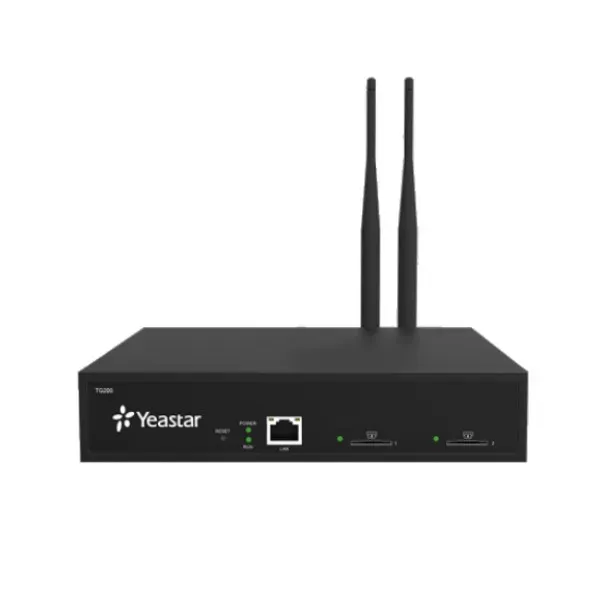
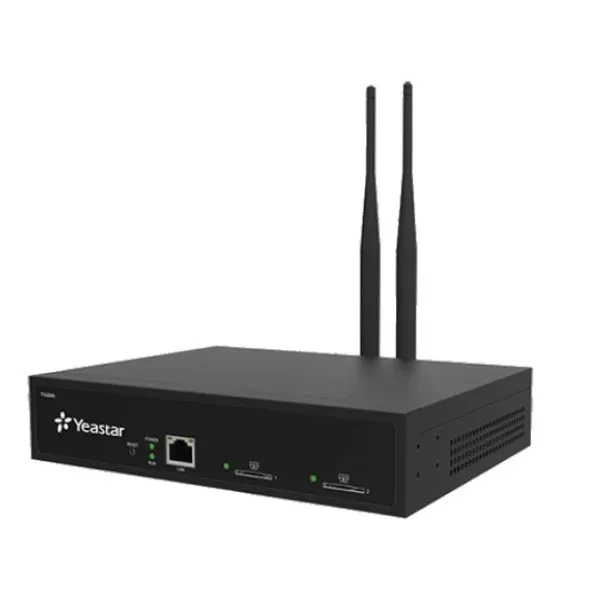
Yeastar TG200 VoIP 4G Gateway
The Yeastar TG200 VoIP 4G Gateway is a compact two-port cellular-to-VoIP gateway for organizations that need to connect mobile-network trunks with an IP PBX, softswitch or SIP-based communications platform. It is designed for two-way communication between supported GSM, 3G or 4G cellular services and VoIP systems, allowing a business to route calls from its IP telephony environment through cellular channels and to accept cellular-originated calls into the VoIP platform. This makes the TG200 relevant for branch communications, cellular trunking, mobile-network call routing, landline or SIP alternatives, and business-continuity designs where two independent cellular channels are useful.
For Tanzania buyers, the most important purchasing step is not simply selecting “4G” on a product list. Yeastar states that supported 4G LTE bands depend on the module type, so the intended mobile operator, voice service, SIM configuration and frequency support should be checked before procurement. FourTeck can help translate the telephony requirement into a practical bill of materials covering the gateway, IP PBX, SIP endpoints, switching, firewall rules, UPS protection and deployment configuration.
TG200 provides two cellular ports, making it suitable for small and mid-sized deployments that need two mobile-network channels rather than the higher port counts of TG400, TG800 or TG1600.
The TG family supports SIP and IAX2, with UDP, TCP, TLS and SRTP transport options listed by Yeastar for integration with compatible VoIP platforms.
Functions include SMS sending and receiving, bulk SMS tools, an SMS center and an open API for SMS and USSD, subject to operator and deployment conditions.
A browser-based interface, backup and restore functions, logs, packet capture and firmware management support ongoing configuration and troubleshooting.
What the Yeastar TG200 does
The TG200 bridges cellular networks and IP telephony. In a typical deployment, the gateway sits on the local IP network and establishes a SIP or IAX2 relationship with a compatible PBX, softswitch or other VoIP system. The cellular interfaces provide the external mobile-network side. Outbound routing rules can direct selected calls through the cellular channels, while inbound mobile calls can be passed into the PBX for routing to extensions, reception groups, IVRs or other destinations.
This architecture can be useful when a company has a significant volume of calls to mobile numbers, wants a mobile-network alternative to a fixed voice service, needs a separate communication path for a branch, or wants to make selected SIM-based services available through a central IP PBX. The TG200 does not replace the PBX itself; instead, it extends the PBX with cellular trunking. For projects that also need extensions, queues, IVRs or unified communications, review FourTeck Tanzania’s IP PBX and VoIP solution portfolio as part of the wider design.
The gateway also includes administrative capabilities that matter after installation. Yeastar lists call-detail records, call-duration limits, incoming and outgoing routing rules, port grouping, caller ID or CLIR, gain adjustment, system logs, packet capture, IP blocklists and network attack alerts. These tools give administrators practical visibility and policy control, but they should still be used within a properly secured network design with strong credentials, restricted management access and documented routing rules.
Verified technical capabilities
| Item | TG200 / TG family information |
|---|---|
| Cellular ports | 2 ports on TG200 |
| VoIP protocols | SIP, IAX2 |
| Transport | UDP, TCP, TLS, SRTP |
| Voice codecs | G.711 A-law/u-law, G.726, G.729A, GSM, ADPCM, Speex |
| DTMF | RFC2833, SIP Info, in-band |
| Echo cancellation | ITU-T G.168 LEC |
| LAN | 1 × 10/100 Mbps Ethernet interface for TG200 |
| Network functions | DHCP, DDNS, firewall, OpenVPN, static IP, QoS, static route, VLAN |
| NAT traversal | Static NAT, STUN |
| Power | AC 100–240V |
| Operating range | 0°C to 40°C |
| Dimensions | 213 × 160 × 44 mm |
Important: Yeastar states that 4G LTE band support depends on the installed module type. Confirm the exact cellular module and operator compatibility for the deployment country before ordering.
Business benefits and deployment decisions
Cellular trunking for an IP PBX
Organizations can add two cellular channels to a compatible IP telephony environment without distributing standalone mobile phones among users. Calls can be controlled through PBX routing rules and business extensions.
Alternative voice path
A cellular gateway can provide a separate external voice path where fixed lines or SIP services are unavailable, constrained or intentionally supplemented. Business-continuity outcomes depend on power, cellular coverage and the PBX design.
SMS workflows
SMS send/receive features and API access can support operational messaging workflows. Before deployment, verify operator policy, local compliance requirements, rate limits and the intended application integration.
Buying checklist before requesting a TG200 quotation
For an accurate quote, identify the mobile operators and SIMs you intend to use, confirm whether the requirement is GSM, 3G or 4G/VoLTE, provide the PBX or softswitch make and version, state whether SIP registration or peer mode is preferred, and estimate simultaneous cellular calls. Also list any SMS/USSD requirement, security policy, VLAN requirement, remote-management need and availability of UPS-backed power.
If your environment includes business IP phones, managed switching, QoS and network segmentation, FourTeck can evaluate the voice path as part of a broader network design. The FourTeck technology network covers integrated IT and communications planning, while regional resources such as FourTeck Kenya and FourTeck Uganda support geographically aligned procurement discussions across East Africa.
Yeastar TG200 VoIP 4G Gateway Tanzania
For businesses in Tanzania, the Yeastar TG200 is most relevant when the telephony plan needs two cellular channels integrated into an IP PBX rather than handled as separate mobile handsets. Typical buyers may include offices, schools, clinics, hospitality operators, retail groups, logistics companies, service organizations and branch networks that already have SIP extensions but need a mobile-network path for selected incoming or outgoing calls. The gateway can sit between the local IP network and supported cellular services, letting the PBX treat mobile-network access as part of its call-routing strategy.
The key Tanzania procurement question is cellular compatibility. Yeastar publishes the TG200 as part of its GSM/3G/4G gateway family, but 4G LTE bands vary by module. A quotation should therefore identify the intended Tanzanian operator and the voice technology expected on the SIM. 4G data is not the purpose of this model; the requirement is cellular voice trunking into VoIP. Where VoLTE is expected, the exact module, operator support and provisioned SIM service should be confirmed before dispatch. This avoids treating “4G” as a universal compatibility label.
Deployment quality also depends on the rest of the site. The gateway needs reliable Ethernet connectivity, sensible IP addressing, PBX reachability and stable power. If the telephony system is business critical, connect the gateway, PBX, switch and router or firewall to appropriate UPS protection so that a short utility interruption does not disable the entire voice path. The TG200 supports QoS and VLAN-related network features, but those features need to align with the site’s switching and security configuration. Management access should be restricted, passwords should be strong, and backup files should be stored after a stable configuration is reached.
FourTeck Tanzania can help buyers define the requirement around channel count, PBX interoperability, routing rules and related network infrastructure. For a two-channel requirement the TG200 is the natural model to evaluate; sites needing more simultaneous cellular trunks should compare higher-capacity TG family models rather than attempting to force too much traffic through two channels. When preparing a Tanzania request for quotation, include the PBX model, current trunk setup, mobile operator, estimated concurrent calls, inbound and outbound routing objective, and whether SMS or API functions are part of the project.
Yeastar TG200 VoIP 4G Gateway Dar es Salaam
Dar es Salaam organizations often operate in communication-heavy environments where customer calls, supplier coordination, field teams and branch contact all depend on consistent voice routing. The Yeastar TG200 can provide a practical two-channel cellular trunk for a compatible IP PBX, allowing selected mobile-network calls to be controlled through the business phone system rather than through individually managed handsets. That is particularly useful for reception desks, customer-service teams, logistics offices, professional services and businesses that want centralized call routing while retaining access to mobile-network services.
A sound Dar es Salaam design starts with coverage testing at the exact installation location. Cellular quality can vary inside offices because of reinforced concrete, reflective glass, building position and antenna placement. A strong outdoor signal does not automatically mean the gateway will have an equally strong indoor signal in a rack room. The gateway should therefore be positioned with antenna performance in mind, while still being connected to a secure, organized network. The PBX and gateway need stable LAN connectivity, and firewall policies should allow only the traffic required by the chosen topology.
For companies with many desk users, combine the TG200 with a properly planned IP PBX and SIP endpoint environment rather than treating the cellular gateway as an isolated appliance. Call routes can distinguish local mobile traffic, overflow rules, backup routes or dedicated departments. Call-detail records can help administrators review usage, while call-duration controls and blocklists can support policy. If remote branches need to reach the gateway through the IP network, security, latency and NAT design should be assessed before enabling remote connectivity.
When requesting a Dar es Salaam quote, specify the intended operator SIMs, whether both ports will use the same carrier or different carriers, and the expected simultaneous call volume. Using two carriers may offer operational flexibility, but it does not create automatic resilience unless routing logic, SIM service and coverage are designed accordingly. Buyers should also clarify whether the system must receive inbound mobile calls, place outbound calls, send SMS, interact with an application through API functions, or provide a cellular alternative when another voice path is unavailable.
Yeastar TG200 VoIP 4G Gateway Mwanza
For Mwanza businesses, the Yeastar TG200 can fit branch offices and operations that use an IP PBX but want a direct connection to cellular voice services. Two cellular ports can support two concurrent cellular channels, subject to the SIM services and network conditions. This is useful for organizations that need a controlled mobile trunk for calling suppliers, field staff or customers, and for sites where the available fixed-line or SIP arrangement benefits from an additional mobile-network path.
The decision to deploy should begin with a call-flow map. Identify which extensions or departments can use the cellular trunks, which destination patterns should prefer them, whether inbound SIM calls should ring a receptionist or IVR, and what should happen when both TG200 channels are busy. A two-port gateway is intentionally compact; when traffic regularly requires more than two simultaneous calls, a higher-port TG model may be more efficient. Capacity planning prevents busy-channel conditions from becoming an unexpected operational problem.
Mwanza deployments should also consider site infrastructure. The TG200 includes one 10/100 Mbps Ethernet interface, which is ample for its voice purpose, but the surrounding LAN should be stable and securely segmented. Put voice equipment on documented switch ports, define static addresses or controlled DHCP reservations, and ensure the PBX can reach the gateway reliably. If remote administration is needed, avoid exposing the web interface directly to the public internet where possible; use secure network access methods and restrict management to authorized users.
For procurement, provide the exact PBX platform and firmware version, intended mobile operators, expected call direction, and any requirement for SMS or USSD. Yeastar’s documentation lists SIP peer and SIP trunk capabilities as well as routing functions and API options, but interoperability should be tested against the actual system rather than assumed from the protocol name alone. A structured request allows FourTeck to identify whether TG200 is the correct capacity, whether additional switching or UPS hardware is needed, and which configuration tasks should be included in the deployment scope.
Yeastar TG200 VoIP 4G Gateway Arusha
Arusha has a broad mix of hospitality, tourism, education, professional services and multi-site organizations, all of which can have different reasons for integrating cellular calling into an IP telephony system. The Yeastar TG200 is suitable when the requirement is specifically two cellular channels tied into a PBX. It can support incoming and outgoing routes between cellular services and VoIP, helping a business centralize calls through extensions and business call flows rather than distribute responsibility across separate mobile devices.
For a hotel or guest-service environment, a cellular trunk may be one component of a larger reception design that includes an IP PBX, extensions, hunt groups, IVR, call reporting and after-hours routing. For a tour operator, the benefit may be easier calling to drivers, guides or mobile numbers from office extensions. For a school or NGO, the need may be a secondary voice path or centralized access to a mobile SIM. The TG200 can serve any of these patterns, but the configuration should follow the business process rather than a generic template.
Before installation in Arusha, test cellular signal at the chosen equipment location and confirm the exact module supports the operator’s relevant bands and voice service. The gateway’s web management interface simplifies administration, while logs, call detail records and packet capture can assist troubleshooting. Those tools work best when the network itself is documented. Keep PBX, gateway, switch and firewall addresses recorded, back up configuration after commissioning, and define who is allowed to modify routing or SIM-related settings.
A useful quotation request should state the number of users, the PBX brand, the desired SIM operators, expected peak concurrent cellular calls and the reason for adding mobile trunks. This information helps determine whether the two-port TG200 is appropriately sized. It also helps decide whether the project needs IP phone provisioning, managed switching, network VLANs, firewall changes or UPS protection. Buyers can use the broader FourTeck Tanzania communications and networking portfolio when the gateway is part of a larger office technology project.
Yeastar TG200 VoIP 4G Gateway Dodoma
In Dodoma, the Yeastar TG200 can support organizations that want to integrate cellular voice trunks with an IP PBX while keeping call control centralized. Government-adjacent offices, professional organizations, educational institutions, service providers and growing enterprises may use a cellular gateway when they need mobile-network calling from desk extensions, a second external voice route or a way to direct incoming SIM calls through PBX groups. Because the TG200 has two ports, its sweet spot is a modest simultaneous-call requirement rather than a large contact-center trunk load.
The gateway supports incoming and outgoing routing rules, port grouping and SIP integration, so administrators can build a clear policy for which calls use each cellular channel. For example, each SIM could be associated with a separate operator, business unit or routing preference. Such a design should be documented carefully. Routing that is too broad can create unexpected usage, while routing that is too restrictive can prevent legitimate calls. Call-detail records provide a practical way to validate the design after go-live.
Security is important in any VoIP deployment. Use strong administrative credentials, restrict access to the management interface, apply firmware updates in a controlled manner and keep a known-good configuration backup. TLS and SRTP capabilities are available in the product family, but secure deployment also depends on the PBX, network and configuration. If the gateway connects to systems across sites, evaluate VPN, firewall and addressing choices rather than simply forwarding management or SIP services openly.
For a Dodoma purchase, do not omit the cellular compatibility check. Yeastar explicitly notes that LTE bands depend on module type. Confirm the intended operators, SIM voice service and local band support before ordering. Include expected traffic, PBX platform, call-flow requirements, SMS needs and any requirement for integration with applications. FourTeck can then scope the gateway alongside related voice, network and power components so that the final installation is not dependent on missing infrastructure.
Yeastar TG200 VoIP 4G Gateway UAE
For UAE deployments, the Yeastar TG200 offers the same core use case: two cellular channels connected to a SIP or IAX2 telephony environment. Businesses may evaluate it for cellular trunking, branch communications, mobile-call routing or an alternative external voice path. The exact commercial and regulatory suitability depends on the intended operator service and applicable telecommunications requirements, so buyers should confirm permitted use, SIM provisioning and operator compatibility before deploying any cellular gateway.
Technically, the TG200 can integrate with a compatible IP PBX through SIP. Yeastar also documents interoperability with a broad range of telephony systems and provides integration guides for selected platforms. Still, each real project should verify the PBX version, SIP mode, codec settings, DTMF behavior and routing plan. A gateway that registers successfully is only the first step; inbound and outbound call presentation, caller ID, failover behavior and permission rules must also work as intended.
UAE businesses commonly operate multi-branch environments, so a two-channel gateway may be placed at a branch while the main call control remains elsewhere. This architecture can be practical, but only when latency, VPN design, security and survivability have been considered. If a WAN link fails, decide whether the branch still needs local calling and whether the PBX architecture supports that objective. Power backup for the gateway and network switch should also be considered if the cellular route is intended as part of continuity planning.
For UAE project coordination, buyers can reference FourTeck UAE for regional solution context. A quotation request should identify the cellular operators, PBX or softswitch, two-port capacity requirement, SMS or USSD needs, preferred integration mode and security expectations. That information makes it easier to determine whether TG200 is the right fit or whether a higher-port TG gateway is required for the expected concurrent call load.
Yeastar TG200 VoIP 4G Gateway Uganda
In Uganda, the TG200 can serve organizations that already use IP telephony and want two cellular voice channels available to the PBX. Potential applications include mobile-network calling from desk phones, receiving calls to business SIMs through a centralized receptionist or IVR, supporting branch locations, and providing a cellular alternative where another external voice service is unavailable or not ideal for every destination. The gateway’s value comes from controlled integration rather than from using it as a standalone mobile device.
Operator and module compatibility should be checked before procurement. Yeastar notes that 4G LTE band support depends on module type, so the project should state which Ugandan operators will be used and whether the SIM is intended for GSM, 3G or 4G/VoLTE voice. Voice service configuration can differ from general mobile broadband, so a SIM that works in a phone for data does not automatically confirm suitability for the exact gateway voice requirement.
The network design should include a stable Ethernet path, documented addressing and secure management. If the gateway is installed at a branch and the PBX is at another site, evaluate whether the inter-site connection is reliable enough for voice and how the system behaves during a WAN interruption. Yeastar supports OpenVPN and other network features in the TG family, but the architecture should be chosen according to the organization’s security standard rather than enabled without a plan.
FourTeck Uganda can be referenced through the Uganda FourTeck regional site when the project is centered there. For multi-country organizations, using similar gateway and PBX patterns across branches can simplify administration, but each country still needs its own operator and band check. Quote requests should include the PBX platform, SIM operators, concurrent calls, inbound and outbound routing objectives, SMS requirements and any need for installation or remote configuration.
Yeastar TG200 VoIP 4G Gateway Kampala
Kampala businesses that run centralized phone systems can use the Yeastar TG200 to add two mobile-network trunks to a compatible VoIP platform. This can be useful for sales teams calling mobile customers, service desks receiving calls through dedicated SIM numbers, offices that want mobile-network routing from standard IP phones, and branches that need a second type of external voice connection. The gateway’s two-port design keeps the solution compact for modest call concurrency.
A good Kampala deployment starts by separating capacity planning from user count. A company might have fifty extensions but need only one or two simultaneous cellular calls, in which case TG200 could still be appropriate. Another company with ten users might regularly place four cellular calls at once, making TG200 too small. Estimate peak simultaneous mobile-trunk demand and consider business growth before choosing the model. TG400 or larger members of the TG family may be more appropriate when concurrency exceeds two channels.
Call routing should be intentionally designed. Outbound rules may select cellular trunks for specific number patterns or departments, while inbound calls can be forwarded into reception, an IVR or dedicated extensions. Caller ID behavior and operator restrictions should be tested. The TG200 includes logs and call detail records that help with validation and troubleshooting. For SMS workflows, define who can send messages and whether an application will use the API, then review operator and compliance requirements.
Installation also needs physical and network planning. Verify indoor signal at the equipment location, maintain airflow within the published operating temperature range, and protect the network and power path. Do not expose the management interface broadly. A quote request for Kampala should include exact operators, PBX details, call-volume expectations and desired routing. This provides enough information to match the gateway capacity and to identify whether network configuration, VPN connectivity, switches or UPS hardware belong in the project scope.
Yeastar TG200 VoIP 4G Gateway Arua
For organizations in Arua, cellular connectivity can be a practical component of branch communications, particularly when an office wants to integrate mobile calling with an existing IP PBX. The Yeastar TG200 provides two cellular ports and supports two-way communication between compatible cellular services and VoIP. This allows a branch to route calls through standard business extensions while the external leg uses the cellular network.
The most important design consideration is whether the installation site has stable service from the intended operators. Check actual signal conditions where the gateway will be installed, not only general coverage maps. Building materials and equipment-room placement can affect reception. If two SIMs from different operators are used, each should be tested. Different operators can provide useful routing choices, but they should not be described as automatic failover unless the PBX and gateway rules have been configured and tested for that behavior.
A branch environment may also have limited on-site IT support, which makes documentation valuable. Record IP settings, trunk configuration, SIM allocation, routing rules and administrator access procedures. Save a configuration backup after commissioning. Yeastar includes browser-based management, system logs and packet capture, which can help remote troubleshooting when a problem occurs. Remote access should be protected through secure network methods instead of leaving administration open to the internet.
For procurement in Arua, state whether the gateway will connect to an on-site PBX or to a PBX at another location. If the PBX is remote, describe the WAN or VPN link and any firewall between sites. Also provide operator names, expected simultaneous calls and SMS requirements. These details determine whether TG200 is suitable and whether additional network design is required. A well-scoped two-channel cellular trunk can be simple to operate once the supporting network, power and routing policies are defined clearly.
Yeastar TG200 VoIP 4G Gateway Mbarara
Mbarara organizations can consider the Yeastar TG200 when they need to connect business extensions to mobile-network trunks without replacing their existing IP PBX. Its two cellular interfaces are designed for relatively small concurrent cellular-call requirements. A business can create outbound rules that choose cellular trunks for selected destinations and can route inbound SIM calls to receptionist groups, extensions or automated PBX flows.
The project should begin by documenting current telephony. Identify the PBX model, software version, existing SIP trunks, extension numbering and firewall layout. Then define what the TG200 must add. If the goal is cheaper or more practical mobile calling, calculate expected concurrent usage rather than relying only on monthly minutes. If the goal is backup, identify which failure scenario is being addressed—fixed trunk failure, provider outage or branch isolation—and make sure the network and power design do not share the same single point of failure.
Cellular module selection deserves the same attention. Yeastar’s TG family supports GSM, 3G and 4G variants, and LTE band support depends on the module. Confirm the Mbarara operator, available voice technology and SIM provisioning before ordering. When VoLTE is part of the requirement, confirm compatibility rather than assuming every LTE SIM and module combination will provide voice service.
Ongoing management can use call records, logs, packet capture and status displays to diagnose issues. Administrators should back up configuration and control access to the web interface. For a quotation, provide PBX details, SIM operators, call-flow requirements, concurrent-call estimate and any SMS or API integration needs. If the business also requires desk phones, managed PoE switching or network security upgrades, include those requirements so that the gateway can be commissioned as part of an end-to-end voice solution instead of a standalone device.
Yeastar TG200 VoIP 4G Gateway Gulu
The Yeastar TG200 can suit Gulu businesses, institutions and branch offices that need two cellular channels connected to an IP-based phone system. Its role is to bridge cellular voice services and VoIP so that users can make and receive selected mobile-network calls through normal PBX extensions. This centralized approach can improve call handling because routing, extension permissions and call records remain part of the business telephony environment.
For a Gulu site, determine whether the gateway will be used continuously as a primary cellular trunk or only for selected routes and contingency scenarios. A continuous trunk may require closer attention to SIM plans, channel utilization and operator policy. A contingency route requires testing so staff know how it activates and what limitations remain. Two channels mean no more than two simultaneous cellular calls through the gateway, so busy-hour demand should be measured realistically.
Physical installation should preserve cellular signal quality while keeping the device within a secure network location. The TG200 is specified for operation from 0°C to 40°C and 10–90% non-condensing humidity, so the equipment area should be ventilated and protected from harsh environmental conditions. Power stability also matters. If the gateway is considered part of the continuity plan, the switch, router or firewall and PBX should receive appropriate backup power as well; protecting only the TG200 will not keep the voice path operational if its network dependencies shut down.
When requesting a Gulu quotation, include exact operator preferences, PBX details, integration mode, incoming and outgoing call objectives, and whether SMS or USSD is needed. This information allows a more accurate compatibility and sizing review. It also helps determine whether the deployment needs VPN connectivity to a central PBX, configuration assistance, network segmentation or additional voice endpoints. The objective should be a documented system that is easy to maintain after installation rather than a gateway added without a clear routing and support plan.
Yeastar TG200 VoIP 4G Gateway Kenya
Kenya has an established market for IP telephony and cellular trunking, and the Yeastar TG200 remains relevant for organizations that need two mobile-network channels integrated with a PBX. The device can support two-way calls between compatible cellular networks and VoIP, allowing office users to place calls from SIP extensions while the external route uses a mobile SIM. Inbound SIM calls can also be delivered to the PBX and routed according to business rules.
Kenyan buyers should distinguish between older GSM-focused listings and current TG 4G variants. The TG200 family has existed across multiple hardware generations and cellular module options, so exact model and module identification matters. Yeastar’s current documentation groups TG200, TG400, TG800 and TG1600 within the VoIP 4G Gateway family, while LTE bands remain module dependent. Confirm operator compatibility, voice support and firmware generation before treating reseller descriptions as interchangeable.
The gateway can integrate with different SIP environments, but the PBX configuration must be planned. Decide whether peer mode or registration is appropriate, select codecs that both sides support, configure DTMF correctly and test caller ID, inbound routing and outbound route priorities. If the business uses multiple branches, document which site owns the SIMs and how remote extensions reach the gateway. VPN and firewall policies should limit unnecessary exposure.
Organizations purchasing for Kenya can use FourTeck Kenya as a regional contact point. A complete quotation request should state the TG200 port requirement, intended operators, PBX platform, expected concurrency, SMS needs and installation location. Where the project also needs IP phones, switches, firewalls or UPS devices, include them in the same scope so the telephony path is designed as one system rather than assembled from unrelated parts.
Yeastar TG200 VoIP 4G Gateway Kuwait
For Kuwait organizations, the Yeastar TG200 can be considered where a compliant deployment requires two cellular voice channels connected to an IP PBX or softswitch. The technical value is centralized call routing: employees continue to use business extensions while the gateway handles the cellular side. This may support branch operations, selected mobile-destination routing, dedicated SIM numbers or an alternative external voice route.
Before purchase, organizations should confirm regulatory, operator and SIM-plan requirements for cellular gateway use in Kuwait. Technical support for a cellular standard does not replace the need to confirm that the intended service may be used in the planned configuration. Yeastar also states that LTE band support depends on module type, making exact hardware and operator compatibility part of the quotation process.
From a network perspective, keep the TG200 on a controlled LAN segment with reliable access to the PBX. Use secure management practices and avoid exposing administration directly to the internet. If remote connectivity is required, a VPN-based design is generally easier to control and audit. After installation, test outbound dialing, inbound call routing, DTMF, caller ID, busy-channel handling and recovery after power or network interruption. Save a configuration backup once the final state is accepted.
Capacity is another important question. Two cellular ports are appropriate only when two simultaneous cellular calls are sufficient. Organizations with larger teams or frequent mobile calling should review higher-port TG models. Quote requests should include PBX details, cellular operators, simultaneous-call estimates, routing goals, SMS or API requirements and any need for commissioning support. These details allow the gateway to be evaluated in the context of the whole communications environment rather than as a generic 4G appliance.
Yeastar TG200 VoIP 4G Gateway Ghana
Ghanaian businesses can use a two-port cellular VoIP gateway when they want mobile-network access integrated into a centralized business phone system. The Yeastar TG200 supports two-way cellular-to-VoIP communication, enabling a compatible PBX to route selected calls through SIM-based channels and to receive inbound calls from those channels. This can be useful for offices that communicate heavily with mobile users, distributed teams or branches.
As with every TG200 deployment, the exact cellular module must match the operator environment. Yeastar’s specification notes that LTE band support depends on module type. A Ghana quotation should therefore identify the intended carriers, SIM voice service and any requirement for VoLTE. Confirming these points before ordering helps prevent a common procurement mistake: assuming all TG200 4G variants are identical regardless of destination market.
The PBX side should be equally specific. Provide the PBX brand and version, network topology, preferred trunk method and routing objective. Yeastar supports SIP and IAX2 plus standard voice codecs, but administrators must still align settings on both ends. Test DTMF for IVRs, verify caller ID behavior, and review how calls are handled if one SIM is unavailable or both channels are in use. The system’s routing should reflect real business priorities.
For Ghana-focused projects, FourTeck Ghana provides a relevant regional path for technology enquiries. Customers planning multi-country deployments can standardize configuration templates where practical, but operator compatibility and regulatory requirements should still be validated separately for each country. Include IP phones, switching, firewalls, UPS power and installation services in the RFQ when those components are needed to create a complete and supportable voice solution.
Yeastar TG200 VoIP 4G Gateway Nigeria
Nigeria has a large mobile-first communications environment, making cellular-to-VoIP integration relevant for some business telephony designs. The Yeastar TG200 provides two cellular ports that can be connected to a compatible IP PBX. Businesses can use PBX routing to control which calls use the cellular channels, while inbound SIM calls can be delivered to designated extensions, groups or automated menus.
The TG200 should be selected according to concurrency, not simply the number of employees. A large office may need only two simultaneous mobile calls, while a smaller outbound team could exceed two channels regularly. Review busy-hour call patterns and consider TG400, TG800 or TG1600 when capacity requirements are higher. A well-sized gateway avoids blocked calls and reduces the need to replace hardware soon after deployment.
Cellular compatibility must be confirmed for Nigerian operators. Yeastar specifies module-dependent LTE bands, so identify the exact SIM providers and intended voice technology before purchase. The installation site should also be checked for signal quality, especially when equipment is placed inside a server room or rack area. Network management should use restricted access, documented IP settings and configuration backups. Where the PBX is remote, use a secure inter-site architecture and consider how latency and WAN outages affect call availability.
For Nigeria enquiries, FourTeck Nigeria can support region-specific project discussions. An effective RFQ should identify the PBX model, desired number of cellular channels, operators, expected simultaneous calls, inbound and outbound route logic, SMS or API requirements and any installation scope. This helps distinguish a straightforward gateway supply request from a broader voice-infrastructure project involving IP phones, switches, security configuration and backup power.
Yeastar TG200 VoIP 4G Gateway Seychelles
In Seychelles, the Yeastar TG200 may be useful for hotels, professional services, offices and other organizations that want two cellular channels integrated with a VoIP phone system. The gateway connects supported mobile services to an IP network, allowing the PBX to manage cellular calling alongside other trunks. Inbound mobile calls can be routed to reception or departments, while outbound rules can select a cellular channel for appropriate destinations.
Because the market is geographically distributed across islands and site conditions vary, deployment planning should pay attention to both operator coverage and the physical location of the equipment. Verify signal strength at the building, then confirm that the exact TG200 module supports the intended carrier bands and voice service. If the installation is in a communications room with weak signal penetration, antenna placement becomes an important part of the design.
For hospitality or service businesses, routing design can make the system more useful. Calls to mobile staff can be routed through the cellular trunks while normal external calls use another provider. Incoming SIM calls can reach a receptionist group rather than a single handset. Call-detail records support review, while SMS functions may be useful for operational messaging if the operator and business policy permit the intended workflow. Any automated SMS application should be tested for API compatibility and compliance before production use.
A Seychelles quotation should include the PBX platform, operator names, expected concurrent mobile calls, inbound and outbound routing goals and any remote-management requirement. If the gateway is part of a continuity plan, include UPS-backed power for dependent network devices and define what should happen when the primary voice route or internet connection fails. The TG200 is a focused two-channel gateway; its benefits are strongest when the organization has clearly defined how those two channels fit into the wider communications architecture.
Compatibility, integration and configuration guidance
Yeastar positions the TG family for interoperability with IP PBXs and softswitches and publishes integration guidance for Yeastar PBXs as well as selected third-party platforms. The presence of SIP support is necessary but not sufficient for a successful deployment. Before commissioning, confirm addressing, trunk authentication or peer settings, SIP ports, allowed IPs, codec order, DTMF mode, caller ID handling and firewall rules. Then create inbound and outbound routes that reflect the business requirement.
For a Yeastar PBX, the TG gateway can extend cellular trunks to the PBX. For third-party systems, confirm whether a SIP peer, registered SIP trunk or another supported approach is appropriate. During testing, make calls in both directions, verify audio both ways, test IVR digit entry, confirm ringback and disconnect behavior, and validate calls after a reboot. Where multiple SIMs are used, test each port separately as well as the routing rules that select between them.
Network security should be part of the implementation checklist. Restrict management access, remove unnecessary exposure, change default credentials, maintain current supported firmware and retain a backup of the production configuration. The TG series includes firewall, IP blocklist, attack alerts, OpenVPN, TLS and SRTP capabilities, but these features should be integrated with the organization’s broader firewall and voice-security policy.
Frequently asked questions
How many cellular ports does the Yeastar TG200 have?
TG200 has two cellular ports. In the TG family, TG400 has four, TG800 has eight and TG1600 has sixteen.
Does TG200 support 4G LTE and VoLTE?
Current TG200 variants are part of Yeastar’s VoIP 4G Gateway family and Yeastar highlights 4G voice and VoLTE support. However, LTE band support depends on the module type, so operator compatibility must be checked for the country and SIM service.
Can the TG200 connect to an IP PBX?
Yes. The gateway is designed to connect cellular networks with VoIP systems and supports SIP and IAX2. The exact configuration depends on the PBX platform, network and chosen trunk mode.
Can TG200 send and receive SMS?
Yeastar lists SMS sending and receiving, an SMS Center, bulk SMS features and an open API for SMS and USSD. Actual service behavior is subject to operator support, SIM provisioning and local policy.
Is TG200 suitable as a backup voice route?
It can provide an alternative cellular voice path, but resilience depends on how the PBX routing, power, network, cellular coverage and SIM services are designed. A complete continuity plan should test the actual failure scenario.
What information is needed for a quotation?
Provide the country and city, mobile operators, PBX make and version, required number of cellular channels, expected simultaneous calls, inbound and outbound routing goals, SMS requirements and whether installation, switches, firewall work or UPS protection are also required.
Decision recap
Choose TG200 when you need two cellular voice channels integrated with a compatible VoIP system and value web management, routing, call records and SMS/USSD capabilities. Move to a higher-port TG model when the project needs more than two simultaneous cellular calls. Always verify the exact cellular module against the target operator and country.
Consultation panel
For a faster technical review, send the PBX model, SIM operators, city, expected simultaneous calls and desired call flow. FourTeck can use that information to prepare a more relevant quotation and identify any integration, switching, firewall or power requirements that should be included.
Quotation checklist
✓ Country and installation city
✓ Intended mobile operators and number of SIMs
✓ PBX or softswitch brand, model and software version
✓ Peak simultaneous cellular calls
✓ Inbound and outbound routing requirement
✓ SMS, USSD or API requirement
✓ Installation, configuration, switching, firewall, VPN and UPS scope



Reviews
There are no reviews yet.