
Cisco Meraki MS130-8 Tanzania
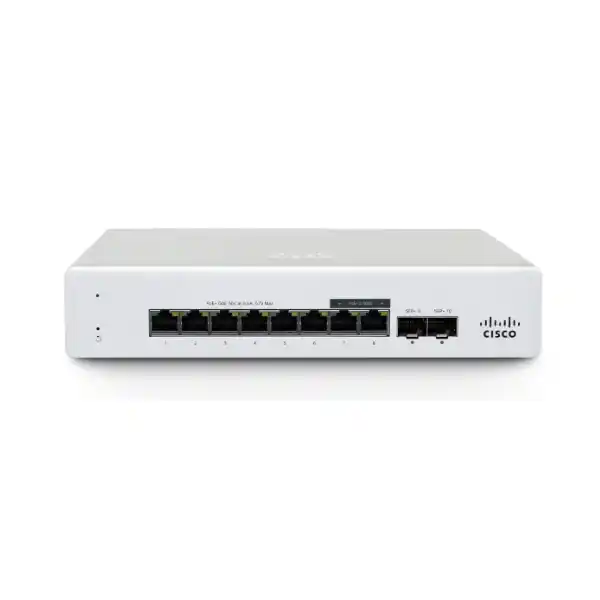
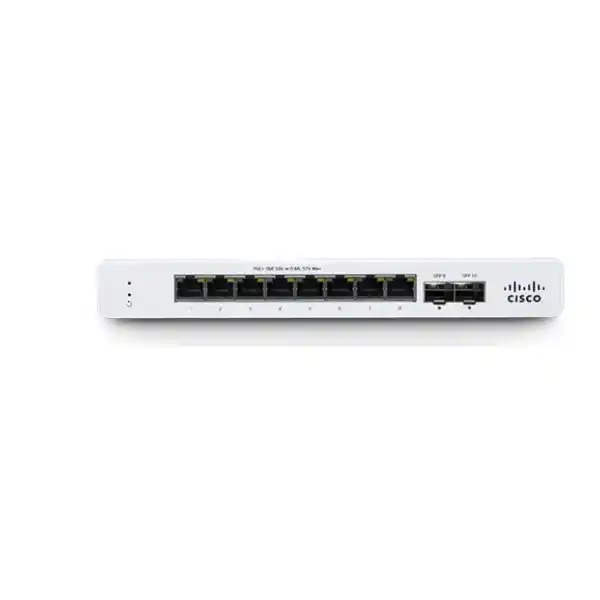
Cisco Meraki MS130-8 is a compact Layer 2 access switch built for businesses that want reliable Gigabit Ethernet connectivity with centralized cloud administration. The model provides eight 10/100/1000 RJ45 access ports and two 1 Gigabit SFP uplinks in a fanless desktop or wall-mountable format. It is especially relevant to small offices, retail points, branch locations, service desks, kiosks and other low-density wired environments where IT teams value remote configuration, visibility and troubleshooting through the Meraki Dashboard.
The MS130-8 is the non-PoE member of the compact MS130 family. If the project must directly power wireless access points, IP phones, cameras or other PoE endpoints, a PoE-capable MS130 variant or a separate powering method should be considered. Licensing is also part of the Meraki operating model and should be included in quotation, ownership and renewal planning.
Choose MS130-8 when you need eight Gigabit copper access ports, two 1G SFP uplinks, cloud management and silent fanless operation, but do not need PoE from the switch itself.
What is Cisco Meraki MS130-8?
Cisco positions the MS130 family as Layer 2 access switching for branch and campus deployments. Within that family, MS130-8 is the compact eight-port Gigabit model. It includes eight 1 GbE RJ45 ports, two fixed 1 GbE SFP uplinks, a 20 Gbps switching capacity, an external power supply and fanless operation. The compact chassis supports desktop placement and integrated wall mounting, which makes it practical where rack space is limited or where a quiet switch is preferred near users.
The operational distinction is Meraki cloud management. Instead of relying on a locally administered command-line interface for everyday configuration, administrators claim the switch into a Meraki organization, add it to a network and manage policy from the Meraki Dashboard. Common functions include port configuration, VLAN tagging, monitoring, remote packet capture, firmware management, event visibility and remote troubleshooting. This model can be valuable to organizations with several branches because network standards can be applied and monitored centrally without a specialist physically present at every site.
The MS130-8 should not be confused with MS130-8P, MS130-8P-I or MS130-8X. Those variants add capabilities such as PoE, internal power or multigigabit and 10G uplink options. MS130-8 itself is deliberately simpler: eight standard Gigabit access ports, two 1G SFP uplinks and no PoE output. That simplicity can be an advantage when connected devices have their own power and the priority is compact managed switching rather than endpoint powering.
RJ45 access ports for business endpoints, printers, workstations, gateways and other Ethernet devices.
Dedicated SFP uplink slots for supported fiber or copper transceiver options and flexible upstream design.
Switching capacity appropriate to the compact eight-port access role documented for this model.
Silent operation makes the model suitable for offices, reception areas and other noise-sensitive spaces.
Verified MS130-8 specifications and capabilities
| Item | Cisco Meraki MS130-8 |
|---|---|
| Switch role | Layer 2 compact access switch |
| Copper access ports | 8 × 10/100/1000 Mbps RJ45 |
| Uplinks | 2 × 1 Gigabit SFP |
| PoE output | No PoE on MS130-8 |
| Switching capacity | 20 Gbps |
| Power input | 12 VDC, 2.5 A |
| Power load | 8 W idle / 8 W maximum |
| Cooling | Fanless |
| Mounting | Desktop / integrated wall mount |
| Dimensions | 1.1 × 8.74 × 6 in (2.8 × 22.2 × 15 cm) |
| Weight | 1.94 lb (0.88 kg) |
| Operating temperature | 0°C to 45°C |
| Management | Cisco Meraki Dashboard cloud management |
Cisco also documents functions across the MS130 line including 802.1Q VLAN tagging, IPv4/IPv6 ACL support, DHCP snooping, 802.1X authentication, SNMP/Syslog integration, remote packet capture and automatic firmware upgrades. Feature availability should always be checked against the selected license, firmware and exact deployment model before a final design is approved.
Why businesses choose cloud-managed access switching
The business value of MS130-8 is not merely its port count. A conventional unmanaged switch can connect devices, but it gives administrators little control over segmentation, authentication, event visibility or remote diagnostics. The Meraki approach is designed for organizations that want the access layer to become part of a centrally managed network. IT teams can standardize port behavior, observe switch health, investigate connectivity problems and coordinate firmware from a shared management plane.
This matters most in distributed environments. A retailer with several small stores, a professional firm with branch offices, or an organization operating service counters across multiple cities may not have skilled networking staff at every location. Cloud management can reduce the number of tasks that require an onsite console session. It does not remove the need for good network design, but it changes how routine administration and troubleshooting can be performed.
Security and operational consistency are also important. 802.1X can support controlled network access when integrated into an appropriate authentication design. VLAN tagging can separate users, voice, printers, guest devices or operational equipment. DHCP snooping can help reduce some forms of rogue DHCP behavior. These tools are most effective when deployed according to a documented policy rather than enabled individually without an architecture.
Licensing and lifecycle planning
Meraki switching is licensed as part of the management and support model. Procurement teams should therefore request the switch hardware and the appropriate Meraki license together. Cisco publishes both co-term and subscription licensing options, and the exact license family and term should be verified at quotation stage because licensing structures can change over the product lifecycle. The chosen organization licensing model also affects how different license levels can coexist.
A good procurement record should identify the Meraki organization that will own the switch, the administrator accounts responsible for it, the selected license type, renewal date, asset name, site and uplink details. This prevents a common operational problem in cloud-managed environments: hardware is installed successfully, but ownership and renewal information is fragmented between purchasing, IT and an external integrator.
For quotations, ask for hardware, required power accessories, SFP transceivers where needed, licensing, implementation scope, configuration, documentation and support as separate line items. That makes competing proposals easier to compare and avoids mistaking a lower hardware-only figure for a complete deployable solution.
Where MS130-8 fits — and where it does not
Good fit
Small branch offices, retail counters, reception areas, compact business networks, management segments, low-density wired zones, kiosks and edge locations where eight copper ports are sufficient and connected devices have their own power.
Consider another model
Sites that need the switch to power cameras, IP phones or access points; environments requiring more than eight copper ports; designs that need 2.5G access ports or 10G uplinks; or high-density access layers where a larger MS130 model is more appropriate.
Related Meraki products and Tanzania network planning resources
The switch should be evaluated as one part of a complete LAN. FourTeck Tanzania’s business technology shop provides broader purchasing context, while the technology services page explains how switching, Wi-Fi, security, cabling and lifecycle support can be coordinated.
Cisco Meraki CW9163E-MROutdoor Wi-Fi 6E option for projects where switching and outdoor wireless infrastructure must be planned together.
Cisco Meraki CW9164I-MRHigher-capacity indoor Wi-Fi 6E access point to consider when wired backhaul and PoE requirements exceed a simple non-PoE edge design.
Cisco Meraki CW9166D1-MRDirectional Wi-Fi 6E access point context for specialized coverage requirements.
Cisco Meraki CW9166I-MRHigh-capacity indoor Meraki wireless option relevant to projects requiring stronger switching and uplink design.
Cisco Meraki CW9171IWi-Fi 7 access point page for organizations planning newer-generation wireless at the edge.
Cisco Meraki MR28Wi-Fi 6 cloud-managed access point for smaller business sites and branch designs.
Cisco Meraki MS130-8 Tanzania
Organizations evaluating Cisco Meraki MS130-8 in Tanzania should begin with the actual role of the switch. The model is best suited to compact access deployments where eight Gigabit Ethernet ports are enough and the connected endpoints do not require power from the switch. That makes it a practical candidate for offices with desktop computers, printers, locally powered appliances, point-of-sale devices, small server-room management networks, reception areas and branch environments where the main requirement is manageable Ethernet connectivity rather than PoE distribution. Buyers should map every proposed connection before ordering and reserve sensible capacity for growth instead of purchasing exactly the number of ports used on day one.
Tanzania deployments should also consider the complete path from user to application. Two SFP uplinks can provide useful fiber connectivity to an upstream switch or another network segment, but the transceiver type, fiber type, connector, distance and upstream compatibility must be confirmed. If the site connects back to a head office through VPN or SD-WAN, the switch configuration should align with the firewall, VLAN and addressing plan. If wireless access points, IP phones or cameras are part of the same project, remember that MS130-8 does not provide PoE. Those endpoints need independent power or a different switch model with an adequate PoE budget.
Cloud management can be particularly useful for Tanzanian organizations with branches in several cities. A central team can manage port configuration, observe events and coordinate firmware through the Meraki Dashboard, reducing reliance on local command-line administration. That benefit depends on good governance: define who owns the Meraki organization, who has administrator rights, how devices are named and how license renewals are tracked. Site labels, port descriptions, VLAN standards and documented uplink paths make remote support substantially more effective.
For a Tanzania quotation, provide the site city, number of switches, connected device list, existing firewall and core switch models, required VLANs, expected uplink medium, SFP requirements, desired license term and installation scope. FourTeck can then assess whether MS130-8 is the right compact model or whether PoE, additional ports or faster uplinks justify another MS130 variant. The goal is to procure a switch that fits the network design, not simply to match a model number.
Cisco Meraki MS130-8 Dar es Salaam
Dar es Salaam businesses often operate a mix of head offices, branch offices, retail outlets, warehouses, service counters and customer-facing sites. The Cisco Meraki MS130-8 can fit smaller network zones inside these environments when only a limited number of wired endpoints are required. A head office might use compact switches for reception areas, meeting-room peripherals or small departments, while a retail site may use one for point-of-sale terminals, a locally powered printer, a workstation and an uplink back to the site router or firewall. Before standardizing the model across many locations, count the real endpoint requirement and verify whether any devices need PoE.
In a multi-floor Dar es Salaam office, the two 1G SFP uplinks can be useful for fiber connectivity where copper distance or electrical isolation makes fiber preferable. The design should specify the fiber type, transceiver pair and upstream switch interface rather than treating “SFP” as a universal connection. If the access switch will carry voice, business data, printers and management traffic, VLANs can separate these functions, while 802.1X may support a broader identity-based access policy where the organization has suitable authentication infrastructure.
Centralized Dashboard administration can reduce operational friction when the Dar es Salaam IT team supports branches elsewhere in Tanzania. Standard templates for port names, VLAN IDs, native VLANs, trunk behavior, alerts and firmware scheduling make it easier to compare sites and troubleshoot remotely. However, cloud management does not compensate for poor cabling, unstable power or an undersized upstream link. The physical installation should still use properly terminated cabling, protected power and a clean location with appropriate temperature and ventilation.
When requesting an MS130-8 quotation for Dar es Salaam, include whether the switch will be desk-mounted, wall-mounted or installed near a rack; whether SFP uplinks are required; the exact endpoint count; whether access points or phones are present; and whether the site already uses Meraki. If powered endpoints are numerous, MS130-8P or another PoE-capable model may be more appropriate. A clear bill of materials should separate switch hardware, license, optics, power accessories and configuration work so the purchasing team understands the full deployment cost.
Cisco Meraki MS130-8 Mwanza
For Mwanza organizations, Cisco Meraki MS130-8 can support compact branch and office networks where central administration is more important than local configuration complexity. A small professional office, education administration room, retail back office or service branch may need only a handful of wired devices. In that setting, eight Gigabit access ports offer a practical footprint while the Meraki Dashboard gives a central IT team visibility into the switch even when specialist staff are not permanently based at the site.
The network plan should still account for growth. If six or seven ports are already committed on day one, there may be little room for an additional printer, workstation, access-control controller or local appliance. Similarly, if future wireless access points or IP phones are expected, note that MS130-8 cannot power them. Selecting a PoE model at the start may be more economical than later adding injectors or replacing the switch. The right choice depends on the known endpoint roadmap rather than the immediate minimum requirement.
Mwanza sites connecting to another branch or to a headquarters should document how traffic is segmented. VLANs can separate business users from operational devices, while the upstream firewall determines which segments can communicate or reach remote networks. If the switch uses an SFP uplink, confirm that the fiber path and transceivers are compatible at both ends. If copper uplink is sufficient, one of the RJ45 ports can be used according to the network design, but capacity and port availability should be considered.
Operational resilience also depends on power and WAN availability. Cloud management makes remote administration easier, yet users still need a functioning local LAN, gateway and internet path for normal business services. A UPS-protected network area may help the switch and associated gateway survive short power interruptions when properly sized. For a Mwanza quotation, share endpoint counts, internet topology, existing switches, VLAN needs, license duration, SFP requirements and whether the deployment must follow standards already used at other company locations.
Cisco Meraki MS130-8 Arusha
Arusha businesses can use the MS130-8 in compact network zones where silent operation and centralized administration are useful. Professional offices, hospitality administration areas, tour and travel operations, training facilities and branch workplaces may have small clusters of wired endpoints that do not justify a large rack-mount access switch. The fanless form factor is convenient in rooms where equipment is physically close to staff, but placement should still protect the device from heat, dust, accidental disconnection and poor-quality power.
Hospitality and customer-facing environments deserve particular attention to network separation. Guest Wi-Fi, staff devices, property or booking systems, printers and security equipment should not automatically share one flat network. MS130-8 supports VLAN tagging as part of a managed architecture, allowing the switch to participate in segmentation defined by the wider network design. The upstream firewall or routing layer then enforces communication policy between segments. This approach is more maintainable than adding isolated switches without documentation whenever a new device appears.
If the Arusha site includes Wi-Fi access points, IP phones or network cameras, check their power source. The non-PoE MS130-8 is appropriate only when those devices have separate power or connect elsewhere. In many modern offices, a PoE-capable switch reduces the number of power adapters and centralizes power protection through a UPS. Therefore, compare the full endpoint list before selecting MS130-8 solely because eight ports appear sufficient.
For organizations with multiple Tanzanian locations, Meraki Dashboard can help standardize an Arusha branch with other sites. Use consistent device names, VLAN numbering, alert policies, administrator roles and documentation. Include licensing in the purchase from the start and nominate responsibility for renewal. A useful quotation request should state the business use case, current network equipment, number and type of wired devices, fiber or copper uplink preference, required optics, license term and whether configuration and installation assistance are needed.
Cisco Meraki MS130-8 Dodoma
Dodoma offices, institutions and distributed organizations evaluating Cisco Meraki MS130-8 should consider how centralized network management supports their operating model. A compact branch with a small number of desktops, printers and locally powered devices can use the switch as a managed access layer while administration remains with a central IT team. This can be useful where the site needs predictable configuration and remote visibility without maintaining a local controller or relying on manual switch-by-switch command-line changes.
The model’s eight Gigabit ports are best for genuinely low-density areas. In an institutional environment, port count can grow unexpectedly as printers, attendance devices, access-control panels, meeting-room systems and local appliances are added. Procurement should therefore reserve ports for realistic expansion. If several powered network devices are expected, select a PoE model instead of building a patchwork of individual injectors. If more than eight copper connections are likely, a 24-port MS130 model may create a cleaner growth path.
Security policy should also be documented before deployment. 802.1Q VLAN tagging can separate departments or device classes, DHCP snooping can contribute to access-layer protection and 802.1X can integrate with a suitable identity infrastructure. These capabilities should be configured intentionally with the firewall, authentication platform and address plan. A cloud-managed switch is easier to oversee, but secure administration still requires controlled Dashboard accounts and appropriate role assignment.
For a Dodoma deployment, document the uplink path, SFP requirements, switch location, power protection, connected devices and license term. If the location is part of a larger organization, include the existing Meraki organization details and naming standards so the new device is claimed into the correct environment. Quotation comparisons should account for the complete lifecycle, not just hardware price: license, optics, installation, configuration and future renewal responsibilities all matter to the real operating cost.
Cisco Meraki MS130-8 UAE
Organizations operating across Tanzania and the UAE may use Cisco Meraki switching to create a consistent branch standard, but each site should still be designed around its own device density and infrastructure. MS130-8 is useful for small UAE offices, retail areas and low-density edge zones where eight Gigabit ports are enough and PoE is not required. Larger offices with extensive Wi-Fi, IP telephony or surveillance will generally need PoE-capable and higher-port-count access switching.
A regional Meraki architecture can simplify administration because switches in different countries can be visible through a common Dashboard organization when corporate governance permits. Standard naming, VLAN numbering, alert policies and firmware practices help regional IT teams understand the environment quickly. However, country-specific procurement, power accessories, regulatory requirements and implementation scope should remain documented for each site rather than assuming the same bill of materials everywhere.
UAE sites often have high-speed WAN services and cloud-heavy workloads, so the compact switch should be used where its 1G access and uplink design fits the traffic requirement. If the branch needs multigigabit access or 10G uplinks, MS130-8X or a larger model may be a better choice. Likewise, if Wi-Fi access points require PoE, the non-PoE MS130-8 should not be selected merely because its port count is sufficient.
For UAE-specific IT infrastructure context, review FourTeck UAE technology solutions. A cross-region quotation should identify the exact deployment country, quantity, license term, power cord requirement, optics, connected devices and organization ownership. This keeps hardware, licensing and operational control clear across borders and helps avoid ordering a technically correct switch with the wrong supporting accessories or lifecycle assumptions.
Cisco Meraki MS130-8 Uganda
Ugandan organizations considering Cisco Meraki MS130-8 can use the model for small branch offices and low-density wired areas where cloud management reduces the need for local switch administration. The switch is especially useful when connected endpoints are standard Ethernet devices with their own power. Eight Gigabit RJ45 ports can cover a modest group of workstations, printers, a locally powered appliance or gateway, while two SFP ports provide options for supported fiber uplinks.
For distributed companies, the main benefit can be operational consistency. A central network team can claim the device, apply standard VLAN and port policies, monitor health and perform troubleshooting through Meraki Dashboard. This works best when the organization defines a repeatable branch template before deployment. Device names, VLAN IDs, uplink ports, addressing, administrator roles and license ownership should all be written down. A standardized branch reduces uncertainty when a technician or support engineer needs to investigate a problem remotely.
Uganda projects should assess power and WAN resilience as part of the network design. The switch itself is low power, but it remains dependent on stable electrical supply and the associated gateway. UPS protection can help maintain short-term continuity where appropriate. If the branch includes IP phones, cameras or wireless access points, confirm how those devices will be powered because MS130-8 has no PoE output. A PoE variant may be operationally simpler.
For regional networking context, visit FourTeck Uganda IT and networking solutions. A useful Uganda quotation request should list sites, endpoint counts, existing Meraki organization information, license duration, SFP or fiber requirements, switch mounting location and implementation scope. Comparing proposals on this complete basis makes it easier to distinguish a hardware-only offer from a deployable, supportable network solution.
Cisco Meraki MS130-8 Kampala
Kampala can act as the operational hub for companies with multiple Ugandan branches, which makes cloud-managed switching particularly relevant. An MS130-8 deployed in a small department, reception area, retail location or satellite office can be administered by the same central team that manages larger sites. This helps maintain consistent VLANs and switch-port standards while reducing dependence on local configuration expertise.
The compact model should nevertheless be sized carefully. A Kampala branch with several IP phones, access points and cameras may appear to have fewer than eight network devices, but those endpoints commonly depend on PoE. Since MS130-8 does not provide PoE, separate injectors would be required and could complicate cabling and power. A PoE-capable MS130 model is usually cleaner when multiple powered endpoints are involved. Conversely, for desktops, printers and appliances with their own power, the non-PoE model can be an efficient fit.
If the switch uses SFP uplinks to a building distribution network, specify the optical standard, fiber type and distance. If it connects through copper, confirm that the uplink does not consume a port needed for an endpoint. VLANs, DHCP services and firewall policies should be coordinated so a new switch does not accidentally extend the wrong network segment. Port descriptions should identify connected devices clearly enough for remote support teams to understand the physical layout.
Licensing and organization ownership should be settled before installation. The switch should be claimed into the correct Meraki organization and network, administrator access should follow company policy and the license renewal owner should be recorded. Kampala procurement teams can request a bill of materials that separates hardware, license, optics, installation and configuration. This gives finance and IT a clearer view of total lifecycle cost and avoids deployment delays caused by missing accessories or licensing assumptions.
Cisco Meraki MS130-8 Arua
For Arua branch locations, the appeal of Cisco Meraki MS130-8 is the combination of a small physical footprint and remote management. A central IT team can configure and monitor the switch through the Meraki Dashboard, which can reduce the number of tasks that require a network specialist onsite. This is helpful for geographically distributed organizations, but it should be paired with clear documentation and a practical support plan for physical issues such as cabling, power and damaged ports.
The eight-port design works best when the branch has a stable, known device count. Typical candidates include user PCs, printers, locally powered terminals, a small appliance and an uplink. If the branch may later add IP cameras, phones or Wi-Fi access points, the purchasing team should decide whether separate power is acceptable. Choosing a PoE-capable switch from the outset can simplify future expansion, especially where keeping multiple power adapters and injectors organized would be difficult.
Arua deployments should also define how the branch connects to central systems. If applications are reached through VPN, SD-WAN or cloud services, the access switch, gateway and WAN circuit form one service chain. VLANs can separate device classes and the upstream firewall can restrict communication according to business need. Remote monitoring is most useful when switch ports have descriptive labels and the branch network diagram shows how the switch, firewall and internet connection are connected.
A quotation request for Arua should include the endpoint inventory, branch growth plan, existing gateway, license term and any SFP requirement. If the business wants the same standard across Arua, Kampala and other locations, share that objective at procurement stage so configuration and naming can be aligned. Standardization should still allow local exceptions where infrastructure differs. The result should be a repeatable branch design that remains understandable to both central and onsite support staff.
Cisco Meraki MS130-8 Mbarara
Mbarara organizations can use Cisco Meraki MS130-8 for compact branch networking where eight Gigabit ports cover the wired requirement and cloud administration is preferred. The model can support small offices, retail back offices, service locations and administrative areas that need managed segmentation and remote visibility without a large switching footprint. Its fanless design also makes it easier to place in occupied rooms where acoustic noise would be undesirable.
Before purchase, classify each proposed endpoint. Desktops and printers usually have their own power, while access points, IP phones and cameras often expect PoE. Because MS130-8 is non-PoE, the endpoint mix determines whether it is the right model. If only one powered endpoint exists, a separate injector may be acceptable. If several are planned, a PoE switch can simplify the installation and allow network equipment to share centralized UPS protection.
Network segmentation can improve manageability in a Mbarara branch. Business PCs, guest systems, printers and operational devices do not always need the same access. VLAN tagging on the switch can support logical separation while the router or firewall enforces policy between networks. If the organization uses 802.1X, the switch can participate in an identity-based access design, but authentication servers and endpoint configuration must be planned as part of the same project.
For procurement, include license term, switch quantity, cable and fiber requirements, exact SFP modules, installation location and existing Meraki environment. If several branches use similar layouts, a common configuration template can speed deployment and make troubleshooting more predictable. A standardized design should include port naming, VLAN IDs, uplink behavior and administrator ownership, while allowing each site to adapt to its local internet, power and physical layout.
Cisco Meraki MS130-8 Gulu
Gulu branches and business sites evaluating MS130-8 should focus on supportability as much as port count. The switch’s cloud-managed architecture can let a central team monitor status and make configuration changes remotely, which is useful when network expertise is concentrated in another city. Remote tools are most effective when the physical site is well documented and the local cabling is organized, because a dashboard cannot identify an unlabeled cable or repair a damaged connector.
Eight Gigabit access ports are suitable for a compact environment, but a port-growth margin is wise. A branch that begins with five endpoints may add a printer, meeting-room device or monitoring appliance later. If the site is already expected to grow beyond eight wired connections, a larger switch can reduce future replacement. Likewise, if planned devices require PoE, the non-PoE MS130-8 may create unnecessary complexity compared with an MS130 PoE model.
Power and connectivity planning are important for continuity. The switch uses an external power supply, and the network depends on the upstream firewall or router and internet service. If business processes are sensitive to brief outages, a correctly sized UPS for the network equipment may be considered. The cloud dashboard supports centralized administration, but user applications still need functioning local and WAN infrastructure.
A Gulu quotation should therefore cover more than the switch itself. List the license duration, power requirements, SFP uplink design, transceivers, connected endpoint types, configuration scope and documentation needed at handover. For multi-site organizations, ask that naming and VLAN standards match other branches. Clear lifecycle records—including serial numbers, Meraki organization ownership and renewal dates—make it easier to operate the network after the initial installation is complete.
Cisco Meraki MS130-8 Kenya
Kenyan organizations planning Cisco Meraki MS130-8 can use the switch in small branch and edge environments where centralized management, eight Gigabit copper ports and two SFP uplinks meet the requirement. The model is particularly suitable when attached devices are independently powered. For offices with several access points, IP phones or network cameras, a PoE-capable variant should be compared before purchase.
Regional companies operating in both Kenya and Tanzania can gain operational value by standardizing on a common Meraki management model. A shared approach to device names, VLANs, port descriptions, administrator roles and license renewal simplifies support. Standardization should not mean copying the same hardware to every site without assessment. A high-density Nairobi office may need larger or faster switching than a small satellite branch, while a remote branch may prioritize compact size and simple remote administration.
The two 1G SFP slots provide flexibility for fiber uplinks, but optics must be selected carefully. Verify transceiver model, wavelength, fiber type, connector and distance at both ends of the link. If the branch uses copper uplink instead, confirm remaining port capacity. Security design should include VLAN segmentation, controlled management access and, where appropriate, 802.1X authentication integrated with the organization’s identity platform.
For Kenya-side infrastructure planning, see FourTeck Kenya networking and IT solutions. Procurement teams should ask for a complete bill of materials showing hardware, Meraki licensing, power accessories, optics and services. This makes regional price comparisons more meaningful and ensures the switch is purchased as part of a usable network design rather than as an isolated appliance.
Cisco Meraki MS130-8 Kuwait
Businesses procuring Cisco Meraki MS130-8 for Kuwait should evaluate the compact model against endpoint density, power needs and uplink requirements. Eight Gigabit RJ45 ports can be appropriate for a small office, retail location, service counter or dedicated network zone. Its fanless operation is useful near occupied work areas, but the switch should still be installed where ventilation, power quality and physical security are suitable.
Meraki cloud management can be attractive for regional companies that administer Kuwait, Tanzania and other locations from a central IT function. Common configuration standards make distributed support easier, while Dashboard visibility reduces the need for console access for many routine tasks. Organization ownership and administrator roles should be agreed before claiming the device so the customer retains clear operational control and knows who is responsible for license renewal.
The non-PoE design should be treated as a deliberate choice. If the Kuwait site uses IP phones, access points or cameras, count how many require power and compare the cost and simplicity of a PoE-capable switch. If the MS130-8 is selected, any powered endpoints need a separate source. Likewise, the 1G SFP uplinks are appropriate only where 1G uplink capacity fits the traffic profile. Multigigabit access or 10G uplinks point toward other MS130 variants.
A robust quotation request should include switch quantity, exact deployment site, license term, required power cord or adapter details, fiber or copper uplink design, SFP modules, connected endpoints and configuration scope. Regional procurement teams should compare equivalent scope across suppliers rather than hardware price alone. Licensing, optics and implementation can materially affect the deployable cost and should be visible before approval.
Cisco Meraki MS130-8 Ghana
Ghanaian businesses can consider Cisco Meraki MS130-8 for compact cloud-managed switching in small offices, branches and low-density network areas. The switch provides a straightforward combination of eight Gigabit access ports, two 1G SFP uplinks and centralized Dashboard administration. It is most suitable where endpoints do not require PoE and where 1G access and uplink performance match the expected workload.
A distributed business may value remote diagnostics and standard configuration more than advanced local switching complexity. Network teams can monitor the switch, manage ports and coordinate firmware from a central console. To make this effective, every Ghana site should have documented device names, port assignments, VLANs and uplink details. A clear branch template makes it easier to compare behavior across sites and to troubleshoot without relying entirely on local knowledge.
Power planning is important when the branch includes cameras, VoIP phones or wireless access points. MS130-8 does not supply PoE, so those devices must be powered elsewhere. Buyers should compare total installation cost rather than only switch price; a PoE model can be more economical once several injectors, local power adapters and additional sockets are considered. The same principle applies to uplinks: if 1G fiber is sufficient, the SFP ports are useful, but higher-speed requirements call for another model.
For Ghana-side technology context, visit FourTeck Ghana business IT solutions. A quotation should identify hardware quantity, license term, optics, power accessories, configuration scope and any requirement to join an existing Meraki organization. Clear scope helps procurement teams compare equivalent solutions and ensures licensing and lifecycle responsibilities are understood before deployment.
Cisco Meraki MS130-8 Nigeria
Nigeria deployments of Cisco Meraki MS130-8 are most appropriate in compact wired environments where cloud management and low port density align. A branch, retail location or departmental network can use eight Gigabit ports for independently powered devices while the Meraki Dashboard provides central visibility. Larger offices should evaluate 24-port or 48-port MS130 models to avoid creating multiple small switches simply to reach the required port count.
For organizations with many sites, standardized cloud management can reduce configuration differences between branches. Templates for VLANs, port roles, management permissions and firmware scheduling support repeatability. However, local infrastructure must still be assessed. WAN capacity, firewall performance, cabling condition, fiber availability and power protection influence the user experience just as much as the access switch itself.
The MS130-8 has no PoE, which is a critical purchasing point in modern business networks. If a Nigerian branch needs several IP phones, cameras or access points, an MS130 PoE model may simplify power distribution and make UPS protection more centralized. If the connected equipment is primarily PCs, printers and appliances with independent power, the non-PoE model can avoid paying for a capability the site does not need.
For Nigeria-side planning, see FourTeck Nigeria IT services and infrastructure. Procurement teams should ask suppliers to identify the exact hardware part, license, license duration, required optics and included services. This is particularly important with Meraki because hardware and cloud licensing must be understood together. A complete asset record should also capture the Meraki organization, network name and renewal responsibility after installation.
Cisco Meraki MS130-8 Seychelles
Seychelles businesses evaluating Cisco Meraki MS130-8 may find the compact switch useful in small offices, hospitality administration areas, retail points and branch locations where space is limited and remote administration is valuable. Eight Gigabit Ethernet ports can serve a modest wired estate, while fanless operation reduces noise in occupied areas. The model is best chosen when attached devices have their own power and when 1G uplink capacity is sufficient.
Remote management can be valuable where IT resources are centralized or shared across sites. The Meraki Dashboard allows administrators to view switch status and configuration without maintaining a separate onsite controller. To benefit from this model, deployment records should be thorough: name the switch and ports clearly, document VLANs, record the upstream connection and define who owns administrator credentials and licensing. Remote tools work best when the physical network is predictable and accurately documented.
Hospitality and mixed-use environments often include access points, IP phones and cameras, which means PoE needs must be checked carefully. MS130-8 is not a PoE switch. If several powered endpoints are part of the design, a PoE-capable variant can simplify deployment and reduce the number of individual power sources. Fiber uplinks can be useful between building areas, but optics and fiber compatibility should be specified before ordering.
For regional architecture context, FourTeck Africa IT solutions can support broader multi-country planning. A Seychelles quotation should include the exact site requirement, endpoint list, switch quantity, license term, optics, power accessories and configuration scope. Buyers should also plan for spares, documentation and renewal ownership so the network remains supportable beyond the initial installation.
Cisco Meraki MS130-8 buying and quotation checklist
Frequently asked questions
Does Cisco Meraki MS130-8 provide PoE?
No. MS130-8 is the non-PoE model. If you need the switch to power access points, IP phones, cameras or other PoE devices, compare MS130 PoE variants such as MS130-8P or select another model with a suitable PoE budget.
How many ports does MS130-8 have?
It provides eight 10/100/1000 Mbps RJ45 access ports and two 1 Gigabit SFP uplink ports. The SFP interfaces are useful for supported fiber or copper transceiver options where required by the uplink design.
Is a Meraki license required?
Meraki switches are deployed within Cisco Meraki’s licensed management model. Procurement should include the appropriate license and term, and should document organization ownership and renewal responsibility. Confirm the current license family and licensing model at quotation stage.
Is MS130-8 fanless?
Yes. Cisco documents MS130-8 as fanless. This makes it suitable for quiet offices and other occupied spaces, subject to normal installation and environmental requirements.
Can MS130-8 be wall mounted?
Cisco documents the compact MS130-8 for desktop use with integrated wall mounting. Installation should still provide safe cable strain relief, appropriate ventilation and protected power.
Can I use MS130-8 for Wi-Fi access points?
You can carry Ethernet traffic to an access point, but MS130-8 cannot provide PoE. The AP would need its own compatible power source. For multiple PoE access points, a PoE-capable switch is usually a cleaner design.
What should I send when requesting a quote?
Send quantity, deployment city, endpoint list, whether PoE is needed, fiber or copper uplink requirements, existing Meraki organization details, required license term, SFP requirements and whether installation or configuration services are needed.
Decision recap
Cisco Meraki MS130-8 is a strong choice when the requirement is compact, fanless, cloud-managed Layer 2 switching with eight Gigabit copper ports and two 1G SFP uplinks. Its value is greatest for organizations that want centralized administration, standardized configuration and remote troubleshooting across small sites.
Do not choose it simply because eight ports are enough. Verify PoE requirements, uplink capacity, growth, licensing and lifecycle ownership. If powered endpoints, multigigabit access, 10G uplinks or larger port counts are required, another MS130 model may fit better.
Talk to FourTeck about the complete switch requirement
FourTeck Tanzania can help review whether MS130-8 matches your endpoint count, uplink design, Meraki licensing and wider network architecture. Share the current switch environment, connected devices, city, quantity and growth expectation. The quotation can then identify the appropriate hardware, license, optics and implementation scope without assuming that every eight-port requirement is identical.



Reviews
There are no reviews yet.