
Cisco Meraki cloud-managed switching
Cisco Meraki MS150-24P-4X Tanzania
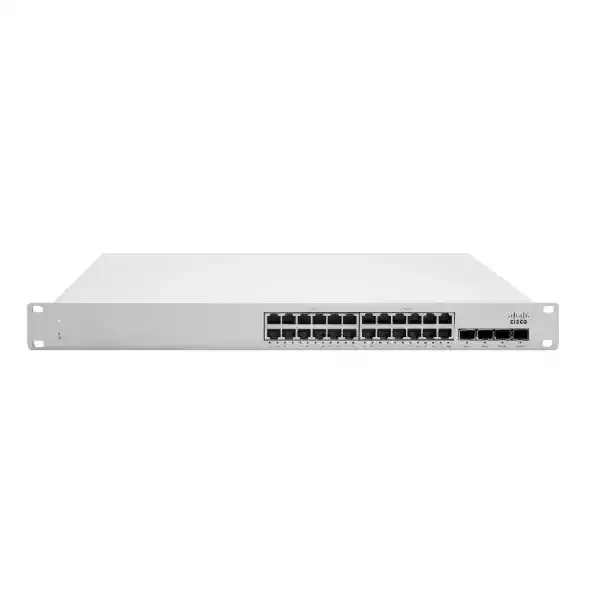
Cisco Meraki MS150-24P-4X is a stackable access switch for branch and campus networks that need twenty-four 1 Gigabit Ethernet PoE access ports, four 10 Gigabit Ethernet SFP+ uplinks, a 370W switch PoE budget and centralized cloud management through the Meraki Dashboard. It combines a practical twenty-four-port edge format with higher-speed uplinks and dedicated physical stacking, making it a strong fit for organizations that want to connect and power access points, IP phones, cameras and other Ethernet devices while keeping configuration, monitoring and troubleshooting under a single operational platform.
What is the Cisco Meraki MS150-24P-4X?
The MS150-24P-4X is part of Cisco Meraki’s MS150 family of cloud-managed access switches. Cisco positions the MS150 series for branch and campus deployments where customers want a scalable switching layer with Meraki Dashboard operations, physical stacking and a selection of Gigabit and multigigabit models. The MS150-24P-4X variant specifically provides 24 10/100/1000 Mbps RJ45 access ports with PoE support, four fixed 10GbE SFP+ uplink interfaces, one dedicated management interface and two dedicated stack ports. Its switching capacity is 128 Gbps, while the two stack ports provide 80 Gbps of stacking bandwidth.
The model is useful when an organization does not need multigigabit access ports on every edge connection but still wants 10GbE uplinks and cloud management. The 370W switch PoE budget can support a mixed estate of powered endpoints, but the final design should be based on the actual power draw of connected devices rather than simply dividing the total budget by twenty-four. Access points, cameras, phones and IoT devices can have different consumption profiles, and some devices draw more power during startup or when advanced functions are enabled.
For Tanzania buyers, the most important purchasing decision is not merely whether the switch has enough ports. The complete requirement should include PoE demand, uplink type, fiber or DAC distances, stacking design, rack depth, power protection, Meraki licensing, VLAN plan, management ownership and the capacity of the upstream firewall or core. FourTeck Tanzania can use those inputs to help shape a more complete bill of materials before quotation.
Cloud-managed operations
Administration through Meraki Dashboard supports centralized configuration, visibility, remote packet capture, firmware management and monitoring across one or many sites.
10GbE uplink headroom
Four SFP+ uplinks help connect the access layer to aggregation, core or other network segments without forcing all traffic through a single 1GbE path.
PoE for edge devices
A 370W total PoE budget supports powered devices such as access points, IP phones and cameras when the endpoint power plan fits within the switch budget.
Physical stacking
Two dedicated stack ports provide 80Gbps stacking bandwidth, helping administrators build a more cohesive access-switch block where the topology requires it.
Cisco Meraki MS150-24P-4X verified specifications
| Specification | MS150-24P-4X |
|---|---|
| Access ports | 24 × 10/100/1000 Mbps RJ45 |
| Uplinks | 4 × 10GbE SFP+ |
| PoE | 802.3bt capable platform; 30W per-port budget on this model, 370W total switch budget |
| Stacking | 2 dedicated stack ports, 80Gbps stacking bandwidth |
| Switching capacity | 128 Gbps |
| Layer 3 | Static routing |
| Management | Cisco Meraki Dashboard |
| Security and controls | 802.1X, IPv4/IPv6 ACLs, DHCP snooping, Dynamic ARP Inspection, broadcast storm control, VLAN tagging |
| Power input | 100–240 VAC |
| Power load | 22.9W idle / 422.2W maximum |
Specifications should be checked against the current Cisco Meraki documentation at the time of procurement. Optics, stacking cables, licensing and region-appropriate power cords are separate planning items and should be confirmed in the quotation.
Licensing, optics and deployment planning
Meraki switching is operated within a licensing model, so hardware and license planning should happen together. Cisco documents Enterprise and Advanced license tiers for MS150 under co-term and per-device licensing, as well as subscription licensing options. The Advanced tier adds Adaptive Policy capabilities, while organization-wide license compatibility rules can affect how an existing Meraki estate is expanded. Procurement teams should identify the current Meraki organization, existing switch license tier and required term before ordering.
For the four 10GbE SFP+ uplink ports, transceiver choice depends on media, distance and the equipment at the opposite end. Cisco lists compatible 1GbE and 10GbE optics plus supported direct-attach cables for MS150 SFP+ models. Stacking uses supported Meraki stacking cables in 0.5m, 1m and 3m lengths. A correct bill of materials should therefore include the switch, applicable license, appropriate optics or DACs, stacking cables when used, rack accessories and the correct regional power cord.
The switch should be installed in a rack with suitable airflow, power protection and organized patching. VLANs, access policies, trunk links and uplink redundancy should be prepared before migration where possible. If the MS150-24P-4X will power a set of modern wireless access points, calculate both PoE and aggregate traffic demand. Four 10GbE uplinks can provide excellent headroom, but the upstream core, firewall and WAN still need to support the applications that those endpoints generate.
Related Cisco Meraki solutions on FourTeck Tanzania
The MS150-24P-4X is often selected as part of a complete wired and wireless architecture rather than as an isolated switch. The following verified FourTeck Tanzania pages are useful when planning access points that may connect to the switch and consume its PoE budget.
Cisco Meraki CW9163E-MR TanzaniaOutdoor Wi‑Fi 6E option for deployments where edge switching may serve outdoor wireless coverage.
Cisco Meraki CW9164I-MR TanzaniaWi‑Fi 6E access point for broader office wireless designs and multi-AP PoE planning.
Cisco Meraki CW9166D1-MR TanzaniaDirectional Wi‑Fi 6E platform for specialized coverage zones where switch port and PoE allocation matter.
Cisco Meraki CW9166I-MR TanzaniaHigher-capacity Wi‑Fi 6E access point for enterprise wireless planning.
Cisco Meraki CW9171I TanzaniaWi‑Fi 7 access point context for newer wireless rollouts and switch-edge modernization.
Cisco Meraki CW9172H TanzaniaWi‑Fi 7 wall-plate access point for hospitality and room-focused deployments.
Cisco Meraki MS150-24P-4X Tanzania
Organizations evaluating the Cisco Meraki MS150-24P-4X in Tanzania should begin with the wired edge rather than the switch model alone. The device is a twenty-four-port Gigabit access switch with PoE, 10GbE SFP+ uplinks and physical stacking, so it fits branch and campus networks where endpoint density is moderate but the upstream design needs more headroom than a basic 1GbE uplink can provide. A typical project can include employee computers, printers, IP phones, access points, cameras, meeting-room systems and specialized devices. The design should count all endpoints, identify which ones require PoE and reserve sensible capacity for growth instead of consuming every port on day one.
Tanzania deployments can vary substantially by building type and power or connectivity conditions. An office floor in Dar es Salaam may have dense wireless and collaboration traffic, while a branch, school, clinic or operational site elsewhere may prioritize simplicity, remote administration and power continuity. The Meraki Dashboard model can help a central IT team manage several sites, but the local rack still needs reliable electricity, suitable UPS protection where required, correct cabling, temperature control and enough upstream bandwidth. Cloud management is not a substitute for physical network discipline.
Procurement teams should also treat licensing, optics and stacking accessories as part of the project scope. The switch requires an appropriate Meraki license, and organizations with existing Meraki switches should confirm which license model and tier they already use before adding hardware. SFP+ transceivers or direct-attach cables should be chosen for the actual distance and media between the access switch and the core or aggregation layer. If two or more MS150 switches are to be physically stacked, the supported stacking cable length should match the rack layout.
For a Tanzania quotation, useful inputs include switch quantity, current and planned endpoint counts, powered-device list, estimated PoE draw, uplink destination, fiber type and distance, desired stacking arrangement, Meraki organization details, license term and any installation or configuration requirement. FourTeck Tanzania can also review the surrounding network through its business IT and network services and technology shop so the switch can be planned with Wi‑Fi, firewall, cabling and endpoint requirements rather than purchased in isolation.
Cisco Meraki MS150-24P-4X Dar es Salaam
Dar es Salaam businesses can use the MS150-24P-4X as an access-layer switch for office towers, professional workplaces, retail operations, hotels, education facilities, branch headquarters and other environments where many devices share the same wired infrastructure. The twenty-four Gigabit ports are particularly useful when a floor or department needs a manageable port count rather than a forty-eight-port chassis, while the four 10GbE SFP+ uplinks allow the access layer to connect back to distribution or core switching at higher speed. This matters when several access points, cameras and users generate traffic at the same time.
A Dar es Salaam head office may also act as the operational hub for branches elsewhere in Tanzania or East Africa. Meraki Dashboard can support centralized visibility and consistent configuration across such locations, but administrators should define standards before rollout. VLAN numbering, port profiles, switch naming, access policies, firmware policy and administrative roles should be documented so each additional branch follows a repeatable design. The benefit of cloud management is strongest when it reinforces a disciplined operating model rather than becoming a collection of site-specific exceptions.
PoE planning can be especially important in offices modernizing their wireless infrastructure. Newer access points, IP phones and surveillance cameras can all draw from the same 370W switch budget. Engineers should calculate realistic device power rather than simply count PoE ports, and should consider startup demand, future expansion and the possibility that some ports will later serve higher-power devices. If wireless access points are expected to carry heavy video collaboration traffic, the 10GbE uplinks should connect into an upstream network that has enough capacity to carry the aggregate load.
Before requesting a Dar es Salaam quotation, identify the rack location, available power, UPS strategy, copper cabling category, uplink medium, fiber distance, target switch count and required license term. Where multiple switches will share a rack, confirm whether physical stacking is needed and choose the correct stacking cable lengths. A well-prepared request also states whether installation, migration and documentation are required. These details allow the project to be evaluated as a network change rather than only as a product purchase, reducing the risk of discovering missing optics, licenses or power accessories during deployment.
Cisco Meraki MS150-24P-4X Mwanza
Mwanza organizations considering the MS150-24P-4X can use it for branch offices, education, hospitality, healthcare administration, retail back offices and other business networks that need centralized control without maintaining a separate on-site management platform. In a branch environment, the twenty-four access ports can support a practical mix of computers, printers, phones and wireless access points, while PoE reduces the number of separate power adapters needed at the edge. The cloud-managed operating model can be valuable when technical administration is concentrated at another location.
Branch resilience should nevertheless be assessed independently of management convenience. A switch may be manageable remotely, but users still depend on local power, the WAN connection, firewall, DNS, DHCP and upstream routing. If business continuity is important, the rack can be designed with appropriately sized UPS protection and clear power distribution. Critical uplinks should be documented, and configuration backups or Dashboard access should be controlled through named administrator accounts. Remote management works best when the physical installation is tidy enough that local staff can identify cables and ports during guided troubleshooting.
For Mwanza projects, the 10GbE SFP+ uplinks create useful flexibility. A single branch may not immediately generate multi-gigabit aggregate traffic, but faster uplinks can reduce bottlenecks when wireless users, cameras, backups and local servers share the access network. Fiber can also be useful between floors or buildings where copper distance limitations or electrical conditions make optical links more appropriate. The transceiver type should match the installed fiber and distance, and the switch at the far end must support the selected link speed and optic.
A strong quotation request should include the number of wired devices, PoE endpoints, current switch models, uplink topology, fiber or copper details, rack capacity, license preference and expected growth. Organizations with several Mwanza or regional sites can also define a standard switch template so VLANs, port profiles and security controls remain consistent. This helps future expansion because each additional switch is introduced into a known operating model rather than configured from scratch with different naming and policy choices.
Cisco Meraki MS150-24P-4X Arusha
Arusha networks often serve a diverse mix of users and devices, particularly in hospitality, tourism-related operations, professional offices, education and customer-facing businesses. In these environments, the MS150-24P-4X can form the wired foundation for staff devices, access points, IP phones and cameras. The twenty-four Gigabit access ports are suitable for smaller wiring closets or departmental distribution, while 10GbE SFP+ uplinks can connect traffic back to a core without forcing every endpoint through a narrow uplink.
Hospitality and guest-facing environments require careful separation between operational systems and visitor traffic. The switch can participate in VLAN-based segmentation, but administrators should design the complete policy with the gateway or firewall. Guest wireless, office systems, CCTV, voice and building devices should not automatically share one flat network. Port profiles, 802.1X where appropriate, DHCP snooping and Dynamic ARP Inspection can support a more controlled access layer, but these features need a deliberate configuration and should be tested against the actual authentication and device environment.
PoE is another planning priority. An Arusha hotel or lodge may connect many access points and cameras across the property. The MS150-24P-4X has a 370W switch budget, so deployment teams should confirm whether that budget matches the number and class of powered devices. If the site needs more powered ports or higher aggregate PoE, multiple switches or another MS150 model may be more appropriate. The objective is not to fill every port simply because it can provide PoE, but to keep enough power and port headroom for reliable operation and expansion.
When requesting an Arusha quote, include room or building layout, access-point count, camera count, phone count, uplink distances, existing core equipment, current Meraki organization details and any fiber requirements. If multiple equipment rooms are involved, determine whether the switches will be physically stacked in one rack or connected through separate uplinks. That distinction affects cabling and topology. Clear documentation at procurement time helps ensure the switch arrives with the correct license and connectivity accessories for the intended deployment.
Cisco Meraki MS150-24P-4X Dodoma
Dodoma organizations, institutions and growing branch networks can evaluate the MS150-24P-4X when they need a manageable twenty-four-port access layer with PoE, centralized cloud operations and faster uplinks. Offices with multiple departments, meeting spaces and wireless coverage zones can use the switch to connect local devices while maintaining a structured separation between business data, voice, guest access and operational systems. The Meraki Dashboard can be especially useful when the local site is managed by an IT team based elsewhere.
Central management should be paired with clear ownership. Procurement and IT teams should decide which Meraki organization will claim the switch, which administrators will have access, whether multi-factor authentication is enforced, how firmware updates are governed and who owns renewal planning. These operational questions are easy to overlook when hardware is purchased quickly, but they influence supportability over the full lifecycle. A documented ownership model is particularly important for public-sector, education and multi-department environments where responsibilities may be divided across teams.
The switch can also support network modernization where existing access switches are limited to 1GbE uplinks or unmanaged operation. Four 10GbE SFP+ ports can provide multiple uplink or connection options, but the network design should avoid creating a faster edge that terminates into an undersized core. If traffic passes through a firewall or centralized WAN path, those systems should be assessed for the expected aggregate load. Likewise, if many PoE devices are attached, the 370W power budget should be checked against real endpoint demand.
For Dodoma quotation planning, provide switch quantities, cabinet locations, endpoint counts, powered-device inventory, current VLANs, uplink type and distance, stack requirements, license term and any configuration or migration scope. If the project is part of a multi-site standardization effort, include the branch template that the organization wants to reproduce. This allows the MS150-24P-4X to be assessed not just as a standalone device but as a repeatable component within the broader network architecture.
Cisco Meraki MS150-24P-4X UAE
Organizations operating between Tanzania and the UAE may consider the MS150-24P-4X as part of a standardized Meraki access-switch platform. A common hardware and Dashboard architecture can simplify training, monitoring and configuration governance across countries, but the procurement process should still be separated by site. Power cords, logistics, regulatory requirements, service arrangements and the exact bill of materials can differ between markets even when the switch model is the same.
UAE offices can generate high aggregate traffic because cloud applications, video meetings, Wi‑Fi and data services often share fast internet connections. In such environments, the four 10GbE SFP+ interfaces can help avoid a basic 1GbE uplink bottleneck at the access layer. However, a meaningful 10GbE design requires compatible optics or DACs, suitable core switching and a firewall or internet edge that can process the required traffic. Network performance should be reviewed end to end rather than inferred from the fastest port on the switch.
Meraki licensing also deserves coordinated planning across regional organizations. Teams should decide whether each country operates within one Meraki organization or separate administrative structures, and they should check the license model and tier before adding switches. Organizations using co-term licensing need to understand compatibility rules across devices, while per-device or subscription approaches have different operational implications. The purchasing team should document renewal ownership and avoid treating licensing as an accessory that can be decided after installation.
Regional buyers can review FourTeck UAE IT and network solutions for UAE-side project context. A cross-border quotation request should separately list switch quantity, site address, license term, optics, stack cables, installation scope and supporting wireless or security equipment for each location. This keeps the architecture standardized while recognizing the practical differences in deployment and procurement between Tanzania and the UAE.
Cisco Meraki MS150-24P-4X Uganda
Uganda organizations can use the MS150-24P-4X in branch and campus access networks where cloud management, PoE and 10GbE uplinks are valuable. The switch is particularly relevant for companies with multiple offices because Meraki Dashboard can provide centralized visibility without requiring a dedicated controller appliance at every branch. That operational simplicity can help a small IT team manage a distributed estate, but each site still needs reliable cabling, power, gateway services and WAN connectivity.
For Uganda deployments, switch sizing should reflect the actual endpoint mix. Twenty-four ports may be ideal for a departmental closet or branch, but a site with many cameras, phones and access points can consume both physical ports and PoE budget quickly. The 370W total PoE capacity should be checked against device specifications, and spare capacity should be reserved where future growth is expected. If the project needs more powered ports, it may be more practical to distribute the load across additional switches rather than operate one unit at its limit.
The four 10GbE SFP+ uplinks are useful for links to a central switch, server network or fiber backbone. Optical design should match the fiber type and distance, while direct-attach cables can be considered for short rack-level links where supported. If multiple MS150 switches are placed together, physical stacking can simplify the switching block, but the supported stack cables must match the rack layout. Network diagrams should show whether links are stack connections, uplinks or redundant paths so future technicians can understand the topology quickly.
Uganda buyers can consult FourTeck Uganda IT and networking solutions for regional context. For quotation accuracy, provide port count, PoE device list, uplink details, existing Meraki licensing, rack information and expected implementation scope. This allows the switch, licenses and connectivity accessories to be evaluated together rather than creating a hardware-only order that may be incomplete at installation time.
Cisco Meraki MS150-24P-4X Kampala
Kampala headquarters and larger branch offices can benefit from the MS150-24P-4X when they need centralized switching operations and a clear path to higher-speed aggregation. A head office often has a more diverse traffic profile than a small branch: staff computers, conference rooms, Wi‑Fi, IP telephony, cameras, printers and local servers may all share the same access layer. The switch’s twenty-four Gigabit ports provide a compact access block, while four 10GbE SFP+ ports create options for resilient or higher-capacity uplinks.
Kampala can also serve as the management center for remote Ugandan sites. Meraki Dashboard can standardize switch templates, VLANs and policies, but administrators should decide which configuration elements are truly common and which need local exceptions. A branch with a simple user network may not require the same port profiles as a head office with servers and video systems. Standardization works best when it defines a clear baseline and then documents justified differences rather than forcing every location into an identical topology.
PoE capacity should be reviewed carefully in collaboration-heavy or surveillance-heavy offices. Multiple wireless access points and cameras can draw significant power, while phones add additional devices across desk areas. The 370W budget is substantial for a twenty-four-port switch, but it is not unlimited. Device power should be totaled using manufacturer information, and the design should retain margin for growth. If a powered endpoint has special requirements, verify that the switch port capabilities are appropriate before ordering.
A Kampala procurement request should also specify whether the four 10GbE uplinks will use multimode fiber, single-mode fiber or supported direct-attach cabling. Fiber distance and connector environment influence optic selection. Include any requirement for physical stacking, since stack cables are separate planning items. By providing the current topology, VLAN plan, switch count, license model and expected growth, buyers can obtain a more accurate solution and avoid discovering compatibility issues after the equipment is delivered.
Cisco Meraki MS150-24P-4X Arua
Arua branch offices, institutions and NGO environments can evaluate the MS150-24P-4X where remote administration is an important operational requirement. Cloud-managed switching can reduce the need for specialist staff to be physically present for every configuration change or first-stage diagnostic check. The Meraki Dashboard can show switch and port status, while remote packet capture and centralized configuration tools can support troubleshooting. Those capabilities are most useful when the site installation itself is clearly labeled and documented.
In a remote branch, resilience often matters more than maximum theoretical speed. The switch should be connected to stable power and, where business continuity justifies it, suitable UPS protection. The branch firewall, router and internet link should be considered part of the same service path. A cloud-managed switch cannot compensate for a failed WAN circuit when users rely on cloud applications, so organizations may also assess backup connectivity at critical locations. The network design should identify which services must remain available during an outage and which dependencies sit outside the switch itself.
The PoE capability can simplify branch deployment by powering access points, phones and cameras over Ethernet. This can reduce local power adapters, but it increases the importance of the switch and rack power supply because multiple services depend on one source. The 370W budget should be matched to the actual device inventory. For high-value or operational endpoints, port descriptions and patch-panel labels should be included in the handover document so remote support teams can direct local staff accurately.
Arua quotation planning should include the number of users, access points, phones and cameras; the required uplink to the gateway or backbone; existing Meraki licensing; and whether installation support is needed. If the switch connects over fiber, provide the distance and fiber type rather than simply asking for an SFP+. That information is necessary to choose a compatible transceiver. A complete branch bill of materials should also include the appropriate power cord and any stacking or rack accessories required for the final installation.
Cisco Meraki MS150-24P-4X Mbarara
Mbarara businesses can position the MS150-24P-4X as a managed access-layer switch for offices, retail administration, hospitality, education or healthcare environments where twenty-four Gigabit edge ports are enough for a wiring zone. Meraki Dashboard management can make the switch easier to include in a wider multi-site standard, especially when an organization already uses Meraki wireless or security infrastructure. The common platform can reduce the number of separate management interfaces administrators must learn.
A well-designed Mbarara deployment should distinguish between simple endpoint connectivity and infrastructure links. User devices generally connect at the Gigabit edge, while the four 10GbE SFP+ ports can serve uplinks to aggregation or core switching. If two uplinks are used for redundancy or link aggregation, the upstream design should be configured accordingly. If the switch is part of a physical stack, stack links are separate from SFP+ uplinks and require the supported stack cables. Clear topology planning avoids using expensive optical ports where a stack connection was intended, or vice versa.
PoE planning should account for wireless growth. A business may begin with phones and a small number of access points, then later add cameras or additional Wi‑Fi coverage. Reserving part of the 370W budget and several physical ports can prevent an early capacity ceiling. If current and future demand exceeds the model, the network can be split across multiple access switches or assessed against other MS150 variants. The correct choice depends on port count, PoE load and uplink needs rather than brand preference alone.
When requesting a Mbarara quotation, buyers should provide the planned switch role, existing gateway or core, endpoint count, powered-device list, fiber requirements, rack conditions, license duration and any need for configuration or migration. If the site is part of a wider Ugandan network, sharing the organization’s standard VLAN and naming conventions can help keep the new switch aligned with other branches from the beginning.
Cisco Meraki MS150-24P-4X Gulu
Gulu organizations can use the MS150-24P-4X where branch manageability, PoE and reliable uplinks are more important than very high port density. The twenty-four access ports can support a balanced mix of business endpoints, while Meraki Dashboard administration helps a central team monitor the device and apply configuration changes without maintaining a separate local controller. This can be useful for distributed organizations that want consistent switching operations across multiple Ugandan sites.
The physical environment still deserves careful attention. The switch should be installed in a proper rack or secure communications area with organized patching, airflow and power. If the local site experiences short power interruptions, a correctly sized UPS can help preserve network services, but runtime calculations should include the switch’s real load and the additional PoE delivered to endpoints. A switch feeding many access points or cameras can draw considerably more power than the chassis itself when idle.
For connectivity between rooms or buildings, the 10GbE SFP+ ports allow fiber uplinks where appropriate. Fiber can be useful when distance exceeds copper limits or when electrical isolation is desirable, but optic selection must match the fiber type and link distance. Organizations should not order generic optics without checking Cisco compatibility and the opposite endpoint. If multiple MS150 switches are installed in the same rack, physical stacking may offer a cleaner design, with supported stack cables selected according to equipment placement.
A useful Gulu request for quotation includes current network topology, planned switch count, endpoint list, PoE devices, uplink distances, license term and any configuration standards used by the parent organization. This information helps determine whether the MS150-24P-4X is a good fit and which accessories must accompany it. It also gives the deployment team enough context to prepare VLANs, port profiles and uplinks before the maintenance window rather than improvising those decisions at the rack.
Cisco Meraki MS150-24P-4X Kenya
Kenya businesses operating alongside Tanzania sites can consider the MS150-24P-4X as part of a regional Meraki switching standard. A consistent model can simplify spare planning, configuration templates and technical training, particularly for organizations with offices in Nairobi and Dar es Salaam or branches across East Africa. The key is to standardize the architecture rather than assume every site needs the same quantity. Each location should be sized from its own device count, PoE load and traffic profile.
In a larger Kenyan office, four 10GbE SFP+ uplinks can be valuable when the access layer carries traffic from multiple Wi‑Fi access points, video calls, cameras and business applications. The network should still be evaluated end to end. If the switch feeds a core with sufficient capacity but the firewall or WAN is undersized, internet-bound applications can remain constrained. Conversely, local server or storage traffic may benefit from faster uplinks even when internet speed is lower. Understanding traffic paths helps determine where 10GbE investment produces real value.
Regional organizations should also coordinate Meraki Dashboard ownership. If Tanzania and Kenya sites belong to the same company, administrators may choose a common organization and template strategy, but licensing and operational policies must be handled deliberately. Named administrators, renewal responsibilities, change control and alerting should be defined. For acquisitions or separate business units, a different organizational structure may be appropriate. The hardware decision and the cloud-management governance decision are closely connected.
Buyers can review FourTeck Kenya enterprise networking solutions for local-market context. A Kenya quotation should list switch quantity, licensing requirement, optics or DACs, stacking cables, powered endpoints and implementation scope. If the same architecture is being deployed in Tanzania, sharing both bills of materials can help identify which components should be standardized and which are site-specific.
Cisco Meraki MS150-24P-4X Kuwait
Kuwait organizations can evaluate the MS150-24P-4X for cloud-managed access switching in offices, retail, hospitality and multi-branch environments. The model is particularly useful where twenty-four edge ports are sufficient but the design still calls for 10GbE connectivity toward aggregation or core switching. In modern workplaces, the access layer may carry traffic from laptops, phones, access points, cameras and cloud collaboration systems at the same time, so uplink design should account for aggregate demand rather than an individual user’s link speed.
Environmental and rack planning are important in Kuwait because network equipment depends on controlled operating conditions. The switch should be installed in a suitable communications space with reliable cooling and power. PoE increases the potential power draw of the access switch, so UPS and power-distribution planning should reflect the expected endpoint load. A switch that is lightly loaded on day one may draw much more power after additional access points or cameras are connected later.
The Meraki operating model can simplify multi-site administration when configuration templates, VLANs, access policies and alerting are standardized. Licensing should be included in the procurement plan from the beginning, and existing Meraki customers should confirm their organization’s license model and tier. Optics also need deliberate selection: four SFP+ ports do not imply that transceivers are included or that every optic is suitable. The link medium, distance and peer device determine the correct component.
For Kuwait-focused network planning, buyers can visit FourTeck Kuwait business IT solutions. A useful quote request identifies the site, rack, switch quantity, endpoint count, PoE requirement, uplink design, license term and any installation or migration requirement. That level of detail is more reliable than asking for a switch price alone because it exposes the accessories and services required for a working deployment.
Cisco Meraki MS150-24P-4X Ghana
Ghana enterprises and branch networks can use the MS150-24P-4X as a compact cloud-managed access platform when they need PoE and 10GbE uplinks. A typical office can connect employee workstations, access points, phones and cameras through the same switch while using VLANs and access controls to organize traffic. The twenty-four-port format is appropriate for wiring zones that do not justify a forty-eight-port switch, and additional MS150 units can be added where device density grows.
For distributed businesses, the Dashboard management model can reduce operational fragmentation. Administrators can monitor multiple sites from a central interface and use consistent naming or configuration patterns. This is useful only when the network team documents what each branch is expected to do. VLANs, IP addressing, uplink design, port profiles, administrator access and firmware policy should be defined at the organizational level, with local exceptions recorded clearly. A consistent branch standard makes expansion and troubleshooting easier.
PoE capacity should be treated as a shared resource. The 370W total budget can support many common devices, but actual consumption varies. Wireless access points may draw more power than desk phones, and camera features such as heaters or infrared systems can change requirements on some models. Procurement teams should calculate current demand and future growth before deciding how many switches are needed. This is especially relevant when new wireless deployments are expected to expand after the initial purchase.
Ghana buyers can reference FourTeck Ghana IT sourcing and network solutions for regional support context. A quotation request should provide the switch role, device count, PoE inventory, fiber or DAC requirements, stack design and license duration. Where the project spans Tanzania and Ghana, a shared network standard can simplify operations while each site retains its own correctly sized bill of materials.
Cisco Meraki MS150-24P-4X Nigeria
Nigeria organizations with branch offices, campuses or multi-floor workplaces can consider the MS150-24P-4X for access switching where centralized cloud operations are a priority. The switch combines twenty-four Gigabit PoE ports with four 10GbE SFP+ uplinks and physical stacking. This balance can be useful for departmental closets, branch networks and office floors that need to power edge devices but still connect to the network backbone at a higher rate than the individual access ports.
Power planning is an important part of the deployment. The 370W PoE budget and the chassis load should be included in UPS sizing, and the communications rack should have reliable power distribution and cooling. If the switch powers critical access points, phones or cameras, an interruption to the switch affects all those services at once. Network teams should therefore identify which edge functions are operationally important and decide whether redundant power infrastructure, spare equipment or other resilience measures are appropriate for the site.
For large cities and multi-branch environments, a cloud-managed model can help central teams apply consistent configuration. However, centralized visibility should not lead to one flat design. Office users, guests, CCTV, voice and infrastructure management often need different VLANs and policies. The MS150 supports features such as 802.1X, ACLs, DHCP snooping and Dynamic ARP Inspection, but the exact policy should be designed around the organization’s identity and security architecture rather than enabled blindly.
For Nigeria-side project planning, buyers can visit FourTeck Nigeria IT services and networking. Quote requests should specify switch quantity, license term, powered endpoints, uplink media, required optics, stacking and implementation scope. If the switch is intended to support a new Wi‑Fi rollout, include the access-point models and quantity so both PoE and aggregate uplink demand can be assessed before finalizing the bill of materials.
Cisco Meraki MS150-24P-4X Seychelles
Seychelles organizations in hospitality, professional services, government, education and distributed business environments can evaluate the MS150-24P-4X where remote manageability and PoE are important. Island and multi-property operations may benefit from the ability to monitor compatible Meraki networks centrally, especially when technical staff are not present at every site. The switch can power access points, phones and cameras while providing the Gigabit edge connectivity expected by common business endpoints.
Hospitality properties should plan switching around guest Wi‑Fi and operational systems separately. Access points may be distributed across rooms, common areas and outdoor spaces, while staff devices, CCTV and property systems have different security requirements. VLAN separation and upstream firewall policy can keep these functions logically organized. The 370W PoE budget should be mapped to the access-point and camera design, and the switch count should reflect both port capacity and power demand rather than only the number of cables terminating in a rack.
Connectivity between buildings or equipment rooms may require fiber because of distance or site layout. The four 10GbE SFP+ ports give the MS150-24P-4X useful uplink options, but the transceiver must suit the installed fiber and distance. Coastal or outdoor cable routes also need appropriate physical infrastructure; the switch itself belongs in a protected indoor environment. Network designers should distinguish between device specification and the environmental protection required by the overall installation.
For a Seychelles quotation, useful information includes property layout, switch locations, access-point and camera quantities, current core or firewall, uplink distances, fiber type, required license term and any need for remote or on-site deployment assistance. When the project is part of a wider regional network, administrators can reuse configuration standards from Tanzania or other sites while documenting local topology and operational differences. This creates consistency without forcing every property into an identical physical design.
Selection and quotation checklist
Ports and growth: Count all current wired devices and reserve realistic spare ports for future additions.
PoE: List every powered endpoint and calculate aggregate demand against the 370W switch budget.
Uplinks: Confirm 10GbE peer ports, fiber type, distance and required compatible SFP+ optics or DACs.
Stacking: Decide whether physical stacking is required and select supported cable lengths for the rack arrangement.
Licensing: Confirm Meraki organization, license model, tier and term before purchase.
Deployment: Identify rack, power cord, UPS, patching, VLANs, migration window and documentation needs.
Frequently asked questions
How many PoE ports does the MS150-24P-4X have?
It has twenty-four Gigabit Ethernet access ports with PoE capability and a total switch PoE budget of 370W. Actual device support depends on the power draw of each connected endpoint.
Does the MS150-24P-4X have 10GbE uplinks?
Yes. It provides four fixed 10GbE SFP+ uplink interfaces. Compatible optics or direct-attach cables are selected separately according to the link design.
Can the MS150-24P-4X be stacked?
Yes. Cisco documents two dedicated stack ports with 80Gbps stacking bandwidth. Supported Meraki stack cables are available in different lengths and should be selected for the rack layout.
Does the MS150-24P-4X require a Meraki license?
Yes. Licensing is part of the Meraki operating model. Buyers should verify the current Enterprise, Advanced or subscription licensing approach that applies to their organization and intended feature set.
Is the MS150-24P-4X suitable for Wi‑Fi 7 access points?
Cisco positions the MS150 family for modern branch and campus access, including next-generation wireless deployments. This particular model provides 1GbE access ports rather than multigigabit access ports, so the AP uplink requirement should be checked. If an access point needs more than 1Gbps wired backhaul, another MS150 model with multigigabit ports may be more appropriate.
What should I include in a quotation request?
Provide switch quantity, endpoint and PoE counts, uplink medium and distance, stacking requirement, Meraki organization and licensing preference, rack and power details, plus any installation, migration or configuration scope. This makes it easier to identify optics, cables and licenses alongside the switch hardware.
Decision recap
Choose the Cisco Meraki MS150-24P-4X when a wiring zone needs twenty-four 1GbE PoE access ports, a 370W PoE budget, 10GbE SFP+ uplinks, physical stacking and centralized Meraki Dashboard management. It is particularly useful for branch and campus access where operational simplicity and uplink headroom matter.
Consider another model when the site needs more than twenty-four access ports, a larger PoE budget or multigigabit edge ports for higher-bandwidth wireless access points. FourTeck Tanzania can help compare the switch requirement against the actual endpoint, PoE, uplink and licensing plan before a quotation is prepared.
Plan the switch as part of the complete network
Share your port count, PoE device list, uplink distances, current Meraki environment and target license term. The resulting proposal can include the switch, licensing, optics, stacking accessories and related wireless or security infrastructure needed for a deployable solution.


Reviews
There are no reviews yet.