
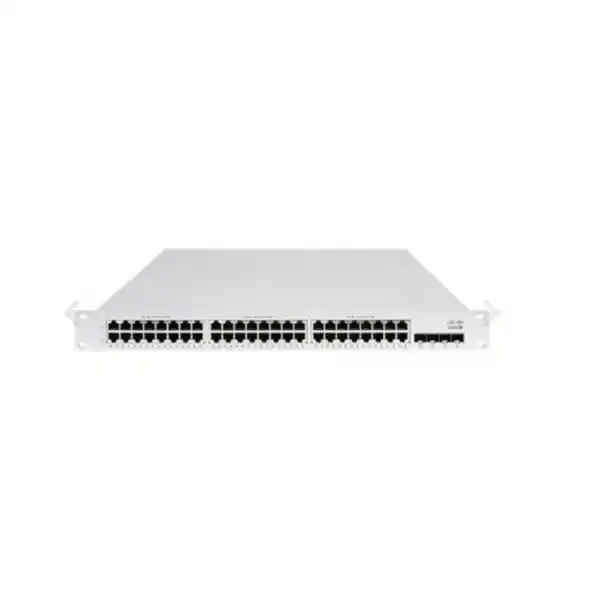
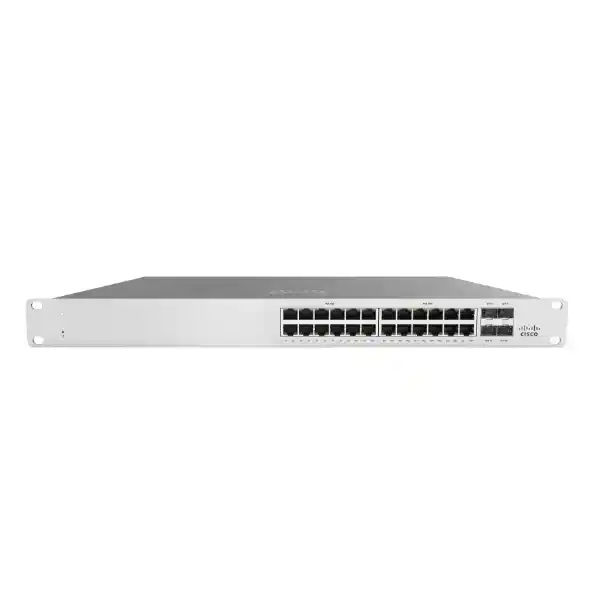
Cisco Meraki MS150-48T-4X Tanzania
Cisco Meraki MS150-48T-4X is a 48-port cloud-managed access switch designed for branch and campus networks that need dense Gigabit Ethernet access, fast 10GbE uplinks, centralized management and physical stacking. The model provides 48 × 10/100/1000 Mbps RJ45 access ports, four 10GbE SFP+ uplink interfaces, two dedicated stacking ports with 80 Gbps stacking bandwidth, a dedicated management interface and 176 Gbps switching capacity. It is a data-only model, so buyers should not select it for endpoints that require switch-supplied PoE power unless separate powering is planned.
For organizations in Tanzania, the main value is operational simplicity at scale. Meraki Dashboard gives administrators a centralized way to configure, monitor and troubleshoot the switching layer, while features such as VLAN tagging, IPv4/IPv6 ACLs, 802.1X authentication, DHCP snooping, Dynamic ARP Inspection, storm control, remote packet capture and static routing support common business LAN requirements. A successful purchase should include the correct MS150 license tier and term, region-appropriate power cord, SFP/SFP+ optics or direct-attach cables where required, and stacking cables if physical stacking will be used.
High port density for business desktops, printers, servers and other wired endpoints that do not need PoE from the switch.
Four 10GbE SFP+ interfaces support higher-capacity links to distribution, core, server or fiber infrastructure.
Two dedicated stack ports support resilient, scalable access-layer design when compatible stacking cables are specified.
A non-blocking access platform intended for modern branch and campus connectivity with centralized cloud operations.
What the Cisco Meraki MS150-48T-4X solves
The MS150-48T-4X is best understood as a high-density access switch for organizations that want the Meraki operating model without paying for PoE circuitry they may not need on every port. It can serve office floors dominated by desktops, fixed appliances, printers and other externally powered devices, or it can form part of a mixed access architecture in which PoE endpoints are placed on separate PoE-capable switches. The four 10GbE SFP+ uplinks make the model particularly relevant when the access layer must connect upstream at speeds higher than 1GbE.
Cloud management is a major differentiator. Meraki Dashboard provides a central management plane for configuration, visibility, firmware operations and troubleshooting. This is useful for multi-site companies because network teams can apply consistent standards and investigate issues without relying on a full command-line workflow at every branch. Features including remote packet capture, SNMP/syslog integration, VLAN tagging, ACLs, 802.1X, DHCP snooping and Dynamic ARP Inspection give administrators practical control over common access-layer risks and operational tasks.
The switch also supports static routing, but buyers should not treat that as a substitute for a full dynamic-routing core where advanced Layer 3 architecture is required. The correct design depends on where routing boundaries sit, how many VLANs exist, whether inter-VLAN traffic should traverse a firewall, how resilient the upstream path must be and whether the organization expects to grow beyond a single access stack.
Verified Cisco Meraki MS150-48T-4X specifications
| Access ports | 48 × 10/100/1000 Mbps RJ45 |
| Uplinks | 4 × 10GbE SFP+ |
| PoE | No; MS150-48T-4X is a data-only model |
| Dedicated management | 1 dedicated management interface |
| Stacking | 2 dedicated stack ports; 80 Gbps stacking bandwidth |
| Switching capacity | 176 Gbps |
| Routing | Static routing and DHCP relay |
| Power input | 100–240 VAC |
| Power load | 23.1 W idle / 49.8 W maximum |
| Operating temperature | 0°C to 45°C |
| Humidity | 5% to 95% |
| Mounting | Integrated 1U rack mount |
Licensing, optics, stacking and quotation planning
An MS150 purchase should be planned as a system rather than hardware alone. Cisco documents Enterprise and Advanced MS150 license tiers in 1, 3, 5, 7 and 10-year terms, with Advanced adding Adaptive Policy functionality. In co-termination organizations, compatible switch license tiers need to be considered across the organization, while per-device and subscription licensing models follow different rules. The procurement team should identify the current Meraki licensing model, existing organization tier, desired term and renewal ownership before finalizing the bill of materials.
For uplinks, Cisco lists compatible 1GbE and 10GbE transceivers including SX, LX10, SR, LR, ER and ZR families, plus supported direct-attach cable options. The correct optic depends on fiber type, distance, connector environment and the device at the far end. Physical stacking also requires separate supported stacking cables, with documented 50 cm, 1 m and 3 m options. Region-specific power cords should be specified as part of the order because the standard box contents and cord inclusion vary by market.
A complete quotation request should therefore state the number of switches, required license tier and term, current Meraki organization model, uplink media and distance, stacking topology, rack availability, power-cord requirement, expected VLAN structure and any implementation scope. This prevents a low-information hardware request from becoming an incomplete deployment package.
Related Cisco Meraki and network resources on FourTeck Tanzania
The MS150-48T-4X is normally part of a wider network. For procurement and design context, use the FourTeck Tanzania technology shop to review adjacent infrastructure categories, and the FourTeck Tanzania services page for planning, configuration and integration scope. The FourTeck Tanzania company overview explains the broader multi-system approach used for business technology projects.
For wireless projects, the Cisco Meraki CW9162I-MR provides a general-purpose Wi-Fi 6E access-point reference, while the Cisco Meraki CW9164I-MR and Cisco Meraki CW9166I-MR help buyers compare higher wireless capacity needs. These APs can be relevant to the broader Meraki estate, but note that MS150-48T-4X itself does not provide PoE; AP powering would need separate PoE-capable switching or approved injectors.
Organizations planning Wi-Fi 7 can also review the Cisco Meraki CW9171I and Cisco Meraki CW9172H. These references are useful because modern AP deployments can place increasing demand on uplinks, access switching, VLAN design and centralized management even when the APs are powered from a different switch model.
Cisco Meraki MS150-48T-4X Tanzania
Businesses evaluating Cisco Meraki MS150-48T-4X in Tanzania should begin with the role the switch will play in the LAN. This is a 48-port, non-PoE access switch, so it is particularly suitable for environments with many wired endpoints that have their own power source: office desktops, printers, appliances, server interfaces, control systems and other fixed equipment. If the same rack must also power IP phones, cameras or wireless access points, the design should either include separate PoE-capable switches or select a different MS150 model for those powered endpoints. That distinction matters because port count alone does not determine the correct access switch.
For Tanzanian organizations with multiple sites, centralized Meraki Dashboard management can simplify configuration consistency. IT teams can standardize VLANs, access policies, port descriptions, firmware practices and monitoring across branches while retaining visibility from a central console. This can reduce the operational burden of maintaining many independently configured access switches, especially where on-site technical resources differ from one branch to another. Cloud management does not remove the need for a good network design, however: upstream bandwidth, firewall capacity, internet reliability, rack cooling, UPS protection and cabling quality still determine the user experience.
The four 10GbE SFP+ uplinks are useful when 1GbE uplinks would create a bottleneck between the access layer and a distribution switch, server network or fiber backbone. Buyers should specify the fiber type and distance before ordering optics. If physical stacking is required, include the correct stacking cables and decide whether the stack topology, uplinks and power arrangement provide the intended resilience. The 80 Gbps stacking fabric can help create a more scalable access block, but redundancy should be planned end to end rather than assumed from stacking alone.
A Tanzania quotation request should include switch quantity, rack location, endpoint count, PoE requirements elsewhere in the design, existing Meraki organization details, license model and term, required optics, stacking requirement, VLAN count, uplink destination and desired installation scope. FourTeck Tanzania can use this information to prepare a more complete bill of materials instead of quoting the base chassis in isolation.
Cisco Meraki MS150-48T-4X Dar es Salaam
Dar es Salaam networks often combine head-office users, customer-facing spaces, warehouses, branch connectivity, cloud applications and high-volume internet traffic. In that environment, the MS150-48T-4X is attractive when an access rack needs many wired data ports and fast upstream connectivity but does not need to provide PoE on those ports. A finance floor, back-office workspace, server-adjacent access rack or operations area may have a large number of externally powered endpoints, making a data-only 48-port switch a more targeted choice than a high-power PoE model.
The four 10GbE SFP+ uplinks should be planned around the building topology. Multi-floor sites may use fiber between access closets and a distribution layer; server rooms may need 10GbE connections into aggregation; larger offices may want redundant uplinks to separate upstream devices. The correct optic depends on fiber media and distance, so procurement should not assume that an SFP+ module suitable for one site will automatically suit another. Patch panels, rack depth, cable management and UPS capacity should be checked before installation day.
Dar es Salaam headquarters can also benefit from the Meraki Dashboard operating model when they manage branches elsewhere in Tanzania or East Africa. Network administrators can view port status, apply common configuration templates where appropriate, troubleshoot remotely and coordinate firmware operations from a shared management plane. This becomes more valuable as the number of sites increases because consistency in VLAN numbering, port roles, access control and documentation reduces confusion during incidents and expansion projects.
Before requesting a Dar es Salaam quote, provide the number of access closets, ports required per rack, expected uplink speeds, fiber type, desired stack size, existing Meraki licensing model, whether the project includes APs or phones needing PoE from other switches, and the firewall or core platform upstream. A design that starts with these dependencies is more likely to deliver the intended performance than a purchase based only on a 48-port requirement.
Cisco Meraki MS150-48T-4X Mwanza
Organizations considering Cisco Meraki MS150-48T-4X in Mwanza may be supporting a branch office, professional facility, education environment, hospitality administration network, warehouse or regional operating site. For these deployments, cloud management can be especially useful when the primary network team is based in another city. The Meraki Dashboard can provide centralized visibility and configuration without requiring every routine task to be performed locally, while remote packet-capture and monitoring tools can support troubleshooting when a branch reports intermittent connectivity.
The branch design should clearly separate what the MS150-48T-4X will connect. Because the model is non-PoE, it is well suited to powered endpoints but should not be assumed to power cameras, IP phones or access points. A Mwanza site that uses many PoE devices may combine this model with PoE-capable access switches, keeping the data-only switch for workstations, printers, servers and appliances. That can be operationally clean when rack labeling and patching make the role of each switch obvious.
Uplink design matters for regional branches that move data to central systems or cloud platforms. The four 10GbE SFP+ interfaces can prevent the access layer from being limited to 1GbE, but the rest of the path must support the intended throughput. If the firewall, WAN circuit, core switch or server uplink is slower, the user may not see a benefit from a faster local uplink. Likewise, stacking can improve scalability inside the rack, but resilience also depends on upstream path diversity, power protection and documented recovery procedures.
For a Mwanza quotation, include endpoint count today and projected growth, desired number of spare ports, uplink media, stack requirement, license duration, existing Meraki organization, VLAN plan, internet connection, firewall model and whether FourTeck should include configuration or rack integration. This turns a generic switch request into a branch-ready specification that addresses lifecycle and operations as well as hardware.
Cisco Meraki MS150-48T-4X Arusha
Arusha deployments can range from offices and professional services to tourism, hospitality, training and operational facilities. The MS150-48T-4X fits sites where the wired access layer needs many data ports, centralized cloud management and fast uplinks. In hospitality or mixed-use properties, however, the network often contains many PoE endpoints such as access points, cameras and phones. Because this model does not provide PoE, it should be positioned deliberately within the architecture rather than selected simply because it offers 48 ports.
One practical approach is to use the MS150-48T-4X for data-heavy endpoint groups and use separate PoE switching for wireless, voice or surveillance. This can make capacity planning clearer: PoE budgets are concentrated on switches designed for powered devices, while the data-only switch handles desktops, servers, printers and other powered hardware. The design should still preserve consistent VLANs and security policies across both switch types so users and devices remain segmented according to function.
Arusha organizations with guest networks should also consider where routing and security policy are enforced. The MS150 supports VLANs, ACLs, DHCP snooping, Dynamic ARP Inspection and static routing, but many businesses will still route sensitive inter-VLAN or internet traffic through a firewall so security policies and inspection remain centralized. Uplink redundancy and 10GbE capacity should be aligned with the bandwidth generated by wireless users, cloud applications, video collaboration and any local server or storage traffic.
When requesting a quote in Arusha, provide the building type, number of racks, expected wired endpoints, any PoE device counts, fiber distances, required uplink redundancy, stack size, license preference and operational model. If the site is part of a wider regional network, also provide naming, VLAN and security standards so the new switch can be integrated consistently rather than treated as an isolated appliance.
Cisco Meraki MS150-48T-4X Dodoma
Dodoma organizations, institutions and distributed-office environments can use the MS150-48T-4X where centralized administration and predictable access switching are priorities. A cloud-managed switch can reduce the need to maintain separate local configuration workflows at each site, which is useful for organizations whose IT team supports several offices. Meraki Dashboard allows administrators to monitor the switching layer, review port status, standardize settings and perform supported troubleshooting actions remotely.
The physical environment should be prepared as carefully as the logical design. The MS150-48T-4X is a 1U rack-mount switch with 100–240 VAC input and a documented operating range up to 45°C. That does not remove the need for rack ventilation, sensible equipment spacing and clean power. UPS planning can help keep network infrastructure available through short interruptions, but UPS capacity should be calculated for the full rack rather than the switch alone. Firewalls, other switches, servers and optical equipment can represent a larger combined load.
In a Dodoma branch or institutional network, the four SFP+ uplinks can support higher-capacity fiber connections between racks or to an upstream core. Fiber selection should be based on distance and existing cabling, with compatible optics at both ends. If the switch will join a physical stack, define the stack topology and cable lengths before equipment arrives. Port naming and patch-panel documentation should be created during installation so remote administrators can identify connected devices without relying on on-site guesswork.
Procurement should include the correct Meraki license term and confirm whether Enterprise or Advanced functionality aligns with the existing organization. A useful Dodoma quotation request therefore lists hardware quantity, license model, rack and power conditions, fiber type, uplink destination, stack requirement, endpoint categories and any configuration or documentation scope. This gives the project team a complete deployment picture instead of focusing only on switch acquisition.
Cisco Meraki MS150-48T-4X UAE
Organizations operating across Tanzania and the UAE may use the MS150-48T-4X as part of a common Meraki switching standard. A shared platform can simplify monitoring, naming conventions, VLAN structure and administrator access across countries, but procurement still needs to be region aware. Power-cord requirements, delivery scope, licensing ownership and installation conditions should be confirmed for each location rather than assuming that a bill of materials created for one country can be copied unchanged.
UAE offices can have high internet speeds, dense cloud usage and substantial collaboration traffic, making 10GbE uplinks useful between access and distribution layers. The MS150-48T-4X provides four SFP+ interfaces, but capacity should be planned end to end. If a stack serves many users, the upstream firewall, core and WAN circuits must also be able to carry peak traffic. Where redundant upstream switching is used, the physical topology and failure behavior should be documented before implementation.
For enterprises standardizing networks across regions, Meraki Dashboard governance becomes as important as hardware. Define organization ownership, administrator roles, MFA practice, firmware policy, alerting and who is responsible for license renewal. Configuration templates can improve consistency, but local exceptions should be documented rather than hidden. A data-only switch such as the MS150-48T-4X should also be clearly distinguished from PoE models so wireless and voice projects are not accidentally assigned to ports that cannot provide power.
Regional buyers can review FourTeck UAE IT and network solutions for UAE-side infrastructure context. When requesting a cross-region quotation, separate the hardware, license term, power cord, optics, stacking accessories, implementation and support scope for each country. This makes budgeting clearer and reduces the risk that a standard design overlooks site-specific requirements.
Cisco Meraki MS150-48T-4X Uganda
Uganda organizations evaluating the MS150-48T-4X should decide whether the requirement is for a single office, a branch rollout or a standardized multi-site switching platform. The cloud-managed model is well suited to distributed environments because a central IT team can monitor and configure compatible Meraki networks without installing a separate local management server at every branch. This operational model can reduce configuration drift when VLANs, port policies and naming conventions are standardized from the beginning.
The 48 data ports make the switch suitable for office users, administrative devices and other externally powered endpoints. Sites with many APs, cameras or IP phones should remember that the MS150-48T-4X does not supply PoE. Those powered endpoints may require other MS150 variants, separate PoE switches or an approved alternative powering strategy. Mixing data-only and PoE access switches can work well when each rack is designed intentionally and the patching clearly identifies which ports provide power.
For branch connectivity, 10GbE uplinks may be more capacity than the WAN circuit itself, but they can still be valuable inside a building or campus where servers, storage, wireless traffic and local applications share the LAN. Physical stacking can simplify expansion as port counts grow, while Dashboard visibility can support troubleshooting from a central location. However, reliability also depends on local power, UPS sizing, fiber quality, firewall configuration and WAN design.
Uganda buyers can consult FourTeck Uganda networking and IT solutions for regional context. A procurement request should include the number of branches, switches per branch, license term, uplink media, stack requirement, VLAN plan, endpoint categories and any local installation or configuration scope so the proposed solution can be evaluated as a complete network rather than a standalone device.
Cisco Meraki MS150-48T-4X Kampala
Kampala can serve as a headquarters, regional coordination point or major operating site for organizations with branches across Uganda. In that role, the MS150-48T-4X can provide dense access switching for users and powered devices while the Meraki Dashboard gives the central IT team a consistent operational view. A headquarters deployment should be sized by traffic patterns and topology, not just desk count, because meeting rooms, local servers, cloud applications, backups and inter-site services can create concentrated demand on access uplinks.
The four 10GbE SFP+ ports provide flexibility for uplinks to distribution or core switches. If the site spans multiple floors, those links may run over fiber from access closets to a central rack. Procurement should identify fiber type, distance and connector requirements so the correct optics are included. If multiple MS150 switches will be stacked, stacking cable lengths and rack placement should also be decided in advance. A well-organized rack and patching scheme makes remote troubleshooting much easier because administrators can correlate Dashboard port information with physical connections.
Security at the access layer should be designed around device roles. 802.1X, VLANs, ACLs, DHCP snooping and Dynamic ARP Inspection can contribute to a controlled edge, while the upstream firewall can enforce broader segmentation and internet security. The organization should decide which controls are applied at the switch, which are enforced at the gateway and how exceptions are documented. This is particularly important in mixed environments containing staff systems, guests, printers, servers and operational equipment.
Before requesting a Kampala quotation, provide the switch count, current Meraki estate, license model, VLANs, authentication approach, upstream core, fiber distances, required optics and any need for physical stacking. If wireless or phones are also in scope, state their PoE requirements so the bill of materials includes suitable power-capable switching rather than expecting the MS150-48T-4X to power them.
Cisco Meraki MS150-48T-4X Arua
Arua branch, institutional and NGO environments can benefit from centralized network operations where specialized IT resources are not permanently located at every site. The MS150-48T-4X supports that operating model through Meraki Dashboard while providing a high-density 48-port access layer. A central team can review status, apply standardized configuration and investigate certain network issues remotely, which can reduce the number of simple checks that require a site visit.
Remote manageability should be paired with strong local infrastructure. The switch still depends on clean power, a suitable rack, reliable cabling and an upstream network path. If a branch experiences unstable power, the rack should be evaluated for appropriate UPS protection rather than protecting only one component. If the branch depends heavily on cloud services or connectivity to a head office, WAN resilience and firewall health can have a larger effect on users than the access switch itself.
The MS150-48T-4X is a data-only platform, making it useful where the branch has many PCs, printers and appliances but fewer PoE devices. If the site includes cameras, phones or access points, those should be mapped to a separate power-capable switch or another MS150 variant. Keeping device roles and patching documented avoids confusion for local staff. The 10GbE uplinks may connect into a local distribution switch or fiber path, with optics selected for the actual medium and distance.
A quotation for Arua should state the number of wired endpoints, expected growth, any PoE devices, uplink medium, required license term, Meraki organization ownership, local rack condition and whether configuration templates will be supplied by a central team. Where the branch is part of a wider Uganda rollout, standardizing VLAN IDs, port profiles and documentation can make future expansion and support more predictable.
Cisco Meraki MS150-48T-4X Mbarara
Mbarara organizations assessing the MS150-48T-4X should look at both current port demand and the network’s expected growth over the lifecycle of the switch. A 48-port model can reduce the need to add small unmanaged switches later, but capacity planning should reserve ports for expansion and infrastructure changes. The switch’s cloud-managed design is useful when a Mbarara site is administered from Kampala, Tanzania or another regional office because Meraki Dashboard can provide a consistent management experience across compatible sites.
The access architecture should distinguish between powered and unpowered endpoints. Since MS150-48T-4X does not provide PoE, it is best matched to externally powered devices. A site with IP phones, Wi-Fi access points or surveillance cameras may need a parallel PoE switch layer. This can still be a strong design if the two roles are separated clearly: one switch or stack for powered infrastructure, another for data-only endpoint density, with shared VLAN and uplink standards across the rack.
The SFP+ uplinks provide room for higher local bandwidth. If the Mbarara site uses centralized storage, large file transfers, CCTV recording on separate PoE switching or high volumes of cloud traffic, 10GbE uplinks can help prevent an access-layer bottleneck. The upstream switch, firewall and WAN path must be sized accordingly. Physical stacking can support further port growth, but the organization should decide how many units belong in each stack and how failure recovery will work.
For quotation accuracy, share the number and type of endpoints, desired spare capacity, uplink distances, existing fiber, stack requirements, license duration, firewall model and whether the branch already belongs to a Meraki organization. Include implementation expectations such as VLAN configuration, port labeling, documentation and testing. These details help ensure the proposed switch becomes part of an orderly network rather than another isolated device in the rack.
Cisco Meraki MS150-48T-4X Gulu
Gulu branch and institutional networks can use the MS150-48T-4X where centralized visibility, dense wired access and straightforward expansion are important. The Meraki Dashboard operating model can be especially valuable for distributed organizations because many configuration and monitoring tasks can be handled by a central team. That advantage grows when each branch follows a standard for switch naming, port descriptions, VLANs, administrator access and documentation.
A branch should not be designed around management convenience alone. The physical network must also be maintainable. Label patch panels, preserve rack ventilation, route fiber and copper cleanly, and protect critical networking equipment with appropriately sized power protection. If the Gulu site depends on cloud applications or VPN access to another office, assess WAN reliability and firewall capacity alongside the switching layer. A well-performing local LAN cannot compensate for an unstable upstream path.
The MS150-48T-4X offers four 10GbE SFP+ uplinks that can be used for higher-speed upstream connectivity or redundancy, subject to the broader design. Optics should be selected from supported options based on the fiber plant and required distance. The model also provides physical stacking, which is useful when a branch needs more than 48 ports and wants a coordinated access stack. Stacking cables are separate items and should be included in the bill of materials with the correct length.
A Gulu quotation should identify how many endpoints are data-only, how many require PoE, current and planned port counts, fiber distances, stack size, license term, existing Meraki organization and configuration responsibilities. If the branch must follow a corporate standard created elsewhere, provide that standard so VLANs, port roles and security settings can be applied consistently from the start.
Cisco Meraki MS150-48T-4X Kenya
Kenya-based organizations with branches in Tanzania or Uganda can use MS150-48T-4X as part of a standardized regional access-switching platform. Standardization can simplify operations when the same naming conventions, VLAN structure, administrator roles and monitoring practices are repeated across countries. The goal is not to force identical hardware into every branch, but to use common design principles while still matching each site’s endpoint density, PoE needs and uplink requirements.
A Nairobi head office or regional hub may justify multiple MS150 switches with 10GbE uplinks into a core or distribution layer. Smaller branches may need only one device. In both cases, the data-only nature of the 48T model should be explicit. Wireless APs, cameras and IP phones require a separate power strategy. This is particularly relevant in modern offices where wireless density is increasing: the access switch selected for user desktops may not be the correct switch for powering the wireless edge.
Meraki licensing also needs regional governance. Procurement teams should identify who owns the Meraki organization, which license model is in use, which tier is required and who manages renewals. In a co-termination organization, tier consistency across supported switch families can affect purchasing decisions. The hardware order should also include the right optics, stack cables and regional power cord rather than assuming these are bundled in the exact combination needed.
Kenya buyers can review FourTeck Kenya enterprise networking solutions for neighboring-market context. A regional quotation should separate quantities and accessories by site, specify uplink media and distances, and document whether implementation will follow one shared configuration template or locally adapted designs. This supports clearer budgeting and reduces deployment surprises.
Cisco Meraki MS150-48T-4X Kuwait
Kuwait organizations evaluating MS150-48T-4X can use the switch for dense, cloud-managed access where 48 Gigabit data ports and 10GbE uplinks align with the site design. Corporate offices, administrative networks and branch facilities often have a mix of wired users, wireless access points, phones and security devices. Because the 48T-4X is non-PoE, it should normally serve externally powered endpoints while PoE-capable switching is reserved for devices that draw power from the network.
The four SFP+ uplinks can be valuable in offices with high-speed internet, virtualization, centralized file services or heavy collaboration traffic. They also provide flexibility for fiber connectivity between access and distribution racks. The procurement team should confirm the fiber type and required reach before selecting optics. If physical stacking is planned, specify the supported stack cables and lengths. A clean bill of materials should make the distinction between switch hardware, license, power cord, optics and stacking accessories visible to finance and IT reviewers.
Cloud operations should be governed with the same discipline as on-premises configuration. Define who owns Dashboard administrator roles, how MFA and account lifecycle are managed, when firmware changes are approved, and how configuration standards are documented. For organizations with sites in Kuwait, Tanzania and the UAE, consistent governance can be more important than making every physical topology identical.
Regional buyers can review FourTeck Kuwait IT and networking solutions for local solution context. A quotation request should list hardware quantity, intended rack role, existing Meraki license model, required term, uplink media, stack size, powered-device requirements elsewhere in the network and any installation, configuration or documentation services needed.
Cisco Meraki MS150-48T-4X Ghana
Ghana businesses can evaluate the MS150-48T-4X for offices, branches, institutions and operational sites that need centralized switching management and high wired port density. The Meraki Dashboard model can reduce operational fragmentation when an IT team manages several branches, because supported configuration and monitoring functions are available through a shared cloud platform. The benefit is strongest when the organization creates standards for VLANs, port profiles, naming and administrator responsibilities before deployment.
The switch is particularly relevant to data-only access zones. If a Ghanaian office has many desktops, printers and appliances but only a limited number of PoE endpoints, the MS150-48T-4X can carry the data ports while a smaller PoE switch handles phones or access points. Larger sites may use separate PoE and non-PoE access blocks. This keeps power budgets aligned with real demand and avoids assuming every port needs PoE capability.
Uplink capacity should reflect application traffic. Four 10GbE SFP+ interfaces create options for fast fiber links, but the organization should check the upstream core, firewall and server environment so no hidden bottleneck simply moves elsewhere. If the switch participates in a stack, stacking cable lengths and rack placement should be coordinated before installation. UPS capacity and rack ventilation should also be based on the complete equipment set, especially in rooms containing security appliances, servers or additional switches.
Ghana buyers can review FourTeck Ghana business technology solutions for regional context. A useful quotation request includes endpoint count, PoE device count, fiber type, uplink distance, license duration, current Meraki organization, stack requirement and configuration scope. This gives procurement a clearer picture of the complete installed solution rather than the chassis price alone.
Cisco Meraki MS150-48T-4X Nigeria
Nigeria organizations with large office networks, multi-floor sites or distributed branches can consider the MS150-48T-4X when centralized operations and 48-port data density are priorities. A Lagos or Abuja headquarters may use several access switches feeding a higher-speed distribution layer, while smaller branches may need only one unit. In both cases, the four 10GbE SFP+ uplinks and physical stacking capabilities support growth beyond a single isolated 48-port switch.
High-density offices frequently mix endpoint types. Staff computers and printers may be data-only, while phones, access points and cameras need PoE. The MS150-48T-4X should be assigned to the first group unless external power is intentionally used. Separate PoE-capable switching can serve the powered edge. This division can simplify capacity planning, but only when VLANs, patching and rack documentation remain consistent so administrators understand which device group is connected where.
For multi-site Nigerian companies, Meraki Dashboard can provide centralized visibility across compatible branch networks. A standard operating model should define administrator roles, firmware policy, alerting, license ownership and configuration templates. Licensing should be treated as a lifecycle requirement rather than a small line item added after hardware selection. Procurement should verify tier, term and organization model before purchase, particularly when adding the switch to an existing Meraki estate.
A Nigeria quotation request should include site list, switch quantities, port counts, PoE requirements, fiber distances, stack size, upstream core or firewall, license term and implementation responsibilities. Where 10GbE uplinks are expected, specify the cable or fiber plant so compatible optics can be quoted. Clear site-by-site requirements make it easier to standardize where appropriate while still allowing each location to be sized for its actual traffic and infrastructure.
Cisco Meraki MS150-48T-4X Seychelles
Seychelles businesses in hospitality, professional services, administration and multi-site operations can consider MS150-48T-4X where a cloud-managed wired access layer simplifies day-to-day operations. Remote visibility can be particularly useful for organizations that depend on regional IT resources or support partners rather than maintaining specialist network staff at every location. Meraki Dashboard enables a central team to monitor and configure compatible switches while preserving a consistent management workflow.
Island and hospitality environments should still be designed around the complete network. Guest Wi-Fi, staff devices, cameras, phones and back-office systems can place different demands on switching and security. Because the MS150-48T-4X is data-only, it should not be chosen as the sole access switch when large numbers of APs or cameras need PoE. Instead, it can handle powered endpoints while PoE-capable switches serve wireless and surveillance equipment. VLAN separation and upstream firewall policy can then keep guest, staff and operational traffic appropriately isolated.
The four 10GbE SFP+ uplinks are useful where access racks connect over fiber or where aggregate wireless and application traffic requires more than 1GbE upstream capacity. Fiber type and distance should be confirmed before ordering transceivers. Physical stacking is another option for sites that need more ports, but stack cables are separate and should be selected according to rack layout. Power protection and spare planning can be especially important where replacement logistics take longer than in a major mainland city.
A Seychelles quotation request should state site type, endpoint quantity, PoE devices, required spare ports, fiber distances, stack requirement, licensing model and any installation scope. For hospitality properties, include guest-network and back-office segmentation requirements; for professional offices, include server, collaboration and internet usage patterns. These details help the switch design support the real operating environment rather than simply matching a catalog port count.
How to decide whether MS150-48T-4X is the right model
Choose it when
You need 48 Gigabit data ports, four 10GbE SFP+ uplinks, physical stacking, centralized Meraki Dashboard management and static Layer 3 routing, and your connected endpoints do not require PoE from this switch.
Check another MS150 variant when
A substantial number of endpoints require PoE or PoE++, you need multigigabit access ports at the switch edge, or the access layer must serve a different power/capacity profile. Compare LP, FP, P or MP variants according to the exact requirement.
Quotation checklist for Cisco Meraki MS150-48T-4X
Cisco Meraki MS150-48T-4X FAQs
Is the MS150-48T-4X a PoE switch?
No. The MS150-48T-4X is a data-only model. If access points, IP phones, cameras or other devices need Power over Ethernet, include a PoE-capable switch model or an appropriate external powering solution.
How many uplinks does it have?
It provides four 10GbE SFP+ uplink interfaces. The correct transceiver or direct-attach cable depends on the device at the far end, fiber type, connector environment and required distance.
Can MS150-48T-4X switches be physically stacked?
Yes. Cisco documents two dedicated stack ports with 80 Gbps stacking bandwidth. Supported stacking cables are separate items and should be selected for the rack layout and cable distance.
Does the switch support Layer 3 routing?
The MS150 supports static routing and DHCP relay. If the network needs dynamic routing or a more advanced core/distribution feature set, assess a platform intended for those requirements.
Is a Meraki license required?
Licensing is part of the Meraki operating model. Cisco documents Enterprise and Advanced MS150 license tiers and multiple term lengths, plus subscription licensing options. Confirm the organization’s licensing model and tier before purchase.
What should I include in a quotation request?
Include quantity, site locations, license term and tier, uplink media and distance, optics, stacking requirements, rack and power conditions, endpoint types, VLAN/security requirements and any installation or configuration scope.
Decision recap
Cisco Meraki MS150-48T-4X is a strong fit for organizations that need 48 Gigabit Ethernet data ports, four 10GbE uplinks, physical stacking and centralized Meraki cloud operations without PoE on the access ports. Its value comes from combining a capable Layer 2 access platform with dashboard-driven visibility and management across one or many sites.
The buying decision should include more than the chassis: verify license tier and term, power cord, uplink optics, stack cables, rack readiness, PoE requirements elsewhere in the design and the operational standards that will govern the Meraki organization. When those dependencies are planned together, the switch can become a clean, scalable part of a branch or campus architecture.
Plan your MS150-48T-4X deployment with FourTeck Tanzania
Share your switch quantity, endpoint count, current Meraki environment, license preference, fiber and stacking requirements, and the cities or sites involved. FourTeck Tanzania can help organize the hardware and related infrastructure requirements into a practical quotation and deployment scope.
For a broader network review, include firewall, wireless, cabling, rack, UPS and branch-connectivity details. That wider context helps identify whether MS150-48T-4X is the right model for every rack or whether a mixed design using PoE and multigigabit variants would better match the environment.



Reviews
There are no reviews yet.