
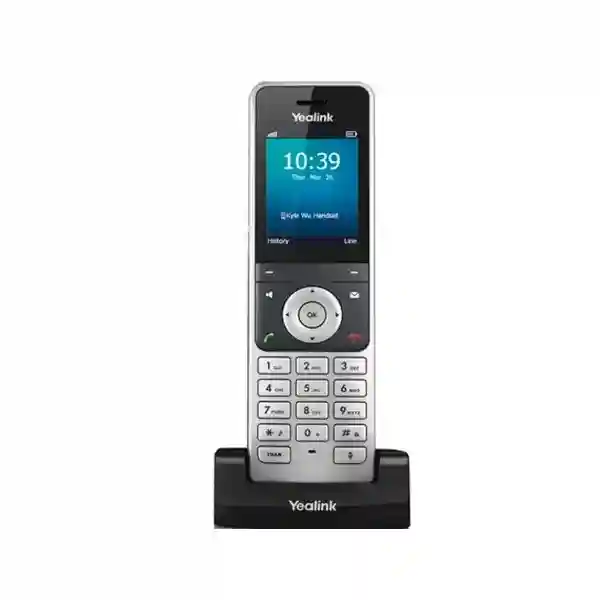
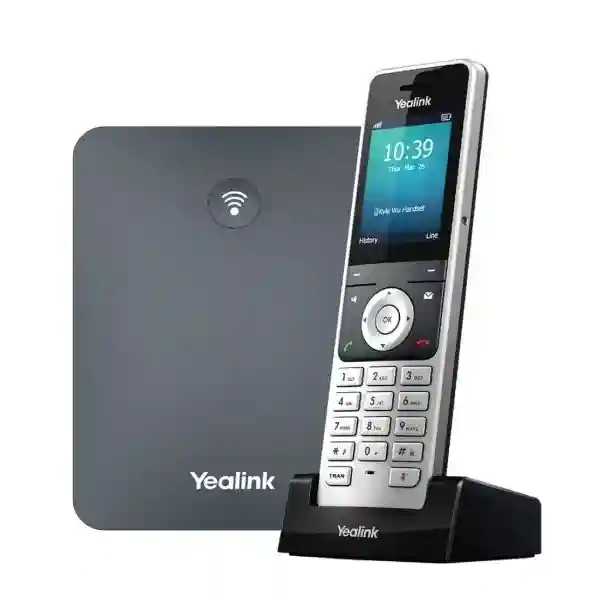
Yealink W76P DECT Phone System Tanzania
The Yealink W76P DECT Phone System is a business cordless VoIP solution designed for teams that need to move around a workplace while staying reachable on their SIP extensions. The package combines a Yealink W70B DECT IP base station with a W56H handset and charger, giving organizations a practical starting point for wireless voice deployment while allowing additional compatible Yealink handsets to be added as the requirement grows. For Tanzanian businesses evaluating cordless IP telephony, the W76P is especially relevant where employees are not continuously seated at desks: reception support, retail counters, warehouses, workshops, clinics, hospitality operations, facilities teams and small offices are typical examples.
Official Yealink specifications state support for up to 10 handsets, up to 10 SIP accounts and up to 20 simultaneous calls per W70B base, with up to two simultaneous calls per handset. The base provides one 10/100 Ethernet interface and supports IEEE 802.3af Class 1 Power over Ethernet, helping simplify installation when a suitable PoE switch is available. Security capabilities include TLS, HTTPS and SRTP, while provisioning can be handled through TFTP, FTP, HTTP, HTTPS, Yealink RPS and plug-and-play workflows. Before ordering, buyers should confirm PBX interoperability, DECT coverage expectations, local frequency suitability, handset quantity, PoE availability and whether repeaters are needed for larger premises.
A single W70B base can support a growing cordless team, making the system useful for departments that need shared mobility rather than a fixed desk phone for every user.
The platform supports up to twenty simultaneous calls across the base, subject to PBX, SIP trunk, network and deployment conditions.
PoE support and centralized provisioning help businesses build cleaner, easier-to-manage voice installations with fewer local power dependencies at the base station.
TLS, HTTPS, SRTP, digest authentication and encrypted configuration options support a more controlled VoIP deployment when configured correctly.
What the Yealink W76P solves
A desk phone works well for employees who spend most of the day at one workstation. It is less suitable for staff who constantly move between counters, stock areas, service points, patient rooms, workshop benches or multiple offices. The W76P addresses that gap by moving the SIP extension onto a cordless handset while keeping call handling integrated with a business IP PBX or hosted SIP service. Users can answer, transfer, hold and manage calls while walking within the usable DECT coverage area instead of returning to a fixed desk every time the phone rings.
The system also gives IT teams a clearer way to scale wireless voice. Rather than treating every cordless handset as a completely independent consumer phone, the W70B base provides a central SIP and management point for compatible Yealink DECT endpoints. Yealink specifies support for up to six RT30 repeaters per base, which can help extend coverage in suitable deployments. Coverage figures are published as up to 50 metres indoors and 300 metres outdoors under ideal conditions, but actual performance depends heavily on walls, reinforced concrete, metal shelving, machinery, interference, floor layout and base placement. A site survey is therefore more valuable than relying on theoretical range alone.
Key verified features
The included W56H uses a 2.4-inch 240 x 320 colour display, backlit keys and a familiar business-handset layout designed for everyday call handling.
Yealink supports G.722 wideband audio and a full-duplex speakerphone, with additional voice processing designed to improve clarity across supported network conditions.
Official data lists up to 30 hours of talk time. Standby time varies by W56H hardware revision, with Yealink listing up to 400 hours for earlier revisions and up to 350 hours for V4 under ideal conditions.
A ten-minute charge is specified to provide up to two hours of talk time, useful for busy environments where handsets must return to service quickly.
The base supports a local phonebook with up to 1,000 entries as well as remote phonebook, LDAP and XML phonebook options for compatible deployments.
Supported functions include hold, transfer, call waiting, three-way conference, forwarding, DND, voicemail indication, speed dial, caller ID and other common SIP telephony features.
Technical specification summary
| Area | Verified W76P capability |
|---|---|
| System capacity | Up to 10 handsets, 10 SIP accounts and 20 simultaneous calls |
| Per-handset calls | Up to 2 simultaneous calls per handset |
| Display | 2.4-inch 240 x 320 colour display on W56H |
| Network interface | 1 x RJ45 10/100M Ethernet |
| Power | IEEE 802.3af PoE Class 1 on W70B; external adapters also included in the published package content |
| Ideal-condition range | Up to 50 m indoors and 300 m outdoors |
| Security | TLS, HTTPS, SRTP, digest authentication, AES-encrypted configuration, SHA256/SHA512/SHA384 support |
| Provisioning | TFTP, FTP, HTTP, HTTPS, RPS and PnP; handset OTA upgrade support |
| Repeaters | Up to 6 RT30 repeaters per base according to current Yealink documentation |
Compatibility and deployment guidance
The W76P is a SIP endpoint system, so a successful installation depends on the complete voice environment rather than on the handset alone. Confirm that the intended IP PBX, hosted PBX or SIP service supports the registration and call features required by the business. Review extension count, concurrent call requirements, codec support, SIP trunk design, firewall traversal, VLAN configuration, DHCP options and QoS. Where centralized deployment is required, Yealink provisioning methods can reduce repetitive manual setup, but templates should still be tested against the exact firmware and PBX environment before mass rollout.
DECT planning is equally important. A base station installed in a central open area may cover a significantly different footprint from one placed inside a communications room surrounded by dense walls and metal equipment. Warehouses, multi-floor offices and compounds may need repeaters or multiple base systems. Yealink also states that its DECT technology is not compatible with third-party DECT bases or handsets, so expansion should be planned using supported Yealink devices. For broader telephony design, see FourTeck Tanzania’s IP PBX and VoIP communication guidance, which explains how call routing, SIP, voice VLANs and business call flows fit together.
Related Tanzania business-technology planning
Cordless phones work best when the wired network beneath them is stable. The W70B base needs Ethernet connectivity and can benefit from PoE, so switch capacity, VLAN design and UPS protection should be considered alongside the handset count. FourTeck Tanzania’s IP phone and business desk-telephony overview is relevant for mixed deployments where fixed desk phones and cordless DECT handsets must coexist. The same site’s network switching and LAN infrastructure guidance is useful when PoE budgets, segmentation and uplinks need to be reviewed. Buyers planning a complete voice project can use the FourTeck Tanzania contact page to provide extension counts, PBX details, building layout and deployment requirements for quotation.
Yealink W76P DECT Phone System Tanzania
For Tanzanian organizations, the Yealink W76P is a practical option when mobility is part of everyday telephone use. A receptionist may need to walk to a document station while staying reachable; a warehouse supervisor may move between receiving, storage and dispatch; a clinic administrator may move between consultation rooms and front-office areas; and a retail manager may need an extension while monitoring the sales floor. The W76P keeps these users connected to SIP-based business telephony without requiring a separate mobile network call for every internal conversation.
Procurement should begin with a simple capacity map. Count the employees who genuinely need cordless handsets, identify how many concurrent external or internal calls are expected during busy periods, document the PBX or cloud voice platform, and note whether the existing network provides PoE. With support for up to 10 handsets and 20 simultaneous calls on one base, the W76P can serve many small and mid-sized teams, but capacity alone does not determine suitability. Coverage, building materials, voice VLAN design, internet reliability, SIP trunk capacity and power resilience are equally important. Where the site includes multiple floors, separated buildings or metal-heavy storage zones, testing DECT coverage before final placement can prevent weak-signal areas.
Tanzania buyers should also confirm the exact handset revision, included accessories and locally appropriate DECT frequency variant in the quotation. Yealink publishes different DECT bands for different regulatory markets, so the supplied product should match the intended deployment region. Businesses replacing older analogue cordless phones should check whether the existing PBX is SIP-ready or whether a gateway or PBX upgrade is required. When the network and PBX are already prepared for SIP, W76P deployment can be clean and scalable, with provisioning and over-the-air handset upgrades simplifying ongoing administration.
Yealink W76P DECT Phone System Dar es Salaam
Dar es Salaam offices often combine reception areas, management rooms, meeting spaces, stores, workshops and customer-facing counters within the same site. The W76P can be useful where staff need to answer business calls while moving between these operational zones. Instead of installing a fixed desk phone at every temporary work point, a DECT handset can remain associated with the user or role. This is particularly useful for logistics companies, distributors, clinics, hotels, retail businesses, professional-service offices and technical teams that handle customer calls while moving around the premises.
A Dar es Salaam deployment should consider building density and radio behaviour. Reinforced walls, lifts, server rooms, shelving and multiple floors can reduce usable DECT range compared with ideal published figures. For this reason, base-station placement should be planned around the real traffic pattern of employees rather than simply locating the base next to the PBX. If the switch supports 802.3af PoE, the W70B can receive power through Ethernet, simplifying placement and making it easier to connect the base to UPS-backed network infrastructure. Where coverage needs extension, compatible Yealink repeaters may be considered after a site assessment.
For quotation preparation, provide the number of cordless users, current PBX brand and model, SIP trunk details, number of floors, approximate coverage area and whether the site already has managed PoE switching. This allows the phone requirement to be matched with network and voice infrastructure rather than treated as a standalone purchase. If the organization also uses fixed executive or reception phones, the W76P can form one part of a mixed endpoint strategy. The objective is to give mobile users freedom without creating inconsistent extension numbering, call-routing rules or management processes.
Yealink W76P DECT Phone System Mwanza
Businesses in Mwanza may require cordless voice in environments that range from small administrative offices to warehouses, hospitality properties, healthcare facilities and distribution operations. The W76P is suited to situations where reliable internal extension access is needed while staff move away from a desk. A cordless SIP handset can help a supervisor remain reachable while checking stock, a front-office employee respond while moving between service points, or a technical team coordinate without relying entirely on personal mobile phones for internal business communication.
The most important planning question is not simply whether the theoretical range is sufficient. Real buildings create obstacles that affect DECT coverage. The W70B should therefore be positioned where it can serve the largest practical area, with Ethernet and power availability considered at the same time. PoE support can make this easier because a data cable from a suitable switch can provide both connectivity and power. Businesses with unstable mains conditions may also want the switch, router, PBX and internet equipment on correctly sized UPS protection so that voice service is not lost during short interruptions even when the cordless handset itself is charged.
Mwanza buyers comparing the W76P with desk phones should consider user behaviour. If the employee spends nearly all day at one workstation, a fixed SIP phone may provide better access to programmable keys and a larger screen. If the employee routinely moves, the W76P offers greater operational flexibility. A mixed deployment is therefore often more sensible than choosing one endpoint type for every employee. Confirm PBX compatibility, required concurrent calls, directory integration and headset needs before ordering, and ensure the selected DECT variant matches the deployment market.
Yealink W76P DECT Phone System Arusha
In Arusha, the W76P can fit hospitality, tourism support, administration, healthcare, education and service businesses that need employees to stay reachable while moving between work areas. Cordless VoIP can be especially useful for back-office teams, maintenance supervisors, reception support and operations staff who cannot remain beside a fixed telephone. Because the handset uses the organization’s SIP extension environment, internal dialing and business call handling can remain structured instead of shifting operational communication onto personal mobile numbers.
Hospitality and multi-building environments require careful coverage planning. Guest rooms, service corridors, concrete walls and separate buildings can create coverage gaps that are not obvious from published maximum ranges. The W76P’s support for compatible repeaters can help in suitable layouts, but a repeater should solve a measured coverage requirement rather than be added automatically. For larger or more complex sites, it may be necessary to evaluate whether a single-base system is the correct architecture at all. The deployment decision should follow the building plan, number of users and expected movement patterns.
Arusha organizations should also review SIP security and network separation. Voice traffic can be placed on an appropriate VLAN where the network supports it, while TLS and SRTP capabilities may be used when supported by the PBX and properly configured. Central provisioning is valuable for businesses that want repeatable settings, but configuration templates should include the correct server addresses, credentials, codecs, time settings, directory options and emergency-call policies. A well-planned W76P deployment is therefore both a telephony and a network project, even when only a few handsets are required.
Yealink W76P DECT Phone System Dodoma
Dodoma businesses and institutions that operate across reception desks, administrative offices, stores and service areas can use the Yealink W76P to give selected users cordless access to the organization’s SIP phone system. The W56H handset supports familiar call features such as transfer, hold, forwarding, caller identification, voicemail indication and three-way conferencing, helping mobile users participate in the same call flows as fixed extensions. This can be useful where staff need to respond quickly without returning to a desk.
When planning the system, begin with coverage and role requirements. A small office may need only one base and one or two handsets, while a larger site can require several handsets and repeaters. The published capacity of up to ten handsets should not be interpreted as a recommendation to attach ten devices in every case; the correct quantity depends on users, concurrent call demand and workflow. Similarly, the quoted ideal indoor range of up to fifty metres can fall considerably in challenging buildings. Testing is the best way to establish whether a proposed base location reaches offices, corridors and work areas reliably.
Organizations in Dodoma should also document the PBX and SIP trunk environment before purchasing. Ask whether the PBX supports standard SIP registration, whether the required codecs and call features are available, whether the firewall requires special configuration and whether extension credentials can be provisioned centrally. If a new IP PBX is being installed at the same time, the handset plan should be created together with dial plans, IVR, ring groups and departmental call routing. This approach produces a more maintainable communication system than choosing phones first and designing call flow later.
Yealink W76P DECT Phone System UAE
For UAE businesses, the W76P is relevant to offices, warehouses, retail operations, clinics, hospitality environments and service centres that need SIP mobility within a controlled premises. The main value is straightforward: a user can carry a business extension instead of remaining at a fixed desk. Organizations with multiple endpoint types can combine cordless DECT handsets for mobile roles with desk phones for receptionists, executives and call-intensive users. The W70B’s capacity and centralized provisioning features can support standardized configuration across a small cordless fleet.
UAE deployments should verify the correct regulatory DECT variant and PBX interoperability before purchase. Voice networks are often integrated with managed switches, firewalls, VLANs and structured cabling, so the base station should be planned as part of this infrastructure. PoE support can simplify installation, particularly where the preferred radio position is not close to a convenient electrical socket. For enterprise environments, IT teams should also check authentication requirements, directory integration, security policies, firmware management and whether voice traffic is allowed across the relevant VLAN and firewall zones.
FourTeck customers working across the UAE can also reference FourTeck UAE technology solutions when a broader local project includes IP PBX, switching, firewalls, Wi-Fi or related infrastructure. For organizations with both Tanzania and UAE operations, standardizing on compatible SIP platforms and documented provisioning methods can simplify support. Exact pricing, stock, lead time and regional availability should be confirmed at quotation stage rather than assumed from generic online listings.
Yealink W76P DECT Phone System Uganda
Ugandan businesses can use the W76P where employees need to carry their extension between nearby work areas. Examples include logistics operations, pharmacies, healthcare sites, retail stores, schools, workshops and offices with shared front-desk responsibilities. The system is particularly useful when the business already uses a SIP PBX and wants to extend the same call plan to mobile staff without relying on cellular calls for every internal conversation.
A good Uganda deployment starts by matching handset count to job roles. Avoid buying a cordless handset for every employee simply because the system supports ten. Identify users whose productivity benefits from mobility, then determine whether the base can be centrally positioned to serve their routes. Where coverage is uncertain, plan a test. Thick walls, metal storage areas and multiple floors can all reduce range. If repeaters are needed, use compatible Yealink options and confirm placement carefully. Voice quality also depends on the wired side of the base station, including switch stability, VLAN configuration, PBX capacity and internet quality for hosted SIP services.
For broader regional support and technology planning, businesses can review FourTeck Uganda. Organizations operating in both Uganda and Tanzania may benefit from common extension standards, naming conventions, provisioning templates and documented PBX policies. This reduces the support burden when employees transfer between branches or when IT teams need to troubleshoot from another location.
Yealink W76P DECT Phone System Kampala
Kampala offices and commercial sites often combine multiple departments within compact but complex buildings. A cordless SIP system can be useful where reception, administration, technical support and management staff move between rooms or floors. The W76P gives these users a portable endpoint while retaining business call features. It can also reduce the need to install a fixed telephone at every temporary work position, provided DECT coverage is adequate.
Multi-floor buildings require special attention because vertical coverage may differ from horizontal coverage. The most convenient network-cabinet location is not always the best radio location. Since the W70B can use PoE, installers may have more freedom to place it at a suitable point connected by structured cabling. If a managed network is available, separating voice traffic and applying QoS can improve operational consistency, particularly when the same LAN carries data, Wi-Fi, CCTV and other services. For hosted voice platforms, internet failover and firewall behaviour should also be considered.
Kampala buyers should prepare quotations around total deployment needs rather than handset price alone. Useful information includes the current PBX, number of cordless users, average concurrent calls, existing PoE switch model, building layout, required directory integration and whether headsets will be used. This helps determine whether the W76P alone is sufficient or whether the project also needs switching, repeaters, PBX licensing or configuration services.
Yealink W76P DECT Phone System Arua
In Arua, the Yealink W76P can support businesses and organizations that need practical cordless communication over a SIP phone system. Rather than assigning employees separate mobile numbers for short-distance internal coordination, selected users can carry a W56H handset registered to the organization’s voice platform. This supports a cleaner extension plan and helps calls remain within established business routing rules.
Infrastructure quality should be reviewed before installation. The base depends on the LAN and PBX, so a reliable switch port, correct IP addressing, DNS and time configuration, and stable PBX connectivity are essential. If PoE is used, confirm that the switch has sufficient budget and that the port is configured correctly. If a hosted PBX is used, internet stability becomes part of call reliability. Power resilience also matters because the handset battery can remain charged while the base, switch or router becomes unavailable if those network devices lose power.
Coverage testing is recommended where the handset must work across storage areas, courtyards or separate building sections. The published outdoor figure assumes ideal conditions and should not be treated as a guaranteed site radius. Buildings, trees, metalwork and radio conditions can alter results. Procurement teams should therefore define the expected service area and user movement before deciding on repeaters or additional systems. This requirement-led approach reduces the risk of buying equipment that works well in one part of the site but poorly where employees actually spend their time.
Yealink W76P DECT Phone System Mbarara
Mbarara organizations looking for cordless business voice can consider the W76P for clinics, hotels, schools, warehouses, offices and retail environments. Its strength is not simply that it is wireless; it is that the handset remains part of a SIP-based business telephony system. Calls can follow extension rules, transfers and departmental workflows while the user moves within coverage. This makes the device different from a standalone consumer cordless phone connected to an analogue line.
The W70B can support multiple users, so the business should plan extension allocation carefully. Decide whether each handset has a dedicated SIP account, whether some calls ring groups of users, and how unanswered calls are handled. The PBX may provide voicemail, queues or IVR, while the handset gives the user access to these features. Directory planning can also be important for organizations with many internal contacts. Yealink supports local and remote directory methods, but compatibility should be tested with the chosen PBX and directory source.
For installation, avoid placing the base in a metal cabinet or an isolated corner purely because that is where the network equipment sits. PoE can allow a more radio-friendly location while keeping the cable run organized. In larger premises, measure signal performance before committing to repeater positions. A documented deployment should record base IP address, firmware version, SIP accounts, handset assignments, provisioning URL and network VLAN so future troubleshooting does not depend on one technician’s memory.
Yealink W76P DECT Phone System Gulu
For Gulu businesses, the W76P can provide cordless extensions for employees whose work takes them beyond a single desk. Service businesses, administrative teams, stores, healthcare operations and educational sites can use DECT mobility to answer and transfer calls without interrupting work to return to a telephone. The system can begin with the included handset and expand with supported Yealink endpoints as requirements grow, subject to the base capacity.
Planning should account for both user density and call density. Ten registered handsets do not mean all users will always be calling at once, but busy periods should be understood so the PBX, SIP trunk and base capacity align. If several handsets are used in one department, ring groups and pickup rules can be configured at the PBX to improve response. For security, use strong credentials, controlled provisioning access and encrypted SIP/media options where the PBX supports them. Avoid exposing management interfaces unnecessarily to the public internet.
Gulu organizations with branch networks should also decide whether the PBX is local at each site or centralized. A centralized PBX can simplify management but increases dependence on WAN connectivity. A local PBX can improve site independence but adds administration. The W76P can operate in either type of architecture as long as SIP registration and network requirements are properly met. The correct design therefore depends on the organization’s wider communication strategy rather than the handset model alone.
Yealink W76P DECT Phone System Kenya
Kenyan companies with mobile staff inside offices, clinics, retail locations, hospitality sites and warehouses can use the W76P to extend SIP telephony away from fixed desks. The system is useful where an employee needs to receive the same business extension while walking through a work area. This can improve response time for internal and external calls without forcing employees to use personal mobile devices for routine business communication.
A Kenya rollout should start with PBX compatibility and radio coverage. If the company already operates a SIP platform, confirm account registration requirements, supported codecs and provisioning methods. If it is moving from analogue telephony, the transition may require a new IP PBX, SIP trunk or gateway design. The network should provide stable Ethernet connectivity to the W70B, and PoE can simplify physical installation. Where call quality is critical, managed switching, voice VLANs and QoS may be appropriate, especially on networks carrying many other applications.
Regional customers can review FourTeck Kenya for wider local technology requirements. Multi-country organizations may benefit from using consistent handset models, standardized provisioning templates and common PBX policies across Kenya and Tanzania. This makes spare management, user training and support easier while still allowing local SIP trunks and regulatory requirements to be handled separately.
Yealink W76P DECT Phone System Kuwait
Kuwait businesses can use the Yealink W76P where mobility is required inside offices, retail premises, workshops and service facilities. The W56H handset offers a business-oriented interface, speakerphone, headset jack and standard call controls while the W70B connects the cordless environment to the IP network. This creates a practical bridge between mobile users and a SIP PBX without requiring Wi-Fi calling on every handset.
The main deployment considerations are the same as in any professional DECT design: correct regional hardware, PBX compatibility, base placement, network resilience and power. Dense construction can affect range, so published ideal figures should be treated as planning references rather than promises. PoE can be particularly useful when the best radio position is away from convenient wall power. Managed networks should document the voice VLAN, switch port settings and any QoS rules applied to the base.
Businesses operating across the Gulf and East Africa may also prefer common models for support consistency, but firmware, provisioning and telecom settings should be validated for each site. The W76P’s centralized provisioning options can make repeated deployment easier once a tested template exists. Quotation requests should include handset quantities, PBX details, building layout and any need for repeaters, headsets or installation support rather than asking only for a single unit price.
Yealink W76P DECT Phone System Ghana
Ghanaian organizations can deploy the W76P where staff require business calling while moving through offices, stores, clinics, hospitality spaces or operational areas. A cordless extension can reduce missed calls and make internal coordination easier, particularly for employees whose responsibilities are spread across several nearby work points. The phone remains part of the SIP environment, allowing the company to retain structured extension numbering and call handling.
When evaluating the system, consider whether one base can cover the intended area and whether all users require cordless access. Fixed phones may remain better for reception, executive offices and call-intensive desks, while the W76P serves operational users. This role-based approach can control cost and improve usability. Where several handsets are required, provisioning and directory design become more important. Standard templates can reduce setup errors and make handset replacement easier if configuration is documented.
Coverage in buildings with concrete walls, elevators or metal shelving should be verified through testing. Repeaters may be used in supported designs, but the goal is reliable coverage, not simply the maximum number of radio devices. Network availability, PBX uptime and internet reliability for cloud voice are also part of the communication service. Buyers should therefore evaluate the W76P as one component in a complete voice solution.
Yealink W76P DECT Phone System Nigeria
Nigeria businesses with large offices, retail floors, clinics, workshops, warehouses or customer-service facilities can use the W76P to support cordless SIP calling for selected staff. The system is most effective when mobility has a clear operational value. A warehouse manager, for example, can receive a transferred customer call while checking inventory; a clinic administrator can remain reachable while assisting at different desks; and a facilities technician can carry an internal extension while moving through a building.
Because the handset is only one part of the communication path, resilience should be planned across the PBX, network switch, router and internet connection. If PoE and UPS-backed switching are used, the base can remain active during short power disturbances as long as the wider voice infrastructure is also protected. For cloud PBX deployments, consider secondary internet connectivity where voice is business-critical. For local PBX deployments, document backup, firmware and configuration procedures.
Security should not be overlooked. Use unique SIP credentials, restrict management access, apply firmware updates and enable encrypted signaling/media where both sides support it. Central provisioning can improve control, but provisioning servers themselves must be secured. Organizations working across Nigeria and Tanzania can standardize the operational model while allowing local telecom services to differ. The result is a handset fleet that users recognize and support teams can manage consistently.
Yealink W76P DECT Phone System Seychelles
Seychelles hotels, offices, clinics, retail operations and service businesses may find the W76P useful where employees move around a property but still need to answer the organization’s SIP extensions. Hospitality environments can be a particularly natural fit for cordless voice, although each property should determine whether the W76P’s single-base architecture and coverage are appropriate for the building size and layout. Larger resorts or separated buildings may require a different DECT architecture after a proper site assessment.
Environmental and building factors should be taken seriously. Concrete, multiple floors, service corridors and outdoor transitions can change radio performance. The published indoor and outdoor range values are measured under ideal conditions, so real-site testing is the safest approach. If the W70B is deployed, PoE can allow the base to be placed at a better radio location while still drawing power from the network switch. The switch, router and PBX should be protected according to the organization’s resilience requirements.
For island businesses where replacement logistics can matter, standardizing compatible handsets and keeping clear configuration documentation can reduce disruption. Record extension mappings, firmware versions and provisioning details, and confirm accessory compatibility before purchasing spares. The W76P can be a strong fit for compact business sites, but selection should always follow the actual call flow, user mobility and coverage requirement.
Buying and sizing guidance
Start with users, not hardware. List each employee who needs cordless mobility and the area in which that person must remain reachable. Then estimate the busiest concurrent call period. Next, document the PBX platform, SIP trunk, network switch, VLAN design and available PoE. A single W76P package includes one handset, so additional users require compatible additional handsets. If the building is difficult for radio coverage, plan testing before ordering repeaters.
For organizations purchasing several systems, configuration standards matter. Define handset names, extension numbering, time zone, language, directory source, voicemail access, emergency numbers and security settings. Maintain a record of firmware versions and provisioning templates. This makes future additions and troubleshooting much easier. Where the PBX is cloud-hosted, include internet resilience in the decision. Where the PBX is local, include server or appliance availability, backup and support.
Quotation checklist
For a more accurate W76P quotation, provide the number of cordless users, current PBX or hosted voice platform, number of SIP accounts, expected concurrent calls, number of floors or buildings, approximate coverage area, existing PoE switch details, internet connection type, need for repeaters, directory requirements, headset requirements and whether installation/configuration is required. This information helps avoid a quotation that contains the phone hardware but misses the infrastructure needed to make it work reliably.
Frequently asked questions
How many handsets does the Yealink W76P support?
The W70B base used by the W76P supports up to 10 compatible Yealink DECT handsets. The appropriate number for a business depends on user roles, concurrent call demand and coverage.
How many simultaneous calls can it handle?
Yealink specifies up to 20 simultaneous calls on the base and up to two simultaneous calls per handset. PBX and SIP-trunk capacity must also support the required call volume.
Does the W76P support Power over Ethernet?
Yes. The W70B base supports IEEE 802.3af Class 1 PoE through its 10/100 Ethernet port, which can simplify installation when a compatible PoE switch is available.
What is the DECT range?
Yealink publishes up to 50 metres indoors and 300 metres outdoors under ideal conditions. Real coverage can be substantially lower depending on walls, floors, metal structures and radio conditions, so site testing is recommended.
Can third-party DECT handsets be registered?
Yealink states that its DECT technology is not compatible with third-party DECT base stations or handsets. Expansion should therefore use supported Yealink devices.
Can the W76P work with a hosted PBX?
It is a standards-based SIP system and can work with compatible hosted or on-premises SIP platforms, but exact interoperability, provisioning and feature support should be checked with the intended PBX service.
What should I confirm before buying?
Confirm PBX compatibility, regional DECT variant, number of users, concurrent calls, building coverage, PoE availability, network VLAN/QoS requirements, repeaters if needed, and any installation or provisioning services.
Decision recap
Choose the Yealink W76P when your business needs SIP-based cordless mobility for a small or mid-sized group and the building can be served by the W70B base with appropriate coverage planning. It is especially attractive where PoE, centralized provisioning, standard SIP call features and long handset battery life are important. Consider a different architecture if the site is very large, spread across many buildings or requires a higher-capacity multi-cell DECT design.
Talk to FourTeck about your W76P deployment
Share your handset quantity, PBX platform, site layout, expected call volume and network details. FourTeck can help structure the requirement around the phone, SIP service and LAN dependencies so the quotation reflects the working solution rather than only the handset package.



Reviews
There are no reviews yet.