
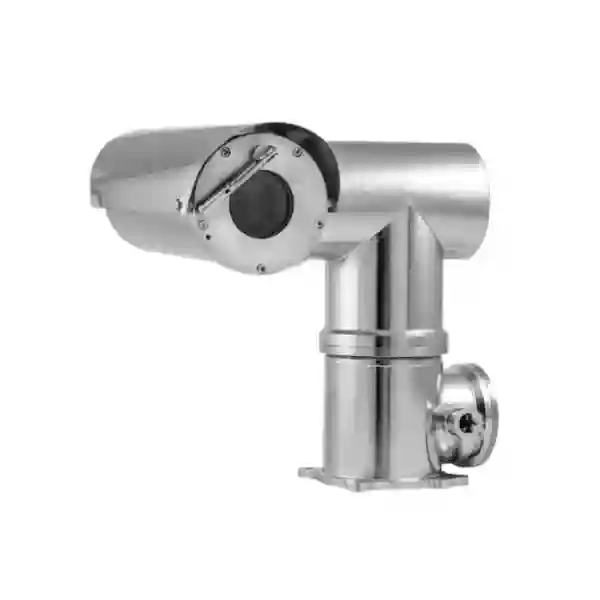
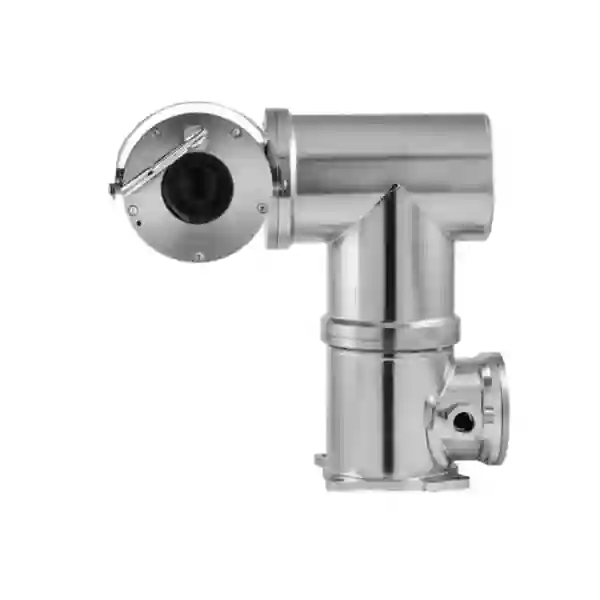
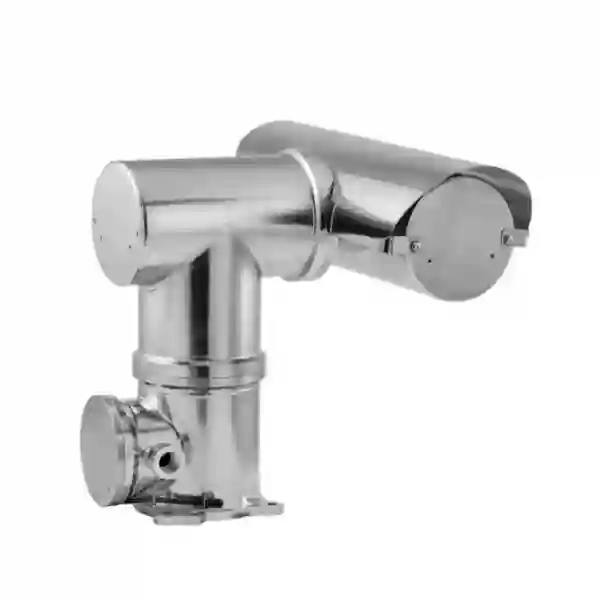
Hanwha Vision TNU-X6320A1F2WT1-M Explosion-Proof PTZ Camera
An industrial 2MP positioning camera with 32x optical zoom, integrated wiper, single-mode fibre Ethernet and a corrosion-resistant 316L stainless-steel station. Evaluate the exact configuration for hazardous-area surveillance, electrical requirements and plant network integration before ordering.
Who benefits from this camera station?
For plant security teams
Remote visual inspection, defined PTZ presets and recorded incident review, subject to complete coverage design.
For engineering teams
A precisely identified 24VAC, single-mode fibre, explosion-protected unit to evaluate against site drawings.
For procurement teams
A clear variant code and a checklist for matching certificates, accessories and quotation scope.
Verified technical specifications at a glance
The details below refer to the named manufacturer model rather than an arbitrary TNU-X6320 family variant. Confirm current project documents before procurement, because manufacturers may revise specifications.
| Camera type | Explosion-proof network positioning/PTZ camera, visible-light imaging |
|---|---|
| Resolution | 2MP, 1920 × 1080 |
| Imaging device | 1/2.8-inch CMOS |
| Lens / zoom | 4.44–142.6 mm; 32x optical and 16x digital zoom |
| Horizontal viewing angle | Approx. 64.44° wide to 2.29° telephoto |
| Pan / tilt | 0–360° pan; -90° to +90° tilt |
| Preset movement | Up to 45°/s pan and 24°/s tilt |
| Video formats | H.265, H.264, MJPEG; WiseStream II |
| Frame rate | H.265/H.264 up to 60/50 fps at 60/50 Hz; MJPEG up to 30 fps |
| Image features | Day/night ICR, WDR 120 dB, gyro-assisted DIS, defog |
| Connectivity | Single-mode 9/125 μm duplex fibre module, 10/100 Mbps Ethernet; manufacturer also lists RJ-45 interface in family specification |
| Interoperability | ONVIF Profiles S and G; SUNAPI |
| Local storage | Two microSD/SDHC/SDXC slots, up to 256 GB each |
| Housing | Electro-polished 316L stainless steel; toughened-glass window; integrated wiper |
| Ingress protection | IP66 / IP67 |
| Operating range | -40°C to +60°C |
| Electrical | 24VAC; maximum 80 W |
| Weight / dimensions | 33 kg; 418 × 457 × 401 mm |
| Published certification references | INMETRO and cLCus C1/D1; verify exact unit marking and project acceptance |
Specifications derived from Hanwha Vision’s exact-model product information and TNU-X6320A manufacturer series datasheet. Safety approval, third-party integration and field suitability need project review.
Industrial surveillance with the right camera for the location
The Hanwha TNU-X6320A1F2WT1-M explosion-proof PTZ camera is designed for demanding monitoring positions where a conventional outdoor camera may not be suitable. It combines a 2MP network camera, motorised pan and tilt, 32x optical zoom, an integrated wiper and single-mode fibre networking in a stainless-steel camera station. For engineering and security teams specifying equipment for an industrial plant in Tanzania, the value is not simply the ability to zoom. It is the ability to plan a controllable surveillance viewpoint around environmental exposure, network distance, installation access and the site’s hazardous-area documentation.
This is a specialist product, not a drop-in substitute for every CCTV camera. The exact installation must match the applicable hazardous-area classification, the certification and marking of the supplied unit, compatible electrical fittings and the manufacturer’s installation instructions. A quote should therefore be built around a defined location and a documented project design. If you already know the zone or division, operating temperature, preferred viewing distances and fibre infrastructure, include those details when requesting an evaluation. If not, establish them before treating any camera selection as approved.
What the specified model actually includes
The TNU-X6320A1F2WT1-M belongs to Hanwha Vision’s TNU-X6320A explosion-protected positioning family. It records up to 1920 × 1080 video and uses a 4.44–142.6 mm autofocus lens with 32x optical magnification. The camera has day/night switching, 120 dB wide dynamic range, gyro-assisted digital image stabilisation and H.265, H.264 or MJPEG encoding. Video analytics, event functions and two memory-card slots provide useful options for a network surveillance design. These features are valuable only when the image framing, recording settings and event response are commissioned for the application.
The suffix matters. The manufacturer identifies F2 as a single-mode fibre option, W as the integrated wiper, T1 as the -40°C temperature configuration, the power code 1 as 24VAC and M as the INMETRO-oriented variant. A visually similar unit with another suffix can differ in electrical supply, temperature configuration or certification. Always put the entire model string on requests for quotation, engineering drawings and receiving paperwork. A model-family photograph or a generic product category is not a substitute for checking the configuration on the delivered nameplate.
Why ordinary weatherproof CCTV is not enough
Industrial sites can present hazards beyond rain, dust and vandalism. An explosive atmosphere may be associated with flammable gas, vapour or combustible dust; a site survey determines whether such hazards exist and how the area is classified. A product marketed as explosion-proof addresses a different engineering problem from an ordinary IP-rated camera. IP66 and IP67 describe ingress protection, whereas hazardous-area suitability depends on the exact approved protection concept, gas or dust group, temperature class, environmental range and installation method.
A camera suitable for exposed marine air is not automatically approved for every classified process area, and an explosion-protected product is not automatically accepted under every national project standard. The site owner or qualified hazardous-area professional should compare the supplied unit’s certificates and markings with the project’s classification drawings and applicable rules. Cable glands, conduit seals, junction boxes, earthing, isolation and maintenance methods may all influence compliance. Buying the correct camera body is only one part of specifying a safe system.
Optical zoom: from an overview to a closer view
The 32x optical zoom is a central reason to select this positioning camera. At its 4.44 mm wide end the lens covers a broad scene, while the 142.6 mm telephoto end narrows the field for inspecting a selected subject. Hanwha lists a horizontal field of view of approximately 64.44 degrees at wide angle and 2.29 degrees at telephoto. These figures make the trade-off clear: a zoomed image can make a remote area easier to examine but cannot simultaneously show the whole yard or process line. Define both the required overview and the detailed inspection points.
The model also provides 16x digital zoom, but digital enlargement does not create missing image detail. For tasks such as reading a distant instrument or identifying a small part, verify the required pixel density and lighting in a design calculation or practical test. Steam, haze, vibration, weather and a moving subject can reduce usable detail even when the optical lens can magnify it. The correct design question is what operators must distinguish, at what distance, under which conditions, rather than asking only for the largest zoom number.
Pan and tilt for industrial coverage
The manufacturer specifies 0–360-degree pan travel and -90 to +90-degree tilt travel, with preset speeds up to 45 degrees per second in pan and 24 degrees per second in tilt. These values support a camera that can change between monitored directions instead of maintaining a single fixed field of view. Common plans include preset viewpoints of a gate, a transfer point, a vessel exterior or a perimeter segment. A control-room operator can then select a viewpoint when a site procedure requires it.
PTZ coverage must be planned honestly. A moving camera sees one direction at any moment, and a preset does not replace continuous coverage of another critical area. If two events happen at once, one positioning station cannot provide the same independent views as two dedicated cameras. For safety-sensitive or evidential requirements, decide which views need continuous fixed coverage and which benefit from PTZ investigation. Check lines of sight for pipework, cranes, structures, vehicles and potential occlusion as equipment moves through the site.
Image performance when conditions are difficult
The camera uses a 1/2.8-inch CMOS imaging device and supports day/night operation with a removable IR-cut filter. Hanwha lists minimum illumination of 0.05 lux for colour and 0.005 lux for black-and-white under stated test conditions. Those figures do not mean a site will produce usable identification images without sufficient light. At night, target movement, shutter settings, glare, reflections and the actual scene can materially affect results. The product is a visible-light network camera, not a thermal imager or a guarantee of darkness-proof observation.
Wide dynamic range is specified at 120 dB and can help where bright and dark portions of a scene must coexist, such as a shaded industrial bay facing an illuminated exterior. Image stabilisation with a gyro sensor can assist when wind or mechanical movement affects the installed view. Defog processing and digital noise reduction provide additional controls. These are image-processing tools, not substitutes for firm mounting, clear windows, sensible exposure settings or a site lighting plan. Commission the image in representative daytime and night-time conditions.
Construction for exposed industrial locations
Hanwha specifies electro-polished 316L stainless steel on the camera station’s welded assemblies and a toughened-glass viewing window. The specified housing material is relevant where a conventional finish may deteriorate quickly, particularly around humid or corrosive industrial conditions. The product is listed with IP66 and IP67 ingress protection, and its declared operating range is -40°C to +60°C. These figures should be checked against both ambient temperature and local heat sources near the actual mounting point.
An integrated wiper helps remove water from the viewing window, but a wiper is not the same as unlimited self-cleaning. Salt deposits, airborne dust, oil mist and other residues may need a defined cleaning procedure. Optional washer arrangements are separate design and procurement questions. For process areas, inspect whether sunlight, radiant heat, chemical exposure or washing practices create demands beyond the published specification. Include access for safe inspection and cleaning, particularly where routine service requires controlled access to a classified or elevated location.
Certification: review the supplied unit, not just a label
Hanwha’s current product information identifies the model as an explosion-proof PTZ camera and lists INMETRO and cLCus Class I, Division 1 references. The M ending is identified with the INMETRO configuration in the manufacturer’s model-code guide. These details are meaningful evidence of the design family, but an engineering team should still obtain the exact applicable certificate, equipment marking, instructions and any conditions of use for the ordered variant. Manufacturer family sheets also list certifications that vary by suffix, so a family-level logo alone is not sufficient.
For a Tanzania project, do not assume that an overseas certificate automatically establishes a local regulatory approval or site acceptance. Confirm the standards, hazardous-area classification and documentary requirements specified by the end user, engineering consultant and any applicable authority. Also verify the temperature class and allowable ambient conditions against the actual process environment. This page describes published features; it does not certify a proposed installation, replace the manufacturer’s safety documentation or authorise use at a particular hazardous location.
The F2 single-mode fibre advantage
A defining feature of this exact version is its integrated single-mode fibre network option. Hanwha describes the F2 configuration as a duplex 9/125 micrometre single-mode fibre module for Ethernet connectivity at 10/100 Mbps. Fibre can be attractive when an industrial camera is some distance from the equipment room or when designers want an optical communications segment between field equipment and the surveillance network. It can also help organise network boundaries where electrical interference and plant layout are design concerns.
Fibre does not eliminate engineering checks. Confirm the actual optical interface, transceiver characteristics, compatible equipment at the opposite end, patching arrangement, fibre route, splice plan and loss budget against the approved manufacturer’s documentation. Do not assume a connector type, maximum reach or universal compatibility from the words single-mode alone. The field route may need mechanically protected cable and suitable entry components. The optical network connection does not supply power to the camera. It still requires the specified 24VAC electrical supply, planned separately.
Network architecture and bandwidth planning
The camera supports H.265, H.264 and MJPEG, with Hanwha’s WiseStream II compression technology. The manufacturer lists up to 10 streaming profiles, plus unicast and multicast options. These capabilities let a system designer separate an operator’s viewing profile from a recording profile when supported by the chosen video management platform. A sensible configuration aims for adequate recording quality without sending unnecessary high-bitrate streams over every network segment.
The actual bandwidth must be calculated using frame rate, codec, resolution, compression, scene complexity, motion and the intended number of streams. There is no honest single Mbps figure that suits every petrochemical yard or workshop. Check latency and packet loss along the full path and consider how fibre termination, network switches, failover, time synchronisation and control-station connectivity will be handled. Plant IT teams may require address reservations, approved VLAN placement, firewall rules and change-control documentation before a camera is admitted to the production network.
Power supply and electrical interfaces
This model requires 24VAC input and has a published maximum consumption of 80 W. Treat the power arrangement as an engineered part of the installation. Specify a suitable power source, protective devices, cable route, allowable voltage drop and isolation provision with the project’s electrical designer. The presence of Ethernet or single-mode fibre does not turn this model into a Power-over-Ethernet camera, and it must not be ordered on that assumption.
Where site operations rely on a security view during power disturbances, evaluate upstream backup power, transfer arrangements and recorder resilience as part of the overall system. Confirm any hazardous-area enclosure, termination and earthing requirements from the relevant product instructions and project documentation. Keep power conductors, optical fibre routes and service access properly coordinated. A camera that is optically well placed but difficult to isolate or maintain may create avoidable operating problems. Electrical work and classified-area connections should be handled by suitably qualified personnel under the site’s procedures.
Mounting, dimensions and structural design
Hanwha lists product dimensions of approximately 418 × 457 × 401 mm and a weight of 33 kg for this unit. The camera therefore needs much more careful support planning than a small wall-mounted CCTV dome. Assess the proposed bracket or pedestal, anchor design, substrate, wind effects, expected vibration and the route required to bring cables safely into the station. Allow enough clearance for the intended pan and tilt movement, window cleaning and service tools.
The manufacturer’s series information shows a compatible explosion-proof PTZ wall-mount accessory, model HT-E-BPW6800, as an optional item. Do not assume it is included in a base camera quotation or that every alternative mount is suitable. For an elevated industrial installation, the specification should address safe lifting, temporary support, working-at-height access and attachment of approved accessories. Structural verification and local site rules take precedence over convenience. A mounting design should be reviewed with the final equipment mass and accessory loads before installation begins.
Recording, frame rates and image retention
The specified camera can provide 1920 × 1080 imaging at up to 60 frames per second for H.265 or H.264 under the published 60 Hz configuration; the stated limit is 50 frames per second for a 50 Hz configuration. MJPEG is listed up to 30 frames per second. Higher frame rates can be useful where moving machinery or vehicles matter, but they can increase network traffic and storage demands. Set the recording rate based on the evidence requirement rather than automatically using the highest setting.
A storage estimate must account for the chosen codec, target bitrate, recording schedule, motion or event triggers, retention period and operational overhead. Define whether a monitoring system needs continuous recording, event clips or both. Review time stamping, clock synchronisation and evidence export with the relevant operators. A surveillance recording plan should also respect site privacy rules and any applicable retention requirements. No fixed recording duration is promised by the camera’s storage-slot specification because real capacity depends on the deployed profile.
Video management software and interoperability
Hanwha’s published interface information includes ONVIF Profiles S and G and its SUNAPI interface. These are useful starting points for integration discussions, not proof that every third-party video management system exposes all camera functions. Basic live video may work through a supported profile while specialist features such as preset handling, analytics events, edge-recording recovery and advanced configuration still need testing. Capture the required functions in an integration matrix before purchase.
For an existing CCTV estate, check the current VMS version, relevant device driver or profile, planned recording capacity and any licensing impact. Ask who will control PTZ access and how conflicting operator commands are managed. Test alarm event mapping, naming conventions, recording retrieval and time accuracy. A successful login to a camera webpage does not demonstrate a finished security workflow. The goal is a usable operational system where authorised staff can view, control, investigate and maintain the exact field device.
Analytics and event-driven operation
The manufacturer’s analytics list includes motion detection, tampering, fog detection, face detection, shock detection, virtual-line events and virtual-area conditions such as intrusion, entry or exit and loitering. These capabilities may help direct an operator’s attention to a defined event, trigger a recording or hand over the camera to a preset. Their value depends on scene geometry and stable configuration. A moving PTZ view can present different analytics challenges from a fixed camera monitoring a permanent perimeter.
Do not interpret the listed face-detection function as facial recognition or assume the device is an AI person-and-vehicle classifier. Neither claim follows from the verified specification. Commission detection zones around the actual environment and test nuisance conditions such as shadows, reflections, rain, blowing vegetation and work crews. Agree on who receives each notification and what response is required. A well-controlled alert with a clear response procedure may be more valuable than many enabled events that staff cannot investigate reliably.
Local edge storage and event resilience
The device has two microSD/SDHC/SDXC slots, with a published maximum of 256 GB per slot and 512 GB combined. Edge storage can be useful for selected event or local recording strategies when supported by the installation design. It should not be treated as an automatic replacement for a central recorder, an industrial network or a tested backup process. Cards are consumable storage media, and capacity and endurance need to suit the actual write pattern.
Decide how any local clips will be retrieved, how storage errors will be noticed and what happens if network connectivity is interrupted. The integration design should confirm how the VMS handles camera-side recordings, if that workflow is required. Give operators clear procedures for checking card health and verifying that event files can be opened. If a site requires evidence that remains available after physical equipment damage, a separately protected central recording or archive design may be necessary.
Security of the surveillance network
The published security capabilities include HTTPS, secure real-time transport options, IEEE 802.1X support, account authentication, IP-based access controls and audit logging. These features offer useful tools for a controlled deployment, but they must be configured. A field device connected to an industrial network should have approved credentials, least-privilege accounts, suitable network segmentation and a documented process for changing access when staff or contractors leave.
Before commissioning, verify firmware support through the manufacturer, align configuration with the site’s cyber-security policy and test secure management access. Disable services that are not needed where supported and appropriate, manage time synchronisation, and record who is authorised to view or move the camera. Maintain an asset record of the exact model, installation position, firmware, IP address and service owner. Cybersecurity is a continuing operating activity, not a one-time specification checkbox.
Practical use cases in industrial facilities
Onshore production and processing areas can benefit from a camera that changes viewing direction while preserving a protected station design. Typical evaluation scenarios include watching an exterior process boundary, reviewing vehicle movement near an industrial gate, investigating an alarm around equipment or observing a transfer area from a controlled point. Marine and offshore installations may also evaluate stainless-steel construction and a wiper, subject to a complete environmental and hazardous-area assessment.
At each proposed location, define the operational question first. Does an operator need a general situational overview, a close-up of a valve position, a view of people entering a restricted area, or an evidential record of vehicle movement? Different questions can require different placements, field of view, illumination and number of cameras. A PTZ device may complement fixed cameras rather than replace them. Never make the camera the sole safety-critical detection method without a separately justified and approved safety engineering design.
Planning deployment for a project in Tanzania
For a Tanzania-based industrial project, the first step is to document conditions at the actual site rather than assume the same needs apply across the country. Record the plant’s hazardous-area drawings, operating climate, available power, access constraints, network topology, corrosion exposure and night-time lighting. If the camera is to form part of an existing CCTV system, include the recorder details, management software version and operational procedures. These facts enable a more accurate technical evaluation.
Local commercial availability, import arrangements, delivery timing, installation scope and warranty terms require a project-specific quotation; none is asserted on this page. The camera’s foreign certification references also should not be used as an unsupported claim of Tanzania-specific approval. A qualified designer should check the client’s project specifications and any applicable regulatory expectations. When approaching FourTeck Tanzania, request a technical quotation that identifies the exact unit, compatible accessories and the information still needed to confirm installation suitability.
Choose the exact variant rather than the closest number
Several members of the TNU-X6320A family look alike in catalogues. The A1 power configuration denotes 24VAC while the manufacturer’s broader family includes other voltage variants. The F2 element is especially important for this model because it specifies single-mode fibre; a model without F2 may have a different network interface arrangement. W identifies the wiper, T1 identifies the -40°C configuration and the M suffix corresponds to the INMETRO option in the manufacturer’s model-number guide.
Substituting a model with a different letter at the end could change the certification evidence required by the project. Substituting a non-fibre unit could force an unexpected redesign of the field network. Some older TNU-X6320E variants are listed by Hanwha as discontinued and replaced by corresponding A-series variants; they should not be silently confused with this model. Ask suppliers to state the complete code on every technical submittal and commercial document. Confirm any proposed substitution in writing with the project engineer before ordering.
Commissioning: what to verify on site
A useful commissioning plan starts before the camera is mounted. Verify the physical product code and nameplate against the approved documentation, inspect the equipment and accessories, confirm the proposed structural arrangement and ensure electrical and hazardous-area work follows the relevant instructions. Confirm optical link operation and 24VAC supply conditions. Once connected, check that the specified camera can be discovered and securely managed by authorised staff, then record the tested firmware and configuration.
Commission image performance at the needed viewpoints. Test focus at wide and telephoto settings, verify that presets return to useful positions, and check any required PTZ speed or control behaviour. Exercise the wiper, recording profiles, event triggers, network-disconnect response, secure access and time synchronisation. Test during representative bright, dark and wet conditions when practical. Finish with a documented acceptance record, staff handover and maintenance procedure. A camera that streams once during installation has not yet demonstrated that it will satisfy the site’s operational surveillance requirement.
Maintenance and ownership considerations
A robust camera station still requires a maintenance plan. The viewing window can accumulate films or residues, and the integrated wiper should be periodically checked for condition and effectiveness. External structures, cable entries, environmental seals and visible signs of corrosion should be inspected according to the manufacturer’s instructions and the site’s safety procedures. Do not open or disturb an explosion-protected enclosure in a classified area without the required precautions and authorisations.
Plan safe access to the installed location, including any lifting equipment or access permits. Monitor recording status, storage alerts, network health and image quality through the surveillance operations process. Check for supported firmware and security updates under change control rather than applying changes blindly. The ownership cost therefore includes compatible mounting, network equipment, power distribution, commissioning, inspection and safe ongoing access—not just the camera unit. These items belong in the procurement discussion even when the base hardware is the main requested product.
Questions to resolve before requesting a quotation
A complete request should identify the exact model and the number of units, the site’s relevant hazardous-area classification, the required certificates or standards, ambient and exposure conditions, intended viewing distances and example scenes. Include the approximate mounting height, proposed structure, available 24VAC power, fibre type and existing network equipment. State the VMS or recorder product and version, expected recording retention, event requirements and commissioning responsibilities. This is more useful than sending a model number without a location or application.
Also clarify whether the purchase must include mounting brackets, a washer system, fibre termination materials, switching equipment, storage media, protection devices or installation services. Ask for any certification documents, dimensional drawings and approved installation manuals needed for project review. Where a detail is not yet known, label it as requiring verification rather than guessing. A complete technical package reduces the risk of receiving a camera that matches a catalogue image but not the finished field installation.
Avoid these frequent specification mistakes
The most expensive mistakes often begin with a small assumption. A camera advertised as explosion-proof may be treated as suitable for every zone or division; a fibre-enabled camera may be assumed to use PoE; an industrial PTZ may be treated as equivalent to several fixed surveillance views; or the maximum zoom may be mistaken for guaranteed identification distance. Each of these assumptions can undermine a project. Confirm the safety documentation, separate electrical supply, coverage plan and optical performance before the final bill of materials is approved.
Another risk is copying a model-family specification without checking the suffix. Confirm the actual power code, fibre variant, temperature configuration and certification option. Distinguish manufacturer information from retailer promises about price, stock, warranty or shipment, which may apply only to a particular country or seller. In Tanzania, request the local offer’s commercial terms explicitly. The goal is an equipment decision that remains correct after the camera has been delivered, inspected, mounted, integrated and handed over to operations.
Frequently asked questions
Is the TNU-X6320A1F2WT1-M a thermal camera?
No. The manufacturer’s specifications describe a visible-light CMOS network camera with day/night switching and 2MP video. A retailer category heading should not be used to reclassify it as a thermal imager. If temperature-based detection or thermal contrast is a core requirement, specify a separately verified thermal model and define the detection task.
What resolution and zoom does it provide?
The manufacturer specifies 1920 × 1080 resolution, a 4.44–142.6 mm lens, 32x optical zoom and 16x digital zoom. Optical zoom changes the scene magnification through the lens; digital zoom enlarges image pixels. Whether a distant feature is recognisable still depends on view angle, lighting, atmospheric conditions and the required level of detail.
Does this model have a fibre connection?
Yes. F2 identifies the integrated duplex single-mode 9/125 micrometre fibre module, described for 10/100 Mbps Ethernet. The network designer must confirm optical interfaces, compatible equipment and loss budget in the approved technical documentation. Fibre connectivity is not a substitute for the separate 24VAC power feed.
Can it be powered by PoE?
Do not design this exact model for Power over Ethernet. Hanwha specifies 24VAC input and up to 80 W maximum consumption. Power supply selection, wiring, protective arrangements and any backup source should be verified with the electrical design and hazardous-area installation requirements before equipment is ordered.
What do IP66 and IP67 mean for the project?
They are the manufacturer’s listed ingress-protection ratings for the camera station. They should be considered alongside, not in place of, explosive-atmosphere certification and project-specific environmental needs. Cable entries, installation practices and maintenance affect the completed system. Review the actual deployment against the approved installation documentation.
Is this camera approved for every hazardous area in Tanzania?
No universal approval is claimed. Hanwha identifies INMETRO and cLCus Class I, Division 1 references, with the M code linked to the INMETRO variant. The site’s qualified engineering team must match the actual equipment marking, documents and conditions of use to the defined hazardous location and applicable local requirements.
Does it have an integrated wiper?
Yes. Hanwha lists a built-in wiper and a toughened-glass viewing window. The wiper can help manage water on the viewing surface, but service procedures and cleaning may still be needed. If a washer tank is required, its suitability and whether it is included should be confirmed as part of the accessory schedule.
What recording options are available?
The camera supports H.265, H.264 and MJPEG streams and has two microSD/SDHC/SDXC card slots, up to 256 GB per slot. Central recording and retrieval depend on the selected VMS or recorder and its configuration. Retention time must be calculated from actual bitrate, frame rate, recording schedule and available storage.
Will it work with an existing video management system?
The manufacturer lists ONVIF Profiles S and G and SUNAPI support, which can assist interoperability. That does not guarantee full feature support in every VMS. Verify the exact software version and test PTZ control, presets, recording retrieval, analytics events, authentication and any additional integration requirements before final approval.
Can it watch an entire plant continuously?
A PTZ camera can move among different viewpoints but does not record every direction with equal detail at the same time. Critical areas that need permanent simultaneous observation may require fixed cameras in addition to a PTZ station. Coverage design should follow a documented site risk assessment and the actual operator requirements.
What details help produce an accurate Tanzania quote?
Provide the complete model number, quantity, relevant hazardous-area classification, location conditions, mounting concept, available 24VAC supply, fibre architecture, VMS information and required accessories. Ask for confirmation of certificates, technical scope, local availability, delivery terms and warranty. No fixed Tanzania price or lead time is presented without a verified listing or quotation.
How should the camera be maintained?
Use the manufacturer’s current maintenance instructions and the site’s permit and hazardous-area procedures. Inspect the window, wiper and accessible fittings, verify video and network health, review storage alerts and manage firmware changes under approved controls. Qualified personnel should handle electrical, structural or explosion-protection work, especially where opening equipment may be restricted.
Request a technical quotation for Tanzania
Contact FourTeck Tanzania to discuss the Hanwha TNU-X6320A1F2WT1-M explosion-proof PTZ camera for a defined industrial surveillance requirement. Include the site classification, quantity, power and fibre details, VMS platform and proposed mounting arrangement. Request confirmation of the exact variant, certification documentation, scope of supply, local commercial terms and accessory compatibility. No stock, price, delivery, warranty or Tanzania-specific regulatory approval is assumed.




Reviews
There are no reviews yet.