
Access control power management • Tanzania
Hanwha SSA-X300 Power Package for Access Controllers
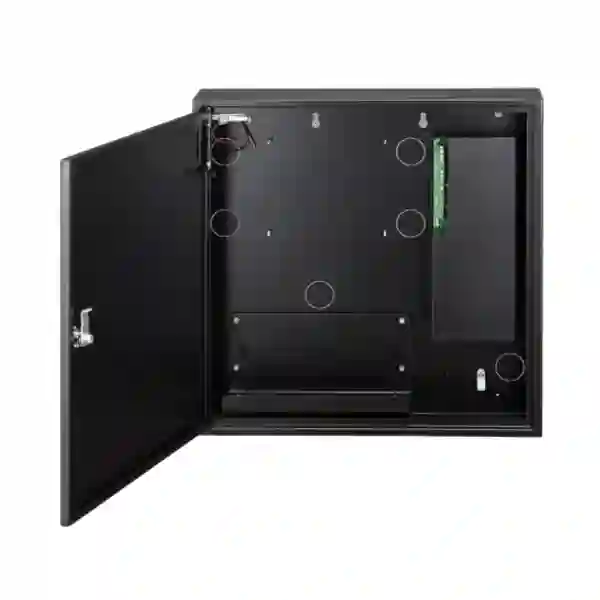
Need a power enclosure for a compatible access control system? The Hanwha SSA-X300 brings together monitored power, battery-backup support, a lockable cabinet and a door-tamper signal. Confirm controller compatibility, load allocation and battery inclusion before ordering for your Tanzania project.
Key specifications at a glance
| Product | Hanwha Vision SSA-X300 power package |
|---|---|
| Product purpose | Power package for access control panels |
| AC input | 100–240V AC, 50/60Hz, 2.0A |
| Documented DC supply | 13.5V ±5%, 4.7A; separate strobe/horn nominal 12.5V DC ±5% |
| Compatible battery | 12V, 18Ah rechargeable; inclusion to be confirmed |
| Battery charging current | 700mA |
| Controller/interface boards | Maximum 2 boards in enclosure; compatibility must be checked |
| Monitoring | AC-loss, battery fail/absence, enclosure-door tamper |
| Protection | Fuse on AC input; documented overcurrent protections |
| Operating temperature | 0°C to +45°C |
| Enclosure | 410 × 410 × 97mm, lockable door |
Manufacturer-documented values are provided for product selection. Confirm delivered revision, accessories and current operating guidance before installation.
What the SSA-X300 is designed to do
The Hanwha SSA-X300 power package is designed to support an access control installation in which the controller electronics, field wiring and backup power need an organized and protected arrangement. Rather than asking an installer to combine unrelated power adapters, a battery charger and an unmonitored enclosure, the package provides a manufacturer-defined power architecture with dedicated connections for compatible control electronics, locks, warning devices and status signals. This can simplify design discussions because the same documented limits can be considered by the security contractor, electrical installer and facilities team. It is still essential to verify the intended controller and every connected load before assuming suitability.
The central distinction is functional: the SSA-X300 is not a card reader, biometric device, network access controller or authorization database. It supplies power and related monitoring functions for compatible equipment, while the access controller remains responsible for door permissions, credential decisions and system logic. That distinction helps prevent ordering the wrong component. If the requirement is to add a reader, enable remote door management or increase software capacity, the power package alone will not deliver those features. The correct order begins with the overall door design and identifies the appropriate controller, reader, lock, power package, battery and cabling as separate decisions.
Who should consider this power package
The SSA-X300 is relevant to security integrators, electrical contractors, facility managers and technical buyers planning wired access control systems. Typical considerations include controlled office entrances, administrative facilities, back-of-house doors, shared building entrances and other locations where access equipment must be installed in a serviceable enclosure. It is most helpful when a compatible controller installation benefits from organized mains input, low-voltage distribution, monitoring connections and provision for a backup battery. A project using a self-contained standalone door terminal with a different power specification may need a different approach.
Buying teams should begin by asking which exact access control platform is already installed or planned. They should then document the control boards, door-lock types, expected current, alarm devices, site power and recovery requirements. An apparently similar cabinet or power supply may use different terminals, monitoring logic or mechanical mountings, which is why a model-by-model compatibility check matters. For renovation work, obtain the existing controller part numbers and a clear photograph or schedule of current wiring, without exposing credentials or sensitive access configuration. For new installations, ask the design consultant for an equipment schedule showing each door and its proposed source of power.
Manufacturer-confirmed features and realistic benefits
Hanwha identifies low-battery checking, AC power failure checking, a battery recharge circuit and a door-opening tamper alarm among the SSA-X300 features. Each performs a specific support role. AC-loss information can help a compatible controller or monitoring arrangement recognize a mains interruption. Battery-status information helps identify a missing or failed battery condition. The charging circuit supports maintenance of a suitable rechargeable backup battery. The tamper mechanism can indicate an opened enclosure door when appropriately wired to a compatible input. These functions improve visibility into power conditions; they do not automatically guarantee remote notifications unless the connected controller and management software are configured for them.
The enclosure also has a front-door key lock, and the specification allows up to two controller or interface boards inside. Those features can help make physical access and service work more orderly. However, capacity means mechanical accommodation according to the manufacturer; it does not establish universal electrical or protocol compatibility with any board an installer can fit. Buyers should expect the integrator to confirm mounting arrangements, clearances, heat dissipation, cable routing and controller-specific wiring before signing off on the bill of materials. The goal is a dependable engineered system, not simply the maximum number of connected devices.
AC input and power-output planning
The published input rating is 100–240V AC, 50/60Hz, 2.0A. The product literature also states 13.5V ±5% and 4.7A for the low-voltage supply characteristic, with a separate nominal figure of 12.5V DC ±5% for the strobe and horn connection. These values should be read alongside the terminal allocations and installation guide rather than treated as an invitation to draw the full rated current from any one terminal. An electrician should check the input supply, protective arrangements, grounding, cable size, local electrical requirements and the loads to be connected.
A practical power schedule should list each controller board, each lock, connected indicators and any warning device, noting steady-state current and possible peak or inrush current. This is especially important for strikes, magnetic locks and devices that change consumption during operation. Compare the schedule against the manufacturer’s distribution and protection provisions, then leave appropriate engineering margin. Where a proposed lock has an incompatible voltage or draw, select a suitable power arrangement instead of improvising connections. The product is a component within an engineered access system, not an unlimited general-purpose 12V source.
Understanding the terminal groups
The installation documentation names AC FAIL, NON BATT, CONTROLLER/INTERFACE, LOCK, STROBE/HORN and CHARGE terminal groups. The manufacturer identifies one AC FAIL connection, one non-battery status connection, two controller/interface outputs, two lock outputs, two strobe/horn outputs and one charging connection. This separation helps the installer map monitoring and power functions to the appropriate destinations. It does not remove the need to use the exact terminal diagram that corresponds to the delivered hardware revision. Similar labels on a different controller or cabinet may not have identical electrical behavior.
The quick guide also describes current allocation for the combined controller/interface and lock connections, the strobe/horn group and the battery charge circuit. The figures given are 3,200mA, 800mA and 700mA respectively. These should be interpreted as manufacturer-specified group allocations, not additional independent current budgets that can be added without checking the overall supply. Before wiring, the installer should obtain the latest official manual, trace each destination, label the cables and document the circuit protection. The objective is to avoid nuisance shutdowns, overloaded wiring and difficult future fault-finding.
Battery backup: what the specification really means
The stated compatible battery is a 12V, 18Ah rechargeable unit, and the charging current is listed as 700mA. The specification confirms that the SSA-X300 supports battery backup when a suitable battery is connected correctly. It does not, by itself, confirm that a battery is included in every sale package, establish a fixed backup duration or promise uninterrupted operation under every load and environmental condition. Buyers should ask whether the quoted configuration includes the battery, the battery’s type and condition, and any installation accessories that may be required.
Backup duration depends on the actual connected loads, usable battery capacity, aging, temperature, discharge characteristics and the system’s power management behavior. A nominal ampere-hour rating is not a guaranteed number of hours at the door. For a project that must maintain a particular security or operational function during a prolonged outage, request a documented load and autonomy calculation from the integrator. The design should specify which doors must remain secured, which must release for safe exit and how all connected devices behave when mains power fails. The power package is one input to that wider safety and continuity decision.
AC loss, battery status and actionable alerts
The manufacturer documents status transmission for AC loss and battery failure or absence. These signals are useful because a power issue may develop before a door stops working. For example, a system that remains online on battery following a mains failure may still need a prompt maintenance response. Similarly, an absent or weak battery could go unnoticed until the next power interruption if nobody verifies status. The SSA-X300 provides signaling capability, but the response depends on where those signals are connected and how the receiving controller interprets them.
During commissioning, the installer should identify the relevant controller inputs, configure event names that users can understand and verify the resulting indication at the agreed monitoring point. A facilities technician should know the difference between an AC-loss event, a missing-battery event and an enclosure tamper event. The team should also determine who receives a warning, what information it includes and how it is closed after corrective action. Do not assume that the power package has its own network interface, cloud account or mobile alerting. Those functions, where available, belong to the wider access control system and must be verified separately.
Enclosure tamper protection and physical access
The enclosure uses a key-operated front-door lock and supports a tamper status signal when its door is opened. Together these features can discourage casual access and make maintenance intervention more visible to the connected system. They are valuable in technical rooms, security closets and other controlled spaces where wiring and power components should not be exposed to ordinary building traffic. They are not equivalent to a certified high-security safe, a site-wide intrusion system or an alarm transmission service. Their contribution depends on correct physical placement and wiring.
Plan the enclosure location so authorized technicians can access it without disrupting building operations, while the general public cannot handle its power connections. Ask who will hold the keys, where a spare will be managed and how maintenance access will be logged. The tamper connection should be tested as part of commissioning, because an unconnected switch gives no useful signal to the controller. Designers should also preserve suitable clearance around the enclosure for safe servicing, cable entry and ventilation. A neat cabinet installation is more useful when future technicians can identify the incoming mains, controller circuits, locks, backup battery and status wiring without guesswork.
Space, mounting and dimensions
The published enclosure dimensions are 410mm wide, 410mm high and 97mm deep. Those measurements should be checked against the intended wall, mounting surface or services cabinet before procurement. Allow additional practical working space for the door to open, for wiring to enter without tight bends and for a qualified technician to remove or inspect a battery. A cabinet may fit into a drawing but still prove difficult to service if installed immediately beside a column, above an obstructing pipe or inside an overcrowded riser.
The unit is described as accommodating a maximum of two controller or interface boards. The installer needs to verify the actual mounting arrangement for the selected boards and ensure that accessories, cable bends and the battery do not obstruct access or airflow. Do not assume that two arbitrary third-party boards will fit because two mounting positions are mentioned in the brochure. For commercial projects, include enclosure location, mounting height, service clearance and cable access in the approved installation drawing. These small checks often prevent expensive site changes after equipment has arrived.
Temperature, moisture and environment
Hanwha specifies an operating temperature of 0°C to +45°C for the SSA-X300. That range matters for equipment rooms that may become hot when ventilation is poor. The published materials do not establish that this enclosure is suitable for exposed outdoor use, rain, water spray or corrosive environments. The quick guide warns against water exposure, blocked ventilation and installation near significant heat sources. A proposed installation in a covered outdoor corridor, damp utility space or unventilated cabinet therefore deserves more scrutiny than a typical protected indoor location.
In Tanzania, designers should evaluate the actual room conditions rather than assume that a country-level climate label predicts cabinet temperature. Consider midday heat, direct sunlight through windows, equipment heat inside the enclosure, dust ingress and moisture risks. If the environment falls outside the product’s documented limits, choose another protected location or specify a more suitable engineered enclosure arrangement approved for the installation. Any external containment, cooling or environmental protection should be assessed for electrical safety and manufacturer compatibility. The important purchasing question is not simply whether the equipment can be delivered, but whether it can operate within its published conditions where it will be installed.
Matching the controller rather than guessing
A compatibility decision starts with the exact control-panel manufacturer, model and hardware revision. The SSA-X300 is associated with the Wisenet access ecosystem, and a published quick guide illustrates connections to V100, V200, V300, V1000 and V2000 family equipment. Those references provide useful context for technical review but should not be interpreted as a blanket promise for every legacy or current controller configuration. Installation instructions, terminal behavior and mounting hardware may differ across revisions. Confirm fit using the corresponding official manuals and the complete planned load schedule.
If the project already contains Hanwha or Samsung-branded legacy access components, gather the product labels and current drawings before ordering. Brand history alone does not prove interchangeability. Where the site uses a different manufacturer’s access controller, obtain written confirmation from the designer or integrator that the electrical interfaces, monitoring contacts and equipment layout are appropriate. This protects the buyer from purchasing a power package that is mechanically convenient but electrically unsuitable. A careful pre-purchase check is usually less disruptive than modifying a live entrance after the wrong cabinet or supply has been installed.
Door-lock behavior in a power interruption
The access-control power design affects what happens at a door when mains electricity is unavailable. Electric strikes, magnetic locks and other locking arrangements may have very different operating behaviors. Some hardware is selected to remain secured when power is lost, while other hardware is arranged to release. Emergency egress requirements and applicable building or fire-safety rules must guide the final choice; security preferences alone are not sufficient. The SSA-X300’s backup capability should be evaluated as part of this overall arrangement and not used as a substitute for door-safety planning.
For each controlled door, document the required behavior during normal operation, controller failure, mains outage, discharged backup battery and emergency release. Consider whether fire-system interfaces, exit devices or dedicated emergency circuits are required. A qualified integrator should coordinate the power package, lock hardware and any safety systems before work begins. The product page cannot determine the correct life-safety design for a building from its model number. Buyers should expect the quotation and installation drawings to clearly distinguish power continuity goals from safe-exit obligations and to identify which party is responsible for approval and testing.
Planning for installations in Tanzania
The SSA-X300’s universal-range AC input is a relevant electrical specification when evaluating equipment for a Tanzania project, but it does not establish local regulatory approval or remove the need to verify site wiring conditions. Before installation, the responsible contractor should check the actual incoming supply, protective devices, reliable earthing, cable routing and any applicable statutory or facility-specific electrical requirements. If the location has unstable power or frequent interruptions, record the expected outage profile and define the desired operational response rather than relying on a general statement that battery backup is present.
Tanzania buyers should also verify local procurement practicalities before issuing a purchase order. Ask for the delivered configuration, battery inclusion, document language, installation accessories, commissioning responsibility and the handling of service requests. Do not assume inventory, delivery coverage, installation service, manufacturer authorization or warranty terms without a current written offer. A good quote identifies what is supplied and what remains the buyer’s responsibility. If the project involves a particular city, remote facility or multi-site rollout, provide that information to the sales or project team so they can determine requirements accurately rather than making unsupported location promises in the product description.
Power allocation and equipment schedule
The most useful document to prepare before ordering is a power schedule. List every controller or interface board that the package is intended to support, its rated input voltage and current, and the hardware revision. Add door locks with their operating and peak current requirements, then record any strobe, horn or other load proposed for the dedicated connections. The installer should distinguish continuous demand from short-duration switching conditions and should confirm that the supply’s published allocations cover the complete installation. Guessing a load from the appearance of the lock is not an acceptable substitute for its datasheet.
The schedule should also identify cable length, conductor size, voltage drop considerations and the location of any intermediate distribution equipment. A long cable run can be unsuitable even when the nominal supply voltage looks compatible on paper. The final design needs engineering margin, protective coordination and a clear plan for commissioning measurements. If the calculated loads are outside the SSA-X300’s intended limits, consider a different rated supply or split the loads appropriately instead of forcing an unsuitable configuration. Asking these questions at quotation stage helps avoid avoidable equipment changes at installation stage.
Battery selection, condition and maintenance
A compatible 12V, 18Ah rechargeable battery is specified for the package. The buyer should not infer that all batteries with the same nominal voltage will fit physically, charge appropriately or behave the same way. The selected battery should meet the manufacturer’s requirements for chemistry, dimensions, connection and use with the charging circuit. Ask the installer to confirm the battery and its retention method inside the enclosure. The manufacturer documents a securing band, but actual package contents and supplied accessories should be confirmed in the offer.
Batteries are consumable items whose usable performance changes with age, temperature and operating history. A maintenance plan should therefore include periodic inspection, recorded tests and a defined replacement decision based on the chosen battery manufacturer’s recommendations. Security personnel should know where the enclosure is located and who may open it, while electrical work should be performed by qualified personnel. It is also sensible to record the battery installation date and any replacement work in the site’s maintenance register. These steps support reliability without promising an arbitrary service life or unsupported number of backup hours.
What happens during mains failure
When mains power is interrupted, the SSA-X300 is designed to support battery-backed power operation if a compatible battery has been correctly installed and remains usable. The broader system response depends on the current required by the connected devices and the design of the controller and locks. The power package’s status outputs can support recognition of the AC failure at a compatible controller. This is a reason to test the full installation instead of assuming that a working system on normal power will behave exactly as required during an outage.
A commissioning test can be planned to observe door behavior, controller operation, connected alarm equipment and status reporting during a controlled mains interruption. The test must be designed and performed by an authorized professional, especially where an entrance is used for emergency exit or operational access. Confirm what happens as the battery becomes depleted and how the system recovers when AC power is restored. Record the measured results and the equipment configuration used. An observed result on one installation should not be presented as a guaranteed runtime or performance figure for a different building with different loads.
Commissioning checklist for installers
Before energizing the system, the installer should confirm the equipment identity, mounting, wiring diagram, breaker or fuse arrangements and the presence of the correct battery. The guide specifically calls for AC power to be switched off while wiring terminal blocks and requires correct battery polarity. Qualified technicians should follow current manufacturer safety instructions rather than relying on this commercial description as a wiring manual. A sensible pre-power inspection also checks that no conductors are loose, the cabinet is clean, the battery is secured and access to live parts is controlled.
After the electrical checks, commissioning should verify normal controller power, lock actions, status signals and the tamper switch. Where designed for the site, simulate an AC-loss event and verify that the connected controller reports it correctly. Repeat appropriate functional checks following restoration of mains supply. Record the installed controller models, software configuration where relevant, observed voltage measurements and the outcome of each required door test. Hand the results to the facility representative together with the applicable manual, circuit labels and maintenance contacts. Proper records reduce future fault-finding time and establish a useful baseline for subsequent inspections.
Maintenance and fault isolation
Power problems in an access control system can resemble controller, reader or lock failures. A door that does not respond may be affected by a discharged battery, interrupted mains supply, overloaded output, disconnected field wiring or an unrelated controller issue. The SSA-X300’s status outputs can provide useful clues when connected and configured, but fault diagnosis still requires an orderly electrical inspection. Avoid repeated resets or unplanned bypass wiring, which can conceal the actual cause or create a safety problem. Work inside the power enclosure should be restricted to qualified, authorized personnel.
For planned maintenance, keep an equipment register showing the SSA-X300 model, connected boards, battery specification, current circuit labels and the last test date. Examine the condition of the enclosure and secure cable entry, check the battery according to the battery supplier’s instructions and verify the integrity of the AC-loss and tamper reporting paths. Where a malfunction persists, have the technician compare measurements and observed behavior with official documentation. This measured approach is more dependable than replacing a controller simply because the reader has stopped reacting. It also helps a facilities team distinguish corrective maintenance from future system expansion.
New-build projects versus retrofits
On a new-build project, the SSA-X300 can be considered early alongside the access-control topology. The design team can reserve an appropriate protected location, coordinate electrical routes and establish cabinet-level servicing access before ceilings and walls are closed. Door schedules, load schedules and controller selection should be developed together. This approach makes it easier to assess whether one power enclosure is suitable for the planned arrangement or whether separate supplies are needed for different entrance groups. Even with a manufacturer-designed package, an approved system design remains essential.
Retrofits require a different investigation. Existing sites may have undocumented adapters, aging batteries, modified lock wiring or older controller revisions. Rather than assuming that the SSA-X300 can be installed as a drop-in replacement, the contractor should inspect the current power distribution and review its original control strategy. Confirm what is retained, what is replaced and which devices need rewiring. Where the existing arrangement is not documented, a supervised survey and updated as-built drawings should precede procurement. For both project types, clear change control and testing criteria matter more than generic compatibility claims.
Offices and multi-tenant properties
In an office building or multi-tenant property, access control often spans different responsibilities: the property team manages shared entrances, tenants manage authorized users, and a service contractor handles the physical hardware. A power package with identifiable status functions can support this division when its events are appropriately integrated with the building’s access controller. The SSA-X300 may suit a compatible control cabinet serving selected door equipment, but it does not determine how tenants are separated in software or how permissions are granted. Those are controller and access-management design questions.
For a shared-property project, establish which party owns the enclosure, who may hold its keys and who receives maintenance notices. The electricity supply and battery maintenance responsibility should also be explicit. If several doors are affected by one cabinet, consider the consequences of a cabinet-level power fault. A designer might prefer additional segregation, subject to the site architecture and load limits. Buyers evaluating this product should therefore ask about the whole building support model, not just the enclosure dimensions or the appearance of the hardware. Well-defined ownership makes it more likely that warning signals lead to timely action.
Industrial and operational facilities
An industrial facility may have equipment rooms, security checkpoints, production entrances and restricted operational areas. These environments can place additional demands on power design, such as longer cable routes, electrical noise, dust, temperature fluctuations and specific access restrictions. The SSA-X300’s published operating range and indoor-oriented safety guidance should be reviewed carefully against the exact installation location. It should not be described as explosion-proof, weatherproof or suitable for hazardous zones without explicit evidence. Choosing a protected room or a different engineered solution may be necessary.
Operational teams should also distinguish a loss of security control from an emergency access requirement. A secure equipment room might have a different failure strategy from a heavily occupied exit route. Map each use case to an appropriate lock, access controller, power supply and emergency-release design. Require a suitable site electrical survey before specifying devices for long or harsh wiring routes. Although the product provides monitoring and battery-backup support, a facility-wide continuity plan may also involve other electrical infrastructure, policies and trained personnel. Clear technical boundaries help avoid expecting this one power package to solve all building power risks.
Schools, clinics and institutional sites
Institutional buildings often need predictable access arrangements and clear responsibility for routine maintenance. Administrative offices, staff-only rooms or equipment storage locations may be candidates for an appropriate access-control design, subject to permissions, safe exit and the facility’s operational policies. The SSA-X300 can be evaluated as a supporting power component where the selected controllers and doors are compatible. It is not a complete protection solution for sensitive areas and should never be presented as replacing staff procedures, life-safety design or required supervision.
For these sites, the procurement discussion should include what happens when mains power is interrupted during occupied hours. The engineering team needs to define which entrances remain operational, which release safely and which require a documented manual procedure. The facilities team should understand where the enclosure is located, how a tamper event is handled and when the battery is checked. Installation arrangements that appear suitable for a small office may not be appropriate for a busy occupied building. A disciplined site-specific design is more useful than applying a one-size-fits-all product claim.
Comparison with a basic standalone supply
A basic low-voltage adapter and the SSA-X300 are not automatically interchangeable. The SSA-X300 combines a documented power package with a lockable enclosure, controller/interface mounting capacity, compatible battery charging and power or tamper status signaling. Those features may be valuable when the project needs a monitored cabinet arrangement. A separate power unit could still be appropriate for a simpler door, or when the required capacity, interfaces or environment differ from this model. The right choice is made from the system design, not from an assumption that the more complex item is always better.
When comparing options, assess required voltage, continuous and peak load, power distribution, battery requirements, monitoring connections, physical security, cabinet dimensions and servicing workflow. Document the controller models that each option supports, and make sure any stated compatibility is grounded in current documentation. Also examine the total installed scope: the cabinet, battery, wiring, labor, testing and future maintenance. A nominal product price alone rarely represents the entire cost of a working access-controlled entrance. A comparison that includes these real engineering and operational factors is much more useful to purchasing teams.
What this package does not include by definition
The SSA-X300 designation identifies a power package, not a complete door access kit. Buyers should not infer that the quoted item necessarily contains a card reader, biometric terminal, controller board, door lock, management software, access cards, cabling, backup battery or installation service. The manufacturer describes mounting capacity and a compatible battery specification, but package contents can depend on the exact commercial offer. This is why a quotation should contain an itemized list instead of relying on a product photograph or a brief title.
Ask the seller to distinguish supplied equipment from compatible equipment that must be obtained separately. The same rule applies to network integration, software licensing, enclosure mounting accessories, service arrangements and remote monitoring: they require confirmation rather than assumption. In a procurement document, identify the product as Hanwha Vision SSA-X300 Power Package for Access Controllers and then list any requested companion items on separate lines. This provides a clearer basis for price evaluation and installation accountability, while reducing the risk of discovering missing parts when the contractor arrives on site.
Questions for a project quotation
A useful quotation request begins with the exact model and the number of sites or cabinets required. Add the controller models and revisions, intended doors, lock types, alarm outputs and their rated load requirements. State whether the project is new or an upgrade, and whether a 12V, 18Ah rechargeable battery should be included. Provide site conditions and any desired backup-duration target, while understanding that runtime must be calculated. If there is a fixed specification or consultant drawing, attach the relevant equipment schedule and ask the supplier to identify deviations.
Also ask the quoting party to specify the delivery contents, confirmed compatibility, applicable warranty terms, any additional cables or protection devices, and the scope of installation or commissioning if these services are offered. Request a clear statement of exclusions, especially for door hardware, readers, control software and batteries. For Tanzania procurement, ask for a current price in the quoted currency, taxes and delivery terms when appropriate, rather than relying on an unverified public estimate. The product description intentionally makes no stock or lead-time guarantee. A written itemized response is the most reliable basis for approval.
Procurement evaluation and acceptance criteria
When several quotations appear similar, compare what is actually offered rather than only their product titles. One quotation might cover the power enclosure alone while another includes a battery, mounting items and testing. A third may propose a substitute with different electrical characteristics. The buyer should evaluate the complete scope against the door schedule, compatibility evidence, safety requirements and planned maintenance arrangement. If a substitute is suggested, ask for its technical documentation and a clear explanation of any effect on the intended controller and lock system.
Set acceptance criteria before purchase. These might include delivery of the correct model, inspection of the enclosure, confirmation of required accessories, review of battery details, verified wiring and documentation of commissioning tests performed by the installer. Define who resolves a compatibility discrepancy before the equipment is installed. A structured acceptance process makes future discussions easier because the parties know what successful delivery means. It is particularly important on multi-site or phased security projects, where inconsistent supply configurations can complicate spare parts and support. The SSA-X300’s published features provide a technical starting point, not a substitute for an agreed project specification.
Secure installation and professional responsibilities
The product contains connections associated with mains electricity and battery-backed low-voltage systems. Its quick guide includes specific electrical safety warnings and directs servicing to qualified personnel. Consequently, this product page is intended to help with selection, not to instruct an unqualified person to wire live circuits. Installation, protection, earthing, cable routing and commissioning must follow the manufacturer instructions and applicable site requirements. Never improvise a battery connection or defeat an electrical protective device to make a load operate.
A responsible project divides work clearly. The designer confirms system suitability, the electrical installer handles the required electrical provisions, the access-control contractor integrates the controllers and locks, and the facility representative accepts the results. Some projects combine these roles, but each responsibility still needs an owner. Maintain the current technical manual with the handover records and ensure service personnel can identify the cabinet without exposing sensitive access information. Do not place passwords, credential codes or administrator keys in public product correspondence. This structured approach protects personnel and makes the final installation easier to support.
Handover documents worth keeping
After installation, a facility should receive an accurate record of the power package and everything connected to it. Useful items include the SSA-X300 model, controller-board models, door and lock references, battery type and installation date, terminal schedule, protective-device identification and a drawing showing the enclosure location. Include any commissioning results for AC-loss indication, battery monitoring, tamper detection and applicable door tests. The record should also identify who is permitted to open the cabinet and how maintenance is requested.
Good documentation becomes particularly important when a security contractor changes or a building is extended. A new technician can compare the installed cabinet to the approved design without guessing which door a cable serves. The document set should be controlled and shared only with authorized personnel because access-control diagrams may contain sensitive operational details. Periodically update records after replacement parts or modifications are fitted. The purpose is practical continuity: a technically sound product is easier to maintain when the site can identify its loads, limits and test history. Ask for these deliverables in the quotation rather than after the contractor has completed the work.
Common ordering mistakes to avoid
One common mistake is confusing SSA-X300 with a reader, a controller or an expansion board because Hanwha uses several model identifiers in its access-control range. Another is assuming the compatible battery must automatically be included. Further errors include overlooking lock inrush current, treating a group current rating as a per-output allowance, and installing the enclosure in a hotter or wetter location than the manufacturer permits. These issues can be avoided by confirming the exact product role and checking the technical schedule before purchasing.
A less obvious mistake is assuming that monitoring signals automatically create mobile alerts. AC-loss and battery-status outputs need suitable connected equipment and configuration to become actionable messages. Similarly, an enclosure tamper switch is useful only if the receiving input has been wired and tested. Finally, do not accept a generic claim of compatibility with every access-control system. Ask for documentation relating to the exact controller model and revision. Buyers who bring the intended controller, lock details, installation environment and scope of supply into the first conversation are more likely to receive an accurate quotation.
FAQ: Is the SSA-X300 a full access control system?
No. The SSA-X300 is a power package for access-control installations, not a standalone access controller, reader or credential-management application. It supports compatible control equipment through electrical power, monitoring and enclosure functions. A complete system may require controller boards, readers, locks, exit hardware, software, networking, cabling and professional integration. These items should be specified separately. The right purchase depends on what the existing or proposed door system already includes and what must be added.
FAQ: Does the package include a backup battery?
The manufacturer specifies a compatible 12V, 18Ah rechargeable battery and describes battery charging and backup functions. That does not verify battery inclusion in a particular seller’s package. Before ordering, request a written confirmation stating whether the battery is included, its specification and any associated accessories. If it is excluded, ask the project installer to identify a suitable battery and the means of securely fitting and connecting it in accordance with official instructions.
FAQ: How long will access control run without mains power?
No universal runtime can be provided from the model number. Backup duration depends on the usable battery capacity, electrical load, lock behavior, age of the battery, ambient conditions and the details of the system configuration. A 12V, 18Ah rating is an input to engineering calculations, not a promised number of operating hours. If a site needs a defined period of operation during an outage, ask a qualified designer to calculate, document and test the required arrangement.
FAQ: Will it work with my access controller?
Compatibility depends on the exact controller model, hardware revision, power requirement, monitoring connections and physical mounting arrangement. Hanwha documentation includes examples from its access-control equipment range, but those examples do not certify universal compatibility. Supply the controller’s full model number and the intended lock and alarm loads to the technical reviewer. Do not buy solely because the controller carries a familiar brand name or because the cabinet can physically accommodate a board.
FAQ: Is the enclosure suitable outdoors?
The manufacturer specifies 0°C to +45°C operation and warns against water exposure in the quick guide. The available product literature does not establish an outdoor weatherproof rating for this enclosure. It should therefore not be assumed suitable for direct rain, high moisture or an exposed location. A designer should review the actual environment and select a protected installation space or an appropriately engineered alternative. Environmental suitability needs verification before work begins.
FAQ: What alerts can it provide?
The SSA-X300 provides manufacturer-documented signaling for AC power loss, battery failure or absence and an opened enclosure door. These signals can be connected to compatible controller inputs and may then become access-system events, depending on configuration. The power package itself should not be described as a standalone network alarm communicator. Buyers needing email, dashboard or mobile alerts should verify those functions in the selected controller software and end-to-end integration.
FAQ: How much space do I need?
The published enclosure measures 410 × 410 × 97mm. Installation planning must allow for the cabinet door to open, cables to enter safely and service staff to access the mounted boards and battery. Check the wall or cabinet structure, mounting hardware and available surrounding space. Confirm that the selected controller boards can be mounted as intended. Two-board capacity is a documented maximum, not a guarantee that all possible combinations fit.
FAQ: Can it supply locks and warning devices?
The manufacturer provides designated terminal groups for lock power and strobe or horn devices, subject to documented electrical limits. The proposal must identify the voltage, continuous current, peak current and operational role of each connected device. A qualified integrator should confirm the total load and safe behavior during power loss. The existence of lock terminals does not mean every electric strike, magnetic lock or alarm device can be connected without additional design work.
FAQ: Can I replace an older cabinet with it?
Possibly, but replacement suitability has to be engineered. Gather the model numbers of the current controllers, the existing power arrangement, cable schedule, battery specification and door-lock loads. Have the contractor compare these with the SSA-X300’s terminal layout, output allocations and installation instructions. If a legacy system has been modified over time, an on-site survey and new as-built drawing may be necessary. Do not assume drop-in compatibility from a similar enclosure size.
FAQ: What should I request from FourTeck Tanzania?
Request a current quotation for the Hanwha Vision SSA-X300 power package and provide the exact controller models, number of doors, lock types, location of installation and battery requirement. Ask for the included contents, compatibility review and clear confirmation of any separate accessories or services. Price, stock, delivery arrangements and warranty should be confirmed in the written offer, rather than inferred from this page. The more precise the equipment schedule, the more accurate the response can be.
Final buying checklist and next step
Before approving purchase, confirm the exact SSA-X300 model, compatibility with the proposed controller boards, combined electrical load, correct battery specification, suitable installation environment, and the desired behavior of locks during mains failure. Check that the quoted goods match the bill of materials and that safety and commissioning responsibilities are assigned. For a retrofit, include existing wiring information; for a new project, include door schedules and cabinet drawings. Keep uncertainty visible rather than treating a provisional assumption as a verified product feature.
If the project meets the manufacturer’s documented conditions, the Hanwha SSA-X300 power package may be a useful component of a professionally engineered access-control installation. FourTeck Tanzania can be asked for a product quotation and technical compatibility review; availability, commercial terms and any proposed services must be confirmed in its response. Share the intended controller and lock specifications with your enquiry. That simple step helps the conversation move from a generic product request to an actionable assessment of the right equipment for the actual building.
Request an SSA-X300 compatibility review and quotation
Tell FourTeck Tanzania which access controllers, door locks and backup-battery requirements are involved. Ask for a written quote confirming the product configuration, availability and any separate accessories or professional installation services.
Next step: contact FourTeck Tanzania with your equipment schedule.




Reviews
There are no reviews yet.