
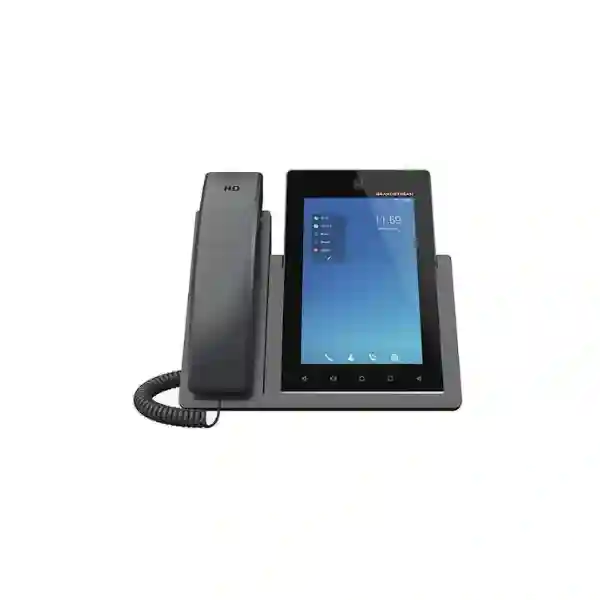
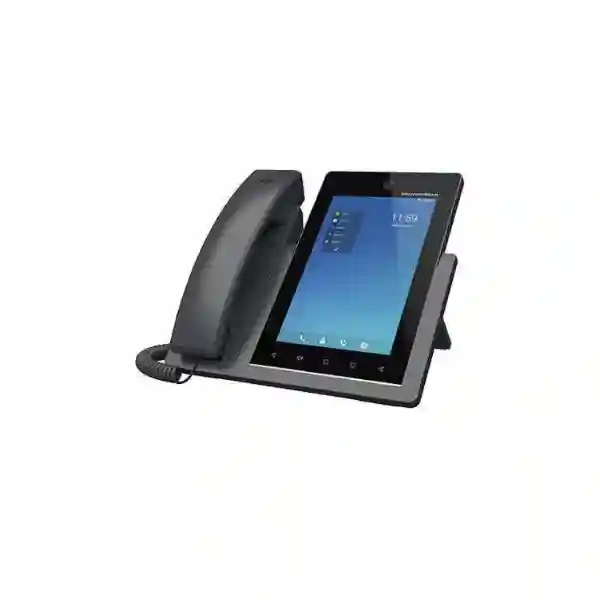
Grandstream GXV3470 Tanzania
The Grandstream GXV3470 brings business calling, video collaboration and Android productivity together on one desktop endpoint. It supports 16 lines with up to 16 SIP accounts, a 7-inch capacitive touch display, dual-band Wi-Fi 6, Bluetooth 5.0, dual Gigabit Ethernet, PoE/PoE+, a built-in 2-megapixel camera with privacy shutter and advanced HD audio. For organizations in Tanzania evaluating a premium IP phone for managers, executives, reception desks, supervisory teams or collaboration-intensive users, the GXV3470 offers a modern interface without abandoning standards-based SIP telephony.
FourTeck can help buyers align the phone with the wider voice environment, including PBX compatibility, SIP account planning, PoE switching, VLAN design, Wi-Fi readiness, headset requirements and deployment standards. The aim is not simply to select a capable handset; it is to make sure the endpoint fits the call flow, network and support model that the organization intends to operate.
16 SIP accounts for multi-line business calling.
7-inch 1280×800 touchscreen for a tablet-like desktop experience.
Android 14 with support for compatible Android applications.
Wi-Fi 6, Bluetooth 5.0, Gigabit Ethernet and PoE/PoE+ for flexible deployment.
What makes the GXV3470 a business-grade smart IP phone?
The GXV3470 is designed for users who need more than a conventional voice handset. Its combination of SIP telephony, video, Android applications, touch interaction and modern network connectivity makes it appropriate where the desk phone is expected to act as a daily communications console. A manager can maintain multiple SIP identities, use a Bluetooth headset, place or join video calls and access supported Android-based tools without replacing the familiar handset-and-speakerphone workflow. This is especially useful in organizations standardizing on IP telephony while also trying to reduce the number of separate devices sitting on an executive or supervisory desk.
Grandstream specifies a quad-core 2.0 GHz ARM Cortex-A55 processor, 4 GB RAM and 16 GB eMMC flash for the GXV3470. The endpoint uses dual switched 10/100/1000 Mbps network ports, integrated dual-band Wi-Fi 6 and Bluetooth 5.0. Built-in PoE and PoE+ allow power and data to share an Ethernet connection when the connected switch provides the required power. These capabilities are valuable during structured rollouts because administrators can choose a wired voice VLAN, a wireless deployment where appropriate, or a mixed environment based on room layout and cabling availability.
The phone includes a tiltable 2-megapixel CMOS camera with a privacy shutter. Grandstream lists 10-way HD audio conferencing and 3-way 720p 30 fps HD video conferencing for the model. The dual-microphone HD speakerphone includes Noise Shield 2.0, advanced echo cancellation and support for double-talk performance. In practical terms, the GXV3470 is best treated as a premium SIP endpoint whose video and Android capabilities can complement a broader unified-communications design rather than as a replacement for every meeting-room system.
Voice and SIP
Sixteen lines and up to sixteen SIP accounts support users who manage multiple extensions, departments, identities or call-routing roles. Confirm PBX feature interoperability before large deployment.
Video collaboration
A 2 MP privacy-shutter camera and 3-way 720p video conferencing capability provide desk-based visual communication for compatible workflows.
Modern connectivity
Wi-Fi 6, Bluetooth 5.0, dual Gigabit Ethernet and PoE/PoE+ simplify connection to wired networks, wireless networks, mobile devices and supported headsets.
Central management
Grandstream lists GDMS device management support, which can help administrators standardize provisioning and lifecycle administration across compatible deployments.
Grandstream GXV3470 technical specifications
| Lines / SIP accounts | 16 lines, up to 16 SIP accounts |
| Display | 7-inch 1280×800 capacitive touch screen |
| Operating system | Android 14 |
| Camera | Tiltable 2 MP CMOS camera with privacy shutter; up to 1080p 30 fps camera capability |
| Conferencing | 10-way HD audio; 3-way 720p 30 fps video conferencing |
| Ethernet | Dual switched 10/100/1000 Mbps ports |
| Wireless | Dual-band Wi-Fi 6, Bluetooth 5.0 |
| Power | PoE / PoE+ |
| Processor / memory | Quad-core 2.0 GHz ARM Cortex-A55, 4 GB RAM, 16 GB eMMC flash |
| Peripheral interfaces | HDMI-out, USB, RJ9 headset with EHS support |
Deployment, integration and buying guidance
A premium endpoint should be selected in relation to the PBX and network rather than in isolation. Before ordering, identify the SIP platform, extension count, expected call features, video use, headset preference, PoE availability and network segmentation policy. If the phone will be connected to an existing PBX, confirm that the required SIP functions—such as transfer, hold, voicemail indication, BLF behavior, directory integration or call recording controls—operate as expected. SIP standards provide a strong compatibility foundation, but advanced vendor-specific behavior can differ between platforms.
Network readiness is equally important. Voice benefits from predictable latency, low packet loss and appropriate Quality of Service. If the organization uses voice VLANs, DHCP options or automated provisioning, the deployment plan should document how each GXV3470 receives its configuration. PoE simplifies desk installation, but the switch must have enough total power budget for the number of connected phones and other powered devices. Where Wi-Fi is preferred, administrators should confirm signal quality, channel planning and authentication policy at the actual desk locations rather than assuming that general office coverage is sufficient for consistent voice and video.
For broader infrastructure planning, FourTeck Tanzania provides contextual guidance on IP telephony, networking and collaboration solutions, while the FourTeck Tanzania services overview helps buyers consider installation, configuration and lifecycle requirements alongside hardware selection. The Tanzania contact page can be used to provide quantities, PBX details, preferred accessories and project requirements for quotation.
Grandstream GXV3470 Tanzania
For Tanzanian organizations, the GXV3470 is most relevant where the telephone user needs richer interaction than a standard button phone can provide. Executive teams, managers, customer-facing coordinators, IT supervisors, operations leaders and reception staff may handle multiple call paths and collaboration tools through the day. The 7-inch touch display provides a clear interface for contacts, call history, Android applications and phone settings, while the handset, speakerphone and headset options preserve conventional business calling ergonomics. This combination can help a company standardize high-capability desks without moving every user to a softphone-only workflow.
Procurement in Tanzania should begin with the communications architecture. Confirm whether the site already runs a SIP-compatible PBX, whether extensions are local or hosted, whether the network switches support PoE/PoE+, and whether the existing LAN has voice VLANs and QoS policies. A new office may choose to design these elements together, while an existing site may need an audit before replacing phones. If the current telephony system relies on analog extensions, proprietary digital ports or an older PBX without standard SIP support, additional gateways or a PBX upgrade may be required. Those dependencies should be identified before endpoint quantities are finalized.
The GXV3470 can also fit mixed connectivity environments. Dual Gigabit Ethernet supports a conventional wired desk deployment and Wi-Fi 6 allows wireless connection where cabling constraints justify it. Bluetooth 5.0 can connect supported wireless headsets or mobile devices, which is valuable for managers who move between handset and headset workflows. For offices using UPS-backed PoE switches, keeping the voice network on centralized protected power can improve continuity during short power interruptions; actual runtime depends on the complete power design and cannot be inferred from the phone alone.
When requesting a Tanzania quotation, provide the number of GXV3470 phones, the PBX brand and model, whether a SIP trunk is already active, the number of locations, headset requirements, preferred wired or wireless connectivity, and whether installation or configuration assistance is needed. This information allows the quote to address the full deployment rather than only the handset. If the project spans East Africa, the FourTeck Uganda regional site and FourTeck Kenya regional site provide related regional context for multi-country requirements.
Grandstream GXV3470 Dar es Salaam
In Dar es Salaam, the GXV3470 is a strong fit for headquarters, professional offices, hospitality administration, logistics companies, financial teams, technology businesses and regional operations centers that depend on structured voice communication. The city’s concentration of multi-department organizations means many deployments involve reception, management, sales, support and branch communication rather than a single small office. For these environments, sixteen SIP accounts give the endpoint room to support complex line assignments or multiple identities, although the actual account design should remain simple enough for users to operate confidently.
A Dar es Salaam deployment should be planned around the existing LAN. Buildings with several floors or departments may already use managed switches, VLANs and multiple internet links. The phone’s dual Gigabit Ethernet ports can fit a wired desk design, while PoE/PoE+ can reduce local power adapters. However, the PoE switch budget must be checked across all phones, wireless access points, cameras and other powered endpoints. Where the site uses Wi-Fi 6, the GXV3470 can connect wirelessly, but business voice and video should still be validated at each desk for signal strength, interference, roaming behavior and congestion.
The built-in camera can be useful for managers who frequently coordinate with branches, suppliers or regional colleagues. Its privacy shutter gives users a physical way to cover the camera when video is not required. For teams that handle long calls, Bluetooth 5.0 and RJ9/EHS headset options can support hands-free workflows. Headset selection should consider wearing style, call-control compatibility and the amount of ambient noise around the desk. A front desk in a busy lobby can have different audio requirements from an executive office or customer service workstation.
Buyers in Dar es Salaam should request a project quote that lists required quantities, PBX platform, SIP provider, desk locations, switching infrastructure and desired configuration services. It is also useful to identify whether users need video calling, Android applications, centralized management or simply a premium touch-based interface. If most users only need basic voice, a mixed-model deployment can be more economical: reserve GXV3470 units for high-value roles and use simpler SIP phones elsewhere, while maintaining a consistent PBX and provisioning framework.
Grandstream GXV3470 Mwanza
Organizations in Mwanza can use the GXV3470 as part of a modern IP telephony rollout for management offices, education, healthcare administration, hospitality, distribution, mining-support operations and other businesses that coordinate with teams outside the city. Its strength is the combination of standards-based SIP communication with a larger touch interface and integrated video. A branch manager who frequently communicates with a Dar es Salaam head office, for example, can use voice as the default channel while retaining desk-based video and Android productivity options when the workflow requires them.
Connectivity planning is particularly important for branch deployments. The phone itself supports Gigabit Ethernet and Wi-Fi 6, but call quality ultimately depends on the WAN path between branches, the SIP platform and the local LAN. Before rollout, confirm internet stability, firewall policy, NAT behavior, DNS, voice VLAN design and QoS. If the PBX is hosted or located in another city, administrators should test real call conditions rather than relying only on theoretical bandwidth. Voice is generally bandwidth-efficient, yet jitter and packet loss can still damage perceived quality even when internet speed tests look fast.
For sites with centralized PoE, the GXV3470 can be powered from a managed switch and kept within the same structured cabling environment as computers and access points. The phone’s second Ethernet port can be useful in desk layouts where a computer shares a nearby network point, provided the network design and VLAN policies are configured correctly. Wi-Fi can solve cabling challenges, but it should not be treated as an automatic shortcut; the radio environment should be surveyed where business calls are critical.
Mwanza buyers should also think about supportability. Standardized firmware, naming conventions, configuration backups and centralized management can reduce troubleshooting effort when phones are spread across departments or multiple premises. When asking for pricing, include whether the devices are replacing existing SIP phones, expanding a current Grandstream system or forming part of a new PBX deployment. That distinction affects provisioning, migration planning, user training and the possibility of staged cutover without disrupting normal business communication.
Grandstream GXV3470 Arusha
Arusha businesses often combine local operations with frequent national and international communication, making a feature-rich SIP video phone relevant to hospitality management, tourism companies, NGOs, conference operations, professional services and regional offices. The GXV3470 gives high-usage staff a touchscreen endpoint that can handle conventional calling, multiple SIP accounts, video communication and compatible Android applications. The key procurement question is not whether the phone has many features, but whether those features match the job role and can be administered consistently.
Hospitality and tourism environments, for example, may have reception desks, reservations teams, accounts, managers and back-office staff with different call patterns. A GXV3470 may be appropriate for supervisory or management positions that need richer access and video, while general guest-service phones may need simpler endpoints. Designing the endpoint mix by user role prevents over-specification and keeps training straightforward. The sixteen SIP accounts can support complex communications, but users should see only the functions they actually need in their daily interface.
For conference-oriented organizations, the built-in camera and 3-way video capability can support quick desk meetings, but larger rooms should still use purpose-built room collaboration systems with appropriate microphones, speakers, displays and camera framing. The GXV3470 should therefore be positioned as a personal desktop collaboration endpoint rather than a substitute for every meeting room. This distinction matters when budgeting for an office refresh because personal and room collaboration solve different acoustic and visual problems.
Arusha procurement teams should provide the existing PBX or cloud telephony platform, expected quantity, office layout, PoE switch details, network segmentation policies and any requirements for Bluetooth or EHS headsets. If users need third-party Android applications, application compatibility should be tested against Android 14 and organizational security rules before mass deployment. A short pilot with representative users can reveal issues with call flows, directories, headset control and app behavior before the configuration is cloned to the wider fleet.
Grandstream GXV3470 Dodoma
In Dodoma, the Grandstream GXV3470 can serve organizations that require a modern SIP endpoint for administrative offices, institutions, service organizations, education, healthcare management and multi-department operations. The phone’s Android 14 platform and touch interface make it especially suitable for users who need more contextual interaction than a traditional keypad phone offers. Contacts, call history, settings and compatible communication applications are easier to navigate on a larger display, while the physical handset remains familiar to users accustomed to standard office telephony.
Deployment planning should begin with governance as well as networking. If a public-sector, institutional or regulated environment uses specific security policies, administrators should define which Android applications may be installed, how passwords are managed, whether USB access is permitted and how firmware updates are controlled. The GXV3470 supports a wide range of functionality, but a business rollout benefits from deliberate restriction and standardization. An endpoint that is configured consistently is generally easier to support than one where every user installs different applications and changes network settings independently.
Voice services should be integrated with network policy. Managed switching, voice VLANs, DHCP, DNS, time synchronization and firewall rules can all affect provisioning and call behavior. If a site uses PoE, verify switch capacity and UPS design. If Wi-Fi is chosen for selected rooms, test the 2.4 GHz and 5 GHz environment and use the network that provides the most predictable service at each desk. High-quality video is more sensitive to inconsistent wireless conditions than basic voice, so wireless convenience should be balanced against application expectations.
When sourcing GXV3470 units for Dodoma, include the anticipated deployment phase and support model in the request. A small executive rollout may need only configuration and user setup, while a larger institutional project may require extension planning, PBX configuration, VLAN changes, labeling, documentation, firmware standardization and administrator handover. Capturing these requirements early makes the commercial comparison more meaningful because it separates the endpoint cost from the work necessary to make the system operational.
Grandstream GXV3470 UAE
For UAE-based projects or Tanzania organizations coordinating procurement through the Gulf, the GXV3470 fits enterprise and SME environments that use SIP telephony and want a premium video-capable Android endpoint. Multi-site businesses often compare phones not only on purchase price but also on provisioning, lifecycle management, headset compatibility, remote support and consistency across offices. Because the GXV3470 supports 16 SIP accounts, Wi-Fi 6, Bluetooth 5.0, Gigabit networking and PoE/PoE+, it can fit a wide range of office architectures without forcing one connectivity method.
A UAE procurement team planning units for a Tanzania branch should keep configuration ownership clear. Decide whether phones will be provisioned centrally before shipment, configured at the destination, or enrolled into a management platform for remote administration. SIP credentials and security information should be handled through controlled processes rather than shared informally. If the destination site has a different PBX, VLAN structure or SIP carrier from the UAE office, the configuration template should reflect those differences instead of assuming one global profile.
The Android platform can be useful for approved collaboration and productivity applications, but cross-border standardization should include application policy. An app that is accepted in one office may not be required or permitted in another. Administrators should test critical apps, document versions and determine how updates will be managed. The phone remains first and foremost a communications endpoint, so additional software should not compromise stability or make support unnecessarily complex.
Commercially, buyers should compare the complete landed and operational requirement rather than only a headline unit price. Quantities, accessories, power method, PBX licensing, SIP services, freight, local installation and support can all affect the project. For a Tanzania-focused project, the practical goal is to ensure the equipment arrives with a configuration and infrastructure plan that works at the destination. That approach is more dependable than choosing a source solely because a product is listed as available online.
Grandstream GXV3470 Uganda
Ugandan organizations evaluating the GXV3470 can treat it as a premium role-based endpoint within a wider SIP phone estate. The device is particularly suitable where users need a large touch display, multiple SIP identities, desk-based video or Android applications alongside normal handset and speakerphone calling. Multi-branch companies can standardize the model for managers and operational leads while deploying simpler endpoints to general users, preserving a consistent PBX and provisioning strategy across the organization.
For multi-country projects linking Uganda and Tanzania, compatibility planning is more important than country labels on the hardware. Confirm that each office’s SIP provider, PBX platform, firewall and network design can support the planned calling model. Extension dialing between branches, centralized reception, call queues, recording and failover should be designed at the PBX and network layers. The GXV3470 then becomes the user interface to those services. Its 16 accounts provide flexibility, but the endpoint cannot compensate for poorly designed call routing or unstable WAN links.
PoE can simplify branch deployment by reducing local adapters and keeping phones on centrally backed switching. The business should still validate power budgets, UPS runtime and cabling quality. Wi-Fi 6 is useful where a wired drop is unavailable, but voice and video traffic require a predictable radio environment. For offices with many wireless users, access-point density, channel planning and uplink capacity should be considered alongside phone count.
Procurement requests should specify whether phones are for Kampala headquarters, up-country branches or a distributed fleet because the provisioning and logistics model may change. The FourTeck Uganda site provides a regional point of reference for Uganda-focused requirements, while Tanzania deployments can be coordinated through the Tanzania contact route. A clear bill of materials should separate phones, headsets, switching, PBX components and services so buyers can evaluate the project transparently.
Grandstream GXV3470 Kampala
Kampala offices often combine customer-facing teams, administration, regional management and branch coordination, making the GXV3470 relevant for roles that need multiple communication tools at the desk. The touchscreen can reduce dependence on nested button menus, while the built-in camera supports short video interactions without requiring a separate webcam and computer workflow. Bluetooth and headset connectivity help users who spend long periods on calls, particularly sales, support and coordination staff.
A Kampala deployment should start with user classification. Executives may value video and Android apps; reception teams may prioritize multiple line appearances and headset use; operations staff may need quick directory access and internal calling. Not every user requires the same phone. Combining the GXV3470 with other SIP endpoints can keep the rollout cost aligned with actual business needs while retaining standardized provisioning and support procedures.
Networking should be tested under realistic conditions. A phone connected through Gigabit Ethernet and PoE has a straightforward physical path, but VLAN tagging, DHCP, firewall policy and QoS must still be correct. A Wi-Fi deployment requires adequate 5 GHz or 2.4 GHz coverage and should be monitored for congestion. When the PBX is cloud-hosted, the internet path becomes part of the voice system, so redundancy and failover can be more important than raw bandwidth alone.
For quotations, Kampala buyers should include whether the project is new, an expansion or a migration from another phone system. Migration projects need more planning because existing numbers, call flows, queues and user habits must be preserved or deliberately redesigned. A pilot group can validate SIP registration, call transfer, conferencing, headset control, video behavior and application compatibility before the production fleet is configured. This reduces the chance of repeating a configuration mistake across dozens of desks.
Grandstream GXV3470 Arua
For organizations in Arua, the GXV3470 can be useful as a high-capability endpoint for branch leaders, NGOs, healthcare administration, education, logistics and businesses that communicate frequently with national offices. Branch environments benefit from phones that can be managed consistently from a central IT team, but that value depends on reliable provisioning and network design. Administrators should define configuration templates, extension naming and firmware policies before the branch rollout begins.
WAN quality deserves special attention when the PBX or SIP service is hosted outside the local site. Users may experience poor calls because of packet loss, jitter or unstable routing even when a speed test reports reasonable bandwidth. Voice monitoring and real call testing are therefore more useful than relying on advertised internet capacity. Where a secondary internet connection is available, the firewall and PBX design should define how SIP sessions behave during failover to avoid unexpected registration or media problems.
The GXV3470’s Wi-Fi 6 support can help in offices where cabling is incomplete, but wireless deployment should be deliberate. A fixed desk phone is often easy to cable and can benefit from PoE; Wi-Fi is best used where it solves a real physical or architectural problem. Bluetooth can be reserved for headsets or mobile-device interaction rather than as a substitute for network planning. Clear separation of these connection types makes troubleshooting easier for remote support teams.
Arua purchasers should specify quantities and whether they need only endpoints or a complete voice solution. If the existing environment does not have a SIP-capable PBX, the project may also require a PBX, SIP trunk, switch ports, QoS policy and user training. If a compatible PBX is already in place, the work may be limited to account creation, templates and endpoint provisioning. Distinguishing those scenarios prevents an apparently simple phone purchase from turning into an unplanned communications migration.
Grandstream GXV3470 Mbarara
Mbarara businesses considering smart IP telephony can use the GXV3470 for managers, team leaders and customer-facing staff who require more than basic dial-and-transfer functionality. Its Android 14 interface supports a modern user experience, while the phone remains standards-based around SIP. This can be attractive for organizations that want a familiar desk handset but also need video, touch navigation and selected Android apps without issuing a separate tablet to every high-usage user.
The deployment should be sized according to role and infrastructure. If only a handful of users need video and touch interaction, those users can receive GXV3470 units while the rest of the office uses simpler phones. If the entire office needs the same interface, centralized management becomes more important. Administrators should maintain a tested configuration baseline, document changes and avoid unnecessary per-user customization that makes future replacement or troubleshooting harder.
Power and network resilience should be part of the design. PoE lets phones share the network switch’s power source, making UPS protection easier to centralize. However, the phone, switch, router, firewall and internet equipment all need power for calling to continue. A UPS connected only to the phone switch will not help if the router or PBX loses power. The full communication chain should therefore be reviewed when continuity is a procurement objective.
When requesting the GXV3470 for Mbarara, buyers should list the required calling functions, intended PBX, number of sites, internet topology and any branch-to-branch dialing needs. If video collaboration is important, test upstream as well as downstream internet performance. If headsets are required, identify the preferred type and control expectations. These details help ensure the quote covers compatible accessories and configuration requirements rather than treating the handset as an isolated item.
Grandstream GXV3470 Gulu
The GXV3470 can suit Gulu organizations that need dependable SIP voice plus richer collaboration at selected desks. Examples include branch management, NGO coordination, education administration, healthcare offices, service businesses and logistics operations. The model’s 7-inch touch screen and Android environment can make daily communication more intuitive for users who regularly switch between contacts, multiple lines and collaboration tools.
A branch office should not assume that because the endpoint is feature-rich, every feature needs to be enabled. IT teams should start with the functions required for normal work and add applications or advanced calling features deliberately. This reduces training burden and lowers the risk of inconsistent behavior between phones. If centralized device management is used, configuration templates can enforce a common baseline while still allowing role-specific settings where necessary.
For remote support, documentation is important. Each phone should have a clear extension identity, network assignment and ownership record. Switch ports, VLANs, PBX extensions and firmware versions should be traceable. When a user reports a problem, support staff can then separate endpoint issues from network or SIP-provider issues more quickly. This approach is especially useful when the technical team is not physically present at the branch.
Gulu buyers should consider whether the project may expand later. Sixteen SIP accounts give the phone capacity, but branch growth can also require more switch ports, PoE capacity, internet bandwidth and PBX licensing. A quotation that anticipates likely expansion can prevent short-term savings from creating a redesign within a year. The objective is not to overbuild the site; it is to leave a practical path for adding users and features without discarding the initial infrastructure.
Grandstream GXV3470 Kenya
Kenyan businesses can use the GXV3470 in the same role-based way as Tanzanian deployments: a premium SIP video endpoint for managers, reception teams, supervisors and users who benefit from a touchscreen and Android applications. For companies operating in both countries, the larger benefit may be standardization. Using the same endpoint family, provisioning conventions and support documentation across sites can simplify administrator training and reduce the number of different spare models that IT must maintain.
Cross-border standardization should still allow local differences. SIP carriers, numbering plans, emergency-dial rules, internet links and PBX locations can vary. Configuration templates should therefore separate common phone settings from country- or site-specific settings. A centralized PBX may make inter-office extension dialing simple, while separate PBXs may require SIP trunks or other interconnects. Those choices belong to the voice architecture and should be confirmed before endpoint rollout.
The GXV3470’s dual Gigabit Ethernet and PoE/PoE+ are useful for structured office LANs, while Wi-Fi 6 provides another deployment option. Headset users can take advantage of Bluetooth 5.0 or supported wired/EHS connections. As with any Android-based enterprise endpoint, organizations should maintain application and security discipline. Approved apps should be tested, and administrators should manage updates in a way that protects call stability.
For Kenya-specific requirements, the FourTeck Kenya website can support regional planning, while Tanzania-focused procurement can use the FourTeck Tanzania contact route. A multi-country RFQ should state quantities by location, PBX topology, preferred currency and logistics assumptions, and whether endpoints need pre-configuration. That gives suppliers a clearer basis for comparing the same scope rather than mixing hardware-only and turnkey quotations.
Grandstream GXV3470 Kuwait
Kuwait organizations that use SIP telephony can deploy the GXV3470 where users require a premium touch interface, multiple accounts and video capability. In multinational companies, Kuwait-based procurement teams may also source communications equipment for East African branches. In that case, technical standardization and destination-site compatibility matter more than simply buying the same handset model. The endpoint must be provisioned against the correct PBX, network and regional calling environment.
A common procurement mistake is to assume that a phone configured successfully at headquarters can be shipped unchanged to a branch. SIP registration may depend on local DNS, firewall rules, certificates, provisioning URLs or account credentials. Voice VLAN IDs can differ, and the target site may use another switch vendor or internet provider. Deployment documents should therefore record which settings are global and which must be generated for each location.
The phone’s Android 14 platform can support compatible applications, but organizations with formal security governance may want to limit installation rights. A controlled endpoint generally provides a more stable lifecycle than an open consumer-style tablet. Administrators can focus on the communication applications and tools that are directly useful to the role. The privacy shutter on the camera is also useful in offices where users want clear physical control over when the camera is exposed.
For a Kuwait-to-Tanzania project, the RFQ should include final destination, quantity, whether phones need pre-provisioning, headset requirements, PBX details and any need for on-site commissioning. Shipping and warranty handling should be explicitly clarified in the commercial quote rather than assumed. This approach keeps technical suitability and procurement accountability aligned across borders.
Grandstream GXV3470 Ghana
Ghanaian organizations looking for a smart video IP phone can consider the GXV3470 for senior staff, support teams and communication-intensive roles. Its sixteen SIP accounts give administrators room to build flexible extension configurations, while the 7-inch touch screen provides a more visual user experience than conventional desk phones. The integrated camera and conferencing features support desk-based collaboration, and Bluetooth or wired headset options suit users who spend significant time on calls.
For businesses operating across Ghana and East Africa, endpoint consistency can simplify support. IT teams can maintain one configuration methodology, common firmware policies and familiar troubleshooting steps. However, local telecom and networking differences should be reflected in deployment templates. The PBX, SIP trunk and firewall determine how calls enter and leave the organization; the GXV3470 presents those services to the user but does not replace them.
Before ordering, review PoE switch capacity and the number of powered devices connected to each switch. If phones share switching with access points and cameras, the total power requirement can be more important than the individual phone requirement. For Wi-Fi-based phones, validate coverage and capacity at desk level. Android app use should be controlled according to company policy so that communications remain the primary purpose of the device.
A complete Ghana quotation request should identify whether the customer needs hardware only, remote configuration or a full voice solution. If replacing an old PBX, include existing extension counts and call-flow expectations. If adding to a current SIP system, provide the PBX brand, firmware level and provisioning process. Clear technical information reduces the risk of purchasing a capable endpoint that later requires unexpected integration work.
Grandstream GXV3470 Nigeria
Nigeria’s large and diverse business market creates many use cases for a premium SIP video phone, from corporate offices and financial services to education, healthcare, logistics, technology and hospitality. The GXV3470 is most appropriate where users benefit from its touchscreen, multiple SIP accounts, video camera, Android 14 environment and headset connectivity. It can be standardized for managers and high-usage roles without requiring the same specification at every desk.
Large deployments should pay close attention to provisioning. Manually configuring each phone becomes inefficient and error-prone as quantities increase. A structured template, centralized management and well-defined device naming can reduce deployment time and make replacement easier. Administrators should also maintain firmware consistency and test updates on a small group before applying them broadly, especially when critical Android applications or PBX features are involved.
Network resilience is important for SIP systems. Where the business uses multiple internet connections, the firewall and SIP design should define how registrations and media behave if the primary link fails. QoS can prioritize voice inside the LAN, but it cannot fix every problem on an uncontrolled internet path. Hosted PBX deployments should therefore be evaluated with real call testing and appropriate WAN monitoring.
Nigeria buyers sourcing for a Tanzania project should state the final deployment location and support expectations clearly. A phone that is physically available in one country is not automatically the best procurement route for another if configuration, warranty handling or local commissioning are unclear. The quotation should distinguish device supply from PBX work, switching, headsets and professional services so decision-makers can compare equivalent scopes.
Grandstream GXV3470 Seychelles
Seychelles businesses, particularly hospitality, tourism, professional services and multi-property operators, may find the GXV3470 useful for management and back-office positions that require richer communication than standard guest-room or basic office phones. The touchscreen, multiple SIP accounts, video capability and Android environment suit supervisors and coordinators, while simpler phones may remain appropriate for rooms, common areas or low-complexity extensions.
Island and multi-property deployments benefit from careful remote-management planning. If IT support is centralized, phones should be provisioned in a consistent way and documented so replacements can be brought online without specialist intervention at every location. PBX redundancy, internet connectivity and VPN design may be more important to service continuity than the endpoint itself. The phone’s feature set should therefore be matched with an architecture that can be supported practically from the available technical team.
PoE is particularly useful for organized deployments because phones can be powered from network switches and protected through centralized UPS systems. Wi-Fi 6 offers flexibility in locations where installing new cables is difficult, but signal quality should be assessed room by room. Hospitality properties can have thick walls, complex layouts and high guest wireless usage, all of which can affect radio performance. A wired connection remains the preferred baseline for fixed critical desks when structured cabling is available.
Seychelles procurement teams should identify shipping, configuration and support expectations before placing an order. If phones are part of a property-wide voice refresh, the project should include extension planning, PBX capacity, switch PoE budgets, call routing and staff training. If only a few management phones are being added, confirm interoperability with the existing SIP system and test required features. A small technical validation can prevent a minor endpoint purchase from exposing hidden limitations in an older PBX.
Compatibility and integration checklist
The GXV3470 uses standards-based SIP, but businesses should still verify the specific features they need with their chosen PBX or hosted platform. Registration and basic calling are only the starting point. Test transfer, hold, conference behavior, BLF, voicemail indicators, directory functions, DTMF, codecs, video interoperability, headset call control and any application integrations that matter to users. When the phone will be deployed in quantity, document the accepted configuration as a repeatable standard.
For network integration, confirm VLAN policy, DHCP, DNS, NTP, firewall rules, PoE budget, QoS and provisioning access. For wireless use, confirm SSID, authentication, coverage and capacity. For Android applications, validate compatibility with Android 14 and the organization’s security policy. For remote branches, test the WAN path to the PBX and plan failover behavior. These checks make the GXV3470 part of a controlled communications platform rather than an individually configured smart device.
Who should choose the Grandstream GXV3470?
The GXV3470 is a strong candidate for executive users, managers, reception or coordination roles, supervisors and staff who need frequent desk-based video or Android applications. It is also useful for businesses that want a modern interface while retaining a conventional handset. A simpler IP phone may be more appropriate for users who make only basic voice calls and do not need the touch display, camera or Android environment. A good deployment therefore maps endpoint capability to user role instead of assuming that one premium model should be installed everywhere.
Organizations should also consider the support model. Android-based endpoints offer flexibility, but that flexibility should be governed. Approved applications, firmware updates, account templates, passwords, network settings and remote management should be defined centrally where possible. This keeps the user experience consistent and reduces the time required to diagnose issues.
If the primary requirement is a meeting-room system, evaluate purpose-built video conferencing equipment rather than using a desktop phone to solve a room-scale problem. If the requirement is only basic desk voice, compare the GXV3470 with simpler SIP models. The GXV3470 delivers its best value where the business genuinely uses the combination of voice, video, touch interaction and application capability.
Frequently asked questions
Does the Grandstream GXV3470 support Android 14?
Yes. Grandstream’s current product information and updated GXV34x0 documentation list Android 14 for the GXV3470. Organizations planning third-party applications should still verify that each required app is compatible with the phone and their security policy.
How many SIP accounts does the GXV3470 support?
The GXV3470 supports 16 lines with up to 16 SIP accounts. That makes it suitable for users who need multiple identities or line appearances, although the exact account configuration depends on the PBX and call-flow design.
Does it have Wi-Fi and Bluetooth?
Yes. Grandstream lists integrated dual-band Wi-Fi 6 for 2.4 GHz and 5 GHz networks and Bluetooth 5.0 for compatible mobile-device and headset connectivity.
Can the GXV3470 be powered through PoE?
Yes. It supports PoE and PoE+. The connected switch must provide sufficient power, and larger deployments should verify the total switch PoE budget for all connected phones and other powered devices.
Does the GXV3470 support video conferencing?
Yes. Grandstream specifies 3-way 720p 30 fps video conferencing for the GXV3470, together with 10-way HD audio conferencing. Video interoperability should be tested with the intended platform before large-scale deployment.
What information should I provide for a Tanzania quote?
Provide quantity, city or site locations, PBX brand/model, SIP provider if known, whether the network has PoE, wired or Wi-Fi preference, headset requirements, video use, and whether you need configuration, installation or migration assistance. This helps produce a quote based on the actual deployment scope.
Quotation checklist for Grandstream GXV3470 projects
Decision recap
Choose the Grandstream GXV3470 when the user role benefits from a premium touchscreen SIP phone with integrated video, Android 14, Wi-Fi 6, Bluetooth 5.0, Gigabit Ethernet and PoE/PoE+. Its sixteen SIP accounts, HD audio features and camera make it well suited to communication-intensive desks. For basic extensions, compare simpler endpoints so the project budget follows user needs.
Before purchase, validate PBX interoperability, network readiness, PoE capacity, headset requirements and application policy. For multi-site deployments, standardize firmware and configuration while preserving site-specific SIP and network settings. A controlled pilot is a practical way to confirm the design before full rollout.
Plan your GXV3470 deployment with FourTeck Tanzania
FourTeck can help you translate a product requirement into a usable communications deployment by reviewing phone quantities, PBX compatibility, network readiness, PoE switching, Wi-Fi, VLANs, headsets and configuration expectations. Whether you are equipping a few executive desks or planning a multi-site refresh, providing the technical context early makes the quotation more accurate and reduces avoidable integration work.
Use the Tanzania contact page to share your quantity and project details. FourTeck will base the discussion on your deployment requirements rather than making assumptions about stock, delivery schedules or site coverage before those details are confirmed.




Reviews
There are no reviews yet.