
Grandstream GWN7002 Tanzania
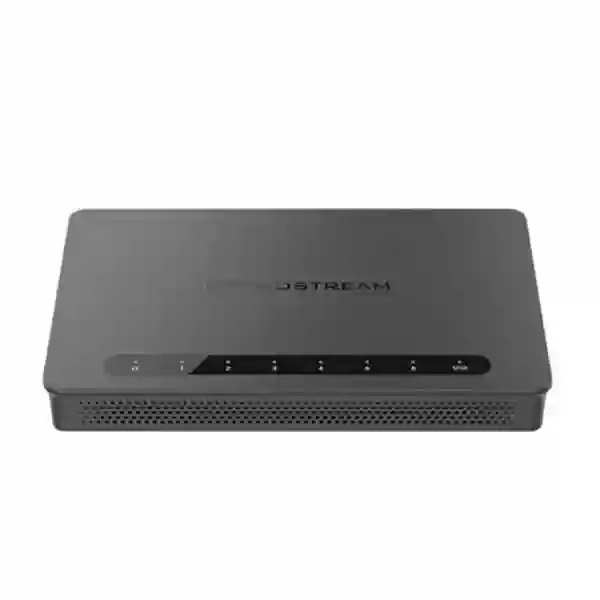
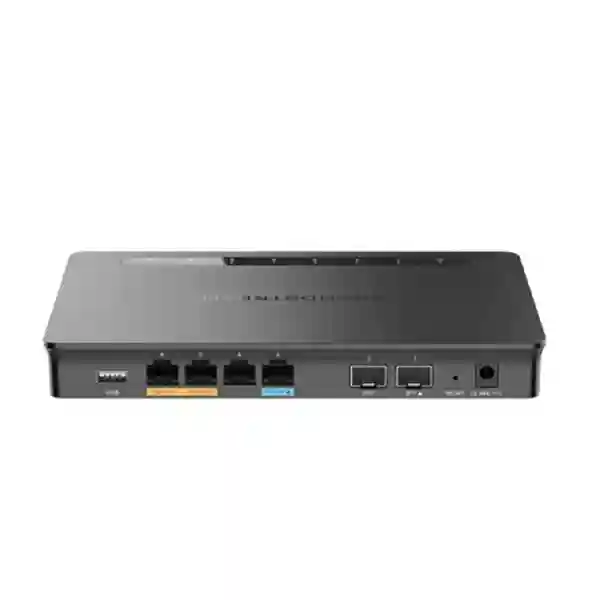
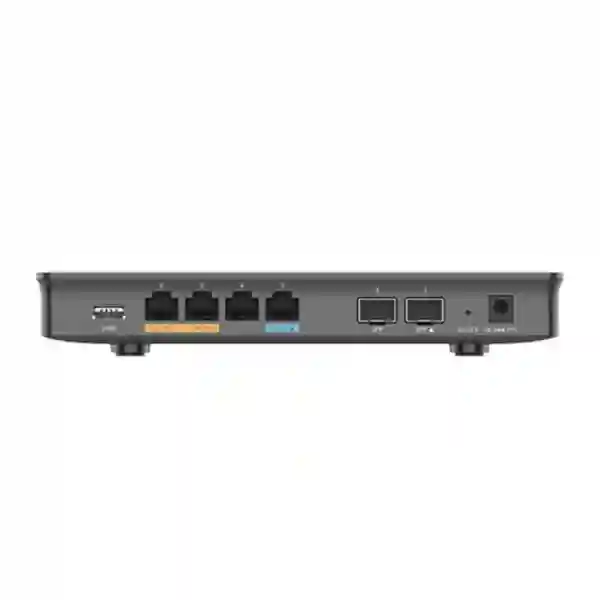
The Grandstream GWN7002 is a wired Multi-WAN Gigabit VPN router built for organisations that need resilient internet connectivity, secure branch links, controlled network segmentation and central management without moving immediately to a large enterprise firewall platform. It combines four Gigabit Ethernet ports and two 2.5 Gigabit SFP ports, with all network interfaces configurable for WAN or LAN roles. That flexibility makes the GWN7002 particularly useful when a site has different carrier handoffs, fibre uplinks, backup internet circuits or separate routed network zones.
For Tanzania buyers, the practical value is not simply the port count. The platform supports multi-WAN load balancing and failover, up to 2.2Gbps NAT routing performance, up to 530Mbps IPsec VPN throughput, up to 50 concurrent VPN tunnels, QoS, firewall functions, content filtering and Deep Packet Inspection-based traffic visibility. It can also act as an embedded controller for Grandstream GWN access points, helping smaller and mid-sized environments simplify network administration. FourTeck can help scope the router around your actual ISP links, branch connectivity, VLAN plan, Wi-Fi estate and voice requirements before quotation.
Official Grandstream specifications list up to 2.2Gbps NAT routing performance for the GWN7002.
Two 2.5 Gigabit SFP interfaces give useful flexibility for fibre or higher-speed uplink designs.
Load balancing, WAN backup and bandwidth management help reduce dependence on a single internet circuit.
IPsec, OpenVPN, WireGuard, PPTP and L2TP options sit alongside firewall, filtering, NAT and traffic-control functions.
What the GWN7002 solves for business networks
Many growing business networks reach a point where a basic consumer router no longer provides enough control. A second internet circuit may have been added, but there is no clean failover policy. A branch needs a permanent VPN tunnel to head office. Voice, guest Wi-Fi, staff traffic and surveillance share the same flat network. Network administrators need to see which applications consume bandwidth, but the existing gateway offers little visibility. The GWN7002 addresses this class of requirement with business-oriented routing, VPN, firewall, QoS and management functions in one wired gateway.
Because every Ethernet and SFP interface can be assigned as WAN or LAN, the device can be adapted to different site topologies rather than forcing every deployment into one fixed port layout. A Tanzania office might use one Gigabit Ethernet interface for a primary ISP, another for a backup circuit, an SFP interface toward a fibre aggregation switch and remaining interfaces for internal VLAN trunks or management. The correct arrangement depends on the carrier equipment, switching design, addressing plan and resilience target, so a pre-deployment diagram is worthwhile.
The GWN7002 is also useful in Grandstream-centred environments because its embedded controller can manage the router itself and Grandstream GWN access points. Current Grandstream documentation identifies support for managing up to 100 GWN APs from the GWN7002 embedded controller, while cloud and on-premise management options are also available through Grandstream platforms. This means the router can sit at the centre of a compact branch or campus design without requiring separate controller hardware for every use case.
Verified GWN7002 technical specifications
| Specification | GWN7002 |
|---|---|
| CPU | Dual ARM Cortex A53 1GHz |
| Memory / sessions | 256MB RAM, 256MB flash, 30K NAT sessions |
| Network interfaces | 4 × Gigabit Ethernet and 2 × 2.5 Gigabit SFP; all configurable as WAN/LAN |
| NAT routing | Up to 2.2Gbps |
| IPsec VPN throughput | Up to 530Mbps |
| Concurrent VPN tunnels | Up to 50 |
| PoE input | IEEE 802.3af/at |
| PoE output | 2 × PoE out; passive 48V or IEEE 802.3af |
| Auxiliary | 1 × USB 2.0 and reset pinhole |
| Mounting | Desktop or wall mounting |
| Power adapter | Universal adapter, 24V DC 1A output |
| Operating range | 0°C to 40°C; 10% to 90% non-condensing humidity |
Performance figures are vendor specifications and should be treated as platform capabilities rather than a guarantee of application experience at every site. Real network performance is affected by traffic mix, VPN encryption, WAN quality, policy configuration, packet size, congestion and the performance of connected devices.
Multi-WAN, failover and load balancing
The most important reason many buyers consider the GWN7002 is multi-WAN flexibility. A business may purchase two internet services because the cost of an outage is higher than the cost of a backup circuit. The router can use load balancing and WAN backup mechanisms so that connectivity design is not dependent on manually moving cables when one service fails. This is valuable for cloud applications, VoIP, remote access, online payments, collaboration tools and branch-to-head-office connectivity where a single failed link can stop work.
A resilient design still requires correct planning. Two circuits from different brands can share the same upstream fibre route, power source or building entry point, so apparent carrier diversity is not always physical diversity. Likewise, failover behaviour should be tested with DNS, VPN and real applications rather than only checking whether a second WAN interface receives an address. Session-sensitive applications may still reconnect when the public IP changes. FourTeck can help buyers describe the required behaviour clearly before configuration: active/standby, weighted load sharing, application priorities or a policy that reserves the backup link for essential services.
VPN, segmentation, QoS and traffic visibility
Grandstream documents IPsec, OpenVPN, WireGuard, PPTP and L2TP support on the current GWN700X software platform. In practical business use, IPsec is commonly selected for persistent site-to-site links, while remote-access methods should be chosen according to client compatibility and the organisation’s security policy. The GWN7002 supports up to 50 concurrent VPN tunnels and the official specification lists IPsec throughput up to 530Mbps. When sizing a branch design, however, VPN throughput should be compared with actual encrypted application demand rather than raw ISP speed alone.
QoS and application-aware traffic statistics help the router play a more active role in user experience. Voice traffic can be prioritised, traffic classes can be separated, and policies can reference ports, IP addresses and DSCP marking. Deep Packet Inspection-based monitoring gives administrators more context than simple byte counters. Content controls include application, URL, DNS and web filtering. These capabilities are especially useful when the gateway serves multiple user groups, although organisations with highly regulated or advanced threat-prevention requirements should evaluate whether a dedicated next-generation firewall platform is more appropriate.
Grandstream GWN management options
The GWN7002 includes an embedded management controller, giving smaller deployments a straightforward way to administer the router and compatible Grandstream GWN access points from the local environment. Grandstream documentation also describes GDMS Networking for cloud management and GWN Manager for on-premise management. This choice matters when an organisation has several branches: local embedded management may be enough for an isolated site, while centralised management can be more efficient when IT staff need shared visibility, configuration standards and remote troubleshooting across many locations.
Management architecture should be discussed before the rollout rather than after devices have been installed. Decide who owns administrator credentials, how configuration backups are stored, how firmware is reviewed, whether remote administration is permitted, and which naming convention identifies each site and access point. A well-managed GWN deployment is easier to support because the network has deliberate standards rather than a collection of individually configured devices.
Choosing the GWN7002: practical buying checklist
Before requesting a quotation, confirm the number and type of internet circuits, expected peak WAN speed, whether any handoff is fibre, the number of internal VLANs, VPN site count, remote-user requirements, access-point count, PoE expectations and future bandwidth growth. Also record the existing switch models, IP addressing, DHCP location, voice platform, CCTV network and any services that must remain reachable during a WAN failover. These details are more valuable than simply asking whether the router is “fast enough.”
If the GWN7002 will replace an existing gateway, migration planning should include public IP services, NAT rules, VPN peers, DNS dependencies, DHCP scopes, static routes, VLAN gateways and change-window rollback. If it is being used in a new site, decide whether the router or another device will provide inter-VLAN routing and DHCP. For projects that include access points, review PoE budgets and switching rather than assuming the router itself will power every wireless endpoint. FourTeck’s Tanzania business technology shop provides a broader context for selecting networking products alongside switching, wireless and security requirements.
GWN7002 Tanzania
For organisations evaluating the GWN7002 Tanzania market requirement, the strongest use case is usually a branch, office, retail operation, school, clinic, hospitality property or multi-site business that needs controlled WAN resilience and secure routing without overcomplicating day-to-day management. Tanzania connectivity can vary significantly by building, carrier handoff and location, so the right design starts with the actual circuits available at the site. A primary fibre service and a secondary broadband, wireless or cellular-backed service can be treated differently from two equivalent fixed lines. The GWN7002 gives the administrator a flexible interface layout and multi-WAN capabilities, but business continuity comes from combining that platform with sensible carrier diversity, UPS-backed power and tested policies.
In a typical Tanzania office network, the GWN7002 can sit between the internet services and the managed LAN. Staff, voice, guest Wi-Fi, cameras and infrastructure devices can be separated logically, while QoS rules protect latency-sensitive services such as IP telephony. Site-to-site VPN can connect a branch to a head office or data centre, and the router’s access-point management functions can simplify a Grandstream wireless rollout. Where multiple offices are being standardised, administrators should document interface assignments, VLAN IDs, VPN naming, firmware policy and failover test procedures so the second and third sites do not become unique one-off builds.
Procurement teams should request a quote using operational details: expected WAN bandwidth, number of users, number of branches, access-point count, required VPN topology and whether SFP connectivity is needed. Ask what power adapter and accessories are included with the offered unit and confirm compatibility with any SFP modules or upstream equipment before ordering. FourTeck’s Tanzania IT and network services overview is useful when the requirement includes configuration, switching, Wi-Fi, cabling or broader infrastructure rather than only the router.
GWN7002 Dar es Salaam
A GWN7002 deployment in Dar es Salaam often has a different emphasis from a small inland branch because the business may have higher user density, more cloud services, faster internet options and a greater dependence on always-on communications. Corporate offices, retail headquarters, professional services firms, logistics companies and hospitality sites can use the router as the wired edge for two or more WAN paths while preserving clear LAN segmentation. The two 2.5 Gigabit SFP interfaces are useful where an ISP or internal aggregation design presents fibre, while the four Gigabit Ethernet interfaces can be assigned around copper WAN and LAN requirements.
For business continuity, do not treat “dual WAN” as a complete solution on its own. Identify which applications must survive loss of the primary link, what public IP changes will occur, whether site-to-site VPN peers can re-establish automatically, and whether cloud voice or payment applications require special handling. A planned test should disconnect or disable the primary WAN during a maintenance window and verify browsing, DNS, VPN, VoIP and remote management. If the backup circuit has lower bandwidth, QoS can be especially important so critical traffic is not crowded out by backups, updates or guest usage during failover.
Dar es Salaam buyers should also consider the network around the router. Managed switches, structured cabling, UPS protection and correctly placed access points are part of reliability. The GWN7002 can manage Grandstream GWN APs, but radio coverage still depends on floor plan, wall construction, interference and client density. For an office moving from a flat network, plan VLANs for staff, guests, voice and infrastructure before migration. A clean logical design makes security policy and troubleshooting easier and gives the business room to grow without continually redesigning the gateway.
GWN7002 Mwanza
For GWN7002 Mwanza deployments, resilience planning may focus on maintaining reliable branch connectivity to central applications, cloud systems or a Dar es Salaam head office. Businesses with distributed operations often need more than simple internet access: ERP, file services, IP telephony, surveillance monitoring and remote support can all depend on the branch gateway. The GWN7002’s site-to-site VPN options, multi-WAN features and policy controls can support that architecture when configured around the actual traffic priorities of the site.
A useful starting point is to classify services into critical, important and non-critical groups. Critical applications might include transaction systems, voice, VPN access to business applications and essential management traffic. Important traffic could include normal web and collaboration use, while large software downloads or personal guest traffic can be deprioritised during constrained periods. The router’s QoS capabilities make such an approach possible, but the policy should be simple enough for administrators to maintain. Overly complex rule sets can make troubleshooting harder than the original bandwidth problem.
Mwanza organisations with several nearby offices or operational locations should decide whether each site terminates its own internet and VPN connection or whether a central site provides shared services. If each branch uses a GWN gateway, standard templates for addressing, VLANs and VPN naming can reduce support effort. Also plan power protection for the router, switches and carrier equipment; keeping only the router on UPS does not help if the optical network terminal or access switch shuts down. When requesting pricing, provide the expected branch count, ISP handoff type, VPN destination and whether local Grandstream access points will be centrally managed.
GWN7002 Arusha
The GWN7002 Arusha use case is well suited to hospitality, tour operations, education, professional offices and branch environments that need dependable internet policy and secure connectivity between sites. Hotels, lodges and guest-facing businesses may need clear separation between operational systems and guest internet. A router can provide the logical boundaries, but the design should also consider the switching and wireless layers so VLAN tags and access policies remain consistent from the gateway to each SSID or wired endpoint.
For a hospitality property, one practical architecture is to keep business administration, voice, staff devices, guest Wi-Fi and infrastructure management separate. The exact number of VLANs should match the risk and support model rather than creating unnecessary complexity. Guest traffic should not gain access to internal resources, while management interfaces should be restricted to authorised administrators. The GWN7002 supports application, URL, DNS and web filtering, along with firewall rules and traffic monitoring, giving administrators tools to build a more intentional edge policy than a basic ISP router typically offers.
Arusha sites should also evaluate WAN redundancy against the real cost of downtime. A property that relies on cloud booking systems, online payments, VoIP or remote reservations may justify a backup circuit even if average bandwidth demand is modest. The backup path should be tested during operating hours in a controlled manner to confirm that critical applications recover as expected. For wider wireless coverage, the GWN7002’s embedded GWN management can be combined with compatible Grandstream access points, but a survey or floor-plan-based AP design remains important in buildings with thick walls, multiple structures or outdoor guest areas.
GWN7002 Dodoma
For GWN7002 Dodoma requirements, common buying priorities can include secure office routing, reliable branch access, controlled guest connectivity and straightforward management for organisations that do not want a complicated edge platform. Government-related offices, education, NGOs, professional services and growing businesses may have multiple departments and a need to keep traffic separated without deploying a large appliance. The GWN7002’s four Gigabit Ethernet interfaces, two 2.5 Gigabit SFP interfaces and flexible WAN/LAN assignment give network designers options for different carrier and LAN topologies.
A Dodoma office that connects back to another city should establish a clear VPN design before equipment is installed. Define which local subnets are advertised through the tunnel, which services stay local to the internet, and what happens when the preferred WAN fails. If there are overlapping IP ranges between branches, address planning should be corrected before building permanent tunnels. The official specification lists up to 50 concurrent VPN tunnels, but practical capacity should be judged against encrypted traffic volume, WAN speed and operational complexity rather than tunnel count alone.
Power quality, rack organisation and documentation can have a large effect on reliability. The router supports desktop or wall mounting, so compact network areas are possible, but switches, ISP devices and UPS equipment should still be arranged cleanly. Keep configuration backups, note the default WAN assignments, record SFP types, label cables and document administrator access. When staff changes occur, central credential ownership prevents the site from becoming dependent on one technician’s personal account. For larger projects, the GWN7002 should be assessed alongside managed switching, access points and the organisation’s security policy as one connected architecture.
GWN7002 UAE
The GWN7002 UAE market is relevant to branch offices, retail units, small hotels, clinics and professional businesses that want a compact multi-WAN router with VPN and Grandstream network management. UAE businesses frequently operate cloud-first applications and IP telephony, so edge reliability can be more important than headline port count. A site with a primary business broadband circuit and a secondary connection can use the router’s WAN failover and load-balancing capabilities to reduce the impact of a single carrier outage, provided failover behaviour is tested with real applications.
The two 2.5 Gigabit SFP interfaces are useful in environments where the network design includes fibre handoffs or a faster uplink toward an aggregation layer. The four Gigabit Ethernet ports remain useful for copper WAN or LAN roles, and all interfaces can be assigned according to the deployment. Where offices use Grandstream access points, the embedded controller can simplify local management. Organisations with multiple sites should consider central management so administrators can apply consistent configuration standards and see remote network health without logging into each branch independently.
UAE procurement often involves standardising the same branch blueprint across several offices or stores. For that model, create a repeatable bill of materials and configuration checklist that covers the router, switch, APs, UPS, SFP modules, rack accessories and cabling. Keep VPN and VLAN templates consistent while allowing each site to use different WAN addressing. FourTeck’s UAE IT and networking solutions site is relevant for customers coordinating infrastructure requirements across the Emirates and Tanzania under a broader regional technology standard.
GWN7002 Uganda
GWN7002 Uganda deployments can serve organisations that want multi-WAN continuity, secure branch networking and a manageable edge for Grandstream-based wireless environments. Uganda businesses with operations in Kampala and regional cities may need their branches to remain connected to cloud applications, head-office resources or an IP PBX even when the preferred internet link has a problem. The GWN7002 provides the routing, failover, VPN and QoS building blocks for that design, while administrators retain flexibility over which Ethernet or SFP ports act as WAN or LAN.
When linking branches, start with an addressing plan that avoids duplicate private subnets. Then define which traffic crosses the site-to-site VPN and which traffic exits directly to the internet. This can improve efficiency because cloud services do not always need to hairpin through head office, while internal ERP or file services may require the tunnel. If a backup WAN becomes active, verify that the VPN endpoint and routing policy recover correctly. Testing is especially important where the second circuit uses a different public IP or network technology.
For procurement, include the complete site context rather than only the router model. Note the number of APs, whether any PoE output is expected from the GWN7002, switching requirements, ISP handoff, SFP needs and UPS capacity. Grandstream’s current software supports several VPN families, but the organisation should choose a protocol aligned with its security policy and remote endpoints. Customers coordinating cross-border networks can also reference the FourTeck Uganda technology solutions site for related communication, CCTV and networking requirements.
GWN7002 Kampala
For GWN7002 Kampala projects, the router can fit office networks that require resilient internet, policy-based traffic control and secure connectivity to remote branches or cloud-hosted services. Kampala sites may have dense user populations and a mixture of wired PCs, IP phones, Wi-Fi clients, cameras and guest devices. Rather than place every endpoint into one network, administrators can use VLAN-based design and firewall rules to create clearer boundaries. This improves troubleshooting and reduces unnecessary access between device groups.
A common deployment challenge is deciding where to prioritise limited bandwidth. VoIP, interactive cloud applications and remote desktop traffic are usually sensitive to latency and packet loss, while large downloads and backups are less time-critical. The GWN7002 provides QoS mechanisms and application visibility that can support a deliberate policy. Administrators should keep rules understandable and document why each priority exists. The goal is not to throttle every service but to protect the applications that staff notice immediately when the network becomes congested.
Kampala organisations planning dual WAN should ask providers about public addressing, modem or ONT mode, and whether the circuits are truly independent. If inbound services or VPN peers depend on a static public address, failover design becomes more than simply checking internet access. The second path may require DNS changes or a different VPN strategy. For Wi-Fi, central management can reduce operational effort across multiple APs, but the wired uplink, PoE budget and placement still determine actual wireless quality. Include those surrounding components when requesting a complete quotation.
GWN7002 Arua
A GWN7002 Arua deployment is often best evaluated as a branch-resilience project rather than a simple router purchase. A regional office may have fewer users than a capital-city site but can be more dependent on remote support and central systems. If the WAN connection fails, staff may lose access to cloud applications, head-office resources, IP telephony or monitoring platforms. Multi-WAN failover can therefore provide substantial operational value even when the branch does not require very high average throughput.
The design should reflect the quality of available circuits. If the backup service has lower bandwidth or higher latency, configure traffic priorities so critical applications continue to work during failover. Non-essential updates, guest streaming or large synchronisation jobs can be restricted or deprioritised while the network is operating on the secondary link. The GWN7002’s QoS and traffic-management functions support that approach, but policies should be tested before the business actually depends on them during an outage.
Remote administration is another important factor for Arua branches. Use central configuration standards, secure administrator access and documented backups so the site can be supported without unnecessary travel. Label WAN ports and carrier devices clearly, keep contact details for service providers in the network record, and place the router, ONT or modem and switch on suitable UPS protection. For a Grandstream wireless deployment, the router’s embedded controller can reduce the number of separate management systems. However, AP quantity and placement should still be based on building layout, user density and expected applications.
GWN7002 Mbarara
For GWN7002 Mbarara buyers, a practical requirement may be connecting a regional business site securely to headquarters while keeping local internet stable for day-to-day applications. Branch environments often need a balance: central resources should remain protected behind a VPN, but cloud services, web browsing and conferencing should not all be forced through a distant head office unless policy requires it. The GWN7002’s routing and VPN functions allow designers to choose the appropriate traffic path rather than use one undifferentiated default.
The router supports both copper and SFP connectivity, which is useful when a site changes carrier technology over time. A new fibre service can be introduced without automatically replacing the gateway, assuming the overall performance requirement remains within the platform’s capabilities. The 2.2Gbps NAT figure and 530Mbps IPsec figure are vendor maximums, so buyers should compare them with realistic traffic under their own policy set. A future internet upgrade, more VPN users or additional branches should be considered before standardising the model across many locations.
Mbarara deployment planning should also include operational ownership. Decide who can change firewall rules, who approves VPN additions, how configuration backups are kept and how quickly a failed unit could be replaced and restored. Small branch networks often become hard to support because no one records the original setup. A simple network diagram, port map, VLAN list, WAN addressing record and VPN summary can save significant time later. Treat that documentation as part of the project deliverable rather than an optional administrative task.
GWN7002 Gulu
The GWN7002 Gulu use case can suit education, healthcare, NGO, retail and branch operations that need reliable WAN access and secure connectivity without managing a large dedicated security appliance. In these environments, internet reliability may be closely tied to cloud productivity, finance systems, communication and remote administration. The router’s WAN backup and load-balancing capabilities allow the network to use more than one service, while VPN features support private connectivity to other organisational locations.
If the site runs voice or video collaboration, traffic prioritisation deserves particular attention. Real-time applications are affected by delay and packet loss long before large file transfers fail completely. QoS should therefore protect voice and interactive sessions during busy periods and especially when the site has failed over to a lower-capacity circuit. Administrators can also use application and protocol monitoring to understand where bandwidth is being consumed instead of troubleshooting by assumption.
A Gulu project should include the physical infrastructure around the router. Reliable network operation depends on power to the carrier termination device, router, switches and wireless access points. If only one component is protected, a power interruption can still take the site offline. Use appropriate UPS capacity, cable management and ventilation. Where Grandstream APs are installed, the GWN7002 can help unify management, but wireless performance still depends on RF conditions. A small floor plan with proposed AP positions, cable paths and switch ports is a useful project document even for a modest site.
GWN7002 Kenya
The GWN7002 Kenya market includes businesses that want to standardise branch routing across Nairobi, Mombasa and other locations while retaining multi-WAN resilience and secure VPN connectivity. A repeatable branch design can reduce support effort because technicians encounter the same VLAN IDs, naming rules, VPN structure and management method at every site. The router’s flexible WAN/LAN interfaces allow the template to adapt when one branch uses Ethernet internet handoff and another uses fibre through SFP.
When choosing the model for a Kenyan site, compare internet capacity with the GWN7002’s official performance figures and the applications that will actually be encrypted. A branch with 100Mbps to 300Mbps internet and moderate VPN demand may have very different needs from a site planning near-gigabit encrypted traffic. Consider future carrier upgrades before committing to a standard hardware lifecycle. The number of VPN tunnels is also only one sizing dimension; packet processing, security policy, application mix and management complexity matter as much as the count of configured peers.
Kenya buyers coordinating with Tanzania operations can benefit from a common documentation set and procurement checklist. Use the same model naming, asset labels and configuration backup process across countries, while adapting ISP and addressing details locally. The FourTeck Kenya IT solutions site provides a regional reference for networking, IP PBX, VoIP and security requirements when a project spans both East African markets.
GWN7002 Kuwait
For GWN7002 Kuwait deployments, the product can serve offices, retail sites, clinics and smaller hospitality environments that need multi-WAN capability, VPN and centrally manageable Grandstream networking. Business users increasingly depend on cloud applications, unified communications and remote services, making a dependable edge gateway important even in relatively small offices. The GWN7002’s two 2.5 Gigabit SFP ports provide useful uplink flexibility, while four Gigabit Ethernet ports can be allocated around copper WAN and LAN requirements.
Kuwait offices often have high expectations for internet performance, so the router should be selected with both present and future bandwidth in mind. The official 2.2Gbps NAT figure is not the same as encrypted VPN throughput; Grandstream specifies up to 530Mbps for IPsec. If a site expects a large proportion of traffic to cross encrypted site-to-site tunnels, use the VPN figure and realistic application behaviour in sizing. If most traffic goes directly to cloud services, routing requirements may be different. This distinction helps avoid buying purely by headline ISP speed.
Multi-WAN should be configured around business policy. A second ISP can be reserved for failover, used in weighted load balancing or dedicated to particular traffic, depending on the design. Keep public-facing services and VPN endpoints in mind because a change of public IP can affect inbound reachability. Use UPS protection for the carrier equipment and gateway, and retain a documented rollback plan for changes. A disciplined deployment is especially valuable where the same branch template will later be repeated in UAE, Tanzania or other regional offices.
GWN7002 Ghana
The GWN7002 Ghana use case is relevant to SMEs, branch offices, education, retail and service businesses that want dependable multi-WAN routing and secure branch connectivity. A site can combine primary and backup internet, apply QoS to voice and interactive traffic, and use VPN to connect to a remote office or hosted private service. The flexibility of the WAN/LAN interfaces is useful when internet providers present different physical handoffs or when a business expects its connectivity model to evolve during the life of the router.
For Ghana deployments, network segmentation should be included from the beginning. Staff computers, guest Wi-Fi, cameras, IP phones and management interfaces do not need identical access rights. Separating them into logical networks makes policy easier to understand and can reduce the impact of a compromised or misconfigured endpoint. The GWN7002’s firewall and filtering controls can then enforce the intended communication paths. Keep rules specific enough to provide value but simple enough for future administrators to audit.
If the business has multiple branches, standardise configuration but not assumptions. Each location may have different ISP reliability, bandwidth and power conditions. The branch template should therefore include variable fields for WAN details while keeping common security and management policy consistent. Backup configuration files, administrator ownership and firmware review should be part of the operating procedure. When a new branch opens, starting from a documented template is faster and safer than cloning undocumented settings from another unit without checking local requirements.
GWN7002 Nigeria
The GWN7002 Nigeria market can include branch offices, retail chains, education, clinics and professional firms seeking a compact router for multiple internet links, VPN and managed Grandstream networking. Where internet resilience is a major concern, the router can be configured with a preferred WAN and a secondary path or with a load-balancing policy. The most suitable design depends on application sensitivity, public addressing and the relative capacity of the circuits rather than on a generic dual-WAN template.
Power planning is especially important for any site that depends on backup connectivity. A multi-WAN router cannot maintain service if the upstream modem, ONT, switch or wireless backhaul loses power. Place the complete critical network path on appropriately sized power protection and confirm that any backup connectivity equipment remains powered for the intended outage duration. The GWN7002 itself can be powered by its specified adapter or suitable PoE input, but power design should follow vendor requirements and the wider site architecture rather than improvising adapters.
Nigeria organisations with many branches can use central management and standard configuration naming to reduce support effort. Keep a site inventory that lists device serials, WAN providers, public IP details, VLANs, VPN peers and software versions. Test failover after configuration changes instead of assuming it remains functional indefinitely. If Grandstream APs are also used, the router’s embedded controller can simplify smaller deployments, while cloud or on-premise central management may be more appropriate as the estate grows. The decision should be based on administration workflow, not only on licensing cost.
GWN7002 Seychelles
A GWN7002 Seychelles deployment can be particularly relevant for hospitality, professional offices and distributed businesses where internet continuity affects guest services, reservations, cloud applications and IP communications. Island and multi-property environments may place greater value on a well-tested backup connection because support or carrier recovery can take time. The router’s multi-WAN capability provides the mechanism, while the project design must determine which secondary service is practical and how applications behave when traffic moves to it.
Hospitality networks benefit from careful separation. Guest Wi-Fi should be isolated from administration, point-of-sale, voice and management systems. Staff and infrastructure access can be restricted according to operational need, and traffic policies can help prevent recreational guest use from consuming capacity needed by business systems. The GWN7002’s VLAN, QoS, firewall and filtering capabilities support that architecture, while Grandstream access-point management can simplify a compatible wireless estate. Physical AP positioning, however, should be planned independently around coverage, outdoor exposure, room construction and client density.
For Seychelles procurement, include logistics and spare strategy in the discussion. A business that cannot tolerate extended downtime may choose to keep a pre-approved replacement or clear recovery process, especially where equipment lead times are uncertain. Store configuration backups securely and document how a replacement unit would be restored. Confirm SFP compatibility before shipping modules with the router, and record the exact WAN handoff at each property. These preparation steps often provide more resilience than adding complex features that no one on site knows how to operate.
Compatibility and deployment guidance
The GWN7002 is a wired router rather than an integrated Wi-Fi router. Wireless coverage is provided by separate access points, which can be a strength in business environments because APs can be positioned where users actually need them. If Grandstream GWN APs are selected, the embedded controller can simplify management. If the site already uses another wireless ecosystem, the GWN7002 can still function as the router, but management will remain separate. Confirm VLAN tagging, DHCP, DNS and routing responsibilities across the full design before deployment.
For fibre connectivity, confirm the optical standard and module compatibility rather than treating all SFPs as interchangeable. The presence of 2.5 Gigabit SFP ports does not guarantee that every provider optic or direct fibre service will work without the correct transceiver and handoff. In many deployments the carrier terminates service on an ONT and presents Ethernet instead. Ask the ISP what interface is provided, whether customer equipment can connect directly and whether static addressing or PPPoE is used.
The USB port can support appropriate 4G USB modems within Grandstream’s stated power limits, but modem compatibility and local carrier operation should be confirmed before treating USB cellular service as a guaranteed failover method. For any backup WAN technology, test link detection, DNS, NAT, VPN recovery and the applications users actually depend on.
Related network planning with FourTeck Tanzania
A business router is only one layer of the network. If the GWN7002 connects to an unmanaged switch, poorly planned Wi-Fi, unlabelled cabling or an unprotected power circuit, the site can still experience instability. FourTeck Tanzania’s broader IT, telecom, security and infrastructure overview explains how routing, switching, wireless, IP telephony, CCTV and power dependencies fit together. That context is useful when the router is being purchased as part of a new office or branch rather than as a like-for-like replacement.
For a complete GWN7002 project, consider managed switches with sufficient uplink capacity, PoE for access points and phones, structured cabling, UPS protection, VLAN design, IP addressing, VPN topology, configuration backup and monitoring. For multi-site organisations, create a standard that defines which settings are global and which are site-specific. This improves support because administrators can diagnose a branch using a known architecture instead of learning a new layout every time.
GWN7002 quotation checklist
Provide primary and backup ISP speeds, handoff type, static or dynamic addressing, PPPoE details if applicable and expected future upgrades.
List existing switches, staff, guest, voice, CCTV and management networks, plus any required inter-VLAN policy.
State branch count, remote-user needs, peer platforms, expected encrypted traffic and whether tunnels must survive WAN failover.
Include the number and model of GWN access points and whether local embedded, cloud or on-premise management is preferred.
Frequently asked questions about GWN7002
Is the GWN7002 a Wi-Fi router?
No. The GWN7002 is a wired multi-WAN VPN router. Wireless connectivity is provided by separate access points. This is often preferable for business sites because access points can be located according to coverage and capacity needs.
How many Ethernet and SFP ports does the GWN7002 have?
Grandstream specifies four Gigabit Ethernet ports and two 2.5 Gigabit SFP ports. The ports are configurable for WAN or LAN roles, giving designers flexibility around internet circuits and internal uplinks.
What is the NAT routing performance?
Grandstream lists up to 2.2Gbps NAT routing performance for the GWN7002. Actual application performance depends on traffic, policies, VPN use, packet characteristics and connected network conditions.
What is the GWN7002 IPsec VPN performance?
The official specification lists IPsec VPN throughput up to 530Mbps and up to 50 concurrent VPN tunnels. Sizing should still be based on realistic encrypted traffic and the topology of the organisation.
Can the GWN7002 manage Grandstream access points?
Yes. Current Grandstream documentation states that the GWN7002 embedded controller can manage itself and up to 100 GWN access points. Grandstream also provides cloud and on-premise management options for wider deployments.
Does GWN7002 support PoE?
Yes. Grandstream lists IEEE 802.3af/at PoE input and two PoE output ports supporting passive 48V or IEEE 802.3af. PoE power budget depends on the power source, so endpoint demand should be checked before using those outputs.
Which VPN types are supported?
Current Grandstream GWN700X documentation lists IPsec, OpenVPN, WireGuard, PPTP and L2TP capabilities. Organisations should choose protocols according to security requirements, peer compatibility and administrator policy.
Can I use the GWN7002 for dual-internet failover?
Yes. The series supports multiple WAN ports, load balancing and failover. For business continuity, failover should be tested with DNS, VPN, VoIP and other critical applications rather than only checking basic browsing.
Is the GWN7002 suitable for a branch office?
It can be a strong fit for small and mid-sized branch environments that need multi-WAN, VPN, firewall functions, QoS and Grandstream network management. Suitability depends on WAN bandwidth, encrypted traffic, user count, security requirements and future growth.
Decision recap: when the GWN7002 is a good fit
Choose the GWN7002 when the site needs a wired business router with flexible WAN/LAN ports, two 2.5Gb SFP interfaces, multi-WAN resilience, VPN, QoS, firewall and filtering functions, and convenient management of Grandstream GWN networking. It is particularly attractive when the organisation wants a consistent branch standard and already uses Grandstream access points or communications products.
Consider a different platform if the primary requirement is integrated Wi-Fi, much higher encrypted throughput, large-scale rack deployment, advanced next-generation threat-prevention services, extensive high-availability clustering or a regulatory security stack beyond the GWN7002’s intended scope. The right choice is based on the complete network requirement, not only price or the number of ports.
Talk to FourTeck about your GWN7002 requirement
For the most useful quotation, send the exact model GWN7002, required quantity, site location, number of WAN connections, expected ISP speeds, VPN requirements, access-point count and any existing switches or routers that must remain in the design. If you are replacing another gateway, include its main functions and the reason for replacement. If this is a new site, include the approximate user count and whether the project also needs switching, Wi-Fi, IP phones, structured cabling or UPS protection.
This information helps separate a simple hardware supply request from a broader network deployment. It also allows technical review of fibre/SFP requirements, PoE expectations, addressing, VPN topology and failover behaviour before hardware reaches the site. A clearer scope produces a more meaningful bill of materials and reduces the chance of discovering missing dependencies during installation.




Reviews
There are no reviews yet.