
Grandstream GWN7701M Tanzania
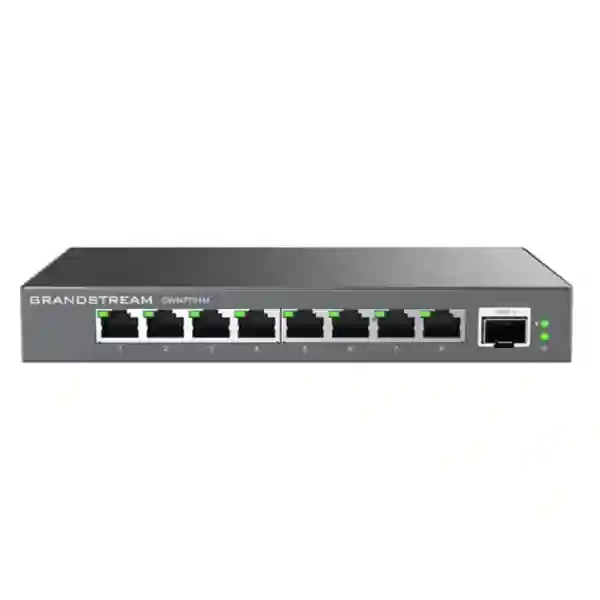
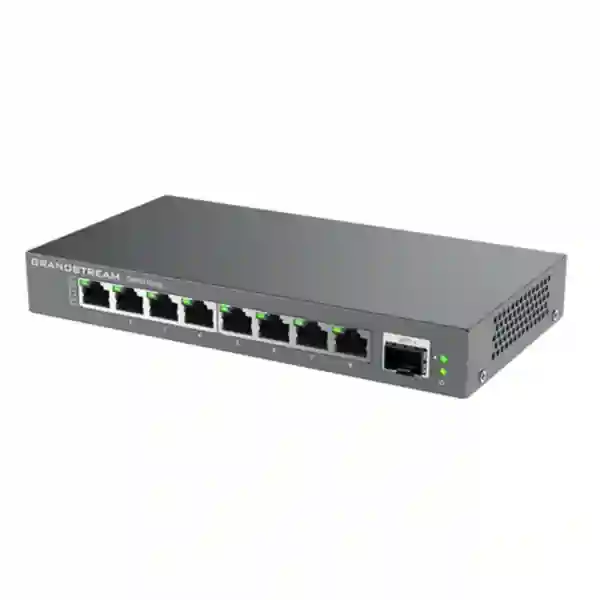
The Grandstream GWN7701M is an unmanaged 2.5G multi-gigabit Ethernet switch designed for home offices and small-to-medium businesses that need a straightforward way to move beyond traditional 1GbE access speeds. It combines eight copper RJ45 ports supporting 100Mbps, 1Gbps and 2.5Gbps connections with one SFP+ fiber uplink capable of 1Gbps or 10Gbps operation. The result is a compact network edge device for workstations, NAS systems, Wi-Fi access points with external power, media systems and other bandwidth-intensive endpoints that can benefit from multi-gigabit wired links.
For buyers in Tanzania, the most important point is fit: this is a non-PoE, unmanaged switch. It does not provide switch-level configuration, VLAN administration or power delivery to endpoints. Instead, it focuses on plug-and-play high-speed Ethernet, quiet fanless operation and an uplink path that can connect to a faster core or aggregation layer. If your requirement is simple multi-gigabit connectivity without management overhead, the GWN7701M is a practical model to evaluate.
Eight RJ45 interfaces auto-negotiate 100/1000/2500Mbps links.
A fiber uplink supports 1Gbps or 10Gbps connectivity to the wider network.
Grandstream specifies a 60Gbps switching capacity for the GWN7701M.
Quiet operation suits desks, meeting rooms and compact offices.
What is the Grandstream GWN7701M?
The GWN7701M is part of Grandstream’s GWN7700M series of unmanaged multi-gigabit network switches. Grandstream positions the series for home offices and small-to-medium businesses that need wired network access up to 2.5Gbps without the administrative burden of a managed switch. The GWN7701M is the eight-copper-port member of the family and adds one SFP+ uplink, giving the chassis a total of nine physical network interfaces.
Its role is simple: connect Ethernet devices at the highest mutually supported speed while automatically handling link negotiation and MDI/MDIX crossover. This means a 100Mbps legacy endpoint, a 1GbE workstation and a 2.5GbE storage system can all connect to the same switch, while the SFP+ interface can carry traffic toward a 10Gbps aggregation or core device where the surrounding network supports it. Because it is unmanaged, there is no web interface to configure, no per-port VLAN assignment and no central switch-control plane to administer.
The model is therefore most suitable where segmentation and policy are handled elsewhere or where the local network segment is intentionally simple. It can also be useful as an edge expansion switch behind a managed network design, provided the architecture does not require features that must be enforced locally on the switch itself.
Grandstream GWN7701M verified technical specifications
| Specification | GWN7701M |
|---|---|
| Copper ports | 8 × 100/1000/2500Mbps RJ45 |
| Fiber uplink | 1 × SFP+ supporting 1Gbps or 10Gbps connectivity |
| PoE | Not supported on GWN7701M |
| Switching capacity | 60Gbps |
| MAC address table | 4K |
| Jumbo frame | 9KB |
| QoS | 802.1p/DSCP QoS; default strict priority when present |
| Flow control | IEEE 802.3x |
| Energy efficiency | IEEE 802.3az Energy Efficient Ethernet |
| IGMP features | IGMP Fast-Leave, IGMP Snooping, route-port auto-learning and query-refresh member-port functions |
| Mounting | Desktop or wall mount |
| Enclosure | Metal |
| Power adapter | External 12VDC/1A |
| Maximum base-system power consumption | 9.7W |
| Operating temperature | 0°C to 40°C |
| Operating humidity | 10% to 90%, non-condensing |
| Dimensions | 190 × 100 × 28mm |
| Unit weight | 0.52kg |
Where the GWN7701M fits best
A strong use case is a compact office with a mixture of 1GbE and newer 2.5GbE endpoints. Modern desktops, mini PCs, NAS appliances and certain wireless access points can expose 2.5GbE interfaces, and a conventional 1GbE switch becomes the limiting link before the device itself reaches its potential. The GWN7701M creates a straightforward local upgrade path while continuing to accept slower Ethernet devices through auto-negotiation.
Another useful scenario is a small media, engineering or creative workgroup that transfers large files between local workstations and shared storage. Multi-gigabit Ethernet can reduce transfer time when the endpoints, cabling, storage and uplink path are all capable of the higher rate. The 10Gbps-capable SFP+ interface also provides a practical way to avoid funneling eight faster access links through a single 1Gbps uplink, although real performance still depends on the connected SFP+ module, upstream switch and workload.
The model can also serve as a quiet desk-side or wall-mounted expansion switch where a full rack switch would be unnecessary. Its fanless design eliminates fan noise, and the metal enclosure provides a more business-oriented construction than a lightweight plastic desktop switch. Buyers should still provide ventilation and remain within Grandstream’s stated environmental limits.
Important buying note: GWN7701M is not a PoE switch
The GWN7701M does not provide Power over Ethernet. If you plan to connect IP phones, IP cameras or wireless access points that expect PoE from the network switch, those devices will need their own compatible power supplies, PoE injectors or a separate PoE-capable switch. This distinction is especially important because Grandstream sells other switch models with PoE capabilities and their model names can appear similar in procurement lists.
Before requesting a quotation, separate your endpoint count into devices that need only data and devices that also require electrical power over Ethernet. If most endpoints need PoE, a PoE model may create a cleaner deployment. If the primary goal is high-speed wired data for workstations, storage and other self-powered equipment, the GWN7701M’s non-PoE design may be entirely appropriate.
Related FourTeck Tanzania resources
For broader infrastructure planning, visit the FourTeck Tanzania technology solutions overview to see how switching fits with firewall, Wi-Fi, telephony, servers and physical-security systems. Buyers comparing equipment categories can use the FourTeck Tanzania shop to review the wider product portfolio and purchasing guidance.
If the GWN7701M is part of a larger rollout, the FourTeck Tanzania services page explains solution planning, installation, configuration and lifecycle support considerations. Organisations evaluating a longer-term technology partner can also review About FourTeck Tanzania for the company’s solution-led approach across networking, security, collaboration and infrastructure.
Grandstream GWN7701M Tanzania
For organisations searching for the Grandstream GWN7701M in Tanzania, the first decision should be whether a simple unmanaged 2.5G edge switch matches the network design. The model is attractive when the requirement is fast local Ethernet without switch-by-switch administration. Eight multi-gigabit copper ports can connect a small group of high-performance workstations, storage systems, servers or other self-powered devices, while the SFP+ port creates an uplink path toward a faster aggregation switch. Because the copper interfaces auto-negotiate 100Mbps, 1Gbps and 2.5Gbps, the GWN7701M can also sit in mixed-generation environments where not every endpoint has been upgraded at the same time.
Tanzania buyers should check the complete path rather than treating the switch speed as an isolated specification. A 2.5GbE port only delivers multi-gigabit value when the endpoint network interface and cabling can support it, and a fast local access layer can still be constrained by a slow upstream connection. Where the SFP+ interface is intended for 10Gbps, confirm the compatible module or direct-attach option, the upstream interface type and the fiber or copper medium before ordering. The GWN7701M itself does not create internet speed; it increases local switching capability within a correctly designed network.
Power and environmental planning also matter. Grandstream specifies an external 12VDC/1A adapter, maximum base-system consumption of 9.7W, a 0°C to 40°C operating range and non-condensing operating humidity. For offices where electrical interruptions are common or where the switch supports critical local traffic, include suitable UPS protection as part of the broader network design. A fanless switch is quiet, but it still needs sensible ventilation and should not be placed in a sealed hot cabinet.
For procurement, provide the expected quantity, endpoint types, required link speeds, whether any devices need PoE, uplink destination and existing cabling standard. This lets the quotation process distinguish a correct GWN7701M deployment from a requirement that would be better served by a managed or PoE-capable model. The key value of the GWN7701M in Tanzania is uncomplicated multi-gigabit access where simplicity is deliberate rather than accidental.
Grandstream GWN7701M Dar es Salaam
Businesses in Dar es Salaam often combine fast internet services, cloud applications, shared storage, IP communications and high-density Wi-Fi in relatively compact offices. In that kind of environment, an unmanaged multi-gigabit switch can be useful at the edge when a small cluster of devices needs more than 1Gbps but the organisation does not need local VLAN or switch-management functions. The Grandstream GWN7701M offers eight 2.5GbE-capable copper ports for those endpoints and a single SFP+ interface that can link the edge segment back to a 1Gbps or 10Gbps core.
A good Dar es Salaam deployment starts by identifying which devices actually benefit from 2.5GbE. High-performance desktop systems, local NAS storage, editing workstations, virtualization hosts or modern self-powered wireless equipment are more likely to use the additional bandwidth than ordinary office printers or basic user PCs. Mixing slower devices on the same switch is not a problem because the ports negotiate down to supported speeds, but buying multi-gigabit capacity for endpoints that will remain at 1Gbps may not provide immediate business value.
The uplink deserves special attention in city offices where several fast devices may communicate with shared resources. If many 2.5GbE endpoints send traffic through one 1Gbps upstream link, the uplink becomes the bottleneck. The GWN7701M’s SFP+ interface can reduce that risk when connected to a suitably equipped upstream switch. Buyers should confirm whether the required SFP+ module is included or must be sourced separately, what fiber type is used, and whether the upstream device supports the intended 1G or 10G optics.
Because the GWN7701M is fanless and compact, it suits meeting-room equipment areas, executive offices, small server rooms and wall-mounted communications spaces where acoustic noise and physical footprint matter. It is not a replacement for a managed access switch where the business requires VLAN configuration, per-port policy, monitoring or PoE. For a Dar es Salaam quotation, specify the network topology and device mix so the switch can be assessed as part of the complete LAN rather than as a standalone box.
Grandstream GWN7701M Mwanza
In Mwanza, the Grandstream GWN7701M can suit offices, professional service firms, branch operations and technical workgroups that want a simple upgrade from 1GbE to 2.5GbE on a limited number of wired devices. Its eight RJ45 ports support mixed 100Mbps, 1Gbps and 2.5Gbps connections, which is helpful when an organisation is replacing equipment gradually rather than refreshing every endpoint at once. Older devices can remain connected while new systems with 2.5GbE interfaces gain the higher access speed.
The switch is particularly relevant where local data movement matters. A business copying large design files, backups, media libraries or database exports to a nearby NAS can benefit from multi-gigabit Ethernet if the storage array and workstations can sustain the throughput. In these cases, calculate performance across the complete path: disk speed, network interface speed, cable quality and switch uplink all influence actual results. A 2.5GbE access port cannot compensate for a storage appliance limited by slow disks or a congested 1Gbps uplink.
For branch connectivity, the SFP+ port can provide a useful higher-capacity connection toward a central switch or fiber distribution point. It is important to choose the correct optic and fiber type for the installed infrastructure. If the branch does not have a compatible SFP+ upstream interface, procurement should include a topology review instead of assuming any fiber module will work. The GWN7701M supports an SFP+ port capable of 1Gbps or 10Gbps connectivity, but module choice, distance and media compatibility remain deployment decisions.
Mwanza customers should also distinguish between data-only switching and PoE requirements. The GWN7701M does not power cameras, phones or access points. If a new office network includes many PoE endpoints, the bill of materials may require a separate PoE switch or a different model. For self-powered endpoints and quiet desk-side use, however, the fanless metal chassis and plug-and-play design make the GWN7701M easy to integrate with minimal configuration effort.
Grandstream GWN7701M Arusha
Arusha organisations evaluating the Grandstream GWN7701M may include hospitality offices, tour operators, professional firms, education environments, creative teams and branch offices where dependable local connectivity supports cloud services and shared resources. The GWN7701M is most appropriate when the local requirement is straightforward high-speed Ethernet rather than advanced switch administration. Its eight 2.5GbE copper ports can connect faster workstations and storage devices, while the SFP+ port offers a path to a 10Gbps-capable backbone where the upstream network supports it.
For hospitality or multi-service properties, buyers should be careful not to use the model where managed segmentation is needed at the access layer. Guest networks, staff networks, cameras, VoIP phones and building systems often benefit from VLAN separation and controlled PoE delivery. The GWN7701M is unmanaged and non-PoE, so it is better used as a targeted high-speed edge device inside a wider managed architecture or for a simple office segment where those controls are already handled upstream.
A practical design approach is to list every intended endpoint and mark its interface speed, power requirement and traffic destination. If the list includes self-powered PCs, NAS appliances or servers with 2.5GbE interfaces, the GWN7701M may be a strong fit. If the list is dominated by PoE cameras and access points, a PoE-capable switch should be considered instead. This pre-purchase classification avoids a common mismatch between attractive port-speed specifications and the actual deployment requirement.
Arusha sites should also consider equipment placement. Grandstream rates the switch for operation from 0°C to 40°C and 10% to 90% non-condensing humidity. A fanless design reduces noise but depends on passive heat dissipation, so the unit should have airflow around the metal enclosure and should not be buried beneath other heat-producing equipment. Including UPS protection, labeled cabling and a documented uplink plan can make the final installation easier to maintain as the network grows.
Grandstream GWN7701M Dodoma
The Grandstream GWN7701M can be a useful compact networking option for organisations in Dodoma that need a high-speed wired segment for administration, professional workloads, local storage or branch-office systems. Its eight multi-gigabit copper ports let different Ethernet generations coexist on one unmanaged switch. A 100Mbps device can operate alongside 1GbE and 2.5GbE endpoints because each port uses auto-negotiation to select the best mutually supported speed.
For offices modernising their infrastructure, this mixed-speed capability supports phased upgrades. An organisation does not need to replace every network interface on the same day. Instead, priority systems such as storage, workstation clusters or high-throughput user devices can move to 2.5GbE first, while ordinary endpoints remain at 1GbE. The investment should still be tied to a traffic need: multi-gigabit links are most valuable where users regularly move substantial data or where modern wireless and compute systems would otherwise be constrained by 1GbE wiring.
The SFP+ uplink offers an important expansion path. When the GWN7701M connects several high-speed endpoints, a 10Gbps upstream link can be more balanced than a 1Gbps uplink. Procurement teams should therefore ask where the switch will connect next and whether the existing distribution or core switch has a compatible SFP+ interface. Fiber type, connector, module specification and distance must be verified as part of the network design.
Dodoma buyers should also account for power continuity and deployment environment. The switch uses an external 12VDC/1A adapter and has a specified maximum base-system power consumption of 9.7W. If the device supports critical operations, suitable UPS backup can reduce disruption during brief power events. Because the unit is unmanaged, no configuration license or cloud management subscription is required for basic operation. That simplicity can be an advantage when the goal is a small, clearly defined high-speed Ethernet segment with minimal administrative overhead.
Grandstream GWN7701M UAE
In the UAE, the Grandstream GWN7701M is relevant to buyers looking for a compact unmanaged 2.5G switch for offices, labs, small production environments and desk-side workgroups. Its strongest selling point is not management sophistication but simple multi-gigabit access: eight RJ45 ports handle 100Mbps, 1Gbps and 2.5Gbps endpoints, and the SFP+ interface can provide a 1Gbps or 10Gbps uplink. This makes the model useful where endpoint bandwidth has increased faster than the need for a large managed switch.
UAE procurement teams frequently compare products by port count, uplink capacity, PoE support and manageability. For the GWN7701M, the correct profile is eight 2.5GbE copper ports, one SFP+ uplink, no PoE and unmanaged operation. It should not be substituted for a managed access switch where the deployment requires VLAN configuration, spanning-tree control, link aggregation, per-port security or centralized administration. Conversely, paying for those capabilities may be unnecessary in a small isolated workgroup where they are not used.
The fanless metal chassis can be beneficial in executive areas, meeting spaces, studios and compact technology zones where acoustic noise is undesirable. It can be wall-mounted or used on a desktop. Even in climate-controlled spaces, equipment should be installed with ventilation and within Grandstream’s stated 0°C to 40°C operating range. Rack deployments may require a shelf because the GWN7701M is a compact desktop-format device rather than a standard full-width rack switch.
For a UAE quotation, identify whether the SFP+ uplink will use fiber or another supported transceiver medium and confirm compatibility with the upstream equipment. If the switch will connect bandwidth-heavy NAS or workstation traffic, a 10Gbps uplink can be important to prevent aggregation bottlenecks. If most traffic is internet-bound and the site has a slower WAN link, the business case may instead be faster local transfers rather than faster external connectivity.
Grandstream GWN7701M Uganda
For Uganda deployments, the Grandstream GWN7701M provides a simple route to 2.5GbE connectivity for organisations that do not need a managed switch at every edge location. Small offices, branch sites and technical teams can connect up to eight copper devices at negotiated speeds of 100Mbps, 1Gbps or 2.5Gbps. The additional SFP+ interface can then carry aggregated traffic toward a 1Gbps or 10Gbps upstream connection, depending on the transceiver and network design.
The most important design question is whether the branch is truly unmanaged. Many modern business sites combine voice, cameras, Wi-Fi and user data, which may require VLAN separation, PoE and centralized control. The GWN7701M does not provide those management functions and it does not deliver PoE. It is therefore best for a data-only high-speed segment, a set of self-powered endpoints, or an extension behind a managed architecture where policy is already applied elsewhere.
Uganda buyers should consider cabling quality when upgrading from 1GbE. Existing installations may have mixed cable categories, patch leads and termination quality. Before assuming 2.5GbE will be reliable across every run, inspect and test the physical layer. The switch can negotiate lower speeds where necessary, but a network upgrade is most successful when the cabling can consistently support the target rate. For fiber uplinks, verify module type, connector and distance rather than purchasing optics solely by speed label.
Because the unit is compact and fanless, it can operate quietly in small offices that do not have dedicated server rooms. Power protection should still be planned where network continuity is important. A UPS sized for the switch and upstream equipment can help during short interruptions. For procurement, include quantity, endpoint types, PoE requirements, uplink speed and existing cabling information so the GWN7701M can be quoted in the correct context.
Grandstream GWN7701M Kampala
Kampala businesses often need to balance rapid network growth with practical administration. The Grandstream GWN7701M addresses a specific part of that challenge: adding eight multi-gigabit copper connections without introducing another managed switch to configure. It is useful for high-performance desk clusters, NAS access, local servers and self-powered network devices that can take advantage of 2.5GbE. The SFP+ uplink allows this compact edge switch to connect into a faster backbone where one is available.
For a Kampala office, start with the traffic pattern. If employees move large files to local storage, perform workstation backups, use high-resolution media assets or access on-premises compute resources, 2.5GbE can improve the local experience when the endpoint and storage sides support it. If the main workload is web browsing through an internet service below 1Gbps, the switch may not make those internet sessions faster. Its value is the capacity of the local wired network.
The GWN7701M also helps during phased migration because each RJ45 port can negotiate among 100Mbps, 1Gbps and 2.5Gbps. That means a company can keep functioning legacy equipment on the switch while newer hardware uses faster links. However, unmanaged operation means administrators cannot apply port-level VLAN or access policies on the GWN7701M itself. Where departmental segmentation, guest isolation or voice VLAN control is required, a managed switch should remain part of the architecture.
When ordering for Kampala, confirm the physical installation and power plan. The switch can sit on a desktop or mount on a wall, and its fanless design reduces noise. Keep ventilation clear and consider UPS backup for the switch and upstream equipment. If an SFP+ fiber uplink is planned, specify the upstream switch model, fiber distance and connector type so the correct transceiver can be selected and compatibility can be validated before deployment.
Grandstream GWN7701M Arua
In Arua, a compact unmanaged multi-gigabit switch can be attractive for branch offices, technical workspaces and local data-processing points that need faster Ethernet without a large network footprint. The Grandstream GWN7701M provides eight RJ45 ports capable of 2.5Gbps operation while remaining backward-compatible with 1Gbps and 100Mbps links. Its SFP+ port adds a higher-speed uplink option, which can be useful when the branch has fiber infrastructure or connects to an aggregation switch with compatible optics.
Arua deployments should be planned around maintainability. Unmanaged switching simplifies local administration because there is no configuration interface to maintain, but that same simplicity limits control. If the branch needs VLANs, port authentication, management visibility or structured traffic policy, those functions must be delivered by other network devices or by choosing a managed switch. The GWN7701M is therefore most appropriate where a simple Layer 2 edge segment is the intended design.
Physical infrastructure also deserves attention. Multi-gigabit performance depends on good copper cabling and terminations, and fiber uplinks depend on correct transceiver and media selection. Where existing cabling is older or undocumented, testing it before deployment can prevent unexpected speed negotiation or intermittent performance. Labeling switch ports and documenting connected devices remains worthwhile even with an unmanaged product because future troubleshooting becomes much faster when physical connections are clear.
Power resilience may be especially important at branch sites. The GWN7701M uses an external 12VDC/1A adapter and consumes relatively little power, so it can be included in a small UPS-backed network stack with the router, firewall or upstream switch. Buyers should confirm how long critical equipment needs to remain available during a power interruption and size backup accordingly. When requesting pricing for Arua, include whether SFP+ optics, UPS equipment, patch leads or installation support are part of the desired scope.
Grandstream GWN7701M Mbarara
The Grandstream GWN7701M can support Mbarara organisations that are upgrading local wired performance for storage, workstation, server or high-throughput application use. Its eight copper interfaces provide up to 2.5Gbps per connected endpoint, while its SFP+ interface can operate as a faster uplink. This layout is especially practical for a small department that needs multi-gigabit access but does not justify a larger managed switch platform.
For example, an office with several 2.5GbE workstations and a shared NAS can connect those endpoints to the GWN7701M and use the SFP+ port to reach the main network. The benefit depends on where the NAS is located. If the NAS sits on the same switch, local traffic can remain on the high-speed edge. If it sits elsewhere, the upstream path must have enough capacity to avoid becoming the constraint. Network planning should therefore map data flows rather than only count ports.
The GWN7701M’s 60Gbps switching capacity and 9KB jumbo-frame capability support its multi-gigabit role, while features such as IEEE 802.3x flow control, Energy Efficient Ethernet and IGMP functions are built into the platform. Because the product is unmanaged, buyers should not interpret these features as a user-configurable managed-switch interface. The switch is designed to work automatically rather than expose extensive settings.
For Mbarara procurement, also check whether endpoint power is required. The model has no PoE output. Access points, IP cameras and IP phones that need PoE must be powered separately or connected to different switching equipment. This is an important bill-of-materials consideration, particularly in new office projects where one switch may be expected to support multiple system types. Defining data speed, power and management requirements separately helps determine whether the GWN7701M is the right component or one part of a mixed-switch design.
Grandstream GWN7701M Gulu
For organisations in Gulu, the GWN7701M is a targeted solution for high-speed wired connectivity where simplicity is preferred. It offers eight 2.5GbE-capable RJ45 ports in a compact fanless metal enclosure, plus one SFP+ interface for a 1Gbps or 10Gbps uplink. This combination can suit offices, training facilities, branch operations and technical environments with a limited number of bandwidth-intensive endpoints.
A key planning advantage is backward compatibility with 1GbE and 100Mbps devices. A business can adopt 2.5GbE gradually instead of replacing all network equipment at once. New workstations or storage systems can use faster links while legacy devices continue at their supported rate. The switch handles auto-negotiation automatically, reducing deployment complexity. The same simplicity means there is no local management interface for VLANs or port policy, so the topology should be designed accordingly.
Gulu buyers should verify the existing cabling before expecting full multi-gigabit performance across every run. Patch cords, connectors and installation quality can matter as much as the switch specification. If a fiber uplink is planned, the SFP+ transceiver and upstream port need to match the intended speed and fiber type. Including those details in the quotation request helps avoid incomplete orders where the switch arrives without the required connectivity components.
Because branch networks may serve essential office functions, include power protection and documentation. The GWN7701M’s low power draw makes UPS support practical, but the UPS should also cover the upstream router, firewall or switch if connectivity must remain available. Document which endpoints occupy the eight ports and how the uplink connects to the wider LAN. Even a plug-and-play switch becomes easier to support when the installation is labeled and its purpose is clearly recorded.
Grandstream GWN7701M Kenya
Kenya organisations looking for the Grandstream GWN7701M are typically evaluating an affordable path to multi-gigabit wired access for small offices, creative teams, high-performance user groups or local storage networks. The switch supports eight 2.5GbE copper connections and one SFP+ uplink. It is unmanaged, so deployment does not require configuring a controller or switch operating system. Connect the endpoints, connect the uplink, apply power and the ports negotiate the appropriate speed automatically.
That simplicity should be matched to the right network layer. In an enterprise office, the main access layer may still need managed switches for VLANs, monitoring, PoE and policy enforcement. The GWN7701M can complement that architecture as a small high-speed edge extension, provided the design does not depend on managed functions at the local device. In smaller offices where all connected systems belong to one simple LAN segment, it may operate as the primary local switch.
Kenya buyers should compare the total cost of deployment rather than the switch alone. If an SFP+ uplink is required, add the correct transceiver or cable. If critical equipment needs UPS support, include it. If connected Wi-Fi access points or cameras require PoE, the GWN7701M cannot supply it, so separate power or alternative switching is necessary. If existing cabling has not been tested for multi-gigabit operation, budget time for verification and remediation where needed.
The model is especially appealing where quiet operation matters because the chassis is fanless. Its 190 × 100 × 28mm size is compact enough for desks and wall installations. For a purchase request, list endpoint quantity, required speeds, expected uplink speed, cabling type and whether the environment needs management or PoE. These details make it easier to confirm that the GWN7701M is being selected for the job it was designed to do.
Grandstream GWN7701M Kuwait
In Kuwait, the Grandstream GWN7701M can serve as a quiet, compact 2.5G access switch for offices, professional studios, technical teams and small server-room edge deployments. Eight copper ports provide multi-gigabit connectivity for compatible endpoints, and the SFP+ interface supports an uplink to a faster switching layer. The unit’s fanless metal construction is helpful where noise reduction and durability are preferred over the higher airflow requirements of larger actively cooled switches.
Environmental placement should still be considered carefully. Grandstream specifies operation from 0°C to 40°C, so the device belongs in a suitable indoor, climate-controlled network environment rather than exposed hot areas. Fanless operation relies on passive cooling, which means surrounding space should allow heat to dissipate. In cabinets or racks, avoid stacking the unit directly against other warm devices without airflow.
From a network-design perspective, the GWN7701M is best viewed as a plug-and-play data switch. It does not provide PoE output, and it does not offer the administrative feature set of a managed switch. If an office needs to power access points or phones, or requires VLAN assignment and port monitoring, specify those needs before procurement. A mixed environment may use the GWN7701M for high-speed self-powered endpoints while separate managed PoE switches handle infrastructure devices.
Kuwait buyers planning a 10Gbps uplink should verify the SFP+ ecosystem end to end. The switch supports a 1G or 10G SFP+ connection, but the optics, fiber type and upstream switch determine whether the link will establish correctly. Include the distance between devices, connector type and upstream port specification in the quotation request. Good procurement identifies all required transceivers and patching components at the same time as the switch, reducing delays during installation.
Grandstream GWN7701M Ghana
Ghana businesses considering the Grandstream GWN7701M may be upgrading from traditional Gigabit Ethernet because newer workstations, storage appliances and network equipment now offer 2.5GbE interfaces. The switch provides eight copper ports that can use those higher speeds while remaining compatible with 1Gbps and 100Mbps equipment. A single SFP+ interface gives the device an uplink path toward a 1Gbps or 10Gbps network core.
The practical value is greatest when local traffic is substantial. Shared project files, backups, media assets, virtual-machine images and other large datasets can benefit from faster Ethernet, provided the server or NAS can deliver the data and the clients can receive it. Buyers should evaluate actual workload rather than assume every office application needs 2.5GbE. Email, ordinary browsing and many cloud applications may still be constrained by internet speed or remote service performance rather than the local switch.
The GWN7701M is unmanaged, which keeps installation simple but limits network control. There is no expectation of switch-level VLAN management or complex policy configuration. If the Ghana deployment includes multiple security zones, voice VLANs, managed Wi-Fi infrastructure or detailed monitoring requirements, the network may need a managed switching layer. The GWN7701M can still be used as a specialized edge device where its role is clearly defined.
Power over Ethernet is another decision point. The switch has no PoE ports, so cameras, phones and access points must be self-powered or served by other equipment. When requesting a quote, identify which endpoints are data-only and which need PoE. Also state whether an SFP+ transceiver is required, the uplink speed and the physical installation preference. These details help create a complete order rather than a switch-only purchase that leaves important accessories unresolved.
Grandstream GWN7701M Nigeria
For Nigeria offices and technical workgroups, the Grandstream GWN7701M offers a straightforward eight-port 2.5GbE access layer with a 10Gbps-capable SFP+ uplink. It is suitable where a handful of devices need more bandwidth than conventional Gigabit Ethernet but the site does not require the configuration complexity of a managed switch. The combination can be especially useful for local storage, high-performance workstations, backup traffic and other bandwidth-heavy business workflows.
Network planners should avoid a common mistake: upgrading endpoint links without upgrading the bottleneck. Eight 2.5GbE devices feeding a 1Gbps uplink can still experience congestion when several communicate with remote resources simultaneously. Where the upstream network supports it, the GWN7701M’s SFP+ interface can operate at 10Gbps and provide a better aggregation path. The correct optical module or supported cable must be selected according to the upstream hardware and distance.
Power quality and resilience should be part of the project scope for critical networks. The switch itself uses modest power, but if it remains active while the router, firewall or storage system loses power, users still lose service. A UPS plan should therefore cover the complete dependency chain appropriate to the business requirement. The GWN7701M’s external 12VDC/1A adapter and low maximum base-system consumption make it easy to incorporate into a protected small network stack.
Nigeria buyers should also identify whether PoE or management functions are needed. The GWN7701M provides neither PoE output nor a managed-switch interface. If cameras, phones or Wi-Fi access points are part of the same project, their power and segmentation requirements may justify additional equipment. The GWN7701M works best when used deliberately for high-speed, self-powered Ethernet devices within a network whose control requirements are already understood.
Grandstream GWN7701M Seychelles
In Seychelles, the Grandstream GWN7701M can suit compact offices, hospitality back-office areas, media workgroups and professional environments where quiet operation and faster local Ethernet are useful. The fanless metal chassis is small enough for desktop or wall mounting, and eight 2.5GbE copper ports can connect newer high-speed devices without excluding older 1GbE or 100Mbps endpoints. The SFP+ interface adds a path to a 1Gbps or 10Gbps backbone where suitable fiber infrastructure exists.
Hospitality and resort networks often contain multiple traffic types, including guest Wi-Fi, staff systems, cameras, telephony and operational devices. In those environments, the GWN7701M should not automatically replace a managed PoE switch because it does not provide PoE or local VLAN management. It is better positioned as a specific high-speed data switch for self-powered equipment or as an edge extension inside a wider managed network architecture.
For island deployments, complete procurement planning can reduce avoidable delays. Confirm all accessories before shipment, including the required SFP+ optics, fiber patch leads, copper patch leads, wall-mount hardware expectations and power protection. If equipment replacement logistics are more complex, documenting the switch role and maintaining appropriate spare components can make support easier. This is operational guidance rather than a claim of local stock or delivery timing.
Environmental conditions should also be considered. Grandstream rates the GWN7701M for 0°C to 40°C operation and non-condensing humidity from 10% to 90%. Install the switch indoors in an appropriate equipment environment with airflow around the fanless enclosure. For a Seychelles quotation, include the endpoint list, uplink design, cabling type, site environment and any related networking equipment so the switch can be reviewed as part of the overall topology rather than in isolation.
Buying and deployment checklist
Confirm how many devices need wired connections today and how many are likely to be added.
Identify which endpoints genuinely support 2.5GbE and which will remain at 1GbE or 100Mbps.
The GWN7701M is non-PoE. Plan separate power or different switching for PoE endpoints.
Decide whether the SFP+ link will run at 1Gbps or 10Gbps and verify transceiver compatibility.
Inspect copper and fiber paths so physical-layer limitations do not undermine the intended speed.
If VLANs, port security, centralized monitoring or configuration are required, choose managed switching where appropriate.
Grandstream GWN7701M FAQs
How many ports does the GWN7701M have?
It has eight 100/1000/2500Mbps RJ45 copper ports plus one SFP+ fiber port. The SFP+ interface can provide 1Gbps or 10Gbps uplink connectivity.
Does the GWN7701M support PoE?
No. The GWN7701M does not provide PoE output. Devices such as IP cameras, access points and IP phones must be powered separately or connected to PoE-capable switching equipment.
Is the GWN7701M managed?
No. It is an unmanaged switch intended for plug-and-play operation. If you need configurable VLANs, per-port policies or centralized management, evaluate a managed switch instead.
Can it connect 1GbE devices?
Yes. Each RJ45 port auto-negotiates 100Mbps, 1Gbps or 2.5Gbps based on the connected device and link capability.
What is the switching capacity?
Grandstream specifies 60Gbps switching capacity for the GWN7701M.
Does it make my internet connection 2.5 times faster?
Not by itself. The switch can provide faster local Ethernet links, but internet speed still depends on your ISP service, router or firewall throughput and the rest of the network path.
Can I use the SFP+ uplink at 10Gbps?
Yes, Grandstream specifies the SFP+ interface for 1Gbps or 10Gbps connectivity. The module, cable or fiber and upstream device must also support the intended link.
Is the switch suitable for a quiet office?
Yes. The GWN7701M uses a fanless design, making it suitable for office areas where fan noise would be undesirable. It should still be installed with adequate ventilation.
Decision recap
Choose the Grandstream GWN7701M when you need eight simple multi-gigabit copper ports, a faster SFP+ uplink, quiet fanless operation and no switch-management overhead. Reconsider the model when the project requires PoE, local VLAN configuration, detailed monitoring or other managed-switch functions. The strongest deployments are those where endpoints, cabling and upstream capacity are all matched to the 2.5GbE access layer.
What to include in your quotation request
Send the required quantity, intended location, endpoint list, required copper speeds, PoE requirements, SFP+ uplink speed, upstream switch model if known, fiber or copper uplink medium, cabling status and whether installation or broader network design is part of the scope. If you are replacing an existing switch, include its model and current port usage. These details help avoid a quotation that is technically incomplete or based only on the product name.
FourTeck can also review whether the GWN7701M should operate as a standalone office switch, a desk-side multi-gigabit expansion device or an edge component connected to a managed core. The objective is to confirm that the product’s unmanaged, non-PoE design aligns with the actual environment before purchase.




Reviews
There are no reviews yet.