
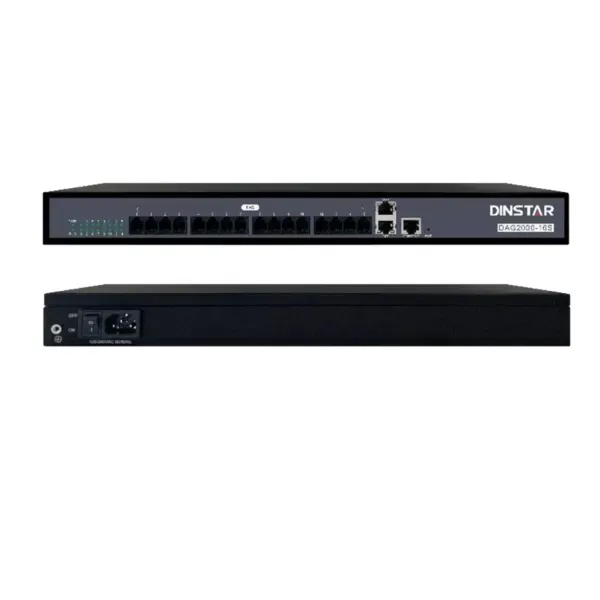
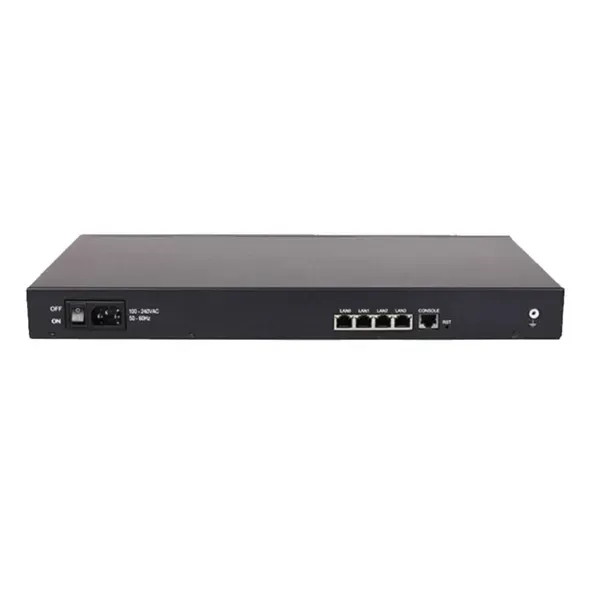
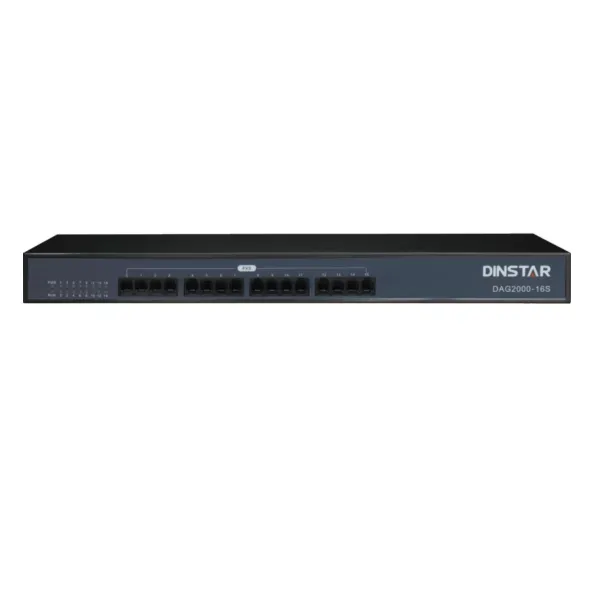
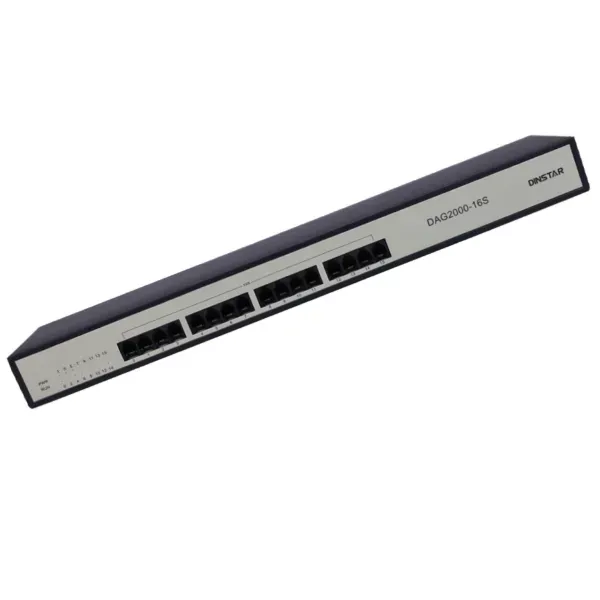
Dinstar DAG2000-16S GE FXS VoIP Gateway
The Dinstar DAG2000-16S(GE) is a 16-port FXS analog VoIP gateway built for organizations that need to retain analog telephones, fax machines or traditional PBX extensions while moving call control and trunking to a SIP-based IP environment. It creates a practical bridge between existing analog endpoints and modern IP PBX, softswitch, IMS and SIP services, reducing the need to replace every analog device during a voice-network transition.
For Tanzania businesses, the gateway is particularly relevant where a site has multiple analog extensions, reception phones, fax endpoints, lift or service-area telephones, legacy PBX interfaces or branch users that must remain operational during an IP telephony upgrade. The GE edition provides two Gigabit Ethernet interfaces rated at 10/100/1000 Mbps, while the voice side presents 16 RJ11 FXS ports. It supports SIP v2.0, IPv4 and IPv6, T.38 and pass-through fax, TLS/SRTP, VLAN tagging, Layer 3 QoS, flexible routing and management through web tools, SNMP, TR-069 and auto-provisioning.
Choose this model when you need up to 16 analog FXS endpoints connected to a SIP-based phone system and prefer Gigabit Ethernet uplinks for the gateway network side.
RJ11 analog interfaces for phones, fax machines and compatible analog PBX connections.
Two 10/100/1000 Mbps RJ45 Ethernet interfaces on the GE model.
Designed to interoperate with SIP-based IP PBX, softswitch and IMS/NGN environments.
Dinstar publishes up to 5 km maximum analog line length, subject to cabling and deployment conditions.
What the Dinstar DAG2000-16S GE solves
Many organizations want the management and routing flexibility of an IP PBX without discarding every analog endpoint already installed across offices, hotels, campuses, healthcare facilities, warehouses or branch sites. An FXS gateway addresses that transition problem. Each FXS interface provides the analog subscriber-side connection expected by a conventional telephone or fax machine, while the gateway converts call signaling and media for transport across the IP network using SIP and RTP. This lets a business keep selected analog equipment while centralizing call control in a newer IP platform.
The DAG2000-16S(GE) is sized for deployments needing sixteen FXS channels. Typical projects include replacing a legacy PBX while retaining existing analog handsets, connecting hotel or apartment room phones to an IP PBX, integrating fax machines into a SIP environment, extending analog service across a campus, or connecting branch analog devices to centralized call control. The model is also useful where replacing wall-mounted or purpose-specific analog phones would be costly or operationally disruptive.
The gateway should be treated as part of a complete voice design rather than as an isolated adapter. SIP server compatibility, extension numbering, codec choices, fax requirements, VLAN design, QoS, firewall policies, IP addressing, analog cabling, power resilience and failover behavior should all be reviewed before deployment. FourTeck Tanzania can help buyers frame these requirements alongside wider business IT and telecom infrastructure in Tanzania, so the gateway selection is connected to the network and phone-system design it will actually use.
Verified features and technical capabilities
Analog interfaces
The gateway provides 16 FXS RJ11 interfaces. Dinstar documents DTMF and pulse dialing, caller ID using DTMF/FSK presentation, reversed polarity, programmable call-progress tones and a maximum published analog cable length of 5 km.
Gigabit networking
The GE variant lists two 10/100/1000 Mbps RJ45 Ethernet interfaces. The gateway supports IPv4 and IPv6, PPPoE, VLAN tagging and Layer 3 QoS/DiffServ features for integration into managed business networks.
Voice and fax
Supported voice codecs include G.711 A-law/u-law, G.723.1, G.729A/B, G.726, AMR and iLBC. Fax options include T.38 and pass-through, with Dinstar documenting high-speed fax up to 14.4 kbps.
SIP and security
SIP v2.0 support includes UDP, TCP and TLS transport. Dinstar also lists SRTP for media security, primary/backup SIP server functions, outbound proxy support and common SIP/NAT mechanisms.
Call features
Call waiting, blind and attended transfer, call forwarding, call hold, do-not-disturb, three-way conference, message waiting indication, hotline behavior, hunting groups and flexible dial-plan functions are among the published capabilities.
Management
Management and maintenance functions include web administration, SNMP, TR-069, automated provisioning, configuration backup/restore, firmware upgrade, CDR, syslog, ping/traceroute, network capture, IVR local maintenance and cloud-based management support.
Technical specification summary
| Item | DAG2000-16S(GE) |
|---|---|
| FXS capacity | 16 × FXS, RJ11 |
| Ethernet | 2 × GE, 10/100/1000 Mbps, RJ45 |
| Console | 1 × RS232, 115200 bps |
| SIP | SIP v2.0 with UDP/TCP/TLS; primary/backup SIP server support |
| IP support | IPv4 / IPv6 |
| Fax | T.38 and pass-through; published fax speed up to 14.4 kbps |
| Codecs | G.711A/U, G.723.1, G.729A/B, G.726, AMR, iLBC |
| QoS/VLAN | 802.1P/802.1Q VLAN, Layer 3 QoS and DiffServ |
| Security | TLS/SRTP; web and Telnet ACL functions documented |
| Management | Web, SNMP v1/v2/v3, TR-069, auto-provisioning, CDR, syslog, backup/restore |
| Power | 100–240 VAC, 50/60 Hz; 30 W published consumption |
| Operating range | 0°C to 45°C; 10%–90% non-condensing humidity |
| Dimensions / weight | 440 × 230 × 44 mm; 2.7 kg |
Specifications above are based on current Dinstar DAG2000-16S(GE) product documentation. Firmware-dependent functions and interoperability should be confirmed against the exact software release and target SIP platform before production deployment.
Deployment, compatibility and buying guidance
Start with the analog endpoint count. If the requirement is exactly or close to sixteen analog lines, the DAG2000-16S(GE) can consolidate them into one gateway. If the business expects rapid growth beyond sixteen FXS channels, compare the 24-port, 32-port or higher-density Dinstar FXS models before finalizing the bill of materials. This avoids installing several smaller gateways where one higher-density platform would be simpler to rack, power and manage.
Next, validate the SIP environment. Confirm the IP PBX, hosted PBX, softswitch or IMS platform supports the required registration or trunking model, codecs, DTMF method, number presentation and supplementary services. For fax, determine whether T.38 will be used end-to-end or whether pass-through is required. Fax behavior can depend on network conditions and the remote carrier path, so testing with the intended SIP provider is recommended before a large migration.
Network preparation matters just as much. Place voice equipment on an appropriate VLAN where the broader network design calls for segmentation, apply QoS consistently across switches and routers, and ensure firewall/NAT policies are suitable for SIP and RTP. Avoid relying on generic SIP ALG behavior without validating the target platform. If the gateway will serve operationally important extensions, include UPS-backed power for the gateway, switch and IP PBX or router path. A functioning analog phone connected to an FXS port still depends on the IP side and gateway power.
For buyers comparing this gateway with a full handset replacement, the decision is usually economic and operational rather than purely technical. Keeping existing analog devices can reduce disruption and preserve specialized endpoints, while moving call control to IP can improve central administration and branch integration. For a broader view of available infrastructure categories, the FourTeck Tanzania technology shop provides context for IP phones, IP PBX hardware, switching, firewalls, cabling and related business systems.
Dinstar DAG2000-16S GE FXS VoIP Gateway Tanzania
Organizations searching for the Dinstar DAG2000-16S GE FXS VoIP Gateway in Tanzania are often trying to modernize business telephony without replacing every analog endpoint in one project. The 16-port FXS format fits offices, hotels, clinics, educational campuses, logistics sites, residential or serviced-property environments and multi-branch businesses that still depend on analog telephones, fax machines or legacy PBX interfaces. Instead of maintaining a completely separate analog phone platform, the gateway can present those endpoints to a SIP-based IP PBX or softswitch, allowing extension control, routing and inter-site calling to move onto the IP network.
For a Tanzania deployment, procurement should begin with an endpoint inventory. Count every analog phone, fax machine and special-purpose device that must be connected, then classify which ports are business-critical. Record current extension numbers, caller ID behavior, dialing rules, fax usage and any analog devices that rely on long copper runs. Dinstar publishes up to 5 km analog cable length for the platform, but actual results depend on cable condition and the site. Older building cabling should therefore be tested rather than assumed to be suitable simply because the theoretical reach is adequate.
The IP side should be planned at the same time. The GE version includes two Gigabit Ethernet ports, but voice quality is still shaped by switching, routing, congestion, QoS, firewall behavior and the SIP service. A managed network with documented VLANs is easier to troubleshoot than a flat network where voice, video, user traffic and surveillance all compete without prioritization. For sites with unstable mains power, include the gateway, PBX, switch and router in the same resilience plan; keeping only the analog phone powered does not keep the call path available.
When requesting a Tanzania quotation, provide the exact model name DAG2000-16S(GE), quantity, number of analog endpoints, target IP PBX or SIP service, fax requirement, site locations and whether configuration assistance is required. This gives the supplier enough information to distinguish a simple hardware purchase from an integration project and helps avoid missing items such as rack space, patching, UPS protection or network configuration.
Dinstar DAG2000-16S GE FXS VoIP Gateway Dar es Salaam
Dar es Salaam businesses frequently operate a mixture of modern IP infrastructure and older telephony assets. A head office may already have SIP trunks, managed switches and a current IP PBX while reception areas, warehouses, security desks, service counters or older departments continue using analog handsets. The Dinstar DAG2000-16S(GE) is useful in this mixed environment because it lets sixteen analog devices participate in a SIP architecture without requiring every endpoint to be replaced at the same time.
For offices, logistics companies, hospitality properties, clinics, schools and commercial sites in Dar es Salaam, deployment planning should pay close attention to the existing copper distribution. If analog lines currently terminate in a central rack or PBX room, the gateway can often be positioned close to those terminations so the legacy wiring remains useful while the uplink to the IP PBX travels over Ethernet. This can be cleaner than extending separate analog trunks across a building. However, technicians should label each FXS port and document which room, desk or function it serves; a sixteen-port gateway becomes difficult to support if the analog side is not mapped carefully.
Dar es Salaam organizations with branch offices should also decide whether the gateway registers to a local PBX or to centralized call control. The answer affects WAN dependency, failover planning and number routing. Dinstar supports primary and backup SIP server behavior, but the overall architecture still needs a clear design for internet outages, local survivability and emergency calling. If calls traverse public links or provider networks, codec selection and QoS should be aligned with available bandwidth and the carrier’s supported configuration.
A useful quotation request for Dar es Salaam should state the required analog port count, existing PBX or SIP platform, whether fax is in scope, expected concurrent calling, current LAN design and whether rack installation or configuration is needed. This level of detail allows the DAG2000-16S(GE) to be evaluated as part of the complete phone system rather than as a standalone box whose success depends on assumptions discovered only during installation.
Dinstar DAG2000-16S GE FXS VoIP Gateway Mwanza
Mwanza organizations considering a 16-port FXS gateway may be supporting branch operations, clinics, schools, hotels, offices, warehouses or mixed-use facilities where the telephone estate has developed over time. A common requirement is to connect existing analog extensions to a new central IP PBX while preserving installed handsets and building cabling. The DAG2000-16S(GE) is designed for exactly that transition: sixteen RJ11 FXS interfaces connect analog endpoints, while SIP carries call signaling toward the IP telephony platform.
In Mwanza, a structured migration can be more practical than changing all telephones at once. Teams can first identify departments where analog devices remain appropriate and move those extensions through the gateway while deploying native IP phones where additional features are required. This phased approach helps procurement separate endpoint replacement from call-control modernization. It also makes training easier because users whose workflows do not need to change can continue using familiar devices, while administrators gain central routing and management on the IP side.
Network and power design deserve attention, particularly when the gateway is installed in a branch equipment room. The two Gigabit Ethernet ports on the GE model provide modern network connectivity, but they do not remove the need for stable switching, routing and SIP reachability. Put the gateway on documented network infrastructure, use appropriate VLAN and QoS policies, and ensure the PBX or SIP service can be reached consistently. If remote support is expected, secure administration with strong access controls and avoid exposing management interfaces directly to the public internet.
For Mwanza procurement, include an analog-port schedule with the quotation request. List each endpoint type, whether it is voice or fax, the approximate cable run, the desired extension number and the system it must call through. This simple document makes configuration and handover much clearer. It also helps identify whether the sixteen-port model is correctly sized or whether a higher-density gateway would provide better expansion capacity.
Dinstar DAG2000-16S GE FXS VoIP Gateway Arusha
Arusha has many business environments where a mixture of front-desk telephony, guest services, administration, security and back-office functions must remain easy to use. Hospitality properties, tourism businesses, educational institutions and professional offices may have significant investments in analog handsets and structured copper cabling. The Dinstar DAG2000-16S(GE) allows those analog endpoints to remain in service while the organization adopts SIP-based call control, creating a bridge between established room or desk telephones and a newer IP PBX.
Hospitality projects are a good example of why gateway sizing matters. Guest rooms often require straightforward calling rather than advanced IP-phone features, so retaining analog handsets can be economically sensible. A 16-port gateway can serve a small block of rooms or service areas, but larger properties should compare the full Dinstar FXS range so the design uses an appropriate density of ports. Reception, reservations and management users may still be better served by native IP phones with programmable keys, displays and headset support, while room phones remain analog behind the gateway.
Arusha deployments should also review signaling and dialing behavior carefully. If the existing analog system uses specific short codes, hotline functions or service numbers, those workflows need to be reproduced in the new dial plan. Dinstar supports flexible routing and digit manipulation, but the final logic should be documented jointly with the IP PBX configuration so a change on one side does not unexpectedly break calls on the other. Fax endpoints should be tested with the real SIP path, not only in a lab, because T.38 support can vary across providers and upstream routes.
When requesting an Arusha quote, describe whether the project is a hotel migration, office upgrade, branch rollout or replacement gateway. Include the current PBX brand, SIP platform, port quantity, fax count and desired cutover approach. This helps define whether the requirement is supply only or whether migration planning, configuration and acceptance testing should be included in the scope.
Dinstar DAG2000-16S GE FXS VoIP Gateway Dodoma
Dodoma organizations upgrading government, education, healthcare, commercial or institutional communication systems may need to modernize centrally while preserving analog endpoints distributed through existing buildings. The Dinstar DAG2000-16S(GE) can simplify that transition by terminating sixteen analog FXS devices and presenting them to SIP-based call control over the IP network. This is especially useful where rewiring or replacing every handset would increase project cost without delivering proportional operational value.
Institutional deployments benefit from disciplined documentation. Before installation, record the current extension plan, department names, cable terminations and any dedicated lines used for security, reception, records rooms or service desks. Then map each requirement to a gateway port and IP PBX extension. This approach reduces confusion during migration and makes future fault isolation much faster. Dinstar provides CDR, syslog, network-capture and diagnostic functions that can support troubleshooting, but good physical labeling remains essential on the analog side.
Network governance is also important in Dodoma environments where voice shares infrastructure with user data, cameras or Wi-Fi. Place the gateway in a controlled rack or communications room, segment voice where appropriate, use QoS end to end and restrict administrative access. The gateway supports TLS and SRTP, but secure deployment also depends on the PBX, certificates, firewall rules, password policy and management practices around the entire voice platform. A single security feature should not be treated as a substitute for a complete design.
For quotation planning, buyers should indicate whether the gateway will register locally or over a WAN to centralized call control, whether backup SIP servers are available and what behavior is expected during link failure. Include rack requirements, UPS needs and whether analog cabling should be tested. These details allow a Dodoma deployment to be scoped around operational continuity instead of focusing only on the hardware purchase.
Dinstar DAG2000-16S GE FXS VoIP Gateway UAE
UAE businesses evaluating the Dinstar DAG2000-16S(GE) are often modernizing PBX infrastructure in hotels, offices, warehouses, clinics, schools or multi-site enterprises where analog devices still perform useful roles. The gateway provides sixteen FXS ports and two Gigabit Ethernet interfaces, allowing legacy analog endpoints to connect to a SIP-based IP PBX, softswitch or hosted communications platform without requiring immediate replacement of the endpoint estate.
In the UAE, projects frequently include high-density office networks and professionally managed switching, so the gateway should be integrated into the wider voice architecture rather than treated as an unmanaged appliance. Use documented IP addressing, voice VLANs where required, QoS policies, restricted administration and resilient power. If the organization already uses redundant call control, confirm how the gateway will register with primary and backup SIP servers and how calls should behave when one platform or network path is unavailable.
Procurement teams should also clarify whether they are replacing an older analog gateway or migrating from a conventional PBX. Replacement projects should capture the old port map, extension numbers, fax devices and special analog applications before the hardware is removed. Migration projects need a defined cutover sequence and rollback plan, particularly in hospitality or customer-facing operations where telephony downtime can affect service. The gateway’s flexible dial-plan and routing features can support complex environments, but the rules should be simplified and documented wherever possible.
For UAE-specific procurement and telecom infrastructure context, organizations can review FourTeck UAE IT and IP telephony solutions. A complete DAG2000-16S(GE) request should state quantity, endpoint count, SIP platform, fax requirements, support expectations and whether staging or configuration services are required before deployment.
Dinstar DAG2000-16S GE FXS VoIP Gateway Uganda
Ugandan organizations with branch networks, hospitality properties, educational institutions, clinics or commercial offices can use the DAG2000-16S(GE) to connect legacy analog endpoints to an IP telephony environment. The product is most valuable where analog devices remain operationally suitable but the business wants SIP-based call routing, centralized extension administration or easier inter-site communication. Sixteen FXS ports provide a practical density for a branch or departmental deployment, while the two Gigabit Ethernet interfaces connect the gateway to modern network infrastructure.
A Uganda design should begin with identifying which services depend on analog lines. Some endpoints may be ordinary desk phones, while others could be fax machines, reception phones or devices installed in locations where an IP handset would be unnecessarily complex. Separate those requirements from users who would benefit from native IP phones. The result can be a hybrid voice architecture in which high-feature users receive IP endpoints while stable analog devices connect through the FXS gateway.
Multi-site projects should consider WAN behavior carefully. If the gateway registers to a centralized PBX outside the branch, voice availability depends on the branch router, connectivity and central platform. Primary/backup SIP server features can add resilience at the gateway level, but true continuity requires an end-to-end plan. Document what should happen when the WAN is unavailable, whether local calling must continue and which numbers are critical to operations. This planning is more important than simply confirming that the gateway supports SIP.
Uganda buyers can review FourTeck Uganda IP PBX and VoIP solutions when coordinating regional telephony requirements. For a useful quotation, include the number of analog endpoints, current PBX details, intended SIP trunk or IP PBX, site list, power-resilience requirements and any support needed for migration or configuration.
Dinstar DAG2000-16S GE FXS VoIP Gateway Kampala
Kampala-based organizations often manage the main PBX, internet connectivity and IT support centrally while serving departments or branches with a mixture of phone types. The Dinstar DAG2000-16S(GE) fits environments where up to sixteen analog devices need to be integrated into this centralized SIP architecture. It can help preserve existing phones and wiring while giving administrators a controlled path toward an IP-based communications platform.
A Kampala head-office project should treat port mapping as a formal implementation task. Assign each analog device to a numbered FXS interface, record the extension, department, physical location and service purpose, and keep the same information in PBX documentation. This is particularly important when a gateway is used for operational phones outside normal desk areas, because those endpoints may not have a user nearby who can explain the circuit during troubleshooting. Good labels can reduce support time dramatically.
Call quality should be tested under normal business load. The GE interface provides ample Ethernet link speed for sixteen voice channels, but voice can still suffer if the LAN or WAN experiences congestion, packet loss or poor QoS. Where the gateway shares switching with cameras, Wi-Fi and user traffic, verify queueing and VLAN policies rather than assuming Gigabit speed alone guarantees quality. For fax, test T.38 with the actual carrier or SIP trunk and keep pass-through as part of the interoperability discussion where required.
Kampala procurement teams should ask suppliers to identify the complete solution scope: gateway hardware, rack placement, Ethernet patching, analog patch leads where required, configuration, testing, documentation and handover. If the project is a migration, include the desired cutover window and the old system details. These inputs help ensure the quotation reflects the work needed to produce a functioning telephony service, not simply a delivered appliance.
Dinstar DAG2000-16S GE FXS VoIP Gateway Arua
Arua organizations that operate as part of a wider enterprise or regional network can use a 16-port FXS gateway to keep local analog endpoints connected while call control is centralized elsewhere. This model can be useful in branch offices, service locations, schools, clinics and accommodation facilities where existing analog phones are still serviceable and easy for users to operate. By converting those endpoints to SIP on the network side, the DAG2000-16S(GE) supports a gradual migration rather than an all-at-once handset replacement.
For a remote or branch deployment, connectivity resilience should be part of the design from the beginning. The gateway can support primary and backup SIP server arrangements, yet the success of the voice service still depends on WAN paths, DNS behavior, routing and the availability of upstream call-control systems. If the business requires internal extension calling during internet disruption, that requirement should be stated explicitly so the architecture can be evaluated against it. Do not assume that a backup server alone provides local survivability.
Arua sites may also benefit from remote management, but access should be controlled. Dinstar supports SNMP, TR-069, web administration, diagnostics and cloud-based management capabilities. Use those tools through secure network paths and restricted administrator accounts. Avoid exposing management interfaces directly to the internet. Configuration backups and clear change records are valuable because a branch gateway can be restored faster when settings are documented and kept centrally.
A quotation request should list the branch name, number of analog devices, endpoint types, current phone service, target SIP platform and any special dialing rules. Include whether the gateway needs preconfiguration before shipment and who will perform on-site connection and testing. These details help an Arua deployment move from hardware delivery to a predictable operational cutover.
Dinstar DAG2000-16S GE FXS VoIP Gateway Mbarara
Mbarara businesses and institutions can use the Dinstar DAG2000-16S(GE) when a telephony upgrade must preserve analog extensions while moving toward a SIP-based core. The sixteen-port capacity is suited to a branch, department, small hospitality block or distributed service area where replacing all analog devices is unnecessary. The gateway gives those endpoints access to IP PBX features and network-based call routing while allowing the physical telephone interface to remain familiar.
Before selecting the model, count not only the active extensions but also the ports likely to be required during the next expansion stage. If fourteen or fifteen ports will be occupied immediately, procurement should compare a higher-density gateway rather than leaving almost no spare capacity. Conversely, if the requirement is only four or eight analog devices, a smaller model may reduce cost and simplify deployment. Correct sizing should be based on the real endpoint plan, not on a generic preference for one chassis.
Mbarara deployments should also review the distinction between FXS and FXO. The DAG2000-16S(GE) provides FXS ports for analog subscriber devices such as phones and faxes. It is not the same as an FXO gateway used to connect analog PSTN lines. Procurement teams should specify whether they need to connect telephones, external analog lines, or both, because choosing the wrong interface type is a common source of project delay. Hybrid requirements may call for a different Dinstar model.
When requesting a quote, include the exact endpoint role for each port, the IP PBX or hosted platform, expected call routing and any fax requirement. State whether the organization wants preconfigured extensions, on-site installation or supply only. This gives the supplier enough context to validate the FXS requirement and provide a proposal that matches the intended Mbarara voice architecture.
Dinstar DAG2000-16S GE FXS VoIP Gateway Gulu
Gulu organizations that are standardizing communication across several facilities can use an FXS gateway to bring older analog endpoints into a managed SIP platform. The DAG2000-16S(GE) provides sixteen subscriber-side analog ports, making it practical for offices, institutions, clinics, hotels or service locations where a group of existing phones needs to remain active after the core PBX is upgraded. This can reduce disruption and let the business modernize call control independently from the endpoint replacement schedule.
A well-planned Gulu deployment should separate three layers: the analog device and copper run, the gateway configuration, and the SIP/PBX configuration. Troubleshooting becomes much easier when each layer is documented. If a phone cannot place a call, technicians can test whether the analog port has dial tone, whether the gateway is registered and whether the PBX is routing the number correctly. Dinstar’s diagnostic tools, CDR, syslog and network capture can assist on the IP side, while basic cable testing and labeling remain essential on the analog side.
Power resilience deserves equal attention. Because the analog phone receives service from the gateway, voice availability depends on the gateway and associated IP infrastructure. Install the gateway, switch, router and PBX on suitable UPS protection when call continuity matters. If the design uses centralized PBX services over a WAN, decide what level of communication should remain available during link failures and document that expectation before installation.
For a Gulu quotation, provide the number of FXS ports needed now and later, model of the target PBX, SIP trunk information where relevant, endpoint locations and desired support scope. If the existing system is being replaced, share its extension plan and any special functions that users expect to retain. This allows migration tasks to be scoped before the cutover rather than discovered after the new gateway is installed.
Dinstar DAG2000-16S GE FXS VoIP Gateway Kenya
Kenyan organizations modernizing branch and office telephony can use the Dinstar DAG2000-16S(GE) to preserve up to sixteen analog devices while integrating them with an IP PBX, softswitch or SIP platform. This is useful where the network core has already moved to IP but selected phones, fax machines or traditional analog interfaces still have practical value. The gateway supports a staged migration model: call control can be modernized first, and endpoint replacement can be prioritized according to business need rather than forced by the PBX change.
Kenya deployments should review scale and topology early. A single branch with ten to sixteen analog endpoints may fit the DAG2000-16S(GE) well. A hotel, campus or multi-building site with many dozens of analog rooms may be better served by higher-density Dinstar gateways. A distributed company might instead place one smaller gateway in each branch. The correct architecture depends on analog cable layout, WAN resilience, support model and the location of the IP PBX, not only on the total number of extensions across the company.
The GE model’s two Gigabit interfaces integrate cleanly with contemporary managed networks, but voice engineering remains important. Configure VLANs and QoS where appropriate, confirm firewall policy, and test SIP registration and RTP flow before migrating users. If the company uses fax, test T.38 with the actual service provider. For security, use TLS/SRTP where supported by the end-to-end platform and restrict gateway management to trusted networks.
Organizations coordinating regional requirements can consult FourTeck Kenya business VoIP and IP PBX solutions. A Kenya quotation request should include quantity, endpoint count, target PBX, location, analog cable condition, fax requirements and any installation or staging work so the proposal reflects the full deployment need.
Dinstar DAG2000-16S GE FXS VoIP Gateway Kuwait
Kuwait businesses that operate hotels, offices, retail facilities, clinics, warehouses or multi-site enterprises may retain analog phones even after the main communications platform moves to SIP. The Dinstar DAG2000-16S(GE) provides a straightforward migration layer with sixteen FXS ports for analog endpoints and Gigabit Ethernet connectivity toward the IP network. It can help organizations extend the useful life of established handsets and cabling while introducing centralized IP PBX control.
For Kuwait deployments, rack and environmental planning should be included with voice configuration. The gateway is a 1U-class device measuring 440 × 230 × 44 mm and is designed for a published operating range of 0°C to 45°C. Install it in a suitable communications rack with controlled temperature and stable power. As with any IP-based telephony component, use UPS protection when the connected extensions are operationally important. The gateway should not be placed in an unconditioned space simply because analog wiring already terminates there.
Organizations replacing an older PBX should preserve the old dial plan and call-flow documentation before migration. Reception routing, department extensions, hotline numbers and fax behavior often matter more to users than the hardware brand. Map these functions into the new IP PBX and gateway configuration, then test representative call scenarios before cutover. Dinstar supports flexible routing, digit maps and number manipulation, but unnecessary complexity should be avoided where the PBX can provide the same logic more centrally.
For procurement, compare quotations on complete scope rather than chassis price alone. Confirm whether configuration, rack accessories, warranty terms, firmware support, shipping, on-site work and PBX integration are included. A clear Kuwait bill of requirements should state the exact DAG2000-16S(GE) model, quantity, analog endpoint count, target SIP platform and any fax or branch-connectivity considerations.
Dinstar DAG2000-16S GE FXS VoIP Gateway Ghana
Ghanaian organizations adopting SIP telephony do not always need to replace every analog device to gain the advantages of centralized IP call control. The Dinstar DAG2000-16S(GE) allows sixteen analog telephones, fax machines or compatible PBX-side endpoints to connect to a SIP-based environment. This approach can be valuable for offices, schools, hotels, clinics and branch sites where established analog wiring is still in good condition and user requirements are straightforward.
A Ghana project should begin by deciding which endpoints are worth retaining. Standard corridor phones, service-area devices and basic room telephones may not need an expensive IP handset, while reception and contact-center users often benefit from richer native IP features. Using the FXS gateway selectively lets the organization invest in IP phones where they create operational value while avoiding unnecessary replacement elsewhere. This can make the overall migration more financially balanced.
Technical validation should include SIP registration, codec selection, DTMF signaling, caller ID format, fax mode and any feature codes users rely on. If the gateway connects to a hosted PBX, test the service across the actual internet connection under normal load. If it connects to a local PBX, confirm LAN VLAN and QoS policies and keep the gateway management interface restricted. The gateway supports TLS/SRTP, but encryption should be validated with the PBX and provider rather than assumed to work automatically across every third-party system.
For Ghana procurement, provide an endpoint list, site topology, desired extension plan and whether the business is replacing an existing PBX or extending a current SIP system. Ask the supplier to confirm the complete scope and the firmware/configuration baseline. Clear documentation makes acceptance testing easier and helps ensure the gateway is integrated consistently with the broader communications environment.
Dinstar DAG2000-16S GE FXS VoIP Gateway Nigeria
Nigeria’s large enterprise, hospitality, education, healthcare and multi-branch environments often contain a significant installed base of analog telephones alongside newer IP systems. The DAG2000-16S(GE) can bridge sixteen of those analog endpoints into a SIP architecture, allowing businesses to modernize call control without making endpoint replacement a prerequisite. This is useful for phased projects, branch standardization and sites where analog room or service phones remain practical.
Because Nigerian deployments can span several sites and connectivity types, architects should decide where each gateway will register and how voice should behave during network interruptions. A centralized PBX simplifies administration but creates WAN dependency at branches. A local PBX can preserve local calling but increases distributed infrastructure. Primary/backup SIP server support on the Dinstar gateway adds flexibility, yet continuity decisions should be made at the architecture level. Define the expected behavior for local extensions, outbound calls and incoming calls during failures before implementing the gateway.
For larger estates, management should be standardized. Use consistent firmware, templates, extension naming, VLANs and monitoring across gateways. Dinstar provides SNMP, TR-069, automatic provisioning and cloud-based management capabilities that can support scale. Keep configuration backups and an asset register that records serial number, site, IP address, PBX association and port mapping. This information becomes increasingly important as the number of gateways grows.
Nigeria buyers should request quotations using a structured site list. Include how many gateways are required per location, analog endpoint counts, PBX architecture, SIP provider, fax devices and power-resilience expectations. Ask whether staging and preconfiguration can be completed centrally before deployment. A well-prepared request makes it easier to compare proposals on equivalent scope and reduces time spent discovering site requirements after equipment has arrived.
Dinstar DAG2000-16S GE FXS VoIP Gateway Seychelles
Seychelles organizations in hospitality, professional services, government and distributed island operations may need to connect existing analog phones to modern IP communications while keeping the endpoint experience simple. The Dinstar DAG2000-16S(GE) offers sixteen FXS ports and is well suited to small clusters of analog devices that need to register to an IP PBX or SIP service. This can be especially useful in properties where guest-room or service-area telephones are already installed and replacing them would add cost without improving the required workflow.
Hospitality and multi-building environments should map gateways to physical cable distribution. Placing an FXS gateway close to the analog termination point can reduce rewiring, while Ethernet carries the traffic back toward the PBX. If the site has several buildings, compare centralized versus distributed gateway placement based on copper distance, rack availability, network resilience and support access. Dinstar publishes a maximum analog cable length of 5 km, but existing cabling should still be tested for condition, joints, interference and labeling.
Seychelles sites that depend on inter-island or upstream connectivity should also define outage behavior. If a gateway uses a hosted PBX, call availability can be affected by internet interruptions even though the analog handset itself remains powered. UPS protection, redundant connectivity and backup SIP options can improve resilience, but the desired level of continuity should be designed explicitly. For local PBX deployments, maintenance responsibility and backup procedures should be equally clear.
A procurement request should state whether the gateway supports guest rooms, office users, fax machines or operational service phones, because each use case has different testing priorities. Include the expected concurrent call level, number plan and SIP provider. This helps suppliers scope configuration and ensures acceptance testing reflects the real Seychelles environment rather than a generic bench configuration.
Common use cases
Legacy PBX migration
Retain analog handsets while moving extension control and trunking to an IP PBX. This can reduce disruption and let the organization replace endpoints in phases.
Hospitality room phones
Connect simple analog guest-room or service phones to SIP call control while reception and administrative teams use native IP phones.
Fax migration
Use T.38 or pass-through modes to integrate compatible fax devices with an IP telephony environment, subject to provider and path interoperability.
Branch analog extensions
Connect analog phones at a branch to centralized SIP call control, with routing and failover planned according to WAN availability.
How to choose between FXS, FXO and IP phones
The DAG2000-16S(GE) is an FXS gateway. That means its analog ports are intended to provide subscriber-side service to analog phones, fax machines and similar endpoints. It is not a 16-port FXO gateway for connecting external analog PSTN lines. If the project requires analog telephone lines from a carrier to be presented to an IP PBX, an FXO gateway is the relevant product category. If it requires both analog phones and analog PSTN lines, a hybrid gateway may be more appropriate.
Native IP phones are different again. They connect directly to the IP network and typically offer richer displays, programmable keys, directory functions and centralized provisioning. A modern office may therefore combine all three technologies: IP phones for knowledge workers and reception, FXS gateways for existing analog devices, and FXO gateways only where analog carrier lines remain necessary. The correct mix depends on business workflow, cabling, feature expectations and service-provider architecture.
This distinction should be settled before asking for price. A quotation based only on the phrase “16-port VoIP gateway” can easily result in the wrong interface type. State explicitly that the requirement is for sixteen FXS ports and the GE model when requesting the Dinstar DAG2000-16S(GE).
Quotation checklist
To receive a useful quotation rather than a hardware-only estimate, prepare the following information before contacting sales:
Frequently asked questions
What does the Dinstar DAG2000-16S GE do?
It connects up to sixteen analog FXS endpoints such as telephones and fax machines to a SIP-based IP telephony system. The gateway converts between the analog interfaces and IP voice signaling/media so existing endpoints can operate with an IP PBX, softswitch or compatible SIP platform.
What is different about the GE version?
The current Dinstar documentation for DAG2000-16S(GE) lists two 10/100/1000 Mbps Gigabit Ethernet RJ45 interfaces. This distinguishes it from older non-GE versions that used Fast Ethernet interfaces.
Can I connect analog PSTN lines to this gateway?
The DAG2000-16S(GE) provides FXS interfaces for subscriber devices such as analog phones and faxes. Analog carrier/PSTN lines normally require FXO interfaces, so a different Dinstar FXO or hybrid gateway should be evaluated for that requirement.
Does it support fax?
Yes. Dinstar lists T.38 and pass-through fax support, with published high-speed fax up to 14.4 kbps. Real-world fax success depends on the SIP service and network path, so interoperability testing is recommended.
Which codecs are supported?
Published codec support includes G.711 A-law/u-law, G.723.1, G.729A/B, G.726, AMR and iLBC. The selected codec should match the IP PBX or SIP provider and the bandwidth/quality objectives of the deployment.
Can it be used with a hosted PBX?
It can work with compatible SIP-based platforms. Before deployment, confirm the hosted PBX accepts the required gateway registration or trunk model and supports the necessary codecs, DTMF method, fax mode and security settings.
Does it support secure SIP?
Dinstar lists SIP over TLS and SRTP support. Secure operation still depends on matching configuration and certificate/security support on the connected PBX or service provider.
How many simultaneous calls can it support?
The product is built around sixteen FXS voice ports. Practical call capacity and codec behavior should be verified against the exact firmware and the intended configuration. For sizing, treat the sixteen physical FXS interfaces as the primary endpoint capacity and confirm any project-specific concurrency requirement before purchase.
Decision recap
Choose the Dinstar DAG2000-16S(GE) when the project requires sixteen FXS ports, standards-based SIP integration and Gigabit Ethernet connectivity while retaining analog telephones or fax machines. It is particularly suitable for phased PBX migrations, hospitality extensions, branch analog endpoints and sites where installed copper wiring remains usable.
Do not choose it solely because it is a “16-port gateway.” Confirm that the project requires FXS rather than FXO, that the SIP platform is compatible, that fax behavior is validated where required and that the network provides appropriate VLAN, QoS, firewall and power-resilience design. If more than sixteen analog endpoints are planned, compare higher-density Dinstar gateways before finalizing the architecture.
For projects that combine the gateway with IP phones, switching, firewall policy, cabling or a new PBX, review the broader solution as one communications system. The goal is not only to make an analog phone ring through SIP; it is to create a voice environment that is documented, supportable and ready for future changes.
Plan your Dinstar gateway deployment with FourTeck
Share your analog endpoint count, current PBX, target SIP platform, fax requirements, locations and expected expansion. FourTeck can help structure the requirement around the correct gateway density and the supporting network environment. For multi-country projects, the same design approach can be coordinated with regional FourTeck teams so extension plans, SIP architecture and deployment standards remain consistent across sites.
A clear request reduces commercial ambiguity. Include whether you need supply only, staging and preconfiguration, installation, PBX integration, testing or support. The more accurately the current system is documented, the easier it is to prepare a quotation and migration plan that reflects the real work.



Reviews
There are no reviews yet.