
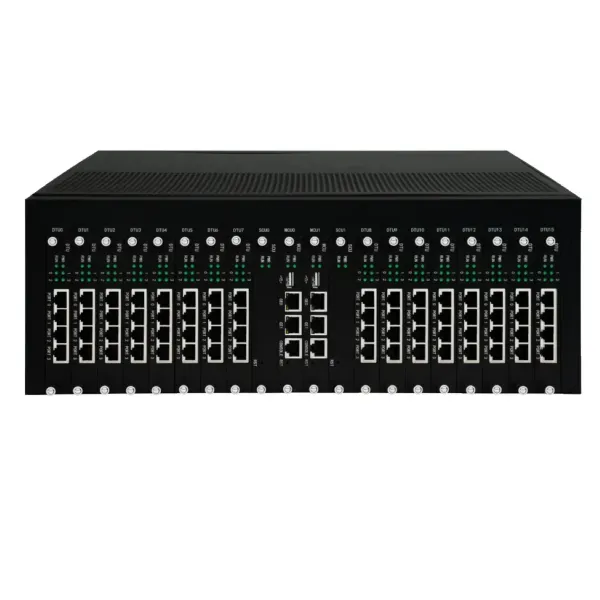
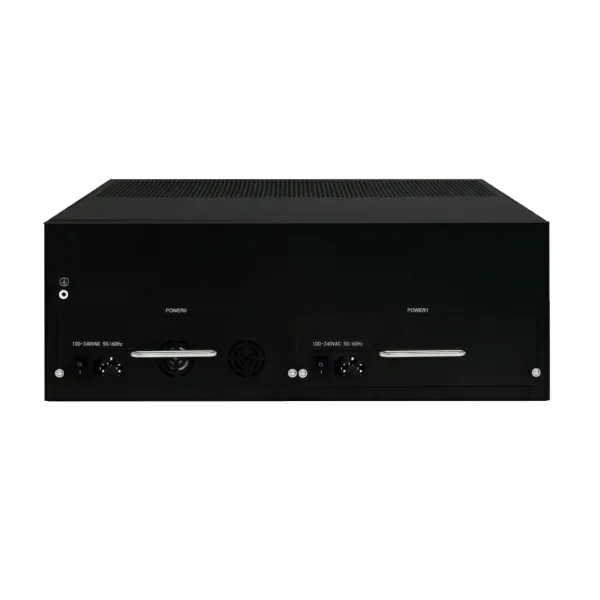
Dinstar MTG5000 Digital VoIP Gateway Tanzania
The Dinstar MTG5000 is a high-density digital VoIP gateway built for large enterprise networks, call centers, carriers, ITSPs and telecom environments that need to bridge traditional E1/T1 infrastructure with SIP and IMS voice platforms. Dinstar specifies support for up to 64 E1/T1 ports, up to 1,920 simultaneous calls, SIP/IMS registration, ISDN PRI, SS7, R2 MFC, T.38 fax, flexible routing, dual power supplies and carrier-focused management tools. For Tanzanian organizations planning migration from legacy PSTN trunks to IP telephony, consolidating multiple digital trunks, or building a high-capacity interconnect between PBX, softswitch and service-provider networks, the MTG5000 provides a purpose-built platform rather than a small-office gateway scaled beyond its intended role.
Choose the MTG5000 when the requirement is high-density E1/T1 to SIP connectivity, carrier-style signaling, large call capacity and resilient trunk interconnection. For smaller port counts, compare a lower-capacity Dinstar digital gateway instead of oversizing the platform.
Maximum E1/T1 ports published by Dinstar for the MTG5000 platform.
Maximum simultaneous calls stated for the high-density configuration.
Designed to connect digital PSTN trunks with modern SIP and IMS voice environments.
Supports major PSTN signaling modes for carrier, enterprise and service-provider integration.
What the Dinstar MTG5000 solves
Many organizations still operate E1/T1 services, legacy PBXs, PRI trunks or SS7-based interconnects while new communications platforms use SIP, IMS, softswitches and IP PBX architecture. The MTG5000 is designed to sit at that boundary. It converts and routes calls between the digital telephony side and the IP voice side while providing enough density for environments where dozens of digital trunks and hundreds or thousands of channels must be managed in one platform.
The business problem is not simply protocol conversion. A high-capacity voice edge must also deal with numbering plans, caller and called number manipulation, trunk grouping, failover design, call routing, signaling compatibility, codec policy, fax behavior, monitoring and operational troubleshooting. Dinstar therefore positions the MTG5000 around carrier-grade VoIP and FoIP services, powerful call control and maintenance tools, multiple SIP trunks and compatibility with mainstream VoIP platforms.
This makes the MTG5000 relevant to telecom operators, contact centers, enterprises migrating from traditional digital PBXs, integrators building SIP migration projects, and service providers that need a controlled interworking point between PSTN signaling and IP voice.
Verified MTG5000 capabilities
High-density digital interfaces
Dinstar publishes support for up to 64 E1/T1 ports and up to 1,920 simultaneous calls. The architecture includes four digital processing units, each supporting up to 480 channels. This capacity is aimed at large production environments rather than small branch deployments.
PSTN signaling
Published signaling support includes ISDN PRI, SS7 and R2 MFC. SS7 support includes ITU-T, ANSI and ITU-CHINA variants with MTP1, MTP2, MTP3, TUP and ISUP functions listed by Dinstar, allowing the gateway to address multiple legacy and carrier interconnect scenarios.
SIP and IMS connectivity
The MTG5000 supports SIP v2.0 and SIP-T, with Dinstar listing RFC3372, RFC3204 and RFC3398. Multiple SIP trunks, peer and access working modes, IP trunk grouping, IP trunk priority and SIP/IMS registration with up to 2,000 SIP accounts are part of the published feature set.
Voice, fax and media handling
Supported codecs include G.711A/U, G.723.1, G.729A/B and iLBC. Dinstar also lists silence suppression, comfort noise, voice activity detection, adaptive jitter buffering, voice and fax gain control, T.38 and pass-through fax, modem/POS support, DTMF via RFC2833, SIP INFO or in-band, and G.168 echo cancellation up to 128 ms.
Routing and numbering control
The gateway supports PSTN-to-PSTN, PSTN-to-IP and IP-to-PSTN routing, time-based routing, caller and called prefix rules, intelligent routing, caller/called number manipulation, whitelist and blacklist controls, PSTN grouping by E1 port or timeslot, up to 512 route rules per direction and up to 2,000 dialing rules.
Management and resilience
Dinstar lists dual power supplies, web GUI configuration, data backup and restore, firmware upgrade by TFTP or web, SNMP v1/v2/v3, syslog, network capture, call statistics, call history records, NTP synchronization and centralized management. These tools are important for a gateway operating inside a critical voice path.
Sizing and procurement guidance
The MTG5000 should be sized from real trunk and call-flow requirements. Start by counting existing E1 or T1 spans, active timeslots, peak simultaneous calls, signaling types, SIP trunks, expected growth and resilience requirements. If the project only has a few E1/T1 links, a smaller Dinstar MTG model may be easier to operate and more economical. If the environment is already approaching tens of digital spans, or consolidation is part of the project, the MTG5000 becomes more relevant.
Interoperability should be validated before production cutover. Dinstar positions the gateway for compatibility with mainstream VoIP platforms and its datasheet references interoperability with established PBX and softswitch environments. However, a procurement team should still document the exact PBX, softswitch, carrier signaling, SIP profile, codec list, number formatting, fax requirements and failover behavior that must be supported. Voice migration projects are most successful when a lab or staged test reproduces the production signaling path before full traffic is moved.
For a quotation, provide the exact MTG5000 model request, number of E1/T1 ports required, signaling type for each trunk group, estimated concurrent call volume, SIP platform details, rack and power requirements, destination, and whether configuration or migration assistance is required. Avoid purchasing solely from the maximum port figure; the correct configuration should be tied to a documented trunk plan.
Compatibility, integration and migration planning
A digital media gateway is often deployed during a transition period in which old and new telephony architectures must coexist. One side may contain legacy PBXs, carrier E1s, PRI circuits, SS7 signaling or R2 trunks. The other side may contain SIP trunks, an IP PBX, an IMS core or a softswitch. The MTG5000 provides the interworking capability, but the migration design still needs clear boundaries. Number plans, calling-line identity, called-party formatting, trunk direction, route preference and failover rules should be written before configuration begins.
For call centers, the gateway may carry large numbers of inbound and outbound calls between telecom circuits and an IP-based contact-center platform. Routing rules can direct calls by caller or called prefix and time, while trunk priorities can influence preferred paths. For carriers and ITSPs, SS7, PRI and SIP interworking may be part of service migration or interconnect consolidation. For enterprises, the gateway may allow an existing PBX to remain in service while a new SIP or IP PBX platform is introduced in phases.
Fax and modem-related applications need separate verification because they are more sensitive to packet loss, codec changes and timing than ordinary voice. Although the MTG5000 supports T.38, pass-through fax, modem and POS functions, the complete end-to-end path must also support the intended application. Production acceptance should therefore include voice, fax, DTMF and any specialized analog-data use cases that the legacy environment still depends on.
Related Dinstar and telephony resources on FourTeck Tanzania
Dinstar DAG1000-1S1O Hybrid GatewayUseful for small hybrid FXS/FXO requirements and a clear contrast with the MTG5000 digital-trunk role.
Dinstar DAG1000-2O FXO GatewayFor connecting a small number of analog PSTN lines to SIP where an E1/T1 gateway would be unnecessary.
FourTeck Tanzania ServicesReview broader IP PBX, IP phone, networking and infrastructure services for a complete voice migration project.
FourTeck Tanzania ShopBrowse business telephony, networking, security and supporting infrastructure categories.
Dinstar MTG5000 Digital VoIP Gateway Tanzania
For Tanzanian enterprises, telecom operators, call centers and system integrators, the Dinstar MTG5000 is best understood as a high-capacity bridge between legacy digital telephony and modern IP voice. Organizations may still have E1/PRI circuits, traditional PBX equipment or carrier interconnects that cannot be replaced in one step. At the same time, new voice platforms increasingly use SIP trunks, centralized IP PBX systems, cloud-connected applications and IMS-style architectures. The MTG5000 allows those environments to coexist while migration is planned around business continuity rather than a forced overnight cutover.
A Tanzania deployment should begin with an inventory of current trunks. Record every E1 or T1 connection, signaling method, active timeslots, direction of traffic, number ranges, peak call volume, fax or modem dependencies, and the equipment connected on the far end. That inventory determines whether the project needs a few digital ports or enough density to justify an MTG5000. It also helps engineers map routing rules before traffic moves. If a company has several sites, include inter-site call flows and disaster-recovery paths so the gateway does not become an undocumented single point of dependency.
Network planning is equally important. The MTG5000 exposes the voice side to an IP network through Gigabit Ethernet, so the surrounding switching, routing and firewall environment must be stable and intentionally designed. Voice traffic benefits from predictable latency and low packet loss. SIP signaling and RTP media paths must pass through security controls correctly, and management access should be restricted to authorized administrators. If the gateway connects to a centralized softswitch or IP PBX, the WAN design should be tested under real business load rather than only during quiet commissioning periods.
Power resilience also matters in Tanzania because an outage affecting the gateway can interrupt a large amount of voice traffic at once. Dinstar provides dual power supplies, but the site still needs suitable UPS capacity, protected feeds, rack space, cooling and a documented recovery procedure. Redundancy should be considered end to end: duplicate power alone does not protect against switch failure, WAN failure, carrier circuit failure or configuration error. Organizations with strict continuity requirements should design alternate call paths and test them periodically.
When requesting a Tanzania quotation, include the required port count, signaling protocols, SIP platform, concurrent call estimate, expected growth, rack environment and service scope. If the project is a migration, provide both the existing and target architecture. This allows the MTG5000 to be evaluated as part of a complete voice transition rather than as an isolated hardware purchase.
Dinstar MTG5000 Digital VoIP Gateway Dar es Salaam
Dar es Salaam organizations often have the strongest concentration of headquarters, contact centers, financial operations, logistics businesses, hospitality groups, service providers and multi-branch enterprises in Tanzania. In these environments, a large digital VoIP gateway is usually considered because voice traffic is already substantial or because an organization needs to consolidate multiple legacy trunks while moving toward SIP. The MTG5000 is suited to that kind of core-site role when the call capacity and E1/T1 density genuinely require it.
A Dar es Salaam contact center, for example, may have several digital circuits feeding an existing telephony platform while a new SIP-based application is introduced. Instead of changing every trunk and application at once, engineers can use the MTG5000 as the controlled interconnection point. Inbound calls can be routed from PRI, SS7 or R2 trunks toward the IP platform, while outbound calls can be directed across selected trunk groups. Prefix manipulation and time-based routing can support staged numbering changes, but the rules should be documented carefully to prevent ambiguous routing as the migration grows more complex.
For corporate headquarters, the buying discussion should include whether the gateway will serve one building or several branches. If branch traffic returns to a centralized PBX in Dar es Salaam, WAN quality and redundancy become part of the voice design. A failure in the central data path can affect remote sites even when their local LAN is healthy. Consider separate carriers, resilient routing or alternate call paths according to the business criticality. The MTG5000 can provide flexible trunk logic, but the wider architecture determines whether calls continue when a carrier or IP link is unavailable.
Commissioning should include a structured acceptance plan rather than a few successful test calls. Test every trunk group, inbound and outbound numbering, CLI presentation, DTMF to IVR systems, fax where required, peak call behavior, busy-hour routing, failover and restoration after power or network interruption. Capture baseline call statistics and logs so future troubleshooting has a reference point. For contact centers, compare agent-side symptoms with gateway statistics before assuming that audio issues come from the endpoint.
When procuring the MTG5000 in Dar es Salaam, share the exact trunk map and migration objective. Organizations that only need a handful of digital links should compare smaller models, while those consolidating many E1/T1 circuits can use the MTG5000 density more effectively. The right choice is the platform that fits the call architecture, not simply the gateway with the largest published capacity.
Dinstar MTG5000 Digital VoIP Gateway Mwanza
In Mwanza, the MTG5000 is most relevant to larger organizations, regional telecom operations and enterprises that need a high-capacity voice hub rather than a branch-scale gateway. A company with operations around the Lake Zone may centralize telephony in Mwanza and connect branch sites over IP, while carrier circuits or older PBXs still enter through E1/T1 interfaces. The gateway can provide the translation point between those digital services and the SIP environment used by the central call platform.
Regional deployment places additional emphasis on WAN design. A branch may use a different access provider or connectivity type from the central site, and voice quality can vary when paths experience congestion or fluctuating latency. The MTG5000 includes adaptive media features and routing control, but it cannot correct an unstable end-to-end network by itself. Engineers should measure call quality during busy periods and confirm that firewall policies, VPN tunnels and upstream routes preserve the required SIP and RTP behavior.
For organizations migrating legacy PBXs in phases, Mwanza can be treated as a regional cutover point. Existing digital trunks remain connected while selected departments or branches move to SIP. Routing tables can direct calls according to prefix and trunk group, allowing old and new numbering plans to coexist temporarily. This approach should have a defined end state. Temporary routes that remain undocumented for years can make troubleshooting difficult, so every migration rule should have an owner, purpose and retirement condition.
Operational support is another important consideration. If specialist voice engineers are not permanently based at the site, remote visibility becomes valuable. Dinstar lists SNMP, syslog, call statistics, network capture and centralized management functions that can help technical teams observe the gateway without being physically present. Remote administration should be restricted to secure management networks, and configuration backups should be stored in a controlled location so recovery does not depend on one administrator’s workstation.
A Mwanza quotation request should therefore include not only the desired MTG5000 hardware but also the role it plays in the network. State whether it terminates carrier trunks, connects a legacy PBX, supports a contact center, or serves as a migration gateway for branches. Include expected concurrent calls, signaling type, the SIP platform and the WAN design. Those details are more useful for correct sizing than a generic request for a digital gateway.
Dinstar MTG5000 Digital VoIP Gateway Arusha
Arusha businesses that may consider the MTG5000 include hospitality groups, travel and tourism operators, large institutions, contact-intensive service organizations, regional offices and telecom integrators handling significant digital trunk capacity. The gateway is not intended for a small property with only a few extensions. Its value appears when multiple E1/T1 connections, large call volumes or complex PSTN-to-SIP integration make a carrier-grade platform appropriate.
Hospitality is a useful example. A large property or group may have an older PBX connected through digital trunks while new systems, call-center functions or centralized reservation workflows are moving to IP. The MTG5000 can support a phased interconnect, but hospitality environments also have specialized call flows: operator services, room extensions, emergency calling, wake-up or service workflows, external billing integrations and fax requirements may still exist. These dependencies must be identified before changing trunk signaling or numbering rules.
Arusha organizations with international or regional operations may also need consistent voice architecture across sites. Standardizing SIP trunk policies, numbering plans, route naming, codec preferences and monitoring can make support easier when different branches use different access providers. The MTG5000 can handle large central interconnects, while smaller branches may use other Dinstar gateway classes. A well-designed hierarchy avoids deploying high-density hardware where it is not needed while keeping common management and configuration principles.
Before deployment, the site should confirm rack depth, ventilation, power redundancy and cable management for the digital interfaces. Large E1/T1 installations can become difficult to maintain if patching is not labeled clearly. Each span should be mapped to its carrier, signaling, timeslot use and logical trunk group. Changes should be recorded during migration so physical patching and configuration remain aligned. This documentation becomes especially valuable when a fault occurs months later and engineers must trace a specific trunk quickly.
For Arusha procurement, request the MTG5000 only after confirming that the capacity fits the project. Provide the number of digital spans, whether they are E1 or T1, the signaling type, expected busy-hour call volume, PBX or softswitch information, and any need for installation or configuration support. A high-density gateway delivers the most value when the project team also invests in disciplined planning, testing and documentation.
Dinstar MTG5000 Digital VoIP Gateway Dodoma
Dodoma organizations may evaluate the MTG5000 for institutional voice systems, large administrative environments, service-provider infrastructure, contact centers and enterprise communication hubs that still depend on E1/T1 connectivity. The strongest reason to choose the platform is not the city or sector but the scale and transition requirement: many digital trunks, high concurrent-call demand, or a need to connect legacy signaling with SIP or IMS services.
Institutional telephony often evolves over many years. Existing PBXs, numbering ranges and carrier services may have been extended gradually, creating a mixture of PRI, R2 or other digital signaling. A migration to SIP can expose hidden dependencies such as direct inward dialing ranges, special service numbers, hunt groups and fax lines. The MTG5000 can provide the technical bridge, but a discovery workshop should map those dependencies before any cutover. The safer objective is to preserve required service behavior while simplifying the architecture in stages.
Security should be included in the design. The voice gateway belongs on a controlled network segment with management access limited to authorized administrators. Routing changes, firmware updates and backup files should follow change-management procedures because one incorrect rule can affect many calls. Syslog, SNMP and call statistics can be integrated into operational monitoring so the support team can distinguish between carrier failures, SIP platform issues and gateway faults.
Power and environmental resilience are also important for a central telephony node. Dinstar specifies dual power supplies, but both feeds should be connected to a sensible power design rather than the same unprotected source. UPS capacity, generator transition behavior where applicable, rack airflow and physical access controls should be considered. Recovery procedures should include a recent configuration backup, software information, trunk documentation and contact details for relevant carriers or PBX teams.
A Dodoma quotation should describe the project outcome: migration from legacy PBX to SIP, carrier interconnection, call-center consolidation, or another clearly defined use case. Include digital port count, signaling, call volume and resilience expectations. This allows the MTG5000 to be assessed as an infrastructure component with operational responsibilities, not merely as an item on a procurement list.
Dinstar MTG5000 Digital VoIP Gateway UAE
In the UAE, the MTG5000 can serve large enterprises, carriers, system integrators and contact-center operators that need to interconnect legacy E1/T1 services with SIP or IMS platforms. Many organizations operate multi-site telephony, centralized contact centers or migration projects that span Dubai, Abu Dhabi and other emirates. In those cases, the gateway may become part of a regional voice core rather than a single-site appliance.
A UAE project should identify regulatory and carrier interface requirements before procurement. Digital signaling profiles can vary by service provider, and SIP trunk parameters must match the selected platform. The MTG5000 supports PRI, SS7 and R2 MFC alongside SIP and SIP-T, giving engineers several integration options, but those options still need to be tested with the actual network. Number presentation, international dialing, emergency call handling and routing policies should be validated according to the organization’s telecom design and applicable service-provider requirements.
Data-center deployment is common for high-density voice gateways. Rack planning should include power feeds, cable organization, ventilation, access control and redundant network paths. The gateway’s dual power supplies improve device-level resilience, while the surrounding network should avoid a single upstream switch or router when availability targets are strict. Operational teams can use SNMP, syslog, capture tools and call statistics to integrate the MTG5000 into normal monitoring procedures.
For enterprises moving from TDM to SIP, the gateway can support phased migration by keeping digital trunks online while users or business units move to the new platform. The organization should avoid an indefinite hybrid state by defining milestones for trunk retirement and route simplification. Each temporary route or number manipulation rule should be documented so future administrators understand why it exists.
For UAE procurement, provide the expected E1/T1 count, signaling type, call capacity, SIP/IMS platform, data-center location, redundancy requirement and migration scope. Businesses with smaller trunk requirements should compare lower-density Dinstar MTG models. The MTG5000 is most appropriate when its scale and carrier-grade feature set align with the actual traffic profile.
Dinstar MTG5000 Digital VoIP Gateway Uganda
Ugandan enterprises and service providers may consider the MTG5000 when they need a central high-density gateway between digital telecom circuits and SIP infrastructure. A national organization with branches can centralize PBX services and connect remote offices over IP while keeping carrier E1/T1 services at a main site. A telecom or contact-center operator may require the gateway for larger interconnect and call handling. In both cases, the MTG5000 should be treated as a core voice system with documented dependencies.
Wide-area network performance deserves particular attention in distributed Uganda deployments. Branch users may depend on a central SIP platform, so voice availability is influenced by both the gateway and the branch connectivity. Engineers should confirm latency, jitter, packet loss, route stability and firewall behavior between branch sites and the gateway. Where alternate WAN paths exist, failover should be tested under active calls as well as new call setup.
For service providers, trunk grouping and routing logic can be used to separate different carriers, customers or call directions. Dinstar’s support for intelligent routing, prefix manipulation, IP trunk priority and multiple SIP trunks can make the platform flexible, but operational governance is essential. Large route tables should follow naming standards and peer review so changes do not create loops, unexpected prefixes or loss of caller identification.
Support teams should establish monitoring before the gateway carries critical traffic. SNMP, syslog and call statistics can provide health and usage indicators. Configuration backups should be taken after approved changes. Network capture tools should be used carefully and securely because voice signaling can contain sensitive information. Administrator accounts should be restricted and change history maintained according to the organization’s policy.
When requesting an MTG5000 quotation for Uganda, specify whether the system will serve enterprise PBX migration, a call center, a carrier interconnect or another use case. Include E1/T1 quantities, signaling, concurrent-call requirements, SIP peer information, expected branch traffic and resilience needs. This produces a more accurate design than requesting a gateway based only on maximum specifications.
Dinstar MTG5000 Digital VoIP Gateway Kampala
Kampala is a natural location for centralized enterprise and service-provider voice infrastructure because many organizations operate headquarters or primary technical facilities there. The MTG5000 can fit a Kampala project where multiple digital trunks terminate in one location and calls need to be presented to a SIP-based PBX, softswitch or contact-center platform. The platform’s high density helps consolidate what might otherwise require several smaller digital gateways.
Consolidation has operational benefits, but it also increases the impact of failure. Before moving many trunks onto one gateway, review redundancy across power, LAN switching, upstream routing, SIP platforms and carrier circuits. Dinstar provides dual power supplies and carrier-focused management features, but availability is an architectural property rather than a single hardware feature. If the contact center must continue taking calls during a carrier problem, an alternate route or secondary provider may be more valuable than adding another internal interface.
A Kampala migration should use controlled phases. Begin with a subset of trunks or number ranges, validate inbound and outbound behavior, then expand after monitoring confirms stability. Test caller ID, called number formatting, DTMF, IVR navigation, transfers, fax where applicable, and busy-hour capacity. If SS7 or R2 signaling is used, include engineers who understand the legacy side as well as the SIP platform so troubleshooting can isolate which domain is causing a problem.
Documentation is critical in large telephony environments. Create a trunk matrix showing physical E1/T1 port, signaling, carrier, number range, route group, SIP destination and business owner. Maintain a route-change log and configuration backup. This turns future troubleshooting into a structured process rather than a search through undocumented rules.
For Kampala procurement, describe the current architecture and target architecture in the quotation request. State how many E1/T1 spans are active today, how many are expected after growth, the peak call level, signaling types, SIP platform and any high-availability requirement. The MTG5000 is a strong candidate when those facts point to genuine high-density digital trunking.
Dinstar MTG5000 Digital VoIP Gateway Arua
An Arua deployment is likely to use the MTG5000 as part of a larger regional or national architecture rather than as a small standalone branch device. If an organization has a substantial communications hub in Arua, multiple digital trunks or service-provider responsibilities could justify the platform. More commonly, an Arua branch would connect over IP to a centralized gateway located elsewhere. The key procurement question is therefore where the E1/T1 circuits actually terminate and where high-density conversion is operationally sensible.
If the gateway is placed in Arua, the site must provide stable power, rack space, environmental control and reliable network connectivity. A high-capacity voice gateway should not be treated like a desktop appliance. Cable labeling, patching and documentation are especially important because dozens of digital interfaces can become difficult to trace without a clear port plan. Each trunk should be associated with a known service, signaling method and destination in the SIP architecture.
Where branches connect to a centralized MTG5000 elsewhere, the Arua focus shifts to WAN quality and local continuity. Users may depend on a distant PBX, so a WAN outage can affect voice even when local equipment remains powered. Organizations should decide whether critical sites need survivability, alternate routing or local emergency-call options. Those decisions should be made before deployment rather than after the first connectivity incident.
Remote monitoring can reduce unnecessary travel. The MTG5000 supports SNMP, syslog, call statistics and diagnostic tools that allow centralized teams to investigate signaling and media behavior. Access to those tools should be secured, and support procedures should specify which logs to collect before escalation. A standard incident template can include affected trunk, time, called number, calling number, direction, error symptoms and related network events.
For Arua procurement, first confirm whether a high-density gateway is truly required at the local site. If only a small number of trunks or analog endpoints are involved, a different Dinstar gateway class may be better. If the site is acting as a regional hub with substantial E1/T1 capacity, provide the full trunk and call-volume plan so the MTG5000 can be configured around real operational needs.
Dinstar MTG5000 Digital VoIP Gateway Mbarara
Mbarara organizations with a significant regional communications hub can use the MTG5000 to connect digital PSTN services to SIP-based voice platforms. Large institutions, service providers, contact operations and enterprises with many inbound or outbound channels are the most suitable profiles. A normal branch office with a few lines will rarely need the capacity of this gateway, so sizing should begin with trunk counts and busy-hour traffic rather than brand preference.
If Mbarara is part of a multi-city voice architecture, the gateway can support centralization while branch offices access the PBX over IP. That model can simplify management, but it creates dependency on the WAN. Network design should therefore include bandwidth planning, route stability, Quality of Service where appropriate, and a business decision about what happens when the central path is unavailable. Critical operations may need alternate communication methods or local survivability depending on risk tolerance.
For legacy PBX migration, retain a clear separation between temporary and permanent routing. During transition, some numbers may terminate on the old PBX while others move to SIP. The MTG5000’s routing features can manage those paths, but each rule should have a documented purpose and owner. After migration, obsolete rules should be removed in a controlled way so the configuration stays understandable.
Operations teams should also monitor capacity. A gateway capable of up to 1,920 simultaneous calls still needs correct trunk provisioning and SIP-side resources. If the IP PBX, SBC or softswitch has a lower session limit, the overall solution is constrained by that component. Capacity planning should include licenses, server resources, carrier channels and network bandwidth across the entire call path.
A Mbarara quotation request should include current E1/T1 services, signaling, concurrent-call measurements, expected growth and target SIP platform. Also state whether the gateway is a new deployment, replacement, consolidation project or migration bridge. These details help determine whether the MTG5000 is the right scale and which configuration and testing activities should accompany the hardware.
Dinstar MTG5000 Digital VoIP Gateway Gulu
For Gulu, the MTG5000 is most suitable where a site serves as a regional voice hub, service-provider node or large enterprise telephony center with multiple E1/T1 interfaces. Smaller offices should not select the platform solely because it is carrier-grade. The practical value comes from consolidating high-density digital trunks and providing advanced interworking with SIP, IMS, PRI, SS7 or R2 environments.
Regional sites should pay particular attention to physical resilience. The gateway’s dual power supplies are useful, but both power and network paths should be reviewed. A single failed switch, fiber link or upstream router can interrupt voice even when the gateway remains healthy. Where availability targets are high, design redundant paths and document how traffic moves when one component is unavailable.
The migration method should also reflect support capacity. A remote technical team may prefer staged cutover because it provides time to observe logs and call statistics before moving the next trunk group. Dinstar’s network capture and syslog functions can help analyze failures, but troubleshooting should follow a consistent method: first identify whether signaling is reaching the gateway, then whether the SIP side accepts the call, then whether media flows correctly in both directions.
For sites serving NGOs, healthcare, education or public-facing services, call continuity may be especially important. The design should identify priority lines, emergency contacts and fallback methods in case of WAN or carrier failure. A technology upgrade should not remove an existing resilience path without a replacement plan. This is a business-continuity discussion as much as a gateway configuration task.
When sourcing for Gulu, provide trunk count, signaling type, site role, SIP destination, concurrent call requirement and support model. If the site only needs a few channels, compare smaller gateway options. If Gulu hosts a major digital interconnect, the MTG5000 can provide the density and management functions expected from a central voice node.
Dinstar MTG5000 Digital VoIP Gateway Kenya
Kenyan carriers, contact centers, enterprises and systems integrators can use the MTG5000 where high-density E1/T1 interconnection remains necessary during SIP migration or ongoing hybrid operation. Nairobi-based data centers and enterprise hubs may host digital circuits that serve several sites, while branch offices connect to centralized communications services over IP. The gateway can act as the conversion and routing layer between those worlds.
Procurement should begin with service-provider details. Confirm whether circuits use PRI, SS7, R2 or another supported profile, how numbers are presented, and which side controls clocking and call-routing expectations. On the IP side, document SIP peer addresses, registration or peer mode, codec preferences, DTMF, security policy and SBC requirements. Compatibility testing with the actual operator and PBX is more valuable than relying only on protocol names in a datasheet.
Large Kenyan contact centers can use the gateway as part of inbound and outbound trunk aggregation. Capacity should be calculated from busy-hour call statistics rather than employee count. Not every agent is on an external call at the same time, and some services may have bursty traffic patterns. Analyze existing CDR or carrier reports where available to determine realistic concurrent-call demand and growth margin.
Management integration can help operations teams maintain a high-density environment. SNMP, syslog and call statistics can feed monitoring systems, while configuration backups protect against accidental loss. Firmware changes should be tested and scheduled because the gateway may carry many active calls. A maintenance window should include rollback instructions and confirmation of the current configuration.
For Kenya procurement, state the required port count, signaling, target SIP system, concurrent calls, data-center or site environment and migration schedule. The MTG5000 is strongest when used as a designed component of a larger telephony architecture, with SBC, PBX, LAN, WAN and carrier responsibilities clearly defined.
Dinstar MTG5000 Digital VoIP Gateway Kuwait
In Kuwait, the Dinstar MTG5000 can support large enterprises, telecom service providers, contact centers and integrators that must bridge E1/T1 infrastructure with SIP or IMS systems. Organizations modernizing long-established telephony may have PRI or other digital interfaces tied to legacy PBXs, while new deployments use IP PBX, SIP trunks and software-based communication platforms. The MTG5000 gives those environments a controlled interconnection point.
Data-center readiness should be part of the buying process. The gateway may carry a large share of an organization’s external calling, so rack power, UPS, cooling, cable management and network resilience should meet the same standards applied to other critical infrastructure. Dual power supplies improve hardware resilience, but redundant switching and routing may still be needed if service continuity targets are strict.
Carrier integration should be validated early. Engineers should confirm signaling, framing, numbering and call behavior with the service provider before migration. On the SIP side, they should verify the peer or registration model, codec policy, DTMF and any session border controller rules. Test calls should include local, mobile, international and special service destinations relevant to the business, along with inbound DID ranges and caller ID presentation.
For a contact-center deployment, include reporting and troubleshooting procedures. A complaint such as one-way audio or failed outbound calls can originate from the carrier, gateway, firewall, SBC, PBX or WAN path. Timestamped call examples, syslog, SIP traces and trunk statistics help isolate the responsible domain. Staff should know how to collect this evidence without making uncontrolled configuration changes during an incident.
A Kuwait quotation request should therefore include the technical design, not only the model name. State E1/T1 quantities, signaling, active channels, expected concurrency, SIP destination, redundancy and migration scope. Where the requirement is smaller, compare other Dinstar digital gateways. Where density and complex routing are central, the MTG5000 becomes a more appropriate candidate.
Dinstar MTG5000 Digital VoIP Gateway Ghana
Ghanaian enterprises and telecom operators can deploy the MTG5000 where many digital voice channels must be integrated with SIP infrastructure. The platform can support a migration from legacy PBX systems, a carrier interconnect, a large call center or a centralized voice hub serving several sites. Its value depends on the scale of the project: up to 64 E1/T1 ports and up to 1,920 simultaneous calls are far beyond the needs of a small office but relevant to substantial voice estates.
A Ghana deployment should begin by mapping carrier circuits and the target IP architecture. Confirm whether each trunk uses PRI, SS7, R2 or another supported signaling arrangement, and record number ranges, timeslot use and expected peak traffic. On the IP side, identify SIP peers, authentication, codecs, NAT or SBC behavior, DNS dependencies and any encrypted signaling requirements imposed by the platform.
For enterprises with sites outside the main hub, WAN stability becomes part of telephony availability. If branches depend on a centralized gateway and PBX, test failover and understand how long remote users can continue operating during a network problem. Redundant connectivity may be justified for high-value operations, but the business should decide this based on the impact of lost calling rather than by default.
Support and change management should scale with the gateway. A high-density system can affect many departments or customers, so configuration changes should be reviewed, documented and backed up. Monitoring should track trunk availability, call attempts, failures and system health. Diagnostic captures can be useful during faults, but access to logs and signaling data should be controlled because they may expose phone numbers and network information.
When asking for the MTG5000 in Ghana, provide the current trunk inventory, desired SIP destination, capacity requirement and migration objective. This gives the supplier and engineering team enough context to recommend the correct port density and implementation scope. If the project has only a small number of digital circuits, a lower-capacity MTG model should be evaluated before selecting the MTG5000.
Dinstar MTG5000 Digital VoIP Gateway Nigeria
Nigeria has many large contact centers, financial institutions, service providers, enterprises and multi-branch organizations that can generate significant voice traffic. In these environments, the Dinstar MTG5000 can be considered when digital E1/T1 infrastructure remains part of the network and a high-capacity bridge to SIP or IMS is required. A central gateway can consolidate multiple trunks and provide consistent routing and management across a complex voice estate.
High traffic volumes make capacity planning important. Use real busy-hour statistics from existing PBXs, CDRs or carrier data where available. Identify not only the number of E1s but how many channels are active at peak, how traffic is split between inbound and outbound, and whether marketing campaigns or seasonal events create sudden call spikes. The MTG5000’s published maximum of 1,920 simultaneous calls should be treated as a platform limit, while the final solution must also account for SIP-side capacity and carrier provisioning.
Nigeria deployments may also involve several carriers for resilience or cost routing. The MTG5000’s trunk grouping, priorities and intelligent routing can support this architecture, but policy should be simple enough to maintain. Routing by prefix or time should be documented, and least-cost routing decisions should not compromise emergency dialing, caller ID or regulatory obligations. Changes should be tested against a defined call matrix before production.
For contact centers, one-way audio and intermittent call setup failures often involve multiple systems. The support team should correlate gateway logs with SBC, firewall and PBX records. Standardizing time synchronization through NTP makes that correlation easier. SNMP and syslog can also support proactive monitoring so a failed trunk is detected before users report widespread symptoms.
When requesting an MTG5000 quotation for Nigeria, specify city, site role, E1/T1 port quantity, signaling types, expected concurrency, carriers, SIP platform, redundancy requirement and implementation scope. The clearer the design inputs, the easier it is to determine whether the MTG5000 is the correct density and to build a migration plan that limits disruption.
Dinstar MTG5000 Digital VoIP Gateway Seychelles
In Seychelles, the MTG5000 will generally fit specialized high-capacity environments rather than ordinary office telephony. Large hospitality groups, telecom operators, government-related infrastructure or organizations consolidating digital trunks may require the platform if E1/T1 services and SIP systems must coexist. For most small properties or offices, a lower-capacity gateway is likely to be more proportionate, so the first step is to verify actual trunk density.
Island environments can place additional importance on remote management and resilience because specialist support may not always be onsite. The MTG5000 supports web management, SNMP, syslog, configuration backup, network capture and centralized management functions. These tools allow a remote engineering team to review system state and collect evidence before deciding whether a physical intervention is required. Secure access controls should limit administration to trusted networks or management VPNs.
For hospitality groups with multiple properties, a centralized voice platform can simplify management, but connectivity between locations must be robust enough for production calling. Test WAN paths during busy periods and consider how a site communicates if the central link fails. Where local carrier trunks remain important for business continuity, the gateway architecture should preserve those paths or provide a clearly documented alternative.
Migration should also consider older hotel PBXs, room systems and service workflows. A digital gateway may carry more than normal guest calls; legacy integrations could depend on specific signaling or number formats. These should be tested before replacing or rerouting trunks. Fax, modem or POS use should be identified explicitly because those applications can behave differently over an IP conversion path even when ordinary voice sounds good.
For a Seychelles quotation, provide the business use case, number of E1/T1 circuits, signaling, target SIP platform, call volume and site-resilience requirements. If the requirement is modest, ask for a comparison with smaller Dinstar digital gateways. If the environment genuinely needs a central high-density interconnect, the MTG5000 provides the capacity and management feature set for that role.
Frequently asked questions
What is the Dinstar MTG5000?
The MTG5000 is a carrier-grade high-density Digital VoIP Gateway designed to interconnect E1/T1 PSTN interfaces with SIP and IMS voice networks. It is positioned for large enterprises, call centers, carriers and telecom service providers.
How many E1/T1 ports does the MTG5000 support?
Dinstar publishes support for up to 64 E1/T1 ports in the MTG5000 platform. The correct configuration should be selected according to actual trunk quantity and growth requirements.
What is the maximum simultaneous call capacity?
Dinstar states support for up to 1,920 simultaneous calls. End-to-end capacity can still be limited by carrier channels, SIP trunks, SBCs, PBX licenses, servers or network resources.
Does it support SS7 and PRI?
Yes. Dinstar lists ISDN PRI, SS7 and R2 MFC among the supported PSTN signaling methods. Compatibility should still be validated with the exact carrier or PBX implementation.
Can the MTG5000 connect to a SIP trunk or IP PBX?
Yes. The gateway supports SIP v2.0, SIP-T and multiple SIP trunks, and is designed to connect traditional digital voice networks with IP PBX, softswitch and IMS-style environments.
Does the MTG5000 support fax?
Dinstar lists T.38 and pass-through fax support. Successful faxing still depends on the complete route, including the far-end device, PBX, SIP service, codec behavior and network quality.
Is the MTG5000 suitable for a small office?
Usually not. It is designed for high-density digital trunking. Small offices with only one or a few analog or digital interfaces should compare lower-capacity Dinstar gateways that are easier and more economical to deploy.
What information should I provide for a quotation?
Provide the number of E1/T1 circuits, signaling type, concurrent call estimate, SIP or IMS platform, existing PBX, number ranges, fax or modem needs, rack and power environment, destination and whether configuration or migration support is required.
Quotation checklist for Dinstar MTG5000
Decision recap
The Dinstar MTG5000 is a strong fit when the project genuinely needs high-density digital trunking, large concurrent-call capacity, support for PRI/SS7/R2, flexible routing and a manageable transition between PSTN and SIP/IMS architecture. It is deliberately more substantial than an analog gateway or low-port digital gateway, so the purchase should be driven by trunk density and migration needs rather than maximum specifications alone.
For procurement, the most useful next step is to share the existing trunk map and target call architecture. That makes it possible to confirm whether the MTG5000 is appropriately sized, identify integration dependencies and prepare a quotation that reflects the real deployment instead of a generic hardware request.
Plan your MTG5000 deployment with FourTeck
Share your E1/T1 count, signaling, peak calls, current PBX or carrier topology, SIP destination, migration objective and destination. FourTeck can use those details to frame a practical product discussion around capacity, compatibility, routing, resilience and implementation scope. No stock, delivery, warranty or carrier-authorization assumptions are made on this page; those commercial details should be confirmed in the quotation for the exact destination and project.



Reviews
There are no reviews yet.