
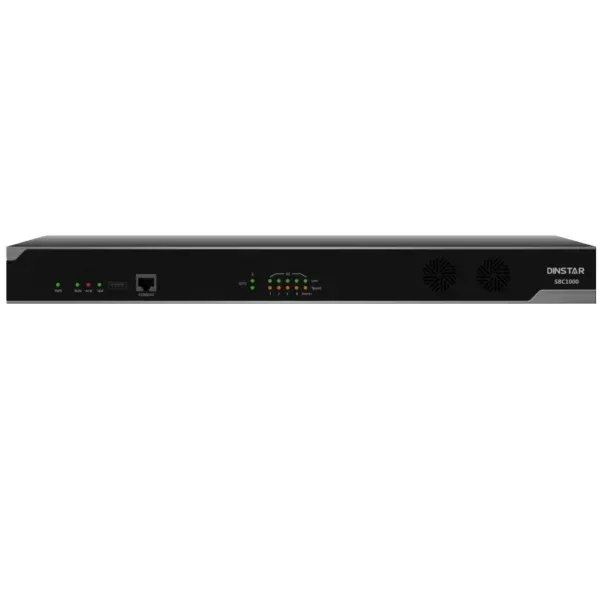
Dinstar SBC1000 Session Border Controller
The Dinstar SBC1000 is designed for organisations that need a controlled, secure and interoperable border between SIP networks. It can sit between an enterprise voice platform and a SIP trunk provider, between different SIP systems, or at the edge of a service-provider environment where signalling, media, routing, security and policy need to be managed deliberately rather than left to a general-purpose firewall. Dinstar positions the platform for medium-to-large enterprise and service-provider VoIP interconnections, with published scalability from 50 to 500 SIP sessions.
What the Dinstar SBC1000 solves
VoIP networks frequently connect systems that were not designed, configured or secured in exactly the same way. A SIP trunk from one carrier can use a different signalling profile from an enterprise IP PBX. A cloud PBX may need to communicate through NAT. A contact centre can require controlled routing, number manipulation, quality-of-service policy and protection from malformed or excessive SIP requests. The SBC1000 addresses this border problem by operating as a Back-to-Back User Agent and policy point between SIP domains, giving administrators a place to enforce routing, manipulate SIP headers and calling numbers, manage registrations, control access, apply rate limits and protect the voice environment.
Dinstar publishes support for SIP 2.0 over UDP, TCP and TLS, SIP trunks in peer-to-peer and access modes, NAT traversal, multiple softswitches, QoS using ToS and DSCP, RTP/RTCP and SRTP, caller and called-number manipulation, flexible routing rules and an embedded VoIP firewall. These capabilities are useful when the business objective is not merely to pass calls but to make the voice border predictable, supportable and secure.
For Tanzania buyers, the practical decision is whether the SBC1000 fits the expected call volume, registration count, transcoding requirement and availability model. Dinstar states a maximum of 500 concurrent SIP sessions, 200 concurrent transcoding calls, 25 calls per second, 5,000 SIP registrations and 25 registrations per second. Those figures should be compared with busy-hour call patterns, expected growth, codec conversion needs, trunk topology and redundancy requirements before the model is approved.
Verified SBC1000 capabilities
Session capacity
Dinstar specifies up to 500 concurrent SIP sessions, up to 200 concurrent transcoding calls and up to 25 calls per second.
Registrations
The published platform limit is up to 5,000 SIP registrations with a registration rate of up to 25 registrations per second.
SIP security
Security functions include TLS, SRTP, access policies, dynamic white and black lists, rate limiting, malformed-packet protection and DoS/DDoS protections.
Interoperability
B2BUA operation, SIP header manipulation, number manipulation, multiple softswitch support and codec transcoding help bridge different SIP environments.
High availability
Dinstar lists 1+1 active-standby redundancy for business continuity together with dual redundant 100–240V AC power supplies.
Management
Web administration, configuration backup and restore, firmware upgrade, CDR export, logs, statistics, network capture, SNMP and central management functions support operations.
Technical specifications for procurement
| Area | Published SBC1000 specification |
|---|---|
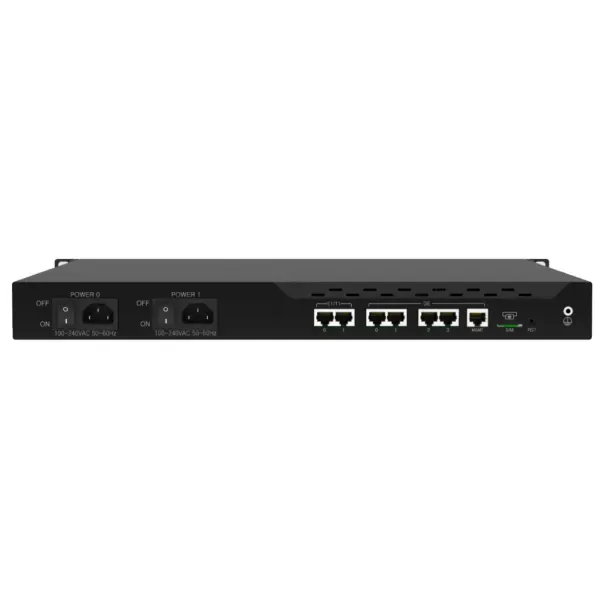
| Ethernet | 4 × 10/100/1000M Base-T Ethernet ports; 1 × 10/100/100M Base-T administration port |
| Other interfaces | 1 × USB 2.0; 1 × RS232 115200 bps RJ45 serial console |
| Concurrent sessions | Up to 500 SIP sessions |
| Transcoding | Up to 200 concurrent transcoding calls |
| Call processing | Up to 25 calls per second |
| Registrations | Up to 5,000 SIP registrations; up to 25 registrations per second |
| SIP | SIP 2.0; UDP, TCP and TLS; peer and access trunks; B2BUA; SIP registrations |
| Media | Voice and fax, RTP transcoding, SRTP, RTCP reports, RFC2833/SIP INFO/in-band DTMF, echo cancellation and adaptive dynamic buffer |
| Codecs | Published datasheet lists G.729, G.723, G.711, iLBC, G.722 and OPUS; Dinstar product material also references AMR and G.726 support in SBC1000 transcoding contexts |
| Power | 1+1 100–240VAC, 50/60Hz; published power consumption 15W |
| Physical | 437 × 302 × 44 mm; 4.5 kg; 19-inch 1U chassis |
Specifications should be reconfirmed against the current Dinstar datasheet and the exact supplied hardware/licence configuration before purchase because product documentation and licensing options can change over time.
SIP security, routing and interoperability
An SBC is valuable when the organisation needs more control over SIP than a conventional firewall normally provides. The SBC1000 can hide internal topology, terminate or mediate SIP signalling, enforce access rules, inspect malformed SIP packets, limit request and registration rates and help shield internal voice infrastructure from scanning and flooding behaviours. Dinstar also lists protection against DoS and DDoS attacks, dynamic white and black lists, access-rule lists and policy-based anti-attack mechanisms.
Routing is equally important. A business may use multiple carriers, different dial plans, different number formats or more than one PBX/softswitch. The SBC1000 supports routing based on prefixes, caller or called number patterns, time profiles, SIP URI, SIP method and endpoint. Number manipulation and SIP header manipulation can help normalize signalling where two systems expect different formats. Dynamic load balancing can also be used in suitable designs.
Transcoding should be sized carefully because it consumes a different capacity pool from basic SIP session handling. If one network leg uses a codec that the other side does not accept, the SBC may need to convert media. Procurement teams should estimate the maximum number of simultaneous calls that can require conversion, not simply the total number of calls. If transcoding is only occasional, the 200-call limit may leave ample headroom; if most calls require conversion, the transcoding figure can become the effective sizing constraint.
How to size an SBC1000 project
Start with busy-hour concurrent calls, not extension count alone. Then identify how many endpoints register through the SBC, how many SIP trunks are required, expected calls per second during peaks, how often codec transcoding is needed, whether TLS/SRTP will be used, whether the design needs 1+1 high availability, and how much growth should be reserved for the next several years.
For an organisation with 200 extensions but only 60 simultaneous calls, the session count may be modest while registrations are much higher. A contact centre can have a different profile, with fewer registered devices but higher call attempts per second. A multi-carrier service environment can have yet another profile. The correct model is therefore selected from traffic behaviour, not simply company size.
Related FourTeck Tanzania resources
See the broader IT, telecom, security and infrastructure portfolio that can support an SBC deployment.
FourTeck Tanzania shop
Browse business telephony, networking, firewall and supporting infrastructure categories.
IP PBX and network services
Review service capabilities covering IP telephony, firewalls, switching and infrastructure.
Dinstar DAG1000-1S ATA
Useful where one analog endpoint needs to connect to a SIP-based voice system.
Dinstar DAG1000-1S1O hybrid gateway
A related Dinstar option where mixed FXS/FXO analog integration is required.
Dinstar DAG1000-2S ATA
A two-FXS option for small analog extension migration into SIP.
Dinstar DAG1000-2S2O gateway
Related gateway hardware for sites that need both analog station and line interfaces.
Dinstar DAG1000-4S FXS gateway
Suitable to review when a voice project includes several analog endpoints.
Dinstar SBC1000 Session Border Controller Tanzania
For organisations evaluating the Dinstar SBC1000 Session Border Controller in Tanzania, the purchasing question should begin with the voice architecture rather than a model number. The SBC1000 belongs at a SIP boundary: for example between an enterprise IP PBX and one or more SIP trunk providers, between a hosted communications platform and branch users, or between two SIP systems that require mediation, routing, security or codec conversion. Tanzania deployments can include corporate headquarters, banks, hospitality groups, universities, contact centres, system integrators, service providers and multi-site businesses where voice must remain stable while networks, carriers and user locations change.
Sizing should document busy-hour concurrent calls, total registrations, carrier trunks, peak call attempts, codec policy and expected growth. Dinstar publishes up to 500 SIP sessions, up to 200 transcoding calls, 5,000 registrations and 25 calls per second. These are useful ceilings, but the engineering decision should also examine whether every call passes through the SBC, whether media is anchored, whether transcoding is common and whether high availability is required. A project with 350 concurrent calls and little transcoding has a different resource profile from a project with 180 calls where almost every call requires codec conversion.
Network planning is equally important in Tanzania. An SBC cannot compensate for unstable last-mile connectivity, severe packet loss or poorly designed LAN segmentation. Voice VLANs, QoS, firewall policy, redundant internet links, DNS, NTP, routing and UPS strategy should be reviewed as part of the deployment. If the SBC connects two carriers or branch networks, each path should be tested for inbound and outbound calls, caller ID, DTMF, transfers, hold, codec negotiation and failover behaviour. TLS/SRTP can improve confidentiality where the complete ecosystem supports the selected security profile.
For a Tanzania quotation, provide the exact model, target concurrent call count, registration count, current PBX or softswitch, SIP trunk providers, required codecs, number of sites, redundancy expectation and whether installation or configuration assistance is needed. FourTeck Tanzania’s contact page can be used to begin the discussion with enough technical context to avoid a generic quotation.
Dinstar SBC1000 Session Border Controller Dar es Salaam
Dar es Salaam businesses often combine headquarters functions, branch connectivity, contact-centre operations, cloud applications and multiple telecom services in one environment. In that setting, the Dinstar SBC1000 can provide a controlled SIP border between internal telephony and external carriers. The most useful deployment is one where the call flow has been mapped first: which numbers arrive from each provider, which PBX or contact-centre platform receives them, which users make outbound calls, which routes are preferred, and what should happen when a trunk or upstream link becomes unavailable.
Organisations moving from legacy PRI or mixed analog environments toward SIP should avoid treating the SBC as a simple replacement for a gateway. The SBC1000 is primarily a SIP-to-SIP security, routing and interoperability platform. If the project also needs analog or other gateway interfaces, those requirements should be separated and matched to appropriate Dinstar gateway hardware. The existing FourTeck Tanzania Dinstar gateway pages can help procurement teams distinguish those roles before a bill of materials is finalized.
For Dar es Salaam contact centres or customer-service teams, peak call attempts per second and transcoding can matter as much as total concurrent calls. Dialer or campaign traffic can create short bursts that differ from normal office calling. The SBC1000’s published maximum of 25 calls per second should therefore be checked against real traffic assumptions. Where multiple service providers are used, route preferences and failover tests should include number presentation, emergency or service numbers where applicable, DTMF behaviour and carrier-specific SIP headers.
A well-prepared Dar es Salaam deployment also includes rack space, redundant power feeds or UPS protection, management access controls, configuration backup, logging and an agreed change process. If high availability is selected, the 1+1 active-standby design should be tested rather than assumed. Procurement requests should specify the expected session licence, transcoding demand, redundancy requirement, current SIP topology and destination site so the quotation reflects the operating environment rather than only the hardware chassis.
Dinstar SBC1000 Session Border Controller Mwanza
In Mwanza, the SBC1000 can be considered by regional offices, distributed enterprises, healthcare groups, education institutions, logistics operations and service businesses that connect local telephony to a centralized or cloud-hosted SIP platform. A branch deployment does not automatically need a large SBC, so the first task is to decide whether the Mwanza site requires its own voice border or whether sessions should terminate centrally elsewhere. That decision depends on survivability, carrier access, latency, WAN design, security policy and how much autonomy the site needs during connectivity disruptions.
Where a local SBC is justified, the network path deserves close attention. Voice quality is sensitive to packet loss, jitter and latency. The SBC1000 supports QoS markings and media handling functions, but upstream networks must honor the intended policy. If the site uses a VPN or SD-WAN path to a headquarters PBX, routing and failover should be tested with real calls. If the site uses a local SIP carrier, the SBC can provide a defined boundary that reduces the need to expose the PBX directly to the service network.
For organisations with limited onsite voice expertise, centralized management, configuration backup, network capture, system logs and statistics can improve support. Remote access should be restricted to trusted management paths and strong credentials. If TLS is enabled, certificate lifecycle and time synchronization should be planned. A secure configuration is not just a checkbox; it requires the PBX, SBC and carrier to use compatible signalling and media security profiles.
Mwanza procurement teams should provide expected concurrent calls, registered extensions, codec use, SIP provider information, IP addressing and NAT design, WAN redundancy and whether the solution must survive loss of a central site. If fewer than 50 sessions are required, the wider Dinstar SBC family may offer a more proportionate model, so sizing should compare the SBC1000 against actual growth and resiliency needs rather than selecting it simply because it has more capacity.
Dinstar SBC1000 Session Border Controller Arusha
Arusha organisations in hospitality, tourism, professional services, healthcare, education and regional administration may use SIP telephony across sites that have different internet providers, PBX platforms or operational priorities. The Dinstar SBC1000 can create a consistent border policy where those systems meet. For a hospitality group, that may mean interconnecting a hotel PBX with a SIP trunk. For a regional company, it may mean standardising routing between headquarters, branches and a cloud communications platform. For an integrator, it may mean isolating customer-facing SIP interconnections from the internal core.
Compatibility testing should be planned early. SIP is a standard, but vendors can still differ in header expectations, number formats, codec preferences, transfer behaviour and response handling. The SBC1000’s header manipulation, number manipulation, flexible routing and B2BUA functions are useful precisely because interconnection is not always plug-and-play. A proof-of-concept should test inbound and outbound calling, hold, transfer, forwarding, DTMF, caller ID, codec negotiation, early media and any application-specific features used by the business.
Arusha deployments should also consider operational continuity. Dinstar publishes 1+1 active-standby redundancy and dual redundant power. These functions can form part of a high-availability design, but resilience also depends on switches, internet circuits, SIP providers, power and the PBX itself. A redundant SBC connected through a single switch or single ISP still leaves a major dependency. The whole call path should therefore be mapped and tested.
When requesting a quotation for Arusha, include the number of hotels, offices or sites involved, whether each site has a local carrier, the intended PBX or UC platform, peak simultaneous calls and any transcoding requirements. If the business also needs IP phones, analog gateways, switches or firewall changes, mention them so the voice border is designed as part of the complete network rather than as an isolated appliance.
Dinstar SBC1000 Session Border Controller Dodoma
Dodoma offices, institutions and organisations with formal procurement processes often benefit from a clear technical requirement before requesting a Session Border Controller quotation. The Dinstar SBC1000 specification can be translated into an acceptance checklist: required SIP sessions, transcoding capacity, registered users, calls per second, trunk count, supported transport, security requirements, redundancy, management access and rack/power conditions. This makes quotations easier to compare because vendors are responding to the same operating assumptions.
A useful requirement document should identify the existing telephony platform and all external SIP relationships. It should state whether the SBC terminates carrier trunks, interconnects two PBXs, supports remote users, provides topology hiding or performs codec conversion. It should also identify whether TLS/SRTP is mandatory, whether the customer has an internal certificate authority, whether NAT exists between systems, and how failover should behave. The SBC1000 supports routing based on prefixes, calling/called number, time profiles, SIP URI, SIP methods and endpoints, which can be used to implement detailed call policies once the operational rules are known.
For institutions with multiple departments, logging and change control are important. CDR export, system logs, signalling trace and network capture can support troubleshooting, but access to those tools should be limited to authorised administrators. Configuration backups should be stored securely and updated after significant changes. Firmware changes should follow a maintenance process that includes rollback planning and service testing.
Dodoma buyers should also clarify what is included in supply: chassis, required licences, high-availability components if needed, rack accessories, configuration, remote or onsite assistance, acceptance testing and documentation. Availability, pricing, warranty terms and delivery timing should be confirmed in the quotation rather than assumed from a generic product page. A precise scope helps procurement teams evaluate total deployment cost instead of comparing only the base appliance price.
Dinstar SBC1000 Session Border Controller UAE
UAE businesses with regional headquarters, multi-site operations, contact centres and SIP-based unified communications can use the Dinstar SBC1000 as a controlled voice edge where enterprise platforms meet telecom or cloud networks. The UAE market often includes complex interconnection requirements: more than one office, multiple service providers, cloud applications and cross-border branches. In this environment, an SBC can help standardise SIP signalling, keep internal addressing hidden, control which trunks and endpoints can communicate, normalize number formats and create failover routes.
The SBC1000’s published scale of up to 500 SIP sessions and 200 transcoding calls fits many medium and larger enterprise scenarios, but licensing and required capacity should still be confirmed before purchase. Contact-centre applications may generate burstier traffic than ordinary office telephony, so the 25-calls-per-second figure should be evaluated against peak dialling behaviour. Enterprises moving between carriers or UC platforms should test the exact SIP features used, including transfers, diversion headers, caller identity, DTMF and codec negotiation.
Security policy should be coordinated with the wider network. TLS and SRTP can protect signalling and media when supported end to end, while access lists, rate limits, topology hiding and SIP-specific protections can reduce unnecessary exposure. The general internet firewall and the SBC have complementary roles. Network segmentation, administrator identity controls, monitoring and patch management remain necessary even when the SBC is deployed.
For organisations comparing a Tanzania and UAE rollout, consistent configuration templates can simplify support. The broader FourTeck UAE platform can support regional infrastructure discussions, while FourTeck’s telecom and IT portfolio provides another reference for multi-market planning. Final UAE supply, licensing, support scope and regulatory or carrier requirements should always be confirmed for the specific project.
Dinstar SBC1000 Session Border Controller Uganda
Ugandan enterprises with operations in Kampala and regional branches can use a Session Border Controller to create a consistent security and routing layer between internal voice systems and external SIP services. The Dinstar SBC1000 is relevant when traffic volumes, registrations or redundancy requirements exceed a small-branch profile, or when a centralised SBC is intended to serve several sites. A national organisation might terminate multiple SIP trunks centrally and route calls to branches, while another organisation may keep trunks local and use the SBC for inter-PBX connectivity.
WAN architecture matters greatly. If branch voice relies on a central SBC, loss of the branch-to-centre link can affect service even when the local LAN is healthy. Procurement should therefore consider whether internet or VPN redundancy is needed and how calls should behave during a failure. If the environment uses more than one carrier, dynamic load balancing and flexible routing can form part of a resilience strategy, but policies must be tested against real carrier behaviour.
The SBC1000 supports a range of operational tools—configuration backup and restore, CDR reports, ping, traceroute, network capture, system logs, statistics and signalling tracking—that are useful when support teams manage remote sites. Those tools can shorten troubleshooting, especially when users report one-way audio, failed registration or intermittent call setup. Administrators should still maintain a clear baseline of normal routing, codec and security settings so diagnostic data can be interpreted quickly.
Uganda buyers can use the FourTeck Uganda site for regional context while coordinating Tanzania or cross-border requirements. A complete request should state the number of branches, user registrations, busy-hour calls, SIP providers, PBX platform, WAN topology and whether the SBC is central or site-specific. That information helps determine whether SBC1000 capacity is appropriate and what supporting network design is required.
Dinstar SBC1000 Session Border Controller Kampala
Kampala can act as the communications hub for organisations with branches across Uganda, making it a logical location for central SIP trunking or voice-control infrastructure. In such a design, the Dinstar SBC1000 can sit between a central IP PBX or UC platform and one or more carriers, then route calls to internal users and branch systems according to policy. The design can simplify carrier management, but it also concentrates dependency, so connectivity and power resilience need to match the importance of the voice service.
Capacity planning should distinguish registered endpoints from concurrent sessions. An organisation may register thousands of devices but have only a few hundred simultaneous calls. Dinstar’s stated limits of 5,000 registrations and 500 concurrent SIP sessions therefore describe different resources. Contact centres and customer-facing departments should also review peak call attempts per second. If transcoding is required between carrier and PBX codecs, the number of simultaneous conversions should be estimated separately against the published maximum of 200.
Kampala deployments commonly benefit from a clear change and testing process. When a new SIP trunk is added, administrators should test number presentation, inbound DID mapping, outbound CLI, emergency or service destinations as applicable, DTMF, hold, transfer, forwarding and failover. When routing rules are changed, an audit record and configuration backup reduce recovery time if unexpected behaviour appears. High availability should include a test of role transition and service restoration.
If the Kampala site also hosts firewalls, core switches, servers and PBX infrastructure, rack design and power redundancy should be coordinated. Dual power inputs offer value only when they connect to independent protected feeds where possible. The SBC management network should be separated from ordinary user access, and remote administration should be allowed only through approved secure paths. These operational disciplines matter as much as the appliance specification when voice is a business-critical service.
Dinstar SBC1000 Session Border Controller Arua
Arua deployments often have a different profile from a large capital-city headquarters. A branch, NGO operation, healthcare site, educational institution or regional office may depend on a central PBX located elsewhere. In that case, an SBC1000 should be justified by specific requirements such as local carrier termination, site survivability, multiple SIP interconnections or a need for strong local policy control. If the site only needs a small number of sessions, another model in the Dinstar SBC family may be more economical.
Connectivity is the central design concern. Voice over a WAN path should be assessed for latency, jitter, packet loss and stability throughout the business day, not only during a short test. If the branch depends on a VPN to Kampala or another hub, the team should define what happens when the VPN fails. A second internet circuit may improve resilience, but failover must preserve SIP routing and registration behaviour. NAT changes during failover can also affect calls and should be included in testing.
When SBC1000 is used, its NAT traversal, routing and media functions can help manage complex edges, but correct firewall and provider coordination remains essential. Administrators should avoid opening broad inbound access simply to make SIP work. Access policies, permitted peers, strong credentials and rate limits should be documented. The management interface should not be exposed unnecessarily to the public internet.
For procurement in Arua, provide a topology diagram if possible. It does not need to be complicated: show the PBX, SBC, SIP carrier, firewall, WAN link and branch users. Add expected call volume, registered devices and codec requirements. This gives the supplier enough context to determine whether the SBC1000 is correctly sized and whether additional switches, gateways, UPS equipment or configuration services belong in the quotation.
Dinstar SBC1000 Session Border Controller Mbarara
Mbarara businesses and regional institutions may operate a mix of local staff, remote branches and central services. An SBC becomes valuable when those voice domains need a deliberate boundary. The Dinstar SBC1000 can mediate SIP between providers and enterprise systems, apply call routing rules, enforce security controls and support codec conversion. The model is most appropriate when capacity and resilience needs justify a platform designed for hundreds of sessions rather than a small office appliance.
A common planning error is to focus only on the number of extensions. If 400 users exist but no more than 80 call concurrently, 80 sessions may be closer to the traffic requirement. At the same time, if all 400 devices register through the SBC, registration capacity must account for them. During a network restoration or mass reboot, many endpoints may try to register at once, making registration rate another useful design parameter. Dinstar specifies up to 25 registrations per second on SBC1000.
Where Mbarara sites share voice traffic with data applications, QoS should be implemented across the LAN and WAN rather than only on the SBC. ToS/DSCP markings can identify voice traffic, but switches, routers and carrier networks determine whether those markings result in prioritisation. Voice VLANs can simplify segmentation and policy. Network monitoring should correlate call-quality problems with interface errors, congestion or WAN events.
For a quotation, include current and future extension counts, expected concurrent calls, trunk providers, PBX platform, whether calls traverse a central hub and whether high availability is required. If the project includes legacy analog devices, specify them separately because they may require Dinstar FXS/FXO gateway products in addition to the SBC. Clear separation between SIP border control and analog conversion avoids ordering the wrong type of equipment.
Dinstar SBC1000 Session Border Controller Gulu
In Gulu, a Dinstar SBC1000 deployment can support organisations that require regional telephony while maintaining a central security and routing standard. NGOs, healthcare operations, educational institutions, logistics businesses and companies with northern branches may connect to a PBX located in Kampala or outside Uganda. If a local SIP trunk is used for cost, numbering or survivability reasons, an SBC can create a clean demarcation between that provider and the enterprise voice environment.
The deployment should be designed around failure modes. Ask what happens if the primary internet link fails, the central PBX becomes unreachable, the local carrier is unavailable, power is interrupted or one SBC node fails. The answer may involve secondary routing, alternate trunks, backup connectivity, local survivability or simply an agreed outage procedure. The SBC1000’s 1+1 high-availability capability can address appliance failure, but it does not automatically solve carrier, WAN or PBX failures.
Maintenance planning is also important for remote sites. Configuration backup, firmware management, logs and packet capture should be part of support documentation. A branch technician may only need to confirm power and cable status, while a central engineer handles configuration remotely. Clear labels on management and voice interfaces, rack documentation and secure remote access can reduce the need for repeated onsite troubleshooting.
Gulu buyers should request pricing with the exact SBC1000 session capacity, any licence assumptions, high-availability requirement and expected deployment services stated clearly. They should also identify the PBX, provider, expected codecs and call volumes. If the system must interoperate with WebRTC, cloud UC or contact-centre platforms, that use case should be stated before purchase so compatibility testing can be included in the project plan rather than discovered during final cutover.
Dinstar SBC1000 Session Border Controller Kenya
Kenyan enterprises with headquarters, branch networks and regional customer-service operations may use the Dinstar SBC1000 to standardise SIP borders across a growing communications environment. The SBC can protect the internal PBX, mediate between carriers, normalize dial plans and support codec conversion where platforms differ. For organisations operating in both Kenya and Tanzania, a common SBC policy model can simplify support, provided local carrier and regulatory requirements are handled independently for each country.
A cross-border design should not assume that the same numbering, routing or telecom rules apply everywhere. Instead, create a shared technical baseline—management security, logging, configuration backup, naming, VLANs, codec preference and change control—then define country-specific trunks and call routes. The SBC1000’s flexible routing engine can support differentiated policy by trunk, prefix, caller, called number, time profile and endpoint.
Kenya contact centres and service businesses should review peak call attempts and media processing carefully. If calls use the same codec end to end, transcoding demand may remain low. If carrier and application codecs differ, transcoding can become a key capacity constraint. Encryption also needs compatibility testing, especially where a cloud UC provider has specific TLS certificate or SRTP requirements.
The FourTeck Kenya site can provide local project context while organisations coordinate shared architecture with Tanzania. When requesting a multi-country quotation, list each destination, quantity, session requirement and local carrier relationship separately. This avoids treating one regional bill of materials as if all telecom conditions are identical and gives engineering teams enough information to define a consistent but locally appropriate deployment.
Dinstar SBC1000 Session Border Controller Kuwait
Kuwait businesses considering the Dinstar SBC1000 may be consolidating SIP trunks, connecting an enterprise PBX to a provider, supporting a contact centre or linking different communications platforms. In each case, the SBC is best specified as part of an end-to-end voice architecture. The organisation should document signalling peers, media paths, numbering rules, security requirements and availability expectations before selecting session capacity.
The SBC1000 provides SIP B2BUA functionality, routing, header manipulation, NAT traversal, security controls and media transcoding. Those features can resolve interoperability problems, but the project team should still test the specific carrier and PBX combination. Telecom providers can have unique requirements for authentication, source addresses, caller identity, number formats and SIP headers. A lab or controlled pilot is preferable to assuming generic SIP compatibility is sufficient.
For business continuity, 1+1 active-standby SBC redundancy and dual power can be valuable, especially where telephony supports customer service or critical operations. The surrounding network should match that resilience: redundant switches, appropriate UPS protection, alternate carrier or internet paths where required and documented failover routes. Monitoring should alert administrators to trunk registration, call failure or interface problems before users report widespread outages.
Kuwait procurement requests should identify the required number of concurrent sessions, peak call attempts, registered users, trunks and transcoding channels. They should also state whether the project requires high availability, TLS/SRTP, centralized management and migration support. Price and availability should be requested for the exact configuration because the base platform, licensing and service scope can vary. A detailed request reduces ambiguity and helps compare quotations on equivalent technical assumptions.
Dinstar SBC1000 Session Border Controller Ghana
Ghanaian enterprises and service organisations can use the Dinstar SBC1000 as a secure interconnection point for SIP trunks, IP PBXs and unified communications platforms. The most important first decision is placement. A central SBC at the headquarters can simplify policy and carrier management, while branch-level SBCs can provide local carrier access or survivability. The right topology depends on WAN reliability, numbering, provider architecture and how much each branch must continue operating during central outages.
Once placement is decided, capacity can be calculated. Dinstar’s published limits provide a clear starting point: up to 500 SIP sessions, 200 transcoding calls, 5,000 registrations and 25 calls per second. A margin for growth is sensible, but over-sizing without a reason can add unnecessary cost. Conversely, ignoring peak call behaviour or transcoding can lead to a platform that meets average demand but struggles during busy periods.
Security should include more than encryption. TLS and SRTP are useful where supported, but access policy, rate limiting, topology hiding, strong administration, monitoring and configuration governance also matter. The SBC1000’s white/black lists, ACL-style functions, malformed-packet protection and DoS/DDoS protections can be incorporated into a layered voice-security design. The internet firewall, endpoint security and identity controls remain part of the broader environment.
For Ghana projects managed as part of a wider African rollout, the FourTeck Africa site can provide regional context. Procurement teams should request the exact model and configuration, destination, PBX platform, carrier, call capacity, redundancy requirement and implementation scope. If analog lines or legacy endpoints are present, list them separately so the design can include appropriate gateway hardware rather than expecting the SBC to perform an unrelated interface-conversion role.
Dinstar SBC1000 Session Border Controller Nigeria
Nigeria’s large enterprise, financial, service-provider and contact-centre environments can create demanding SIP border requirements. The Dinstar SBC1000 can be appropriate for a defined segment of these deployments where up to 500 concurrent sessions and up to 200 transcoding calls fit the traffic profile. Larger carrier or enterprise environments may need a higher-capacity platform, so traffic measurement and growth planning should be completed before standardising on SBC1000.
Multi-carrier routing is a common reason to deploy an SBC. An organisation may prefer one provider for certain destinations and another for failover or cost control. Flexible routing based on prefixes, caller/called numbers, time profiles and endpoints can support those policies. Number manipulation can normalize national and international formats, while SIP header manipulation can address differences between provider expectations and PBX output. These rules should be documented carefully because routing complexity can grow quickly.
Security and fraud control are also important. The SBC can limit requests and registrations, restrict permitted peers, hide internal topology and detect malformed or abusive signalling patterns. However, fraud prevention also depends on PBX permissions, user credentials, dial-plan restrictions, account monitoring and provider controls. Administrators should review international calling permissions, after-hours patterns and unusual call volumes instead of assuming the SBC alone prevents misuse.
For Nigerian deployment, request a design review with call statistics if available. Useful inputs include busy-hour calls, average call duration, peak CPS, registered users, trunk count, codec distribution and failure history. These measurements allow engineering teams to distinguish an interoperability problem from a capacity problem. If the organisation operates branches across West Africa, standard management and security templates can be reused while local carrier and numbering policies remain country specific.
Dinstar SBC1000 Session Border Controller Seychelles
Seychelles organisations in hospitality, financial services, government, tourism and multi-site business can use SIP telephony to connect offices, hotels and service teams, but island connectivity and resilience can make architecture especially important. A Dinstar SBC1000 may be used to create a secure local border between an IP PBX and SIP service or to mediate between local and cloud communications platforms. The decision should account for what happens when external connectivity is degraded or unavailable.
For hospitality environments, voice systems can include front desk, administration, guest-related systems and integrations that require predictable call routing. If the PBX interfaces with property-management or legacy telephony components, each integration should be mapped separately. The SBC1000 handles SIP border functions; analog, digital or specialised interface conversion may require other gateway products. Clear architecture prevents one appliance from being expected to solve functions outside its role.
Because service visits can be more difficult or costly for island sites, remote management and documentation are valuable. Secure web administration, backups, logs, network capture and central management can allow specialists to diagnose many issues remotely. Local staff can be given a simple physical checklist—power, port status, uplinks and cabling—without exposing configuration privileges. Spare strategy and support escalation should be planned according to the criticality of voice service.
A Seychelles quotation request should specify the island/site, user count, call concurrency, SIP provider, PBX, codec requirements, internet redundancy and support expectations. If high availability is required, include whether both SBC nodes and network paths will be protected by suitable power and switching. This turns the product purchase into a complete availability plan rather than relying on appliance redundancy alone.
Deployment and acceptance checklist
Confirm current and future concurrent sessions, registrations, peak CPS and transcoding channels.
Document PBX, softswitch, UC platform, carrier, codecs, DTMF, SIP transport and number formats.
Define trusted peers, ACLs, rate limits, TLS/SRTP, management access and monitoring.
Test HA, dual power, switch redundancy, WAN failover and alternate carrier routing where required.
Plan backups, logs, CDRs, firmware, administrator roles and change records.
Record topology, routes, trunks, addresses, credentials process, support contacts and test results.
Frequently asked questions
What is the Dinstar SBC1000 used for?
It is a Session Border Controller for securing, routing and mediating SIP-based voice interconnections. Typical uses include enterprise SIP trunking, PBX-to-provider borders, multi-provider routing, UC interconnection, contact centres and service-provider environments.
How many calls does SBC1000 support?
Dinstar publishes support for up to 500 concurrent SIP sessions and up to 200 concurrent transcoding calls. The configured/licensed capacity and actual traffic profile should be confirmed for the specific order.
Does SBC1000 support SIP over TLS and SRTP?
Yes. Dinstar lists SIP over TLS and SRTP among SBC1000 security capabilities. End-to-end use still depends on compatible PBX, carrier or UC settings.
Can it connect multiple SIP providers?
Dinstar specifies unlimited SIP trunks, multiple softswitch support, flexible routing and dynamic load balancing. The practical number and routing design depend on capacity, provider configuration and licence scope.
Is an SBC the same as a firewall?
No. A firewall protects general network traffic, while an SBC understands SIP sessions and voice media and can perform SIP-specific policy, topology hiding, mediation, routing, rate limiting and media functions. They are complementary security layers.
Does SBC1000 provide high availability?
Dinstar lists 1+1 active-standby redundancy and dual redundant AC power. A complete resilient design should also review switches, carriers, internet paths, PBX availability and power infrastructure.
What information should I provide for a quotation?
Provide the exact product name, destination, expected concurrent calls, registrations, peak CPS if known, PBX/UC platform, SIP carriers, codec requirements, transcoding estimate, redundancy requirement and desired configuration or support scope.
Quotation checklist
A useful SBC quotation should identify more than the appliance name. Include session capacity, transcoding expectation, registration count, SIP providers, PBX or UC platform, required security profile, number of sites, HA requirement, rack/power environment and implementation scope. Ask the supplier to state exactly what hardware, licences, services and support are included.
Do not assume stock, delivery time, warranty, licences or local installation are included unless they appear in the quotation. If the project is part of a regional rollout, list each country and site separately so telecom and logistics assumptions are explicit.
Decision recap
The Dinstar SBC1000 is a strong candidate when an organisation needs an enterprise-class SIP border with capacity for up to 500 sessions, substantial transcoding, 5,000 registrations, flexible routing, SIP security and high-availability options. It is particularly useful where multiple carriers or SIP platforms need to interoperate and where the business wants the PBX protected from direct external exposure.
The correct purchase decision depends on traffic measurements and architecture. Confirm session count, CPS, registrations, transcoding, PBX/provider compatibility, network quality and redundancy before ordering. For smaller sites, compare other Dinstar SBC models; for larger deployments, evaluate higher-capacity platforms rather than forcing SBC1000 beyond its intended scale.
Consult FourTeck on the complete voice edge
An SBC works best when it is planned together with the SIP trunk, PBX, switching, firewall, WAN, power and support model. FourTeck Tanzania’s broader portfolio includes IP PBX and VoIP, IP phones, firewalls, switches, structured cabling and infrastructure services that can be reviewed alongside SBC1000 requirements.
For regional businesses, the FourTeck network also includes Uganda, Kenya, Africa, UAE and regional IT and telecom solutions. These links are useful for organisations seeking consistent architecture across more than one market.



Reviews
There are no reviews yet.