
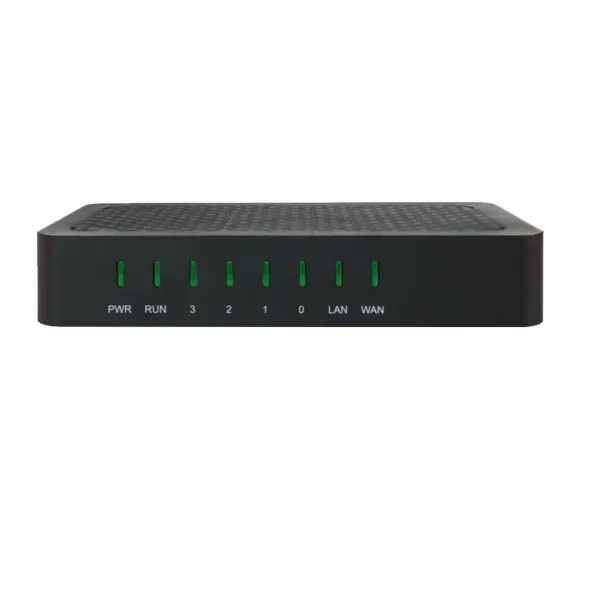
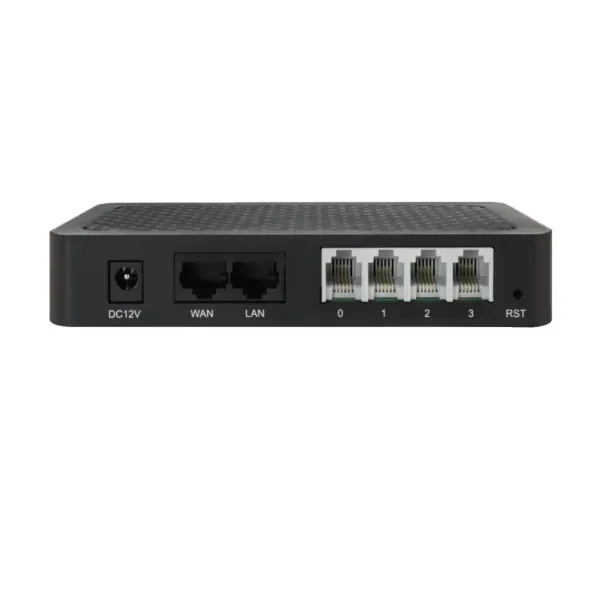
4 FXS ANALOG VOIP GATEWAY • TANZANIA
Dinstar DAG1000-4S FXS VoIP Gateway
The Dinstar DAG1000-4S is a compact four-port FXS gateway for organizations that need to connect legacy analog telephones, fax machines or analog PBX interfaces to a modern SIP-based voice platform. It provides four RJ11 FXS ports, one 10/100 Mbps WAN interface and one 10/100 Mbps LAN interface, supports SIP and IMS environments, and includes T.38 fax, flexible routing, dial-plan control, IPv4/IPv6, TLS/SRTP and multiple administration methods. For businesses in Tanzania, it is especially useful when a complete replacement of existing analog endpoints is unnecessary or when a staged migration to IP telephony is more practical.
What does the Dinstar DAG1000-4S solve?
Many organizations move to an IP PBX or SIP service while still having useful analog equipment. Replacing every telephone, fax machine or PBX extension at once can add unnecessary cost and operational disruption. The DAG1000-4S provides a controlled migration path: its FXS interfaces present analog telephone service to compatible endpoints while the network side registers or communicates with SIP-based systems. This allows a business to keep selected analog devices in service while the core telephony platform becomes IP-based.
The model is suited to small offices, branch locations, reception areas, call-handling environments, SOHO deployments and other sites that need up to four analog endpoints. Buyers should distinguish the DAG1000-4S from the DAG1000-4S(GE). The standard DAG1000-4S uses 10/100 Mbps Ethernet interfaces; the GE variant is a separate model with Gigabit Ethernet. For a voice gateway handling four analog channels, the correct choice should be based on the exact model requirement, network design and procurement specification rather than assuming the two versions are interchangeable.
Preserve analog endpoints
Connect traditional analog phones, fax devices or compatible PBX analog interfaces to an IP telephony environment without forcing an immediate endpoint replacement.
Standard SIP integration
The gateway supports SIP-based operation and is intended to interoperate with SIP servers, IP PBXs, softswitches and IMS/NGN platforms where configuration and compatibility requirements are met.
Fax and voice continuity
T.38 and pass-through fax support can help retain fax workflows, while voice features such as call hold, transfer, forwarding, waiting and three-way conferencing support common business telephony needs.
Verified technical highlights
| Area | DAG1000-4S capability |
|---|---|
| Analog ports | 4 FXS ports using RJ11 connectors |
| Ethernet | 1 × WAN 10/100 Mbps RJ45 and 1 × LAN 10/100 Mbps RJ45 |
| Core signalling | SIP v2.0 with UDP/TCP; SIP over TLS; IMS support |
| Fax | T.38 and fax pass-through |
| Security | TLS and SRTP are supported; access-control functions are also provided in the platform |
| Networking | IPv4/IPv6 dual-stack operation, VLAN tagging and Layer-3 QoS/DiffServ support |
| Routing | Flexible routing, dial plans, digit maps and number manipulation options |
| Management | Web management, SNMP, TR-069, provisioning, backup/restore and firmware upgrade functions |
| Resilience | Primary/backup SIP server support helps provide signalling failover when designed and configured correctly |
Exact codec use, fax behavior, interoperability and supplemental features can depend on firmware, SIP platform settings, network conditions and configuration. A quotation should therefore be paired with a compatibility check for the intended PBX, SIP provider, fax workflow and analog endpoint type.
Deployment and integration guidance
A four-port FXS gateway sits between the IP network and analog devices, so a successful installation depends on both sides. On the IP side, the administrator should confirm addressing, VLAN membership where used, DNS, routing, firewall policy, SIP registration or peer settings, codec expectations, DTMF method and Quality of Service. On the analog side, each endpoint should be checked for the intended dial mode, caller-ID behavior, ringing expectations and cable conditions. If fax is required, the network and SIP platform should be tested with the actual fax machines and remote destinations because fax over IP is sensitive to packet loss, jitter and transcoding.
The DAG1000-4S supports programmable call-progress tones, digit maps, routing rules, number manipulation and related controls that can be useful when matching an existing dialing habit to a new IP PBX. A migration project should document extension numbers, emergency or service dialing needs, outbound prefixes, caller-ID presentation and how calls should be handled if the primary SIP server becomes unavailable. Good documentation is particularly valuable when the gateway is installed in a branch office where remote troubleshooting may be required later.
For network planning, voice traffic is usually modest in bandwidth compared with video or large file transfers, but quality is more sensitive to delay, jitter and loss. Managed switching, sensible VLAN design and QoS can help keep voice stable on busy networks. The gateway itself should be connected to reliable power; where telephony continuity matters, consider the wider power path including the gateway, router, switch, firewall, PBX or SIP access equipment and internet termination. A UPS only protects the devices connected to it, so the full dependency chain should be reviewed.
Buying checklist for the DAG1000-4S
Confirm that four FXS ports are enough for the analog phones, fax machines or PBX interfaces that must remain active.
Specify DAG1000-4S if you require the standard 10/100 Mbps model. Do not substitute DAG1000-4S(GE) without deliberate approval.
Record the IP PBX or SIP platform, registration method, codecs, DTMF method, authentication and any provider-specific requirements.
State whether fax is needed, how many fax devices are involved and whether T.38 is supported end-to-end in the intended environment.
Check IP addressing, VLANs, firewall/NAT, DNS, QoS, internet stability and remote-management policies before deployment.
If more than four analog endpoints are likely soon, compare a higher-density FXS gateway rather than chaining small units without a design reason.
Related FourTeck Tanzania resources
For a complete deployment, the gateway should be considered as part of the wider voice and network environment. Review the FourTeck Tanzania technology overview for integrated IT, telecom and networking planning. The Tanzania technology shop explains how product selection is tied to compatibility, capacity and infrastructure. For implementation questions, the FourTeck Tanzania services page covers solution delivery and support considerations.
Organizations evaluating a broader communications refresh can also use the FourTeck Tanzania approach to understand how voice, networking, security and lifecycle planning fit together. For a quotation, compatibility discussion or exact model request, use the verified FourTeck Tanzania contact page. These are the distinct relevant same-domain pages that were publicly verifiable for this product topic; no unverified product URLs are invented here.
Dinstar DAG1000-4S Tanzania
Businesses searching for the Dinstar DAG1000-4S in Tanzania are commonly trying to solve a practical migration problem: they want the flexibility of SIP-based telephony but still have analog phones, fax equipment, door phones, modems or PBX-side analog interfaces that remain operationally useful. The DAG1000-4S gives a small site four FXS channels in one appliance, which makes it particularly suitable for branch offices, professional firms, clinics, schools, hospitality back offices, small contact environments and distributed enterprises that need to keep a limited number of analog endpoints connected to an IP voice system.
For Tanzania deployments, the procurement discussion should start with the existing voice platform rather than the gateway alone. Confirm whether the organization uses an on-premises IP PBX, a hosted SIP platform, a carrier SIP service or a mixed environment. Record the analog endpoint count and identify which ports are for telephones and which are for fax. If an existing analog PBX is involved, document how its extensions or trunk-side interfaces are expected to connect. These details affect dial plans, routing rules, caller-ID behavior and the test process. Where several offices are involved, using the same numbering plan and configuration conventions across sites can simplify remote administration.
Network quality is equally important. Tanzania businesses may operate with fiber, fixed wireless, mobile backup or combinations of access services. The gateway does not remove the need for reliable IP connectivity between the branch and the SIP platform. Packet loss, jitter and unstable NAT behavior can affect voice and are even more noticeable with fax. A voice-ready LAN should therefore include sensible VLAN and QoS policy, stable routing and appropriately configured firewall rules. If the PBX is hosted outside the site, the internet path becomes part of the telephony system and should be included in continuity planning.
When requesting a Tanzania quotation, specify “Dinstar DAG1000-4S, 4 FXS, standard 10/100 Ethernet model,” quantity, intended endpoints, PBX/SIP platform and whether configuration assistance is needed. FourTeck can then discuss product fit together with IP PBX, switching, firewall, cabling and power considerations. For customers with multi-country requirements, the same design principles can be coordinated with FourTeck’s regional sites without assuming that pricing, stock or deployment conditions are identical in every market.
Dinstar DAG1000-4S Dar es Salaam
In Dar es Salaam, the DAG1000-4S can be a practical fit for offices that are moving from traditional telephony toward SIP while keeping a small analog footprint. Corporate offices, logistics companies, professional services firms, retail support teams, property managers and hospitality sites may have individual analog phones or fax machines that do not justify immediate replacement. A four-port gateway lets those devices participate in a modern IP PBX design while preserving a familiar analog interface at the endpoint.
A Dar es Salaam deployment should begin by mapping the call flow. Reception may need one analog extension while a fax machine uses another; the remaining ports might serve utility phones, lift or lobby communications, or other compatible analog devices. The correct design is not simply “four ports equals four devices.” Administrators should identify extension numbers, inbound DID routing, outbound caller ID, emergency dialing expectations, after-hours behavior and any call-forwarding rules. If the analog endpoints are distributed across a building, existing copper cabling should be inspected and documented so that port assignments remain clear during commissioning.
Dar es Salaam sites often combine voice with busy data networks carrying cloud applications, CCTV, Wi‑Fi and video meetings. Because real-time voice is sensitive to congestion, managed VLANs and QoS can be useful where switches and routers support them. Firewall NAT and SIP handling should be reviewed rather than relying on generic settings, especially when the SIP server is off-site. If fax is business-critical, test actual fax sending and receiving under typical network load. A configuration that works for a voice call is not automatically proof that fax will behave reliably.
For procurement teams in Dar es Salaam, provide the exact model, quantity, PBX platform, SIP provider if relevant, number of analog devices and desired commissioning scope. The verified Tanzania contact page lists Dar es Salaam contact information and can be used to start a quotation discussion. Avoid assuming stock or delivery timing until confirmed for the specific order, and include any requirement for power backup, rack placement, patching or network changes in the request so the total deployment can be assessed rather than pricing the gateway in isolation.
Dinstar DAG1000-4S Mwanza
For organizations in Mwanza, the Dinstar DAG1000-4S can support branch telephony where a small number of existing analog endpoints must connect to an IP-based communications platform. This is relevant for branch offices, clinics, educational facilities, distribution operations, hospitality sites and other organizations that want centralized SIP calling without replacing every field device. Because the gateway supports four FXS channels, it is most appropriate when the analog requirement is clearly bounded; larger sites should compare higher-density gateways before deciding on architecture.
A useful Mwanza deployment plan separates local dependencies from central services. If the IP PBX is hosted in Dar es Salaam, another country or a cloud environment, the local gateway depends on WAN connectivity for registration and calls. That makes internet resilience, routing and DNS important. If the PBX is located on the same LAN, the external internet path may be less critical for internal calls but still important for SIP trunks or inter-branch traffic. The design should document what happens during a WAN interruption and which calls, if any, must remain possible.
Power continuity should also be reviewed at branch level. A UPS for the gateway alone may not maintain service if the router, switch, firewall or internet terminal loses power. For sites where voice continuity is operationally important, identify every device in the path and estimate the desired backup duration. The gateway’s configuration should be backed up after commissioning, and remote-management access should be restricted to approved administrators. Where TR-069, SNMP or web management is used, those interfaces should be incorporated into the organization’s security and monitoring policy rather than left exposed by default.
When a Mwanza buyer requests a quote, it is useful to include a simple port schedule: for example, FXS1 reception phone, FXS2 fax, FXS3 warehouse phone and FXS4 spare or future endpoint. Include the intended extension numbers and SIP platform details as well. This gives the supplier or integrator enough context to discuss configuration, testing and any additional switching or cabling requirements. If the expected analog count could grow above four, mention that early so a larger model can be evaluated instead of creating an unnecessarily fragmented gateway design.
Dinstar DAG1000-4S Arusha
Arusha businesses in hospitality, tourism, professional services, education and branch operations often need communication systems that blend existing devices with newer IP platforms. The DAG1000-4S can serve as a compact bridge when a site has only a few analog endpoints but wants to standardize calling on SIP. A hotel office might retain a fax line and several service phones; a professional office may preserve a trusted analog conference or utility phone; a branch may need to connect legacy PBX extensions while its central communications platform is modernized.
The key planning question is whether the analog endpoints genuinely need FXS service. FXS ports provide line-side service for analog telephones and similar devices. They are not interchangeable with FXO ports, which connect to analog PSTN or PBX line interfaces. Buyers should verify the interface required by each device before ordering, especially when integrating with older PBX hardware. Misidentifying FXS and FXO is a common procurement error and can lead to equipment that cannot connect in the intended way.
For Arusha sites using centralized or cloud-based IP PBX services, test call quality during real operating hours rather than only during a quiet installation window. Wi‑Fi, backups, CCTV uploads and guest internet traffic can change network conditions significantly. Voice should preferably use wired Ethernet to the gateway, and the network can prioritize real-time traffic where appropriate. If the site uses multiple internet links, define which path carries SIP traffic and how failover affects registration, public IP addressing and firewall state. Failover that works for web browsing does not always behave identically for active SIP sessions.
FourTeck Tanzania’s contact page lists Arusha as one of its office locations, making it a verified channel for discussing requirements. A strong request should include the exact model, whether the standard DAG1000-4S or GE variant is required, the number and type of analog endpoints, PBX or SIP service, site network details and the desired level of configuration or testing. That information supports a technically useful quotation rather than a simple unit-price comparison.
Dinstar DAG1000-4S Dodoma
In Dodoma, the Dinstar DAG1000-4S can support public-sector offices, private organizations, educational institutions and branch operations that need to retain up to four analog endpoints while moving their main telephony environment to SIP. It is especially useful when the business requirement is continuity and controlled modernization rather than a complete rip-and-replace. Analog phones and fax machines can remain available while call routing, extension management and inter-site communications are handled by an IP PBX or SIP platform.
For organizations with formal procurement processes, model precision matters. The purchase description should identify Dinstar DAG1000-4S, four FXS RJ11 ports, standard 10/100 Mbps Ethernet interfaces, and any required accessories or configuration scope. If a bid document simply states “4-port Dinstar gateway,” suppliers may quote different variants. Separating the standard model from DAG1000-4S(GE) helps keep technical evaluations consistent. The same discipline should apply to firmware requirements, PBX interoperability expectations and whether T.38 fax is a mandatory acceptance criterion.
A Dodoma project should also define acceptance testing. Voice tests can include inbound and outbound calls, DTMF, hold, transfer, caller ID, forwarding and failure behavior. Fax tests should include sending and receiving to representative destinations if fax is in scope. Network tests should verify addressing, VLANs, DNS, SIP server reachability and behavior after an internet or PBX interruption. Configuration backup should be created after successful handover so that a replacement or factory reset does not require the installation to be rebuilt from memory.
The verified FourTeck Tanzania contact page identifies a Dodoma office and provides a route for product and project enquiries. When submitting a requirement, include quantity, analog endpoint list, SIP/PBX platform, preferred delivery scope and expected deployment schedule. Do not assume availability, delivery time or local stock until confirmed. If the gateway is part of a larger office build, include switching, structured cabling, firewall, UPS and rack requirements so procurement can evaluate the complete dependency chain.
Dinstar DAG1000-4S UAE
Organizations with operations in both Tanzania and the UAE may want a consistent analog-to-SIP gateway design across branches. The DAG1000-4S can provide a common four-port FXS platform where each site retains a small number of analog devices. Standardization can simplify configuration templates, troubleshooting procedures, spare strategy and documentation, but each country or branch should still be validated for its own SIP provider, numbering plan, firewall design and local telecom requirements.
A UAE deployment may involve an on-premises IP PBX, private WAN, hosted communications platform or SIP service. The gateway’s flexibility with routing and dial plans allows it to fit different architectures, but the settings should be documented site by site. For example, branch extension ranges, outbound prefixes and emergency dialing behavior may differ. If the gateway is used with fax, confirm T.38 capability throughout the call path rather than assuming gateway support alone guarantees fax success. Session border controllers, SIP trunks and carrier transcoding can all influence real-world behavior.
For network security, use TLS/SRTP where supported by the complete solution and policy, restrict management access, maintain current approved firmware and avoid exposing management interfaces directly to the public internet. If remote administrators manage multiple gateways, consistent naming, backups and monitoring can reduce support time. Where failover SIP servers are configured, test the switchover and recovery process so that the operational team understands what happens during an outage.
FourTeck’s verified UAE IT and telecom site covers IP PBX and VoIP solutions and can be used for related UAE requirements. For a multi-country deployment, document which site owns the central PBX, where SIP trunks terminate, how extensions are allocated and who administers the gateways. That approach makes the DAG1000-4S part of an intentional regional communications design rather than an isolated adapter at each location.
Dinstar DAG1000-4S Uganda
For Uganda deployments, the DAG1000-4S can bridge four analog endpoints into a SIP-based phone system without requiring immediate replacement of every device. Businesses with offices in Kampala, regional branches or cross-border operations may use it to retain analog phones, fax machines or PBX interfaces while managing extensions and call routing through a centralized IP PBX. The product is best suited to clearly defined small analog requirements; organizations with many analog rooms or extensions should evaluate higher-density FXS gateways before purchase.
The verified FourTeck Uganda site highlights IP PBX and VoIP as core communications services, which makes it a relevant regional resource for a gateway project. A buyer should provide the PBX type, location of the SIP server, internet connectivity, extension plan and analog endpoint list. If branches connect over public internet, consider VPN or secured SIP architecture according to the broader platform design rather than treating the gateway as the only security control.
Uganda organizations with remote sites should also plan for supportability. Record the gateway’s IP address, site name, port mapping, SIP account assignments, firmware version and configuration-backup location. Remote management can be convenient, but access should be limited to trusted networks or secure administrative paths. Monitoring through supported management protocols can help identify registration or network problems before users report them, provided those protocols are configured securely.
For procurement, separate the device price from the deployment scope. A complete project may require switch ports, VLAN configuration, cabling, UPS power, PBX licenses or SIP accounts, firewall changes and testing. Clarifying these dependencies helps a buyer compare quotations on equivalent assumptions. If the gateway will be shipped to or configured for multiple Uganda sites, standard templates can speed deployment, but every site should still receive final testing for local network quality and call behavior.
Dinstar DAG1000-4S Kampala
Kampala offices can use the Dinstar DAG1000-4S when they have a modern IP PBX but still need up to four analog devices at reception, finance, facilities or other operational points. The gateway converts those endpoint requirements into SIP-side connectivity, allowing businesses to modernize the core telephony system while extending the useful life of selected analog equipment. This can be especially practical during phased office upgrades or when a specific analog device has no immediate IP replacement.
For a busy Kampala network, prioritize call quality by reviewing switch congestion, firewall behavior and internet stability. The gateway supports VLAN and QoS capabilities, but end-to-end quality depends on the rest of the network honoring the design. A voice VLAN can create useful logical separation, while QoS can prioritize signaling and media during congestion. However, QoS cannot compensate for a severely undersized or unstable internet circuit. Baseline latency, jitter and packet loss should therefore be assessed if the SIP server or trunk is remote.
Fax use should be treated as a separate test case. T.38 can improve fax transport where supported, while pass-through may be used in other designs, but reliable results depend on the remote side and network path. Procurement teams should specify whether fax is mandatory and include a real acceptance test. If fax is not required, the remaining ports can be dedicated to analog telephones or compatible devices, with each port assigned a clear extension and call policy.
For Kampala customers comparing gateway options, the most important decision factors are exact port count, PBX compatibility, management requirements, security policy and growth. The DAG1000-4S is deliberately compact; if the expected analog count could rise to eight, sixteen or more, selecting a higher-density platform may be cleaner than adding multiple small gateways. FourTeck Uganda’s communications focus can support the broader IP PBX discussion, while the Tanzania site can coordinate requirements for organizations operating across both markets.
Dinstar DAG1000-4S Arua
Arua organizations that need to connect a small number of analog endpoints to a centralized SIP platform can use the DAG1000-4S as a compact branch gateway. In regional offices, the value often lies in avoiding an unnecessary replacement of functional analog devices while still gaining centralized extension management, inter-office dialing and SIP call routing. This is particularly useful when a branch has only a receptionist phone, a fax machine and one or two utility handsets.
Connectivity planning is especially important for a branch that depends on a PBX in another city or country. The local gateway may be technically healthy while calls fail because the WAN path, DNS, NAT or firewall is unavailable. A clear troubleshooting diagram should show the gateway, local switch, router/firewall, internet or WAN service and remote SIP platform. This gives support teams a logical sequence for fault isolation and avoids replacing hardware when the problem is elsewhere in the path.
If the site has variable connectivity, configure and test primary/backup SIP behavior where the PBX architecture supports it. Understand that server failover is not the same as internet failover: if both servers are reached through the same failed WAN circuit, a secondary registration target may not restore service. Conversely, dual internet links need correct routing and NAT behavior for SIP sessions. Resilience should therefore be designed at multiple layers rather than attributed to one gateway setting.
For an Arua quotation, provide the number of analog ports required now and over the expected planning period, endpoint types, central PBX details, branch internet arrangement and preferred management approach. If the branch is part of a larger Uganda rollout, ask for a standard configuration template and site-specific parameter sheet. This makes deployment repeatable while preserving unique extension numbers, local addresses and network settings. The result is easier to hand over and support than a collection of individually configured gateways with inconsistent documentation.
Dinstar DAG1000-4S Mbarara
In Mbarara, the DAG1000-4S may suit clinics, educational institutions, professional offices, hospitality businesses, distributors and other organizations that retain a few analog communication devices. It can connect those devices to a SIP-based PBX while preserving existing user workflows. Because the platform offers four FXS ports, it is simple enough for a compact branch but still provides business-oriented functions such as flexible dial plans, SIP server redundancy, management tools and secure signaling/media options where the wider solution supports them.
A common planning mistake is to focus only on the gateway and forget the analog cabling. Before installation, trace and label the pairs that run from the gateway location to each telephone or fax device. Old cabling may have undocumented joins, splitters or connections to previous PBX equipment. A controlled cutover should isolate the intended analog circuit before it is connected to an FXS port. Documentation should state which physical cable maps to which FXS port and extension number.
Configuration should then be validated against the business call flow. Test local extensions, outbound calls, inbound routing, DTMF to IVR systems, hold and transfer where required. If caller ID is important on analog handsets, confirm the endpoint and regional signaling configuration. For fax, send and receive several real documents rather than relying on a single successful page. After acceptance, save the configuration backup and record administrative access according to the organization’s credential policy.
Mbarara buyers planning future expansion should also consider whether four ports remain enough for the expected lifetime of the deployment. If additional rooms, branches or analog systems are likely to be added, it may be more efficient to select a higher-port-count Dinstar FXS model. Conversely, if only one or two analog devices are required, the four-port model provides spare capacity without requiring a large chassis. The correct decision balances present need, realistic growth and support simplicity rather than maximizing port count without purpose.
Dinstar DAG1000-4S Gulu
For Gulu businesses and institutions, the Dinstar DAG1000-4S can provide a straightforward analog extension bridge into a central IP telephony platform. A site with a small administration team may need to preserve a reception phone, security desk phone, fax machine or other compatible analog endpoint while moving the main organization to SIP. Using a dedicated FXS gateway helps separate that legacy requirement from the broader PBX architecture and can make future replacement more orderly.
The installation should be treated as part of the branch network. Assign a documented IP address or DHCP reservation, place the device in the appropriate VLAN, configure DNS and time settings, and restrict management to trusted sources. If the site is supported remotely, agree on how administrators reach the gateway during troubleshooting. Direct public exposure of a management interface should be avoided; secure VPN or controlled management paths are preferable as part of a broader network-security design.
Voice quality testing should include calls at busy times. A branch network may share bandwidth among cloud applications, updates, CCTV synchronization and user browsing. The gateway supports QoS-related features, but traffic prioritization should also be configured on switches, routers and WAN edges where necessary. If calls traverse a VPN, verify that the tunnel capacity and MTU behavior are suitable for SIP/RTP traffic. If the PBX is local, confirm how external calls are routed when the internet connection changes state.
For Gulu procurement, list the actual analog endpoint types, not just the quantity. A fax machine has different acceptance requirements from a telephone; a legacy PBX connection may require careful interface verification. Include desired installation, configuration, testing and documentation scope in the quotation request. FourTeck Uganda provides a regional reference for IP PBX and VoIP solutions, while organizations with Tanzania operations can coordinate a common voice architecture through the respective FourTeck regional channels.
Dinstar DAG1000-4S Kenya
Kenya organizations can use the DAG1000-4S when a SIP migration leaves a small number of analog devices that still need service. The gateway’s four FXS ports make it appropriate for compact offices, branches, reception areas and specialized analog endpoints. For multi-country companies, using the same gateway family in Kenya and Tanzania can reduce differences in configuration and support procedures, but the actual SIP service, numbering plan and network design should still be validated independently at each site.
The verified FourTeck Kenya site includes IP PBX, VoIP business phones and unified communications among its core solutions. A gateway project can therefore be discussed as part of a larger telephony upgrade rather than only as a hardware purchase. The buyer should explain whether the analog devices are being retained temporarily during migration or are expected to remain for the full lifecycle. That distinction affects whether spare port capacity and future expansion should be prioritized.
For offices connected to a central PBX over WAN or internet, define QoS, VPN and failover behavior before rollout. SIP registration can be sensitive to NAT changes when an internet circuit fails over, so testing should include both primary and backup network paths where applicable. Security should include strong administrative credentials, restricted management interfaces and supported encrypted signaling/media when the PBX and policies permit. Configuration backups should be stored centrally with clear site labels.
Kenya procurement teams comparing suppliers should ask whether quotations refer to the standard DAG1000-4S or DAG1000-4S(GE), whether configuration is included, and which assumptions are made about the PBX, SIP accounts, cabling, power and network. A lower hardware price may not represent a lower project cost if essential integration tasks are excluded. Comparing complete scope, acceptance tests and support responsibility produces a more meaningful evaluation for business telephony.
Dinstar DAG1000-4S Kuwait
For businesses in Kuwait evaluating a four-port FXS gateway, the Dinstar DAG1000-4S provides a focused way to connect legacy analog endpoints to a SIP platform. It can be useful for branch migrations, utility phones, fax machines and older PBX-side devices where an analog interface remains necessary. The product should be specified by exact model because Dinstar also offers a DAG1000-4S(GE) variant; the standard DAG1000-4S uses 10/100 Mbps Ethernet and is a separate procurement item.
A Kuwait deployment should document how the gateway fits into the company’s voice architecture. If the IP PBX is located on-premises, the LAN path and switch design are central. If the PBX is hosted or located in another country, WAN connectivity and security become more prominent. SIP signaling and RTP media flows should be understood so firewall rules can be applied deliberately. Where encrypted SIP and SRTP are enabled, confirm compatibility across the full path, including PBX, gateway and any service-provider elements.
For organizations with offices in the Gulf and East Africa, a common gateway model can support standard operating procedures. Configuration templates can define naming, NTP, administrative policy, logging, codecs, DTMF and monitoring, while site-specific sheets contain addresses, extension accounts and routing. This approach reduces configuration drift and helps support teams compare a working branch with a problem site. Firmware changes should be managed rather than performed casually, especially in an environment where interoperability has already been validated.
When requesting a Kuwait quotation, include quantity, exact model, PBX platform, analog endpoint type, fax requirement and desired commissioning scope. The approved FourTeck network includes a Kuwait regional site, but public availability was not reliably verifiable during this run, so no unverified deep link is inserted. Buyers should confirm current commercial details directly rather than relying on assumptions about stock, pricing or local service coverage.
Dinstar DAG1000-4S Ghana
Ghana businesses moving from traditional telephony to SIP can use the Dinstar DAG1000-4S to keep up to four analog endpoints connected during or after migration. The gateway may serve small offices, branches, hospitality back offices, clinics, schools or other sites where a few analog phones or fax machines remain practical. Because it supports flexible dialing and management features, it can be integrated into a structured IP PBX design rather than treated as an unmanaged adapter.
The verified FourTeck Ghana site provides a regional technology resource for organizations that operate in Ghana as well as Tanzania. For a shared communications standard, document the common PBX architecture, user numbering scheme, gateway settings and network-security policy. Then allow each country or office to use site-specific SIP accounts, local routing and carrier requirements. This creates consistency without incorrectly assuming that telecom conditions are identical across markets.
Where fax remains important, test T.38 with the actual SIP service and remote destinations. Fax success depends on more than the gateway specification. Packet loss, jitter, codec conversion and service-provider handling can affect results. If fax is mission-critical, include it as a formal acceptance test rather than discovering limitations after deployment. The same principle applies to caller ID, transfer, DTMF and failover: write the expected behavior before configuration so testing is objective.
For Ghana procurement teams, compare the gateway as part of the complete telephony solution. Confirm switching and VLAN requirements, power backup, firewall changes, PBX licenses, SIP accounts, analog patching and administrator training if relevant. If more than four analog channels are required, evaluate a higher-density model instead of buying multiple DAG1000-4S units solely because each unit appears inexpensive. A clean design considers lifecycle support and rack or power complexity in addition to initial hardware cost.
Dinstar DAG1000-4S Nigeria
Nigeria organizations with hybrid analog and IP telephony environments can use the DAG1000-4S as a four-port bridge between traditional endpoints and SIP systems. This can support phased migrations in offices, retail operations, service businesses, educational sites and branch networks. The value is strongest when only a small analog requirement remains and the organization wants centralized call control without discarding devices that still serve a clear operational role.
The verified FourTeck Nigeria site is an appropriate regional reference for related IT and communications enquiries. When coordinating a Nigeria and Tanzania rollout, define a shared baseline configuration for the gateway, but verify each site’s PBX, SIP provider, firewall and WAN design. The same hardware can behave differently across sites when NAT, packet loss or carrier handling changes, so commissioning should include live testing rather than assuming a configuration copied from another country will work unchanged.
Power and internet resilience can be significant design considerations. If the gateway must remain available during short outages, identify every dependency: gateway, switch, firewall/router, PBX if local, internet modem or ONT, and any supporting network device. UPS sizing should reflect the required runtime and load. Where dual internet links are used, test SIP behavior during failover and failback. Active calls may drop even when new registrations recover, and operational teams should understand that behavior in advance.
For Nigeria quotations, specify whether the gateway is for analog phones, fax machines or PBX integration, and identify the expected quantity and future growth. Include configuration, testing and documentation requirements. If a site expects substantial expansion, a higher-density gateway may provide better operational simplicity. If four ports are sufficient for the lifecycle, the DAG1000-4S offers a compact and manageable option that can be standardized across smaller branches.
Dinstar DAG1000-4S Seychelles
In Seychelles, the Dinstar DAG1000-4S can support hospitality properties, professional offices, service organizations and branch environments that need a small analog extension footprint alongside SIP telephony. A site might keep fax, reception or back-office analog phones while centralizing call handling on an IP PBX. The four-port form factor is useful when the requirement is modest and clearly understood, avoiding the complexity of a high-density chassis for only a few endpoints.
Island and multi-property deployments benefit from strong remote-management discipline. The gateway supports web management and other administration mechanisms, but access should be secured and documented. Each device should have a site-specific name, IP information, port map, SIP account reference and configuration backup. This makes it easier for a central support team to troubleshoot without depending on local staff to remember how the system was originally configured.
For hospitality use, pay attention to how analog endpoints interact with the PBX call plan. Guest-service, reception, back-office and emergency dialing can have different rules. If existing copper pairs run long distances inside a property, inspect cabling quality and confirm that the endpoint behavior is acceptable. The Dinstar datasheet specifies long analog line capability, but actual cable condition, topology and connected devices should still be assessed during installation rather than assuming every legacy pair is suitable.
A Seychelles buyer should request a solution that covers the gateway, required PBX configuration, network changes, testing and handover. If the gateway connects to a cloud PBX, evaluate internet resilience and voice quality. If the PBX is local, confirm how external SIP trunks or inter-property calls are routed. Avoid assuming local stock, delivery or installation coverage until confirmed for the project. Providing complete scope at enquiry stage helps the supplier determine what can be offered and what dependencies need separate coordination.
Regional FourTeck network for multi-country projects
Organizations that operate beyond Tanzania can coordinate related communications requirements through verified regional FourTeck sites including FourTeck Uganda for IP PBX and VoIP projects, FourTeck Kenya for IP PBX and business communications, FourTeck UAE for telecom and IT solutions, FourTeck Ghana for regional technology requirements and FourTeck Nigeria for regional IT requirements. These links are provided as regional coordination resources; exact product availability, pricing, warranty and deployment scope should be confirmed for each country and project.
Frequently asked questions
What is the Dinstar DAG1000-4S?
It is a four-port FXS analog VoIP gateway designed to connect analog telephones, fax machines and compatible PBX interfaces to SIP-based IP telephony networks.
What is the difference between DAG1000-4S and DAG1000-4S(GE)?
The standard DAG1000-4S uses 10/100 Mbps WAN and LAN interfaces. DAG1000-4S(GE) is a separate Gigabit Ethernet model. Buyers should specify the exact required variant.
Can it connect a normal analog telephone to an IP PBX?
Yes. Its FXS ports are intended for analog endpoint connectivity while the network side integrates with compatible SIP-based IP PBX or SIP platforms.
Does the DAG1000-4S support fax?
Dinstar specifies T.38 and fax pass-through support. Successful faxing still depends on the PBX, SIP provider, network quality and remote endpoint, so testing is recommended.
Does it support secure SIP?
The platform supports SIP over TLS and SRTP. Encryption should be enabled only after confirming compatibility with the PBX or service and the organization’s security design.
Can it work with a hosted PBX?
It can work with compatible SIP servers and IP PBX platforms. A hosted deployment should verify SIP registration, NAT/firewall handling, codecs, DTMF and internet quality.
How many analog devices can it connect?
It provides four FXS ports, so up to four compatible analog endpoint connections can be provisioned, subject to the intended configuration.
What should I provide for a quotation?
Provide the exact model, quantity, analog endpoint types, PBX or SIP platform, fax requirement, site location, existing network details and whether configuration or installation is required.
Quotation checklist
Before requesting a Dinstar DAG1000-4S quotation, prepare: exact quantity; confirmation that the standard DAG1000-4S rather than GE variant is required; list of analog phones, fax machines or PBX interfaces; PBX/SIP server brand and platform; SIP account or trunk architecture; extension numbers; dialing requirements; fax requirement; network VLAN and IP plan; firewall/NAT information; power-backup requirement; installation location; configuration scope; testing scope; and any expected growth beyond four analog ports.
This information helps distinguish a simple hardware request from a deployment that also needs PBX configuration, network changes, cabling, security policy or commissioning. It also reduces the risk of comparing quotations that include different assumptions.
Decision recap
Choose the Dinstar DAG1000-4S when you need exactly four FXS ports, want to retain analog endpoints, and have a compatible SIP/IMS-based telephony environment. Its strongest fit is a small office or branch where analog phones or fax devices remain necessary but the core phone system is moving to IP. The gateway supports useful business functions including T.38 fax, flexible routing, VLAN/QoS, TLS/SRTP, IPv4/IPv6 and remote management.
Consider another model if you need Gigabit Ethernet specifically, require more than four analog ports, need FXO rather than FXS interfaces, or have a PBX/service that has not been validated for compatibility. A technically sound purchase is based on the endpoint interface, channel count, SIP environment and future growth—not simply on the product name or lowest unit price.
Discuss your Dinstar DAG1000-4S requirement
FourTeck Tanzania can review the product requirement together with your IP PBX, SIP platform, analog endpoints and network environment. Share the quantity, port use, site, PBX details and expected deployment scope so the conversation can focus on compatibility and a complete quotation rather than an isolated hardware price.



Reviews
There are no reviews yet.