
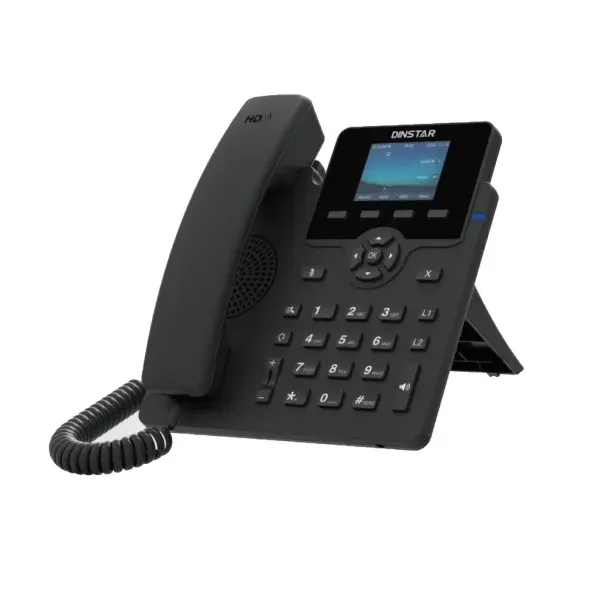
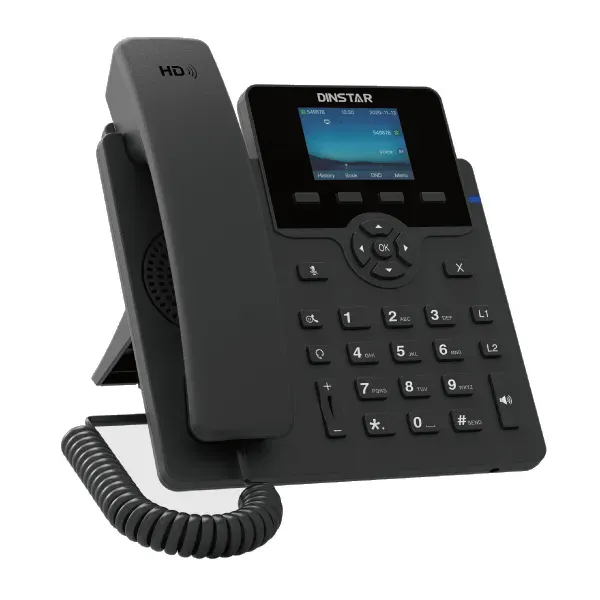
Dinstar C62U Business IP Phone
The Dinstar C62U is an entry-level color-screen SIP desk phone designed for organizations that need reliable business calling, multiple SIP identities and Gigabit desktop networking without moving to a premium executive handset. It combines a 2.4-inch 240 × 320 backlit color display, up to six SIP accounts, two line keys, five-way conferencing, HD voice processing, dual Gigabit Ethernet and support for compatible EHS wireless headsets. For buyers in Tanzania, the important model distinction is power: the C62U uses a power adapter and does not support Power over Ethernet, while the related C62UP is the PoE variant.
The 2.4-inch TFT color screen presents call state, contacts, menus, messages and soft-key labels in a compact business-friendly format.
Up to six SIP registrations allow one handset to support several extensions or service identities when the connected PBX platform is configured for them.
Dual 10/100/1000 Mbps Ethernet ports can support a phone-and-PC desk topology while preserving Gigabit connectivity on compatible networks.
Five-way audio conferencing, programmable keys, hold, transfer, forwarding, voicemail notification and other SIP features support daily office communication.
What is the Dinstar C62U?
The Dinstar C62U is a compact business SIP phone in Dinstar’s C62U/C62UP family. Dinstar positions the family as an entry-level color-screen IP phone for business users who want more visual clarity and account flexibility than a basic two-line monochrome handset. The published specification lists a 2.4-inch 240 × 320 color TFT display with backlight, six SIP accounts, two line keys, five-way conferencing and two Gigabit Ethernet ports. Dinstar also documents HD voice processing with a full-duplex speakerphone and support for wideband codecs including G.722 and OPUS-WB, subject to the end-to-end voice platform supporting the selected codec.
The C62U is suitable for standard office desks, supervisors, small service teams, branch administrators and users who may need more than one SIP identity on the same physical phone. The two line keys can be configured for supported telephony actions, while soft keys and menu functions provide access to common calling operations. Dinstar publishes compatibility with widely used SIP and IP PBX environments including 3CX, Asterisk, Yeastar, Xorcom, VoIP.ms, BroadSoft and FreeSWITCH. Practical interoperability should still be checked against the exact PBX version, firmware, provisioning method and feature set required by the customer.
Power planning is a critical procurement point. The C62U is the non-PoE model. It is designed for use with the appropriate power adapter. The C62UP is the PoE version. Businesses that standardize on centrally powered desk phones should therefore specify C62UP when PoE is mandatory rather than assuming that all C62-family devices accept switch power. FourTeck Tanzania can help map that distinction against the existing switch, UPS and desk-power environment before a quantity is finalized.
Verified Dinstar C62U features and business value
| Area | Verified capability | Why it matters |
|---|---|---|
| Display | 2.4-inch 240 × 320 color TFT with backlight | Improves visibility of call status, menus, directories and soft-key labels. |
| SIP | Up to 6 SIP accounts | Supports multi-extension or multi-service workflows when the PBX permits them. |
| Conference | 5-way audio conference | Allows quick multi-party collaboration from the desk phone. |
| Network | 2 × 10/100/1000 Mbps Ethernet | Supports Gigabit pass-through desk designs where policy allows a PC behind the phone. |
| Audio | HD voice, full-duplex speakerphone, DSP, G.722 and OPUS-WB support | Can provide clearer speech on compatible end-to-end call paths. |
| Headset | EHS wireless headset support | Useful for users who spend significant time on calls and need mobility. |
| Management | Web administration and auto-provisioning via common protocols | Helps standardize larger deployments and reduce manual handset setup. |
| Power | C62U does not support PoE | Requires correct adapter and desk-side power planning; choose C62UP if PoE is required. |
Compatibility, security and deployment planning
A SIP phone is only one layer of an IP telephony system. Before deploying the C62U, confirm the IP PBX or hosted SIP platform, extension numbering, codec policy, outbound calling plan, voicemail behavior, directory integration, transfer workflow and any queue or reception features users expect. Dinstar documents SIP V1/V2 support, DTMF options, VLAN, HTTPS management, OpenVPN, SIP over TLS and SRTP. These capabilities are useful only when the rest of the environment is configured to match. A secure design should also protect administrator credentials, restrict management access and avoid exposing handset web interfaces directly to the public internet.
For larger deployments, centralized provisioning can reduce setup time and configuration drift. Build a standard template that contains SIP server addresses, time zone, language, VLAN, codec order, firmware policy, key assignments and security settings. Pilot that template with representative users before mass deployment. Reception, ordinary office staff and supervisors may each need a slightly different key layout. Testing should include incoming and outgoing calls, attended and blind transfer, hold, conferencing, voicemail indication, directory access and headset operation where applicable.
Network quality directly affects voice quality. A phone can be correctly configured yet still produce poor calls if the LAN or WAN has congestion, packet loss or unstable latency. Managed switching, voice VLANs, QoS, reliable DNS and NTP, correctly sized firewalls and resilient internet links all contribute to a predictable VoIP experience. The C62U’s dual Gigabit ports are helpful where one desk network outlet must serve both the phone and a workstation, but VLAN behavior and security policy should be validated before adopting that topology throughout the office.
Related FourTeck Tanzania products and resources
A C62U deployment may sit alongside other Dinstar endpoints and gateways. Buyers needing a higher-capacity desk phone can review the Dinstar C66G Business IP Phone, which adds a larger display and substantially more SIP and programmable-key capacity for reception or advanced users. Where centralized PoE is preferred, the Dinstar C66GP PoE Business IP Phone is a higher-tier PoE endpoint option.
Organizations migrating analog devices into a SIP environment can evaluate the Dinstar DAG1000-1S Analog Telephone Adapter for a single FXS endpoint, the Dinstar DAG1000-2S Analog Telephone Adapter for two analog stations, or the Dinstar DAG1000-1S1O Hybrid VoIP Gateway where one FXS and one FXO interface are required. Larger mixed analog scenarios can consider the Dinstar DAG1000-2S2O Hybrid VoIP Gateway, while the Dinstar DAG1000-2O FXO VoIP Gateway addresses two FXO trunk interfaces. These devices are not substitutes for the C62U; they solve migration and analog integration requirements around the IP telephony system.
For broader project planning, the FourTeck Tanzania technology shop helps buyers consider IP phones alongside switching, Wi-Fi, firewalls and supporting infrastructure, while the FourTeck Tanzania services portfolio is relevant when installation, configuration, network preparation or wider IT integration is part of the requirement.
Dinstar C62U Business IP Phone Tanzania
For businesses in Tanzania, the Dinstar C62U is best approached as a practical SIP endpoint for users who need dependable desk calling, a color interface and several account registrations without the complexity of a premium executive phone. Typical buyers may include professional offices, SMEs, branch networks, schools, clinics, NGOs, hotels, logistics companies, retail administration and service organizations moving from analog extensions to IP telephony. The C62U can support up to six SIP accounts, which is useful when a user needs more than one extension identity, but the project should assign only the accounts that are operationally meaningful. A simple configuration is easier to train, troubleshoot and support than a handset loaded with unused registrations.
Tanzanian procurement teams should pay particular attention to network and power architecture. The C62U has dual Gigabit Ethernet ports but no PoE. Each desk therefore needs the correct adapter and dependable mains power. In offices where switches and routers are backed by UPS systems, it is worth deciding whether local desk power provides the desired resilience. If the organization wants centralized switch power and fewer desk adapters, the C62UP is the more appropriate family variant. The model name should be written precisely on the RFQ because C62U and C62UP share many features but have a materially different power design.
Voice network readiness matters just as much as the handset specification. A Tanzania deployment should review switch port capacity, voice VLAN design, QoS, DHCP, DNS, NTP, firewall behavior and internet or WAN reliability. If calls register to a cloud PBX, quality should be assessed during realistic busy periods rather than inferred from a headline internet speed. Packet loss, jitter and latency can disrupt real-time voice even when general web browsing feels fast. For multi-branch organizations, document whether extensions register directly to a central PBX, through VPN, or through a hosted service, and define how calls behave if a WAN path fails.
A useful Tanzania quotation request should include quantity, city, user roles, IP PBX or hosted SIP platform, headset requirements, expected number of SIP registrations, existing switch model, whether voice VLANs are already configured and whether setup assistance is required. That information lets the phone be evaluated as part of the complete communications environment. FourTeck Tanzania can then help buyers avoid common mismatches such as choosing the non-PoE C62U for a design that assumes switch power or ordering a handset before confirming PBX interoperability and network readiness.
Dinstar C62U Business IP Phone Dar es Salaam
Dar es Salaam organizations often combine busy customer-facing communication with dense office networks, cloud services, Wi-Fi, CCTV and shared internet connections. In that environment, the Dinstar C62U can serve general office users, supervisors, sales staff and administrative desks that need multiple SIP identities but do not require the very large key capacity of an executive or receptionist phone. Its color display and five-way conferencing can make daily calling easier, while the two Gigabit ports are useful where the phone and a desktop computer share one structured-cabling outlet.
For a Dar es Salaam rollout, start with user roles and call flow. A sales desk may need a direct extension plus a shared departmental identity. An administrator may need one account for headquarters and another for a regional SIP service. A shared operations desk may need quick access to transfer, hold and conference features. Configure only the functions required by those roles, and keep key placement consistent. If employees frequently use headsets, verify the exact EHS headset model and any interface cable before purchasing large quantities. Dinstar documents support for compatible Plantronics, Jabra and Sennheiser EHS environments, but accessory compatibility should be checked at the specific-model level.
Infrastructure planning is especially important in offices where voice competes with heavy internet or surveillance traffic. Put phones on a dedicated voice VLAN where the network design supports it, prioritize voice sensibly with QoS and monitor congestion at uplinks and firewall interfaces. If a phone passes the workstation connection through its second Gigabit port, verify that voice and data VLAN tagging works correctly from access switch to endpoint. Test call quality during normal peak usage, including transfers, conference calls and external SIP trunk traffic.
The C62U’s non-PoE design must also appear in the bill of materials. Desks need adapters and accessible power outlets. If a company is fitting a new Dar es Salaam office with UPS-backed PoE switches and wants phones to remain powered from the network, request the C62UP instead. A complete Dar es Salaam RFQ should state whether the project requires handsets only or also includes IP PBX configuration, provisioning, VLAN design, cable changes, user onboarding and headset supply. Clear scope makes quotation comparison more meaningful than comparing handset price alone.
Dinstar C62U Business IP Phone Mwanza
Mwanza businesses and branch offices may need a desk phone that is straightforward for users while still fitting a centrally managed SIP environment. The Dinstar C62U is relevant for commercial offices, education, healthcare administration, hospitality, distribution and professional services where phones register to an on-premises or hosted PBX. Up to six SIP accounts gives administrators flexibility to support a local extension, shared service identity or centralized corporate account on one handset, but the configuration should remain as simple as the business process permits.
For organizations whose PBX is located outside Mwanza, the WAN path becomes part of the voice system. Measure latency, jitter and packet loss between the branch and the PBX during representative working hours. If voice traverses VPN, SD-WAN or public internet, confirm that firewalls and routers preserve SIP and RTP traffic correctly and that failover behavior is understood. QoS can help prioritize voice on managed links, but it cannot remove congestion or instability beyond the organization’s control. Users should also know what happens to active calls if the primary WAN connection changes.
Central provisioning is valuable in distributed deployments. Instead of manually entering every SIP credential at each Mwanza desk, administrators can maintain a controlled template for SIP server addresses, time zone, codecs, VLAN, firmware and feature keys. That process reduces configuration differences between branches. Keep a record of each phone’s user, extension, location and relevant network port. Secure management interfaces and avoid exposing device administration directly to the internet. Where SIP over TLS and SRTP are required, align handset settings with the PBX and certificate policy.
Power should be checked during the site survey because the C62U relies on a local adapter rather than PoE. Existing offices may already have suitable desk outlets, while new installations may prefer the PoE-capable C62UP to centralize power through the switch. A Mwanza quotation request should include phone quantity, PBX platform, branch connectivity method, whether a voice VLAN exists, expected headset use, available desk power and whether configuration is centralized. This turns the procurement conversation from a simple unit-price request into a deployable communication plan.
Dinstar C62U Business IP Phone Arusha
Arusha has a mix of hospitality, tourism, NGOs, education, professional services, travel operations and regional offices where reception quality and reliable coordination matter. The Dinstar C62U can fit standard administrative and supervisory desks that need a clear color interface, multiple SIP accounts and straightforward conference or transfer functions. It is not designed as a hotel guest-room phone or a large receptionist console; it is most useful where an individual business user needs richer SIP flexibility than a very basic endpoint.
Hospitality and travel organizations should separate front-office, reservations, back-office and guest-room requirements. A reservations employee may benefit from headset support and multiple SIP identities, while a front-desk receptionist handling many monitored extensions might need a model with more programmable keys. By grouping users into roles, an Arusha organization can deploy C62U units where six-account flexibility is useful and select other handsets where requirements differ. This mixed-endpoint strategy can be more economical and easier to support than buying the same model for every desk.
Network design should account for shared infrastructure. Voice may travel across the same switches and internet links used by booking systems, cloud applications, CCTV and guest Wi-Fi. Managed VLANs and QoS can help isolate and prioritize voice, while careful monitoring identifies congestion that may otherwise appear as random call problems. In properties or campuses with more than one building, examine how voice VLANs traverse fiber links, wireless bridges or routed segments. Test calls over the real topology before duplicating a configuration across the entire site.
When preparing an Arusha RFQ, include the exact number of C62U phones, user types, IP PBX platform, headset preference, power arrangement and whether any inter-building or branch connectivity is involved. Remember that the C62U is not PoE capable. If a project is designed around PoE switching, request C62UP rather than adding local adapters later. For call-intensive staff, test the selected EHS headset with the phone before standardizing it. The strongest deployment combines correct endpoint selection with a stable LAN, sensible call flows and consistent user training.
Dinstar C62U Business IP Phone Dodoma
Dodoma organizations including professional offices, education, NGOs, project teams, government-related operations and growing private businesses can use the Dinstar C62U as a practical SIP desk endpoint. Its six SIP accounts provide more flexibility than a basic single- or dual-account phone, while the 2.4-inch color display keeps the interface compact. The device is appropriate where users need dependable everyday calling, transfers, voicemail, speed dials and occasional multi-party conferencing rather than the extensive key capacity of a high-end receptionist phone.
New office projects in Dodoma should decide early how phones will be powered. The C62U is adapter powered and does not support PoE. In an office designed from the beginning with PoE access switches and centralized UPS backup, the C62UP may create a cleaner power architecture. In an existing office with mains outlets at each desk, the C62U can be practical without changing switching. The right choice depends on the installed network, resilience target and operational preference, so procurement documents should state the exact suffix and not simply request a generic C62 phone.
Configuration should be role based. Six account slots do not mean every user needs six registrations. Excessive lines and features can make a handset harder to operate. Create profiles such as standard office user, supervisor, shared desk and administrator. Assign only the required SIP accounts and maintain consistent key positions for hold, transfer, voicemail and frequently called destinations. If the organization has several Dodoma departments or branch sites, a standardized provisioning template can help keep firmware, security and network settings aligned.
A complete Dodoma quotation should describe whether the PBX is local, hosted or located in another city; the number of required handsets; existing network-switch capability; internet or WAN architecture; headset use; and whether users need configuration assistance. If the PBX is remote, test the network path and define fallback behavior for WAN outages. If switching is being upgraded at the same time, design voice VLANs and QoS before handsets are rolled out. Treating telephony as part of the LAN produces a more supportable result than installing phones as isolated devices.
Dinstar C62U Business IP Phone UAE
Organizations that operate in both Tanzania and the UAE may want consistent SIP handsets, provisioning templates and user training across offices. The Dinstar C62U can form part of that strategy for standard business users when the same PBX family and endpoint policy are used. Standardization can reduce the number of device types support teams need to understand, but it should not force identical telecom configurations where local numbering, trunking or regulatory requirements differ. Treat the handset template as a common baseline while keeping country-specific calling rules under local control.
UAE offices frequently use managed PoE switching, which makes the C62U/C62UP distinction especially important. The C62U does not accept PoE and therefore requires its power adapter at each desk. If a corporate standard expects every phone to be powered from a UPS-backed switch, specify C62UP instead. For mixed estates where the C62U is already standardized, include adapters and desk power in deployment documentation. This simple model decision can affect installation speed, resilience planning and spare-parts management across a large number of endpoints.
Cross-border deployments should also define how SIP identities are assigned. A UAE user may require only a local corporate extension, while a regional manager might register an additional shared or headquarters identity. The C62U supports up to six accounts, but the PBX architecture and dialing plan should determine how many are actually used. Keep outbound caller identification, emergency calling, recording policy and local trunk behavior under appropriate governance rather than assuming that one Tanzania template can be copied unchanged.
For regional coordination, buyers can use FourTeck UAE as a related FourTeck network resource. A multi-country RFQ should break quantities down by country, identify the PBX topology, specify C62U versus C62UP, list headset needs and state whether common provisioning is required. The goal is consistent user experience and support documentation while still respecting the local network and telecom design of each office.
Dinstar C62U Business IP Phone Uganda
Ugandan organizations evaluating the Dinstar C62U may include NGOs, education, healthcare administration, hospitality, retail, professional services and multi-branch companies. The handset is strongest as a standard or supervisory business endpoint rather than a high-capacity receptionist console. Its six SIP accounts can support several line identities, while the color display and five-way conferencing provide a practical step up from very basic phones. Organizations with Tanzania and Uganda sites can also consider a common endpoint policy so training and support remain consistent across the region.
If the PBX is centralized in one country or hosted in the cloud, WAN quality becomes a major design factor. Voice should be tested across the real branch path, including VPN or firewall inspection where used. Monitor latency, jitter and packet loss during busy periods. Where managed QoS is available, prioritize voice sensibly without starving other essential applications. Define how extensions behave if the primary internet circuit fails, whether phones re-register to a secondary server and whether a local mobile or PSTN fallback exists for critical calling requirements.
Central provisioning can make Uganda branch deployments easier to support. Use consistent firmware, time settings, codecs, key layouts and security policies. Keep per-site VLAN, gateway and numbering differences configurable rather than creating entirely separate handset standards. Protect administrator access and use secure management paths. The C62U supports security capabilities such as SIP over TLS and SRTP, but the PBX and network must support the same settings for them to be effective.
Power planning remains important because C62U is not PoE. If Uganda offices already use PoE switches and want centrally backed handset power, compare the C62UP before finalizing quantities. A regional purchasing team can review FourTeck Uganda for related market support. An RFQ should identify site count, handset quantities, PBX location, WAN topology, preferred power model and whether configuration is to be performed centrally or per branch.
Dinstar C62U Business IP Phone Kampala
Kampala businesses often have busy reception areas, sales teams, professional-service desks and regional offices that rely on consistent call handling. The Dinstar C62U can suit ordinary office users and supervisors who need more than one SIP identity without the dozens of programmable keys found on premium desk phones. Its display makes call and menu information easier to read, while HD voice support and full-duplex speakerphone operation can improve the user experience on properly configured networks and compatible end-to-end codec paths.
A Kampala deployment should begin with a pilot rather than configuring every handset at once. Test one or more phones with representative roles. Verify registration, inbound and outbound calls, attended and blind transfer, hold, voicemail indication, conference behavior and any directory or BLF functions that the PBX provides. If the organization wants EHS wireless headsets, test the exact headset and cable combination. A short pilot can reveal PBX interoperability or user-interface issues before they are multiplied across many desks.
The LAN should be evaluated for voice and data sharing. Managed switches can place phones on a voice VLAN while passing workstation traffic through a separate data VLAN. The C62U’s dual Gigabit ports support a phone-plus-PC topology, but the switch configuration must enforce the intended separation. Document switch ports and labeling so support teams can identify faults quickly. If CCTV, Wi-Fi and voice all share the same uplinks, capacity and QoS should be considered together rather than configured independently.
The C62U’s adapter-powered design should appear in every Kampala site plan. Where the organization wants PoE and centralized UPS-backed power, select C62UP instead of C62U. For a new office, coordinate structured cabling, switching, PBX and phone rollout at the same design stage. For an existing office, include quantity, PBX vendor, switch model, headset needs, power availability and support scope in the quotation request. This produces a complete deployment plan instead of a hardware-only purchase that leaves network dependencies unresolved.
Dinstar C62U Business IP Phone Arua
Arua branch offices, NGOs, logistics operations, healthcare administration, hospitality and commercial service locations may need reliable SIP phones that can be configured centrally even when onsite IT support is limited. The Dinstar C62U is appropriate for standard business calling where a small number of SIP identities, transfer functions and conferencing are needed. Its six-account capacity provides flexibility, but simpler branch configurations are generally easier to maintain. Assign only the functions required by each role and keep common keys in the same position across all handsets.
Remote management can be more valuable than a long feature list in a distributed site. Prepare a controlled configuration template and maintain records of each phone’s user, extension and location. Avoid manual one-off settings that are difficult to reproduce when a phone is replaced. Keep firmware and configuration backups under appropriate access control, and restrict management interfaces to trusted networks. If a central IT team supports Arua from another city or country, documentation should make it possible to isolate whether a call problem originates at the handset, LAN, WAN, firewall or PBX.
Connectivity to a remote PBX must be validated. A high nominal internet speed does not guarantee consistent VoIP. Measure packet loss and latency, observe performance during large file transfers or backups and use QoS where the network supports it. If the site has more than one WAN connection, define SIP re-registration and failover behavior. The C62U can provide capable endpoint features but cannot compensate for an unstable network path.
Because the C62U is not PoE capable, each Arua desk needs the correct adapter and power source. If the branch uses UPS-backed PoE switching and wants phones powered centrally, compare C62UP. Procurement can also use a role-based mix: place C62U phones with staff who need several SIP identities and simpler phones at low-usage desks. A good Arua RFQ includes site quantity, PBX location, internet path, switch details, power strategy, user roles and whether remote provisioning must be included.
Dinstar C62U Business IP Phone Mbarara
Mbarara organizations can deploy the Dinstar C62U in commercial offices, education, health administration, hospitality, distribution and branch operations that need a straightforward color-screen SIP phone. The handset’s multiple registrations can be useful when one user works with several service identities, but the strongest deployment starts by mapping the actual calling workflow. A manager may need a primary extension and a shared departmental line. A service desk may need a queue-related identity. A branch administrator may need a local extension plus a centralized corporate account.
Call handling should be matched to the PBX rather than assumed from the handset alone. Test transfer methods, hold behavior, voicemail indication, conference setup and directory features with the exact PBX platform. The C62U supports many SIP functions, but feature interoperability can vary by server configuration and firmware. For users who spend much of the day on calls, verify EHS headset compatibility and include any required cable or adapter in the quotation. User comfort is an operational requirement, not merely an accessory decision.
Power and network resilience should be documented for each site. Since C62U requires a local power adapter, short utility interruptions can affect a desk phone even if the core switch and PBX remain protected. Organizations that already use PoE access switches may prefer C62UP if centralized power is important. Network monitoring should also consider whether large transfers, backups or cloud applications create congestion that affects voice. A voice VLAN and QoS can help create more predictable behavior on a managed LAN.
A Mbarara quotation should identify the number of handsets, PBX type, whether the PBX is local or remote, switch environment, power preference, headset requirement and expected user profiles. If the branch belongs to a larger East African organization, include regional extension dialing and WAN topology in the design. A consistent provisioning template can then be used across sites while retaining local addressing and call-routing details. That approach simplifies support and gives procurement a clearer view of the complete deployed cost.
Dinstar C62U Business IP Phone Gulu
Gulu organizations in education, NGOs, health administration, professional services and branch operations may value a desk phone that combines familiar operation with centralized SIP management. The Dinstar C62U fits that requirement for standard users and supervisors who need a few line identities, a color display and common business call functions. Although it supports up to six SIP accounts, branch deployments should avoid unnecessary complexity. A clean configuration with predictable keys reduces training time and makes support easier when staff move desks or phones are replaced.
If the PBX is hosted outside Gulu, treat the WAN connection as part of the telephony service. Monitor latency, jitter and packet loss, and confirm that DNS, firewall and NAT behavior are stable. Do not expose the phone’s management page to the public internet. Use secure administration paths and strong credentials. Where the organization uses TLS and SRTP, keep certificate, time synchronization and PBX policy aligned so security features do not introduce registration failures.
Standardization is useful for distributed IT teams. Maintain one approved firmware branch, a controlled provisioning source and role-based templates. A basic user can receive one SIP registration and familiar transfer or voicemail keys. A supervisor can receive additional line identities and speed dials. Avoid assigning every available feature simply because the phone supports it. Consistency usually delivers more operational value than maximum configuration density.
Power architecture should be checked before ordering. The C62U uses an adapter and is not PoE capable. If Gulu offices are being equipped with new PoE switches, compare C62UP early so switch budgets and UPS sizing reflect the intended phone model. A Gulu RFQ should state whether the phones are being added to an existing LAN or are part of a wider network upgrade. Include quantity, PBX details, WAN path, power strategy, user roles and any requirement for remote configuration. This gives buyers a realistic deployment scope rather than a unit-only purchase.
Dinstar C62U Business IP Phone Kenya
Kenyan businesses planning SIP telephony across Nairobi, Mombasa or regional branches can use the Dinstar C62U as a standardized desk endpoint for ordinary office users, supervisors and small service teams. The phone’s six SIP accounts give enough flexibility for several identities without the complexity of a high-end 20-account device. For companies operating in both Kenya and Tanzania, a common handset template can reduce support overhead and make employee training more consistent across sites.
Regional standardization should cover firmware, administrator security, user key layouts and provisioning methods while leaving country-specific dial plans and trunking under local control. If one centralized PBX serves multiple offices, clearly define extension ranges and inter-office dialing. Document whether calls traverse VPN, SD-WAN or direct internet to a hosted service. The C62U’s dual Gigabit ports are useful when a desk phone shares a network drop with a computer, but VLAN and security policy must work consistently across access switches.
Power design again influences model choice. Many business networks in Kenya standardize on PoE for phones. C62U is not PoE capable, so it requires desk adapters. If the network design assumes switch-powered phones, choose C62UP instead. This distinction should be made before procurement so installation teams do not arrive with phones that conflict with the planned cabling and power architecture. Where continuity matters, understand which devices remain operational during utility outages and how the PBX or internet connection is protected.
Organizations procuring across Kenya and Tanzania can use FourTeck Kenya as a related regional resource. A cross-border RFQ should split quantities by site, identify the exact C62U or C62UP model, state PBX and headset requirements and describe whether common configuration templates are expected. Keeping spares, naming conventions and user instructions aligned can simplify long-term support without ignoring the network and telecom differences between locations.
Dinstar C62U Business IP Phone Kuwait
Kuwait offices that want a compact multi-account SIP handset can evaluate the Dinstar C62U for standard administrative, sales and supervisory desks. The 2.4-inch color display, six SIP accounts, five-way conferencing and dual Gigabit Ethernet provide a balanced feature set for users who need more than a basic phone but do not require a large receptionist console. Multinational companies may also use the C62U as part of a common endpoint policy spanning Gulf and East African offices.
A common regional policy should specify which features are standardized and which remain local. Firmware, administrator credentials, key placement, directory behavior and provisioning method can often be common. SIP trunks, emergency dialing, outbound caller ID and local numbering should be managed according to the relevant Kuwait telecom environment. If the PBX is centralized outside Kuwait, confirm WAN performance and failover behavior so remote registration does not become a single point of operational uncertainty.
Many Kuwait business networks use managed switching and centralized power, so procurement must distinguish C62U from C62UP. The C62U uses a power adapter and does not support PoE. If the network standard requires switch-powered phones, request C62UP. If C62U is intentionally chosen, make sure adapters, desk outlets and backup-power expectations are documented. Do not assume that a family name implies identical power capabilities across all suffixes.
Kuwait buyers should also consider headset workflow, especially for sales or customer-service users. Dinstar documents EHS support for compatible wireless headset ecosystems, but the exact headset model and interface should be checked. A useful quotation request lists phone quantity, user roles, PBX platform, number of SIP accounts expected per user, network-switch environment, power preference and whether configuration assistance is needed. The objective is a phone rollout that fits the wider voice architecture rather than a stand-alone hardware purchase.
Dinstar C62U Business IP Phone Ghana
Ghanaian organizations in professional services, education, retail, hospitality, NGOs and multi-site businesses can consider the Dinstar C62U as a standard SIP desk phone for employees who need several registrations and a color user interface. Six SIP accounts can support more complex identity requirements than entry-level two-account phones, but each account should map to a real business function. Keeping unnecessary lines off the phone reduces user confusion and simplifies troubleshooting.
For multi-site Ghana deployments, centralized provisioning can help standardize firmware, security settings and calling features. Administrators should maintain role-based templates and test them against the exact IP PBX platform. A phone may register successfully while advanced functions such as voicemail indication, BLF, directory services or transfer behavior still require platform-specific configuration. Complete acceptance testing should therefore cover the workflows users rely on every day, not just dial tone and registration status.
Network design determines much of the real voice experience. Place phones on a managed voice network where appropriate, monitor WAN links and prevent backup traffic or large transfers from overwhelming the path used by SIP media. The dual Gigabit ports can simplify desk cabling, but security and VLAN design should remain deliberate. If the organization’s PBX is cloud hosted, firewall and NAT behavior should be tested to ensure stable registration and media flow.
The C62U is the adapter-powered version and does not support PoE, so Ghana project teams must confirm local desk power. Where the organization prefers PoE, the C62UP should be specified. Buyers coordinating regional projects can use FourTeck Ghana as a related network resource. An RFQ should include site quantities, PBX details, switch environment, user roles, power preference and configuration scope. That information allows procurement to evaluate a complete deployed solution rather than compare handsets without their network dependencies.
Dinstar C62U Business IP Phone Nigeria
Nigerian businesses with headquarters, branch offices, service teams or distributed departments can use the Dinstar C62U as a practical desk endpoint within an IP PBX environment. Its six SIP accounts can support several identities, and the dual Gigabit Ethernet ports are useful in offices where the phone and workstation share a structured-cabling point. The handset is particularly appropriate for standard users and supervisors rather than high-volume receptionists who may need significantly more programmable keys.
In larger Nigerian networks, deployment should be template driven. Create standard phone profiles, define firmware and security policy and assign extension credentials through controlled provisioning rather than repeated manual setup. Test the exact PBX integration with common workflows such as transfer, hold, voicemail, directory access and conference calls. Where headset use is expected, verify the chosen EHS accessory. Consistent deployment reduces support variation across branches and makes replacement devices easier to configure.
Power resilience is a central buying consideration. The C62U does not use PoE; it requires local power through the correct adapter. If an office has UPS-backed PoE switches and wants handsets to remain powered centrally, the C62UP is the more suitable family variant. If C62U is selected, define which desk outlets are protected and remember that the phone still depends on the switch, router, firewall, PBX and internet path. End-to-end resilience requires more than protecting the handset itself.
For organizations coordinating across West and East Africa, FourTeck Nigeria is a related FourTeck network point. A Nigeria quotation should list user roles, handset quantities, PBX platform, branch topology, expected SIP accounts, headset needs, switch model and power preference. Where voice traverses wide-area links, include bandwidth and failover considerations. A well-scoped request helps determine whether C62U is the right standard endpoint or whether some users should be assigned a different model.
Dinstar C62U Business IP Phone Seychelles
Seychelles businesses in hospitality, travel, professional services, administration and multi-property operations can consider the Dinstar C62U for office desks that need SIP calling, multiple identities and a compact color interface. Hotels should distinguish back-office employee telephony from guest-room requirements. The C62U is more appropriate for reservations, administration, management and service coordination than for specialized guest-room deployments, where different phone characteristics may be preferred.
Connectivity between properties or islands can make WAN planning especially important. If the PBX is centralized, test latency, packet loss and failover on the actual links used by the phones. Real-time voice can be sensitive to unstable routing even when normal browsing remains acceptable. Where links are bandwidth constrained, avoid large backups or updates during busy calling periods and use QoS on managed network segments. The handset’s capabilities should be paired with a network that can deliver consistent SIP signaling and media.
For hospitality operations, user profiles can keep deployment efficient. Reservations or customer-service teams may need headsets and several SIP identities. Finance or administration may need only one extension. Managers may benefit from additional speed dials and conferencing. Configure the C62U according to these role differences instead of applying the same six-account template to every phone. Test EHS headsets with the exact accessory before purchasing at scale.
The non-PoE C62U needs local adapter power. If a Seychelles property uses centralized PoE switching and UPS backup, the C62UP may be more practical. Procurement should therefore specify the exact model, quantity by site, PBX platform, power preference, headset requirement and whether configuration is performed centrally. Where a multi-property organization wants common endpoint standards, maintain shared firmware, naming and key layouts while adapting VLAN and IP settings to each site. This produces a predictable support model without ignoring the physical network differences between locations.
Buying guidance: C62U or another phone?
Choose the C62U when a user needs a color display, up to six SIP accounts, Gigabit Ethernet and business call features but local adapter power is acceptable. Choose the C62UP when the same general endpoint class is required but PoE is part of the network design. Consider a higher-tier model such as C66G or C66GP when receptionists, executives or service desks need substantially more SIP accounts and programmable keys. The best procurement strategy can mix endpoint types by role rather than forcing one handset onto every user.
Before ordering, verify exact quantity, PBX platform, SIP account requirement, call-handling roles, headset models, switch capability, voice VLAN, WAN quality, power arrangement and any installation or provisioning scope. For a regional project, also document quantities by country and whether one configuration standard will be used across sites. This checklist avoids the most common purchasing errors: selecting the wrong power variant, overlooking accessories, assuming PBX features will work automatically or deploying phones before the network is ready.
Dinstar C62U FAQs
Does the Dinstar C62U support PoE?
No. The C62U is the non-PoE model and uses a power adapter. The C62UP is the PoE-capable version in the same family. Confirm the exact model suffix before purchasing.
How many SIP accounts does the C62U support?
Dinstar specifies support for up to six SIP accounts. The number actually configured should reflect the user’s role and the connected PBX or hosted SIP service.
Can the C62U connect a computer through the phone?
The phone has dual Gigabit Ethernet ports, so it can be used in a phone-and-PC desk topology where the network design permits it. VLAN and security behavior should be configured correctly on the switch and phone.
Which IP PBX platforms can work with the C62U?
Dinstar documents compatibility with platforms including 3CX, Asterisk, Yeastar, Xorcom, VoIP.ms, BroadSoft and FreeSWITCH. Exact feature interoperability should be tested with the specific PBX version and firmware used by the customer.
Does the Dinstar C62U support conferencing?
Yes. Dinstar specifies five-way audio conferencing. The overall experience also depends on the PBX, network quality and codec configuration.
What should I include in a FourTeck quotation request?
Include quantity, city or country, PBX platform, number of SIP accounts required, user roles, headset needs, switch and power environment, whether PoE is required and whether configuration or network assistance is part of the project.
Quotation checklist
Decision recap
The Dinstar C62U is a sensible business IP phone when users need six SIP accounts, a compact color display, Gigabit Ethernet and five-way conferencing, and when local adapter power fits the deployment. It should not be purchased as a PoE phone; use the C62UP when switch power is required. For Tanzania and regional projects, validate the PBX, LAN, WAN, headset and power environment before finalizing quantities.
FourTeck can help structure that evaluation around user roles and the complete voice architecture. For related regional coordination, customers can also use the broader FourTeck network, including FourTeck, alongside the Tanzania, Kenya, Uganda, Ghana, Nigeria and UAE resources referenced above.
Talk to FourTeck about your Dinstar C62U requirement
Send the expected quantity, deployment city, PBX platform, power preference and user roles. FourTeck Tanzania can use those details to help you determine whether C62U is the correct model, whether C62UP is better for PoE, and what network or configuration dependencies should be addressed before rollout.



Reviews
There are no reviews yet.