
4G SIP BUSINESS TELEPHONY • TANZANIA
Dinstar C60U-T 4G IP Phone Tanzania
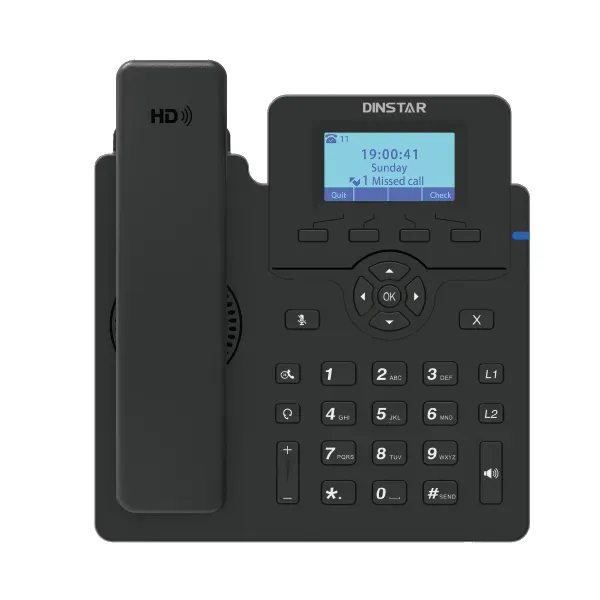
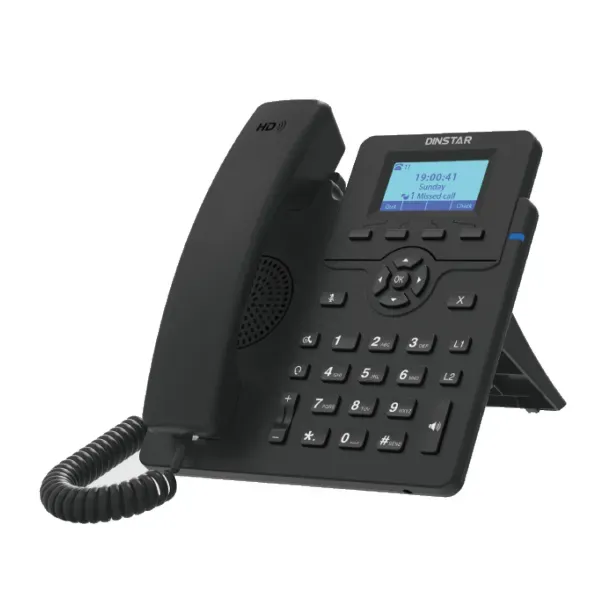
The Dinstar C60U-T is an entry-level business IP phone with a built-in 4G antenna, created for SIP calling in locations where conventional wired data coverage may be unavailable, inconvenient or not the preferred access method. Dinstar specifies two SIP accounts, two line keys, five-way audio conferencing, HD voice, a 132×64-pixel backlit graphical LCD, dual 10/100 Mbps Ethernet ports, LTE TDD/FDD support and compatibility with selected EHS wireless headsets. For Tanzanian businesses, the product is especially relevant when the project requires a desk-phone experience but the access network cannot be assumed to be Ethernet at every desk.
What the Dinstar C60U-T is designed to solve
Many IP-phone projects begin with a simple assumption: every handset will sit beside a live network outlet and a suitable switch port. That assumption is not always practical in temporary offices, remote operational areas, pop-up workspaces, construction environments, branch counters or locations where structured cabling is still being built. The C60U-T adds cellular-network flexibility to the familiar desk-phone format. Its built-in 4G antenna allows the endpoint to establish network access without depending exclusively on a fixed Ethernet connection, subject to compatible LTE bands, an appropriate SIM/service plan, local radio coverage and correct configuration.
The device remains a SIP endpoint rather than a conventional mobile phone. That means the deployment still depends on an IP PBX or SIP service, account credentials, dial plan, codec policy and network/security settings. Dinstar lists interoperability with platforms including 3CX, Asterisk, Yeastar, Xorcom, VoIP.ms, BroadSoft and FreeSWITCH. In a real project, those platform names are a useful starting point rather than a substitute for testing. Features such as transfer behavior, voicemail indication, remote phonebook, TLS certificates, NAT traversal and provisioning should be validated against the exact PBX version and service design.
For procurement teams, the most important model distinction is power. Dinstar’s official C60U-T/C60UP-T datasheet shows the C60U-T as the non-PoE model supplied for 5V DC adapter power, while the C60UP-T is the PoE-capable variant. A quote should therefore name the exact C60U-T model rather than use a family label that could blur the difference. If centralized PoE is a mandatory design goal, the C60UP-T should be evaluated instead.
Verified Dinstar C60U-T technical highlights
4G network access
Built-in 4G antenna with LTE TDD and LTE FDD support. Dinstar publishes multiple regional LTE-band variants, so the exact hardware type should be matched to the intended operator and country before purchase.
SIP and calls
Two SIP accounts, two line keys, call hold, mute, DND, forwarding, waiting, transfer, redial, auto answer, hotline and five-way audio conferencing are listed by Dinstar.
HD audio
Wideband codecs include G.722 and OPUS-WB, with full-duplex speakerphone, DSP, echo cancellation, dynamic jitter handling, voice activity detection and comfort-noise generation.
Management
Auto provisioning is listed through FTP, TFTP, HTTP, HTTPS and PnP, with web configuration, SNMP, TR-069, network capture, syslog, firmware upgrade and backup/restore options.
Technical specifications and deployment meaning
| Area | Verified detail | Why it matters |
|---|---|---|
| Display | 132×64 graphical LCD with backlight | Provides a conventional visual interface for line status, menus and call handling. |
| Accounts | 2 SIP accounts | Fits standard desk users or roles that need two registrations rather than a high-density multi-line console. |
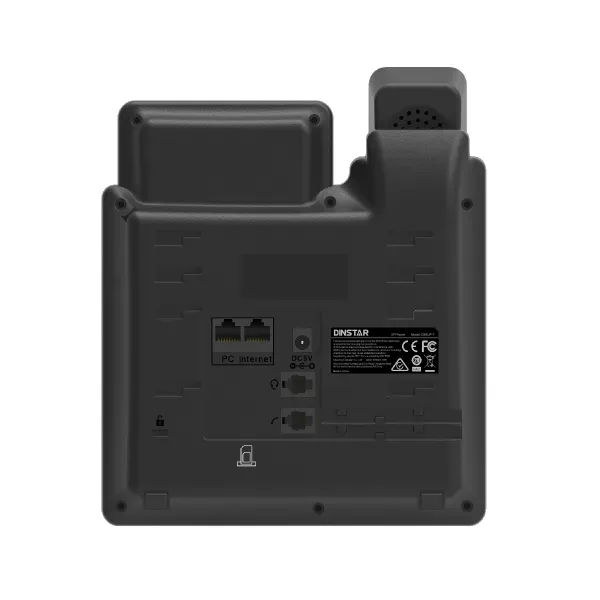
| Ethernet | 2 × RJ45 10/100 Mbps | Supports wired connectivity and PC pass-through where Fast Ethernet is sufficient. |
| Power | C60U-T: 5V DC power adapter; no PoE in the official model table | Desk power and continuity planning must include the handset adapter. C60UP-T is the PoE alternative. |
| Security | SIP over TLS, SRTP, 802.1X, OpenVPN listed | Allows stronger signaling/media or network-access designs when the PBX and surrounding infrastructure support them. |
| Headset | EHS support for selected Plantronics, Jabra and Sennheiser wireless headsets | Useful for staff who handle calls continuously, subject to exact headset/EHS cable compatibility. |
Dinstar also lists an adjustable dual-angle stand, wall mounting, local and remote phonebook functions, LDAP, multiple languages, selectable ring tones, DTMF methods, voicemail/MWI and several management protocols. Buyers should decide which of these features are operationally important before deployment so that the PBX template and user training are configured around real workflows instead of leaving useful capabilities unused.
Compatibility, 4G bands and IP PBX integration
The C60U-T combines two compatibility questions that should be checked separately: SIP-platform compatibility and cellular-radio compatibility. On the SIP side, Dinstar identifies major platforms such as 3CX, Asterisk, Yeastar, Xorcom, VoIP.ms, BroadSoft and FreeSWITCH. A proof-of-concept phone is still advisable before a large rollout because organizations may depend on features such as BLF, transfer modes, remote directories, voicemail indication, emergency dialing rules or custom provisioning templates that behave differently between environments.
On the 4G side, Dinstar publishes C60U-T/C60UP-T variants with different LTE band groups, including EUX, AFX, AUX and CN types. The correct radio variant must match the frequencies used by the intended operator in the deployment country. This should be confirmed before purchase rather than assuming that “4G” is globally interchangeable. SIM availability, data-plan policy, private APN requirements, network address translation and signal quality can also affect deployment.
For customers building a complete voice environment, FourTeck Tanzania’s IP PBX and VoIP planning guidance explains why endpoint selection should be connected to call routing, network capacity and support processes. The FourTeck Tanzania technology shop also helps procurement teams compare phones, PBX hardware and related infrastructure within one business-technology view.
Related Dinstar phone options on FourTeck Tanzania
Dinstar C63G Business IP Phone
A six-SIP-account color-screen business phone for users who need more lines and Gigabit desk connectivity than the C60U-T.
Dinstar C64G Business IP Phone
A higher-feature Dinstar desk-phone option for business users who require a richer call-handling interface.
Dinstar C64GP PoE Business IP Phone
A PoE-capable alternative for structured office deployments that want centralized switch power and a more advanced endpoint.
Dinstar C66G Business IP Phone
A larger-account Dinstar phone suited to roles where many SIP identities and higher call-control capacity are important.
Dinstar C66GP PoE Business IP Phone
A PoE business model for larger line requirements where the network design supports centralized power.
FourTeck Tanzania Services
Useful when phone procurement forms part of a broader requirement covering installation, configuration, networking or ongoing IT support.
About FourTeck Tanzania
Provides context on FourTeck’s integrated IT, telecom, security and infrastructure approach for business projects.
Dinstar C60U-T 4G IP Phone Tanzania
For organizations searching for the Dinstar C60U-T 4G IP Phone in Tanzania, the first question should be whether cellular access solves a genuine deployment constraint. The phone is most compelling where a conventional SIP desk handset is required but a wired network outlet is absent, temporary or operationally awkward. Examples can include branch counters, temporary administration spaces, field offices, project compounds and other sites where 4G coverage is available and the business prefers a desk-phone workflow rather than a softphone-only model. The C60U-T keeps the familiar handset, speakerphone, line keys and graphical display while connecting through its built-in 4G capability.
A Tanzania deployment should begin by confirming the exact LTE hardware variant and the bands used by the chosen mobile operator. Dinstar publishes several band configurations for this product family, so procurement teams should not assume that any C60U-T sourced globally will work equally well on every local network. Signal strength at the intended desk or building area should also be evaluated. A strong outdoor mobile signal does not guarantee the same performance inside a concrete office, warehouse or building with reflective glass. Where voice availability is important, the SIM plan, data allowance, APN policy and network stability should be documented.
The phone itself supports two SIP accounts, so it fits standard users who need one or two identities rather than reception positions that require many simultaneous line appearances. Five-way conferencing can support quick internal or external discussions without moving to a separate meeting platform. HD-voice codecs and full-duplex speaker operation can improve clarity, but the wider call path matters: PBX codec settings, SIP trunk behavior, 4G latency and the far-end endpoint all contribute to perceived quality.
Tanzanian buyers should also plan power carefully. The C60U-T is not the PoE variant in Dinstar’s official model comparison; it uses a 5V DC adapter. If phones must remain available during short power interruptions, continuity planning should include the local adapter and any upstream PBX, router or 4G service dependency. Before quotation, provide the required quantity, target operators, PBX platform, number of SIP accounts per user, expected headset use, installation locations and whether centralized provisioning is needed. FourTeck can then align the phone with the broader voice and network design instead of treating it as an isolated handset.
Dinstar C60U-T 4G IP Phone Dar es Salaam
Dar es Salaam businesses often operate from a mix of modern office towers, converted commercial premises, warehouses, retail locations and project sites. In that variety of environments, structured cabling may be excellent in one building and incomplete or inconvenient in another. The Dinstar C60U-T can be evaluated where a fixed desk-phone experience is required but the voice endpoint would benefit from cellular-network flexibility. Rather than pulling a new data cable solely for a temporary or difficult desk location, the phone can use its built-in 4G connection when the correct LTE variant, SIM service and indoor coverage are available.
For customer-service, logistics, dispatch, reception overflow or temporary operations teams, two SIP accounts may be sufficient when users primarily manage one extension plus a second identity. The C60U-T also supports call hold, waiting, forwarding, transfer and five-way conferencing, which covers the daily functions expected from a business endpoint. EHS support can be useful for staff who need wireless headsets, but the exact headset and electronic-hook-switch cable should be verified before ordering. Compatibility should never be inferred only from the headset brand name.
A Dar es Salaam rollout should include radio testing inside the actual premises. Mobile performance can change by floor, room, wall construction and network congestion. If multiple phones will use 4G at one site, the business should also consider how service continuity will be managed if one mobile network has a local outage. Depending on the criticality of calling, some sites may choose a mix of wired SIP phones and 4G-enabled endpoints rather than making every extension dependent on the same access method.
Procurement teams should identify whether the C60U-T is intended as a primary endpoint, a temporary deployment tool or part of a resilience strategy. They should also confirm the IP PBX location, whether SIP services are reachable securely over the mobile network, and how TLS/SRTP, VPN or NAT traversal will be configured. FourTeck Tanzania can coordinate those endpoint questions with broader telecom and network services, helping the project account for calling, connectivity, power, provisioning and support as one system.
Dinstar C60U-T 4G IP Phone Mwanza
Organizations in Mwanza may need business telephony for offices, distribution operations, hospitality administration, service counters and branches where communications infrastructure develops in stages. The Dinstar C60U-T gives IT teams another way to place a SIP desk endpoint where dependable 4G coverage exists but an Ethernet connection is not immediately available. This is particularly useful when a business wants a physical handset, dedicated extension and standard call-control buttons without turning a personal smartphone into the primary business-voice device.
The phone’s two SIP accounts are suitable for straightforward user profiles: for example, one personal extension and one shared departmental identity where the PBX supports that arrangement. Five-way conferencing can support quick coordination between branch staff, suppliers and head-office teams. The graphical backlit display is compact rather than executive-class, which is consistent with the product’s entry-level positioning. Buyers who need a larger color screen, more programmable functions or more SIP accounts should compare other Dinstar models rather than assuming the C60U-T will fit every user role.
Mwanza projects should place particular emphasis on manageability when phones are distributed across more than one site. Dinstar lists provisioning through FTP, TFTP, HTTP, HTTPS and PnP, as well as web configuration, TR-069, SNMP, syslog and configuration backup/restore. Those capabilities can support standardized deployment, but they need an operational process. Administrators should define firmware versions, extension naming, provisioning credentials, remote support access and how replacement devices will receive the correct configuration.
Before purchasing, verify the LTE band variant against the intended carrier, check signal quality at the installation point and confirm how the phone will reach the SIP server. If the PBX is hosted elsewhere, mobile-network NAT and firewall behavior can influence registration and audio. If the PBX is on premises, an appropriate secure route may be needed. The quotation request should therefore include the number of phones, intended locations, carrier preference, PBX platform, headset needs and whether local power backup is required. This information is more useful than asking only for a unit price because it determines whether the C60U-T is technically appropriate.
Dinstar C60U-T 4G IP Phone Arusha
Arusha has a wide range of business environments, including tourism operations, hospitality administration, professional offices, schools, service organizations and project-based teams. Some of these users work from established networks, while others operate from temporary offices or locations where adding a network outlet for every telephone is not convenient. The Dinstar C60U-T can be considered when a SIP desk phone is still preferred but the endpoint needs the option to use 4G as its access path.
For hospitality or travel-related operations, reliable call handling may matter more than having a large touchscreen. The C60U-T provides the essentials: two SIP accounts, HD voice, transfer, hold, forwarding, voicemail indication, speakerphone and five-way conferencing. Supported EHS headsets can help reservations, coordination or customer-service staff who spend long periods on calls. The product is therefore best evaluated by user role. A standard reservations desk may fit the C60U-T well; a main switchboard that monitors many extensions may need a higher-capacity phone.
Arusha procurement should also distinguish between endpoint flexibility and total system resilience. A 4G-capable phone removes the need for a wired network path at the handset, but the service still depends on mobile coverage, the carrier network, the SIP server and electrical power. Dinstar’s published model table shows the C60U-T using a 5V DC adapter. Businesses that require calling during short power interruptions should therefore protect the phone’s local power source as well as any PBX, router or supporting equipment.
LTE-band compatibility is another purchase checkpoint. Dinstar sells multiple regional variants, so the exact unit must be matched to the operator and country where it will be used. For organizations with seasonal or project-based sites, this matters if handsets are expected to move between regions. A useful quotation request will specify deployment sites, mobile operator, PBX platform, expected extensions, call volumes, headset preferences and any security requirements such as SIP over TLS or SRTP. FourTeck can then recommend whether the C60U-T should be used as the main endpoint, a specialized remote-site phone or part of a mixed handset estate.
Dinstar C60U-T 4G IP Phone Dodoma
Dodoma organizations that are expanding offices, setting up temporary administration points or connecting branch users to a central SIP platform may find the C60U-T useful where conventional structured cabling is not the preferred access method. The phone maintains the controls expected from a fixed business handset while adding built-in 4G connectivity. This makes it relevant for desks that need a dedicated corporate extension but are located away from a ready network outlet or where the office layout may change.
Public-facing teams, administrative staff and project offices can use two SIP accounts for straightforward extension arrangements. Five-way conferencing is useful when several parties need to join an ad-hoc call. The phone also supports directory, voicemail indication, call waiting, transfer and forwarding features commonly required in office telephony. Because it is an entry-level model, organizations should verify that two SIP registrations are sufficient before standardizing on it. Users with complex line monitoring or reception duties may be better served by higher-end Dinstar endpoints.
Security and remote administration can be important for dispersed Dodoma deployments. Dinstar lists SIP over TLS, SRTP, 802.1X and OpenVPN as supported technologies, plus HTTPS configuration and multiple provisioning options. These should be implemented according to the PBX architecture rather than enabled without a plan. Certificates, credentials, firewall policies and remote-management access need to be documented. For larger fleets, consistent provisioning templates can reduce configuration drift between handsets.
A purchasing team should also confirm power and radio details. The C60U-T is adapter powered, while the related C60UP-T is the PoE model. The exact LTE band variant must be suitable for the selected carrier. Before quotation, share the intended mobile network, site count, number of handsets, IP PBX platform, required codecs, security expectations, headset requirements and whether the phones need centralized configuration. These details help turn a handset request into a deployable communication design rather than leaving critical compatibility checks until installation day.
Dinstar C60U-T 4G IP Phone UAE
UAE businesses often have strong structured networks, yet 4G desk-phone capability can still be useful for temporary offices, construction projects, site cabins, exhibition operations, rapid branch setup and locations where adding a wired drop is inconvenient. The Dinstar C60U-T provides a traditional SIP handset with built-in 4G rather than requiring every temporary user to depend on a softphone. Its two SIP accounts and five-way conferencing suit standard business calling where the user does not need a high-density reception console.
For UAE procurement, the exact LTE variant remains essential. Dinstar publishes multiple radio-band options, and the selected type should be checked against the intended UAE operator before purchase. The SIM subscription, APN and enterprise mobile-network policy may matter as much as the handset itself. If phones will connect to a hosted PBX, IT teams should evaluate SIP registration behavior across carrier NAT, security requirements and whether TLS/SRTP or VPN is part of the design.
The C60U-T is particularly distinct from conventional PoE office phones because the official Dinstar table identifies it as adapter powered. In established UAE offices with PoE access switches and UPS-backed telecom racks, another model—such as the C60UP-T or a higher Dinstar GP-series endpoint—may fit better. The 4G model should be selected because its cellular access solves a real requirement, not simply because 4G appears on the datasheet.
Organizations sourcing across the UAE can review FourTeck UAE integrated IT and telecom solutions for regional planning. A quote request should state the number of phones, use case, operator, PBX, target locations, power arrangement and security expectations. For multi-country projects, the same model name may require different LTE hardware variants in different markets, so a regional bill of materials should identify the radio type explicitly for each destination.
Dinstar C60U-T 4G IP Phone Uganda
Ugandan organizations can evaluate the Dinstar C60U-T for branch offices, field administration, temporary workspaces and other environments where a physical SIP phone is required but a fixed network drop is unavailable or undesirable. Built-in 4G gives the handset an alternative access path while retaining standard business telephony functions. The device supports two SIP accounts, which is generally appropriate for ordinary desk users or staff managing a limited number of identities rather than complex switchboard roles.
For an Uganda deployment, the first technical check should be the exact LTE band configuration. Dinstar offers multiple hardware variants, and the chosen type must align with the operator used at the site. Coverage should be tested at the actual installation point because indoor radio conditions vary by building material, floor level and distance from the serving cell. Businesses should also understand whether the carrier connection places the phone behind NAT and how the PBX handles SIP registration and media in that environment.
The C60U-T includes management features that can help distributed deployments. Auto provisioning, web configuration, SNMP, TR-069, syslog and backup/restore can support repeatable setup when a central IT team manages phones across several branches. A formal template should define SIP credentials, codecs, time settings, directories, firmware and security options. This is especially useful when replacement phones need to be brought online without recreating settings manually.
FourTeck’s Uganda IT and VoIP solutions can provide regional context for organizations coordinating voice, networking and branch infrastructure. Before requesting pricing, specify phone quantity, PBX location, carrier, branch addresses, local power conditions, headset requirements and any need for encrypted SIP or centralized provisioning. Those inputs determine whether the C60U-T is a suitable endpoint and whether additional networking or power components should be included.
Dinstar C60U-T 4G IP Phone Kampala
Kampala offices frequently combine conventional wired networks with mobile connectivity, cloud applications and distributed staff. The Dinstar C60U-T offers a specialized endpoint for desks where mobile-network access is advantageous but the business still wants a dedicated SIP handset. It can suit temporary branches, serviced offices, operations desks or locations being occupied before full structured cabling is completed. The handset’s 4G capability should be treated as an access design choice rather than as a replacement for careful voice-network planning.
Two SIP accounts can cover a personal extension plus a secondary business identity where the PBX supports that model. Five-way conferencing, transfer, hold, call waiting and forwarding provide a practical office feature set. HD-voice capability is available through wideband codecs, but call quality will depend on mobile-network latency, packet loss, PBX settings and the far-end path. A strong LTE signal alone does not guarantee excellent voice if the SIP service or internet route is congested.
Kampala IT teams should decide how phones will be secured and managed before rolling them out. If SIP over TLS and SRTP are required, certificate handling and PBX support need to be tested. If remote provisioning is used, the provisioning server and credentials should be protected. Dinstar also supports OpenVPN and 802.1X, which may be relevant in certain architectures, but they should be selected according to the network design rather than used as isolated features.
Power is a separate issue because the C60U-T is not the PoE member of the pair. Each phone requires its 5V DC power arrangement. For offices that want UPS-backed centralized power through Ethernet, the C60UP-T or another PoE model should be compared. Kampala buyers can make the quotation more accurate by providing the carrier, site count, desk count, PBX platform, call-flow requirements, headset preference and continuity expectations. This information helps determine whether a 4G phone is the correct primary solution or should be combined with standard wired SIP handsets.
Dinstar C60U-T 4G IP Phone Arua
Arua branch offices and operational sites may need telephony that can be deployed without waiting for a full local LAN build-out. The Dinstar C60U-T can address that use case when reliable 4G coverage exists and the organization already uses, or plans to use, SIP telephony. It provides the familiarity of a desk phone and allows the user to operate a corporate extension without depending on a personal mobile handset. This can make business calling more consistent and easier to manage.
The product is intentionally simple. Two SIP accounts suit staff who do not require many line appearances, while five-way conferencing supports small coordination calls. Dinstar lists call forwarding, waiting, transfer, DND, voicemail indication and other common functions. EHS wireless-headset support can help users working at service counters or administrative desks, although the exact accessory combination should be verified before purchase.
For an Arua site, connectivity testing is crucial. The exact C60U-T LTE variant must support the operator’s bands, and signal should be checked indoors where the phone will sit. If the SIP PBX is located in another city or country, the business should confirm how the phone reaches it over the mobile network and how failover will be handled if the carrier link becomes unavailable. A 4G phone reduces dependence on local Ethernet but does not eliminate dependence on upstream connectivity.
Centralized management can make branch support easier. Provisioning templates can standardize account details, codecs, time zone, directory URLs and firmware. IT teams should maintain a record of SIM numbers, phone MAC addresses, SIP extensions and site assignments so support personnel can quickly identify which element is failing. When requesting a quote for Arua, include the number of users, operator, PBX information, expected call patterns, local power conditions and whether phones will be administered remotely. That context helps FourTeck determine the appropriate handset and supporting components.
Dinstar C60U-T 4G IP Phone Mbarara
Mbarara businesses planning new branches, temporary offices or distributed operations can use the Dinstar C60U-T where a dedicated SIP handset is needed but structured cabling is not immediately available at every location. The built-in 4G antenna gives the endpoint a way to reach an IP-based phone system through cellular data, provided that the correct hardware band variant and SIM service are selected. This can shorten the dependency chain for a single desk, although the overall PBX and security architecture still needs to be ready.
For ordinary business users, the two SIP accounts can cover common extension scenarios without introducing a complicated interface. The backlit 132×64 display, two line keys and standard call controls make the phone familiar to users moving from traditional desk telephony. Five-way conferencing allows local initiation of group calls, and HD-voice support can improve clarity when the network path and peer devices support the same codecs.
A Mbarara deployment should compare cellular flexibility against power requirements. The C60U-T uses a 5V DC adapter rather than PoE, so a phone placed at a remote counter still needs dependable local electrical power. If the primary reason for choosing the model is to avoid an Ethernet cable, the power outlet must remain part of the site checklist. For continuity-critical users, a small UPS or other approved power-backup design may be considered as part of the wider infrastructure rather than assumed to be included with the phone.
IT administrators should also plan for lifecycle management. Firmware, configuration backups, SIP credentials and SIM assignments should be controlled centrally where possible. If the business has several Mbarara locations, a pilot at one representative site can reveal radio, PBX and support issues before larger rollout. A useful quotation request should include expected quantity, carrier, installation addresses, PBX platform, security method, headset needs and whether the phone will connect only by 4G or may also use its Ethernet interfaces in some locations.
Dinstar C60U-T 4G IP Phone Gulu
Gulu organizations may operate offices, NGOs, project sites, distribution points, education facilities or administrative branches where technology infrastructure must be practical and easy to support. The Dinstar C60U-T can be considered when users require a corporate SIP extension in a physical desk-phone form but a wired network is not available at the desk. Its built-in 4G access can simplify endpoint placement if mobile coverage is stable and the proper radio variant is selected.
The phone’s business feature set is focused rather than excessive. Two SIP accounts, two line keys, five-way conferencing, call transfer, hold, waiting, forwarding, DND and voicemail indication meet many general-office needs. Full-duplex speakerphone and wideband codecs support clearer conversations when the upstream connection is healthy. For staff who need hands-free mobility, Dinstar lists EHS support for selected Plantronics, Jabra and Sennheiser wireless headsets, but organizations should confirm the exact headset model and EHS interface.
Gulu deployments should avoid assuming that mobile access automatically makes the system simple. SIP still requires careful treatment of NAT, authentication, media paths and security. IT teams should test registration, inbound and outbound calls, transfer, voicemail and recovery after a temporary network interruption. If the handset reconnects through a different mobile-network address, the PBX and firewall must handle that behavior correctly.
The C60U-T’s management features can support remote sites when the organization defines a consistent provisioning process. A configuration template, asset register and documented replacement procedure can reduce support time. Because the phone is adapter powered, electrical continuity should also be assessed. Quote requests for Gulu should specify site type, user count, mobile operator, PBX location, security requirements, local power conditions and whether multiple branches need identical provisioning. These details give the supplier and IT team enough context to validate the solution before deployment.
Dinstar C60U-T 4G IP Phone Kenya
Kenyan businesses with branch, project or temporary-office requirements can evaluate the Dinstar C60U-T as a 4G-enabled SIP endpoint that retains the dedicated desk-phone experience. It can be useful where a user needs a corporate extension but the site does not yet have structured cabling to the desk, or where cellular access is preferred for a specific operational location. The handset is not a standalone mobile phone; it remains part of a SIP architecture and therefore requires suitable account provisioning and PBX reachability.
The C60U-T supports two SIP accounts, HD voice and five-way conferencing, making it appropriate for standard users rather than line-dense reception roles. Dinstar’s published interoperability list includes major IP PBX platforms, but the exact Kenyan deployment should be tested for required features. This is particularly important for hosted PBX services, where network address translation and mobile-carrier policies may influence registration and media paths.
Kenya procurement teams should verify the LTE band variant with the intended carrier before purchase. They should also evaluate indoor signal strength at the actual desk, not only general neighborhood coverage. If several phones will be deployed across branches, the organization should maintain a matrix showing model variant, SIM/operator, extension number, physical location and support owner. This helps avoid situations where identical-looking phones have different radio compatibility or service plans.
Businesses coordinating deployments in Kenya can use FourTeck Kenya business communication and IT solutions as a regional resource. A quotation should include quantity, PBX platform, mobile operator, installation locations, headset requirement and whether adapter power is acceptable. Because the C60U-T is not PoE in Dinstar’s official model table, projects that already have PoE switching at every desk should also compare the C60UP-T or other Dinstar PoE models before standardization.
Dinstar C60U-T 4G IP Phone Kuwait
Kuwait businesses may use 4G-connected desk phones in project offices, temporary facilities, remote operational sites or rapid deployments where fixed cabling is not immediately available. The Dinstar C60U-T brings SIP telephony into that scenario without forcing users to rely solely on smartphones or laptop softphones. It has a conventional handset, speakerphone, two SIP accounts and a graphical display, so the operating model remains familiar for office users.
Radio compatibility must be confirmed for Kuwait before procurement. Dinstar publishes several C60U-T frequency variants, and the chosen unit should align with the LTE bands of the target operator. Businesses should also consider SIM-plan policies and whether enterprise APN or private-network features are required. Indoor radio testing is valuable in portacabins, basements, industrial buildings or reinforced structures where mobile signal can differ from outdoor conditions.
The endpoint supports secure SIP technologies and remote-management tools, which can be useful when IT teams administer project sites centrally. A documented provisioning template should define account settings, codec priorities, time synchronization, security settings and remote phonebook behavior. If OpenVPN or TLS/SRTP will be used, these features should be validated end-to-end with the PBX and network before mass rollout.
Power design is straightforward but important: the C60U-T uses a local 5V DC adapter. A project site that expects the phone to remain operational during short interruptions must provide appropriate backup for the handset itself in addition to any PBX or network equipment. Kuwait buyers should request a quote using the exact model name, required quantity, operator, PBX platform, site type and security requirements. For broader regional coordination, FourTeck Kuwait can provide a market-specific technology context while maintaining consistent model and configuration requirements across projects.
Dinstar C60U-T 4G IP Phone Ghana
Ghanaian businesses with distributed branches, temporary workspaces or sites where wired data is limited can consider the Dinstar C60U-T as a way to extend SIP telephony through 4G. The product keeps the operational advantages of a dedicated desk handset while reducing dependence on a local Ethernet connection at the installation point. It can therefore support standardized extension calling in environments where mobile data is the more practical access service.
The handset supports two SIP registrations, which is a good fit for general users but should be checked against each role. Reception teams that monitor many lines may need a different endpoint, while managers, administrative staff, security desks or branch counters may find two accounts sufficient. Five-way conferencing and common transfer/forward/hold functions cover many routine office workflows. Headset support can improve ergonomics for frequent callers when a compatible EHS combination is selected.
The exact LTE variant is a critical procurement item in Ghana because Dinstar offers multiple frequency sets. Buyers should confirm the carrier’s bands and test signal at the deployment site. They should also document the SIM service, expected data use and whether the SIP platform is reachable over the public mobile network. Security settings such as TLS, SRTP or VPN should be chosen based on the wider communications architecture.
Organizations can reference FourTeck Ghana IT and communication solutions when planning regional supply and integration. For a useful quotation, provide phone quantity, locations, operator, PBX platform, expected user roles, headset needs and local power arrangements. Since the C60U-T is adapter powered, power availability remains part of the site checklist even when Ethernet cabling is removed from the requirement. A pilot deployment can validate radio quality, call behavior and provisioning before the model is rolled out across several Ghana locations.
Dinstar C60U-T 4G IP Phone Nigeria
Nigeria’s large and varied business environment includes corporate offices, retail networks, project locations, branch operations and temporary facilities where the availability of wired infrastructure can differ significantly. The Dinstar C60U-T is relevant when a business wants a controlled SIP desk endpoint but prefers or requires 4G access at a particular desk. Its built-in cellular capability can reduce the need to extend Ethernet solely for the phone, while keeping extension-based PBX functions familiar to users.
Because Nigeria has multiple mobile operators and a wide range of deployment conditions, the exact Dinstar radio variant should be matched carefully. Procurement teams should verify supported LTE bands, SIM service and indoor signal quality for the actual site. For mission-critical positions, they should also think through what happens if the selected carrier experiences a localized outage. Some organizations may choose to use 4G phones only for specific positions or combine them with wired endpoints and mobile softphones for resilience.
The C60U-T’s two SIP accounts are best for straightforward user roles. It supports common business calling features and five-way conferencing, while management tools can help IT teams deploy consistent configurations across branches. Where the PBX is hosted, secure SIP and remote provisioning should be tested over the carrier network. If the PBX is private, VPN or other controlled access may be required depending on the architecture.
FourTeck’s Nigeria business IT solutions can support regional planning around voice, networking and security. A quote request should identify the number of phones, cities/sites, target operators, PBX platform, power arrangement and support model. As with every market, the C60U-T should be selected because cellular access is useful—not merely because it is available. If the site already has PoE cabling and needs centralized power continuity, a PoE Dinstar model may offer a cleaner design.
Dinstar C60U-T 4G IP Phone Seychelles
Seychelles businesses in hospitality, administration, services and distributed island operations may need telephony in locations where extending a wired network to every desk is not always the first choice. The Dinstar C60U-T can be considered when 4G coverage is suitable and a dedicated SIP handset is preferred for operational consistency. The phone provides the familiar experience of a fixed extension while using cellular data as the access method.
For hotels, guest-service offices, remote administration desks or temporary operations points, the two SIP accounts can support ordinary business calling without the complexity of a high-end console. Five-way conferencing may assist quick coordination across departments or properties. The device’s HD-voice features can support clear calls, although the final result depends on the mobile network, IP PBX, SIP trunk and far-end codec path.
Seychelles buyers should give particular attention to LTE-band compatibility and coverage at the exact property or site. Island geography, building construction and indoor placement can influence signal quality. Dinstar’s multiple regional variants mean the hardware should be specified explicitly in the bill of materials after verifying operator bands. If a business intends to move phones between islands or properties, that mobility should be tested rather than assumed.
The C60U-T uses local adapter power, so eliminating the Ethernet requirement does not eliminate the need for reliable electricity at the desk. Where business continuity is important, local backup power and the availability of the hosted or on-premises PBX should be included in the resilience plan. Before requesting a quote, provide the phone count, properties or sites, mobile operator, PBX environment, headset needs and management approach. A small pilot can confirm radio performance and SIP behavior before broader rollout, which is especially useful when deployment conditions vary between locations.
Buying guidance: when the C60U-T is the right choice
Choose the C60U-T when the user genuinely needs a physical SIP desk phone and 4G access solves a cabling, site-readiness or deployment-flexibility problem. It is particularly logical for temporary locations, remote counters, field offices and desks that need to become operational before the permanent LAN is complete. It can also be used as part of a differentiated endpoint strategy, where most users have ordinary Ethernet/PoE handsets but selected locations require cellular independence from the access switch.
Consider another model when the user requires more than two SIP accounts, a large color screen, many programmable keys, Gigabit PC pass-through or native PoE. FourTeck Tanzania already lists related Dinstar business phones that cover those roles. Standardizing every employee on the same model is not always the most efficient approach; grouping users into standard desk, mobile/temporary site, reception, supervisor and executive profiles can produce a clearer bill of materials.
For multi-country procurement, FourTeck’s regional network—including UAE, Kenya, Uganda, Ghana and Nigeria—can help organizations maintain a consistent product-selection framework while still respecting local LTE compatibility, carrier conditions and deployment requirements.
Quotation checklist for Dinstar C60U-T
✓ Required phone quantity and exact destination sites
✓ Preferred mobile operator and confirmed LTE-band requirement
✓ IP PBX or hosted SIP platform and software version
✓ Number of SIP accounts required per user
✓ Headset model and EHS requirement
✓ Security requirements such as TLS, SRTP or VPN
✓ Local adapter power and backup-power expectations
✓ Provisioning, firmware and remote-management method
Dinstar C60U-T FAQs
Does the Dinstar C60U-T support PoE?
No. Dinstar’s official C60U-T/C60UP-T model table identifies the C60U-T as adapter powered without PoE, while the C60UP-T is the PoE-capable version. This distinction should be preserved in quotations.
Can the C60U-T work without Ethernet?
Its built-in 4G capability is intended to provide network access where wired coverage is unavailable or inconvenient. The correct LTE hardware variant, SIM service, carrier bands and indoor coverage must still be confirmed.
How many SIP accounts does the C60U-T support?
Dinstar specifies two SIP accounts and two line keys. Users who need more identities or extensive line monitoring should compare higher-capacity models.
Which IP PBX systems are compatible?
Dinstar lists platforms including 3CX, Asterisk, Yeastar, Xorcom, VoIP.ms, BroadSoft and FreeSWITCH. Exact feature behavior should still be tested against the PBX version, provisioning method, security settings and desired call functions.
Does the phone support HD voice?
Yes. Dinstar lists G.722 and OPUS-WB wideband codecs, along with DSP, full-duplex speakerphone, echo cancellation and dynamic jitter handling. End-to-end quality still depends on the PBX, network and remote endpoint.
Will one C60U-T model work in every country?
Not necessarily. Dinstar publishes several LTE-band variants. The exact radio version should be matched to the operator and country before purchase.
Can the C60U-T be centrally provisioned?
Dinstar lists FTP, TFTP, HTTP, HTTPS and PnP auto provisioning, along with web configuration, TR-069, SNMP, syslog and configuration backup/restore. The deployment process should be integrated with the chosen PBX or management environment.
Can I use a wireless headset?
Dinstar lists EHS support for selected Plantronics, Jabra and Sennheiser wireless headsets. Confirm the exact headset model and required EHS cable before ordering.
Decision recap
The Dinstar C60U-T is a specialized entry-level SIP phone whose strongest differentiator is built-in 4G connectivity. It is a good candidate for standard users at locations where wired network access is missing, temporary or deliberately avoided. Its two SIP accounts, five-way conferencing, HD voice and remote-management features cover everyday business telephony without moving into a complex executive endpoint.
Before purchase, confirm four items: the exact LTE band variant, the intended mobile operator, the SIP/PBX compatibility requirement and the local power arrangement. If PoE, many SIP accounts or a richer display are priorities, compare another Dinstar model. FourTeck Tanzania can help map those requirements to the correct endpoint and supporting voice infrastructure.
Consult FourTeck before finalizing the model
Share your required quantity, locations, mobile operator, IP PBX platform, user roles, headset requirement and power arrangement. FourTeck can help confirm whether the C60U-T fits the deployment or whether a PoE, higher-account or larger-screen Dinstar model is the better choice. You can also review related products in the Tanzania shop and deployment and support services for broader project planning.
A complete quotation is easier to validate when it distinguishes handset hardware, power adapters, SIM/operator requirements, PBX configuration, accessories and installation scope. That clarity reduces the chance of ordering the right phone model but discovering later that the radio variant, power design or call-platform settings are unsuitable.

Reviews
There are no reviews yet.