
Accessible SIP communication • Tanzania
Fanvil X305 Big Button IP Phone
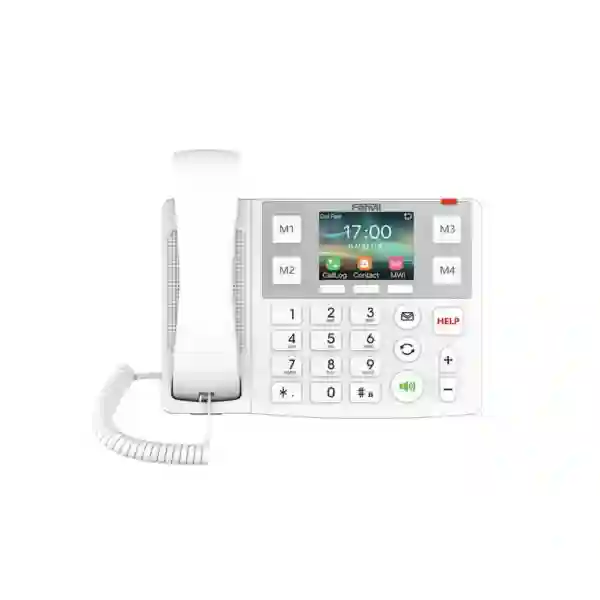
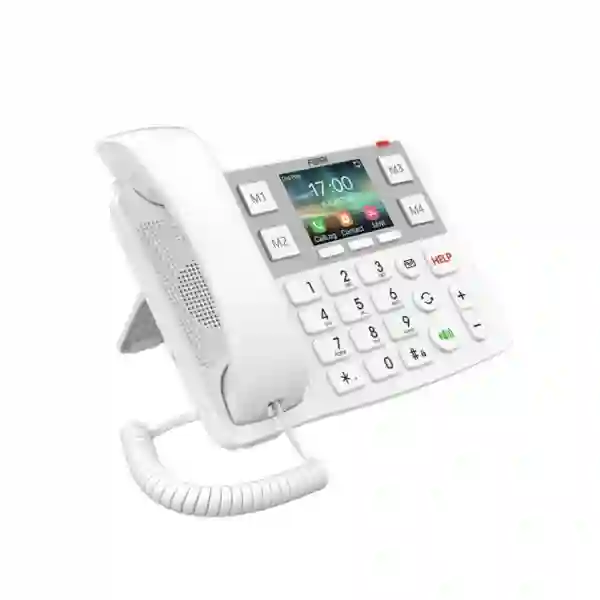
The Fanvil X305 Big Button IP Phone is designed for users who benefit from clearer controls, larger number keys and straightforward access to important contacts. Fanvil positions the X305 for nursing homes, hospitals and other environments where easy operation matters. The phone combines a 3.5-inch 320×240 color screen, large digit keys with Braille dots, four customizable speed-dial keys, two SIP lines and a dedicated HELP key with modern IP telephony features. Built-in dual-band Wi-Fi, Bluetooth 4.2, dual Gigabit Ethernet and integrated Power over Ethernet provide flexible network choices, while hearing-aid compatibility and HD audio support can improve day-to-day usability.
For organizations in Tanzania, the X305 is particularly relevant when endpoint usability must be considered alongside the PBX, SIP service, switching, Wi-Fi, VLAN design and power continuity. It can be evaluated for healthcare reception areas, patient rooms, senior-care environments, accessible workplace extensions, service points and other locations where a conventional small-button business handset may not be ideal.
Large, accessible controls
Ten large digit keys with Braille dots, a dedicated HELP key and four programmable speed-dial keys give the X305 a more accessible control layout than a typical compact office phone.
Flexible connectivity
Dual-band 2.4GHz/5GHz Wi-Fi, Bluetooth 4.2, dual Gigabit Ethernet and PoE give network teams several practical deployment options.
Emergency-button support
Fanvil documents support for compatible 433MHz wireless emergency buttons, allowing the phone to be considered in workflows where a simple request-for-help mechanism is required.
SIP business telephony
Two SIP lines, HD audio, common call features, secure signaling options and centralized provisioning methods allow the X305 to fit a managed IP PBX environment.
What the Fanvil X305 is designed to solve
Many business IP phones are optimized for information density: numerous soft keys, small number pads, compact labels and several layers of menu navigation. That can be useful for power users, but it can become a barrier for people who need clearer physical controls. The X305 takes a different approach. Its large numeric keys make dialling more visible and tactile, while Braille dots on the digit keys provide an additional accessibility cue. Four programmable speed-dial keys can be associated with frequently used contacts, which can reduce the number of steps required for routine calling.
The model also addresses communication continuity in environments where users may need assistance quickly. Fanvil specifies a HELP key and support for compatible 433MHz wireless buttons from its KT series. In a correctly designed deployment, these capabilities can form part of a broader communication workflow. They should not, however, be treated as a substitute for regulated nurse-call, life-safety or emergency-response systems unless the complete design has been assessed for the applicable operational and regulatory requirements.
From an IT perspective, the X305 is still a standards-based network phone. It can register to a compatible SIP platform, obtain power from a PoE switch, connect through Ethernet or Wi-Fi and be managed through common provisioning methods. This means accessibility does not need to be separated from enterprise voice administration. A deployment can still use extension numbering, VLANs, Quality of Service, secure SIP, centralized firmware policies and documented configuration standards.
Verified Fanvil X305 technical highlights
| Area | Verified capability | Deployment relevance |
|---|---|---|
| Display | 3.5-inch 320×240 color screen | Provides clear call, menu and contact information. |
| SIP | 2 SIP lines | Suitable for simple extension and secondary-account requirements. |
| Accessibility | Large digit keys with Braille dots; HAC handset | Supports users who benefit from tactile, larger controls and hearing-aid compatibility. |
| Quick calling | 4 DSS/speed-dial keys with image customization | Can simplify access to frequently called contacts. |
| Wireless | 2.4GHz/5GHz Wi-Fi and Bluetooth 4.2 | Useful where cabling, wireless access or compatible peripherals influence placement. |
| Ethernet | Dual 10/100/1000 Mbps ports | Supports Gigabit desk pass-through designs. |
| Power | Integrated PoE; external DC power option | Allows centralized PoE deployment or local power where required. |
| Audio | HD voice, G.722 and Opus among supported codecs | Can provide wideband voice when the PBX and call path support it. |
| Security | SIP over TLS, SRTP, 802.1X, L2TP and OpenVPN support | Can participate in secured voice and network-access designs when configured end to end. |
| Management | FTP/TFTP/HTTP/HTTPS, DHCP option 66, SIP PnP and TR-069 provisioning | Supports repeatable multi-phone configuration. |
PBX compatibility, network planning and deployment
The X305 uses SIP, so the first compatibility question is whether the intended PBX or hosted voice service supports standard SIP endpoints and the specific functions the organization wants to use. Registration alone is not enough to prove complete feature compatibility. Provisioning, BLF behavior, voicemail indication, directory services, transfer methods, secure signaling and emergency-button workflows should be tested against the exact PBX version and configuration. A pilot unit is a sensible step before a larger rollout.
Network design also matters. If the phone is powered by PoE, the access switch must provide adequate power and should ideally be protected by UPS if call continuity during short power interruptions is required. Where the phone shares its second Ethernet port with a computer, VLAN design and switch configuration should ensure voice and data are handled correctly. The X305 supports Gigabit Ethernet, which avoids the Fast Ethernet bottleneck found on some entry-level phones, but the overall call quality still depends on latency, packet loss, jitter, PBX performance and WAN stability.
Wi-Fi can be useful where a network cable is difficult to install, but it should not be selected automatically. Healthcare, hospitality and office environments can have radio congestion, thick walls and roaming demands. For fixed desk locations, wired Ethernet may offer simpler predictability. When Wi-Fi is required, check signal strength, channel design, authentication method and whether the handset location remains within reliable coverage. FourTeck’s Tanzania technology services page explains how telephony, switching, Wi-Fi and other infrastructure should be considered as connected systems rather than isolated purchases.
Where the X305 can fit
Healthcare and senior-care environments are the most obvious fit because Fanvil specifically positions the X305 for nursing homes and hospitals. A patient room, care facility reception, nurse support area or accessible common room may benefit from the large keys, speed-dial customization, HAC handset and help-oriented controls. The same design can also be useful outside healthcare. Organizations may deploy the X305 at an accessible reception point, security desk, service counter, senior staff residence, community facility or other location where simple physical controls are preferred.
The phone should be selected by user need rather than by feature count. A receptionist who manages dozens of simultaneous calls may need a more advanced console, while a user who needs a small number of trusted contacts may gain more value from the X305’s simplified layout. For wider product context, review the FourTeck Tanzania technology shop. Buyers comparing ordinary business endpoints can also look at the Dinstar C60S business IP phone, the Dinstar C60SP PoE phone, the Dinstar C60U-W Wi-Fi phone and the Dinstar C60U-T 4G IP phone to understand how specialized accessibility requirements differ from conventional desk-phone priorities.
Fanvil X305 Big Button IP Phone Tanzania
Organizations evaluating the Fanvil X305 Big Button IP Phone in Tanzania should begin with the user experience. The X305 is not simply another two-line SIP phone; its main value is the combination of accessible controls and modern network connectivity. Large digit keys with Braille dots can reduce visual and tactile difficulty during dialling, while four programmable DSS keys can place important contacts one press away. The dedicated HELP key and support for compatible 433MHz wireless buttons make it relevant to care-oriented communication workflows, provided the complete application is assessed correctly.
For Tanzanian hospitals, clinics, assisted-living facilities, residences, hotels with accessibility requirements, educational institutions and office environments, procurement should connect the handset decision to the surrounding voice system. Confirm the PBX platform, expected SIP accounts, extension numbering, call routes and whether the organization wants secure TLS/SRTP signaling. Determine whether phones will use wired Ethernet or Wi-Fi. If PoE is planned, verify the access-switch power budget and whether the switch is protected by UPS. This is particularly useful where uninterrupted internal calling during short power interruptions is important.
A Tanzania rollout should also define who will administer the phones. Fanvil supports several auto-provisioning methods, allowing administrators to standardize settings rather than configure every device manually. This becomes valuable across multiple wards, floors, branches or sites. A provisioning template can define SIP server addresses, time settings, codecs, VLANs, speed-dial assignments and security options, but the template should be tested with a pilot phone before being repeated widely.
When requesting a quotation, include quantity, site type, PBX brand and software version, whether PoE or Wi-Fi will be used, any emergency-button requirement, preferred wall or desk installation, headset needs and the people who will use the phone. FourTeck Tanzania’s contact and quotation page explains the project information that helps turn a product request into a better scoped solution.
Fanvil X305 Big Button IP Phone Dar es Salaam
Dar es Salaam organizations can consider the Fanvil X305 where voice endpoints must be easy to operate in busy public, healthcare or service environments. Hospitals, clinics, retirement or assisted-living settings, hotels, reception points and office buildings may all have users who benefit from bigger controls and fewer navigation steps. The phone’s four speed-dial keys are especially useful when a small number of contacts—reception, security, nurse station, family contact, help desk or facilities—must be reached repeatedly without searching through a long directory.
Large urban offices often run voice, CCTV, Wi-Fi, cloud applications and general data over the same switching infrastructure. In that environment, the X305’s dual Gigabit ports can help avoid slowing a computer connected through the phone, but network quality still has to be managed. Voice VLANs, QoS and congestion control can protect call traffic when backups, video or internet use increases. Where the phone is installed in patient rooms or areas away from existing cabling, built-in dual-band Wi-Fi creates another option, but coverage should be surveyed rather than assumed.
PoE can simplify deployment by delivering both power and data over one Ethernet cable. A centrally UPS-backed PoE switch can also support short-term continuity more effectively than independent adapters at every desk. Before standardizing this approach, the installer should calculate the switch power budget for all phones and any other PoE devices such as access points or cameras. If wall mounting is required, include the optional mounting requirement in the bill of materials and confirm the exact installation method.
For Dar es Salaam procurement, send the expected quantity, floor or room count, PBX platform, network topology, PoE switch models, Wi-Fi coverage information and any wireless emergency-button requirement. This makes it easier to decide whether the X305 is best used in every extension or selectively for users who specifically benefit from its accessible controls.
Fanvil X305 Big Button IP Phone Mwanza
Mwanza buyers evaluating the Fanvil X305 may be planning a new SIP system, replacing analog phones or adding accessible endpoints to an existing PBX. The most useful starting question is not whether the X305 has enough features, but whether its interface matches the intended user. Two SIP lines are sufficient for many care, residential and straightforward office roles. The phone is designed to make everyday calling easier through large keys, simple controls and programmable speed-dial contacts rather than through a dense set of executive functions.
For branch environments, centralized configuration can reduce support effort. Fanvil documents multiple provisioning methods and web management. An IT team can prepare a repeatable profile and then adjust only the extension-specific information for each user. A consistent profile is useful for speed-dial placement, HELP-key behavior, time zone, ring volume, audio settings and network parameters. The profile should be controlled carefully because incorrect settings can be replicated just as efficiently as correct ones.
Connectivity should reflect the building. Wired Gigabit Ethernet and PoE are strong choices when structured cabling is available because they provide predictable bandwidth and centralized power. Wi-Fi can support areas where new cabling is difficult, but signal strength and roaming behavior should be measured. If wireless emergency buttons are part of the requirement, test the exact button model, installation position and expected response workflow in the real environment before scaling.
A Mwanza quotation should identify whether the project is handset supply only or includes PBX configuration, switching, Wi-Fi, cabling, UPS or support. Provide user roles and room types so the X305 is reserved for places where its design adds value. Other employees may be better served by conventional multi-line desk phones, while the X305 can remain the accessibility-focused endpoint within the same SIP system.
Fanvil X305 Big Button IP Phone Arusha
Arusha organizations in healthcare, hospitality, education, tourism administration and professional services can use the Fanvil X305 where simple and accessible calling is more important than a large number of programmable line appearances. The phone’s visible large keypad, Braille-marked digits, HAC handset and customizable speed-dial keys can make everyday use less demanding for seniors and other users who prefer clearer physical interaction.
Hospitality environments present a useful example. A hotel or lodge may need phones in reception, back offices, accessible rooms or staff areas. The same handset does not need to be used everywhere. The X305 can be assigned to selected rooms or service points where large keys and quick contacts improve usability, while receptionists continue using higher-capacity operator phones. On an IP PBX, both endpoint types can share the same extension plan and call-routing policies.
Healthcare and residential-care buyers should think carefully about the HELP function. A phone feature can support communication, but critical emergency processes require more than a button. Define who receives the call, what happens if the first destination does not answer, how events are logged, whether backup paths exist and how staff respond operationally. If 433MHz wireless buttons are used, confirm range and placement in the actual building and ensure users understand their purpose.
For Arusha deployments, also assess power and connectivity. PoE is useful where central switch power and UPS are available. Wi-Fi can extend placement flexibility but should be designed around actual signal conditions. When requesting pricing, include room count, phone quantity, network method, PBX model, call-flow expectations, wireless-button requirement and installation type. That gives procurement teams a clearer bill of materials and avoids treating an accessible phone as a simple box purchase.
Fanvil X305 Big Button IP Phone Dodoma
Dodoma institutions, healthcare organizations, administrative offices and service facilities may consider the Fanvil X305 when a standards-based SIP endpoint must be straightforward for a wide range of users. Its two SIP registrations fit roles where a primary extension and perhaps one secondary identity are sufficient. Four speed-dial keys can be customized for the most important contacts, helping users reach reception, security, support or another designated destination without navigating a directory.
Public-sector and institutional deployments often benefit from standardized configuration. A large phone rollout should document extension numbers, user names, MAC addresses, rooms, switch ports, firmware versions and PBX profiles. The X305’s provisioning options support this model. Configuration can be prepared centrally, but the organization should retain a controlled baseline and test changes before wide release. This is especially important when secure SIP, VLANs, certificates or network authentication are enabled.
Accessibility should also be addressed in user onboarding. Large buttons improve physical usability, but users still need to know what each speed-dial key does, how to adjust volume, how to use speakerphone and what the HELP key is configured to trigger. Simple labels or approved images for the programmable keys can make the phone easier to understand. Administrators should keep those assignments consistent across similar rooms wherever possible.
A Dodoma request for quotation should state the exact number of X305 phones, whether the project is new or an expansion, the PBX environment, expected PoE or Wi-Fi use, VLAN requirements, emergency-button quantities and any wall-mounting needs. If the site is also upgrading switches, cabling or UPS capacity, include those details in the same project discussion so voice reliability and endpoint deployment are planned together.
Fanvil X305 Big Button IP Phone UAE
For organizations operating in the UAE, the Fanvil X305 can be assessed as a specialized accessible SIP endpoint within a broader office, healthcare or hospitality telephony standard. Companies with branches in both Tanzania and the UAE may benefit from using a consistent PBX architecture while selecting different handset classes by user role. The X305 can serve users who need large buttons, Braille markings, hearing-aid compatibility and simplified speed dialing without forcing the entire organization to adopt the same endpoint.
Enterprise UAE networks often use managed PoE switching and segmented VLANs, which aligns well with the X305’s Gigabit Ethernet and PoE capabilities. Network teams should still validate PBX interoperability, firmware policy, certificate requirements and provisioning. If Wi-Fi deployment is considered, survey the actual radio environment because high-density offices, hospitals and hospitality properties can have many access points and competing wireless clients. Wired Ethernet generally remains the predictable choice for fixed desk phones when cabling is available.
The X305’s emergency-button support should be treated as part of a defined communication workflow. Test the exact Fanvil KT-series button required, confirm range in the building and decide how the resulting call or event is handled. Critical care or regulated emergency applications may require dedicated systems beyond a SIP phone, so buyers should distinguish convenience and assistance functions from certified life-safety processes.
Organizations coordinating regional projects can review FourTeck UAE IT and telecom solutions and the FourTeck IP phone specialist site for related voice-system context. For quotation, provide phone count, PBX platform, site type, PoE switching, intended emergency-button use and installation requirements.
Fanvil X305 Big Button IP Phone Uganda
Ugandan organizations evaluating the Fanvil X305 may be modernizing a healthcare voice system, adding accessible extensions or deploying SIP phones across branch locations. The model is a good candidate where a user needs clear, large physical controls and only a small number of important calling destinations. Two SIP lines support common extension designs, while programmable speed-dial buttons can reduce the steps required to reach reception, security or a caregiver.
For multi-site Uganda deployments, supportability matters. Auto-provisioning can help central administrators deploy consistent phone settings across several branches, but a branch rollout should start with a tested template. Confirm inbound and outbound calls, transfer behavior, voicemail indication, ring settings, directory access, Wi-Fi or VLAN configuration and any HELP-button workflow before shipping phones to remote locations. A device inventory with extension, MAC address, room and firmware information makes future troubleshooting easier.
Power continuity should be decided intentionally. With PoE, phones can be powered from a switch in a controlled rack and can share the same UPS strategy as other network equipment. This can simplify resilience compared with separate adapters at each desk. Wi-Fi remains available for locations without cabling, though signal quality must be validated. Where the X305 is used with wireless emergency buttons, range and response procedures should be tested at each site rather than assumed from another building.
For regional voice and networking context, organizations can refer to FourTeck Uganda. A useful quotation request should include the number of sites, quantity per site, PBX system, network method, PoE availability, emergency-button needs and whether central provisioning or remote deployment assistance is required.
Fanvil X305 Big Button IP Phone Kampala
Kampala hospitals, clinics, offices, hotels and care-oriented facilities can consider the Fanvil X305 when user-friendly physical design is a procurement priority. The X305 is not intended to compete with feature-dense executive phones on the number of line keys. Its advantage is clarity: a larger keypad, Braille dots, a 3.5-inch color display, four direct-call keys and a dedicated HELP key create a more approachable interface for users who may struggle with smaller controls.
In a Kampala office or healthcare campus, voice traffic may share the LAN with cloud applications, surveillance, Wi-Fi and general data. Managed switching can separate voice using VLANs and prioritize delay-sensitive traffic. The X305’s Gigabit Ethernet ports allow a PC to share the desk connection without limiting that path to 100 Mbps, but QoS and network health still influence audio quality more than raw port speed. Packet loss or unstable WAN connectivity can affect even a well-specified phone.
Healthcare deployments should map the speed-dial and HELP functions to real workflows. One key may reach a nurse station, another reception, another security and another a family or internal support contact. Consistent icon or image assignments can reduce confusion. Administrators should document the mapping and ensure replacement phones receive the same profile. If wireless emergency buttons are part of the project, include them in acceptance testing across rooms and corridors.
A Kampala quotation should therefore capture more than handset quantity. Include user types, rooms, PBX brand, SIP server location, switch and PoE environment, Wi-Fi coverage, UPS design and any accessory requirements. This information supports a dependable deployment and helps determine whether the X305 should be used widely or only for selected accessible endpoints.
Fanvil X305 Big Button IP Phone Arua
Arua organizations may value the Fanvil X305 for branch or facility locations where simplicity and remote manageability need to work together. A straightforward two-line SIP phone can be easier to support than a complex touchscreen endpoint when the user mainly needs a primary extension and a few important contacts. Large keys and Braille dots make dialling more accessible, while the color display provides clear status information.
Remote branches benefit from predictable provisioning. Rather than configuring every phone independently, an administrator can create a tested baseline with SIP server, codecs, time, ring settings, VLAN parameters and speed-dial assignments. That baseline can then be adapted for each extension. The approach reduces inconsistent configuration and can make replacement easier when device records are maintained carefully. Firmware changes should still be controlled and tested because a bulk update can affect every endpoint at once.
Connectivity may vary by site. Where structured cabling and PoE switching are available, wired deployment is usually easier to monitor. If Wi-Fi is necessary, confirm access-point coverage and authentication before deciding phone positions. Organizations should also review how their PBX or SIP service depends on WAN connectivity; a local phone cannot overcome an unstable upstream connection. For critical calling, resilience may require redundant internet, local call-routing options or documented fallback procedures depending on the PBX architecture.
For Arua procurement, specify whether phones are for patient rooms, offices, public service counters or other roles. Include the expected call destinations, PBX platform, PoE availability, network conditions, wall-mounting needs and any wireless button requirements. A role-based bill of materials can reserve the X305 for the users who benefit from it most while using other endpoint classes elsewhere.
Fanvil X305 Big Button IP Phone Mbarara
Mbarara facilities considering the Fanvil X305 can use it as an accessibility-focused endpoint in a standard SIP telephony design. Clinics, hospitals, hospitality properties, education facilities, offices and residential-care environments may need a phone that is physically easier to operate than a compact business handset. The combination of large keys, Braille dots, a hearing-aid-compatible handset and direct-call buttons provides a practical basis for that requirement.
Before purchase, define whether users will dial numbers manually or rely mainly on programmed contacts. If direct calling is important, decide which destinations belong on the four DSS keys and who has authority to change them. Simple visual labeling can improve usability, but consistency matters. A site with many X305 units should use a documented key map so users and support staff know what each position represents.
From a network perspective, PoE and Gigabit connectivity fit modern managed LANs. The phone can also use Wi-Fi, which may help in renovated or temporary spaces. Wireless voice should be tested under realistic load, not only when the building is empty. If the Wi-Fi network is busy, channel utilization and roaming behavior can affect performance. Where voice reliability is critical and cabling exists, wired Ethernet remains a strong option.
A Mbarara buyer should also separate phone features from emergency-system requirements. The X305 can support help-oriented calling and compatible 433MHz buttons, but the organization must design the response process around them. For quotation, provide phone quantity, user profiles, PBX details, switch models, power method, Wi-Fi requirements, button accessories, installation type and any need for configuration or training. That scope allows the endpoint to be evaluated as part of an operational communication system rather than just an individual device.
Fanvil X305 Big Button IP Phone Gulu
Gulu organizations can consider the Fanvil X305 when accessible calling must remain compatible with a centrally managed IP PBX. A care facility or branch office may have a small IT team yet still need repeatable configuration across several rooms. Because the X305 supports common provisioning methods, administrators can prepare standardized settings and reduce hands-on configuration at each endpoint.
The user-facing design is equally important. Large digit keys with tactile Braille dots, programmable speed dials and a dedicated HELP key can reduce complexity. The phone also supports HD voice and hearing-aid compatibility, which can improve suitability for users who need clearer audio. Actual perceived quality still depends on the PBX, codec negotiation, acoustic environment and network conditions, so deployment testing should include real users where practical.
For sites where power interruption is a concern, PoE can simplify continuity planning. Rather than protecting individual phone adapters, an organization can protect the PoE switch and upstream network equipment with appropriately sized UPS systems. The complete call path must remain powered, including router, firewall and PBX or internet equipment. If the phone is configured over Wi-Fi, the relevant access points also need power protection for the same continuity objective.
Gulu procurement should include a basic acceptance plan. Test SIP registration, outbound and inbound calling, transfer, speakerphone, volume, speed dials, HELP behavior, emergency buttons if used and restart recovery. Record the final settings and firmware. These steps are particularly valuable for remote support because they establish a known working baseline. Include this operational information with quantity and infrastructure details when requesting a quote.
Fanvil X305 Big Button IP Phone Kenya
Kenyan businesses and healthcare organizations can evaluate the Fanvil X305 as a specialized accessible phone within a wider SIP estate. It is suitable where users benefit from clearly separated large buttons, tactile Braille markings and quick access to a small number of contacts. Two SIP lines cover many ordinary extension needs, while Gigabit Ethernet, PoE and Wi-Fi give infrastructure teams flexibility in how the phone reaches the voice platform.
For organizations standardizing across East Africa, the X305 can be introduced as a role-based endpoint rather than as the default phone for every employee. General office users may use conventional desk phones, supervisors may use high-end models, and accessible rooms or care-oriented users may receive the X305. This approach keeps training and procurement aligned with actual job requirements while maintaining common SIP and network standards.
A Kenya deployment should validate PBX interoperability before quantity purchase. Test the exact features required, including secure signaling, directory behavior, transfer, voicemail indication and provisioning. If wireless 433MHz buttons are used, test the intended button model and coverage. If Wi-Fi is chosen, inspect radio conditions around beds, offices, corridors and service areas. If PoE is chosen, check total switch budget and UPS capacity.
Regional procurement teams can use FourTeck Kenya for related IT, VoIP and network context. A complete quote request should state phone quantities by role, site count, PBX model, power method, switch infrastructure, installation preference and any emergency-button or wall-mounting requirement. This improves comparison between handset-only and full-deployment proposals.
Fanvil X305 Big Button IP Phone Kuwait
Organizations in Kuwait can consider the Fanvil X305 for hospitals, clinics, senior-care environments, hospitality properties and workplaces where accessible physical controls matter. The phone provides modern SIP connectivity without abandoning a familiar handset and keypad experience. That balance can be important for users who do not want a touchscreen-based interface but still need VoIP features, centralized management and network integration.
The device supports wired Gigabit Ethernet, PoE and dual-band Wi-Fi. In a managed office or healthcare network, wired PoE is often attractive because it reduces local adapters and can be included in centralized UPS planning. Wi-Fi remains useful for difficult-to-cable positions, but buildings with dense wireless usage should be surveyed. Secure SIP and SRTP capabilities can be used where the PBX supports them and certificates, firewall policy and provisioning are configured correctly.
The X305 is also distinctive because of its 433MHz button support. A buyer should confirm whether that functionality is required, which compatible Fanvil button model will be used and how it maps to the response process. The function may support assistance-oriented communication, but it should not be marketed or designed as a universal substitute for dedicated emergency or life-safety systems.
For Kuwait regional projects, FourTeck Kuwait provides related IT and VoIP context. Include site type, quantity, PBX, cabling, PoE switch model, Wi-Fi requirements and accessibility goals in the quotation brief. Where a multi-country business wants the same configuration standard in Kuwait and Tanzania, document the common SIP settings while allowing local network and service-provider differences to be handled separately.
Fanvil X305 Big Button IP Phone Ghana
Ghanaian organizations can evaluate the Fanvil X305 when phone accessibility is part of the endpoint selection process. A standard business phone may be technically compatible with the PBX but still be difficult for a particular user to operate. The X305 addresses that gap through large number keys, Braille dots, hearing-aid compatibility and simplified direct-call controls while remaining a SIP network device.
Healthcare and assisted-living applications should start with workflow. Decide whether the phone will be used for normal inbound and outbound calling, quick contact with staff, assistance requests or a combination. Program the speed-dial keys accordingly and keep assignments consistent. If the HELP key or wireless button is used, define the destination and fallback behavior. Test what happens when the destination is busy, unanswered or unavailable so the operational process is understood.
Infrastructure selection can follow the site. PoE over Gigabit Ethernet offers a clean fixed installation, while built-in Wi-Fi enables locations where cable installation is constrained. Bluetooth can support compatible peripherals, and the handset itself supports hearing-aid compatibility. For larger deployments, provisioning and device records help administrators maintain consistent configuration. Secure signaling should be implemented as a system setting with PBX and certificate support rather than as an isolated phone checkbox.
Organizations coordinating Ghana technology projects can review FourTeck Ghana for regional infrastructure context. When requesting a quote, provide user needs, quantity, facility type, PBX, network connection, power strategy, emergency-button requirement and any installation or support scope. This information helps distinguish the X305 from ordinary desk endpoints and keeps purchasing focused on accessibility value.
Fanvil X305 Big Button IP Phone Nigeria
Nigerian healthcare providers, offices, hospitality operators and care facilities can assess the Fanvil X305 when they need an IP phone that is easy to identify and operate. The X305 combines a conventional handset with a 3.5-inch color display and oversized controls, making it less dependent on small text or closely spaced buttons. Four direct-call keys can simplify routine access to selected contacts, while the dedicated HELP function supports assistance-oriented calling workflows.
Power planning is especially important in any telephony deployment where continuity matters. Using PoE allows endpoints to receive power from a central switch, which can then be protected with UPS. The router, firewall, PBX, SIP gateway and internet equipment also need continuity if calls depend on them. A phone remaining powered has limited value if the rest of the call path is unavailable. This system view should therefore be part of any X305 proposal.
For multi-branch deployments, centralized provisioning can support consistency. Create and test a baseline profile, document the settings and then apply it by site or user group. Avoid putting sensitive SIP credentials into unmanaged documents. If the phone uses Wi-Fi, ensure the wireless authentication method and coverage are stable. If emergency buttons are required, test them under real building conditions before deciding quantity and placement.
For regional project context, see FourTeck Nigeria. A useful quotation request should include PBX type, number of phones, branch count, PoE and UPS strategy, Wi-Fi usage, emergency-button needs, configuration responsibility and installation scope. Those details make it easier to compare total deployment cost rather than handset price alone.
Fanvil X305 Big Button IP Phone Seychelles
Seychelles hospitality, healthcare, residential and service organizations can consider the Fanvil X305 for locations where an accessible phone interface is valuable. Resorts, clinics, care environments and offices may have guest, patient or staff roles that benefit from large number keys and direct access to a few trusted contacts. The X305’s combination of accessible controls and SIP connectivity allows those roles to remain part of the same managed voice environment as other business phones.
Hospitality deployments should think about room purpose. The X305 may suit accessible rooms, staff care areas or selected guest locations where direct keys can be assigned to reception, emergency assistance, housekeeping or another defined service. The exact call destinations should follow the property’s operational design. Consistent labeling matters because users may not be familiar with the phone. Settings should also prevent unnecessary complexity where possible.
Island and multi-property environments can make remote support valuable. Auto-provisioning, centralized configuration and a clear device inventory can reduce site visits for routine settings. Connectivity architecture should be documented so support teams know whether each phone uses Ethernet, PoE or Wi-Fi. Where internet-dependent SIP services are used, network resilience and local fallback options should be discussed with the service provider and PBX administrator.
For a Seychelles quotation, provide the number of properties or sites, room categories, phone quantities, PBX or hosted-voice platform, network connection, PoE availability, emergency-button requirements and any wall-mounting accessories. If the deployment is part of a wider regional standard, specify what must remain common across countries and what can vary locally. This helps keep configuration consistent without ignoring site-specific infrastructure.
Related FourTeck Tanzania pages and buying guidance
The FourTeck Tanzania home page outlines the wider IT, telecom, security and infrastructure portfolio that can surround a voice deployment. This is relevant because IP phones depend on switching, network policy, power and sometimes Wi-Fi rather than functioning as isolated analog devices.
The FourTeck Tanzania services page explains integrated IP PBX, IP phone, network and lifecycle planning. The technology shop provides broader product-selection guidance for business phones and the infrastructure they connect to.
Buyers comparing standard office phones can review the Dinstar C60S for a basic two-account desk-phone role, the Dinstar C60SP where PoE is required, the Dinstar C60U-W for a conventional Wi-Fi business phone and the Dinstar C60U-T 4G model for another connectivity profile. These alternatives highlight why the X305 should be selected primarily for its accessibility and care-oriented interface rather than simply because it supports SIP.
When the intended model and quantity are known, use the FourTeck Tanzania contact page to submit the project details needed for quotation and compatibility review.
Quotation checklist for Fanvil X305
A complete quotation is easier to prepare when the request describes the deployment rather than only the handset model. Before contacting sales, gather the approximate phone quantity, number of sites, user type, PBX or hosted voice platform, SIP account design, existing switch model, available PoE budget, Wi-Fi requirement, VLAN policy, internet or WAN dependence, UPS expectations and any wall-mounting or headset requirement.
If accessibility functions are the reason for choosing the X305, describe them. State whether the user needs large keys, Braille markings, hearing-aid compatibility, direct speed-dial contacts, the HELP key or compatible wireless emergency buttons. For button projects, include the number of rooms and the expected assistance workflow. This gives the technical team enough context to determine whether the phone is the right endpoint and whether additional accessories or systems are required.
Also confirm what is included in the project scope: product supply only, PBX registration, switch configuration, VLAN setup, provisioning, Wi-Fi assessment, cabling, mounting, training, documentation or support. Separating these items prevents two quotations with different scopes from being compared as though they were equivalent.
Fanvil X305 FAQs
How many SIP lines does the Fanvil X305 support?
Fanvil specifies two SIP lines. That is suitable for many care, residential and straightforward office roles where a user does not need numerous independent line registrations.
Does the Fanvil X305 support PoE?
Yes. The X305 supports integrated Power over Ethernet. A compatible PoE switch can carry both power and network connectivity over the Ethernet cable, subject to switch power budget and correct network design.
Does the X305 have Wi-Fi and Bluetooth?
Yes. Fanvil specifies built-in 2.4GHz and 5GHz Wi-Fi and Bluetooth 4.2. Wired Ethernet may still be preferable for fixed installations where structured cabling is available.
Is the Fanvil X305 suitable for seniors?
Fanvil specifically positions the model for seniors and care-oriented environments. Large number keys, Braille dots, hearing-aid compatibility, four direct-call keys and a HELP key can make operation easier for users who benefit from more accessible controls.
Can the X305 work with wireless emergency buttons?
Fanvil documents support for compatible 433MHz wireless buttons from its KT series. Exact button choice, range, workflow and compatibility should be validated for the intended deployment.
Is the X305 a certified emergency or life-safety system?
The X305 is a SIP IP phone with help-oriented features. Buyers should not assume that a phone or wireless button replaces a regulated nurse-call, emergency or life-safety system. The complete application should be assessed against operational and regulatory requirements.
Can the Fanvil X305 be wall mounted?
Fanvil lists desktop installation and optional wall-mounted installation. Confirm the required mounting accessory and site conditions when preparing the bill of materials.
What should be tested before a larger X305 rollout?
Test SIP registration, inbound and outbound calls, transfer, voicemail indication, volume, speakerphone, PBX features, provisioning, wired or Wi-Fi connectivity, VLAN and security settings, speed-dial assignments, HELP behavior and any wireless-button workflow required by the organization.
Decision recap
Choose the Fanvil X305 when the project requires a standards-based SIP phone with unusually accessible physical controls. Its large Braille-marked digit keys, four customizable speed dials, hearing-aid compatibility and help-oriented design distinguish it from ordinary office phones. The modern connectivity layer—Gigabit Ethernet, PoE, dual-band Wi-Fi and Bluetooth—allows it to participate in contemporary managed voice networks without forcing an organization to maintain a separate analog environment.
Do not choose the X305 solely from a feature list. Confirm the PBX, call flow, user requirements, power, Wi-Fi or Ethernet method, emergency-button workflow and management model first. The best deployment may use the X305 selectively for users who benefit from its interface while other staff use conventional desk or executive phones.
Talk to FourTeck about your X305 requirement
Send the number of phones you need, the type of users or rooms, your PBX platform, network and power environment, any required wireless emergency buttons, preferred installation method and whether you need supply only or a broader IP telephony deployment. FourTeck can then evaluate the endpoint in context rather than treating the request as a model number alone.
For customers with related projects in other markets, the FourTeck network includes UAE IT and telecom solutions, Uganda technology solutions, Kenya IT and VoIP solutions, Ghana technology solutions, Nigeria IT services and Kuwait IT and VoIP solutions. These links provide regional context for organizations coordinating voice standards across multiple countries.




Reviews
There are no reviews yet.