
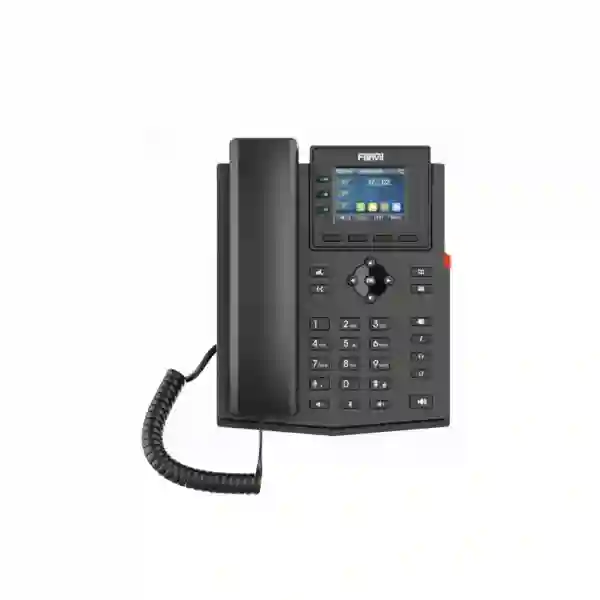
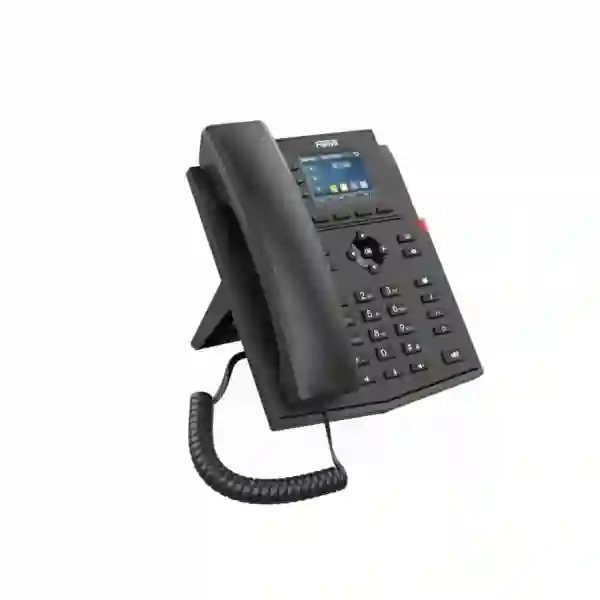
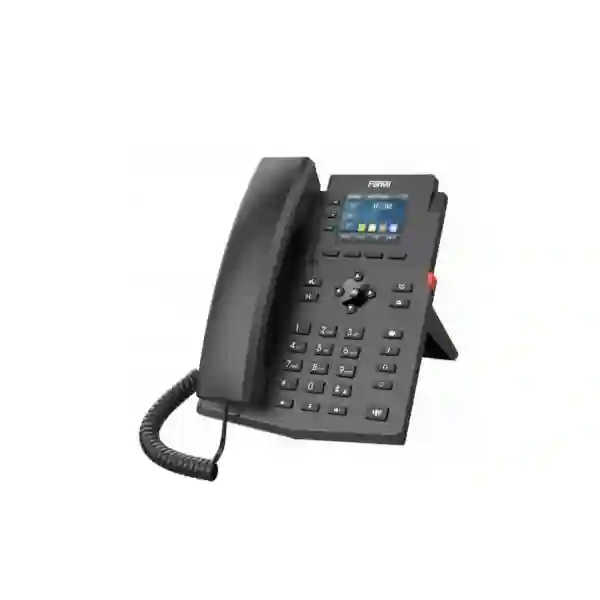
Fanvil X303 Enterprise IP Phone
The Fanvil X303 is a practical color-screen SIP phone for organizations that want reliable desk calling, four SIP lines, HD audio, straightforward call control and centralized VoIP management without paying for features that ordinary users may never use. Fanvil specifies a 2.4-inch 320×240 color screen, support for four SIP lines, six-way local audio conferencing, G.722 and Opus wideband audio, two 10/100 Mbps Ethernet ports, headset connectivity, IPv4/IPv6 support and multiple provisioning methods. The X303 is the non-PoE model in the X303/X303P pair and uses an external power supply, so power planning should be part of the purchasing decision.
Choose the X303 for standard office desks that need four SIP registrations, a color display, HD voice and six-way conferencing over Fast Ethernet. If centralized PoE power or Gigabit desk pass-through is mandatory, compare another Fanvil variant before standardizing.
What the Fanvil X303 is designed to do
The X303 sits in Fanvil’s X300 business-phone family and is intended as a cost-conscious enterprise endpoint for day-to-day SIP calling. Its four SIP lines give one user room for a primary extension plus additional identities, shared lines or departmental registrations where the IP PBX supports them. The color display provides a clearer interface than a basic monochrome phone while staying compact enough for ordinary desks, reception counters and branch-office workstations.
For voice quality, Fanvil lists HD audio on the handset and speaker, with G.722 and Opus among the supported wideband codecs. The phone also supports full-duplex acoustic echo cancellation, packet-loss concealment, adaptive jitter buffering, noise reduction and automatic gain control. These functions help the endpoint handle real-world voice conditions, but voice quality still depends on the complete path: the IP PBX, SIP trunk or service, LAN, WAN, codec policy and the device at the other end of the call.
The X303 supports six-way local audio conferencing for quick multi-person discussions without requiring a dedicated conferencing application. It also supports handset, hands-free and headset modes, making it suitable for users who alternate between private calls, short speakerphone conversations and longer headset-based work. For busy offices, the practical value is not a single headline feature but the combination of familiar keys, multiple SIP identities, manageable provisioning and standards-based network integration.
Verified Fanvil X303 technical highlights
Supports four SIP registrations for multi-line office use, shared identities or flexible extension arrangements.
A 320×240 color screen presents menus, call status, contacts and line information in a compact desk-phone format.
G.722 and Opus wideband codec support, plus full-duplex audio processing, help deliver clearer business conversations when the complete voice path supports them.
Supports six-party audio conferencing for quick internal coordination, supplier discussions and ad-hoc customer calls.
Two 10/100 Mbps Ethernet ports support network connectivity and a bridged PC connection at desks with a single wall outlet.
A dedicated headset port and EHS compatibility can support call-intensive roles; verify the exact headset and EHS cable before volume deployment.
X303 versus X303P: power method matters
Fanvil publishes the X303 and X303P together because the two models share the main user experience, but the power method is a key purchasing difference. The X303 is the adapter-powered model. Integrated IEEE 802.3af PoE is specified for the X303P, not the X303. This distinction affects desk power, UPS strategy, cable organization, resilience and how easily a large quantity of phones can be managed during short utility interruptions.
If a business already has PoE switches and wants phones powered centrally from a protected rack, the X303P can be a more natural fit. If desks have reliable AC power and local adapters are acceptable, the X303 can still be a straightforward endpoint. Procurement teams should therefore place the exact model suffix in their request rather than writing only “X303 series.” That prevents a quotation from mixing different power assumptions.
Both models use dual 10/100 Mbps network ports. That is suitable for many ordinary office users, but it should be evaluated when a desktop computer will connect through the phone. Employees who transfer large files, use high-speed local storage, work with media-heavy applications or depend on Gigabit LAN performance may need a separate data outlet or a Gigabit phone variant.
IP PBX compatibility, security and centralized management
The X303 is a SIP endpoint, so it is designed to register to a compatible SIP-based IP PBX or service. In practical deployments, compatibility should be checked against the exact PBX version and the functions the business expects to use. Successful registration does not automatically guarantee identical behavior for BLF, voicemail indication, remote directories, transfer methods, secure signaling, provisioning templates, feature keys or call pickup. A pilot phone is a sensible step before a large rollout.
Fanvil documents network support including IPv4, IPv6 and dual-stack operation, static addressing, DHCP, PPPoE, 802.1X, VLAN, LLDP and QoS. It also lists SIP over UDP/TCP/TLS, SRTP, OpenVPN and L2TP among protocol capabilities. These features can participate in a secure voice design when the PBX, certificates, switch controls and firewall policies are configured consistently. Security is an end-to-end architecture decision; simply enabling a checkbox on one phone does not secure the overall voice environment.
For management, Fanvil supports auto-provisioning via FTP, TFTP, HTTP, HTTPS, DHCP options, SIP PnP and TR-069, together with a web-management portal, configuration export/import, firmware upgrade, packet capture and syslog. Standardized templates can reduce repetitive desk-by-desk configuration. Organizations with many phones should document server addresses, extension policies, codec preferences, time settings, VLAN details, directory configuration and firmware versions so replacements can be introduced predictably.
The broader Tanzania environment matters just as much as the handset. FourTeck Tanzania’s integrated IT and telecom overview explains how voice, switching, Wi-Fi, security and cabling interact. Buyers can also use the FourTeck Tanzania technology shop to compare endpoint and infrastructure options, and the services page to consider installation, configuration and lifecycle needs around the phone deployment.
Who should consider the Fanvil X303?
Employees who mainly need reliable inbound and outbound calling, transfer, hold, voicemail indication, a clear screen and occasional conferencing can use the X303 without the complexity of a premium touchscreen endpoint.
Four SIP lines, programmable keys, headset support and six-way conferencing can fit moderate call-handling positions where a very large BLF console is not required.
Provisioning options, SIP standards support and a consistent interface make the X303 relevant to organizations that want repeatable phone profiles across offices and branch locations.
Related IP phones and infrastructure on FourTeck Tanzania
The Fanvil X303 should be compared with other desk endpoints according to user role, power method, SIP-line count, screen preference and network speed. The Dinstar C60S Business IP Phone is a simpler two-account Fast Ethernet phone for basic office users. The Dinstar C60SP PoE Business IP Phone is useful when the buyer wants a comparable entry-level desk role with centralized PoE power.
For users who need additional connection options, the Dinstar C60U-W Wi-Fi IP Phone adds wireless flexibility, while the Dinstar C62U Business IP Phone provides a higher SIP-account count for roles that need more identities. These are not presented as direct substitutes on every feature; they are useful comparison points for selecting the right endpoint class.
A phone purchase also depends on switching, cabling, VLAN design, internet connectivity, PBX capacity, SIP trunks, UPS strategy and user headsets. The FourTeck Tanzania contact page can be used to request a scoped quotation that includes the handset plus the supporting components required for a working business extension.
Regional buying and deployment guidance
Fanvil X303 Enterprise IP Phone Tanzania
Organizations buying the Fanvil X303 Enterprise IP Phone in Tanzania should treat the handset as one component of a voice system rather than an isolated desk accessory. The X303 is well suited to standard office employees, administration teams, sales desks, reception areas, branch users and service staff who need four SIP registrations, a color display, HD voice, transfer and hold functions, headset support and occasional multi-party conferencing. It can be attractive where a business wants a consistent user experience across many desks without moving every employee to a premium executive endpoint.
The most important Tanzania planning point is power and network architecture. The X303 is the adapter-powered variant and does not include the integrated PoE function reserved for the X303P. A project with local AC outlets at every desk may be comfortable with adapters. A project designed around centralized UPS-backed PoE should evaluate the X303P or another PoE model before quantity ordering. The dual 10/100 Mbps ports can let a PC share the desk network point, but IT teams should verify whether Fast Ethernet pass-through meets the employee’s data workload. Heavy file users may need Gigabit access or a separate data connection.
Voice quality across Tanzania depends on switching, VLAN design, QoS, PBX configuration and WAN stability. The phone supports useful networking and security capabilities, but those features need to be implemented coherently. For a quotation, provide phone quantity, office or branch count, PBX brand and version, SIP trunk or extension design, switch model, cabling condition, headset requirement, power preference, directory integration and whether centralized provisioning is planned. FourTeck Tanzania can then assess the endpoint in context with business telephony and network products. This approach is especially important for organizations expanding from a few extensions to a standardized multi-site environment, because consistent profiles, naming, firmware and support documentation reduce future troubleshooting.
Fanvil X303 Enterprise IP Phone Dar es Salaam
Dar es Salaam offices often combine reception, finance, logistics, sales, customer service and management functions in the same building, which means one voice deployment may support very different call patterns. The Fanvil X303 can be a sensible standard endpoint for general users who need clear SIP calling, four line registrations, transfer, hold, forwarding, voicemail indication, speakerphone use and headset connectivity. Its color display offers a more approachable daily interface than a basic monochrome phone, while the six-way conference feature can handle short coordination calls without opening a separate meeting application.
In dense Dar es Salaam office networks, voice traffic may share infrastructure with cloud applications, CCTV, Wi-Fi, backups and general internet access. Endpoint specifications alone cannot prevent congestion. Managed switches, deliberate VLAN segmentation, QoS, stable uplinks and correctly configured firewall policies help keep delay-sensitive voice packets predictable. Since the X303 provides two 10/100 Mbps Ethernet ports, the decision to connect a desktop PC through the phone should be based on the user’s real bandwidth requirements. A finance workstation accessing large local datasets or a design user moving media files may be better served by Gigabit connectivity.
Power planning should be equally explicit. The X303 uses an external adapter, so keeping only the access switch on UPS will not keep adapter-powered phones active if desk power is unavailable. Where centralized telephony continuity is an objective, compare the X303P. Call-intensive teams should also pilot the intended headset and EHS cable combination before ordering at scale. A strong Dar es Salaam quotation request should include extension counts by department, PBX details, SIP trunk requirements, switch and VLAN information, number of shared phone-and-PC outlets, headset users and provisioning preferences. That information helps separate a simple handset supply from a complete voice deployment involving configuration, network preparation and ongoing support.
Fanvil X303 Enterprise IP Phone Mwanza
Mwanza organizations may be introducing IP telephony for the first time, extending an existing PBX or standardizing phones across departments and branches. In each case, the Fanvil X303 works best when the requirement is defined around ordinary business users who need several SIP identities and a clear interface but do not require a large touchscreen or Gigabit pass-through. Four SIP lines can accommodate a primary extension plus secondary business identities where the PBX supports the intended call flow. Six-way conferencing gives teams a practical option for quick discussions with colleagues, suppliers and customers.
For distributed businesses, the management features can be as important as the handset itself. Fanvil supports multiple auto-provisioning methods, web administration, configuration export/import, firmware upgrades, packet capture and syslog. An IT team can use those capabilities to create repeatable profiles across multiple devices, but the template should be tested with the actual PBX. A pilot X303 should verify registration, transfer, voicemail indication, caller ID, conference behavior, time settings, remote directories, secure signaling and any VLAN policy before a large shipment is configured.
Mwanza buyers should also review desk power and data speed. The X303 relies on a power adapter and offers Fast Ethernet rather than Gigabit. If the project expects centrally powered phones or high-speed PC traffic through the handset, another model may fit the infrastructure better. If users mainly work with typical office applications and standard voice calling, the X303 can remain a practical option. Before quotation, provide quantity, department roles, PBX platform, branch topology, existing switch capability, power availability, cabling condition, headset requirements and the desired support model. These details allow the phone to be selected as part of a stable communications system rather than only by purchase price.
Fanvil X303 Enterprise IP Phone Arusha
Arusha businesses in tourism administration, hospitality, education, professional services, logistics and general commerce often need dependable desk phones for reception, reservations, back-office coordination and departmental communication. The Fanvil X303 can fit these roles when users need four SIP lines, familiar call controls, HD voice, a color screen and headset support without an executive-class endpoint. For front-office and reservation staff, the ability to use a headset can be particularly important because the user may spend long periods answering and transferring calls while working in another application.
Headset procurement should be treated as a compatibility task rather than an accessory afterthought. Fanvil documents EHS support, but the exact wireless-headset model, EHS cable and firmware combination should be checked before quantity purchase. Back-office employees may instead use the handset or full-duplex speakerphone. Six-way conferencing can support quick coordination with managers, suppliers, guides, remote offices or service partners, while four SIP registrations can support multiple identities where the PBX design calls for them.
An Arusha deployment should also consider power resilience and network structure. Because the X303 is adapter powered, UPS protection of only the switch does not preserve the phone during a desk-power outage. If centralized PoE resilience is needed, compare the X303P. The phone’s dual 10/100 Mbps ports are convenient at a single-cable desk but may not suit every PC workload. For quotation, specify user roles, phone quantities, PBX and trunk configuration, switch ports, VLAN policy, cabling, power arrangement, headset needs and whether phones will be preconfigured or provisioned centrally. A role-based bill of materials can then mix endpoint types where necessary instead of forcing one model onto reception, ordinary users and high-bandwidth power users alike.
Fanvil X303 Enterprise IP Phone Dodoma
Dodoma offices, institutions, service organizations and expanding businesses can use the Fanvil X303 as a standards-based SIP endpoint for everyday extensions. The four-line design provides more registration flexibility than a basic one- or two-line phone, while still keeping the user experience familiar. Hold, transfer, forwarding, call waiting, redial, do-not-disturb, voicemail indication and six-way conferencing cover common desk-phone workflows, and the color display makes status and menu information easier to read for users migrating from traditional telephony.
Organizations with formal IT policies should pay attention to management and security. Fanvil lists web administration, provisioning through several protocols, firmware upgrade, configuration import/export, syslog and packet capture. The phone also supports network features such as VLAN, LLDP, QoS and 802.1X, along with SIP over TLS and SRTP capabilities. These tools can participate in a controlled voice environment, but each requires compatible PBX, switch, certificate and firewall configuration. A phone that supports secure protocols does not automatically create a secure deployment if default passwords, open management access or inconsistent certificate policies remain elsewhere.
Power continuity should be decided before ordering. The X303 uses local adapter power; projects that intend to keep phones running from a central UPS-backed PoE switch should evaluate the X303P. Dodoma procurement teams can improve quotation accuracy by listing exact quantities, user groups, PBX brand and software version, SIP service, switch infrastructure, required codecs, headset needs, remote directory requirements and installation scope. Including these dependencies makes it easier to distinguish handset-only supply from a complete implementation that may also involve network segmentation, configuration, cabling, UPS planning and documentation.
Fanvil X303 Enterprise IP Phone UAE
For UAE offices and regional operations, the Fanvil X303 can serve as a standardized entry-level color-screen SIP endpoint where users need four registrations, HD voice and reliable business call control without premium desk-phone features. Companies operating both in Tanzania and the UAE may benefit from a repeatable endpoint policy because extension naming, codec settings, provisioning methods, user training and support documentation can follow the same principles across locations. The X303’s compact interface can suit general employees, branch administration, retail back offices, warehouses and service desks with moderate call-handling needs.
Many UAE office networks use managed PoE switching, so the model distinction should be considered early. The X303 itself is adapter powered; the X303P is the PoE version. A site already designed around UPS-backed PoE may therefore prefer the P variant. The X303’s dual Fast Ethernet interfaces should also be matched to workstation requirements. Users moving large files, accessing high-speed local storage or needing Gigabit LAN performance may be better served by a Gigabit endpoint or separate PC connection.
Regional buyers can review FourTeck UAE IT and telecom solutions for broader infrastructure context and FourTeck’s IP phone specialist site for additional voice-system planning. A UAE quotation should include office count, phone quantity, PBX and SIP service, switch and VLAN design, preferred power method, headset users, directory integration and whether the configuration must be standardized with Tanzania or other regional branches. Those inputs help determine whether the X303, X303P or a higher-speed Fanvil endpoint provides the best operational fit.
Fanvil X303 Enterprise IP Phone Uganda
Ugandan businesses evaluating the Fanvil X303 may be moving from analog phones to an IP PBX, extending an existing VoIP system or creating a standard handset profile for several branches. The model fits ordinary office users who need a color screen, four SIP identities, HD voice, conference calling and familiar transfer and hold functions. Administration, finance, sales support and service teams can use the phone when their call flow is moderate and the PBX handles advanced routing such as IVR, queues, time conditions and department logic centrally.
Branch deployments should emphasize repeatable configuration. Auto-provisioning and web-management tools can reduce manual setup, but templates should be tested and controlled. IT teams should document extension credentials, server addresses, codec preferences, VLAN parameters, time settings, directory sources and firmware. A pilot phone can verify inbound and outbound calling, transfers, voicemail indication, conference behavior and any secure signaling before a larger rollout. These checks are more valuable than assuming every SIP PBX exposes every feature in exactly the same way.
The X303 is adapter powered and uses dual 10/100 Ethernet. Organizations wanting centralized UPS-backed endpoint power should compare the X303P, while desks that require Gigabit data pass-through may need another phone class. Companies planning wider Ugandan deployments can review FourTeck Uganda IP PBX and VoIP solutions. For an accurate request, list phones by user role, PBX platform, SIP trunk arrangement, switch capability, cabling status, power method, headset needs and installation or remote-configuration scope. This makes the quotation about a complete working extension rather than the handset price alone.
Fanvil X303 Enterprise IP Phone Kampala
Kampala offices can use the Fanvil X303 as a practical SIP endpoint for employee desks, moderate reception positions, back-office teams and branch-standardization projects. Four SIP lines support flexible registrations, while call hold, transfer, forwarding, DND, redial, voicemail indication and speakerphone operation address the tasks most employees use every day. G.722 and Opus support can improve voice clarity when the PBX, network and remote endpoint negotiate appropriate wideband codecs, and six-way audio conferencing supports short multi-person discussions without a separate conference room.
In larger Kampala offices, network conditions may have a greater effect on call quality than the handset specification. Voice packets can share links with cloud software, backups, Wi-Fi traffic, CCTV streams and general browsing. A managed LAN can segment voice, prioritize latency-sensitive traffic and provide better troubleshooting visibility. Since the X303 has 10/100 Mbps pass-through, IT teams should decide whether the employee’s PC should share the phone port. High-bandwidth users may need a dedicated outlet or a Gigabit phone.
Power method should be included in the bill of materials. The X303 uses an adapter. That can be fully acceptable, but businesses that want centralized UPS-backed phone power should specify the X303P or another PoE endpoint instead. Headset-heavy teams should verify the exact EHS accessory before buying many units. A Kampala quotation becomes much more accurate when it includes extension count, PBX version, switch and VLAN environment, shared phone/PC cabling, expected headset users, local power arrangements and centralized provisioning requirements. These inputs help determine the real deployment cost and reduce avoidable changes during installation.
Fanvil X303 Enterprise IP Phone Arua
Arua businesses and branch offices can consider the Fanvil X303 when they need a manageable SIP desk phone that does not depend on premium endpoint features. The combination of four SIP lines, color display, HD voice, standard call controls, headset support and six-way conferencing is suitable for administration, accounts, reception, sales support and general staff. For organizations with a central PBX in another location, the phone can operate as a remote branch extension when WAN, security and SIP routing are designed appropriately.
Remote branches benefit from configuration consistency. Provisioning templates can define server addresses, line identities, codec priority, time settings and other parameters, while syslog and packet capture can support troubleshooting. The value of centralized provisioning is greatest when the organization also controls firmware versions and maintains a clear asset list. A pilot unit should test actual branch connectivity, transfer behavior, voicemail indication and any directory requirements before the same template is pushed to many phones.
Arua deployments should include power and connectivity resilience in the design. The X303 is adapter powered, so a central UPS on the network cabinet does not by itself power the handset. If the voice service is intended to remain active through short utility interruptions, endpoint power must be protected separately or a PoE model selected. Fast Ethernet pass-through is convenient for many ordinary PCs but should be checked against the attached workstation’s needs. For procurement, provide phone count, branch connectivity, PBX location, SIP trunk or extension architecture, switch capabilities, power plan, headset requirements and the expected level of remote support. This creates a clearer decision between the X303 and alternatives that may offer PoE, Wi-Fi or Gigabit networking.
Fanvil X303 Enterprise IP Phone Mbarara
Mbarara organizations can deploy the Fanvil X303 for standard office extensions where users need dependable VoIP calling and several SIP registrations without a complex executive endpoint. The phone’s color display makes menus and call information easier to navigate, while HD audio, headset operation and full-duplex speakerphone support can improve daily communications. Six-way conferencing can be useful for quick coordination among branch managers, suppliers, customers and central-office teams when a formal video meeting is unnecessary.
Before choosing the X303 as a standard, map the user profiles. General staff may be an excellent fit, but receptionists requiring a very large number of monitored extensions or users needing Gigabit pass-through may need another model. Similarly, organizations that have invested in PoE switches and centralized UPS protection may prefer the X303P. The goal is not to maximize the handset specification at every desk; it is to match each role to the functions, data speed and power model it actually needs.
Network readiness is critical. Voice VLANs, QoS and stable branch connectivity can protect call quality, while correct firewall and SIP settings reduce avoidable registration or one-way-audio problems. If secure signaling or media is required, PBX and certificate configuration must be aligned with the phone. A useful Mbarara quotation request includes the extension plan, device quantities by role, PBX and firmware information, network switch models, cabling, power availability, headset requirements, expected phonebook source and whether configuration should be preloaded or delivered through provisioning. These details support a cleaner rollout and make future troubleshooting more systematic.
Fanvil X303 Enterprise IP Phone Gulu
Gulu offices, NGOs, service organizations, education environments and commercial branches can use the Fanvil X303 where a practical four-line SIP phone is required for routine desk communication. The endpoint combines a color screen with HD audio, call-transfer functions, speakerphone use, headset connectivity and six-way conferencing. These capabilities make it suitable for users who need more flexibility than a one-line phone but do not require a large executive display, integrated video or advanced expansion modules.
For multi-site organizations, the X303’s management capabilities can support a repeatable branch standard. IT teams can define provisioning profiles, firmware policies, time settings and network parameters centrally, then use logs or packet capture when troubleshooting. The process should still begin with a pilot at the actual site. WAN latency, firewall behavior, DNS, SIP trunk design and PBX configuration can differ between branches, so testing registration and call flows under real conditions is more dependable than relying only on a laboratory setup.
Gulu buyers should decide how phones will be powered. The X303 uses a local adapter. If the organization wants to keep endpoints alive from a UPS-backed PoE switch, select the X303P or another PoE model. The Fast Ethernet PC pass-through also needs to match the workstation workload. For a branch quotation, list phone quantity, extension numbering, PBX location, internet or private-WAN design, switch capabilities, cabling, power protection, headset use and remote-support expectations. Where the same company operates across Uganda, aligning these standards with FourTeck Uganda’s voice and network guidance can make support more consistent from one city to another.
Fanvil X303 Enterprise IP Phone Kenya
Kenyan businesses comparing the Fanvil X303 can use it as a standard SIP endpoint for general office users, reception points with moderate call handling, retail administration and branch operations. Four SIP registrations provide flexibility for shared or departmental identities, while G.722 and Opus support, full-duplex speakerphone, headset mode and six-way conferencing cover common professional communication needs. The phone can be especially relevant where a company wants a compact color-screen endpoint without the cost and complexity of a touchscreen model.
Kenya deployments should be scoped around the LAN and power architecture. The X303 is not the PoE version; the X303P is. A project already using UPS-backed PoE access switches may therefore standardize more easily on the P model. The two 10/100 Mbps ports are adequate for many workstations, but buyers should not assume Fast Ethernet is sufficient for every user. High-speed file access, large local backups or other data-heavy workflows may call for Gigabit pass-through or a separate PC connection.
Organizations operating in Kenya and Tanzania can benefit from consistent PBX templates, codec policies, directory methods and phone naming conventions. FourTeck Kenya provides regional context around IP PBX and VoIP business-phone deployments, while the Tanzania site can coordinate the local project requirement. When requesting a Kenya quotation, include phone quantity, branch count, PBX and SIP service, power preference, switch design, VLAN requirement, headset users and centralized provisioning plans. That information helps determine whether the X303 is the right endpoint or whether a PoE, Wi-Fi or Gigabit model better matches the actual network.
Fanvil X303 Enterprise IP Phone Kuwait
For Kuwait offices, the Fanvil X303 can provide a consistent four-line SIP endpoint for staff who need a color display, HD voice and routine business call functions. It can fit administrative users, branch staff, service teams and back-office desks where reliable telephony matters more than executive-screen size or multimedia features. Six-way local conferencing is useful for quick multi-person calls, and headset support can improve comfort for employees who spend significant time on the phone.
Infrastructure fit should guide the model choice. The X303 requires its external power adapter, whereas the X303P supports PoE. In an office where access switches are already PoE-capable and protected by centralized UPS, the X303P may simplify cabling and resilience. Fast Ethernet pass-through should also be reviewed. Many routine office PCs can work comfortably through a 100 Mbps link, but users who depend on fast local storage, large datasets or substantial file transfers may require a different topology or phone model.
Multi-country organizations can standardize user profiles while still adapting network settings to local conditions. FourTeck Kuwait provides regional IT, VoIP and network context that can complement a broader multi-site phone standard. For a Kuwait procurement request, provide extension count, PBX platform, SIP connectivity, switch and VLAN design, desired power method, headset models, directory requirements and whether phones should arrive preconfigured. These details make it easier to distinguish the cost of the handset from the cost of creating a stable, supportable extension.
Fanvil X303 Enterprise IP Phone Ghana
Ghanaian organizations considering the Fanvil X303 may be upgrading from analog telephony, extending a SIP-based PBX or creating a repeatable desk-phone standard for offices and branches. The X303 is designed for everyday enterprise use rather than premium executive features. Four SIP lines, a 2.4-inch color display, HD voice, headset connectivity and six-way audio conferencing give employees a useful set of call-handling capabilities without making the endpoint unnecessarily complex.
A successful rollout depends on more than registering extensions. Voice VLAN configuration, QoS, secure PBX access, correct firewall behavior and stable WAN connectivity all affect the user experience. The X303 supports common enterprise networking and provisioning features, which can help IT teams standardize devices across sites. A pilot should test call transfer, voicemail indication, caller ID, remote directory behavior, conferencing and any secure signaling before many units are deployed. This is particularly valuable in mixed-vendor PBX environments where advanced SIP functions may be implemented differently.
Power and desk data requirements need the same attention. The X303 is adapter powered, and its PC path is Fast Ethernet. Buyers who need centralized PoE or Gigabit pass-through should compare alternatives. FourTeck Ghana can provide broader regional technology context, while Tanzania-based procurement teams can retain common standards across branches. A quotation request should list quantities, user roles, PBX version, SIP trunk design, switch models, cabling, local power strategy, headsets and provisioning expectations. That creates a more accurate deployment plan than selecting a phone only from its headline specifications.
Fanvil X303 Enterprise IP Phone Nigeria
Nigerian businesses can use the Fanvil X303 as a cost-conscious color-screen SIP endpoint for general office telephony, branch operations, administration, reception and service teams. Four SIP registrations give flexibility for multiple identities, while G.722 and Opus support, full-duplex speakerphone processing and six-way conferencing address everyday voice requirements. For organizations deploying many phones, the familiar keypad and compact display can reduce training effort compared with endpoints built around large touch interfaces.
Continuity planning is important in any voice deployment. The X303 relies on an external power adapter, so protecting only the network switch with UPS does not keep the handset itself powered. If centralized PoE resilience is part of the design, the X303P or another PoE model should be considered. The phone’s 10/100 Mbps Ethernet ports should also be matched to the workstation. Ordinary office tasks may be comfortable with that speed, whereas users transferring large local files can benefit from Gigabit connectivity.
IT teams should standardize firmware, provisioning, extension naming, codecs, time settings and security parameters, especially across several branches. The X303’s provisioning and diagnostic functions can support this model when combined with good documentation. FourTeck Nigeria provides regional context for IP telephony and business IT projects, and FourTeck Africa can support a broader multi-country planning perspective. For quotation, provide quantities by role, PBX and SIP service details, switch topology, power strategy, headset needs, branch links and configuration scope. Those inputs help ensure the selected endpoint fits the complete communications architecture.
Fanvil X303 Enterprise IP Phone Seychelles
Seychelles businesses in hospitality, professional services, administration, retail operations and multi-site organizations can consider the Fanvil X303 for routine SIP desk communications. The model combines four SIP lines, a compact color display, HD voice, full-duplex hands-free operation, headset support and six-way conferencing. Those capabilities can support reception points, reservations staff, back offices and general employee desks where users need reliable call handling rather than advanced multimedia features.
For hospitality and service environments, endpoint roles should be defined carefully. A back-office phone may fit the X303 well, while a high-traffic front desk monitoring many extensions could require more programmable keys or an expansion-capable model. Headset users should test the intended EHS combination, and IT teams should verify PBX functions such as transfer, voicemail indication, directories and call pickup before approving a large quantity. The SIP standard provides broad interoperability, but individual PBX features still need validation.
Network and power conditions also shape the final choice. The X303 uses an external adapter and dual Fast Ethernet. Organizations that want centralized PoE power, UPS-backed endpoint resilience or Gigabit workstation pass-through should compare another variant. For a Seychelles quotation, share phone quantities, site count, PBX and SIP-trunk design, network switches, VLAN requirements, desk cabling, power arrangements, headset users and whether centralized provisioning is needed. Companies coordinating several African offices can also consult FourTeck Africa for regional IT and telecom context. A consistent multi-site design helps administrators support phones, switches, PBX profiles and user training with fewer one-off configurations.
Selection and quotation checklist
List ordinary users, reception positions, supervisors and call-intensive staff separately so one handset is not forced onto every role.
Provide the exact PBX platform and version, extension count, SIP trunk details and any special features such as BLF, LDAP or remote directories.
Confirm that the X303 uses an external adapter. Choose the X303P if integrated PoE is required and compatible with the project.
Check whether 10/100 Mbps PC pass-through is appropriate for every desk or whether some users need Gigabit connectivity.
Identify headset users and validate the exact wired or EHS wireless headset combination before buying accessories in volume.
Decide whether phones will be manually configured, preconfigured or centrally provisioned, and document firmware plus standard settings.
Fanvil X303 frequently asked questions
Does the Fanvil X303 support PoE?
No. In Fanvil’s X303/X303P pair, integrated IEEE 802.3af Power over Ethernet is specified for the X303P. The X303 uses an external power adapter. This distinction should be confirmed before ordering because it affects cabling, UPS planning and desk power.
How many SIP lines does the X303 support?
Fanvil specifies four SIP lines. The exact way those registrations are used depends on the PBX and the organization’s call-flow design.
Does the Fanvil X303 support HD voice?
Yes. Fanvil lists HD audio and supports wideband codecs including G.722 and Opus. End-to-end HD quality also depends on PBX, SIP service, codec negotiation, network conditions and the remote endpoint.
Can I connect a computer through the X303?
Yes. The phone has two 10/100 Mbps Ethernet ports, including a bridged PC connection. Buyers should confirm that Fast Ethernet is sufficient for the attached workstation’s data requirements.
Can the X303 be centrally provisioned?
Fanvil documents provisioning through FTP, TFTP, HTTP, HTTPS, DHCP options, SIP PnP and TR-069, along with web administration and configuration import/export. A tested template should be used for large deployments.
Is the X303 suitable for reception?
It can suit moderate reception or service-desk roles that need four SIP lines, transfer, conference and headset functions. Very high-volume receptionists who monitor many extensions may need a phone with more programmable keys or expansion options.
Does the X303 support wall mounting?
Fanvil lists desktop installation and optional wall mounting. Confirm the required wall-mount accessory and installation surface before ordering.
Decision recap
The Fanvil X303 is a strong fit when the target user needs a compact color display, four SIP lines, HD voice, six-way conferencing, headset support and manageable enterprise VoIP features over Fast Ethernet. It is not the right default where PoE is mandatory, where the attached PC needs Gigabit pass-through, or where a receptionist requires a very large number of monitored keys. In those situations, compare another Fanvil model before standardizing.
The best purchasing decision combines endpoint selection with PBX compatibility, network readiness, power continuity, headset requirements and provisioning strategy. FourTeck can use those inputs to prepare a more complete recommendation instead of treating the phone as a standalone box.
Consultation panel
For a Fanvil X303 quotation, share the required quantity, user roles, PBX platform and software version, SIP trunk or service, network-switch models, whether phones and PCs share the same desk cable, power requirements, headset preference, phonebook or LDAP needs and whether centralized provisioning is required. If the requirement spans several countries, mention the branch locations so the configuration and endpoint standard can be reviewed consistently.



Reviews
There are no reviews yet.