
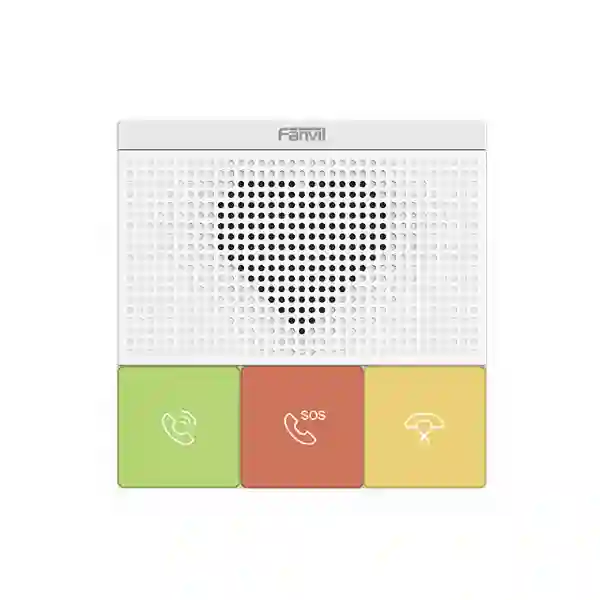
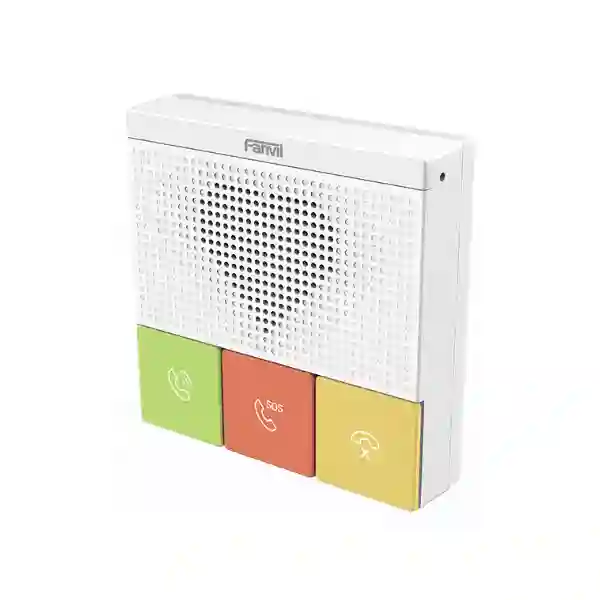
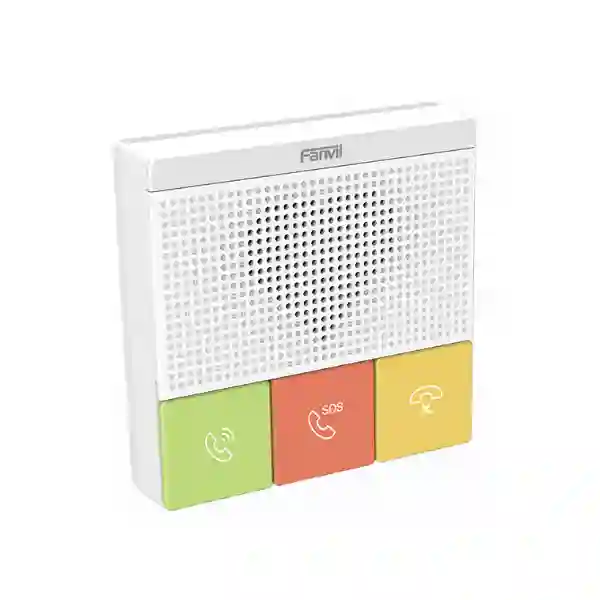
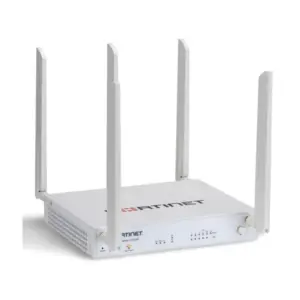
Fanvil Y501W Wi-Fi Healthcare Intercom
The Fanvil Y501W is a purpose-built indoor SIP healthcare intercom designed for environments where patients, residents or staff need a simple way to initiate voice communication and where administrators need a standards-based IP endpoint that can fit into a wider nurse-call, VoIP or facility communication design. Fanvil documents two SIP lines, HD audio, built-in dual-band 2.4 GHz and 5 GHz Wi-Fi, PoE and DC power options, three detachable function buttons, IP54 protection, support for compatible 433 MHz wireless buttons, one short-circuit input and an integrated relay. For buyers in Tanzania, the practical value is flexibility: the Y501W can join a wired Ethernet/PoE network or use supported Wi-Fi connectivity while retaining SIP-based call integration.
This page focuses on verified product capabilities and real deployment questions rather than assuming that every healthcare site has the same PBX, wireless coverage, cabling or emergency workflow. Before purchase, confirm where the unit will be mounted, which SIP platform will receive calls, whether the Wi-Fi network has reliable coverage at bedside or washroom locations, whether PoE or local DC power is preferred, which optional wireless call buttons are required, and how relay or alarm-input functions will be used. For broader voice-system planning, review FourTeck Tanzania’s integrated IT and telecom solutions, business technology shop and technology services.
What the Fanvil Y501W is designed to solve
Healthcare intercoms have a different job from ordinary office telephones. The user may have limited mobility, may need to call for assistance quickly, or may be interacting with the endpoint in a room where simple controls matter more than a large screen. The Y501W is part of Fanvil’s Y501 healthcare family and is positioned for indoor home-care, nursing and similar environments. Its front controls are intentionally straightforward, while SIP support enables connection to a compatible communications platform. The device can form part of a broader nurse-call architecture that includes Fanvil nurse-station products, corridor indicators and compatible wired or wireless call accessories, but those elements should be scoped as a system rather than assumed to be included with the intercom.
Dual-band Wi-Fi
The Y501W supports 2.4 GHz and 5 GHz Wi-Fi, useful where pulling a dedicated data cable to every intercom location is difficult. Coverage, VLAN design and signal quality still need validation at the exact mounting point.
SIP healthcare endpoint
Two SIP lines allow the unit to register to compatible SIP infrastructure. Call routing, priorities, extension plans and nurse-station behavior are determined by the surrounding system configuration.
HD audio
Fanvil specifies wideband audio including G.722 and Opus plus full-duplex acoustic echo cancellation and noise-processing functions for clear two-way intercom communication.
Healthcare accessory support
Compatible 433 MHz wireless call buttons can extend the call point beyond the wall unit. Accessory model, quantity, range and workflow should be verified for each room layout.
Verified technical highlights
| SIP | 2 SIP lines; SIP 2.0 over UDP/TCP/TLS | Audio | HD voice with G.722 and Opus; full-duplex AEC |
| Network | 10/100 Mbps Ethernet; IPv4/IPv6; VLAN; QoS | Wi-Fi | 2.4 GHz and 5 GHz on Y501W |
| Power | PoE or 12 V DC | Protection | IP54; indoor deployment |
| Controls | 3 detachable function/DSS buttons on Y501W | Wireless call buttons | Compatible 433 MHz wireless-button support |
| I/O | 1 short-circuit input and integrated relay output | Management | Web management, auto provisioning, firmware upgrade, logs and configuration import/export |
Deployment, integration and buying guidance
The most important design decision is not simply whether the Y501W has Wi-Fi; it is how the endpoint will participate in the facility’s communication workflow. A typical project should identify the destination for normal calls, emergency calls and any secondary function keys, then map those destinations to SIP extensions, groups, nurse stations or other compatible endpoints. Wi-Fi operation should be tested in the actual room because healthcare buildings may contain reinforced walls, tiled wet areas, service shafts or medical equipment that changes radio conditions. Where Ethernet is available, PoE can simplify power and network delivery; where Wi-Fi is preferred, power is still required and the local electrical design needs to be considered.
For network preparation, see FourTeck Tanzania’s Wi-Fi SIP endpoint example, PoE SIP endpoint example, standard SIP phone example, multi-account SIP phone example and Gigabit business phone example. These products are not substitutes for the healthcare intercom; they illustrate related SIP, PoE, Wi-Fi and endpoint-planning considerations that can matter when the same IP network carries both general telephony and healthcare communication.
Fanvil Y501W Wi-Fi Healthcare Intercom Tanzania
For organizations evaluating the Fanvil Y501W Wi-Fi Healthcare Intercom in Tanzania, the starting point should be the care workflow rather than a device-only specification. Hospitals, clinics, assisted-living facilities, residential care sites and home-care environments can have very different escalation paths. A bedside call may need to ring a nurse console, a reception extension, a ward phone or a defined SIP group. A toilet or washroom call may require a different priority, optional pull-cord or wireless accessory, and a visible indication outside the room. Before requesting a quotation, list the number of rooms, the number of call points per room, whether each endpoint will use Ethernet or Wi-Fi, the intended power source, and the SIP platform already in use. This provides a more accurate basis for device quantity, PoE capacity, access-point coverage and any accessory requirements.
Tanzania deployments also benefit from careful infrastructure planning. Wi-Fi is convenient, but a healthcare intercom should not be placed on a poorly designed guest network or an overloaded access point. The 2.4 GHz band may offer better reach in some buildings, while 5 GHz can provide more channel capacity where coverage is strong. The correct choice depends on site measurements and access-point design. If PoE is used, confirm switch port availability and total power budget. If DC power is used, plan safe, accessible power near the installation point. SIP signaling, RTP media, VLANs, QoS and firewall rules should be tested end to end so an endpoint can place and receive calls predictably. Administrators should also document extension names, room labels, button assignments and provisioning settings.
Procurement teams in Tanzania should avoid assuming that optional wireless buttons, nurse-console components, corridor lights, mounts, power adapters or integration services are included unless the quotation states them explicitly. The Y501W supports compatible 433 MHz wireless buttons and can participate in Fanvil’s broader nurse-call ecosystem, but system architecture should be matched to the facility. A sensible tender or RFQ should include room schedules, floor plans where available, expected call flows, PBX details, Wi-Fi coverage information, switch models, required accessories, installation method and the desired level of configuration or support. FourTeck Tanzania’s contact and quotation page can be used to submit that scope for review.
Fanvil Y501W Wi-Fi Healthcare Intercom Dar es Salaam
Dar es Salaam healthcare and assisted-care projects often involve multi-floor buildings, busy reception areas, dense wireless environments and a mix of new and existing network infrastructure. For a Fanvil Y501W deployment, those conditions make survey work important. A unit installed in a patient room may be only a few metres from an access point yet still experience poor radio performance because of concrete walls, bathrooms, service risers, metal equipment or neighboring wireless networks. A room-by-room Wi-Fi plan is more useful than assuming that general staff Wi-Fi coverage automatically guarantees reliable intercom connectivity. Where structured cabling already reaches the room, Ethernet and PoE can provide a simple alternative; where cabling is difficult, the Y501W’s dual-band Wi-Fi offers design flexibility.
The call workflow should be mapped around how the facility actually operates. A clinic may route assistance calls to reception during the day and another extension after hours. A hospital ward may need different call destinations by floor, department or shift. A care residence may want simple one-touch communication with a staffed desk. The Y501W supports SIP, which makes these designs possible when the PBX or nurse-call system is configured appropriately, but the device itself does not decide the operational policy. Button labels, extension naming, call groups and escalation rules should be agreed before rollout. For sites using compatible 433 MHz call buttons, placement and user training should be included in commissioning.
A Dar es Salaam quotation should therefore separate hardware from deployment scope. Request the exact Y501W quantity, compatible wireless accessories if needed, power method, mounting requirements, network switches, access-point additions, PBX licensing if applicable, configuration, testing and user handover as separate line items. This makes it easier for procurement and clinical stakeholders to understand what creates a complete working system. Businesses coordinating general IT at the same facility can also use FourTeck Tanzania’s shop and service pages to review switching, Wi-Fi and voice infrastructure that may support the intercom network.
Fanvil Y501W Wi-Fi Healthcare Intercom Mwanza
In Mwanza, organizations considering the Fanvil Y501W may be planning a new care facility, upgrading an analog call system, expanding an existing SIP environment or adding communication points to a clinic or residential-care property. Each scenario requires a different migration plan. In a new build, structured cabling, PoE switching and Wi-Fi access-point placement can be designed before finishes are complete. In an existing building, the Y501W’s wireless capability can reduce the need for new data cabling at selected locations, but reliable power and strong Wi-Fi coverage are still essential. A site survey should identify where wired and wireless approaches make the most operational and economic sense instead of forcing one connectivity method everywhere.
For voice integration, the Y501W should be treated as a SIP endpoint with healthcare-focused controls. Confirm the PBX address, registration method, codecs, call destinations, caller identification format and any VLAN or QoS requirements. If the facility wants an emergency button to call multiple staff members, that behavior is usually implemented through PBX or nurse-call routing rather than by simply programming the endpoint in isolation. Test failure scenarios as well: what happens if the Wi-Fi connection is lost, if the SIP server is unavailable, or if power is interrupted? The answers determine whether extra redundancy, UPS protection, monitoring or alternative call paths are needed.
Mwanza buyers should also consider maintenance. Document every installed unit by room, MAC address or asset identifier, SIP extension, Wi-Fi profile, firmware version and button assignment. Centralized provisioning can simplify configuration when many endpoints use the same template, while web management and logs can support troubleshooting. A pilot deployment in a representative room or ward can expose radio, audio or workflow issues before a larger rollout. When requesting pricing, provide room count, floor plan, existing PBX information, switch and access-point details, required accessories, installation method and support expectations so the proposal reflects the actual project rather than only the unit price.
Fanvil Y501W Wi-Fi Healthcare Intercom Arusha
Arusha has a varied mix of healthcare, hospitality-linked medical services, residential care and institutional environments where a compact SIP intercom can be useful. The Fanvil Y501W is most appropriate when the project needs simple wall-mounted patient or resident communication, standards-based SIP calling and the option to use either Ethernet or dual-band Wi-Fi. The product should not be selected only because Wi-Fi is available. First establish the response workflow: who answers a normal call, who handles an urgent call, whether staff need room identification on the receiving device, and whether the facility wants supplementary wireless call buttons. Those questions determine PBX configuration and the supporting nurse-call design.
In buildings with guest Wi-Fi, staff Wi-Fi and operational networks, the healthcare intercom should normally be planned as a managed operational endpoint rather than placed on an open or captive-portal guest SSID. Stable addressing, VLAN policy, authentication, QoS and firewall rules can help make SIP behavior predictable. The Y501W supports common enterprise networking functions, but the surrounding WLAN and switching environment must be designed consistently. Where 5 GHz coverage is strong it can reduce congestion; where room construction attenuates higher frequencies, 2.4 GHz may be more practical. The appropriate band should be confirmed through real coverage testing.
For Arusha procurement, ask suppliers to identify exactly what is included: Y501W hardware, power supply if required, mounting, wireless call buttons, any nurse-station device, licenses, configuration, testing and documentation. Avoid comparing quotations only on the intercom’s unit price if one proposal includes network or commissioning work and another does not. A useful handover should include extension maps, admin access procedures, backup configuration, firmware policy, wireless settings and basic user guidance. This allows the site to maintain the system after installation and makes later expansion to additional rooms easier.
Fanvil Y501W Wi-Fi Healthcare Intercom Dodoma
Dodoma organizations may use the Fanvil Y501W in hospitals, clinics, institutional accommodation, assisted-care facilities or other indoor environments where a fixed wall intercom needs to connect users quickly to staff. Because the endpoint supports two SIP lines, organizations can design flexible registration or routing arrangements where the chosen PBX supports them. The key requirement is to define the operational process before programming. Room labels, call destinations, after-hours handling and the meaning of each detachable button should be documented so the physical interface matches staff procedures and patient expectations.
Government, institutional and larger private projects in Dodoma may also have formal network standards. If the intercom is joining an existing enterprise LAN, IT teams should review VLAN assignment, IP addressing, switch port settings, PoE budget, QoS and security policy. If Wi-Fi is used, the SSID should provide stable access without browser-based authentication, and coverage should be validated at each mounting position. The Y501W supports web management and provisioning options that can make larger deployments more repeatable. Templates should nevertheless be tested on a limited number of endpoints before being rolled out widely, especially where button behavior, SIP security or network authentication is involved.
A well-prepared Dodoma RFQ should include quantity by building and floor, the intended mounting method, whether PoE or DC will be used, PBX make and version, Wi-Fi and switch infrastructure, required 433 MHz accessories, alarm or relay integration, and whether installation and commissioning are part of the request. The Y501W’s IP54 rating supports indoor environments where some splash and dust resistance is useful, but it should not be treated as an outdoor weatherproof intercom. Clear scope documents reduce model confusion and help ensure the quoted system fits the real site.
Fanvil Y501W Wi-Fi Healthcare Intercom UAE
For UAE healthcare and care-facility projects, the Fanvil Y501W can fit projects that need a compact SIP endpoint with dual-band Wi-Fi, PoE capability, HD audio and healthcare-oriented call controls. Multi-site groups operating in both Tanzania and the UAE may benefit from standardizing naming conventions, provisioning templates and PBX call flows while allowing each facility to use the network design that suits its building. Standardization should focus on repeatable configuration and documentation rather than assuming identical access-point placement, switch capacity or local telecom conditions in every country.
Enterprise facilities in the UAE frequently have segmented wireless networks and centralized infrastructure, so coordination with the network team is important. The Y501W can support VLAN, QoS and secure SIP-related functions, but those features must align with the PBX, switches, WLAN controllers and certificate policies already in place. PoE can simplify rack-based power continuity when switches are protected by UPS systems, while Wi-Fi can be helpful in retrofit areas where new cabling is disruptive. For high-dependency care workflows, resilience, monitoring and alternative communication paths should be discussed as part of the wider system design rather than inferred from the endpoint alone.
FourTeck’s verified UAE IT, telecom and security site provides regional project context. When requesting a Y501W quotation for a UAE branch or facility, include room count, nurse-station or PBX platform, call priorities, network standards, Wi-Fi security method, PoE availability, accessory requirements and commissioning expectations. If the organization has a multi-country procurement program, use a common specification sheet that distinguishes global endpoint requirements from country-specific installation, network and support scope.
Fanvil Y501W Wi-Fi Healthcare Intercom Uganda
Ugandan healthcare providers, clinics and care facilities evaluating the Fanvil Y501W should begin by deciding whether the device is being added to an existing SIP environment or used as part of a new healthcare communication design. Existing systems require compatibility validation: confirm registration, codecs, transfer behavior, call routing and any nurse-console integration before purchasing a large quantity. New systems give the design team more freedom to coordinate switches, access points, PBX capacity and room call workflows from the start. In either case, the Y501W’s Wi-Fi capability can make retrofit locations easier, but it does not remove the need for dependable power, strong coverage and controlled network access.
Facilities with multiple buildings or branches can benefit from consistent provisioning. Assign room-based extension names, create standard button templates, use predictable VLANs and document firmware versions. If compatible 433 MHz wireless buttons are used, assign each accessory to a room record and test it from realistic positions before handover. Staff should know what visual or audio feedback indicates that a call has been initiated and who is expected to respond. Operational training matters because a technically successful SIP registration is not the same as a complete care workflow.
FourTeck’s verified Uganda IT and VoIP site can support regional context for organizations coordinating projects across East Africa. An Uganda RFQ should state the number of Y501W units, accessory requirements, PBX or nurse-call platform, Wi-Fi and switching details, power method, room schedule, installation scope and desired testing. This makes it possible to compare proposals on a full solution basis and reduces the chance that small but essential components are omitted from the bill of materials.
Fanvil Y501W Wi-Fi Healthcare Intercom Kampala
Kampala facilities can have dense Wi-Fi usage, multi-floor buildings and mixed generations of network infrastructure. A Fanvil Y501W project should therefore include both voice-system design and radio planning. If a hospital already has strong enterprise Wi-Fi, the intercom can be placed on an operational SSID with suitable security and QoS policies. If coverage was designed mainly for laptops and phones in corridors, bedside or washroom signal levels may be weaker than expected. A survey should test the exact installation points, especially behind closed doors or in rooms with tiled surfaces and dense construction.
The Y501W provides three detachable function buttons and can support compatible wireless call buttons. Those controls should be mapped to a defined response process. For example, one site may use a general assistance button, another may want separate destinations or priorities. Such behavior depends on endpoint programming and PBX or nurse-call configuration, so stakeholders from nursing, facilities and IT should agree the workflow before deployment. This is also the right stage to decide whether corridor indicators, nurse-console products or additional endpoints are required.
Procurement in Kampala should ask for a room-by-room quantity schedule and clear separation of mandatory versus optional components. Confirm whether the quote includes PoE switch capacity, DC adapters, mounting, wireless accessories, PBX licenses, configuration, training and support. If the device will share infrastructure with general voice, data and CCTV, network capacity and VLAN design should be reviewed together. A small pilot can verify audio quality, roaming behavior where relevant, SIP registration recovery and staff response workflows before the remaining rooms are equipped.
Fanvil Y501W Wi-Fi Healthcare Intercom Arua
For Arua healthcare or residential-care sites, a compact Wi-Fi-capable healthcare intercom can be attractive when new cabling is difficult or when a building is being upgraded in phases. The Fanvil Y501W provides that flexibility, but site planners should distinguish network convenience from system reliability. Each endpoint still requires power, a reachable SIP service and a stable path to the staff who answer calls. Before choosing wireless operation, test coverage at every intended room and identify how the access-point infrastructure is powered during interruptions. Where Ethernet can be installed economically, PoE may offer a more centralized power approach.
Arua projects may also benefit from simple, supportable configurations. Use consistent extension naming, minimize unnecessary network complexity and document the configuration so local staff or remote support personnel can identify each unit quickly. Fanvil’s provisioning and web-management options can reduce repetitive setup, but templates should be backed up and version controlled. Optional wireless call buttons should be tested for real-world range within the room, and staff should be trained on how to identify and respond to the originating location.
When seeking a quotation, provide building details, number of rooms, existing internet and LAN infrastructure, PBX information, preferred power method and accessory needs. If the facility has unreliable connectivity between buildings, clarify whether the SIP server is local or remote and how calls are expected to behave during WAN disruption. These questions help determine whether the Y501W is appropriate by itself or whether additional local communications infrastructure is required. A complete proposal should make those dependencies visible rather than presenting the healthcare intercom as a standalone emergency system with no network requirements.
Fanvil Y501W Wi-Fi Healthcare Intercom Mbarara
Mbarara organizations considering the Fanvil Y501W can use it as an IP-based bedside or care-area communication point where SIP calling and simple user controls are appropriate. The project should identify whether the device is replacing an existing analog call point, extending a VoIP environment or forming part of a larger nurse-call solution. Replacement projects need special care because existing cabling, power and workflow assumptions may not translate directly to an IP endpoint. An old two-wire nurse-call circuit cannot simply be assumed to support Ethernet, PoE or SIP without redesign.
Where Wi-Fi is selected, the endpoint can avoid new data cabling but still needs an engineered wireless network. Confirm SSID coverage, authentication method, IP addressing and access to the SIP server. Where Ethernet is selected, confirm switch ports, VLAN configuration and PoE budget. The device’s IP54 protection is useful for indoor clinical or care environments where dust or incidental splashes may occur, yet installation should still follow Fanvil’s indoor-use guidance. Relay and short-circuit input functions should be documented carefully if they are integrated with alarms, indicators or external buttons.
A Mbarara purchasing checklist should include Y501W quantity, room map, mounting style, accessory models, PBX details, required call destinations, network method, power method, configuration and user training. Organizations with several sites should also define who owns ongoing administration: the clinical engineering team, facilities, IT or an external support provider. Clear ownership matters because firmware, Wi-Fi changes, extension credentials and network policy can affect operation. Including lifecycle responsibility in the original proposal helps avoid a system that works at installation but becomes difficult to manage later.
Fanvil Y501W Wi-Fi Healthcare Intercom Gulu
Gulu healthcare facilities may need communications that can be expanded gradually as wards, consultation rooms or care areas are added. The Fanvil Y501W’s SIP architecture can support a modular approach when the PBX and network are sized for growth. Instead of treating every room as a separate custom installation, the project can establish a standard endpoint profile covering SIP server settings, room naming, button assignments, Wi-Fi or VLAN parameters and firmware. New units can then be added using the same tested template, reducing configuration differences across the site.
Growth planning should include the wireless and switching layers. Additional Wi-Fi endpoints increase client density even if each intercom uses modest bandwidth, and access points need enough coverage and capacity for the wider mix of devices. PoE deployments require spare switch ports and power budget. SIP systems require sufficient extension licenses or platform capacity. If a nurse console or central answering point is used, its workflow must remain manageable as the number of rooms grows. A system that works well for ten rooms may need revised call groups or staffing procedures at fifty rooms.
For Gulu procurement, request a bill of materials that identifies endpoint hardware, accessories, network additions, PBX requirements, configuration, testing and documentation. Ask how replacement units will be provisioned and how settings will be backed up. If a remote support model is expected, ensure administrators can securely reach the device management interfaces without exposing them directly to the public internet. A staged rollout can begin with representative rooms, capture feedback from staff, refine button labels and call flows, then expand once the operational design is proven.
Fanvil Y501W Wi-Fi Healthcare Intercom Kenya
Kenyan buyers searching for the Fanvil Y501W often compare it with ordinary SIP intercoms and with more specialized nurse-call systems. The correct choice depends on whether the project needs a simple SIP communication point, a wider Fanvil nurse-call workflow, or integration with an existing communications platform. The Y501W combines healthcare-focused controls with standard IP networking, dual-band Wi-Fi, HD audio and PoE support. That makes it flexible, but it should be assessed as part of a complete room-to-staff communication path. Verify what happens after a user presses the button, how the receiving staff member identifies the room, and what the fallback is if the primary destination does not answer.
Network planning in Kenya follows the same practical principles as Tanzania: test wireless coverage rather than relying on assumptions, use managed VLAN and QoS policies where appropriate, and coordinate PoE with switch capacity. If many endpoints are deployed, centralized provisioning can reduce manual setup. Hospitals and care facilities should also consider physical cleaning routines, button labeling, user accessibility and whether optional wireless call buttons are needed for users who cannot easily reach the wall unit. Any third-party integration should be validated against the exact interface and desired workflow.
FourTeck’s verified Kenya IT and VoIP site provides regional context. A quotation request should list unit count, site locations, PBX or nurse-call platform, Wi-Fi design, Ethernet/PoE availability, accessory needs, mounting method and installation scope. Buyers should compare what is included rather than only published unit prices, because accessories, licensing, configuration and network upgrades can materially affect the complete deployed cost.
Fanvil Y501W Wi-Fi Healthcare Intercom Kuwait
Kuwait healthcare and assisted-care environments evaluating the Fanvil Y501W may prioritize standardized IP infrastructure, centralized management and dependable indoor communication. The device can register to compatible SIP platforms and operate through Ethernet or dual-band Wi-Fi, allowing different building areas to use the most practical connectivity method. In a new facility, designers can reserve PoE switch capacity and structured cabling for each room. In retrofit areas, Wi-Fi may reduce construction disruption, provided the radio environment is verified and the endpoint has a reliable power source.
Security and management should be included in the architecture. SIP over TLS and SRTP support can contribute to protected signaling and media when the PBX and certificates are configured correctly. Management access should be restricted to trusted networks, credentials should be controlled and firmware should be maintained through a documented process. If the healthcare organization has strict network-access policies, validate 802.1X or other authentication requirements with the actual switch/WLAN environment before rollout. The presence of a supported protocol in a datasheet does not replace system testing.
For regional planning, the verified FourTeck Kuwait site can support related technology discussions. Kuwait buyers should send room quantities, system topology, desired call behavior, accessory list, PoE or DC preference, Wi-Fi security method and commissioning scope with the RFQ. Multi-country organizations can keep the endpoint configuration standard while adapting radio channels, network addressing and local operational processes to each facility. This approach simplifies documentation without assuming every site is technically identical.
Fanvil Y501W Wi-Fi Healthcare Intercom Ghana
Ghanaian clinics, care homes and healthcare providers can consider the Fanvil Y501W where SIP-based voice communication and straightforward user controls fit the care model. The endpoint is especially relevant when a facility already uses VoIP or intends to consolidate voice devices on an IP network. Two SIP lines provide registration flexibility, while Wi-Fi can simplify certain retrofit locations. However, the intercom should not be placed on an uncontrolled wireless network or treated as independent of the PBX. Call routing, room identification and staff response depend on the complete communication platform.
A Ghana deployment should assess power quality and continuity along with network connectivity. PoE can centralize power when supported by suitable switches and UPS systems. DC operation can be practical for individual rooms but distributes power dependencies across the building. Wi-Fi access points and switches should themselves be protected according to the facility’s continuity requirements. For optional 433 MHz call buttons, confirm their intended placement, pairing and room mapping. Relay or input integrations should be tested with the actual external device rather than inferred from a generic electrical specification.
The verified FourTeck Ghana site provides related regional IT context. Procurement teams should request a proposal that separates hardware, accessories, licenses if any, installation, network work, configuration, testing and support. Include a floor plan or room schedule where possible. This allows suppliers to identify whether additional access points, PoE ports or SIP capacity are necessary and gives the buyer a clearer total-cost picture than a unit-only quote.
Fanvil Y501W Wi-Fi Healthcare Intercom Nigeria
Nigeria’s healthcare market spans small clinics, specialist centers, hospitals, residential-care environments and multi-site groups, so the Fanvil Y501W should be matched to the scale and operating model of each project. For a small site, a few SIP intercoms may route directly to a reception or nursing extension. A larger hospital may require structured call groups, nurse consoles, corridor indicators and more formal escalation. The Y501W can be an endpoint in those designs, but the overall solution must be engineered so staff can identify, prioritize and respond to calls consistently.
Network resilience is especially important for any IP-based care communication. If Wi-Fi is used, evaluate coverage, interference, access-point redundancy and the effect of power loss. If Ethernet/PoE is used, evaluate switch redundancy, UPS runtime and uplinks. SIP services hosted remotely depend on WAN availability unless a local platform or survivability strategy is provided. The right architecture depends on how critical the call function is to the facility. Buyers should explicitly state required availability and response expectations so the design can be assessed against them rather than assuming consumer-style Wi-Fi is sufficient.
The verified FourTeck Nigeria site provides related regional project context. Nigerian procurement teams should include exact site count, rooms, current PBX, internet/WAN design, switches, Wi-Fi controllers or access points, power arrangements, wireless-button quantities and integration requirements in the RFQ. A pilot in one ward or floor is often a practical way to validate audio, radio behavior, button mapping and staff workflow before scaling to a larger number of endpoints.
Fanvil Y501W Wi-Fi Healthcare Intercom Seychelles
Seychelles healthcare, assisted-living and hospitality-linked care environments may have smaller sites but still require dependable communication between rooms and staff. The Fanvil Y501W is attractive where a compact wall-mounted SIP intercom and Wi-Fi flexibility are more suitable than a full desk telephone. Building layout can strongly influence design: concrete construction, multiple levels and isolated guest or care rooms may create wireless coverage pockets. A site survey should therefore validate signal levels at the precise mounting locations and ensure the operational SSID reaches every endpoint consistently.
For island facilities or organizations with limited on-site IT resources, manageability is particularly important. Standardize configuration, keep backups, record extension-to-room mappings and define a firmware process. If remote administration is required, use secure methods through the organization’s network rather than exposing web interfaces directly to the internet. Optional wireless call buttons can improve accessibility for users who may not be able to reach the wall unit, but their placement and range should be tested in each room. Staff training should cover both normal operation and what to do if an endpoint indicates a network or registration problem.
A Seychelles quotation should include hardware quantity, room schedule, PBX or nurse-call integration, Wi-Fi and power design, accessories, mounting, configuration, commissioning and documentation. Buyers should also clarify spares strategy because replacing an endpoint quickly may be more important than waiting for a new unit after a fault. Keeping one preconfigured or easily provisioned spare can be useful for larger deployments, subject to the organization’s procurement and maintenance policy. The goal is a system that remains understandable and supportable after the initial installation.
Related products and infrastructure considerations
The Y501W sits at the intersection of healthcare communication, SIP telephony, Wi-Fi and PoE networking. It therefore benefits from the same disciplined infrastructure planning used for other business voice endpoints. On FourTeck Tanzania, the Dinstar C62UP PoE business phone illustrates a PoE-powered SIP endpoint, while the Dinstar C60U-W Wi-Fi IP phone illustrates wireless voice-endpoint considerations. These are not healthcare substitutes; they are useful internal references for PBX, PoE, Wi-Fi and provisioning discussions when a facility is designing one converged voice network.
A complete Y501W project may also require managed switches, business wireless access points, UPS protection, firewall configuration, structured cabling and PBX licensing or nurse-call components. Those requirements depend on the existing site, so they should be confirmed during design rather than bundled by assumption. FourTeck Tanzania’s services page describes a coordinated approach to networking, Wi-Fi, IP telephony and infrastructure, which is particularly relevant when the healthcare intercom will share the same LAN as other operational systems.
Fanvil Y501W quotation checklist
List each room, bedside, washroom or care point and identify how many intercoms are required.
Provide PBX, nurse console or SIP server brand, version and the intended call-routing behavior.
State whether each unit will use Ethernet/PoE or Wi-Fi and provide switch or WLAN details where known.
Identify required 433 MHz wireless buttons, corridor lights or other nurse-call components separately.
Confirm wall-mount position, available power, cable route and any building constraints.
Specify whether you need supply only, configuration, installation, testing, training, documentation or ongoing support.
Frequently asked questions
Does the Fanvil Y501W support Wi-Fi?
Yes. Fanvil specifies built-in 2.4 GHz and 5 GHz Wi-Fi for the Y501W. Wireless coverage and authentication should be validated at the installation point.
Can the Y501W use PoE?
Yes. The Y501 series supports PoE, and Fanvil also specifies 12 V DC power. Choose the power method based on switch capacity, cabling and continuity requirements.
How many SIP accounts does the Y501W support?
Fanvil specifies two SIP lines. The exact call routing and registration design depends on the PBX or nurse-call platform.
Does it support wireless emergency or call buttons?
The Y501 family supports compatible 433 MHz wireless buttons. Confirm the accessory model, quantity and intended use in the quotation because accessories are separate system components.
Is the Y501W an outdoor intercom?
Fanvil positions it for indoor installation. Its IP54 rating provides dust and splash protection, but it should not be treated as a general outdoor weatherproof intercom.
Can it work with an existing IP PBX?
It uses SIP, so it can integrate with compatible SIP platforms. The exact PBX version, registration, codecs, TLS/SRTP settings, call features and provisioning behavior should be validated before a large rollout.
Decision recap
Choose the Fanvil Y501W when the project needs a compact indoor healthcare-focused SIP intercom with HD audio, dual-band Wi-Fi, PoE/DC flexibility, simple detachable function buttons and support for compatible 433 MHz call accessories. Before finalizing, verify the complete care workflow, PBX compatibility, Wi-Fi or Ethernet design, power continuity, accessory list and installation scope. For facilities with several rooms, a pilot and standardized provisioning plan can reduce risk and simplify future expansion.
Consult FourTeck Tanzania
Send FourTeck Tanzania the number of rooms, desired call workflow, existing PBX or nurse-call platform, switch and Wi-Fi information, required wireless buttons and whether you need supply only or installation/configuration. The more complete the scope, the easier it is to distinguish endpoint cost from the network, power, licensing and commissioning work needed for a functioning system.


Reviews
There are no reviews yet.