
Fanvil A10W Wi-Fi SIP Mini Intercom
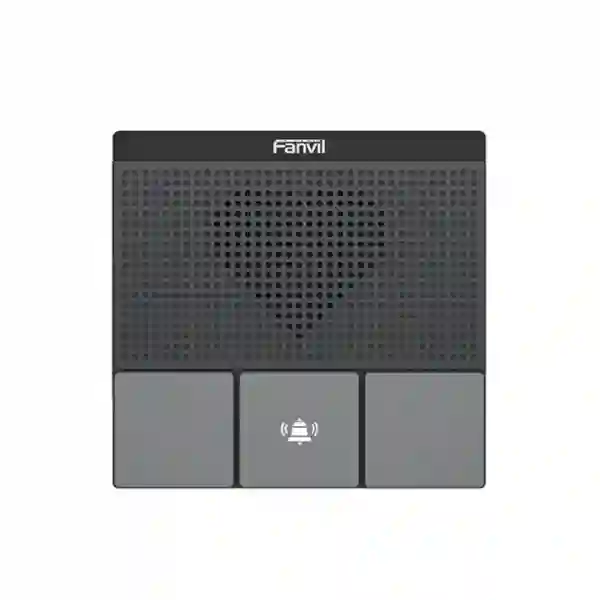
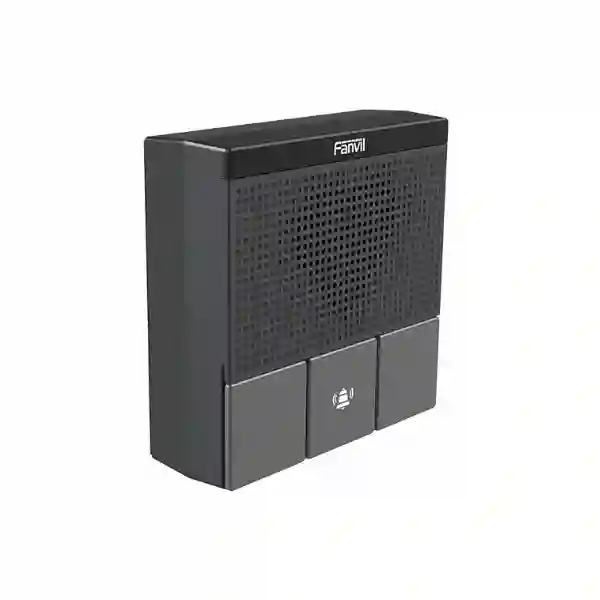
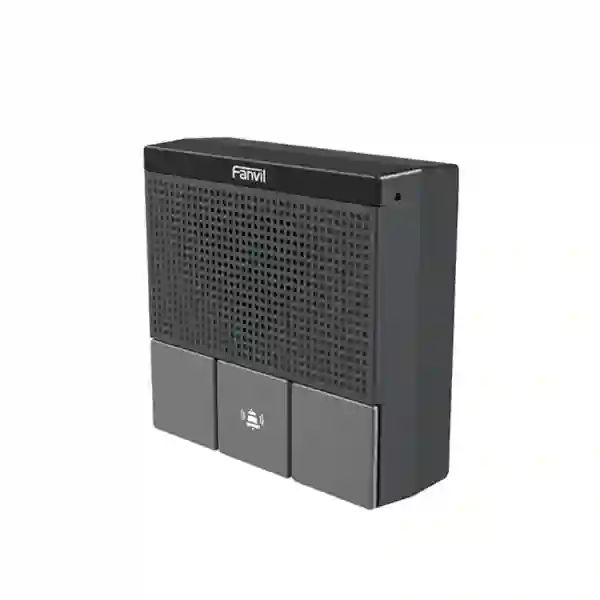
The Fanvil A10W Wi-Fi SIP Mini Intercom is a compact indoor SIP communication endpoint for security, intercom and broadcasting scenarios where a business needs clear two-way audio, programmable calling actions and flexible network access. Fanvil specifies two SIP accounts, three detachable customizable function buttons, HD audio with G.722 and Opus, a built-in 2W speaker, acoustic echo cancellation, 10/100 Mbps Ethernet, PoE and dual-band 2.4 GHz/5 GHz Wi-Fi for the A10W model. The unit is wall mountable and carries an IP54 dust-and-water protection rating. For organisations in Tanzania, the practical value is the ability to deploy an intercom at a reception point, controlled doorway, service counter, security desk, staff area or other indoor communications position while choosing wired Ethernet, PoE or Wi-Fi according to the site design.
What the Fanvil A10W is designed to do
Fanvil positions the A10 series as SIP mini intercoms for indoor scenes that combine security, intercom and broadcasting functions. The A10W adds wireless connectivity to the wall-mounted A10 form factor. This makes it relevant to projects where an intercom must register to a SIP platform and provide simple, repeatable calling actions without the size or complexity of a full desk phone. Two SIP accounts allow the endpoint to participate in a standards-based voice environment, while three detachable function buttons can be mapped to practical tasks such as calling a security desk, reception, supervisor or service team, subject to the final PBX configuration.
The device uses full-duplex audio with acoustic echo cancellation and supports wideband codecs including G.722 and Opus. That matters at a doorway or counter because users often speak from a short distance rather than holding a handset. The built-in speaker, microphone processing, packet-loss concealment, jitter handling, voice activity detection and comfort-noise functions are designed to support intelligible IP voice, although real call quality still depends on the PBX, LAN, Wi-Fi conditions, codec negotiation and upstream connectivity. The A10W is not a substitute for good network design.
Because the model supports both Ethernet and Wi-Fi, it can be considered in new deployments and retrofit situations. Ethernet with PoE is typically attractive when a cable is available because power and data can be delivered through the network connection. Wi-Fi can reduce data-cabling dependence where radio coverage is stable, but local power is still required when PoE is not used. The best method should therefore be selected from the site conditions rather than from convenience alone.
Verified technical highlights
The A10W supports two SIP lines using SIP 2.0 over UDP, TCP or TLS; HD audio through G.722 and Opus; 10/100 Mbps Ethernet; IPv4 and IPv6; DHCP, static IP, PPPoE, VLAN, LLDP and QoS; dual-band Wi-Fi with 2.4 GHz 802.11 b/g/n and 5 GHz 802.11 a/n; security options including TLS, SRTP, OpenVPN and L2TP; one short-circuit input; one relay output; PoE and supported DC power; wall mounting; and an IP54-rated enclosure. These functions should be matched to the PBX, switching, WLAN and access-control design rather than assumed to work identically in every environment.
Compatibility, relay integration and deployment planning
The A10W can be part of an IP PBX, SIP security, access-control or service-call design, but procurement should begin with the intended workflow. Decide who the intercom must call, whether one button or several buttons should dial different destinations, what happens when the destination is busy, whether calls should overflow to another extension, and whether the relay output or input will participate in a broader access-control sequence. A SIP registration proves basic connectivity; it does not guarantee that every PBX feature or automation behaves identically on every platform. For a multi-unit rollout, a pilot installation is a sensible way to validate registration, dial plans, DTMF, relay behavior, audio levels and provisioning.
Network planning is equally important. If using PoE, confirm the switch standard, available power budget and cable run. If using Wi-Fi, test both signal strength and channel quality at the intended mounting position rather than relying on coverage measured in the middle of the room. Security teams should decide whether the device will sit in a dedicated voice or IoT VLAN, which systems it may reach, and how SIP TLS, SRTP, 802.1X or VPN capabilities fit the wider policy. Documentation should record the device name, SIP account, IP addressing method, VLAN, button assignments, relay wiring and firmware baseline.
Related FourTeck resources
For broader procurement, see the FourTeck Tanzania shop for IP telephony, networking and infrastructure, the Dinstar C60U-W Wi-Fi IP Phone for a complementary user endpoint, and the main FourTeck Tanzania technology portal for business IT solutions. Regional buyers can also use FourTeck UAE, FourTeck Uganda, FourTeck Kenya, FourTeck Ghana, FourTeck Nigeria and FourTeck Kuwait when coordinating multi-country technology requirements.
Fanvil A10W Wi-Fi SIP Mini Intercom Tanzania
For Tanzanian organisations, the Fanvil A10W is most useful when the requirement is defined as a compact indoor communication point rather than a conventional office telephone. A reception entrance, internal controlled door, security room, warehouse office, service hatch, clinic staff area or back-of-house hospitality location may need a clear way for a visitor or employee to reach a designated extension without exposing a full keypad or desk-phone interface. The A10W’s three configurable buttons support this simplified interaction. Two SIP accounts can also provide flexibility when the design requires more than one registration or service identity.
Tanzania deployments should treat connectivity as a design choice. In a newly cabled office, PoE over Ethernet can be attractive because data and power are managed centrally and the switch can be protected by UPS. In an existing building where adding a new data cable is difficult, the A10W’s dual-band Wi-Fi may reduce cabling work, provided a dependable power source is available at the mounting point. Wireless should be surveyed at the actual installation position. Concrete walls, metal doors, electrical rooms, lift shafts and dense neighbouring Wi-Fi can all change signal quality. A device that connects during a quick test may still experience unstable voice if the radio environment is congested.
Procurement teams should also decide whether the relay output and short-circuit input are needed. If the intercom is expected to interact with a lock, door controller, sensor or external event, the electrical design must be reviewed by the installer. The A10W should not be purchased on the assumption that a relay alone completes an access-control system. Locks, power supplies, emergency release, door contacts, life-safety rules and access policies may require separate components and engineering. For voice integration, confirm the PBX platform, SIP transport, codec policy and DTMF method.
A strong Tanzania quotation request should therefore include quantity, site type, mounting location, PBX brand and version, required button actions, Ethernet or Wi-Fi preference, PoE availability, local power, relay/input use, VLAN or 802.1X requirements and the expected support model. That information allows the A10W to be evaluated as part of a working communication system instead of as an isolated hardware item.
Fanvil A10W Wi-Fi SIP Mini Intercom Dar es Salaam
Dar es Salaam businesses often combine office, retail, logistics, hospitality and service functions within busy facilities where staff need fast internal communication between entrances, reception points and operational teams. The Fanvil A10W can serve as a compact SIP call point for such environments when the installation position is indoors and the network, power and PBX are prepared correctly. Instead of placing a full desk phone at a doorway, the organisation can assign the A10W’s programmable buttons to specific destinations such as reception, security or facilities. That gives users a simpler interaction and allows the PBX to handle routing, time conditions, forwarding or escalation.
In multi-tenant offices and dense commercial buildings, network planning deserves particular attention. If Ethernet is available at the door or service point, PoE can simplify power and can make continuity easier when the switch and network core are protected by UPS. If installation constraints favour Wi-Fi, the A10W supports both 2.4 GHz and 5 GHz bands. The installer should verify which band offers the best balance of signal, interference and wall penetration at the exact mounting point. A crowded 2.4 GHz environment may benefit from 5 GHz where coverage is strong, while a more distant access point may make 2.4 GHz more practical. The decision should follow a site test rather than a generic rule.
For buildings where the intercom is linked conceptually to access control, define responsibilities between the SIP system and the door system. The A10W provides input/output capability, but the overall door design can involve lock hardware, controller logic, power supplies, fire-alarm interfaces and exit devices. Procurement should identify whether the intercom is only for voice, for voice plus remote release, or for a more integrated workflow. Testing should cover button calls, audio in both directions, DTMF if used, relay timing and behavior during network or power interruptions.
A Dar es Salaam buyer can speed up specification by sharing floor plan information, network cabinet location, switch model, Wi-Fi coverage, PBX details, desired button destinations, door hardware and quantity. This creates a complete scope for supply and deployment planning and reduces the risk that a small intercom purchase turns into a delayed installation because cabling, PoE, relay interfaces or configuration requirements were omitted.
Fanvil A10W Wi-Fi SIP Mini Intercom Mwanza
In Mwanza, the Fanvil A10W can fit branch offices, educational facilities, clinics, hospitality properties, warehouses and other organisations that want a small SIP communication endpoint for an indoor entrance or staff-controlled area. The two SIP accounts and programmable buttons allow the device to be integrated into a call plan that reflects the way the site actually works. One button might reach reception, another security and a third a backup destination, or all buttons may be configured differently according to the project. The final behavior depends on the PBX configuration rather than the hardware alone.
For a Mwanza branch that is supported by an IT team in another city, manageability should be considered during deployment. Record the device’s firmware, SIP server, account labels, VLAN, IP addressing, Wi-Fi profile and button functions. A controlled configuration template can make replacement or expansion easier. A pilot unit should be validated before a larger rollout so that call routing, codecs, time settings, DTMF and relay actions can be observed in the real PBX environment.
Power resilience can also influence the design. If the site has a PoE switch connected to suitable UPS capacity, Ethernet and PoE can centralize the A10W’s network and power dependency. If Wi-Fi is preferred, remember that wireless connectivity does not eliminate the need for device power; the intercom still needs a supported local supply. The access point, router, PBX or WAN connection also need continuity if calls must remain possible during short outages. A communications endpoint is only as resilient as the systems behind it.
Before requesting a Mwanza quotation, specify the intended room or doorway, whether Ethernet already reaches the location, available Wi-Fi bands, PBX platform, expected call destination, whether remote door release is part of the requirement and how many units are planned. Include any need for VLANs, secure SIP, 802.1X or VPN. With those inputs, the A10W can be assessed against installation effort and operational needs instead of being chosen only because it offers Wi-Fi.
Fanvil A10W Wi-Fi SIP Mini Intercom Arusha
Arusha organisations in hospitality, tourism administration, education, healthcare, professional services and general commerce may need an intercom that is discreet, easy to operate and compatible with an IP voice environment. The Fanvil A10W can support indoor entrances, staff corridors, service areas, office reception doors and other points where a simple push-to-call workflow is more appropriate than a full desk telephone. Its compact wall-mounted design, three configurable buttons and HD audio capabilities make it suited to that role when the installation is planned around the exact environment.
Hospitality properties, for example, may have front-office and back-of-house teams that need different call destinations by time of day. The PBX can be used to create routing rules so a button reaches reception during normal hours and an alternative team after hours, subject to platform capabilities. Schools or clinics may instead want the device to call a security desk or administration office. The important step is to map the user journey before configuration. A label or icon on each detachable button should make its purpose obvious so visitors and staff do not have to guess.
Arusha sites should also check the acoustic environment. A10W wideband codec support and acoustic echo cancellation are useful, but hard surfaces, loud equipment, crowd noise or an intercom mounted too far from the speaker can still reduce intelligibility. During commissioning, test both ends of the conversation at realistic speaking distance and adjust gain or placement if necessary. If Wi-Fi is used, test during busy periods when guest or staff networks are under load; radio conditions at an empty property may not represent peak operation.
For procurement, provide the number of intercom points, mounting surface, cable availability, preferred power method, PBX and extension plan, any required relay action, operating hours and support expectations. If the A10W is part of a hotel, campus or multi-building standard, define naming and provisioning conventions at the start. That discipline makes later expansion easier and helps technicians understand each endpoint without recreating the design from scratch.
Fanvil A10W Wi-Fi SIP Mini Intercom Dodoma
Dodoma offices, institutions, professional organisations and service facilities can use the Fanvil A10W where a straightforward indoor SIP intercom is needed for controlled communication between a visitor point and internal staff. Two SIP registrations and three customizable buttons give system designers enough flexibility to create simple call paths without presenting users with an ordinary telephone interface. The device can fit reception vestibules, administrative access points, records areas, internal security doors or staff-only zones where the organisation wants a visible, dedicated communication endpoint.
For formal environments, security configuration may matter as much as the physical installation. Fanvil lists SIP over TLS, SRTP, 802.1X-related Wi-Fi security and VPN capabilities in the A10 platform. These features should be treated as components of a wider architecture, not as automatic protection. TLS needs appropriate certificates and PBX configuration; SRTP needs matching media support; 802.1X depends on network authentication design; VPN requires compatible concentrator settings. Network administrators should decide which mechanisms are necessary and test them before mass deployment.
The A10W can run over wired Ethernet or dual-band Wi-Fi, giving Dodoma projects flexibility for new buildings and retrofits. Wired PoE is attractive where structured cabling is available because it simplifies endpoint power and can be monitored through managed switches. Wi-Fi may be useful in finished spaces where adding cable is disruptive, but site survey and power planning remain essential. If an organisation expects the intercom to remain available during utility interruptions, the entire communications path must be included in the continuity plan.
A complete Dodoma request for quotation should list the number of endpoints, exact indoor locations, network method, PoE availability, PBX platform, call destinations, button labels, required I/O use, security policy and whether configuration or installation assistance is required. With those details, the A10W can be evaluated against the real communication and access workflow rather than purchased only from a specification sheet.
Fanvil A10W Wi-Fi SIP Mini Intercom UAE
For UAE offices, warehouses, commercial facilities and service environments, the Fanvil A10W offers a compact way to add SIP-based intercom calling to an existing IP communications architecture. Multi-country organisations that also operate in Tanzania can benefit from standardising endpoint logic even when each building has different cabling and wireless conditions. A repeatable configuration can define SIP servers, naming conventions, button actions, VLANs and security settings while allowing each site to choose wired PoE or Wi-Fi according to its physical layout.
Modern UAE buildings often have structured network infrastructure, making PoE a natural option where a network point can be provided at the mounting location. Central PoE can reduce local adapters and can be included in rack-level UPS planning. In retrofit areas, the A10W’s 2.4 GHz and 5 GHz Wi-Fi provides another path, but enterprises should still apply the same wireless governance used for other business endpoints. Signal strength, channel utilisation, SSID security and VLAN placement should be documented.
Where the A10W is used with a door or gate-control process, engineering responsibilities should be clear. Its input/output interfaces can participate in supported automation, yet the intercom is only one element of the complete access solution. Lock ratings, controller logic, emergency release, fire-alarm interfaces, door position monitoring and local regulations can require additional devices. A commissioning test should verify normal calls, after-hours routing, loss-of-network behavior, power recovery and any relay sequence.
UAE buyers should share the PBX platform, site count, quantities, door or service-point use case, PoE switch availability, wireless standards, security policy and required integrations before confirming a model. For organisations coordinating a common telephony standard between UAE and East African branches, consistent documentation and a tested pilot configuration can reduce support complexity even when the local infrastructure is not identical.
Fanvil A10W Wi-Fi SIP Mini Intercom Uganda
Ugandan businesses and institutions evaluating the Fanvil A10W may be modernising an existing phone system, adding controlled communication points to a new IP PBX or standardising branch equipment. The product is especially relevant when a location needs one-touch SIP calling rather than a handset with a keypad. Three programmable buttons can be assigned to operational destinations, while two SIP accounts provide flexibility for system design. The exact use should be defined through the call flow: who is called, what happens if no one answers, and whether the call should transfer or ring another group.
In distributed Ugandan organisations, remote support is an important buying consideration. Each deployed A10W should be named consistently and documented with its SIP account, network address method, Wi-Fi or Ethernet status, button mappings and physical location. If the organisation uses multiple branches, configuration templates and controlled firmware policies can reduce the time required to troubleshoot or replace units. Before rollout, test a representative device with the production PBX to confirm registration, audio, DTMF, time synchronisation and any relay operation.
Infrastructure varies by site, so power and networking should not be assumed. Where managed PoE switching exists, wired installation can centralise both connectivity and power. Where Wi-Fi is used, confirm that signal quality remains stable at the mounting point and that the access point itself has suitable power resilience. Organisations that rely on the intercom for security communication should consider how it behaves when the WAN, PBX or electricity is unavailable and whether a local fallback process is needed.
For a Uganda quotation, provide the site list, quantity per site, PBX brand and version, desired calling destinations, cabling status, PoE availability, Wi-Fi coverage, relay or input requirement, security settings and installation scope. This allows the A10W to be matched to the practical branch architecture and makes it easier to determine whether the same design can be repeated across Kampala, Arua, Mbarara, Gulu and other locations.
Fanvil A10W Wi-Fi SIP Mini Intercom Kampala
Kampala offices, commercial buildings, clinics, schools, hospitality businesses and distribution facilities can use the Fanvil A10W as a compact indoor SIP call point at controlled entrances and operational locations. In busy facilities, the advantage of a dedicated intercom is simplicity: a visitor or employee can press a labelled function button and reach the correct team without navigating a telephone menu. The PBX can then apply ring groups, time conditions, forwarding or other routing appropriate to the organisation.
Kampala sites with dense wireless use should be careful when choosing Wi-Fi simply because the A10W supports it. Offices may already have staff laptops, phones, cameras, handheld devices and guest traffic sharing the radio environment. A site survey should verify channel utilisation and signal quality at the intercom location. When Ethernet is available, PoE can provide a more deterministic path and can simplify power continuity. The choice should reflect the building, not a preference for wireless or wired technology in isolation.
Voice quality should be tested during normal business traffic. The A10W supports G.722 and Opus, acoustic echo cancellation and full-duplex conversation, but the LAN and PBX must preserve packet delivery and codec compatibility. VLANs and QoS can help in larger networks where voice competes with cloud backups, CCTV streams and other data. If the device will trigger a relay, verify both electrical compatibility and the operational process so that remote unlocking cannot occur unintentionally.
A Kampala procurement brief should include the number of intercoms, intended mounting points, PBX platform, call routing, PoE or local power preference, Wi-Fi availability, any voice VLAN, button labels and access-control interfaces. If several branches are being equipped, add the expected standardisation approach and support ownership.
Fanvil A10W Wi-Fi SIP Mini Intercom Arua
For organisations in Arua, the Fanvil A10W can provide a manageable SIP communication point where a branch, clinic, school, administrative office or business site needs straightforward indoor intercom calling. The product’s two SIP accounts and three buttons are well suited to clearly defined communication tasks. A branch may assign one button to reception, one to a security or facilities contact and one to an alternate extension. Another site may use only one primary button and reserve the others for future requirements.
Remote manageability can be particularly valuable when technical staff are not permanently based at the site. Documenting the SIP credentials, server address, network method, Wi-Fi SSID or Ethernet port, firmware and button assignments can reduce troubleshooting time. Before deploying multiple units, one device should be tested against the production PBX and, if relevant, the door-control interface. That validates two-way audio, DTMF behavior, relay actions and recovery after power cycles.
Connectivity should be chosen based on local infrastructure. PoE is useful where a network cable reaches the intended position and the switch has sufficient power budget. Wi-Fi can reduce cabling work, but the endpoint still requires power and the radio path should be stable. Critical communication points may justify a dedicated coverage check.
An Arua quotation request should specify the exact use, quantity, mounting location, power source, wired or wireless preference, PBX details, call destinations and any access-control interaction. If the branch is part of a national standard, include the naming and extension scheme used elsewhere.
Fanvil A10W Wi-Fi SIP Mini Intercom Mbarara
Mbarara businesses, institutions and branch operations can consider the Fanvil A10W when they want SIP intercom functionality in a compact wall-mounted format. Typical indoor use cases can include reception access, back-office doors, service counters, stores, internal security positions or staff-only areas. Because the interface can be reduced to three clearly defined buttons, users do not need to understand the wider telephone system. The device can simply initiate the communication action programmed by the administrator.
The most important design question is what the intercom should do after a button is pressed. A call might ring one extension, a hunt group or a sequence of destinations. After-hours behavior may differ from daytime behavior. If the PBX supports the desired routing, the A10W becomes the physical trigger for that workflow. This is why the PBX brand, version and current dial plan should be confirmed before purchase.
For Mbarara sites where new data cabling is available, PoE installation can keep the intercom simple and place power protection in the network cabinet. Where cable work is difficult, dual-band Wi-Fi gives an alternative, but signal stability and local power must be verified. If the device is expected to support a security process, also consider network segmentation.
When preparing a request for quotation, list the number of A10W units, deployment locations, PBX platform, button functions, Ethernet or Wi-Fi plan, PoE switch details, local power, relay/input requirements and any configuration services required. If equipment will be supported remotely, state whether configuration backup, documentation and standard firmware are part of the handover.
Fanvil A10W Wi-Fi SIP Mini Intercom Gulu
In Gulu, the Fanvil A10W can support organisations that need a dedicated indoor communication endpoint at a controlled or service-oriented location without installing a conventional desk phone. Two SIP accounts provide standards-based registration flexibility, while three removable function buttons allow the user interface to remain simple. This can be useful in offices, schools, clinics, warehouses and branch facilities where a person needs to contact reception, security or a responsible department with one action.
A Gulu deployment should begin with a small call-flow diagram. Identify each button, destination, no-answer behavior and after-hours rule. If the intercom will be used for remote release, define the authorization process and verify how DTMF or relay control is implemented. Access control should never be reduced to a single relay specification; the lock, controller, door contact, exit device and emergency-release requirements all need to be compatible with the building and organisational policy.
Network availability can influence whether Ethernet or Wi-Fi is the better choice. PoE is often attractive where structured cabling reaches the installation point because one cable can carry both network and power. Wi-Fi is useful where adding cable is difficult, but the A10W still needs local power and should be tested for stable radio coverage. If the PBX is hosted remotely, WAN reliability becomes part of the service path.
For purchasing, Gulu buyers should provide quantity, site layout, network topology, PBX details, desired SIP security, button destinations, power method and any I/O integration. For branch standards, include device naming and support contacts so every unit can be identified quickly.
Fanvil A10W Wi-Fi SIP Mini Intercom Kenya
Kenyan organisations can use the Fanvil A10W for indoor SIP intercom projects where compact size, programmable buttons and a choice of Ethernet or dual-band Wi-Fi are important. Offices, warehouses, education sites, clinics, hospitality properties and service locations may all have points where staff or visitors need to reach a known destination without using a full telephone. The A10W provides a purpose-built interface for that task and can register to a compatible SIP environment using one or two accounts.
For Nairobi and other dense commercial areas, wireless planning should consider the number of neighbouring networks and the expected traffic on the organisation’s own WLAN. The availability of both 2.4 GHz and 5 GHz gives flexibility, but the best band depends on local signal and interference. Where Ethernet cabling exists, PoE can simplify power and can be integrated with managed switching. For remote or branch sites, the choice may be different.
Integration with an IP PBX should be validated beyond simple call setup. Test transfer or ring-group behavior, DTMF, secure signaling if required, codec selection, time synchronization and button functions. If a relay is used, verify its load limits and use an appropriate controller or interface when the connected device requires something different. Door security should be engineered as a complete system with safe exit and emergency behavior.
A Kenya quotation request should include the number of units, target locations, PBX platform, switch and PoE availability, wireless environment, desired button labels, relay/input use and whether installation or remote configuration is required. Buyers coordinating East African branches should also specify whether extension numbering, SIP servers or security policy will be shared with Tanzania and Uganda.
Fanvil A10W Wi-Fi SIP Mini Intercom Kuwait
For businesses and institutions in Kuwait, the Fanvil A10W offers a small indoor SIP endpoint for reception access, controlled doors, staff communication and service points. Its two SIP accounts and three configurable buttons enable simple interactions while still participating in an IP-based voice system. Organisations that manage multiple facilities can create a standard button scheme and naming convention so users encounter the same experience even when each site has different PBX or network infrastructure.
Commercial buildings in Kuwait commonly have strong structured-cabling environments, making Ethernet with PoE a practical choice when a network outlet can be provided. The benefits include centralized power, easier switch monitoring and the possibility of protecting the endpoint through rack-level UPS. Wi-Fi remains useful for retrofit positions, temporary layouts or locations where cable work is difficult. The dual-band capability should be tested at the final mounting point.
Security teams should decide whether the A10W is simply a voice endpoint or part of a door-control workflow. If its relay output is used, the electrical and access-control design should be reviewed carefully. The relay should not be assumed to directly power any lock without checking ratings and system design. Where secure SIP is required, TLS and SRTP support can be evaluated alongside certificates, PBX capabilities and firewall policy.
Kuwait procurement teams should provide the exact quantity, building type, mounting positions, PBX platform, call routing, PoE availability, Wi-Fi design, access-control needs and support expectations. Multi-country customers should also state whether a common configuration must be shared with UAE, Tanzania or other offices.
Fanvil A10W Wi-Fi SIP Mini Intercom Ghana
Ghanaian businesses and institutions can consider the Fanvil A10W for indoor SIP intercom applications where the user needs quick communication with reception, security, facilities or another predefined destination. The device combines two SIP accounts, three configurable function buttons, HD audio, PoE and dual-band Wi-Fi in a compact wall-mounted unit. This makes it useful for projects that want a dedicated voice endpoint without the full controls of a desk phone.
The decision between wired and wireless connectivity should follow the building. Ethernet with PoE can provide a predictable path in offices and facilities with structured cabling. Wi-Fi may reduce installation work in existing spaces, but coverage should be tested at the wall location and during periods of normal network activity. If the intercom serves a security function, the organisation should also consider whether the wireless network has suitable authentication, segmentation and resilience.
For voice, wideband codecs such as G.722 and Opus can improve clarity when both ends and the PBX support them. The built-in speaker and acoustic echo cancellation are designed for hands-free intercom use, yet real rooms still need practical testing. A device mounted beside noisy equipment or in a highly reverberant corridor may need a different position.
A Ghana quotation should include quantity, location type, PBX details, intended call flow, required button functions, Ethernet or Wi-Fi preference, available PoE, local power, I/O use and any installation requirement. If the A10W will be repeated across several sites, specify the configuration standard and documentation expected at handover.
Fanvil A10W Wi-Fi SIP Mini Intercom Nigeria
Nigeria organisations with offices, estates, clinics, schools, warehouses, hospitality facilities or multi-site operations may use the Fanvil A10W as an indoor SIP mini intercom for defined communication points. The three configurable buttons enable fast contact with nominated teams, while two SIP accounts give system designers flexibility within compatible IP PBX environments. The A10W is particularly relevant when the required user interaction is one-touch calling and clear two-way audio rather than telephone-style dialing.
Power continuity can be an important architectural consideration. When the A10W is connected by PoE to a switch protected by adequate UPS capacity, the endpoint can share centralized power resilience with the network. If Wi-Fi is used, local power still needs protection if the service is expected to remain available during brief interruptions, and the access point and PBX path must also stay operational.
Network designers should determine whether the unit belongs on a voice, security or dedicated device VLAN and what communication should be allowed between that segment and the PBX or management systems. Secure SIP and media options can be evaluated when supported by the PBX. If remote access to device administration is required, use controlled management paths rather than exposing the web interface openly.
A Nigeria procurement brief should identify each site, quantity, PBX platform, call destinations, expected button labels, network and power method, Wi-Fi conditions, I/O requirements and installation scope. For organisations operating in several states or countries, a standard device template can simplify support while preserving local differences in connectivity.
Fanvil A10W Wi-Fi SIP Mini Intercom Seychelles
In Seychelles, the Fanvil A10W may be useful for hotels, offices, service facilities, clinics, schools and operational sites that require a compact indoor SIP call point. Hospitality environments in particular can have back-of-house doors, staff entrances, service desks and controlled areas where a simple one-touch intercom is more practical than a desk handset. Three configurable buttons let the project define exactly who a user can contact, while two SIP accounts support flexible registration within the voice system.
Properties with existing structured networks can use Ethernet and PoE when cabling reaches the mounting location. For retrofit spaces, dual-band Wi-Fi can reduce data-cabling requirements, but survey the exact location because building materials and equipment rooms can affect signal. In hospitality, wireless utilisation can change substantially between quiet and busy periods, so testing should consider realistic guest and staff traffic.
The A10W’s IP54 rating can offer some protection against dust and splashes, but installation should still follow Fanvil’s indoor use positioning and environmental specifications. Do not treat IP54 as permission to place the device in an exposed outdoor location or in conditions beyond its stated operating range. Where sea air, moisture or exterior access is a concern, the installation team should choose an endpoint and enclosure specifically suited to the environment.
For a Seychelles quotation, provide the site type, number of units, exact indoor mounting positions, PBX platform, call-flow requirements, wired or wireless preference, PoE availability, local power and any relay integration. Hotels should also specify whether the intercom must reach front office, security, engineering or another department at different times.
Buying guidance: when the A10W is the right fit
The A10W is a strong candidate when the requirement is a compact indoor SIP intercom with simple physical controls and flexible network connectivity. It is especially relevant where three programmable actions are enough, two SIP registrations meet the voice design, and wall mounting suits the space. It becomes more compelling when a project may need to choose between PoE Ethernet and Wi-Fi across different locations while retaining a common endpoint model.
It may not be the right endpoint when the project needs an integrated camera, touchscreen directory, outdoor-rated construction beyond the stated IP54 positioning, a large number of physical call buttons, specialist industrial audio levels or a purpose-built emergency call station. In those cases, define the requirement first and compare another Fanvil intercom or security product rather than forcing the A10W into an unsuitable role.
Quotation checklist
Provide quantity and mounting locations; PBX brand and SIP server; desired button destinations; Ethernet or Wi-Fi preference; PoE switch details; local power needs; VLAN, QoS, TLS/SRTP or 802.1X requirements; relay and input use; door-control components if applicable; cabling and mounting scope; configuration and testing requirements; and multi-site standardisation needs.
Fanvil A10W FAQs
Does the Fanvil A10W support Wi-Fi?
Yes. Fanvil specifies built-in 2.4 GHz 802.11 b/g/n and 5 GHz 802.11 a/n Wi-Fi for the A10W. Wireless deployment should still include coverage, security and power planning.
Can the A10W use PoE?
Yes. The A10W supports PoE and 10/100 Mbps Ethernet. Confirm that the switch, cabling and power budget are suitable.
How many SIP accounts does it support?
Fanvil specifies two SIP accounts for the A10 series, including the A10W.
Is it an outdoor intercom?
Fanvil positions the A10 series for indoor scenes and specifies IP54 protection. IP54 should not be interpreted as blanket approval for exposed outdoor use.
Can it work with access control?
The A10W includes a short-circuit input and relay output that can participate in supported integration workflows. The complete door system still requires correct lock, controller, power and safety design.
Decision recap
The Fanvil A10W is best viewed as a compact indoor SIP communications endpoint that bridges voice, security workflows and network flexibility. Its two SIP accounts, three configurable buttons, PoE, dual-band Wi-Fi, HD audio and I/O interfaces give integrators useful options without turning the device into a full desk phone. The right deployment starts with a clear call flow and then validates PBX compatibility, connectivity, power, audio and any relay integration.
Consultation panel
Planning a Fanvil A10W deployment for one site or multiple branches? Prepare the number of intercom points, PBX platform, desired call destinations, network and power method, and any door-control requirement. FourTeck can use that information to discuss a practical bill of materials and configuration approach without assuming unsupported stock, pricing, warranty or delivery claims.




Reviews
There are no reviews yet.