
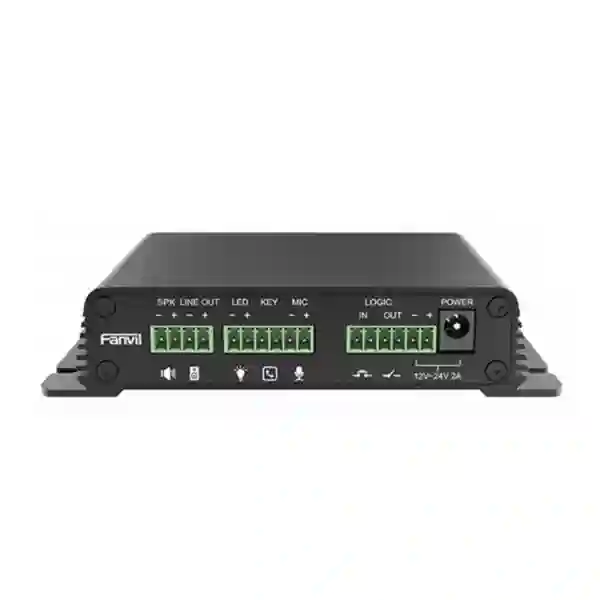
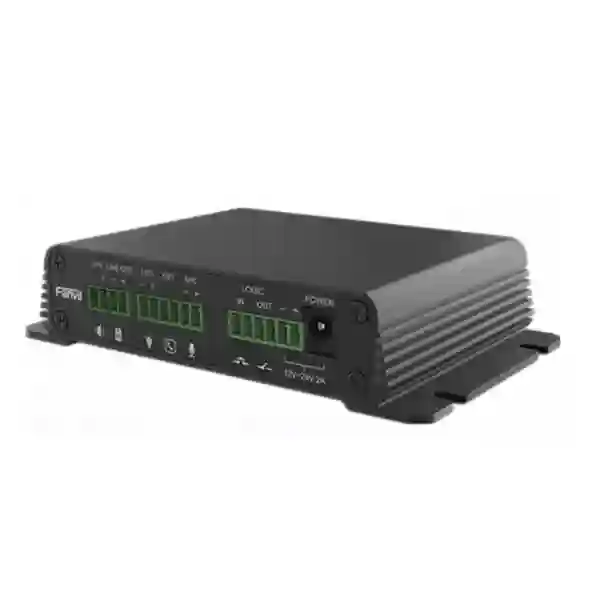
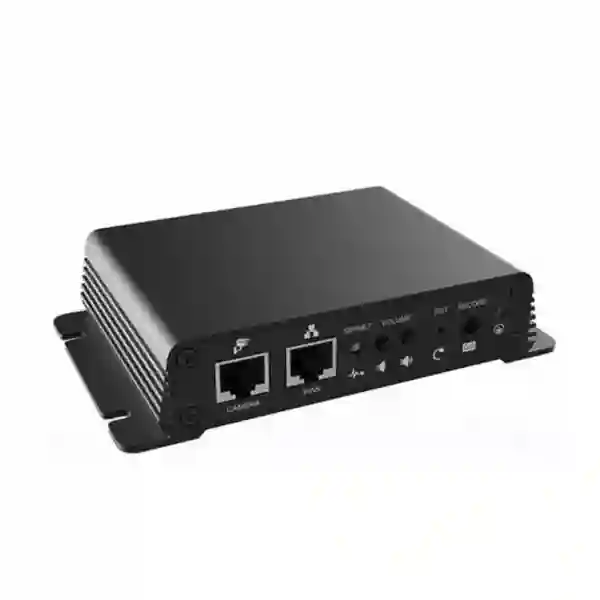
Fanvil PA3 SIP Paging Gateway
The Fanvil PA3 is a compact SIP public-address gateway designed to bridge IP telephony with speakers, microphones and broadcast applications. It gives businesses a practical way to send announcements through a SIP network, build one-touch intercom points, play scheduled or local MP3 audio and connect a public-address endpoint to an existing IP PBX without treating paging as a completely separate communications system.
For buyers in Tanzania, the complete design also needs the right speaker impedance, power method, network connectivity, PBX registration, VLAN and QoS policy, audio source, mounting position and operational workflow. FourTeck can help align the gateway with the surrounding voice and network infrastructure before quotation and deployment.
Verified Fanvil PA3 capabilities
The PA3 supports two SIP lines, 10/100 Mbps Ethernet with PoE, SIP over UDP, TCP and TLS, RTP/RTCP/SRTP, IPv4 and IPv6, VLAN, DHCP, static addressing and common provisioning methods. Its 4Ω mono amplifier output is specified at approximately 10W when powered by PoE or 12V DC, 20W at 18V and 30W at 24V. Audio interfaces include line input, line output, microphone input and passive-speaker terminals, while USB 2.0 and TF-card storage support local audio playback. Fanvil lists common codecs including G.711, G.729, iLBC, G.723.1, G.726-32K, G.722 and Opus.
Management functions include a web portal, firmware upgrade, configuration import and export, packet capture, syslog and auto-provisioning. The device can be desk- or wall-mounted and is compact enough for installation near the paging endpoint or in a communications enclosure. As with any SIP endpoint, final behavior depends on PBX settings, network security policies and the surrounding audio system.
The PA3 solves a common integration problem: organizations may already have an IP PBX and Ethernet network but still rely on a separate analog paging workflow. By registering as a SIP endpoint and connecting to local audio equipment, the PA3 can bring paging, intercom and announcement functions into the managed voice environment.
Compatibility, PBX and network design
Fanvil lists compatibility with established SIP platforms including Asterisk, BroadSoft, 3CX, Metaswitch, Elastix and Avaya environments. Compatibility should still be validated against the exact PBX release, SIP transport, authentication method, codec policy and paging workflow. Multicast paging, auto-answer, DTMF, call routing and encrypted media can behave differently depending on PBX configuration.
The network should be designed for consistent latency rather than raw bandwidth. Voice VLANs and QoS can help protect real-time traffic from bulk data. If multicast is used, switching behavior should be reviewed so packets reach intended endpoints without flooding the rest of the LAN. PoE budgets should be checked if the unit is switch-powered, and a suitable external DC source should be used when higher amplifier output is required.
FourTeck Tanzania can align the PA3 with wider technology integration services, while the Tanzania technology shop provides a path to related infrastructure categories.
Typical use cases
In offices, the PA3 can provide reception paging, visitor calls and staff announcements through a SIP extension or paging group. In warehouses and workshops, it can connect telephony to a speaker or downstream amplifier so operational messages reach staff away from desk phones. Schools and campuses may use it for live announcements, tones or prerecorded messages, while retail and hospitality sites may combine staff paging with locally stored audio or line-level integration.
A successful design starts with the workflow rather than the hardware. Decide who can page, which zones should receive audio, whether messages are live or prerecorded, whether two-way intercom is required and how the system should behave during network or power interruption. Then select speakers, amplification, PoE, PBX routing and network policy to support that workflow.
Fanvil PA3 SIP Paging Gateway Tanzania
Organizations searching for a Fanvil PA3 SIP Paging Gateway in Tanzania are usually trying to connect IP telephony with physical announcement speakers, build a compact intercom point or replace an isolated analog paging workflow with something addressable from a SIP environment. The PA3 is relevant because it combines SIP registration, network media handling and audio interfaces in one compact device. For Tanzania deployments, planning should start with who is allowed to page, which zones need announcements, whether content is live or prerecorded and whether the same endpoint also requires intercom functions.
A PA3 connected to a passive loudspeaker needs the speaker load and cabling to match the amplifier output. The available power source influences amplifier capability, so PoE and higher-voltage external DC should not be treated as identical. Where an active speaker or external amplification chain already exists, line output may be the better integration path. Microphone input, line input and local storage should be included only where they improve the actual user workflow.
Tanzania businesses may have sites where power stability, rack location and cable distance vary. A UPS-backed PoE switch can simplify resilience for the network side, while higher-power audio designs may require separately protected DC power. Voice and paging traffic should sit on a controlled network with documented addresses and administrator credentials. If remote branches are involved, routing and security rules need to pass SIP and media without opening unnecessary exposure.
For procurement, a useful quotation request includes PA3 quantity, PBX platform, number and type of speakers, paging zones, required speaker power, PoE availability, mounting location and whether installation, configuration or testing is required. FourTeck can review those requirements together with IP PBX, switching and structured network infrastructure.
Fanvil PA3 SIP Paging Gateway Dar es Salaam
Dar es Salaam businesses can have very different paging environments: offices, warehouses, retail sites, hospitality venues and multi-floor commercial buildings. A PA3 deployment should be sized around sound coverage and operational workflow rather than the assumption that one gateway and one loudspeaker will serve every area. Reception may need a small targeted zone, while a warehouse can require multiple speaker positions or an external amplifier for even coverage.
If an IP PBX is already installed, the PA3 can be registered as another endpoint or paging destination. Administrators can control extension permissions and auto-answer behavior so only authorized users can trigger announcements. Existing PoE infrastructure can simplify installation, but the switch power budget and intended amplifier output should be checked before choosing PoE as the final power method.
Acoustic conditions in commercial properties can reduce speech intelligibility. Hard surfaces, open warehouse roofs, machinery, customer noise and long corridors all change the result. Speaker sensitivity, impedance, placement and coverage angle are as important as amplifier wattage. Where larger audio systems already exist, the PA3 can act as the SIP bridge and feed line-level audio into professional downstream amplification.
A Dar es Salaam quotation should identify building type, zone count, PBX brand, network availability, speaker arrangement, required announcement sources and whether scheduled MP3 playback is needed. Those details help distinguish a simple hardware purchase from a complete paging integration project.
Fanvil PA3 SIP Paging Gateway Mwanza
For Mwanza organizations, a SIP paging gateway can connect announcement needs in offices, workshops, stores, classrooms or clinics with the same IP voice environment used for extensions. The PA3 can receive SIP communications and convert them to local audio, allowing paging to become part of call routing and administration instead of a separate analog process.
The design should first decide whether the unit will directly drive a passive speaker or feed an active speaker or external amplifier. Direct speaker output is only suitable when the loudspeaker and power requirements fit the PA3 limits. Larger spaces may need dedicated PA amplification and multiple speakers; in that situation, line output can preserve the PA3’s SIP-gateway role while specialized audio hardware handles distribution.
Network requirements vary by PBX topology. Local SIP paging on one LAN may operate without internet access, while hosted PBX registration or multi-branch communication depends on WAN connectivity, DNS, NAT and firewall policy. Multicast must be tested if used. Device management should be protected with strong credentials and configuration backups stored for recovery.
Mwanza buyers can improve quotation accuracy by sharing a site sketch, expected speaker locations, distance to the network cabinet, current PBX model and how staff should initiate announcements. This provides enough context to decide whether one PA3 is sufficient or additional zones and infrastructure are required.
Fanvil PA3 SIP Paging Gateway Arusha
Arusha has offices, hospitality environments, tourism operations, educational facilities and service organizations that can benefit from paging integrated with IP telephony. The Fanvil PA3 can interface a SIP communications platform with local speakers or audio equipment, allowing calls or paging actions to produce announcements at the required zone.
Guest-facing environments should balance audibility with comfort. Background audio, staff paging and customer announcements may need different levels and priorities. The PA3’s audio interfaces provide flexibility, but the design should still account for speaker placement, any existing mixer or amplifier and whether separate zones are required.
For sites spanning several buildings, network paths should be mapped before using multicast or cross-site paging. VLANs, routed interfaces and firewall boundaries can affect delivery. SIP call-based paging may be simpler across routed networks, while multicast can be efficient within local segments when switching is correctly configured. Both methods should be tested under realistic conditions.
An Arusha procurement request should describe the business environment, number of paging points, whether announcements start from desk phones or a control console, whether prerecorded audio is required and whether speakers already exist. These details make it easier to determine the surrounding infrastructure needed for a dependable deployment.
Fanvil PA3 SIP Paging Gateway Dodoma
Organizations in Dodoma can use the Fanvil PA3 where building announcements, staff paging or SIP-connected audio need to reach people away from desk phones. This can be relevant to administrative offices, education, commercial facilities, clinics and operational sites. A well-designed paging endpoint complements the existing voice environment rather than creating another isolated communications system.
Two SIP lines enable flexible voice workflows, while USB and TF storage can support local MP3 playback. Line and microphone connections create options for other audio sources. The project should assign these features deliberately; one site may prioritize live announcements while another may need scheduled audio and an external one-touch button.
Lifecycle documentation is important. Record the device IP, SIP account, firmware, switch port, VLAN, power method and connected audio equipment. Store configuration exports with project records. This reduces the risk of future paging failures caused by unknown network settings after a switch, PBX or addressing change.
Before requesting a quote, Dodoma buyers should identify whether they need hardware only or also speaker selection, cabling, PoE switching, PBX configuration and commissioning. Supplying the extension plan and audio coverage objective helps create a technically complete proposal.
Fanvil PA3 SIP Paging Gateway UAE
UAE deployments often involve structured enterprise networks, multi-floor offices, warehouses, retail estates and hospitality sites. The PA3 can fit environments where a SIP paging endpoint must integrate with an existing IP telephony platform while feeding a local speaker or downstream audio system. Standards-based SIP helps avoid unnecessary dependence on a proprietary paging controller for every small zone.
Larger projects should treat the PA3 as one component of the public-address design. The integrated amplifier is appropriate for specific direct-drive loads, but distributed ceiling speakers or long speaker runs may require professional amplification. In those architectures, line output allows the gateway to handle SIP and media while downstream PA hardware handles speaker power distribution.
Enterprise policies may involve strict VLAN segmentation, NAC, firewalls and centralized administration. The PA3 supports common IP configuration and provisioning functions, but management access should still be restricted. TLS and SRTP may be used where supported end-to-end by the PBX and policy. VPN-connected sites should be tested for latency and routing.
Businesses can also review FourTeck UAE for broader regional technology requirements. A quotation should specify quantity, PBX platform, speaker architecture and installation scope.
Fanvil PA3 SIP Paging Gateway Uganda
Ugandan businesses planning SIP paging can use the Fanvil PA3 where they need to turn a voice call or paging command into audio at a physical location. This can suit offices, schools, warehouses, retail premises and service facilities that already use Ethernet and SIP or are upgrading from separate analog communication systems.
Coverage area is the first design question. A corridor has a different acoustic requirement from a warehouse or school courtyard. Speaker type, mounting height and ambient noise can matter more than amplifier wattage alone. Larger speaker networks may require external amplification, with the PA3 retained as the SIP and audio gateway.
Organizations with several sites can potentially standardize SIP paging administration while allowing each branch to use locally appropriate speakers. WAN quality, security policy and fallback operation should be considered if a centralized PBX is involved. Local storage or site-specific procedures may be useful where branch continuity is important.
The FourTeck Uganda technology site supports related regional requirements. Buyers should state whether they need hardware supply only or a full scope covering PBX integration, speakers, cabling and testing.
Fanvil PA3 SIP Paging Gateway Kampala
Kampala offices and commercial sites can contain reception, customer spaces, back offices, stores and technical rooms, each with different announcement needs. A SIP paging design can give staff a simple way to reach those areas without installing a separate communications platform for every zone. The PA3 can register to the voice platform and output audio through a connected speaker or PA system.
Existing PoE switches can make network integration straightforward, but available PoE capacity should be checked. If the design needs higher amplifier output, an appropriate external DC source may be preferable. That choice should be made together with the speaker design, not after installation.
In customer-facing environments, access control is important. Not every user should be able to activate building-wide paging. PBX permissions and any programmable buttons should follow staff roles. Prerecorded content should also have a defined owner so audio files remain current and appropriate.
A Kampala quotation should include the PBX, paging zones, speaker count and network topology. That allows the gateway, switching and audio components to be sized together.
Fanvil PA3 SIP Paging Gateway Arua
Arua organizations may use the PA3 to consolidate voice and announcement functions onto Ethernet and SIP. Instead of maintaining a separate microphone system with little remote visibility, the gateway can be administered through the network and tied to defined extensions or paging groups. This can simplify support where similar configurations are needed at more than one site.
Physical distance between the network point and speaker location must be considered. Ethernet limits, speaker cable length, audio loss and power arrangements all affect installation. In some projects it is more practical to place the PA3 near the audio endpoint and provide network connectivity there. Wall mounting can help keep the installation secure and organized.
USB or TF storage can hold repeated messages or local announcements. Schools may use tones, warehouses may use operational reminders and offices may use routine messages. Live emergency communications should be assessed separately from routine paging so the overall system aligns with the organization’s safety procedures.
A complete Arua request should include announcement type, approximate coverage area, PBX details, network switch and existing speakers. This allows a realistic quotation rather than a hardware-only estimate.
Fanvil PA3 SIP Paging Gateway Mbarara
Businesses and institutions in Mbarara can use SIP paging to connect operational announcements with the same communications infrastructure used for voice. The Fanvil PA3 is useful when a compact gateway is preferable to a full paging console at the audio endpoint. It receives SIP communications and can drive or feed suitable audio equipment.
A common mistake is to focus only on the gateway and ignore the acoustic design. Required power depends on speaker sensitivity, area size, background noise and listening distance. Multiple well-placed speakers or external amplification may provide better intelligibility than one loud source. The PA3’s line output gives integrators that flexibility.
Network administrators should decide on static addressing or DHCP reservation, management access and configuration-backup policy. Hosted PBX deployments may depend on DNS, NAT and firewall rules, while local PBX systems depend more on LAN switching and UPS protection. These decisions should be documented during commissioning.
Mbarara buyers should state the number of zones, how staff will initiate announcements, the existing PBX and whether local audio playback is required. Early cabling planning is especially valuable in new or renovated buildings.
Fanvil PA3 SIP Paging Gateway Gulu
Gulu offices, schools, clinics, warehouses and service facilities can use a SIP endpoint to simplify paging administration. The Fanvil PA3 can be addressed through a SIP system and connected to a suitable speaker or audio path. Its compact enclosure and wall-mount option support installation close to the audio endpoint.
Programmable DSS interfaces can support external buttons and indicators in appropriate intercom designs. The project should define exactly what pressing a button does, which destination receives the call, how the far end answers and whether local microphone and speaker performance is adequate for the environment.
The network layer should remain simple and documented. A voice VLAN can be appropriate where one already exists. Multicast should be enabled only when needed and understood. Web management should be limited to trusted administration paths, and firmware upgrades should be controlled changes.
A Gulu quotation should state whether the gateway is for paging, two-way intercom, prerecorded playback or a combination, together with speaker and power requirements. This helps procurement teams compare complete solutions instead of only hardware price.
Fanvil PA3 SIP Paging Gateway Kenya
Kenyan businesses may deploy the PA3 for office paging, warehouse communication, school announcements, retail audio or intercom endpoints integrated with an IP PBX. Its standards-based SIP approach and audio interfaces allow telecom and facilities teams to connect the managed voice platform to physical sound systems.
Managed switching and structured cabling can simplify the IP side, but audio engineering remains essential. Passive speakers must match the gateway’s output limits. Larger systems may use a central amplifier with the PA3 providing line-level audio. The right topology depends on coverage and existing equipment.
Organizations with multiple branches can standardize provisioning templates and documentation. Each site still needs unique IP details, PBX credentials and local audio commissioning, but core configuration practices can be consistent, reducing support effort.
The FourTeck Kenya site supports related VoIP and network requirements. Quotations should cover total paging scope, including speakers, PoE, PBX configuration and testing when required.
Fanvil PA3 SIP Paging Gateway Kuwait
Kuwait deployments can use the PA3 in offices, warehouses, hospitality environments and service facilities where SIP telephony needs a physical announcement endpoint. It is particularly useful for targeted zones where a full enterprise paging controller would be unnecessarily complex.
The gateway should be installed in a protected indoor environment with appropriate ventilation and organized cabling. Speakers installed in hotter, dusty or outdoor locations should be selected independently for those conditions. Electrical noise and physical protection may need attention near machinery or plant equipment.
Customers may integrate the PA3 with SIP call groups, intercom buttons or scheduled audio. The project should define audio priority and user behavior, including what happens when local playback is active and a live page arrives. These rules should be agreed during commissioning.
The FourTeck Kuwait site provides a regional path for related VoIP and infrastructure projects. Quotations should identify quantity, audio architecture and exact PBX environment.
Fanvil PA3 SIP Paging Gateway Ghana
Organizations in Ghana can use the Fanvil PA3 where business telephony and physical paging need to operate together. Staff can initiate announcements through familiar SIP workflows, while the gateway’s local audio ports allow the endpoint to be adapted to the site’s speaker system.
For schools and multi-building facilities, zone planning is essential. One PA3 may suit a single zone, but larger campuses can require several endpoints or an external PA architecture. Designers should decide which areas need independent announcements and which can share content.
Warehouses and operational sites should test speech intelligibility during real activity, not only in an empty building. Machinery, fans and people change the required volume. Speaker direction and quantity can often improve clarity more effectively than simply increasing output.
The FourTeck Ghana site supports related regional technology categories. A detailed RFQ should list the PBX, paging zones, speaker requirements, switch infrastructure and installation scope.
Fanvil PA3 SIP Paging Gateway Nigeria
Nigeria has many multi-site organizations where centralized communications can reduce operational complexity. The PA3 can serve as a standardized SIP paging endpoint across offices, stores, warehouses and service locations, provided each branch has suitable network and audio infrastructure.
Power design should be considered carefully where continuity is important. A PoE-powered gateway can benefit from a UPS-backed switch, while higher speaker output may require external DC. If external amplification is used, it should be included in the backup-power plan where paging availability matters during short outages.
Security practices should include unique SIP credentials where appropriate, protected web administration and documented firmware. Hosted PBX projects need firewall and NAT review, while local PBX deployments need documented VLAN and switching configuration.
The FourTeck Nigeria site supports related IT and VoIP projects. Buyers should include site count, gateway quantity, speaker topology and commissioning scope in the RFQ.
Fanvil PA3 SIP Paging Gateway Seychelles
Seychelles businesses in hospitality, offices, retail and services may use SIP paging to integrate staff communication with the IP network. The Fanvil PA3 is a compact option for focused paging or intercom endpoints, especially where one or a few audio zones are required.
Hospitality deployments should distinguish guest-area audio from staff operational paging. Different zones may need separate content, volumes and permissions. If background music is involved, the relationship between local playback, live announcements and existing AV systems should be agreed before installation.
Island environments make lifecycle planning important. Standardized configuration, exported backups and clear hardware records can make replacement easier. Procurement teams should still ask for current lead times rather than assuming stock, and compatibility should be reconfirmed when expanding older systems.
A Seychelles RFQ should state whether the project is a single endpoint, a multi-zone installation or part of a broader telephony upgrade, together with PBX, speaker, PoE and location information.
Related infrastructure for a complete PA3 deployment
A SIP paging gateway performs best when the surrounding network and voice platform are planned correctly. FourTeck Tanzania covers IP PBX and IP phone solutions, managed switching, Wi-Fi, structured infrastructure and integration through the Tanzania technology solutions site. Cross-border projects can also use FourTeck Africa as a regional reference point.
IP PBX and SIP platform: provides extensions, authentication, call routing, paging groups and permissions. Confirm exact compatibility, licensing and paging behavior before rollout.
Managed PoE switch: provides connectivity and can provide power while supporting VLANs and QoS. Verify PoE budget and decide whether external DC is required for higher speaker output.
Speakers and amplification: select by coverage, impedance, sensitivity, environment and background noise. External amplification is often preferable for wider or distributed speaker systems.
Cabling and power protection: plan Ethernet, speaker cable, DC power where required and UPS strategy so the full paging chain remains maintainable.
How to select and size a Fanvil PA3 project
Start with the use case. Decide whether the endpoint is for live paging, intercom, scheduled playback, local MP3 announcements or a combination. Define who initiates audio and how users respond.
Define the audio zone. Measure or describe the area, ambient noise and existing speakers. Decide whether the PA3 will directly drive the selected speaker or feed an external amplifier.
Confirm the PBX. Record PBX brand, version, SIP authentication and codecs. Decide whether the gateway receives a normal extension, paging group or dedicated routing rule.
Check the network. Identify switch port availability, PoE, VLAN, IP addressing, multicast behavior and firewall boundaries. Multi-building or branch deployments should document routed paths between the gateway and PBX.
Plan handover. Record credentials securely, export the configuration, label the switch port and audio cables and retain firmware information for support.
Quotation checklist
Include PA3 quantity, PBX brand and version, paging or intercom workflow, number of audio zones, speaker type and quantity, any existing amplifier, PoE availability, required DC power, VLAN information, mounting location, local playback requirements and whether the scope is supply-only or includes installation and testing.
Fanvil PA3 FAQ
What is the Fanvil PA3 used for?
It is a SIP paging and public-address gateway that connects IP telephony to speakers and other audio equipment for announcements, intercom and local playback.
How many SIP lines does it support?
Fanvil specifies two SIP lines. Their use depends on the PBX and project configuration.
Can the PA3 power a passive speaker?
Yes, for a suitable 4Ω load. Fanvil specifies approximately 10W with PoE or 12V input, 20W at 18V and 30W at 24V. Speaker compatibility must be checked before connection.
Does it support PoE?
Yes. The Ethernet interface supports PoE, but switch power budget and desired amplifier output should be considered when choosing the final power method.
Can it play prerecorded announcements?
Yes. USB and TF-card storage can be used for local or offline audio playback.
Can it connect to an external amplifier?
Yes. Line output can feed compatible active speakers or downstream amplification for larger PA systems.
Decision recap
Choose the Fanvil PA3 when you need a compact SIP endpoint that converts IP voice and paging functions into local audio output, supports intercom-style workflows and provides local media playback. It is especially suitable for targeted zones where integration with an existing IP PBX is more practical than deploying a separate paging control platform.
Confirm PBX compatibility, speaker design, required amplifier power, PoE or DC power, network VLANs, multicast behavior and installation location before ordering. Larger PA systems may use the PA3 as the SIP gateway feeding dedicated amplification.
Consult FourTeck about your paging requirement
Share your PBX model, number of paging zones, speaker information and preferred deployment scope. FourTeck can review the Fanvil PA3 together with the surrounding IP PBX, PoE switching, cabling and audio requirements so the quotation reflects a workable system rather than only a gateway.




Reviews
There are no reviews yet.