
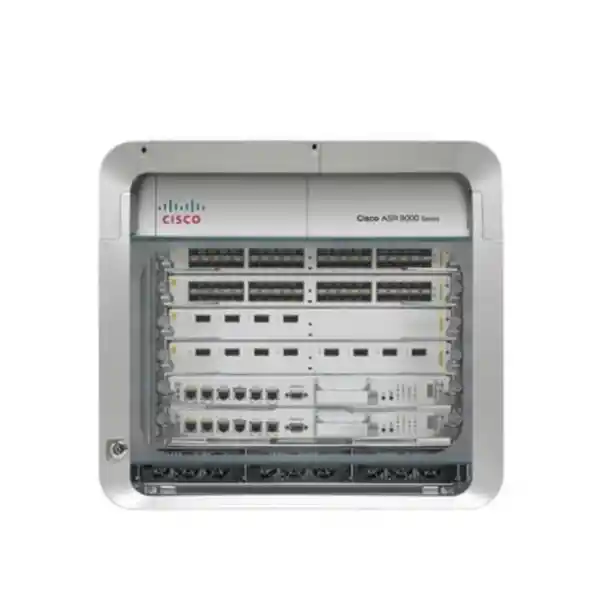
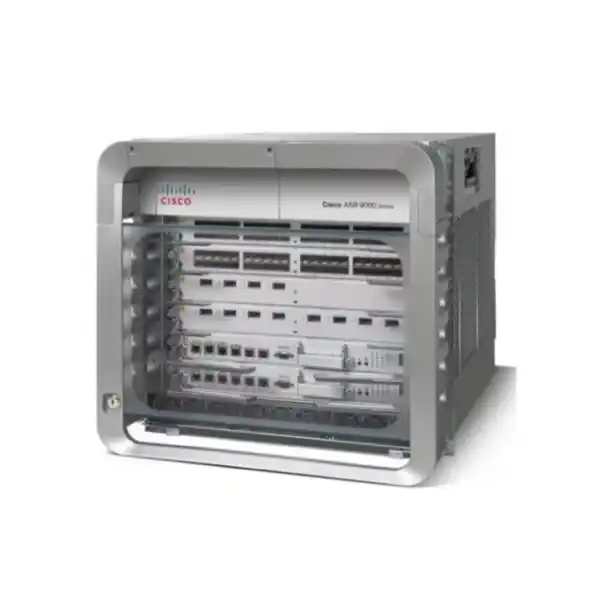
4 line-card slots
2 RSP slots
Up to 16 Tbps*
Cisco IOS XR
Cisco ASR 9006 Aggregation Services Router in Tanzania
Build a scalable service-provider edge, aggregation, or high-capacity transport platform around the Cisco ASR 9006 when your network needs modular interfaces, strong redundancy, and the operational model of Cisco IOS XR. The chassis is designed for demanding Layer 2 and Layer 3 services rather than ordinary branch routing, making it relevant to internet service providers, carriers, large network operators, data-center environments, and organizations building resilient backbone or aggregation layers.
Cisco currently describes the ASR 9006 as a 10-RU system with four line-card slots and two Route Switch Processor slots, with maximum platform capacity of up to 16 Tbps in supported configurations. The important qualification is “supported configuration”: real throughput, port density, 100G or 400G capability, feature scale, and power demand depend on the exact RSP, line cards, optics, software release, and licenses selected for the deployment.
For a Tanzania project, the right starting point is therefore not simply “one ASR 9006 chassis.” A complete bill of materials should be designed around required interfaces, traffic forecasts, service type, redundancy policy, rack and cooling constraints, AC or DC power architecture, fiber distances, optics, software compatibility, and operational support. FourTeck Tanzania can use those requirements to prepare a configuration-focused quote without assuming stock, price, or a one-size-fits-all hardware bundle.
Maximum figures are platform capabilities, not a promise that every ASR 9006 configuration includes the corresponding interfaces or licenses. Confirm hardware and software compatibility for the exact design before ordering.
Cisco ASR 9006 quick facts
| Planning item | Verified platform detail | What it means for the buyer |
|---|---|---|
| Platform family | Cisco ASR 9000 Series | Built for service-provider edge, aggregation and high-scale routing roles. |
| Form factor | 10 rack units | Rack height, depth, weight, airflow and maintenance clearances must be planned before delivery. |
| Line-card capacity | 4 line-card slots | Port density is created by the selected cards, not by fixed chassis ports. |
| Control/fabric | 2 RSP slots with integrated fabric | A redundant RSP design can protect control and switching functions when configured appropriately. |
| Maximum system capacity | Up to 16 Tbps | Actual capacity is tied to supported RSP, line-card and software combinations. |
| High-speed Ethernet | ASR 9000 family options extend through 400 Gigabit Ethernet; Cisco’s current routed-optical guide lists up to 20 400G QSFP-DD ports for ASR 9006 | Confirm exact line card, RSP, optic and IOS XR release compatibility before specifying 400G. |
| Operating system | Cisco IOS XR | Supports a distributed, service-provider-oriented operating model and broad routing/service features. |
| Power architecture | AC or DC power systems; mixed AC+DC operation is not supported | Choose the site power strategy before finalizing the power shelf and module plan. |
The ASR 9006 should be evaluated as a platform rather than a fixed appliance. Its chassis defines the mechanical envelope, line-card count and RSP architecture, while the installed modules define the usable ports, forwarding capacity, service scale and much of the power requirement. This modularity is valuable when a network needs to evolve, but it also means that a quotation that lists only the chassis model is not enough for a deployable system.
Who should consider the Cisco ASR 9006?
The ASR 9006 is most appropriate where the routing layer is carrying many services, large traffic volumes, or strict availability requirements. Typical buyers include service providers aggregating access networks, operators building Metro Ethernet or IP/MPLS infrastructure, organizations interconnecting major data centers, mobile-network transport teams, broadband providers, and large enterprises or public-sector networks that require a carrier-class core or edge. For smaller offices, ordinary internet edge routing, or branch connectivity, the platform can be unnecessarily large and operationally complex.
A strong use case is a network that needs multiple high-speed interfaces today and a credible path to higher interface rates later. The four line-card slots let a design combine different Ethernet densities and speeds according to current Cisco compatibility rules. This is different from buying a fixed-port router, where every interface is predetermined. The modular approach gives planners flexibility to dedicate slots to access aggregation, upstream transit, inter-site backbone links, or service-facing connectivity while retaining room for growth if the initial design does not consume all slots.
Another fit indicator is operational maturity. IOS XR is aimed at networks that benefit from service-provider routing practices, structured change control, routing policy, high availability, telemetry, automation, and a separation of management, control and forwarding responsibilities. Teams deploying the ASR 9006 should have an operational model for software maintenance, configuration backup, AAA, monitoring, logging, route-policy review, interface capacity management and security updates. The platform can provide excellent control and resilience, but it should be supported by equally disciplined network operations.
The final fit question is service complexity. Cisco documents ASR 9000 family support for Ethernet services, MPLS, Segment Routing, SRv6, EVPN, VXLAN, L2VPN, L3VPN, IPv4, IPv6, multicast, OAM, hierarchical QoS and several resiliency mechanisms. This breadth is valuable when one platform must carry business VPNs, internet traffic, aggregation, transport and timing-sensitive services. It does not mean that every feature is automatically available on every card and release. Design validation must map each required feature to the exact hardware, software and license combination.
Architecture: four line cards, dual RSPs and distributed forwarding
At chassis level, the ASR 9006 contains six principal front slots: four positions for line cards and two positions reserved for Route Switch Processor cards. The RSP is central to system control, switching fabric and timing functions. In a redundant design, one RSP operates as the active control element while the second can provide standby control. Cisco’s architecture documentation also places the switching fabric on the RSPs for the ASR 9006, providing redundant fabric capability when the system is configured with redundant processors.
Packet processing is distributed to the line cards. This matters because the chassis is not relying on a single central forwarding engine for all service traffic. Cisco describes ASR 9000 line cards as carrying their own forwarding resources, while the fabric moves packets between cards. For buyers, the practical consequence is that the selected line-card generation and type influence forwarding performance, supported port combinations, feature behavior and scale. A high-speed chassis target cannot be reached by choosing the chassis alone; the line-card and RSP generations must be engineered together.
Current Cisco documentation shows support for newer RSP families on the ASR 9006, including RSP5 and RSP5-X options under the appropriate software and hardware rules. RSP5 is designed for high-density 100G and 400G line-card environments, while RSP5-X is a newer route switch processor that Cisco documents for the ASR 9006 and related modular platforms. The presence of these options gives existing chassis a modernization path, but migrations should be treated as an engineering change with software, card and compatibility review rather than as a simple component swap.
For network architects, the four-card layout creates an important design tradeoff. It provides more modular interface positions than the two-line-card ASR 9904, while using less rack space than an eight-line-card ASR 9010. The best platform therefore depends on how many independent card positions, ports and terabits are needed, not only on the headline maximum throughput. A design with many lower-speed service interfaces may value slot flexibility differently from a design focused on a smaller number of very high-speed uplinks.
Redundancy also needs to be intentional. Two RSP slots make processor redundancy possible, but a chassis populated with one RSP is not equivalent to a dual-RSP design. The same principle applies to power modules, external feeds, uplink diversity, routing topology and optics. A resilient network outcome comes from eliminating single points of failure across the complete deployment, including elements outside the router such as distribution panels, rectifiers, upstream paths and physical fiber routes.
Capacity and interface planning
Cisco’s current product portfolio lists the ASR 9006 at up to 16 Tbps of maximum system capacity. The current model comparison also identifies four line-card slots and a bandwidth-per-slot figure of up to 2 Tbps for the ASR 9006. Maximum capacity figures should be read as platform ceilings under supported designs, not as guaranteed throughput for any arbitrary card combination. The installed RSP generation, line-card generation, port mode, optics and software release determine what a particular chassis can actually deliver.
The ASR 9000 family spans Ethernet rates from lower-speed access interfaces through 100G and 400G options. Cisco’s present routed-optical documentation lists up to 20 400G QSFP-DD ports for an ASR 9006 configuration. That is useful evidence of the chassis’s high-speed role, but the figure is conditional on compatible current hardware. A quote for 400G should therefore identify the exact line-card PID, RSP requirement, optic or coherent module, breakout behavior where applicable, software release, license entitlement and any restrictions on slot population or mixed card generations.
Port count alone is not enough. Network planners should state how many links are needed at each speed, whether interfaces are client-facing or backbone-facing, expected oversubscription, peak and average traffic, expected growth, required packet features and whether traffic engineering is part of the design. A 100G interface carrying simple IP transit can have different service-scale requirements from a 100G interface carrying large numbers of VPNs, QoS classes, multicast groups, subscriber sessions or deep policy. Capacity engineering must therefore combine bandwidth and feature scale.
Optics should be specified by reach, fiber type and interoperability requirement rather than by connector name alone. For each route, record whether the link is short-reach within a facility, single-mode metro fiber, long-haul transport, or connected through an optical system. Confirm supported transceiver families and any digital-coherent requirements against the selected line card. Do not assume that a generic QSFP or QSFP-DD module is supported simply because it fits mechanically.
Growth planning is another reason to document the slot strategy. A system that starts with two populated line-card slots can retain physical expansion space, but that does not automatically mean future cards will work with the original RSP, power configuration or software version. A useful design document records present cards, reserved slots, expected future interface rates, projected traffic, power headroom and the likely controller/software upgrade path. This makes future expansion a planned migration rather than an emergency redesign.
Routing and service capabilities with Cisco IOS XR
Cisco IOS XR is the software foundation of the ASR 9000 family. Cisco describes it as a distributed operating system designed for high availability and large-scale routing environments. For the ASR 9006 buyer, the value is less about a single feature and more about operating a broad set of Layer 2, Layer 3 and transport services on a common platform. That can simplify service-provider networks that would otherwise need separate systems for aggregation, VPN edge functions, high-capacity routing and transport integration.
Cisco’s ASR 9000 data sheet lists support across the family for Ethernet services, Segment Routing, SRv6, EVPN, VXLAN, L2VPN, IPv4, IPv6, L3VPN, Layer 2 and Layer 3 multicast, IP over DWDM, Synchronous Ethernet, Ethernet OAM, MPLS OAM, access-control lists, hierarchical QoS, MPLS Traffic Engineering Fast Reroute, multichassis link aggregation, integrated routing and bridging, Nonstop Forwarding and Nonstop Routing. Each of these capabilities should be treated as a design requirement to validate, because availability and scale can vary by line card, RSP, software train and license.
For IP/MPLS networks, the chassis can serve as an aggregation or provider-edge platform where routing policy, label-switched services and resiliency are important. Segment Routing can reduce dependence on some traditional signaling approaches and is part of Cisco’s current ASR 9000 software documentation. EVPN and VXLAN can support modern Layer 2 and Layer 3 service designs, including data-center or metro use cases, but the exact control-plane architecture, route-target strategy, redundancy and multihoming model should be defined before hardware is selected.
Quality of Service is particularly important when a single chassis carries multiple customer or application classes. Hierarchical QoS can support service differentiation, but queue scale and scheduling behavior are tied to specific hardware capabilities. A proper design identifies committed and peak rates, shaping and policing points, priority classes, burst requirements, congestion behavior and SLA objectives. This prevents a situation in which raw port bandwidth is sufficient but the chosen card does not match the intended QoS scale or hierarchy.
Timing is another specialized capability in the ASR 9000 architecture. Cisco documents support for timing sources and technologies such as SyncE and PTP in the platform family, and current RSP documentation includes dedicated synchronization interfaces. These functions can be relevant to mobile backhaul and other timing-sensitive networks. Buyers needing timing should specify the required profile, clock source, redundancy, holdover expectations and interfaces so the exact RSP and software support can be verified.
High availability and network resiliency
Carrier-class availability is a design goal of the ASR 9000 family, but availability is produced by the complete architecture rather than by the model name alone. Cisco documents redundancy for RSPs, switching fabric, fans, power supplies, power feeds and software in the ASR 9006 platform. To benefit from those capabilities, a deployment must actually populate and wire the redundant components and must build routing and service redundancy around them.
Dual RSPs are the first major decision. A single RSP can operate the system, while a redundant pair provides a standby control path and fabric redundancy. For critical networks, the design should also consider software behavior during failover, route-protocol convergence, line-card state, synchronization, and planned maintenance procedures. High availability should be tested in a staging or maintenance window using scenarios that reflect the real network, including RSP switchover, uplink failure, power-feed loss and upstream routing changes.
Power redundancy should extend beyond inserting multiple modules. Independent feeds should be mapped to physically and electrically diverse sources where the site architecture supports it, and power capacity must be calculated for the installed cards plus reasonable growth. The ASR 9006 supports AC or DC power architectures, but Cisco states that a hybrid AC+DC configuration is not supported. This makes the site’s electrical standard a purchasing decision that needs to be settled before the power subsystem is finalized.
Network resiliency also depends on topology. Multiple upstreams, diverse fiber paths, ECMP or protected routing, fast failure detection, MPLS or Segment Routing protection, and service-level redundancy may all be more important to customer experience than chassis redundancy by itself. The router should be placed inside a failure-domain design that identifies what happens if a fiber, optic, line card, RSP, power feed, software process or entire site is lost.
Rack, power, cooling and environmental planning
The ASR 9006 is a substantial chassis. Cisco lists a height of 17.50 inches, equivalent to 10 rack units, a width of approximately 17.38 inches, and a depth of about 29.05 inches. The empty or partially equipped chassis must be handled with appropriate lifting practices, and the rack must be suitable for the installed weight. Rack selection should consider the equipment depth, cable-management space, front and rear service access, airflow clearances, grounding and the weight of the final configuration rather than only the rack-unit count.
Power design is configuration-specific. Cisco lists worldwide-ranging AC input of 200 to 240 V at 50 to 60 Hz and DC input of -40 to -72 V for the ASR 9006/9010 family specifications. The precise branch-circuit, connector, cable, breaker, rectifier and power-module requirements depend on the selected power system. Tanzania sites should have the electrical design reviewed against local site standards and the actual equipment bill of materials. Do not size UPS or generator capacity from the chassis name alone.
Cisco’s hardware guide distinguishes ASR 9006 power-system versions. The version 1 system supports up to three modules in the power tray, while version 2 supports up to four. Cisco also notes that the ASR 9006 chassis does not support version 3 power modules. This is an important procurement detail for upgrades and spares: a power module that belongs to another ASR 9000 platform or power-system generation should not be assumed compatible with the ASR 9006.
Cooling deserves the same attention as electrical supply. Cisco documents two fan trays for the ASR 9006 and a chassis layout with side air intake and rear exhaust, while the power-module airflow is specified separately. Rack rows, cabinet doors, adjacent equipment and cable bundles should not obstruct the intended air path. Hot-air recirculation can reduce thermal margin even when the room’s average temperature appears acceptable, so inlet temperature should be monitored at the equipment rather than inferred from a distant room sensor.
For environment, Cisco lists nominal operating temperature from 5°C to 40°C and a short-term range for the ASR 9006 down to -5°C and up to 55°C under the documented short-term conditions. Nominal relative humidity is listed at 5% to 90%. A production design should target stable operation inside the nominal range and treat extended conditions as exceptions, not everyday operating targets. Dust control, filter maintenance and predictable cooling are especially important where the router is carrying critical traffic.
Finally, plan maintenance access. Fan trays, power components, RSPs, line cards and fiber connections require space and disciplined labeling. Document slot numbers, port identifiers, optic types, fiber destinations, power-feed assignments and spare positions before service activation. This documentation reduces the risk of disconnecting the wrong circuit during an incident and makes it easier to replace components without turning routine work into a network outage.
Planning an ASR 9006 deployment in Tanzania
A Tanzania deployment should begin with the service objective: what traffic must the router carry, where will it sit in the topology, what availability is expected, and how quickly is demand growing? The answers determine whether the ASR 9006 should operate as a provider edge, aggregation node, internet edge, transport aggregation system, data-center interconnect router, or another specialized role. Defining the role first prevents overbuying interfaces that are not useful or under-specifying service scale that later becomes difficult to correct.
Power resilience is often a central infrastructure question for critical network rooms. The router design should be coordinated with the site’s UPS, generator, rectifier or DC plant, distribution panels and grounding plan. The objective is to know how long the network must remain online during upstream power events, which feeds are genuinely independent, and whether cooling remains available for the same duration. A router with redundant power modules cannot provide site resilience if both feeds ultimately depend on one unprotected electrical source.
Fiber planning should cover both physical and optical diversity. For every high-speed circuit, record fiber type, route distance, connector and patch-panel path, attenuation budget, optic requirement, intermediate transport equipment and restoration method. Where a service relies on two uplinks, verify that the fibers do not share a hidden common duct, patch panel or upstream device if route diversity is part of the availability requirement. The same principle applies to carrier handoffs: logical diversity is not always physical diversity.
Environmental readiness should be confirmed before hardware arrives. Verify rack depth and mounting, available rack units, equipment loading, cable paths, airflow direction, cooling capacity, dust control, grounding and access for replacement of modules. A 10-RU modular router may fit numerically into a rack while still being awkward to service if the cabinet is shallow or crowded. A pre-installation site survey is therefore more useful than relying only on a rack elevation drawing.
Local commercial details such as stock, delivery time, price, import charges, support entitlement and installation scope should be confirmed in the specific quote rather than assumed from a generic product page. The ASR 9006 can be assembled in many valid combinations, and even Cisco product IDs distinguish chassis and power variants. A precise Tanzania quotation should identify what is included, what must be ordered separately, and what customer-side infrastructure is required for commissioning.
What to include in the bill of materials
A deployable ASR 9006 solution usually includes more than the chassis. The first line item should identify the exact chassis and power variant. Cisco’s data sheet lists ASR-9006-AC-V2, ASR-9006-DC-V2 and ASR-9006-SYS among chassis options. These are manufacturer product identifiers, not a FourTeck Tanzania store SKU. The correct selection depends on the intended power architecture and the rest of the configuration.
Second, choose the RSP generation and redundancy level. A single processor may suit a lab or noncritical role, while production service-provider designs commonly evaluate dual RSPs for control and fabric resilience. Current Cisco documentation supports RSP5 and RSP5-X families for the ASR 9006 under defined software requirements. Existing installations considering an RSP upgrade should verify line-card compatibility, memory requirements, software migration path and any feature differences before scheduling the change.
Third, define the line cards slot by slot. For each card, state required interface speeds, port count, service type and scale. If the requirement includes 400G, specify whether ports are standard Ethernet, routed-optical, coherent or connected to a separate optical layer. If the requirement includes many 10G or 100G services, verify the density and breakout options that fit the network. Avoid a bill of materials that says only “100G card” without a specific supported product identifier.
Fourth, specify optics and cabling. The transceiver must be supported by the selected line card and must match fiber type, reach, connector and the far-end interface. For coherent optical applications, wavelength plan, optical line system interaction and link engineering may be needed. Include spare optics where operational policy requires them, and record whether the quote includes patch cords, fiber trays, attenuators or other passive components.
Fifth, calculate the power modules required for the actual installed load and redundancy objective. The number of modules should be determined from Cisco power-planning guidance for the chosen cards, not from a generic minimum. Confirm the correct ASR 9006 power-system version and remember that version 3 power modules are not supported by this chassis. Include the correct power cords or DC cabling approach and ensure the site-side feed can safely support the design.
Sixth, verify cooling and replaceable infrastructure such as fan trays and filters. Cisco lists two fan trays and a fan filter for the ASR 9006. New installations should confirm that required common components are included in the chosen bundle, while existing chassis upgrades should record the installed fan and power versions before new cards are ordered. A component mismatch discovered after delivery can delay commissioning even if the primary line cards are correct.
Seventh, include software, licenses, support and spares in the commercial scope. Cisco IOS XR feature entitlement and software compatibility should be reviewed for the intended services. Support coverage should match the organization’s response requirements and lifecycle policy. Spare strategy may include optics, power modules, fan components or line cards depending on business impact, lead time and installed base. The quote should distinguish hardware purchase, software licensing, support services and any professional implementation work.
Software, licensing and lifecycle planning
The ASR 9006 runs Cisco IOS XR, and Cisco documents 64-bit IOS XR support for the ASR 9006 and ASR 9010 beginning with Release 6.1.1. Cisco continues to publish ASR 9000 software documentation and current configuration guides. That continuing software activity does not remove the need for hardware-specific compatibility review: older line cards, RSPs or modular adapters can have different support windows from the chassis itself, and individual components may reach end of sale before the platform family does.
Before choosing a release, build a compatibility matrix containing the chassis, RSP, every line card, optics where relevant, required features and any service modules. Then identify a Cisco-supported IOS XR release that satisfies the complete set. This is especially important in mixed-generation systems, because a software train suitable for a newer RSP may not be the desired choice for an older card. Review field notices and release notes as part of change planning, not only after an issue occurs.
Licensing should be based on actual services. Cisco’s licensing model can associate entitlements with routing capabilities and feature sets, and Smart Licensing is part of the IOS XR ecosystem. A proposal should state which licenses are required for the intended deployment and whether they are included in the commercial offer. Avoid treating software as a minor accessory: a chassis with the correct ports but missing required entitlement is not a complete service platform.
Lifecycle management should be component-level. The ASR 9006 support page currently lists the router as available, while Cisco also publishes end-of-sale notices for specific ASR 9000 line cards, modular port adapters and related components. A network team should therefore track the lifecycle of each installed PID, identify migration options early and avoid building future expansion plans around a module already approaching retirement. This is especially relevant for long-lived carrier infrastructure where the chassis can outlast several interface generations.
For upgrades, define rollback and maintenance procedures in advance. Back up configuration and software state, verify available storage and package requirements, check redundant RSP behavior, validate route-policy and protocol convergence expectations, and arrange console or out-of-band access. Large routing platforms should not be upgraded as if they were unmanaged appliances; the operational plan is part of the solution.
Security, visibility and automation considerations
The ASR 9006 sits in a position where configuration errors or unauthorized access can affect large amounts of traffic, so management-plane security should be part of initial deployment. Use role-appropriate AAA, secure remote administration, controlled management addressing, routing-policy review and logging. Restrict who can change software, route policy, interface state and service configuration. Where a dedicated management network is available, keep operational access independent from customer forwarding paths so an outage does not remove the team’s ability to diagnose the router.
Control-plane and forwarding policies should be designed around the services actually carried. Cisco documents Layer 2 and Layer 3 ACL capability in the ASR 9000 family, and IOS XR provides extensive policy mechanisms. Protect infrastructure addresses, validate routing adjacencies, define prefix policy, set appropriate protocol authentication where supported, and avoid broad management exposure. Security policy should be tested against operational needs so that protection does not accidentally block routing protocols, telemetry or recovery access.
Visibility is equally important. Monitor interface utilization, errors, optic diagnostics where supported, CPU and memory, RSP state, line-card state, routing-neighbor health, power and fan status, environmental alarms and service-specific KPIs. High-capacity routers can hide developing problems because the total platform has ample bandwidth even while one link or service is congested. Alert thresholds should therefore be tied to individual resources and growth trends, not only to chassis-wide utilization.
Automation can reduce repetitive work, but templates and APIs should be governed carefully. Standardize interface descriptions, routing policy, QoS naming, telemetry, logging and management controls. Validate generated changes before deployment and retain a human-readable source of truth for intended state. The goal is not automation for its own sake; it is safer, repeatable configuration across a platform that may support many customers and services.
Common ASR 9006 deployment scenarios
Provider edge
Terminate or aggregate IP/MPLS and VPN services at a high-capacity network edge where resilient routing, policy, QoS and multiple interface rates are required.
Metro aggregation
Aggregate access or distribution nodes into a metro transport layer using Ethernet, MPLS, Segment Routing and service OAM as required by the architecture.
Mobile transport
Support high-bandwidth backhaul or aggregation designs where routing scale, timing options, resiliency and predictable QoS are important.
Data-center interconnect
Provide high-speed routed interconnection between major sites, subject to the chosen 100G/400G interfaces, optics, EVPN/VXLAN or MPLS design and optical reach.
In a provider-edge role, the chassis can consolidate many customer or wholesale services on a common routing platform. The design normally emphasizes routing scale, VPN separation, QoS, redundancy and clean handoff to core or upstream networks. The four line-card slots allow planners to divide service-facing and core-facing connectivity according to port density. This is useful when access-side interfaces and backbone interfaces have different speed profiles.
For metro aggregation, the ASR 9006 can sit between access devices and a larger core. Ethernet OAM, MPLS OAM and fast convergence capabilities can help operations teams localize faults and maintain service objectives. The practical design question is whether the four-card chassis provides the right balance of rack footprint and port density for each aggregation location. Some sites may need the larger ASR 9010, while others may fit a denser compact platform.
Mobile transport can add timing and QoS requirements to ordinary IP capacity planning. If the router will carry radio-access traffic, document synchronization requirements and verify support across the RSP, line card and software release. Define latency and loss objectives, protection mechanisms, packet-class treatment and uplink diversity. Timing-sensitive networks should also validate the complete clock path, not simply whether the router has a synchronization feature.
For data-center interconnect, 100G and 400G options can make the ASR 9006 relevant to large inter-site links. Determine whether the design is pure routed IP, MPLS, EVPN/VXLAN, routed optical, or connected through a separate DWDM system. Optical reach, failure domains and route policy often matter as much as port speed. If coherent optics or routed optical networking are planned, include the optical engineering team early in the bill-of-materials process.
The ASR 9006 may also be used by very large enterprise or public-sector networks that have service-provider-like requirements. In that case, the key question is whether the organization has the operational skills and infrastructure to benefit from IOS XR and modular carrier routing. A simpler platform can be a better choice when the requirement is only a few internet links, straightforward enterprise WAN routing or ordinary branch services.
How the ASR 9006 fits within the current ASR 9000 family
Selecting a chassis by maximum throughput alone can lead to the wrong result. Cisco’s current model information shows several modular platforms with different combinations of rack height, line-card count and capacity. The ASR 9006 occupies a useful middle position: it offers four line-card slots in 10 RU and a maximum platform capacity of up to 16 Tbps. The comparison below is a planning aid, not a substitute for a validated bill of materials.
| Model | Rack size | Line-card slots | Current listed max capacity | Planning perspective |
|---|---|---|---|---|
| ASR 9904 | 6 RU | 2 | Up to 16 Tbps | Higher density per slot in a smaller chassis; fewer card positions. |
| ASR 9006 | 10 RU | 4 | Up to 16 Tbps | More line-card positions than 9904 with moderate rack footprint. |
| ASR 9906 | 14 RU | 4 | Up to 32 Tbps | Higher-capacity four-card platform with separate fabric-card architecture. |
| ASR 9010 | 21 RU | 8 | Up to 32 Tbps | More physical card positions for broad interface expansion. |
The ASR 9904 can be attractive when rack efficiency is critical and two line-card positions are sufficient. The ASR 9006 offers four card positions, which can provide more flexibility to separate interface groups or preserve expansion slots. The ASR 9906 also has four line-card positions but belongs to a newer architecture with higher current maximum capacity. The ASR 9010 doubles the line-card count of the ASR 9006 and suits designs that need more interface modules at one location.
For an existing ASR 9006 installation, replacement is not automatically necessary simply because newer chassis exist. If the current chassis can meet projected capacity and feature requirements with supported RSP and line-card upgrades, extending the platform can be operationally efficient. Conversely, a greenfield build that expects rapid growth beyond four card positions or 16 Tbps should compare newer platforms before standardizing. The decision should consider software commonality, spare strategy, installed expertise, power, cooling, rack space and lifecycle—not only purchase price.
A practical configuration and deployment process
Step 1 is to document traffic and service requirements. List every required interface by speed and media, current traffic, three- to five-year growth assumption, services carried, VPN or subscriber scale, QoS objectives, multicast requirements, routing protocols, timing needs, and expected availability. This creates measurable design inputs instead of a generic request for a “high-capacity router.”
Step 2 is to map those requirements to RSPs and line cards. Choose a supported controller generation, decide whether dual RSPs are required, assign line cards to the four slots, and verify that the selected cards support the intended features and port modes. Confirm the IOS XR release that supports the complete hardware set. If an existing chassis is being upgraded, inventory the current PIDs rather than relying on old purchase descriptions.
Step 3 is to engineer optics and physical connectivity. For each port, specify peer device, interface speed, fiber type, reach, transceiver, patch-panel path and route diversity. Validate optics against Cisco compatibility information for the exact card. If the project includes 400G or coherent optics, add optical power budget, wavelength or line-system information where applicable.
Step 4 is to complete facility planning. Confirm rack position, mounting hardware, physical depth, cable-management space, airflow clearances, room cooling, grounding, AC or DC source, redundant feeds, power-module count and backup power duration. Review how the router will be accessed for module replacement without disturbing neighboring equipment. These checks should be complete before shipping because facility changes can take longer than router configuration.
Step 5 is to define software and operations. Select the supported IOS XR release, licenses and feature packages; establish management addressing, AAA, logging, telemetry, NTP or timing, configuration backup and upgrade procedures; and agree on monitoring thresholds. Build a migration or turn-up plan that includes rollback criteria, test traffic, protocol verification and acceptance checks.
Step 6 is commercial validation. The quotation should list exact manufacturer PIDs, quantities, included power and fan components, software or subscriptions, support coverage, optics, accessories, professional services and exclusions. Confirm local availability and delivery timing only in the quote, because they can change independently from the product’s technical specifications. This final review turns the architecture into an orderable, auditable bill of materials.
Frequently asked questions
Is the Cisco ASR 9006 a 6-RU or 10-RU router?
Cisco’s current ASR 9000 product portfolio and the ASR 9000 data sheet list the ASR 9006 as a 10-RU chassis. Some older or secondary references can contain inconsistent form-factor wording, so the current chassis documentation should be used for rack planning. The listed chassis height is approximately 17.50 inches.
How many line cards does the ASR 9006 support?
The chassis provides four line-card slots plus two slots for Route Switch Processor cards. The four line-card positions determine how many modular interface cards can be installed. Port count depends on the density of the selected cards rather than on the chassis slot count alone.
What is the maximum capacity of the ASR 9006?
Cisco’s current model information lists up to 16 Tbps maximum system capacity. This is a platform maximum reached only with supported modern component combinations. An older RSP or line-card set can have materially lower capacity, so the exact build must be checked rather than assuming every ASR 9006 delivers 16 Tbps.
Can the ASR 9006 support 400 Gigabit Ethernet?
Yes, current Cisco ASR 9000 documentation includes 400G line-card options, and Cisco’s routed-optical guidance lists the ASR 9006 at up to 20 400G QSFP-DD ports under supported configurations. The exact 400G line card, RSP, software release, optics and licensing must be validated together. Do not assume 400G support from the chassis model alone.
Which operating system does it use?
The platform uses Cisco IOS XR. Cisco documents 64-bit IOS XR support for the ASR 9006 beginning with Release 6.1.1, and it continues to publish current ASR 9000 configuration guides. Production software should be selected from a compatibility review of the exact hardware and required features rather than simply choosing the newest release.
Does it support MPLS, Segment Routing, EVPN and VXLAN?
Cisco lists MPLS-related services, Segment Routing, SRv6, EVPN, VXLAN, L2VPN and L3VPN among ASR 9000 family capabilities. Availability, scale and specific behavior can depend on the selected RSP, line card, software release and license. State these technologies explicitly in the design request so they can be validated before ordering.
Can AC and DC power supplies be mixed?
No. Cisco’s hardware installation guidance states that the router is powered by one input type and that a hybrid AC plus DC configuration is not supported. Choose the site power architecture first, then configure the correct ASR 9006 power system and module count for load and redundancy.
Does the ASR 9006 support version 3 power modules?
Cisco specifically notes that the ASR 9006 chassis does not support version 3 power modules. Version 1 and version 2 power systems have different module counts, so upgrades and spare procurement should identify the installed power-system version before parts are ordered.
Is this router suitable for a normal office or branch?
Usually not. The ASR 9006 is a carrier-class modular routing platform intended for high-capacity edge, aggregation and service-provider-style networks. A normal branch that needs internet access, VPN and a few WAN links can generally use a smaller platform with lower power, space and operational requirements. The ASR 9006 makes sense when service scale, interface density, modularity or resiliency justify the infrastructure.
What information should I provide for a Tanzania quote?
Provide the intended network role, interface speeds and quantities, expected traffic and growth, required routing and VPN features, QoS needs, timing requirements, redundancy target, AC or DC preference, rack constraints, fiber distances, optic requirements, preferred IOS XR baseline if one exists, support expectations and whether the project is new installation or an upgrade. For an existing chassis, include current RSP, line-card and power-module product IDs. This information allows a quote to be based on a complete, compatible design.
Request an ASR 9006 configuration review and quote
Send the required port speeds, port counts, traffic growth, network role, services, redundancy target, power preference, optics and support requirements. A configuration review can then identify the appropriate chassis variant, RSPs, line cards, power modules, optics, licenses and support items for the project.
Pricing, stock, delivery schedule, warranty scope and local service coverage should be confirmed in the resulting Tanzania quotation. No local availability or price is assumed on this page.



Reviews
There are no reviews yet.