
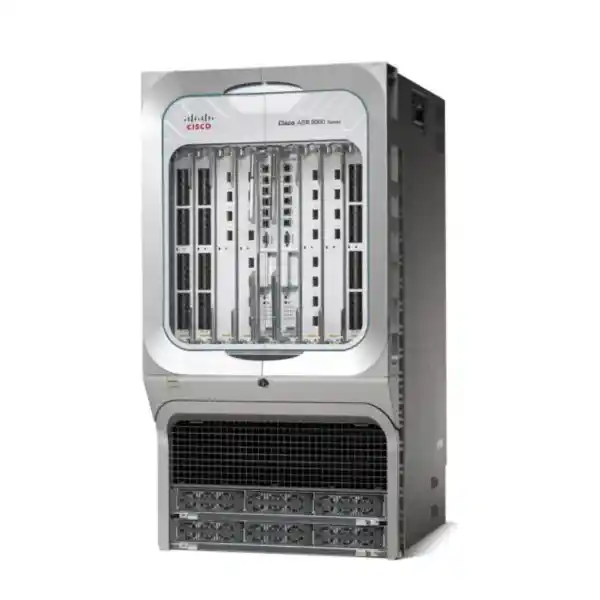
Carrier-class modular routing for high-capacity networks
Cisco ASR 9010 Aggregation Services Router
The Cisco ASR 9010 is a 21 RU modular aggregation-services router designed for service-provider edge and aggregation environments that need high capacity, resilient system architecture and flexible line-card choices. The chassis provides eight line-card slots and two route switch processor slots, while Cisco currently lists the platform at up to 32 Tbps system capacity. It is a platform to evaluate when network growth, service scale and operational continuity justify a large modular chassis rather than a fixed-form-factor router.
8 line-card slots
2 RSP slots
Up to 32 Tbps platform capacity
Cisco IOS XR
Best fit
Service-provider aggregation, IP/MPLS edge, broadband edge, metro Ethernet and high-capacity routing environments that need modular growth and resilient architecture.
Key decision
The chassis alone does not define the solution. Capacity, ports and features depend on the selected RSPs, line cards, optics, licenses and supported IOS XR software combination.
Tanzania planning
Validate rack space, power feeds, cooling, upstream optics, maintenance access and component lifecycle before committing to a deployment or expansion bill of materials.
What the Cisco ASR 9010 is designed to solve
Large networks often reach a point where adding more fixed routers increases operational complexity instead of solving the underlying scaling problem. Multiple devices may each carry separate groups of access links, peering links, customer services or transport paths, while engineering teams have to maintain duplicated routing policy, software baselines, spare inventories and resilience designs. The ASR 9010 addresses a different class of requirement: a modular routing chassis that can aggregate a large number of high-speed interfaces and service functions into one platform with redundant route-switch-processor positions and a broad line-card ecosystem.
For an ISP, carrier, data-centre network, large enterprise backbone or infrastructure operator in Tanzania, the important question is not whether the chassis is “powerful.” The question is whether its architecture matches the traffic model and growth plan. A useful design starts with expected aggregate throughput, interface speeds, port counts, routing-table scale, service types, subscriber functions, convergence targets and redundancy objectives. Those requirements then determine the appropriate RSP generation, line-card families, optics and software release. This is especially important on a platform with a long hardware history, because not every older card supports every newer function, capacity target or software capability.
Verified platform facts at a glance
| Item | Cisco ASR 9010 | Why it matters |
|---|---|---|
| Chassis size | 21 RU | Requires substantial rack allocation and physical planning. |
| Modular slots | 8 line-card slots plus 2 RSP slots | Supports modular interface growth and redundant control-plane design. |
| System capacity | Up to 32 Tbps | Actual usable capacity depends on the installed hardware combination. |
| Power options | AC or DC power infrastructure, depending on configuration | Data-centre and telecom power design must match the exact chassis power version. |
| Airflow | Front-to-back | Rack orientation and hot-aisle/cold-aisle planning should be checked before installation. |
| Operating temperature | Nominal 5°C to 40°C; short-term limits vary by chassis and hardware | Cooling design and installed card limits matter in real deployments. |
The figures above describe the platform, not a promise for every possible build. For example, “up to 32 Tbps” is a chassis-level capability published by Cisco, while line-card bandwidth, port density, forwarding features and optical support depend on the exact cards and software release. A technically correct quotation therefore needs more than a chassis part number. It should identify the RSPs, fan and power system, line cards, transceivers, licenses, accessory kits and software assumptions that make up the intended system.
Modular architecture and expansion strategy
The ASR 9010 chassis is built around eight line-card positions with two central slots reserved for route switch processors. This architecture allows operators to separate chassis investment from interface evolution. Instead of replacing a fixed router when port density or media requirements change, a modular design can allow new line cards to be introduced within the limits of chassis, fabric, software and lifecycle compatibility. That can be valuable where a network must support a mixture of access, aggregation, peering, transport and service-edge interfaces over a long planning horizon.
Modularity also creates engineering responsibility. A legacy line card may physically fit while lacking a newer feature or desired forwarding scale. A high-density card may require a particular route-switch-processor generation, fan tray, power system or IOS XR train. Some line-card families have their own end-of-sale milestones even while the ASR 9010 chassis remains listed by Cisco. Buyers should therefore avoid treating “ASR 9010 compatible” as a complete compatibility statement. Every card should be checked against current Cisco hardware compatibility, software release notes and lifecycle notices before purchase or reuse.
For brownfield networks, the design exercise should begin by documenting the installed chassis power version, current RSPs, line-card PIDs, optics, software release, free slots and operational constraints. For greenfield designs, start with the service and traffic requirements and work backward to the minimum hardware set. In both cases, the result should be a complete bill of materials rather than a chassis-only quote.
Resilience for service-provider operations
Carrier and ISP networks depend on predictable recovery from component failures and planned maintenance. The ASR 9010 provides two RSP positions so designs can use redundant control-plane hardware where the selected configuration supports it. Cisco also documents redundant power approaches for the platform, including AC and DC arrangements, power-module redundancy, A/B feed redundancy and power-entry-module redundancy on the ASR 9010. These capabilities are useful building blocks, but a resilient chassis does not automatically create a resilient service.
End-to-end availability depends on the full topology. Uplinks should be distributed across appropriate line cards and upstream devices. Routing and MPLS designs should provide alternate paths. Power should come from properly engineered independent feeds where required. Optical paths may need physical route diversity. Software maintenance procedures should be validated against the actual feature set and release. Monitoring should cover hardware alarms, environmental conditions, interface errors, routing adjacencies, forwarding health and capacity headroom. When those design layers are combined, the chassis can form part of a robust aggregation or edge architecture rather than becoming a single concentration point with hidden dependencies.
Cisco IOS XR and service-provider routing
The ASR 9000 family runs Cisco IOS XR, Cisco’s service-provider-oriented network operating system. For buyers, the practical value is the availability of mature routing, MPLS and service-provider functions across supported hardware and software combinations. Current Cisco documentation for the platform family covers technologies such as BGP, IS-IS, OSPF, MPLS services, Layer 2 VPNs, EVPN and segment routing. Broadband Network Gateway functions are also documented for ASR 9000 software. These capabilities make the ASR 9010 relevant to networks that need more than basic IP forwarding.
Feature support must still be verified at the card and release level. Cisco explicitly documents limitations for some technologies on older hardware. Segment routing, for example, is not supported on first-generation ASR 9000 Ethernet line cards. A design that assumes a modern control-plane feature without checking the forwarding hardware can therefore fail even when the chassis itself supports the broader software family. The correct procurement approach is to define required protocols and services first, then validate each RSP and line card against an IOS XR release that supports those requirements.
IP/MPLS aggregation and edge roles
One common role for a platform in this class is IP/MPLS aggregation. Access or metro networks can feed into the chassis, where traffic is aggregated toward a provider edge, core or data-centre interconnect. The modular slot count allows the operator to combine different interface densities while maintaining a consistent routing platform. Depending on validated hardware and software, the router can participate in MPLS-based services and Layer 2 or Layer 3 VPN designs. That is useful for carriers delivering enterprise connectivity, mobile transport, wholesale services or multiservice aggregation.
The design should distinguish physical capacity from service scale. Two deployments with the same number of 100G or 400G ports can have very different requirements if one carries simple transit traffic and the other maintains large VPN tables, EVPN state, extensive QoS policy, subscriber sessions or complex telemetry. Memory, forwarding resources and software behavior matter alongside raw interface bandwidth. Buyers should therefore request sizing against the actual routing and service model rather than choosing a chassis only from advertised throughput.
EVPN and modern Ethernet service design
Cisco provides current ASR 9000 documentation for Ethernet VPN features, including single-homed and multihomed Ethernet-segment operation. EVPN can be relevant where operators need scalable control-plane signaling for Ethernet services, data-centre interconnection or provider-edge designs. Multihoming can improve service resilience by allowing customer or access devices to connect through more than one provider edge, subject to the exact topology and feature support.
For an ASR 9010 project, EVPN should be treated as an engineered software-and-hardware requirement, not a marketing checkbox. Confirm the desired EVPN service type, encapsulation, redundancy behavior, route-scale requirements and integration with the rest of the network. Check whether existing line cards are supported for the intended release and whether any operational constraints apply. This is particularly important when integrating older chassis investments into newer service architectures.
Segment routing and traffic-engineering considerations
Segment routing can simplify parts of an MPLS control plane and provide flexible path steering. Cisco maintains segment-routing configuration documentation for ASR 9000 platforms, including contemporary IOS XR releases. This makes the platform family relevant to operators modernizing transport and traffic-engineering designs. However, compatibility varies across generations of hardware, and older first-generation Ethernet line cards do not support segment routing according to Cisco documentation.
If segment routing is a requirement, document whether the design needs SR-MPLS, SR-TE or SRv6 functions, then validate those requirements against the exact RSPs, line cards and target IOS XR release. The same principle applies to EVPN over segment routing and other feature combinations. A feature may exist in Cisco software documentation but still have platform-specific scale or hardware limitations. Predeployment validation is therefore part of the purchase decision, not an optional post-sale task.
Broadband edge and BNG use cases
Cisco documents Broadband Network Gateway capabilities for ASR 9000 Series routers. A BNG sits at a critical point between subscriber access networks and IP services, applying functions related to subscriber session handling, routing, policy and service handoff. This can make the ASR 9010 relevant to broadband providers that need a scalable edge platform, subject to the supported software packaging, licenses, line cards and subscriber-scale requirements of the design.
BNG sizing should be treated separately from generic routing throughput. The engineering team should define expected subscriber sessions, access technology, authentication model, addressing, QoS policy, redundancy, IPv4/IPv6 requirements and integration with AAA or policy systems. A quote should then be built around those requirements. This avoids the common mistake of assuming that a high-throughput chassis automatically meets a particular subscriber scale or feature combination.
High-speed Ethernet and optical planning
Cisco’s current ASR 9000 material positions the ASR 9010 at up to 32 Tbps and documents support for high-capacity line-card options in the platform family. Cisco’s routed optical networking guidance also lists ASR 9010 configurations with up to thirty-two 400G QSFP-DD ports when appropriate supported hardware is used. This does not mean every ASR 9010 can accept any 400G optic or reach that density. The installed RSP, line-card generation, port mode, transceiver, fiber plant and IOS XR release must all be compatible.
Optical design should identify reach, fiber type, connector type, wavelength plan, breakout requirements and interoperability expectations. For coherent or routed-optical designs, validate the exact optics and line-card support rather than substituting a generic “400G” requirement. For shorter data-centre or metro links, confirm whether the intended QSFP, QSFP28, QSFP-DD or other form factor is supported on the chosen line card. Optics are part of the engineered system and should appear in the bill of materials with the same precision as the router cards.
Power, rack and cooling planning for Tanzania deployments
A 21 RU modular router is a facility-planning decision as well as a network decision. The ASR 9010 chassis is approximately 36.75 inches high and roughly 29 inches deep depending on the installed door configuration. Cisco documents front-to-back airflow. Before delivery, confirm the rack type, usable depth, front and rear clearance, cable-management space, mounting hardware, floor loading where relevant, and access path into the equipment room. A chassis that fits the rack on paper can still be difficult to install if doorways, lifts, aisle width or rear maintenance clearance are overlooked.
Power requirements depend heavily on the installed components. Cisco publishes AC input ranges of 200–240 V and DC input ranges of -40 to -72 V for the ASR 9006/9010 platform specifications, with redundancy options varying by the configuration. Older Version 1 power bundles have separate lifecycle notices, while current data-sheet material lists Version 2 and Version 3 power infrastructure components. Do not mix a chassis quote with an assumed power arrangement. Confirm the exact power-entry modules, supplies, feed redundancy and connector requirements before electrical work is planned.
Cooling is equally important. Cisco lists a nominal operating range of 5°C to 40°C for the ASR 9010 and a short-term range extending to 50°C under specified conditions. Those limits are equipment specifications, not a recommendation to run a room near the maximum. Data-centre cooling should maintain suitable inlet temperature and airflow with headroom for environmental events. Fan power can rise significantly at higher temperatures, and individual cards may impose their own environmental constraints. In locations where utility interruptions are possible, UPS, generator and DC-plant strategy should be sized for the complete router load and the required autonomy, not the empty chassis.
Lifecycle and component compatibility matter
The ASR 9010 has been available for many years, and Cisco still lists the model as available in the ASR 9000 support catalogue. At the same time, individual power bundles, line cards, modular port adapters and other components have their own end-of-sale and end-of-life schedules. This distinction is essential when sourcing new equipment, spares or upgrades. A chassis that remains orderable does not make every historical component a current choice.
For a new bill of materials, prefer currently supported component families that meet the feature and capacity requirement. For an expansion of an installed chassis, record the exact part IDs and software release before selecting additions. Review Cisco lifecycle notices for each component and consider how long replacement hardware and software support will be needed. If the project has a multi-year service horizon, lifecycle alignment can be as important as initial purchase cost.
When the ASR 9010 is a strong fit
Aggregation growth
You need more modular interface capacity than a small fixed router can provide, with a path to change line cards as traffic patterns evolve.
Service-provider features
The design requires IOS XR routing, MPLS, EVPN, segment-routing or broadband-edge functions on supported hardware.
Resilient architecture
Redundant RSP and power design are important parts of the availability plan, alongside redundant links and upstream topology.
Long-lived chassis strategy
You value a modular chassis that can be engineered around changing interface generations, with careful lifecycle management.
When to consider a different platform
The ASR 9010 is not automatically the right answer for every high-speed routing requirement. Its 21 RU form factor, facility demands and modular complexity can be excessive for smaller POPs, enterprise branches, compact edge sites or installations with modest port counts. A newer fixed or smaller modular platform may deliver the required interfaces in less rack space and with lower operational overhead. If the target is primarily high-density 400G or newer routed-optical architecture, compare current Cisco platforms and component roadmaps rather than assuming an older chassis is the most efficient choice.
A good comparison should consider usable capacity, port density, power per transported bit, rack footprint, software feature parity, lifecycle horizon, sparing strategy, staff familiarity and migration cost. Existing ASR 9000 experience and installed spares may strongly favor the ASR 9010 in one network, while a greenfield design may favor a newer platform. The purchasing decision should follow the service requirements and total operational context.
Pre-purchase engineering checklist
- Define aggregate throughput, expected three- to five-year traffic growth and required headroom.
- List every required interface speed, media type, reach and port count.
- Specify routing protocols, MPLS services, EVPN, segment routing, BNG and QoS requirements.
- Confirm route-scale, VPN-scale, MAC-scale or subscriber-scale targets where applicable.
- Select RSP and line-card generations that support the required software features.
- Validate the target IOS XR release against every critical hardware component.
- Confirm chassis power version, AC/DC feed design, power supplies and redundancy arrangement.
- Check rack RU, depth, weight, mounting kit, cabling space and front-to-back airflow.
- Size cooling and backup power for the complete installed configuration.
- Review lifecycle notices for the chassis, RSPs, line cards, optics and adapters.
- Define sparing, maintenance and replacement strategy for critical modules.
- Request a complete bill of materials rather than a chassis-only quote.
Brownfield upgrade planning
An existing ASR 9010 can often remain useful when the network around it evolves, but upgrade planning should begin with an inventory. Record the chassis and power-system version, both RSPs, each line card, fan trays, power modules, optics and current IOS XR release. Capture utilization and resource data under normal and peak conditions. Then map the desired new service or capacity increase against Cisco’s supported hardware and software combinations.
If the change introduces higher-speed interfaces, segment routing, newer EVPN functions or different optics, determine whether the existing line cards can support the feature. If a software upgrade is required, review release notes for removed support, minimum hardware versions and operational caveats. If power consumption will rise, recalculate feed and cooling capacity. A brownfield expansion is successful when every dependency is addressed before the maintenance window, not when a new card is simply inserted into an available slot.
Greenfield design approach
For a new deployment, start from traffic and services rather than a preselected hardware list. Build a port map showing access, aggregation, core, peering and management connections. Define redundancy at both chassis and network level. Decide which services will terminate on the router and which will transit through it. Establish the software features required on day one and those expected later. From that design, select an RSP generation and line-card mix with sufficient headroom and a support horizon that matches the project.
This approach also improves commercial comparison. Two quotations can look similar because both contain an ASR 9010 chassis, while one includes modern supported line cards and the other relies on older components with a shorter lifecycle. Asking vendors to identify every part number, support status and software assumption makes those differences visible and reduces procurement risk.
Operations, telemetry and change control
A high-capacity aggregation router should be treated as infrastructure with formal operational controls. Baseline CPU, memory, fabric utilization, interface errors, environmental sensors and routing convergence before major changes. Use network management and telemetry appropriate to the chosen IOS XR release. Establish configuration backup, software image management, rollback and out-of-band access procedures. Maintenance documentation should identify which services depend on each line card and uplink so engineers understand blast radius before changes are made.
Capacity management is also important because modular chassis can hide local bottlenecks. Overall system bandwidth may be high while one line card, bundle, fabric path or external link becomes saturated. Monitoring should therefore look at service and component-level utilization, not only chassis totals. Thresholds should be tied to engineering headroom rather than waiting for interfaces to reach sustained full utilization.
Migration and cutover considerations
When the ASR 9010 is replacing another aggregation or provider-edge platform, migration planning should cover more than physical cabling. Build a service inventory that maps VLANs, routed interfaces, routing peers, MPLS labels, VPNs, QoS policies, access lists, BFD sessions, multicast functions and management dependencies. Determine which configuration constructs translate directly into IOS XR and which require redesign. Validate optics and fiber polarity before the cutover window.
For low-risk migration, stage and test the router with the target software and production-like configuration before moving traffic. Where the topology allows, migrate links or services in controlled groups so monitoring can confirm routing, latency, loss and policy behavior at each step. Define rollback triggers in advance. A modular chassis can consolidate many services, so disciplined cutover sequencing helps avoid turning multiple small migrations into one large operational event.
Frequently asked questions
How many line cards does the Cisco ASR 9010 support?
The chassis provides eight line-card slots and two slots for route switch processors. The supported card mix depends on the selected RSP, power and fan infrastructure, IOS XR release and line-card compatibility.
What is the capacity of the ASR 9010?
Cisco currently lists the ASR 9010 at up to 32 Tbps system capacity. Actual usable throughput and port density depend on the installed hardware and configuration.
Does it support 400G interfaces?
Cisco documents high-speed ASR 9000 configurations and routed-optical designs that include 400G on supported hardware. Do not assume that any ASR 9010 build supports a particular 400G port or optic; validate the exact line card, RSP, transceiver and software release.
Can the ASR 9010 be used for MPLS and EVPN?
The ASR 9000 software family includes MPLS, L2VPN and EVPN capabilities on supported hardware and releases. Feature requirements should be validated against the exact cards and IOS XR version in the proposed system.
Can it be used as a broadband network gateway?
Cisco publishes BNG documentation for ASR 9000 Series routers. A BNG design requires separate sizing for subscriber scale, policy, licensing and feature support rather than relying on chassis throughput alone.
Is the Cisco ASR 9010 end of sale?
Cisco’s current ASR 9000 support catalogue lists the ASR 9010 model as available. Some historical power bundles, line cards, adapters and related components have separate lifecycle notices, so the status of each proposed part number should be checked.
What power does the chassis require?
The platform supports AC or DC power configurations depending on the hardware version. Cisco publishes 200–240 V AC and -40 to -72 V DC input ranges for current ASR 9006/9010 platform specifications. The exact power modules, feed count and redundancy plan must match the selected chassis power infrastructure.
What information is needed for a quotation?
Provide required port speeds and counts, optics and fiber reach, expected throughput, routing and service features, redundancy targets, power preference, rack constraints and the desired software or support horizon. For an expansion, also provide the current chassis, RSP, line-card and IOS XR details.
What to include in the final bill of materials
A usable ASR 9010 solution normally contains more than the chassis. The final bill of materials should identify the exact chassis and power-system variant, route switch processors, line cards, fan trays, power modules, power-entry modules, mounting hardware, cable-management parts, optics, interface adapters where required, software and licenses where applicable, plus the support services chosen for the deployment. Spare strategy may add replacement power modules, fan trays, optics or line cards depending on the site’s operational requirements.
If the proposal is for an existing chassis, the BOM should state what is retained and what is being added or replaced. This avoids ordering parts that are incompatible with the installed power, fan or RSP generation. It also gives operations teams a clear record for future lifecycle and maintenance planning.
Buying guidance for Tanzania
For Tanzanian network operators, the strongest procurement approach is to request a configuration based on engineering requirements rather than asking only for “one Cisco ASR 9010.” State whether the router is for ISP aggregation, provider edge, broadband edge, metro Ethernet, core-adjacent transport, data-centre interconnection or another role. Include the current and forecast traffic levels, required interface types and any mandatory protocols or services. If the project is an upgrade, provide the installed part numbers and software release so compatibility can be checked before quotation.
Price, availability, lead time and warranty can vary by the exact component mix and sourcing channel, so they should be confirmed for the specific quotation rather than assumed from the chassis model. The same applies to local installation, commissioning or support scope. A precise technical request leads to a more useful commercial response and reduces the risk of receiving a chassis that still requires major components before it can enter service.
Support-status verification before purchase
Because the ASR 9010 spans multiple generations of route processors, line cards, power systems and software, support status should be checked at part-number level immediately before ordering. Cisco’s current product catalogue can show the chassis as available while a specific card or adapter used in an older design has already entered an end-of-sale or end-of-support phase. That is not unusual for a long-lived modular platform, but it means a quote needs lifecycle context as well as technical compatibility.
For each proposed component, verify that it is supported in the target IOS XR release and that its lifecycle horizon fits the expected operating period. Where refurbished, spare or inherited hardware is being considered, distinguish physical compatibility from supportability. A component that powers up in the chassis may still be unsuitable for a new service because of feature limitations, software restrictions or a near-term support milestone. Documenting those checks in the design record helps procurement, operations and management understand why a particular hardware generation was selected.
Request a configuration review for the Cisco ASR 9010
Share your target interface speeds, port counts, traffic level, routing and service requirements, preferred AC or DC power design, rack constraints and deployment role. For an existing chassis, include the RSP, line-card, power-system and IOS XR details. A configuration review can then focus on the exact hardware compatibility, capacity headroom and bill of materials needed for your network.
Ask for a complete ASR 9010 solution quotation based on your technical requirements.



Reviews
There are no reviews yet.