
Cisco ASR 9000 Series • Compact Service-Provider Edge Platform
Cisco ASR 9903 Aggregation Services Router for high-capacity edge, aggregation and peering networks
The Cisco ASR 9903 is a 3RU compact routing platform designed for organizations that need dense 10G, 25G, 40G, 100G, 200G and 400G connectivity without moving immediately to a much larger modular chassis. It is relevant to service-provider edge, metro aggregation, Internet peering, data-center interconnect, mobile-edge and large enterprise border designs where resilient control, high port density, precise timing and Cisco IOS XR operations are important. For Tanzania projects, the key buying decision is not simply whether the chassis is fast enough; it is whether the selected route processors, port expansion card, optics, licenses, power feeds, rack depth and software feature set match the actual network role.
*Cisco’s current ASR 9000 model comparison and Routed Optical Networking guidance list the ASR 9903 at up to 7.2 Tbps. The dedicated ASR 9903 datasheet describes up to 3.6 Tbps of nonblocking, full-duplex capacity for the original fixed-board plus 2T expansion configuration. Capacity figures should therefore be validated against the exact hardware, licensing, software release and measurement convention used for the planned deployment.
Why buyers consider the ASR 9903
The ASR 9903 sits in a useful space between smaller fixed routers and large multi-slot aggregation chassis. It gives network architects a compact way to concentrate high-speed Ethernet interfaces while retaining the operational model of the broader Cisco ASR 9000 family. This makes it attractive where rack space is limited but the design still requires dual route processors, redundant switching fabrics, redundant power, redundant fan modules and a service-provider routing operating system. The chassis can start with integrated fixed-board connectivity and use an optional Port Expansion Card (PEC) when the interface mix or capacity requirement grows.
Cisco positions the platform for business provider-edge routing, metro aggregation, cloud edge, Internet peering, data-center interconnect and mobile-edge environments. Large enterprises can also use it as a border or peering router when ordinary branch-class hardware no longer provides the interface density, routing scale, operational resilience or high-speed uplink options required. In Tanzania, these roles can appear in ISP backbone modernization, carrier metro rings, mobile transport, content or cloud interconnects, financial or government networks with high-volume WAN aggregation, and campus or data-center environments that need resilient upstream routing. Those examples describe technical fit, not guaranteed availability for any specific local project.
The value of the ASR 9903 is therefore best understood as architectural flexibility. A team can combine integrated 100GE and 10GE interfaces with optional multirate ports, keep consistent IOS XR tooling with other ASR 9000 deployments, introduce 400GE where justified, and preserve redundancy in a relatively compact footprint. The result can reduce the pressure to overbuy chassis space while still leaving a migration path for faster uplinks. The exact commercial advantage depends on optics, software entitlements, spare strategy, support terms and the capacity model selected, so a bill-of-materials review should happen before quotation.
Hardware architecture and port options
The ASR 9903 uses a fixed chassis architecture with two route-processor positions, two integrated switch fabrics, four power-supply-module positions and four fan modules. Cisco documentation describes the system as supporting redundant route processors, fabrics, power and cooling. This matters for edge and aggregation roles because maintenance and component failures should not automatically translate into a complete loss of forwarding or control-plane capability when the system is designed and configured correctly. Redundancy still depends on the installed bill of materials and the operational design; a chassis does not become fully redundant merely because it can accept redundant components.
| Component | Verified platform detail | Why it matters |
|---|---|---|
| Fixed board | 16 QSFP28-based ports plus 20 SFP+-based ports; Cisco documents up to 1.6T fixed-board bandwidth. | Provides a dense integrated base without consuming a separate line-card slot. |
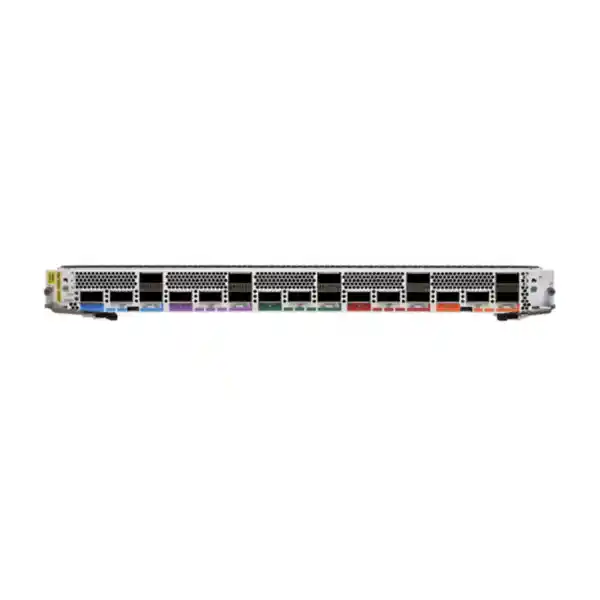
| A9903-20HG-PEC | 20 physical ports and up to 2T data bandwidth; five ports are 400GE/200GE/100GE multirate QSFP-DD/QSFP28 and fifteen are 100GE QSFP28. | Best suited to designs needing high-speed 100G and a migration path to selected 400G links. |
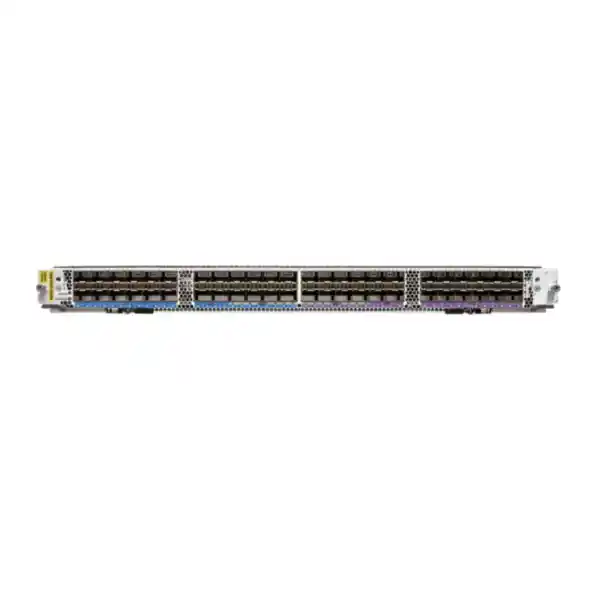
| A9903-8HG-PEC | Cisco’s dedicated datasheet describes 48 physical ports with up to 800G data bandwidth: 32 multirate 25GE/10GE SFP28/SFP+ ports and 16 10GE SFP+ ports. | Useful where the requirement emphasizes more 10G/25G attachment rather than maximum 400G density. |
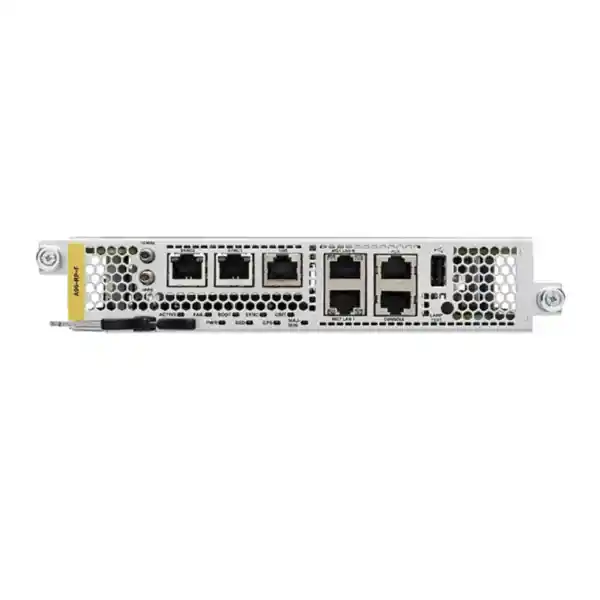
| Route processors | Two route processors are supported; the service-edge route processor documented for ASR 9903 uses a 64-bit Intel CPU and 32GB memory. | Supports resilient control-plane design and IOS XR operations. |
| Power and cooling | Up to four AC or DC 1.6kW power modules and four fan modules; AC and DC supplies are not mixed in the same system. | Enables resilient power design when feeds, modules and site infrastructure are planned correctly. |
On the integrated faceplate, Cisco documents operating combinations such as 16 x 100GE, 15 x 100GE plus 10 x 10GE, or 14 x 100GE plus 20 x 10GE. The reason to pay attention to supported combinations is that a port count on a datasheet does not mean every connector can always run every speed simultaneously. Breakout modes, optics, port grouping, software support and license state can affect the usable design. A procurement request should therefore describe the required number of links at each speed rather than asking only for “one ASR 9903 chassis.”
For 400GE planning, the A9903-20HG-PEC is the key expansion option. Cisco states that five of its ports can operate at 400GE, 200GE or 100GE, with migration to 400GE controlled by the appropriate licensing model. This gives operators a staged path: deploy 100G where that matches current transport or peer capacity, then move selected interfaces toward 400G as traffic, optics and upstream equipment justify the change. The physical and commercial details should be checked at quote time because software consumption models and entitlement structures can change independently of the chassis hardware.
Cisco IOS XR and service-provider feature fit
The ASR 9903 runs Cisco IOS XR 64-bit, the same operating-system family used across many ASR 9000 deployments. For teams already operating IOS XR, this can reduce operational fragmentation because configuration models, automation approaches, telemetry concepts and troubleshooting workflows can remain within a familiar environment. Cisco documents automated installation and provisioning capabilities in IOS XR 64-bit, as well as streaming telemetry that can export operational data to external collectors. These functions are valuable in networks where manual device-by-device monitoring is no longer sufficient.
The ASR 9000 software family supports advanced service-provider technologies including MPLS services, Layer 3 VPN, VPWS, VPLS, EVPN and Segment Routing. Cisco’s Segment Routing documentation describes integration with MPLS services and EVPN, while current EVPN guides cover control-plane MAC learning and multihoming behavior. Whether a particular function is available on an ASR 9903 depends on the exact hardware, interface, IOS XR release and feature entitlement. Buyers should not treat a broad family feature list as proof that every feature is enabled in every ASR 9903 build.
MACsec is another relevant capability for designs that need Layer 2 encryption on supported links. Cisco’s current ASR 9000 security documentation lists MACsec support for the ASR 9903 fixed board and A9903-20HG-PEC from IOS XR 7.1.3, with the removable A9903-8HG-PEC supported from later releases. That makes software-release verification important when security requirements are part of the project. It is also necessary to validate the exact interface and optic design because encryption requirements can influence hardware selection and interoperability testing.
For subscriber edge designs, Cisco documentation includes ASR 9903 hardware support in Broadband Network Gateway environments and identifies support for both the A9903-20HG-PEC and A9903-8HG-PEC in relevant IOS XR releases. BNG deployments are highly configuration-dependent, however, and should be scoped around subscriber scale, services, redundancy, accounting, address management, QoS, lawful or regulatory requirements, and integration with the rest of the provider architecture. The router can be a building block in a BNG solution; it is not by itself a complete broadband-service design.
Timing, synchronization and mobile-edge readiness
Packet networks supporting mobile transport and time-sensitive infrastructure often require more than routing throughput. The ASR 9903 includes hardware-based IEEE 1588 timing support, SyncE support, GPS-related interfaces and BITS interfaces. Cisco documents support for PTP Telecom profiles including G.8265.1, G.8275.1 and G.8275.2. These capabilities help position the platform for mobile-edge and transport roles where network synchronization is part of the design rather than an afterthought.
A Tanzania mobile or carrier-edge project should still define where timing originates, how it is distributed, the boundary or transparent clock behavior required, the expected holdover strategy, and what happens during loss of GNSS or upstream timing. Simply purchasing a router with timing interfaces does not complete the synchronization architecture. Engineers should confirm the intended PTP profile, SyncE requirements, optics, topology and IOS XR support before the configuration is frozen.
Physical design also matters. Cisco describes front-to-back airflow and a 600 mm chassis depth when ejectors are excluded, which can suit many carrier and data-center rack layouts. However, the full installation depth, cable bend radius, rear clearance, hot-aisle/cold-aisle orientation and access for power and service work must be checked against the actual rack. A high-capacity router is a thermal and power-planning decision as much as it is a routing decision.
Practical deployment scenarios
Metro aggregation
Aggregate multiple access or distribution links into high-speed upstream connections while keeping a compact footprint. Evaluate the ratio of 10G/25G/100G access-facing ports to 100G/400G core-facing links, route scale, QoS and redundancy.
Internet peering
Use the ASR 9903 at a network edge where multiple high-capacity peers, transit providers or exchange connections must be terminated. Check BGP policy, full-table requirements, route-policy complexity, optics and DDoS architecture as part of the design.
Data-center interconnect
Connect data-center or cloud-edge locations over high-speed Ethernet where route scale, EVPN/MPLS services, resiliency and 100G/400G migration are important. Validate distance, transceiver type, fiber plant and encryption requirements.
Mobile edge and transport
Support packet transport roles where PTP, SyncE, GPS/BITS connectivity and high-speed aggregation are required. Confirm timing architecture, profile support, redundancy, packet-delay objectives and site environmental conditions.
Provider edge services
Terminate enterprise VPN and Ethernet services using IOS XR capabilities such as MPLS, L3VPN, EVPN or VPWS where supported by the chosen release and hardware. Define service scale and operations before selecting licenses.
Large enterprise border
Use the platform where a major enterprise needs resilient high-speed Internet or WAN edge routing beyond normal branch-router capacity. Evaluate whether service-provider features add useful flexibility or unnecessary complexity for the operational team.
Specifications that affect the physical design
| Form factor | 3RU, 19-inch rack mounting. |
|---|---|
| Dimensions | Cisco lists approximately 131.57 mm x 443.86 mm x 762 mm including ejector bracket/lever; depth excluding ejector is 600 mm. |
| Configured chassis weight | Approximately 37 kg for the documented chassis configuration including two route processors, four PSUs and four fans. |
| Airflow | Front to back. |
| Power modules | 1.6 kW AC or 1.6 kW DC modules, up to four. Cisco documents 2+2 redundancy for DC and AC high-line; AC low-line uses a different redundancy arrangement. AC and DC modules are not mixed. |
| Operating temperature | 5°C to 40°C in the dedicated datasheet, with limitations possible when high-power optics are used. |
| Operating humidity | 10% to 85% relative humidity, nominal, as documented by Cisco. |
For procurement teams, these figures translate directly into site checks. Confirm rack depth and rail compatibility, confirm that the room and rack airflow direction match the router, confirm the number and type of power feeds, and calculate UPS and generator capacity with the actual modules and optics rather than a generic chassis number. High-power coherent or long-reach optics can materially change thermal and power behavior, so optics must be part of the power budget.
In locations where utility interruptions or voltage instability are a concern, resilience should be designed at the facility level as well as inside the router. Dual power feeds are most useful when they come from appropriately independent upstream sources. The choice between AC and DC should align with the existing telecom or data-center power plant, maintenance practices and spares. FourTeck should confirm the required power-supply part numbers and quantities in the quotation rather than assuming one universal bundle.
Choosing the right ASR 9903 configuration
A good ASR 9903 quote starts with traffic and interface requirements, not just the chassis name. The purchasing team should identify current and expected throughput, the number of physical links at each speed, whether interfaces must be breakout-capable, the expected routing table, MPLS or EVPN service scale, whether subscriber services are involved, the need for MACsec, timing requirements, redundancy targets, and the preferred software consumption model. This prevents common errors such as ordering a high-capacity chassis without the right PEC, power modules, optics or licenses.
List 10G, 25G, 40G, 100G, 200G and 400G links separately, including breakout needs and expected migration.
State whether the router will be used for PE, peering, aggregation, DCI, BNG, mobile transport or enterprise border.
Specify route-processor redundancy, power-feed design, spare requirements, maintenance expectations and failover objectives.
Identify BGP, MPLS, EVPN, Segment Routing, MACsec, telemetry, timing, subscriber functions and automation requirements.
Provide fiber type, link distance, connector environment and peer-interface standards so transceivers are matched correctly.
Confirm rack depth, airflow, AC or DC plant, UPS, ambient conditions, cable routing and physical access for service.
If the project is replacing an older ASR 9000 or another vendor’s platform, include the existing interface list and a sanitized configuration summary. Migration planning should cover routing adjacencies, route policies, MPLS labels, L2/L3 VPN services, QoS, multicast, timing, management addressing, telemetry, authentication and rollback procedures. A like-for-like port count does not guarantee a like-for-like service scale, and the correct replacement may depend more on features and operations than on headline throughput.
ASR 9903 compared with nearby ASR 9000 options
Cisco’s current ASR 9000 comparison positions the ASR 9903 between the smaller ASR 9902 and the larger ASR 9904. The most useful difference is not simply capacity; it is how much chassis space, modularity and interface growth the network needs. Current Cisco comparison data lists the ASR 9902 at 2RU and up to 1.6 Tbps, the ASR 9903 at 3RU and up to 7.2 Tbps, and the ASR 9904 at 6RU and up to 16 Tbps. These are family-level maximum figures and should not replace an exact bill-of-materials calculation.
| Model | Rack size | Cisco current maximum | General selection logic |
|---|---|---|---|
| ASR 9902 | 2RU | Up to 1.6 Tbps | Smaller fixed footprint where the port and scale requirement fits. |
| ASR 9903 | 3RU | Up to 7.2 Tbps | Compact high-density edge with one PEC slot and up to five 400G-capable multirate ports on the 20HG PEC. |
| ASR 9904 | 6RU | Up to 16 Tbps | Larger modular choice where additional line-card scale and capacity justify more rack space. |
The ASR 9903 is particularly compelling when the design needs more high-speed density than a small fixed router but does not yet justify a larger multi-line-card chassis. Conversely, it can be the wrong choice when the network requires substantially more modular growth, very different access-port density, or a simpler operational model. FourTeck can review the topology and bill of materials before quotation so that the selected platform reflects the service role rather than only the product family.
Tanzania procurement and deployment checklist
For a Tanzania deployment, procurement should connect technical requirements with practical delivery and site-readiness information. Exact stock, lead time, support entitlement, warranty route, import conditions and delivery schedule must be confirmed for the selected part numbers; they should not be inferred from a general product page. A complete request helps reduce back-and-forth and allows alternatives to be evaluated before the network design is committed.
- Network role: PE, P router, Internet edge, IXP/peering, DCI, metro aggregation, mobile transport, BNG or enterprise border.
- Port plan: required count at 10G, 25G, 40G, 100G, 200G and 400G, including breakout and future-growth assumptions.
- Optics: fiber type, distance, connector type, wavelength, peer hardware and any coherent-optics requirement.
- Routing and services: BGP tables, MPLS, L3VPN, EVPN, VPWS/VPLS, multicast, QoS, Segment Routing, subscriber functions and route-policy requirements.
- Security: MACsec requirement, management-plane controls, AAA, logging, software lifecycle and patch-management expectations.
- Timing: PTP profile, SyncE, GPS/BITS inputs, synchronization source and redundancy model if the deployment supports mobile transport.
- Power: AC or DC preference, independent feeds, UPS or DC plant details, generator strategy and rack power-distribution layout.
- Physical environment: rack size and depth, airflow, room temperature, cable routing, weight loading and access for maintenance.
- Operations: IOS XR release policy, telemetry, automation, configuration management, out-of-band access, spares and escalation process.
- Commercial scope: chassis, route processors, PEC, power supplies, fan modules, optics, licenses, support and any required services should be listed individually in the quote.
Where a project has multiple sites, provide a simple topology showing which locations need ASR 9903-class capacity and which can use smaller edge platforms. This can prevent unnecessary standardization on an oversized router while still preserving a consistent IOS XR architecture at the most demanding nodes. It also makes spares planning more deliberate: some organizations prefer common hardware across critical hubs, while others optimize each site independently. The right answer depends on operational skill, repair strategy and traffic concentration.
Operational considerations before production
A router of this class should be introduced through a controlled engineering process. Build the intended IOS XR release and feature set in a lab or staging environment when practical. Validate interface modes, optics, routing adjacencies, service policies, redundancy behavior and management access before moving customer traffic. For brownfield migrations, confirm how the existing network handles maximum transmission unit, routing timers, BFD, MPLS labels, EVPN multihoming, route reflectors, QoS markings and any proprietary features that may not translate directly.
Software lifecycle matters because advanced features evolve across releases. Cisco’s current support library for the ASR 9000 family continues to publish recent IOS XR configuration guidance, including 2026 documentation for Segment Routing, MPLS, BNG, L2VPN/EVPN, system security and software installation. That ongoing documentation is useful, but it does not mean every new software feature is supported on every older interface. A release selection should be based on the hardware compatibility matrix, feature requirements, Cisco recommendations and the organization’s own qualification policy.
Observability should also be designed from the beginning. IOS XR 64-bit supports streaming telemetry, and the ASR 9903 offers carrier-class OAM capabilities described by Cisco, including tools such as NetFlow, IP SLA, ping, traceroute and Ethernet OAM functions. Define which counters and state information will be collected, where telemetry is stored, how alerts are generated, and which thresholds represent actual customer-impacting conditions. High-capacity links can fail softly through errors, congestion or optical degradation long before they fail administratively.
Finally, document the deployed bill of materials and software state. Record chassis and module part numbers, serials, optic types, licenses, management addresses, cable labels, power feeds, IOS XR version and rollback information. This documentation is especially valuable when systems are installed in remote points of presence or shared facilities where the engineer responding to an incident may not be the engineer who designed the network.
Licensing, optics and ordering details that should not be overlooked
Cisco documents the ASR 9903 under both traditional purchasing and software flexible-consumption approaches. The exact commercial model affects which chassis and software part numbers appear on the bill of materials, and high-speed feature activation can be tied to licensing. For example, the A9903-20HG-PEC provides multirate physical interfaces that can migrate toward 400GE, but the hardware connector alone is not proof that every 400G function is already licensed for use. Procurement teams should therefore ask for the hardware, software entitlement and support components to be shown separately instead of accepting a single-line description such as “ASR 9903 complete.”
Optics need the same discipline. The router’s QSFP28, QSFP-DD, SFP28 and SFP+ interfaces create many possible combinations, but transceivers must be chosen for the required Ethernet rate, reach, fiber type, wavelength plan and peer compatibility. A 100G link across a data hall is a different optical requirement from a 100G metro link, and a 400G coherent design is different again. Breakout designs also need the correct cable or optic type and confirmation that the intended parent port and software release support the desired child interfaces. For an existing network, provide the exact optic models at the far end so compatibility can be checked before shipment.
Spares planning should cover more than the chassis. Depending on the criticality of the site, an organization may need spare power supplies, fan modules, route processors, optics or a strategy for replacing the PEC. The appropriate spare level depends on how many ASR 9903 systems are deployed, how remote the sites are, the support contract, and how quickly a failed component can be replaced. A network with several common nodes may justify centralized spares, whereas a single critical site may place more emphasis on vendor support and immediate component redundancy.
Finally, confirm lifecycle status at the time of order. Cisco’s current support page lists the ASR 9903 as available to order, but individual PIDs, software bundles, optics and accessories can have different lifecycle dates. A valid platform family does not guarantee that every historical part number remains the best orderable choice. FourTeck should therefore prepare the quote against current Cisco ordering information and the exact project date, while any proposed substitute should be reviewed for technical equivalence before acceptance.
Migration planning for existing carrier and enterprise networks
When the ASR 9903 is introduced into an existing routed network, migration risk can be more important than chassis installation. Start by identifying every adjacency and service touching the router that will be replaced or augmented. For BGP, document peer addresses, address families, route-policy behavior, maximum-prefix settings and any communities used for traffic engineering. For MPLS or Segment Routing, document the IGP, label or SID conventions, traffic-engineering policies and fast-reroute expectations. For EVPN, capture route-target design, Ethernet segments, multihoming mode and any dependency on specific convergence behavior.
The physical migration plan should map old ports to new ports and include optics, patching, fiber polarity, breakout mapping and labeling. If interfaces are moving from 10G to 100G or from 100G to 400G, confirm that the remote endpoint, intermediate optical system and fiber plant support the new rate. Where parallel operation is possible, bring up routing and service validation before the final traffic cut. Where it is not possible, prepare a tested rollback procedure with clear decision points so an unexpected interoperability issue does not become an open-ended outage.
After cutover, validate more than simple reachability. Check routing-table size and stability, CPU and memory behavior, interface errors, optics levels, queue drops, latency-sensitive services, timing state where applicable, telemetry, logging, redundancy and failover. Compare these observations with the pre-migration baseline. The purpose of a high-capacity edge upgrade is not merely to pass traffic on day one, but to create a platform that the operations team can monitor, maintain and expand predictably over the life of the deployment.
Frequently asked questions
What is the Cisco ASR 9903 used for?
Cisco positions the ASR 9903 for business provider-edge routing, metro aggregation, cloud edge, Internet peering, data-center interconnect and mobile-edge use. Large enterprises may also use it as a resilient high-capacity border or peering router. The correct role depends on routing scale, interface mix, software features and operational requirements.
How much capacity does the ASR 9903 support?
Cisco’s current ASR 9000 comparison and Routed Optical Networking guidance list the ASR 9903 at up to 7.2 Tbps. The dedicated ASR 9903 datasheet describes up to 3.6 Tbps of nonblocking, full-duplex capacity for the original fixed-board plus 2T PEC configuration. Because these figures use different presentation conventions and may reflect platform evolution, capacity should be confirmed against the exact bill of materials and software/licensing model.
Does the ASR 9903 support 400 Gigabit Ethernet?
Yes, with the A9903-20HG-PEC. Cisco documents five multirate ports on that expansion card that can support 400GE, 200GE or 100GE using supported QSFP-DD/QSFP28 options. 400GE use is license- and configuration-dependent, so the exact entitlement and optics should be confirmed when quoting.
What ports are built into the chassis?
The fixed board includes 16 QSFP28-based ports and 20 SFP+-based ports. Cisco documents supported faceplate combinations including 16 x 100GE, 15 x 100GE plus 10 x 10GE, and 14 x 100GE plus 20 x 10GE. The actual operating combination should be validated against the planned software release and interface mode.
Does the router support redundant components?
The platform supports two route processors, two integrated switch fabrics, up to four power modules and four fan modules, with redundant configurations documented by Cisco. Achieving the desired resilience requires ordering and installing the appropriate components and connecting power to a suitably redundant facility design.
Can the ASR 9903 be used for mobile transport?
It can fit mobile-edge and transport architectures because Cisco documents hardware-based IEEE 1588, SyncE, GPS/BITS interfaces and PTP Telecom profile support. Engineers should confirm the exact PTP profile, timing topology, holdover design, software release and upstream synchronization sources for the intended network.
Does the ASR 9903 support MACsec?
Cisco documents MACsec on the ASR 9903 fixed board and A9903-20HG-PEC from IOS XR 7.1.3, with support for the A9903-8HG-PEC from later releases. Exact interface support and the chosen software release should be checked before MACsec is made a mandatory design assumption.
Is the ASR 9903 suitable for BNG?
Cisco’s ASR 9000 BNG documentation lists the ASR 9903 and its supported PEC options in the hardware-support matrix. A production BNG design must still be sized for subscriber sessions, services, policy, redundancy, accounting, QoS and software feature support rather than selected only by chassis model.
What should be supplied when requesting a quote in Tanzania?
Provide the intended network role, required port speeds and counts, preferred PEC, optics and fiber distances, routing and service features, power type, redundancy target, rack constraints, software or support requirements, destination and quantity. If replacing an existing router, include current model numbers and a sanitized interface/service summary.
Is price or stock confirmed on this page?
No. Price, stock, delivery time, warranty route and support entitlement should be confirmed for the exact ASR 9903 part numbers, licenses, optics, quantity and Tanzania destination at quotation stage. This page is intended to help define the correct technical requirement before a commercial commitment is made.
Request an ASR 9903 configuration review and quotation
For a useful Cisco ASR 9903 quotation in Tanzania, send the planned network role, expected throughput, port-speed mix, fiber distances, routing/service requirements, redundancy target, AC or DC power preference, required optics, quantity and project destination. If you already have a bill of materials, include the Cisco part numbers so the configuration can be checked for completeness before commercial review.
Recommended next step: request a configuration review before ordering. The review should confirm the chassis variant, route processors, PEC, power modules, optics, software/licensing requirements and support scope for the intended deployment. This avoids relying on a generic chassis description when the real requirement is a complete, compatible routing system.



Reviews
There are no reviews yet.