
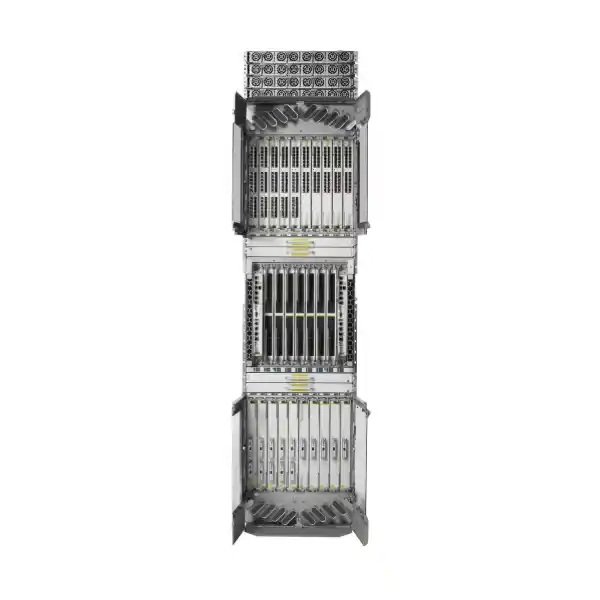
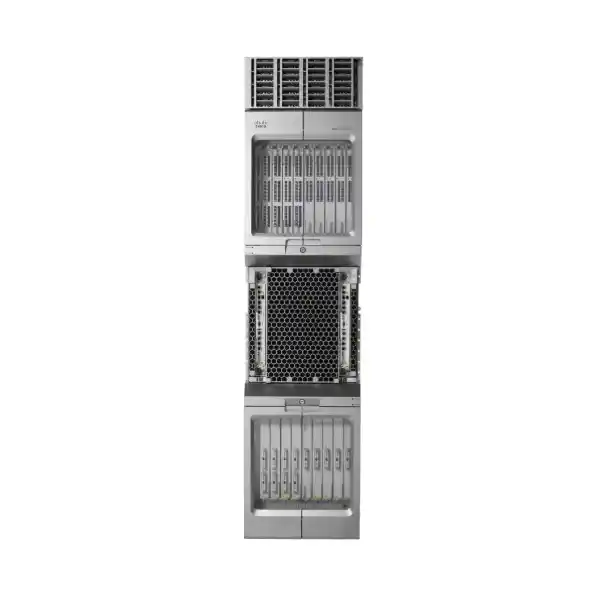
Cisco ASR 9922 Aggregation Services Router
The Cisco ASR 9922 is the largest modular chassis in the ASR 9000 family, designed for high-capacity edge, core, aggregation, peering and multiservice transport roles where interface density, resilient forwarding and long-term expansion matter. Cisco specifies a 44RU chassis with 20 line-card slots, two route-processor slots, seven fabric-card slots, up to 4 Tbps bandwidth per slot and up to 160 Tbps system capacity when the appropriate hardware generation is used.
For a Tanzania deployment, the buying decision should be based on the complete engineered configuration—not the chassis name alone. Line cards, route processors, fabric generation, optics, software release, licenses, AC or DC power, cooling, rack layout and traffic-growth assumptions all affect what the finished system can deliver. Use this page as a planning guide, then request a configuration review against your actual services and interfaces before purchase.
Quick answer: who should evaluate the ASR 9922?
The ASR 9922 is most relevant when a network requires substantially more modular capacity and port-growth headroom than a compact or mid-size router can provide. Typical design discussions include national or regional service-provider aggregation, large IP/MPLS edge nodes, internet peering, converged business and mobile services, high-capacity interconnection, and core or super-core roles where a large number of high-speed interfaces must be concentrated in one chassis. It is not automatically the right choice simply because it is the largest chassis. A 44RU system consumes significant rack space and requires careful power, cooling, floor-loading, cabling and maintenance access planning.
A sound selection process therefore begins with ports, traffic, services and failure-domain requirements. If the expected three-to-five-year design can be met comfortably by a smaller ASR 9900 chassis, the smaller platform may reduce facility complexity. If the design calls for a dense mix of 100G and 400G interfaces, extensive route scale, multiple service roles and future slot growth, the ASR 9922 can provide the physical and switching foundation for that requirement.
Verified platform specifications
| Item | Cisco ASR 9922 | Planning note |
|---|---|---|
| Rack size | 44RU | Reserve suitable rack height, depth, service clearance and cable-management space. |
| Line-card slots | 20 | Line cards are selected separately according to port type, density, scale and service profile. |
| Route processors | 2 slots | Use a supported redundant pair and validate software compatibility with the chosen card generation. |
| Fabric cards | 7 slots | Cisco describes a 6+1 redundant fabric design; fabric generation affects achievable slot capacity. |
| Bandwidth per slot | Up to 4 Tbps | Treat this as a platform maximum, not a guarantee for every installed line card or older fabric combination. |
| Maximum system capacity | Up to 160 Tbps | Capacity is dependent on the supported hardware generation and system build. |
| Chassis height | 77 in / about 1955 mm | Confirm rack opening, delivery path and safe lifting/installation procedures. |
| Width | 17.60 in / about 447 mm | Cisco documents rack-mount adapter options for common telecom rack widths. |
| Depth | About 30.68 in with doors | Allow additional working room for cabling, doors and airflow; do not size a rack from chassis depth alone. |
| Airflow | Front-to-back | Coordinate cabinet orientation and hot-aisle/cold-aisle practice with the site cooling design. |
| Nominal operating temperature | 5°C to 40°C | Facility cooling should be designed for continuous operation within the supported environmental range. |
| Power options | AC or DC architectures | Power-module quantity and feed design must be calculated for the actual installed cards and redundancy objective. |
Specifications above summarize Cisco-published platform data. Feature availability, port combinations, scale and performance depend on the exact route processors, fabric cards, line cards, optics, software release, licenses and configuration. Always validate a final bill of materials against current Cisco compatibility and release documentation.
Why the chassis architecture matters
Large routing platforms are not single fixed-function appliances. The chassis provides a common mechanical, power, cooling and backplane environment; the installed route processors, fabric cards and line cards determine how that platform behaves. In the ASR 9922, forwarding is distributed across the line cards rather than being dependent on one central forwarding engine. This architecture is intended to support high interface density and scale while keeping control-plane and forwarding responsibilities appropriately separated.
The seven fabric-card positions are another important design point. Cisco documents the platform around a redundant fabric architecture, while newer fabric and line-card generations raise the amount of bandwidth that can be delivered to each slot. This is why an upgrade conversation must include more than the new line card. Cisco explicitly notes that some newer 400G-capable cards can require updates to fabric cards, route processors or route switch processors, and cooling components. A chassis that is physically compatible with a card may still need surrounding hardware changes before the intended capacity or interface mix is supported.
For procurement, ask for the proposed chassis, route processors, fabric cards, fan trays, power entry modules, individual power supplies, line cards, optics, software and licenses as one reviewed system. If the project is an expansion of an existing ASR 9922, provide the current inventory and software release so compatibility can be checked before new components are ordered.
High-speed interfaces and line-card choices
Cisco’s current ASR 9000 portfolio includes line-card options spanning multiple interface generations, including 10G, 25G, 40G, 100G and 400G capabilities. For ASR 9922 designs, fifth-generation high-density and multi-rate cards are particularly relevant when the objective is 100G or 400G growth. Cisco documents 5th-generation A99 line cards for the ASR 9922, including 4 Tbps 10-port 400 Gigabit Ethernet variants as well as other high-density multi-rate cards. Exact port breakout, optical support and service scale are card-specific.
Packet transport profile
Transport-optimized line cards are suitable where the priority is high-density forwarding and a basic QoS profile. Confirm the scale and feature requirements before assuming a transport-optimized card can replace a service-edge variant.
Service-edge profile
Service-edge-optimized variants are designed for richer edge functions such as enhanced hierarchical QoS. They can be appropriate when many customer or service classes need granular traffic treatment.
Mixed-rate expansion
Multi-rate cards can simplify migrations where 10G, 25G, 40G, 100G or 400G interfaces coexist. Optical type, breakout behavior and supported combinations still need to be checked per card and software release.
Do not choose a card solely from port count. Consider packet scale, route scale, QoS scale, service types, expected oversubscription, optic reach, transceiver format, redundancy, fabric compatibility, fan requirements and software support. These details determine whether the finished router matches the engineering requirement.
Cisco IOS XR and multiservice routing
The ASR 9000 family runs Cisco IOS XR, Cisco’s carrier-oriented network operating system. Cisco positions IOS XR for distributed, high-availability routing and service-provider operations. On the ASR 9000 family, supported technologies include IPv4, IPv6, MPLS, Segment Routing, SRv6, EVPN, VXLAN, L2VPN, L3VPN, multicast, integrated routing and bridging, Ethernet OAM, MPLS OAM, access control lists, hierarchical QoS, traffic-engineering functions and high-availability mechanisms. The exact feature set available on an ASR 9922 depends on the installed line cards, route processors, software train and licensing.
This breadth allows one chassis to be considered for multiple network roles. A provider can use the same hardware family for packet transport, Ethernet services, MPLS VPN services and modern Segment Routing designs rather than deploying a different router family for every function. Operational consistency can be valuable when engineering teams already have IOS XR standards for routing policy, telemetry, change control and troubleshooting.
However, a broad software feature list should not be mistaken for a promise that every feature combination scales equally on every card. Before procurement, define the intended role in concrete terms: number of BGP peers, expected IPv4 and IPv6 routes, VPN route scale, labels, EVPN instances, L2 and L3 interfaces, QoS queues, ACL entries, multicast requirements and convergence objectives. The design can then be checked against the selected hardware and software release.
IP/MPLS, Segment Routing and EVPN design possibilities
For established provider networks, MPLS remains an important service and transport foundation. The ASR 9000 software portfolio supports MPLS-based L2VPN and L3VPN services together with traffic engineering and operations, administration and maintenance functions. This can make the ASR 9922 suitable for large aggregation and provider-edge positions where business, wholesale, mobile or infrastructure traffic shares a common packet core.
For modernization projects, Segment Routing can reduce reliance on separate label-distribution and RSVP-TE signaling mechanisms for many traffic-engineering use cases. Cisco’s IOS XR documentation covers Segment Routing over MPLS and SRv6 capabilities on the ASR 9000 family, including integration with VPN and EVPN services. EVPN provides a BGP-based control plane for Ethernet services and supports operational models such as single-homing and multihoming. These technologies are especially useful when a network is moving toward a more programmable and policy-driven architecture.
The practical migration path depends on the current network. An operator with an established LDP/MPLS core does not need to redesign everything simply to deploy an ASR 9922. The platform can be introduced into an existing architecture and later used in a broader Segment Routing plan if the business case justifies it. Conversely, a greenfield build can standardize on newer protocols from the start. In both cases, software interoperability, peer capability, convergence testing and operational tooling deserve the same attention as forwarding capacity.
Common deployment scenarios
High-capacity aggregation
Concentrate many access, metro or regional links into a resilient Layer 3 and MPLS aggregation point with room to expand port density over time.
Internet peering and edge
Use high-speed interfaces and scalable routing for upstream transit, internet exchange, content-network or large external BGP interconnection designs.
Provider IP/MPLS edge
Terminate and transport Layer 2 and Layer 3 VPN services while applying routing policy, QoS and resiliency appropriate to enterprise and wholesale services.
Core routing
Build a large packet-routing node where high slot bandwidth, many 100G/400G interfaces and redundant fabrics are more important than a compact physical footprint.
Mobile transport
Support high-bandwidth mobile backhaul or transport architectures where timing, MPLS, Ethernet services and deterministic traffic engineering are part of the design.
Network convergence
Reduce separate transport domains by converging business, wholesale, infrastructure and other packet services onto a common routing platform where the service model allows it.
Resilience and high-availability planning
Carrier-class availability is achieved through architecture and configuration rather than through a model name. The ASR 9922 provides redundant route-processor positions, redundant fabric capacity, multiple fan trays and modular power infrastructure. IOS XR also includes routing and forwarding resiliency mechanisms. These elements can reduce single points of failure, but only when the system is built and cabled to preserve the intended redundancy.
Power feeds are a good example. Installing multiple power supplies does not automatically create facility-level resilience if every module ultimately depends on the same upstream breaker, UPS or generator path. A high-availability design should trace each power feed from the chassis through distribution equipment to the facility source. The same principle applies to fiber routes: diverse router ports provide limited protection if both circuits share the same duct, patch panel or upstream device.
Control-plane redundancy also needs operational preparation. Software versions, route-processor pairing, graceful restart behavior, Nonstop Routing or Nonstop Forwarding features, BFD timers and routing-protocol convergence should be tested according to the production design. Maintenance procedures should define how a fabric, line card, route processor or software package can be serviced without creating an avoidable outage.
For a critical Tanzania node, include redundancy acceptance tests in the commissioning plan. Simulate the loss of a route processor, a power feed, a selected link and an upstream peer where safe to do so. Confirm not only that the router remains reachable, but that customer or backbone traffic converges within the target service objective.
Power, cooling and rack planning for Tanzania sites
The ASR 9922 is a large infrastructure platform, so facility readiness should be assessed before a purchase order is finalized. Cisco supports AC and DC power architectures, with the required number and type of power modules depending on the system generation and installed load. Cisco provides a power-calculation approach because consumption varies with line cards, optics and configuration. The design team should therefore calculate the expected and worst-case electrical load for the proposed bill of materials rather than using a generic chassis figure.
In Tanzania, the practical questions include the available utility supply, UPS architecture, generator capacity, DC plant where applicable, distribution-board capacity, breaker sizing, earthing, power-feed diversity and maintenance bypass strategy. Those requirements are site-specific and should be reviewed by qualified electrical and facility personnel. The router’s front-to-back airflow must also match the cabinet and aisle layout. Obstructed intake, recirculated exhaust air or insufficient room cooling can undermine an otherwise correct network design.
Physical access deserves equal attention. At 44RU, the chassis occupies essentially the full active height of a standard 42U rack and therefore requires an appropriate taller telecom or equipment rack arrangement rather than being treated as an ordinary data-center appliance. Confirm doorways, lift access, floor loading, rack anchoring, service clearance and the installation method before delivery. The fully built system is heavy, and safe installation requires suitable handling equipment and procedures.
Environmental monitoring should include inlet temperature, room temperature, humidity and power conditions. Cisco publishes a nominal operating temperature range of 5°C to 40°C for the platform. Short-term ranges are not a substitute for normal environmental control. Design cooling for continuous normal operation and treat any extended high-temperature operation as a facility issue that should be corrected rather than accepted as routine.
Routing automation, telemetry and operations
A router of this scale is usually managed as part of a larger operations system rather than through occasional manual CLI sessions. IOS XR supports model-driven programmability using YANG data models and protocols such as NETCONF and gRPC on supported 64-bit platforms. This makes it possible to automate configuration, inventory, validation and telemetry workflows when the selected software release and platform support the required interfaces.
Automation should be introduced with the same engineering discipline as routing. Define a source of truth, configuration ownership, approval process, rollback mechanism and credential model. Use pre-change and post-change checks to confirm routing adjacencies, interface state, traffic levels, alarms and service health. Large routers often carry many unrelated services, so a small configuration error can have a much larger impact than it would on a branch device.
Telemetry can help operations teams move from reactive troubleshooting to measurable capacity planning. Interface utilization, errors, queue drops, optical levels, routing events, CPU, memory, environmental sensors and fabric health can all be incorporated into monitoring. The objective is not to collect every counter indefinitely; it is to define data that answers operational questions. For example: Which peering ports are approaching upgrade thresholds? Are any queues consistently discarding traffic? Is an optic deteriorating? Is one line card running unusually hot? Are route counts trending toward platform or policy limits?
When requesting an ASR 9922 solution, state whether your operations team expects CLI-only management, centralized NMS integration, model-driven automation, streaming telemetry, configuration backup or orchestration. Management and security requirements can then be included in the design rather than added after the router is installed.
Important compatibility note for upgrades
The ASR 9922 has existed across several hardware generations. That longevity is useful, but it also means an older installed chassis can contain route processors, fabric cards, fan trays, power modules and line cards from earlier generations. Do not assume that a new high-speed line card can simply be inserted into every existing ASR 9922 configuration.
Cisco documentation for newer 400G line cards states that the chassis may require hardware updates to fabric cards, route processors or route switch processors, and cooling systems. Some cards also have specific fan-tray requirements. For an expansion project, provide the exact current part numbers and IOS XR release. A compatibility review can then determine whether the change is a simple line-card addition, a staged infrastructure upgrade or a wider platform refresh.
ASR 9922 vs smaller ASR 9900 chassis
The ASR 9922 should be selected for a measurable capacity or density reason. Cisco’s modular ASR 9900 range includes smaller chassis with the same broad software family but fewer line-card slots and lower maximum system capacity. For many networks, that creates a useful choice between facility efficiency and consolidation.
| Model | Rack size | Line-card slots | Published max capacity | Best fit |
|---|---|---|---|---|
| ASR 9906 | 14RU | 4 | 32 Tbps | Smaller high-capacity nodes with limited slot-count requirements. |
| ASR 9910 | 21RU | 8 | 64 Tbps | Medium-to-large aggregation and edge nodes needing more modular growth. |
| ASR 9912 | 30RU | 10 | 80 Tbps | Large nodes that need substantial capacity without the 20-slot footprint. |
| ASR 9922 | 44RU | 20 | 160 Tbps | Maximum modular density, expansion room and large-node consolidation. |
The smaller models are not simply “less capable” versions of the ASR 9922. They can be the better engineering choice when rack efficiency, failure-domain separation, power distribution or site constraints matter more than maximum slot density. Some operators intentionally deploy more than one smaller chassis to separate roles or improve physical diversity. The correct comparison therefore includes topology and operational risk, not just terabits per second.
How to size the router from real traffic requirements
Start with current traffic and interface inventory. Record each 10G, 25G, 40G, 100G or 400G circuit, whether it is customer-facing, backbone-facing, peering-facing or internal, and its current peak utilization. Then add known projects and realistic growth. The objective is not to create an inflated forecast; it is to prevent a new chassis from reaching an avoidable slot or port-density limit during its planned service life.
Next, map services to those interfaces. A 100G internet peer may need comparatively simple forwarding but very large routing tables and policy. A 100G enterprise aggregation interface may carry many subinterfaces, VPNs, QoS policies and ACLs. A mobile transport link may add timing and traffic-engineering requirements. The same port speed can therefore create very different resource demands.
Then define resilience. Decide whether dual-homing, MC-LAG, ECMP, fast reroute, redundant route processors, diverse optics or dual router nodes are required. Some capacity must often be reserved for failure conditions. If normal traffic uses 70 percent of a group of links, losing one member can push the survivors above safe operating levels. Capacity planning should therefore model both normal and degraded states.
Finally, translate the requirement into a line-card and slot plan. Leave deliberate room for expansion, but avoid installing unnecessary hardware years before it is needed. The ASR 9922’s modular architecture supports incremental growth; an engineered bill of materials can balance initial cost, facility load and future expansion.
Optics and cabling are part of the router design
High-speed routing projects often fail at the interface between the router and the optical design. Port speed alone does not define a connection. The required transceiver depends on fiber type, reach, wavelength, connector, patching loss, remote equipment and any optical transport system between endpoints. For 100G and 400G links, these choices can materially affect cost and operational flexibility.
Prepare an interface schedule showing the A-end and B-end device, distance, fiber type, patching points, expected optical budget and required speed. Where links pass through a DWDM system, confirm whether the router uses grey optics to a transponder, coherent pluggables, or another architecture supported by the selected card. Cisco’s routed optical networking portfolio includes ASR 9000 line-card options for high-speed optical integration, but exact ZR or ZR+ support depends on the line card, optic and software release.
Spare strategy should also be intentional. Stocking only chassis spares is of little value if the likely failure item is a transceiver with a long replacement path. For critical sites, identify which optics, fans, power modules, line cards or route processors need local or regional sparing based on service impact and support arrangements.
Software release, licensing and lifecycle checks
Cisco currently lists the ASR 9922 platform as available in its support catalog. That status does not mean every historical ASR 9922 component remains orderable. The platform has been in the market for many years, and Cisco has issued end-of-sale notices for various older line-card, power, fan and accessory generations while introducing newer replacements. A current bill of materials should therefore use supported components rather than copying part numbers from an older deployment.
Software compatibility should be checked at the same time. New route processors and line cards can require a minimum IOS XR release, while an existing network may have operational reasons to remain on a particular software train until interoperability testing is complete. Build an upgrade path that accounts for configuration migration, image size, maintenance windows, route-processor redundancy, rollback and feature validation.
Licensing is also configuration-dependent. Some hardware and software are offered under flexible consumption or subscription models, while traditional ordering options also exist. The correct commercial model depends on the selected components and features. Do not infer license entitlement from the chassis alone. A quotation should itemize required software and licenses so the engineering and procurement teams can compare complete solutions rather than incomplete hardware lists.
Tanzania deployment checklist
- Define the network role. State whether the node will be core, peering, aggregation, provider edge, mobile transport or a combination.
- List interfaces and optics. Include present and planned port speeds, fiber reaches, connector types and remote-device details.
- Document routing scale. Provide BGP peers, expected route counts, IPv4/IPv6 use, VPN requirements, multicast and routing-policy complexity.
- Document service scale. Include subinterfaces, L2VPN/L3VPN, EVPN, QoS, ACL, MPLS or Segment Routing requirements as applicable.
- Choose the redundancy model. Define route-processor, fabric, power, uplink and node-level resilience requirements.
- Confirm facility readiness. Check rack dimensions, floor/loading constraints, cooling, front-to-back airflow, UPS or DC plant, generators and feed diversity.
- Review compatibility. For an existing ASR 9922, provide all current chassis components and IOS XR version before adding newer cards.
- Plan operations. Define NMS, telemetry, automation, configuration backup, AAA, logging, NTP and out-of-band management requirements.
- Set acceptance tests. Include throughput, routing, failover, optics, alarms, management and service tests before production cutover.
- Request a complete bill of materials. Ensure the quote includes the chassis and all required route processors, fabrics, fans, power hardware, line cards, optics, licenses and support items.
Migration from an existing core or aggregation router
A chassis migration should be planned as a service migration, not just a rack-and-stack exercise. Begin by collecting the existing routing table, BGP neighbors, IGP adjacencies, MPLS label protocols, VPNs, interface configurations, QoS policies, ACLs, multicast state, timing configuration, management services and monitoring dependencies. This inventory reveals features that may otherwise be discovered only during the cutover.
Build the ASR 9922 in a staging environment where possible. Load the intended IOS XR release, install the final hardware combination, validate optics, configure management and apply a representative production configuration. Route-policy behavior and prefix filtering deserve particular attention because subtle differences can affect a large number of destinations. If the migration introduces Segment Routing or EVPN at the same time, separate the project into testable stages rather than combining every architectural change into one maintenance window.
For live cutover, identify which circuits can be moved incrementally and which create shared failure dependencies. Dual-attached customers or peers may be migrated one link at a time. Single-homed services may require a defined outage. Coordinate both ends of high-speed links, especially when optic types or breakout modes change. Keep rollback criteria explicit: if route counts, loss, latency, errors or application tests exceed agreed thresholds, the team should know when to return traffic to the previous path.
After migration, compare the observed network state with the pre-change baseline. Check route counts, forwarding paths, interface errors, optical power, QoS drops, CPU, memory, fabric alarms, environmental readings and customer-facing service indicators. A migration is complete only when the new router is stable, documented and incorporated into monitoring and support procedures.
What to include in a quotation request
A useful ASR 9922 quotation starts with engineering information. Provide the number of sites, intended router role, target software strategy, current and future interfaces, approximate peak traffic, expected route scale, MPLS or Segment Routing requirements, EVPN or VPN services, multicast, QoS and high-availability objectives. If the router will replace an existing platform, include the current model and a sanitized configuration summary or feature inventory.
Also provide facility details: AC or DC preference, available feeds, UPS or DC plant capacity, cabinet dimensions, rack type, airflow direction and any environmental or access restrictions. For optics, list each connection distance and fiber type. If exact distances are not known, identify whether links are within the same room, same building, metro area or long-haul path so the optical design can be refined.
The resulting proposal should make clear what is included and what is not. It should distinguish chassis hardware, route processors, fabric cards, line cards, power modules, fan trays, optics, licenses, support and implementation services. This makes technical review easier and prevents comparisons between one quote that includes a complete system and another that includes only a base chassis.
Buying considerations and limitations
- It is physically large. A 44RU chassis is unsuitable for sites that cannot provide the required rack height, depth, cooling and service access.
- Maximum capacity is configuration-dependent. The published 160 Tbps figure requires the appropriate modern fabric and line-card architecture; older installed systems may provide lower slot bandwidth.
- High-speed cards can trigger wider upgrades. Fabric, route processor and cooling changes may be required when introducing newer 400G cards into older systems.
- Power planning is not optional. The number of supplies, feeds and facility capacity depends on the installed cards and redundancy objective.
- Feature scale varies. Routing, QoS, EVPN, ACL and VPN scale should be verified against the exact line card and IOS XR release.
- Optics can represent a major part of the project. Transceivers must be selected from reach, fiber and interoperability requirements rather than from speed alone.
- Chassis consolidation increases failure-domain size. Concentrating many services in one node can be efficient, but the architecture should also consider node-level diversity and maintenance risk.
Frequently asked questions
How many line cards does the Cisco ASR 9922 support?
The chassis provides 20 line-card slots. The usable port density and services depend on which supported line cards are installed, their generation, and the surrounding route-processor, fabric and cooling configuration.
What is the maximum capacity of the ASR 9922?
Cisco’s current model comparison lists up to 160 Tbps system capacity and up to 4 Tbps bandwidth per slot. These are platform maximums and should be validated against the exact hardware generation and line-card mix proposed for the project.
Does the ASR 9922 support 400 Gigabit Ethernet?
Yes. Cisco documents multiple ASR 9000 fifth-generation 400G-capable line cards as compatible with the ASR 9922. Some existing chassis configurations may require upgrades to fabric, route processors or cooling before those cards are deployed.
Can it be used for IP/MPLS and EVPN?
The ASR 9000 IOS XR software portfolio supports MPLS, L2VPN, L3VPN, EVPN and Segment Routing capabilities. Exact support and scale depend on hardware and software release, so the requested service design should be validated before ordering.
Does it support Segment Routing and SRv6?
Cisco publishes Segment Routing and SRv6 configuration guidance for the ASR 9000 family. Deployment requirements can vary by IOS XR release and line-card generation, especially for advanced EVPN and SRv6 use cases.
Is the ASR 9922 still a current Cisco platform?
Cisco currently lists the ASR 9922 router as available in its support catalog. Individual historical components may have separate lifecycle notices, so a new quotation should use currently supported part numbers rather than an old bill of materials.
Can an older ASR 9922 be upgraded to newer line cards?
Often, but the answer depends on the installed route processors, fabrics, fan trays, power system and IOS XR release. Cisco notes that newer cards can require hardware updates. A component-by-component compatibility review is necessary before purchase.
Does the chassis use AC or DC power?
Cisco provides AC and DC power architectures for the ASR 9922. The correct power-entry modules, supplies, feed count and facility design depend on the system configuration and resilience target. Mixing AC and DC supplies in the same supported power arrangement should not be assumed.
What rack and cooling requirements should be checked?
Plan for a 44RU chassis, approximately 77 inches high, front-to-back airflow and significant installed weight. Verify rack dimensions, service clearance, cooling, delivery path, floor loading and safe handling before the equipment arrives.
What information should I provide for a Tanzania quotation?
Provide the intended network role, current and planned interfaces, optic distances, traffic levels, BGP and VPN scale, MPLS or Segment Routing requirements, redundancy objectives, software preference and site power/cooling information. For an upgrade, include the existing ASR 9922 component part numbers and software release.
Request an ASR 9922 configuration review
The Cisco ASR 9922 is best purchased as a validated system design. Share your interface counts, traffic, services, routing scale, redundancy needs, rack and power environment, and expected growth. A configuration review can then identify the appropriate line cards, route processors, fabric, cooling, power and optics for the target deployment.
Request a detailed bill of materials and quotation before ordering.




Reviews
There are no reviews yet.