
Higher-Scale C9300 Platform
StackWise-480
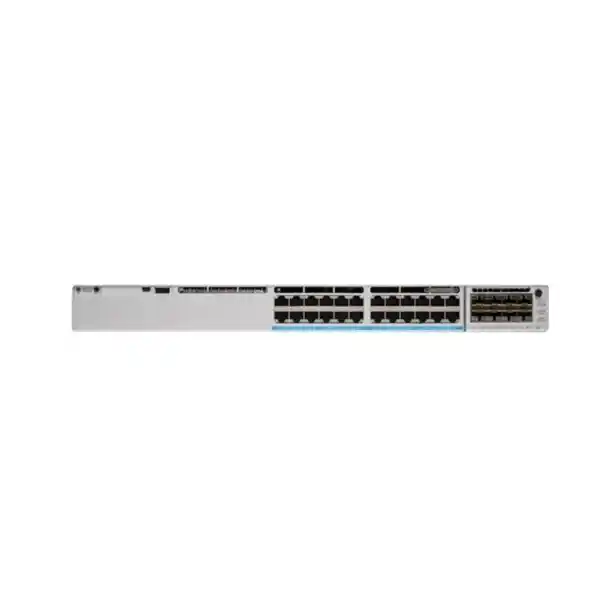
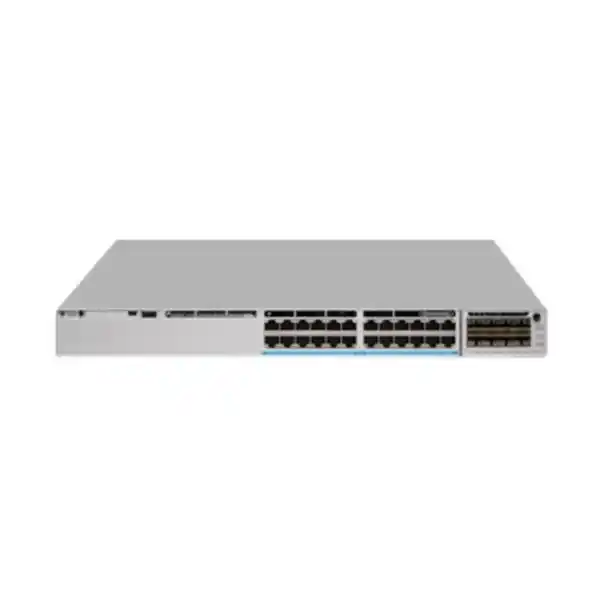
Cisco Catalyst C9300-24UXB Network Switch
The Cisco Catalyst C9300-24UXB is designed for enterprise access networks that need more than conventional 1 Gigabit edge switching. It combines 24 multigigabit copper access ports, Cisco UPOE, modular uplinks, StackWise-480 and the higher-scale UADP 2.0 XL architecture in a 1RU platform. For a Tanzanian organisation refreshing a campus, office, education environment, healthcare facility, financial-services network, hospitality property or other high-density site, the main reason to consider this model is straightforward: it can serve endpoints that need both higher data rates and substantial power while providing deeper buffering and larger hardware tables than standard Catalyst 9300 models. The correct configuration still depends on the required software tier, uplink module, optics, stacking design, endpoint power draw and support plan. A project quotation should therefore be based on the exact bill of materials rather than the chassis name alone.
Quick product information
| Model | Cisco Catalyst C9300-24UXB |
|---|---|
| Access ports | 24 × 100 Mbps / 1 / 2.5 / 5 / 10 Gbps multigigabit copper ports with Cisco UPOE |
| Default power supply | 1100 W AC |
| PoE budget with default PSU | 560 W |
| Switching capacity | 640 Gbps standalone; 1.12 Tbps with stacking |
| Forwarding rate | 476.19 Mpps standalone; 833.33 Mpps with stacking |
| Packet buffer | 64 MB on the higher-scale 24UXB model |
| Stacking | StackWise-480, up to eight compatible higher-scale C9300 members |
| Uplink architecture | Modular; supported C9300 network modules include 1G, 10G, 25G, 40G and multigigabit options |
| Form factor | 1RU; 1.73 × 17.5 × 20.2 in (4.4 × 44.5 × 51.3 cm) |
Who should consider the C9300-24UXB?
This model is most relevant when the access layer is expected to carry unusually demanding endpoint traffic or when an organisation wants to avoid a 1 Gigabit bottleneck at the user edge. Examples include wireless access points with multigigabit Ethernet interfaces, workstations that move large files, media-production endpoints, high-resolution surveillance infrastructure, network-attached devices, lab equipment and other systems that can benefit from 2.5G, 5G or 10G over copper. The UPOE capability also makes the platform attractive where one switch needs to power a mix of access points, IP phones, cameras, building systems and other compatible powered devices.
It is not automatically the right answer for every 24-port requirement. A small branch where every endpoint is 1G and PoE demand is modest may not need the higher cost and scale of a 24UXB. Conversely, a site planning dense 90 W endpoints may need to compare the 24UXB against Cisco UPOE+ platforms because this model is a 60 W UPOE design. The best fit is a network that specifically benefits from multigigabit access, higher forwarding scale, deeper buffers, modular uplinks and enterprise stacking.
24 multigigabit ports for mixed-speed edge devices
The C9300-24UXB provides 24 copper downlink ports that support 100 Mbps, 1 Gbps, 2.5 Gbps, 5 Gbps and 10 Gbps Ethernet. That range is important in a real campus because endpoints rarely upgrade at the same time. A network may have older 1G phones and workstations beside newer access points, engineering systems or content-production devices capable of several gigabits per second. Multigigabit Ethernet allows the switch to negotiate an appropriate supported rate per device instead of forcing the entire edge to a single speed class.
For wireless projects, multigigabit access can be especially useful because modern access points can aggregate enough client traffic that a single 1G wired uplink becomes restrictive. The switch does not by itself guarantee any particular Wi-Fi throughput; actual performance depends on the access-point model, radio design, channel plan, client capability, upstream network and internet or application path. What the 24UXB offers is a wired access layer capable of matching higher-speed Ethernet interfaces where they are justified.
Cabling should be reviewed before assuming a target speed. Existing copper quality, cable category, length, patching and termination can affect whether a desired multigigabit or 10G link is practical. A refresh project should therefore include structured-cabling verification instead of treating a switch replacement as an isolated purchase.
Cisco UPOE power: useful, but budget it correctly
Each access port is a Cisco UPOE-capable interface, enabling higher-powered devices than conventional PoE and PoE+ designs when endpoint and cabling requirements are met. Cisco identifies the C9300-24UXB as a 60 W PoE platform. With the default 1100 W AC power supply, the published available PoE budget for this model is 560 W. That distinction matters: a port can support a high per-port power class, but the total simultaneously available power is governed by the installed power-supply configuration and the switch’s overall budget.
Before ordering, list every powered endpoint and its expected power requirement. Include wireless access points, phones, cameras, badge readers, sensors, signage, small compute devices or other equipment that will draw power from the switch. Add headroom for growth and verify the required power class for each device. If the calculated requirement approaches or exceeds the budget of the default configuration, the power design needs to be revisited rather than assuming all 24 ports can simultaneously provide maximum power.
Power planning should also include the rack UPS, upstream electrical circuit, redundant PSU strategy and any StackPower design. In locations where continuity is important, the electrical path is part of the network architecture; a high-capability switch cannot compensate for an undersized UPS or a single unprotected feed.
Why the “B” model matters: higher scale and deeper buffering
The C9300-24UXB is not simply a renamed C9300-24UX. Cisco classifies the 24UXB as one of the higher-scale Catalyst 9300 models and bases it on UADP 2.0 XL silicon. The higher-scale family increases resources for environments that carry more endpoints, routes, policy entries and flow records. Cisco documents a 64 MB packet buffer for the 24UXB, compared with lower buffer figures on several standard C9300 models, and the higher-scale family provides expanded MAC, routing, ACL and NetFlow scale.
That extra scale can matter in larger campus or aggregation-like access designs where many VLANs, hosts, routes, policies or monitored flows converge on the switch. Deeper buffering can also help absorb short traffic bursts, although it should not be treated as a substitute for sound capacity planning or appropriate uplinks. Persistent congestion still needs to be solved with suitable bandwidth and traffic engineering.
The buying implication is that the 24UXB should be chosen for a reason. If the project only needs 24 multigigabit UPOE ports and standard C9300 scale is sufficient, compare the standard 24UX. If higher scale, a 64 MB buffer and the associated hardware resources are valuable to the design, the 24UXB becomes the more relevant option.
Performance for dense enterprise access
Cisco publishes 640 Gbps of switching capacity and a forwarding rate of 476.19 Mpps for the C9300-24UXB in standalone operation. With stacking, the published figures rise to 1.12 Tbps of switching capacity and 833.33 Mpps. These figures position the switch for demanding access designs where multiple high-speed copper ports may be active at the same time and where the access layer must forward traffic without becoming a basic chassis bottleneck.
Performance numbers still need architectural context. A 10G endpoint does not automatically receive 10G end-to-end application throughput. Uplink capacity, server interfaces, WAN bandwidth, storage speed, firewall performance, routing design and traffic patterns all influence the result. For example, a floor switch serving several multigigabit access points may need higher-speed fiber uplinks to an aggregation or core layer, while a standalone office may be limited by a much smaller internet circuit.
When evaluating the 24UXB, map the traffic path from endpoint to application and size each stage. The switch’s performance gives substantial headroom, but the project should also specify the selected uplink module, optic or DAC type, upstream switch ports and redundancy design. This prevents the common mistake of buying high-speed access ports while leaving a narrow uplink as the real bottleneck.
Flexible modular uplinks
Unlike fixed-uplink access switches, the modular-uplink C9300 architecture allows the uplink interface set to be chosen according to the network design. Cisco lists network modules for the Catalyst 9300 family that provide four 1G SFP slots, four multigigabit interfaces, eight 10G/1G SFP+ slots, two 40G QSFP+ slots or two 25G/10G/1G SFP28 slots. The exact module should be selected for the intended topology and validated with the current compatibility documentation.
Four 1G SFP uplink slots for designs that do not require higher uplink speeds.
Eight 10G/1G SFP+ slots for denser high-speed fiber uplink requirements.
Two 25G/10G/1G SFP28 slots where 25G uplinks fit the aggregation design.
Two 40G QSFP+ slots for designs that use 40G upstream connectivity.
The network module and transceivers are part of the bill of materials and should not be treated as an afterthought. Confirm fiber type, distance, connector format, upstream interface, redundancy target and supported optics before ordering. If the site already has optics or DAC cables, verify compatibility rather than assuming they can be reused.
StackWise-480 for a single logical access system
The C9300-24UXB supports Cisco StackWise-480. A supported stack can combine up to eight switches and present them as a single logical switching system, simplifying management while increasing port density and resilience. The 480 Gbps stacking fabric is separate from ordinary network uplinks and uses dedicated StackWise connections on the rear of the chassis.
There is an important compatibility rule for this specific model. Cisco identifies the C9300-24UB, C9300-24UXB and C9300-48UB as higher-scale SKUs, and these higher-scale models must be stacked with other higher-scale models. A project should not assume the 24UXB can be dropped into any existing Catalyst 9300 stack. Existing stack member models and software-license levels need to be checked before expansion.
Stacking is useful when an access closet needs many ports with one operational control plane, when link aggregation should span physical members, or when maintenance and resilience goals favour a multi-member design. It is not a substitute for upstream redundancy. The complete architecture should still consider dual uplinks, upstream switch design, routing boundaries and failure domains.
Stack cables also need to be included in the order. Cisco offers supported StackWise cable lengths for C9300 modular-uplink models, so rack layout should be planned before selecting cable lengths.
StackPower and redundant power planning
Cisco Catalyst 9300 modular-uplink switches support StackPower, which allows power supplies across supported stack members to participate in a shared power design. This can be useful for power redundancy or for allocating available power across members according to the chosen topology. Cisco also provides two power-supply bays on the Catalyst 9300 chassis. The switch ships with one power supply by default, and a second supply can be added when redundancy or additional power design requires it.
For the C9300-24UXB, the default supply is 1100 W AC. The default PoE budget is 560 W, but supported power configurations can change the available budget. A designer should therefore calculate both device load and redundancy behaviour. If one PSU is expected to carry the switch after the other fails, confirm the remaining PoE budget under that failure condition rather than only considering normal operation.
A resilient design should document which devices are critical, what happens when a PSU, UPS or utility feed is lost, and how long the backup power system needs to operate. In a Tanzania deployment, this is especially a practical engineering consideration whenever power continuity is a business requirement. The page does not assume a particular local power condition; the recommendation is simply to size the electrical and UPS design against the real site load.
Higher hardware table scale for complex networks
Cisco’s higher-scale Catalyst 9300 class increases the hardware resources available for forwarding and policy. Published platform figures include up to 64,000 MAC addresses, 112,000 IPv4 routing entries, 56,000 IPv6 routing entries, 18,000 ACL scale entries, 18,000 QoS scale entries and 256,000 Flexible NetFlow entries for the higher-scale 24-port multigigabit model class. Actual usable scale can depend on software release, feature configuration and selected templates, so these values should be treated as platform maxima rather than a guarantee for every simultaneous feature combination.
These resources are relevant in networks with many endpoints, routed segments, access-control policies, traffic classes or monitoring requirements. A straightforward office with a few VLANs may never approach these limits. A larger campus, research environment, data-intensive building, service organisation or segmented enterprise could benefit from the extra capacity, especially if the switch is expected to perform more Layer 3 and policy work at the access edge.
The practical selection question is therefore not simply “Is the 24UXB faster?” It is “Does this network require the multigigabit port density plus the higher hardware scale and buffer resources?” If the answer is yes, the model is easier to justify. If not, a lower-cost member of the Catalyst family may deliver the required outcome without unnecessary over-specification.
Layer 2, Layer 3 and segmentation capabilities
Catalyst 9300 switches run Cisco IOS XE and support enterprise switching and routing features according to the installed software and license level. At the access layer this can include VLANs, spanning-tree functions, QoS, first-hop security, 802.1X access control, routed access and telemetry. Network Advantage adds advanced capabilities such as broader routing, segmentation and security functions beyond the Essentials base feature set.
For buyers, the important point is to map software to the intended design before the order is placed. A switch selected for simple VLAN access has different licensing needs from one intended to participate in more advanced routing, VRF-based segmentation, automation or Cisco campus architecture. The hardware model alone does not determine which advanced features are available.
A good requirement document should identify whether the switch will operate primarily at Layer 2, provide routed access, terminate multiple VRFs, participate in dynamic routing, enforce access policy, export flow telemetry or integrate with a broader Cisco management architecture. This allows the software tier to be selected from actual requirements instead of choosing Essentials or Advantage only by habit. If an organisation is replacing an older Catalyst platform, compare the current configuration feature by feature so the migration does not discover a licensing or design dependency late in the project.
Software and licensing: decide this before requesting the quote
Cisco offers the C9300-24UXB in Network Essentials and Network Advantage hardware ordering variants, represented by product IDs such as C9300-24UXB-E and C9300-24UXB-A. Cisco’s current ordering guidance also requires an applicable Cisco Catalyst or Cisco DNA software subscription to be selected when purchasing Catalyst 9300 hardware with these network license tiers. Cisco also offers unified licensing through the Cisco Networking Subscription for eligible Catalyst 9300 deployments.
Because Cisco licensing evolves, the quotation should state the exact hardware PID, base network license level, subscription offer and term. Avoid comparing two supplier quotations that list only “C9300-24UXB” without showing whether the software entitlement, support and required subscription items are equivalent. A lower hardware-only number may not represent the complete deployable configuration.
Network Essentials provides foundational switching and routing functions, while Network Advantage adds advanced routing, segmentation and security capabilities. The correct tier depends on the features the network will actually use. If the switch is being added to an existing stack, also verify license-level compatibility across members. Buyers should ask for a line-item bill of materials that clearly identifies hardware, license, subscription term, uplink module, transceivers, stacking accessories, extra power supply and support option where required.
Security and access control at the campus edge
An enterprise access switch is often the first managed network device that directly connects users, phones, access points, cameras and operational technology. The C9300 platform supports security functions such as 802.1X-based access control, first-hop security, control-plane policing and MACsec capabilities according to software and license level. Network Advantage adds higher-tier security and segmentation options, including MACsec-256 in Cisco’s feature matrix.
Security value comes from configuration rather than the product label. A switch left with flat VLANs, unused authentication features and broad management access will not become secure simply because the hardware supports advanced controls. Deployment planning should define identity sources, authentication behaviour for managed and unmanaged endpoints, guest or contractor handling, management-plane access, logging, secure administration protocols and the relationship between switch policy and the organisation’s firewall or NAC platform.
For regulated or sensitive environments, document the required controls before deciding the license tier. If encrypted links, advanced segmentation or specific telemetry functions are part of the requirement, validate them against the chosen IOS XE release and license package. This is more reliable than assuming every capability listed for the Catalyst 9300 family is enabled by default on every configuration.
A strong access-layer match for high-performance Wi-Fi designs
One of the clearest use cases for the C9300-24UXB is a wired edge serving high-capacity wireless access points. Newer enterprise APs can use multigigabit Ethernet because aggregate wireless traffic can exceed a 1G wired connection under the right conditions. The switch’s 2.5G, 5G and 10G access speeds give network designers options to match the Ethernet side of an AP without immediately replacing copper with fiber at every location.
The UPOE capability also helps when access points require more power than basic PoE. However, the AP model and its power mode should be checked carefully. Some devices reduce radio, USB or feature capability when powered below their preferred level. The network bill of materials should therefore pair each AP with its required Ethernet speed and power class, then confirm that the aggregate requirement fits the switch’s PoE budget.
Wireless performance depends on far more than the switch. RF design, access-point placement, channel width, spectrum availability, client mix, interference, authentication services and upstream bandwidth all matter. The 24UXB addresses the wired access portion of that design. It is especially useful when a project wants to avoid installing a high-end wireless system only to constrain it with legacy 1G access switching.
Deployment fit for Tanzania projects
For organisations in Tanzania, the procurement discussion should begin with the site rather than with a generic “enterprise switch” request. Provide the number of access closets, expected endpoints, current and future access-point models, camera count, phone count, VLAN and routing requirements, uplink media, fiber distances, rack conditions and power-protection design. If the organisation already runs Cisco Catalyst switches, include current model numbers and IOS XE versions so stack, optics, management and migration compatibility can be checked.
Availability, pricing and delivery should be confirmed for the exact part numbers at quotation time. This page does not assume local stock, a fixed lead time, an included warranty package or a particular support entitlement. Those commercial details can change with model availability, distributor position, subscription term, quantity and delivery destination.
It is also useful to identify whether the project is equipment supply only or whether the scope includes configuration, migration, testing or documentation. A 24UXB may be technically suitable, but the final project can still fail if optics, uplink modules, stacking cables, power supplies, licenses or rack accessories are missing. Treat the switch as one line in a complete access-layer bill of materials.
Resiliency beyond stacking
The Catalyst 9300 chassis is designed with operational resilience in mind. Cisco documents dual power-supply bays and three field-replaceable fans on the platform. The fan modules are hot-swappable, and the system can continue operating with two functional fans while a failed unit is replaced, although a failed fan should be addressed promptly. A second power supply can be used where the design requires PSU redundancy.
These hardware features are valuable, but resilience is only as strong as the overall topology. Two PSUs connected to the same unprotected power strip do not create the same fault tolerance as separate protected power paths. Likewise, a switch stack with one uplink to one core switch still has an upstream single point of failure. A robust design considers power, stacking, uplinks, core or distribution redundancy, gateway placement and the physical paths used by fiber and copper cabling.
Maintenance planning also matters. Define how software upgrades will be handled, how configurations are backed up, where logs and telemetry are collected and which spare components are practical to hold. If the access network supports critical operations, document acceptable outage windows and recovery procedures. The 24UXB provides enterprise hardware capabilities, but high availability is achieved by combining those capabilities with a deliberate operational design.
Rack, depth and thermal planning
The C9300-24UXB is a 1RU switch. Cisco lists dimensions of approximately 1.73 × 17.5 × 20.2 inches, or 4.4 × 44.5 × 51.3 cm, with the applicable configuration, and a published weight of about 18.18 lb or 8.25 kg with the default power supply. These dimensions deserve attention in wall cabinets and shallow communications racks because the 24UXB is deeper than many compact branch switches.
Allow additional rear clearance for power cords, StackWise cables, StackPower connections and the selected uplink module or cable routing. The switch uses front-and-side to rear airflow through field-replaceable fan modules, so rack layout should not obstruct cooling. High-density PoE deployments can also place a substantial thermal load in a communications room when several switches, UPS systems and other network appliances are installed together.
Before delivery, confirm rack depth, available rack units, cable management, PDU outlet type, UPS capacity, grounding practice and ventilation. These checks are inexpensive compared with discovering after delivery that the chassis cannot be accommodated correctly. For new facilities, coordinate the network rack, structured cabling and electrical design early rather than treating them as separate procurement activities.
C9300-24UXB versus nearby Catalyst choices
| Model type | Best reason to choose it | Main trade-off to review |
|---|---|---|
| C9300-24UXB | 24 × up to 10G mGig UPOE plus higher-scale UADP 2.0 XL resources and 64 MB buffer. | Higher-scale stacking compatibility is restricted to the higher-scale C9300 models. |
| C9300-24UX | 24 × up to 10G mGig UPOE when standard C9300 scale is sufficient. | Lower hardware scale and buffer resources than the 24UXB. |
| C9300-24UB | Higher-scale 24-port UPOE when 1G copper access is adequate. | Does not provide the same multigigabit downlink capability as the 24UXB. |
| C9300-24H | Useful where 90 W UPOE+ endpoint power is more important than multigigabit access. | Access-port speed profile differs from the 24UXB, so compare endpoint needs carefully. |
This comparison is about architectural fit, not a universal ranking. The right model depends on port speed, endpoint power, table scale, buffer requirement, stack compatibility, uplink design and software tier. If an existing network already has a defined Catalyst standard, compatibility with that installed base may be more important than choosing the model with the highest specification.
Migration from older access switches
A Catalyst 9300 refresh is often triggered by a need for faster wireless access, stronger segmentation, higher PoE power, modern software support or replacement of an older switching generation. The migration should start with an inventory of the current network rather than only counting ports. Capture VLANs, trunks, spanning-tree roles, port channels, routing protocols, ACLs, QoS policies, voice VLANs, authentication settings, monitoring, SNMP or telemetry, static routes, DHCP relay, multicast settings and any special edge configurations.
Then map every physical dependency. Record which copper ports serve phones, access points, cameras and user devices; which fiber links connect to upstream switches; which optics are installed; and which ports are part of aggregated links. Confirm whether current transceivers are supported on the new platform and selected network module. For stacked environments, check the exact compatibility rules instead of assuming that old stack members can remain.
A staged migration plan should include configuration preparation, software version choice, pre-staging, backup, maintenance-window tasks, validation tests and rollback criteria. High-speed hardware is useful only when the transition preserves required network behaviour. Procurement and engineering teams should therefore agree on the intended configuration and accessories before the purchase order is finalised.
What to include in a complete bill of materials
A usable quotation should contain more than the switch chassis. Start with the exact 24UXB ordering variant and software tier. Add the required Cisco software subscription and term, the chosen modular uplink card, supported optics or DACs, StackWise cables if stacking is planned, StackPower accessories if used, and a second power supply if the resilience or PoE design requires it. Include rack and cable-management items where they are part of the supply scope.
For an expansion project, provide the models and license levels of existing stack members. For a fiber uplink, provide fiber type, connector type, approximate distance and upstream interface. For PoE, provide endpoint models or at least their required power classes. For a new wireless deployment, include the access-point models and expected number per switch. For a routed design, state whether advanced routing or segmentation features are required so the software tier can be checked.
Finally, identify quantity, delivery destination and whether commercial support, configuration or deployment services are part of the requirement. This level of detail reduces the risk of receiving quotations that appear comparable but contain different license terms, missing optics or different redundancy assumptions. It also makes technical review faster because the bill of materials can be evaluated as a system rather than as isolated line items.
Practical sizing checklist before ordering
Count current and planned endpoints. Identify which actually require 2.5G, 5G or 10G and which can remain at 1G.
Calculate the expected powered-device draw and compare it with the available budget under normal and failure conditions.
Choose the network module only after confirming upstream speed, fiber type, distance, redundancy and transceiver compatibility.
Verify that existing or planned members are compatible higher-scale models and use the same supported license level.
Decide whether Essentials meets the requirement or advanced routing, segmentation and security justify Advantage.
Confirm rack depth, cooling, PDU outlets, UPS sizing, grounding and whether dual PSUs or separate feeds are required.
Frequently asked questions
Does the C9300-24UXB support 10G on all 24 access ports?
Cisco documents the model as having 24 multigigabit copper ports supporting 100 Mbps, 1G, 2.5G, 5G and 10G. Actual link speed depends on the connected endpoint and cabling. The access ports should not be confused with the separate modular uplink interface set.
How much PoE power is available?
Cisco publishes a 560 W PoE budget for the C9300-24UXB with the default 1100 W AC power supply. The switch supports UPOE on its access ports, but the total simultaneous powered-device load must stay within the available budget for the installed power configuration.
What is the difference between C9300-24UX and C9300-24UXB?
Both provide 24 multigigabit UPOE access ports. The 24UXB is a higher-scale model based on UADP 2.0 XL and carries deeper buffering and larger hardware scale. It also has specific stacking compatibility rules for the higher-scale Catalyst 9300 group.
Can the C9300-24UXB stack with any Catalyst 9300?
No. Cisco states that the higher-scale C9300-24UB, C9300-24UXB and C9300-48UB models need to be stacked with other higher-scale models. Confirm exact model and license compatibility before expanding an existing stack.
Which uplink module should I choose?
Choose from the supported Catalyst 9300 network modules according to the required upstream interface. Cisco lists options for 1G SFP, 10G/1G SFP+, 25G/10G/1G SFP28, 40G QSFP+ and multigigabit copper. Verify the exact module, optic and upstream compatibility for the project.
Do I need Network Essentials or Network Advantage?
That depends on the feature set. Essentials covers foundational switching, routing and security functions, while Advantage adds advanced routing, segmentation and security capabilities. The quote should also include the applicable Cisco software subscription and term required by the current ordering model.
Is the switch suitable for Wi-Fi 6 or newer access points?
It can be a strong wired access option for APs that use multigigabit Ethernet and UPOE-class power. Suitability depends on the exact AP model, required Ethernet rate, PoE class, cabling and total power budget. Wireless design and RF planning remain separate requirements.
Is price or stock confirmed for Tanzania?
No price, stock level or fixed lead time is asserted on this page. Request a current quotation for the exact hardware PID, license tier, subscription term, uplink module, optics, accessories, quantity and delivery destination.
Request a C9300-24UXB configuration and quotation review
Send the required port count, endpoint speeds, PoE devices, uplink type, existing Catalyst models, stacking requirement, software features, quantity and Tanzania delivery destination. A useful quotation should identify the exact C9300-24UXB ordering variant, software subscription, uplink module, optics, stacking accessories, power supplies and other components needed for the intended deployment.
Buying note: confirm the full bill of materials before purchase. The C9300-24UXB is a high-capability platform, but the right result depends on matching its multigigabit access, UPOE budget, higher-scale hardware, modular uplinks and license level to the real network design.



Reviews
There are no reviews yet.