
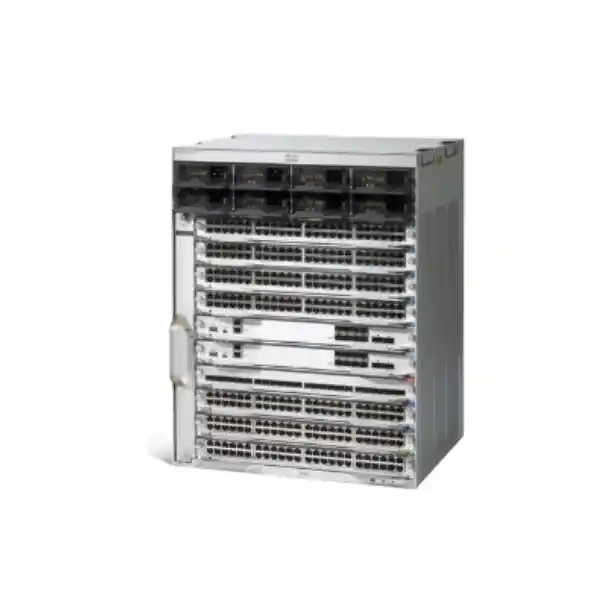
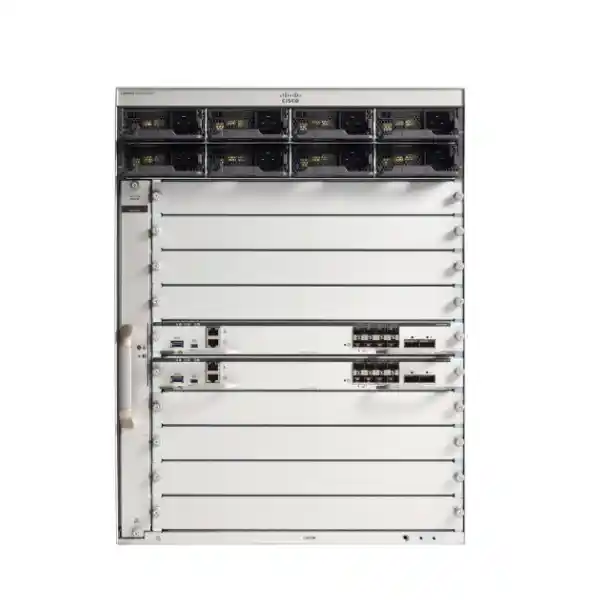
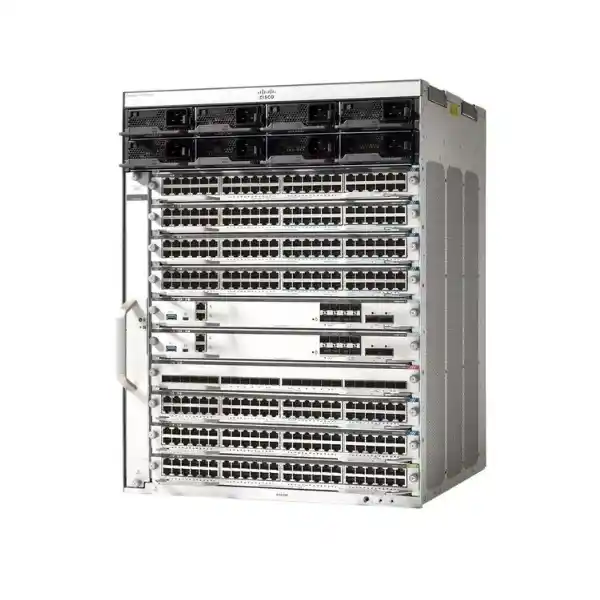
8 line-card slots
Redundant supervisor design
Campus access & distribution
Cisco Catalyst C9410R Network Switch Chassis
The Cisco Catalyst C9410R is the largest chassis in the Catalyst 9400 Series family, designed for organizations that need a modular switching platform rather than a fixed-port appliance. It provides ten physical slots: two dedicated supervisor-engine slots and eight line-card slots. That architecture lets a network team choose the port types, uplink speeds, power-delivery capability, software features, and level of redundancy that match a particular campus or enterprise design.
For buyers in Tanzania, the practical value of the C9410R is flexibility over the life of a network. A deployment can be built around high-density copper access, multigigabit connectivity for modern wireless access points, fiber aggregation, high-speed uplinks, or a mixed environment. The chassis itself is only the foundation of the system, so a correct quotation should also account for compatible supervisor engines, line cards, power supplies, optics or transceivers, software and licensing, and any redundancy required by the site. Ask for a configuration review before ordering so the complete bill of materials matches your rack, power, cooling, endpoint, and growth requirements.
C9410R at a glance
| Platform type | Cisco Catalyst 9400 Series modular campus switch chassis |
|---|---|
| Total slots | 10 |
| Dedicated supervisor slots | 2, in slots 5 and 6 |
| Line-card slots | 8, in slots 1–4 and 7–10 |
| Supervisor redundancy | Supported with two matching compatible supervisor engines |
| Maximum line-card slot bandwidth | Up to 480 Gbps per line-card slot with C9400X-SUP-2XL; lower values apply with other supervisor engines |
| Maximum 1G/copper-class port density | Up to 384 ports with appropriate line cards |
| Power-supply bays | Up to 8 supported power-supply modules |
| Rack size | 13 RU, 19-inch rack compatible |
| Chassis size and weight | 57.43 × 43.94 × 41.40 cm; approximately 29.48 kg with fan tray |
Important: Port count, uplink type, PoE capability, switching capacity, software functions, and licensing are configuration-dependent. Do not treat the maximum platform figures above as the specification of every C9410R build.
What the Cisco C9410R is — and what it is not
A common purchasing mistake with modular switches is to compare a chassis part number directly with a fixed-port switch. The C9410R is not a complete fixed configuration with a predetermined number of access ports and uplinks. It is the physical switching chassis into which compatible Catalyst 9400 supervisor engines, line cards, and power supplies are installed. That modular structure is exactly why the platform can serve very different network designs, but it also means buyers need to define the complete system before placing an order.
The two supervisor slots are reserved for the control and forwarding components that operate the switch. The eight remaining payload slots accept compatible line cards that provide the actual network interfaces. A campus that needs mostly copper Ethernet for users and IP phones may choose a different line-card mix from a university backbone that needs fiber and higher-speed aggregation. A wireless-heavy environment may prioritize multigigabit copper and high-power PoE support. A distribution-layer design may place greater emphasis on higher-bandwidth supervisor engines and fiber uplinks.
This distinction matters commercially as well as technically. A chassis-only price does not represent the full deployed cost of the switch. A complete design can include one or two supervisors, one or more line cards, multiple power supplies, transceivers, patching, rack accessories, software subscriptions, and support services. The right question is therefore not simply “How much is a C9410R?” but “Which C9410R configuration meets the required ports, throughput, power, resiliency, software, and growth target?”
Modular architecture for high-density campus networks
The C9410R has eight usable line-card slots, giving network architects substantially more expansion space than the smaller chassis in the same family. This makes it suitable when port growth is expected, when multiple interface types must coexist in one system, or when a design team wants to consolidate access or distribution switching into a modular platform. The physical slot layout also helps separate long-life chassis investment from shorter refresh cycles in individual line cards or supervisor components, subject to Cisco compatibility and software support.
Slots 5 and 6 are dedicated to supervisor engines. Cisco supports single-supervisor operation and dual-supervisor configurations for redundancy, but high availability requires two compatible supervisors of the same supported type. The line-card positions are slots 1 through 4 and 7 through 10. Planning these slots in advance is useful because different cards can impose different bandwidth, power, transceiver, and software requirements.
The chassis can support a wide range of interface choices across the Catalyst 9400 line-card portfolio. Depending on the selected cards and supervisor, designs can include standard Gigabit Ethernet, multigigabit copper, PoE and UPOE-class edge connectivity, 1/10 Gigabit fiber, 25 Gigabit interfaces, and higher-speed 40/100 Gigabit options. Some higher-speed line cards and port modes require newer supervisor engines, so compatibility should be checked before finalizing a bill of materials.
Modularity is especially useful when a network contains mixed endpoint types. One floor or building may need dense wired access; another may need multigigabit links for Wi-Fi access points; a server, CCTV, security, or building-services network may need a different port profile; and the distribution side may require fiber. Instead of forcing every requirement into identical fixed switches, the C9410R can be configured around the actual interface mix while keeping a common platform.
Performance depends on the supervisor you choose
The chassis does not have one universal per-slot bandwidth figure. Cisco lists different capacities according to the supervisor engine installed. On the C9410R, the earlier C9400-SUP-1, C9400-SUP-1XL, and C9400-SUP-1XL-Y operate at up to 80 Gbps per line-card slot. The C9400X-SUP-2 raises that figure to up to 240 Gbps per slot, while the C9400X-SUP-2XL supports up to 480 Gbps per line-card slot. Those differences are important when the planned access density and uplink speeds can generate significant aggregate traffic.
A buyer should therefore size the supervisor for more than the port count visible on day one. Consider expected uplink utilization, east-west campus traffic, the number of high-speed wireless access points, data-intensive applications, segmentation requirements, future line-card upgrades, and the possibility that access speeds will increase during the chassis lifetime. Choosing a very high-capacity supervisor does not automatically improve a lightly loaded access network, but choosing too little backplane capacity can limit future expansion or the value of higher-speed line cards.
The supervisor also influences supported uplink interfaces, software minimums, security capabilities, and compatibility with particular line cards. For this reason, supervisor selection should be completed together with the line-card design and software plan rather than treated as a separate accessory decision.
Line-card choices: build the port mix around the real workload
Cisco provides multiple Catalyst 9400 line-card families, and the correct choice depends on endpoint speed, media type, power requirements, uplink design, and supervisor compatibility. The examples below illustrate the planning options; they do not mean every card is included with the C9410R chassis.
High-density copper access
48-port Gigabit and multigigabit RJ-45 line cards can support user devices, IP phones, cameras, access points, and other Ethernet endpoints. With eight 48-port line cards, the platform can reach 384 access ports where the selected card and power design support that configuration.
Multigigabit access
Cards such as the 5G or 10G multigigabit RJ-45 options are useful when existing or new copper cabling must carry more than 1 Gbps to capable endpoints. This is often relevant to newer Wi-Fi access points and other high-throughput edge devices.
Fiber access and aggregation
SFP and SFP+ line cards can support fiber-based 1G and 10G connectivity, while newer high-speed card options extend into 25G, 40G, and 100G designs. Transceiver type, fiber plant, distance, and supervisor support must be validated for each link.
PoE and high-power edge devices
PoE+, UPOE, and UPOE+ capable line cards can deliver power to compatible endpoints. The usable power budget depends on the exact line card, number and type of power supplies, redundancy mode, and endpoint demand, so port count alone is not enough to size the system.
A practical configuration exercise should start with an endpoint inventory. Count ports by speed and media, identify which devices need PoE and how much power each class may draw, define the uplink capacity required from each building or wiring zone, and allow for spare ports. From there, map the demand into line cards and check that the chosen supervisor, software release, and power design support the intended combination.
PoE planning: port density and power budget are separate decisions
The C9410R is attractive for large powered-edge deployments because Catalyst 9400 line cards can provide PoE-class services, including higher-power options on supported cards. However, the number of physical ports that can accept PoE is not the same as the number of ports that can simultaneously deliver the maximum supported wattage. The total available power depends on the installed power supplies, the selected operating mode, chassis consumption, line-card requirements, and the power draw of connected devices.
This matters in real deployments where access points, PTZ cameras, video phones, badge readers, IoT gateways, and other devices can have very different power profiles. A design based only on “384 PoE ports” can be misleading if the actual endpoints require higher wattage. Before ordering, collect the expected power requirement for each device type, apply realistic growth headroom, and size the power supplies and redundancy model accordingly.
Cisco supports multiple power-supply bays and redundancy modes on the Catalyst 9400 platform. That gives architects flexibility, but electrical planning should include the upstream circuit capacity, available sockets or PDUs, input type, UPS or generator strategy, and the failure scenario the business wants to tolerate. A resilient chassis is only as resilient as the power feeds and facility design supporting it.
Resiliency and serviceability
The C9410R supports two supervisor slots, enabling 1+1 supervisor redundancy when two matching compatible supervisor engines are installed and the software design is appropriate. It also provides up to eight power-supply bays, allowing redundant power strategies to be designed around the expected load. These capabilities make the platform suitable for networks where maintenance windows and component failures need to be planned rather than treated as unexpected events.
The chassis uses a serviceable fan-tray assembly, and Cisco documents online fan-tray replacement with strict time and operating-condition constraints. The key design point for buyers is that the chassis has one fan-tray bay, so fan service is not the same as having two independent fan trays. Operational procedures, environmental monitoring, spare-part planning, and trained support staff remain important even in a resilient modular design.
At the network level, Cisco also supports high-availability capabilities such as StackWise Virtual on supported Catalyst 9400 configurations and software releases. Whether a particular design should use chassis-level redundancy, two separate chassis, StackWise Virtual, first-hop redundancy, routing convergence, or a combination depends on the failure domains and service objectives of the organization. Those features should be validated against the selected supervisor, software release, topology, and license rather than assumed from the chassis name alone.
For mission-critical environments, document what happens if a supervisor fails, a power feed fails, a line card is removed, a fiber path is cut, or one chassis becomes unavailable. The goal is not simply to purchase redundant components, but to build a network in which traffic paths, power sources, software state, and operational procedures all support the intended availability target.
Cisco IOS XE, automation, segmentation, and licensing
Catalyst 9400 platforms operate with Cisco IOS XE, giving organizations a common enterprise switching software environment with programmable interfaces, automation options, telemetry, policy controls, and integration with Cisco management platforms. The exact functions available are not determined by the C9410R chassis alone; they depend on the supervisor, software version, license tier, and broader management architecture.
Cisco currently documents multiple licensing paths for the Catalyst 9400 family, including Network Essentials and Network Advantage base capabilities together with Cisco DNA or newer unified switching subscription options depending on the ordering model and software release. Feature entitlement can change across releases and subscription models, so licensing should be treated as part of the design rather than an afterthought. If the project requires advanced routing, segmentation, assurance, application visibility, automation, fabric capabilities, or particular high-availability functions, verify the exact license level before purchase.
For larger deployments, centralized management can reduce operational complexity by standardizing configurations, software images, policy, and monitoring across many switches. However, management-platform integration should be scoped to the organization’s operational maturity. A network team that primarily uses CLI and established configuration-management tools may have different requirements from an organization deploying Cisco Catalyst Center, Software-Defined Access, automated segmentation, or assurance workflows.
When upgrading an existing campus, review software interoperability with neighboring switches, wireless controllers, authentication systems, routing protocols, network-management tools, and security platforms. A successful hardware refresh is not only a chassis replacement; it is also a software and operations transition.
Physical installation and environmental planning in Tanzania
The C9410R occupies 13 rack units and is designed for a standard 19-inch rack. The chassis measures approximately 57.43 cm high, 43.94 cm wide, and 41.40 cm deep, and weighs about 29.48 kg with the fan tray before supervisors, line cards, power supplies, optics, and cabling are added. That means the final installed system will be heavier and should be planned with appropriate rack loading, lifting procedures, rail or mounting preparation, and cable management.
Cisco specifies normal operating temperature limits according to altitude, including up to 45°C at lower stated elevations and up to 40°C at higher stated elevations. These are equipment limits, not a target data-room temperature. For a Tanzanian deployment, the room should still be designed for stable cooling, clean airflow, dust management, and reliable electrical service. Hot spots at the rack face, blocked side-to-side airflow, or overloaded power circuits can reduce reliability even when ambient room temperature appears acceptable.
Power quality is another important planning point. Where sites experience utility interruptions or transfer to generator power, network availability depends on the UPS, distribution system, grounding, circuit redundancy, and generator transition design as much as on the switch itself. If the C9410R will power many edge devices, an outage can simultaneously affect switching, wireless access, telephony, cameras, and building systems. Capacity planning should therefore include both network load and powered-device load.
Before installation, verify rack depth and access, airflow path, available RU space, PDU position, cable routing, optical-fiber bend radius, grounding, input power, spare capacity, and maintenance clearance. For multi-building campuses, also document fiber routes, protection, distances, transceiver types, and the path diversity required between buildings.
Where the C9410R fits best
Large campus access
A single modular chassis can aggregate a large number of user, phone, camera, wireless, and IoT connections. This can simplify operations where many fixed switches would otherwise be required, provided the design accepts the resulting chassis-level failure domain.
Distribution layer
With suitable supervisors and fiber line cards, the chassis can serve as a campus distribution platform where multiple access blocks or buildings need to converge on higher-capacity switching and routing.
Wireless-heavy environments
Multigigabit and high-power line-card choices make the platform relevant where newer wireless access points require more than 1 Gbps and higher PoE classes, subject to cable quality and total power budget.
Mixed copper and fiber estates
Organizations with legacy copper access, new multigigabit requirements, and fiber aggregation can combine interface types within one modular system instead of forcing a single fixed-port profile everywhere.
Typical candidates include universities, large schools, hospitals, government facilities, corporate campuses, hotels and resorts, transport facilities, industrial sites, and other environments with substantial wired and wireless density. Suitability still depends on the actual topology. Smaller sites or branches with modest port counts may be better served by fixed-port switches that use less rack space and have a lower platform entry cost.
How to size a C9410R configuration
1. Count endpoints by interface
Separate 1G copper, multigigabit copper, PoE endpoints, 1/10G fiber, and higher-speed aggregation links. Add spare capacity instead of filling every line-card port on day one.
2. Calculate PoE demand
Estimate realistic wattage per powered endpoint, not only the standards maximum. Size power supplies for normal load, growth, and the desired redundancy mode.
3. Define uplink and backplane needs
Map access traffic toward servers, internet gateways, data centers, and other buildings. Use this to choose uplink speeds and a supervisor with enough per-slot capacity.
4. Set the availability target
Decide whether the design requires dual supervisors, redundant power feeds, multiple chassis, diverse fiber paths, or virtualized distribution. Design for the failure event that matters to the business.
5. Confirm software and licensing
List routing, security, automation, segmentation, assurance, and management features. Match those requirements to the current supported software release and license tier.
6. Validate facility constraints
Check 13 RU of rack space, final loaded weight, airflow, room cooling, power circuits, UPS capacity, grounding, maintenance access, and structured cabling before procurement.
Migration from an existing campus switch
Replacing an older modular or stack-based campus switch with a C9410R should be planned as a migration project, not only a hardware swap. Start by documenting the current VLANs, routing adjacencies, first-hop gateway design, access-control policies, spanning-tree topology, port channels, QoS, multicast, DHCP relay, device authentication, management addresses, SNMP or telemetry, logging, time synchronization, and software dependencies. Identify configuration features that may behave differently under the target IOS XE release.
Next, map every existing physical connection to the new line-card and port plan. Confirm copper categories, fiber type, connector type, optical distance, transceiver compatibility, and patch-panel capacity. If the migration includes a move from 1G to multigigabit access or from 10G to 25/40/100G uplinks, the cabling plant must support the new speed. A chassis capable of higher rates cannot overcome unsuitable copper, optics, or fiber.
Build a staged cutover plan with rollback criteria. For high-availability environments, test supervisor switchover, routing convergence, access-layer redundancy, and power-feed behavior before the production window. Back up existing configurations, capture baseline interface and routing information, and compare the post-migration state against that baseline. If a large number of endpoints depend on PoE, include startup power behavior and endpoint recovery in the test plan.
Finally, update operational documentation. Record slot assignments, line-card models, supervisor models, power-supply positions, circuit mapping, serial inventory, software versions, license status, management addresses, fiber destinations, and spare-part strategy. Good documentation reduces future maintenance time and makes the flexibility of a modular platform easier to manage.
C9410R versus a fixed-port switch
| Decision factor | C9410R modular chassis | Typical fixed-port approach |
|---|---|---|
| Port growth | Add or change compatible line cards within the available slots | Usually add more switches when ports are exhausted |
| Interface mix | Can combine different copper and fiber line-card types | Port mix is largely fixed by the selected model |
| Supervisor redundancy | Supports dual compatible supervisors | Control plane is typically integral to each switch |
| Rack footprint | 13 RU before considering surrounding cable-management needs | Often 1 RU per switch, but multiple units may be required |
| Failure domain | Many ports can depend on one chassis, so internal and network-level redundancy matter | Ports are distributed across separate physical switches |
| Best fit | High-density, modular, growth-oriented campus access or distribution | Smaller closets, branches, or predictable fixed-port requirements |
Neither approach is automatically better. The C9410R earns its place when its modular density, supervisor options, power flexibility, and expansion path solve a real design problem. If a site only needs a small number of ports, the extra chassis space and component choices may add complexity without delivering a useful benefit.
Buying checklist before requesting a quotation
- Required copper port count today and expected growth over the next several years.
- Required fiber port count, speeds, distances, connector types, and transceiver standards.
- Number of multigigabit endpoints and the cable categories serving them.
- PoE endpoint count and approximate power requirement by device type.
- Required supervisor model and whether dual-supervisor redundancy is needed.
- Required line-card models and slot plan.
- Power-supply quantity, input type, redundancy mode, circuit allocation, UPS capacity, and generator strategy.
- Uplink speeds and expected traffic load toward the core, data center, internet edge, or other buildings.
- Routing, segmentation, automation, assurance, security, and management features that drive licensing.
- Target Cisco IOS XE release and compatibility with supervisors, line cards, and neighboring systems.
- Rack space, rack loading, airflow, cooling, grounding, maintenance clearance, and cable management.
- Required support coverage, spare strategy, implementation assistance, and migration testing.
Providing these details with the quotation request makes it easier to distinguish a chassis-only requirement from a complete operational system and reduces the risk of missing a supervisor, power supply, line card, optic, license, or facility dependency.
Design trade-offs to review before standardizing on the C9410R
A large modular chassis can simplify a campus by concentrating many interfaces, but concentration changes the failure domain. If hundreds of endpoints depend on one chassis, a chassis-level outage can affect a large part of the site even when individual line cards and supervisors are redundant. For this reason, high-density designs should compare two questions at the same time: how much equipment can be consolidated, and how much service should depend on a single physical enclosure. In some buildings, one C9410R with internal redundancy may be appropriate. In others, two smaller chassis or separate switching blocks can provide better physical separation.
Growth planning also needs discipline. Eight line-card slots create expansion headroom, but unused slots are not automatically free capacity. Future cards can require additional power, higher supervisor bandwidth, different optics, or a later software release. A sensible design reserves both physical slots and system resources. If the initial build uses six line cards, for example, the team should still check whether the chosen supervisors and power supplies can support the expected seventh and eighth cards rather than assuming the chassis can simply be filled later without other changes.
Cabling architecture can also influence whether a central chassis is the right answer. Consolidating many copper endpoints into one rack can increase horizontal-cabling distances and cable bulk. In larger buildings, distributing access switches closer to users may be more practical, with the C9410R serving as a distribution platform over fiber. Where the chassis is used for direct access, verify that copper runs remain within the applicable Ethernet cabling limits and that pathways, patch panels, and rack-side cable management can handle the density.
Operational skills are another consideration. Modular platforms offer flexibility, but they introduce more component combinations than a fixed switch. Support teams need clear records of supervisor models, line cards, power supplies, optics, software versions, and licenses. Spare-part strategy should reflect the components whose failure would have the greatest impact. Teams should also understand module replacement procedures, maintenance-mode requirements where applicable, and how to confirm system health after a field-replaceable unit is changed.
Procurement should separate verified current requirements from optional future items. A quote can be easier to evaluate when the required day-one chassis, supervisors, line cards, power supplies, licenses, and optics are listed separately from growth modules or spares. This prevents a low chassis price from obscuring the cost of the operational configuration and helps finance and technical teams compare alternatives on the same basis.
Finally, consider the lifecycle of the surrounding network. A C9410R can remain useful across several generations of edge devices because its modular cards and supervisors can be selected around changing requirements, but that flexibility is governed by Cisco’s supported hardware and software combinations. Before committing to a long-term standard, review the intended software train, compatibility matrix, support policy, and expected refresh cycle for access points, phones, cameras, uplinks, and management systems. The goal is to choose a platform that matches both today’s topology and the organization’s realistic operational roadmap.
Frequently asked questions
Is the C9410R a complete switch by itself?
No. C9410R identifies the 10-slot Catalyst 9400 chassis. A working deployment requires a supported supervisor engine and appropriate power supplies, and network ports are provided by compatible line cards. Software and licensing also need to be selected for the required features. Confirm the exact contents of any quotation rather than assuming all modules are included.
How many line-card slots does the C9410R have?
It has eight line-card slots. Slots 1–4 and 7–10 are used for line cards, while slots 5 and 6 are reserved for supervisor engines.
Can the C9410R use two supervisors?
Yes. The chassis supports supervisor redundancy with two compatible matching supervisor engines. The specific supervisor model, software release, high-availability design, and configuration should be validated for the intended deployment.
What is the maximum bandwidth per line-card slot?
With the C9400X-SUP-2XL, Cisco specifies up to 480 Gbps per line-card slot on the C9410R. The C9400X-SUP-2 supports up to 240 Gbps per slot, while earlier supervisor options provide lower per-slot figures on this chassis. The supervisor must therefore be included in performance sizing.
How many Ethernet ports can the chassis support?
With appropriate 48-port line cards, the platform can scale to as many as 384 1G/copper-class access ports. Other interface types have different maximum densities. Higher-speed 25G, 40G, and 100G options also depend on line-card and supervisor selection.
Does it support PoE?
Yes, when suitable PoE-capable Catalyst 9400 line cards and sufficient power supplies are installed. The actual PoE budget is determined by the selected line cards, power supplies, redundancy mode, and endpoint demand. Do not size the system from port count alone.
How much rack space does the C9410R require?
The chassis is 13 RU high and is compatible with a standard 19-inch rack. Plan additional space and clearance for cabling, patching, airflow, and service access.
Which businesses should consider the C9410R?
It is most relevant to organizations with high port density, mixed interface requirements, significant PoE demand, modular growth needs, or distribution-layer requirements. Smaller offices and branches may be better suited to fixed-port switches.
What information is needed for an accurate C9410R quote?
Provide the required port counts and speeds, fiber and copper mix, PoE device types, uplink requirements, redundancy target, routing and software features, rack constraints, power environment, and growth plan. From those inputs, the chassis can be matched with compatible supervisors, line cards, power supplies, optics, and licensing.
Request a C9410R configuration review
Before purchasing a Cisco Catalyst C9410R for a Tanzanian campus or enterprise network, prepare a short requirements list covering port density, interface speeds, PoE load, uplinks, supervisor redundancy, power sources, software features, rack conditions, and expected growth. A configuration review can then turn those requirements into a complete bill of materials instead of treating the chassis part number as a finished switch.
Next step: request a quotation and configuration check for the C9410R chassis, supervisor engines, line cards, power supplies, optics, licensing, and deployment requirements that match your network.


Reviews
There are no reviews yet.