
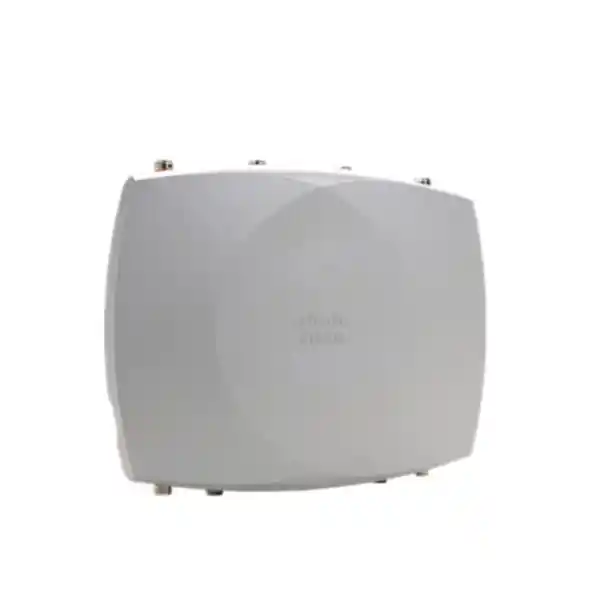
External Antenna Design
10G Copper + 1/10G SFP+
IP66/IP67
Cisco Wireless CW9177E Wi-Fi 7 Outdoor Access Point for Custom RF Coverage
The Cisco Wireless CW9177E is built for outdoor enterprise networks where a fixed internal antenna pattern is not enough. Its defining advantage is the use of external N-type antenna connectors, allowing a wireless designer to choose a supported omnidirectional or directional antenna system that matches the actual coverage objective. That makes the CW9177E especially relevant for large campuses, industrial yards, logistics areas, public venues, outdoor hospitality spaces and other environments where access-point placement and the required RF pattern do not naturally align.
The platform combines Wi-Fi 7 features, three client-serving radios, up to 12 spatial streams, multigigabit and fiber uplink choices, integrated scanning and IoT radios, GNSS/GPS and a hardened outdoor enclosure. It can operate with Cisco Catalyst 9800 wireless controllers or with Meraki cloud management, subject to the supported software release, licensing and deployment design. For Tanzania, the practical next step is not simply to select the access point: confirm the external antenna, mounting method, PoE or DC power strategy, surge protection, cabling, controller or cloud architecture, and the radio bands that are permitted and enabled for the exact deployment.
Outdoor enterprise Wi-Fi projects that need high capacity and a deliberately engineered antenna pattern rather than a general-purpose integrated antenna.
What the CW9177E is designed to solve
Outdoor wireless design is usually constrained by more than raw access-point performance. The radio may have to be mounted on a wall, pole or mast that is not located in the center of the desired coverage zone. A warehouse yard may need coverage along loading lanes rather than behind the building. A stadium or open-air venue may need energy concentrated toward seating or gathering areas. A resort or institutional campus may require a broad pattern in one zone and a controlled directional pattern in another. In these situations, the ability to separate the access-point location from the antenna pattern can be more valuable than simply buying a higher-speed access point.
CW9177E addresses that design problem by providing external antenna connectors while retaining the core capabilities of Cisco’s 9177 outdoor Wi-Fi 7 family. Supported Cisco antenna options include tri-band directional and omnidirectional designs, alongside selected 2.4/5 GHz antennas. The correct choice depends on the required bands, gain, beam shape, mounting height, client distribution, cable path, regulatory limits and expected interference. For that reason, antenna selection should be part of an RF design rather than treated as an accessory decision made after the access points are purchased.
For buyers, this also changes the way the product should be specified. A complete bill of materials may include the access point, supported antenna system, antenna cables where required, mounting hardware, cable glands or SFP accessories, grounding materials, lightning protection, suitable Ethernet or fiber infrastructure, PoE or DC power components, licensing and the controller or cloud-management entitlement. Confirm the exact included items and required accessories on the project quotation.
Key capabilities at a glance
Wi-Fi 7 radio platform
Tri-radio architecture with 4×4:4 operation per client-serving radio and up to 12 spatial streams. Cisco documents 802.11be features including 4096-QAM, Multi-Link Operation, OFDMA, Target Wake Time and preamble puncturing.
External antenna flexibility
External N-type connectors allow the RF pattern to be designed around the site. Supported antenna options include tri-band directional and omnidirectional models for different coverage objectives.
High-speed uplinks
One multigigabit RJ-45 interface supports 100M, 1G, 2.5G, 5G and 10G Ethernet, while a separate SFP/SFP+ interface supports 1G or 10G Ethernet for fiber-based designs.
Outdoor hardened
The 9177 platform is specified for demanding outdoor use with IP66/IP67 ingress protection, a wide operating-temperature range and published wind, corrosion and solar-radiation test characteristics.
Flexible management
The same hardware architecture supports on-premises Cisco wireless management and Meraki cloud management, helping organizations align the outdoor network with their preferred operating model.
Integrated intelligence
A dedicated scanning radio supports spectrum intelligence, while integrated GNSS/GPS and IoT capabilities support location, operational and wireless-use cases beyond basic client connectivity.
Wi-Fi 7 performance: what matters in a real deployment
Wi-Fi 7, based on IEEE 802.11be, introduces techniques intended to improve capacity, efficiency and latency in modern wireless networks. On the CW9177E, Cisco specifies 4×4 uplink and downlink MU-MIMO with four spatial streams per client-serving radio. In tri-band operation, the platform can use 2.4 GHz, 5 GHz and 6 GHz. Cisco also describes a dual-5-GHz operating option in supported regulatory environments. The maximum PHY-rate figures published for the family are theoretical radio-layer rates under specific channel-width and modulation conditions; they should not be interpreted as a guaranteed application throughput for one user or for an entire site.
Multi-Link Operation is one of the important Wi-Fi 7 capabilities. In compatible client and network conditions, MLO can allow traffic to use multiple radio links more intelligently. Preamble puncturing can help a wider channel remain useful when part of the spectrum is affected by interference, while OFDMA helps the access point schedule spectrum resources among many clients. 4096-QAM can increase data density when signal quality is high enough. These features are valuable, but their benefit depends on client support, channel availability, RF conditions, software and configuration. A Wi-Fi 7 access point does not automatically make every existing device a Wi-Fi 7 device.
Channel width is another important planning point. Cisco lists 20 MHz operation at 2.4 GHz, up to 160 MHz at 5 GHz and up to 320 MHz at 6 GHz for 802.11be. Wider channels can increase peak capacity, but they also consume more spectrum and may not be the right choice in dense outdoor networks. In a campus, stadium or industrial environment with many access points, narrower channels can sometimes produce a better overall design by improving channel reuse and reducing contention. Channel planning should be based on the number of APs, available spectrum, client capabilities, interference and the regulatory rules for the site.
The 6 GHz capability must be handled carefully in Tanzania. Cisco states that where 6 GHz operation is not allowed, or where there is no current software support, the 6 GHz radio will be disabled. Cisco also directs customers to its compliance resources for country-specific approval and regulatory-domain information. Tanzania’s communications regulator maintains a national frequency allocation framework and requires applicable communications equipment to be type approved. Therefore, project design should confirm the current status of the exact hardware, software release, band and operating mode before relying on 6 GHz as part of the capacity plan.
External antennas: the main reason to choose CW9177E
The CW9177E differs from the CW9177I and CW9177D primarily in how RF coverage is created. The I model uses internal omnidirectional antennas and the D model uses an internal directional antenna system. The E model exposes external antenna connectors so a designer can choose a supported antenna configuration. This is valuable when the AP must be installed in a secure or serviceable location while the RF energy needs to be shaped toward a different area.
Cisco lists the CW-ANT-T-D4-N as a supported tri-band directional antenna and the CW-ANT-T-O3-N as a supported tri-band omnidirectional antenna. The data sheet publishes different peak gains and beam characteristics for these options. Cisco also lists the CW-ANT-T-D3-N directional tri-band antenna and selected 2.4/5 GHz patch antennas. The supported-antenna list can change with software and documentation updates, so the antenna and cable combination should be verified against the current Cisco ordering and installation guidance at the time of purchase.
Directional antennas can be useful when coverage should be concentrated into a defined zone, such as a yard, gate, seating section, road corridor, building frontage or point-to-area application. Omnidirectional antennas can suit environments where clients surround the antenna location. High-gain antennas are not automatically better; gain changes the radiation pattern and can create coverage tradeoffs. The design also needs to account for antenna polarization, mounting orientation, cable loss, connector loss, EIRP limits, neighboring cells, roaming behavior and how client devices transmit back to the AP.
Because the CW9177E uses external antennas outdoors, lightning and surge protection deserve explicit attention. Cisco’s installation guidance recommends a lightning arrestor for the CW9177E external-antenna path and emphasizes proper grounding. Outdoor Ethernet, fiber, power and mounting work should follow the applicable electrical, safety, grounding and building requirements for the site. A durable enclosure does not replace good installation practice.
Uplink design: 10G multigigabit copper or 1/10G fiber
Outdoor Wi-Fi capacity can be limited by the wired network if the uplink is not designed with enough headroom. CW9177E provides a multigigabit RJ-45 port supporting speeds from 100 Mbps through 10 Gbps and a separate 1/10G SFP/SFP+ Ethernet interface. This gives designers flexibility to use high-speed copper where the cable distance and power design make sense, or fiber where distance, electrical isolation or campus infrastructure favors an optical uplink.
The presence of a 10G-capable interface does not mean every installation needs a 10G uplink, but it prevents the access point from being unnecessarily constrained in high-density designs. The actual requirement depends on expected client count, traffic profile, channel plan, radio utilization, applications and upstream switching. Where fiber is selected, confirm the exact supported SFP/SFP+ optics, environmental suitability, gland kit and enclosure requirements. Where copper is selected, confirm cable category, outdoor pathway, surge protection and the PoE standard delivered by the switch or injector.
It is also important to design beyond the access point. The upstream switch needs the right port speed, PoE budget and redundancy strategy. Distribution and core links need enough capacity for the aggregate traffic of multiple APs. If the deployment uses controller-based management, controller capacity and software compatibility should be checked. If it uses cloud management, internet reachability and the operational model should be planned. The access point is one component in an end-to-end wireless service.
Power requirements and feature tradeoffs
Power is a major design decision for the CW9177E. Cisco specifies 802.3bt Class 6 / UPOE+ / PoE++ for full 4×4 operation, with a published maximum PoE consumption of 45.1 W in the listed full-power configurations. Under 802.3at PoE+, Cisco documents reduced radio configurations and a 2.5G copper uplink. Cisco lists 802.3af PoE for staging with all radios off rather than normal service. A DC power-adapter option is also part of the platform design.
This means an existing outdoor switch may physically connect to the AP but still fail to provide the intended radio configuration if its PoE class or total power budget is insufficient. Before installation, verify per-port PoE capability, total switch PoE budget, cable length and loss, surge devices, environmental rating of intermediate equipment and whether other powered devices share the same switch. Cisco recommends correct LLDP/CDP power negotiation so the access point and power source can establish the appropriate power level.
For new deployments, sizing power correctly from the beginning is usually more cost-effective than accepting a reduced radio mode and then upgrading the switching layer later. For retrofit projects, the existing switch model and available PoE budget should be part of the site survey. If DC power is preferred, confirm the supported power supply, mounting arrangement and electrical installation requirements for the exact site.
Built for outdoor operating conditions
Cisco specifies IEC 60529 IP66/IP67 ingress protection for the 9177 series, meaning the enclosure is designed for outdoor exposure when installed correctly. The published operating-temperature range extends to -40°C to 65°C without solar load, and Cisco also publishes a solar-load operating condition. The data sheet includes wind-resistance, corrosion, icing and solar-radiation test information for the family. These specifications make the platform relevant for demanding outdoor sites, but the complete installation still depends on correct glands, seals, grounding, mounting hardware and cable routing.
For Tanzania, environmental design can vary widely by site. Coastal environments may increase concern around salt and corrosion. Industrial sites may present dust, vibration, machinery and electrical noise. Open campuses and hospitality sites can expose equipment to intense solar heating and seasonal rain. High mounting points may make service access more difficult. A professional design should consider the environmental conditions of the exact location, not only the nominal IP rating.
The CW9177E enclosure measures approximately 352.2 mm by 270 mm by 76.2 mm without mounting brackets and the AP itself weighs approximately 4.12 kg. The mechanical design must therefore account for the access point, selected antenna system, brackets, cables, surge protection and wind loading. Cisco lists compatible vertical wall/pole mounting options for CW9177E, including MA-MNT-MR-16 and CW-MNT-VERT3 in its current series documentation. Confirm the bracket appropriate to the final installation before procurement.
Management choices: Cisco Catalyst or Meraki cloud
A notable characteristic of the current Cisco wireless portfolio is the unified hardware approach. CW9177E can be used in an on-premises Cisco wireless architecture or in a Meraki cloud-managed architecture, allowing the same physical platform to align with different operational preferences. Cisco lists support for Catalyst 9800 Series Wireless Controllers and also documents Meraki software support. The exact minimum software release should be confirmed during solution design because new access-point families require specific controller or cloud releases.
Controller-based designs may appeal to organizations already standardized on Cisco Catalyst infrastructure, Cisco Identity Services Engine, SD-Access or existing operational workflows. Cloud management may suit teams that prefer centralized browser-based operations across distributed sites. The decision should be based on the whole environment: existing licenses, network architecture, security policy, WAN dependency, administrator skills, monitoring requirements and roadmap.
Do not treat management mode as an afterthought. Licensing and software support are part of the bill of materials, and feature availability can depend on the chosen platform and release. During procurement, state whether the required design is Cisco Catalyst controller managed or Meraki cloud managed so the quotation can include the correct software and licensing components.
Spectrum intelligence, IoT and location capabilities
High-performance wireless depends on understanding the RF environment, not only transmitting more power. The 9177 platform includes a dedicated scanning radio and supports Cisco CleanAir Pro spectrum intelligence across the supported bands. This allows the network platform to observe RF conditions and identify types of interference that can affect service quality. Intelligent Capture capabilities are also part of Cisco’s troubleshooting approach, helping administrators investigate wireless issues with deeper telemetry.
The platform also includes an IoT radio supporting technologies such as Bluetooth Low Energy, Thread, Zigbee and Matter according to Cisco’s current hardware documentation. These capabilities can support location-aware or IoT use cases when the surrounding solution, software and devices are designed for them. They should not be interpreted as automatic support for every third-party sensor or application; interoperability and licensing need to be verified for the intended use case.
Integrated GNSS/GPS supports location intelligence and is used by Cisco as part of regulatory-domain and Automated Frequency Coordination capabilities where applicable. For an outdoor AP that may be installed across many sites, location awareness can simplify operational control. As with 6 GHz operation, AFC-related behavior and regulatory functionality depend on country rules and supported software, so the project should be validated for Tanzania before those functions are made part of the required design.
Security and enterprise integration
Cisco lists WPA3 support, 802.1X authentication methods and modern AES-based encryption capabilities for the 9177 family. These are important foundations for enterprise WLAN security, but the security of a deployment depends on more than the AP. Authentication architecture, certificate lifecycle, identity sources, network segmentation, guest-access design, administrator permissions, logging, firmware management and incident-response procedures all influence the actual risk profile.
Organizations using Cisco Identity Services Engine can integrate policy and network-access control as part of a broader Cisco design. Cisco Catalyst Center and Cisco Spaces can also contribute operational and location-oriented capabilities where licensed and supported. The CW9177E can therefore fit into a larger enterprise networking architecture rather than operate as a standalone outdoor hotspot.
For procurement, define the required SSIDs, authentication methods, guest workflow, VLAN or segmentation model, roaming expectations and monitoring requirements before finalizing hardware quantities. A good outdoor WLAN design aligns RF, security, switching and operations from the beginning.
Where CW9177E can fit in Tanzania
The following are deployment scenarios to evaluate rather than claims about any specific customer or site. The external-antenna architecture is particularly useful where the coverage requirement is unusual, the access point cannot be mounted exactly where RF energy is needed, or a mixture of directional and broad outdoor cells is required.
Industrial and logistics yards
Provide engineered coverage around loading areas, outdoor inventory zones, vehicle lanes and operational spaces. Directional antennas can help concentrate RF where devices work rather than behind buildings or outside the intended service area.
University and institutional campuses
Extend enterprise WLAN service between buildings, across courtyards and into outdoor gathering areas while maintaining integration with the organization’s existing authentication and management platform.
Hotels, resorts and event grounds
Design coverage for outdoor guest spaces, pathways, recreation areas or event zones, with antenna selection based on the shape of the area and expected client density.
Stadiums and public venues
Use focused RF design to serve defined audience areas and manage interference in dense environments. Capacity planning should consider client density, channel reuse and the available spectrum rather than coverage alone.
Ports, transport and large compounds
Support wireless access across expansive outdoor operational areas where fiber or copper termination points may not be located directly inside the desired coverage zone.
Mining and remote industrial sites
Assess hardened outdoor Wi-Fi for operational areas that require enterprise management and carefully planned antennas. Site conditions, backhaul, power continuity and mounting access are especially important.
CW9177E vs CW9177I vs CW9177D
The three 9177 models share the same broad outdoor Wi-Fi 7 platform, but their antenna systems serve different design requirements. Choosing the correct model at the beginning can simplify installation and avoid unnecessary external RF components.
| Decision point | CW9177I | CW9177D | CW9177E |
|---|---|---|---|
| Antenna design | Integrated omnidirectional | Integrated directional | External antenna connectors |
| Typical design goal | Broad general outdoor coverage | Focused coverage without external antenna engineering | Maximum RF-pattern flexibility |
| Installation complexity | Simpler antenna planning | Requires directional alignment | Requires antenna, cable, grounding and surge design |
| Best reason to select | You want integrated broad coverage | You want integrated focused coverage | You need a custom antenna pattern or separated AP/antenna placement |
If a standard omnidirectional or directional pattern already fits the site, an integrated-antenna model may reduce installation complexity. Choose CW9177E when the external antenna flexibility is genuinely useful to the design. This keeps the bill of materials focused and reduces unnecessary connectors, cables and outdoor RF components.
Tanzania regulatory and spectrum planning
Wireless equipment used in Tanzania needs to be planned within the country’s regulatory framework. The Tanzania Communications Regulatory Authority maintains the National Frequency Allocation Plan and publishes type-approval requirements for electronic communications equipment. TCRA guidance states that equipment intended for sale or use in Tanzania is subject to applicable type approval, and that type approval does not automatically provide a right to use spectrum where a separate spectrum authorization is required.
Cisco’s AP channel lookup currently includes CW9177E in outdoor on-premises and cloud listings for the United Republic of Tanzania, but Cisco explicitly states that this lookup is not a compliance-status page and directs customers to its Product Approvals Database for formal product validation. Public research for this content did not establish the exact TCRA type-approval record for CW9177E itself. Therefore, the safest procurement approach is to verify the exact model, current Cisco country approval, applicable TCRA type approval and the permitted channel/power behavior before deployment.
The 6 GHz band deserves particular attention because outdoor Wi-Fi rules differ by country and can evolve. Cisco states that the 6 GHz radio is disabled in countries where use is not allowed or where current software support is unavailable. A project should therefore be capable of meeting its business requirement even if the locally permitted configuration differs from the theoretical maximum tri-band specification.
FourTeck Tanzania can use the requested site information to prepare a solution quotation, but regulatory confirmation should be based on the current official Cisco and TCRA status for the exact deployment rather than assumptions from specifications published for other countries.
Deployment checklist before ordering
1. Coverage objective
Define the exact outdoor areas to be served, expected user density, application types, roaming paths and performance targets. Distinguish between simple coverage and high-capacity coverage.
2. RF survey and antenna
Select the antenna pattern and gain using a predictive design and, where appropriate, an on-site survey. Confirm supported antennas, cable assemblies, connector requirements and orientation.
3. Power source
Verify 802.3bt power where full radio capability is required, or design the supported DC option. Check the total switch PoE budget and environmental suitability of power equipment.
4. Uplink path
Decide between multigigabit copper and 1/10G fiber based on distance, switching architecture, electrical isolation, capacity, pathway and outdoor protection requirements.
5. Mounting and weatherproofing
Confirm pole or wall structure, bracket, fasteners, cable glands, drip loops, service clearance, grounding and the effect of wind load on the complete installed assembly.
6. Lightning protection
Plan suitable surge and lightning protection for the external antenna and cable paths, with grounding implemented according to Cisco guidance and applicable local electrical practice.
7. Management and licensing
State whether the project uses Catalyst controller management or Meraki cloud management and confirm the corresponding software, subscription and support requirements.
8. Regulatory validation
Confirm exact model approval, locally enabled bands, channel rules, transmit-power limits and any other conditions that apply to the final Tanzanian installation.
Technical specification summary
| Model | Cisco Wireless CW9177E |
|---|---|
| Product type | Outdoor enterprise Wi-Fi 7 access point with external antenna connectors |
| Wireless standard | IEEE 802.11be Wi-Fi 7 with support for earlier compatible Wi-Fi standards |
| Client-serving radios | Tri-radio design; 4×4:4 per radio, up to 12 spatial streams |
| Bands | 2.4 GHz, 5 GHz and 6 GHz where permitted/enabled; supported configurations can also include dual-5-GHz operation |
| Wi-Fi 7 features | 4096-QAM, Multi-Link Operation, preamble puncturing, uplink/downlink OFDMA, Target Wake Time, BSS coloring and MU-MIMO |
| Antenna system | External N-type antenna connectors; select from supported Cisco antenna options according to the RF design |
| Copper uplink | 1 × 100M/1G/2.5G/5G/10G multigigabit Ethernet RJ-45 |
| Fiber uplink | 1 × 1/10G Ethernet SFP/SFP+ |
| Management console | RJ-45 console port |
| Primary power | 802.3bt Class 6 / UPOE+ / PoE++; DC power option supported |
| Published maximum PoE draw | 45.1 W in Cisco’s listed full-power 802.3bt configurations |
| Ingress protection | IEC 60529 IP66/IP67 |
| Dimensions | 352.2 × 270 × 76.2 mm without mounting bracket |
| Weight | Approximately 4.12 kg for the access point |
| Management platforms | Cisco Catalyst wireless controller architecture or Meraki cloud management, subject to supported software and licensing |
| Manufacturer warranty | Cisco states a one-year limited hardware warranty for the 9177 series; current Cisco warranty terms and regional applicability should be confirmed for the order. |
Buying guidance: when CW9177E is the right choice
Choose the CW9177E when the project needs the capabilities of Cisco’s 9177 outdoor Wi-Fi 7 platform and the external antenna system provides a clear design advantage. This could mean focusing coverage into an elongated outdoor zone, using a specific omnidirectional pattern, locating the AP in a more serviceable position than the antenna, or integrating the AP into an RF design that cannot be achieved cleanly with an internal antenna.
It may not be the best fit when a standard integrated omnidirectional or directional pattern already meets the requirement. In that case, CW9177I or CW9177D can reduce the number of RF connections and accessories. It may also be unnecessary for a low-density outdoor network that does not need Wi-Fi 7 capacity, 10G uplinks or the broader enterprise feature set. The correct solution should be based on business requirements, existing network architecture, client mix and total lifecycle cost rather than the newest wireless standard alone.
When requesting a quotation, provide as much site detail as possible: number of locations, approximate outdoor area, mounting heights, existing switch models, copper or fiber availability, power sources, current Cisco controller or Meraki environment, expected client count and any application that requires mobility, low latency or higher capacity. Photos, site drawings and an existing network diagram can make the initial design more accurate.
Frequently asked questions
Is the Cisco CW9177E an outdoor access point?
Yes. Cisco designed the 9177 series for outdoor enterprise environments, and the CW9177E is the external-antenna version. Cisco specifies IP66/IP67 ingress protection and a wide environmental operating range for the series.
Does CW9177E support Wi-Fi 7?
Yes. It supports IEEE 802.11be Wi-Fi 7 and includes features such as 4096-QAM, Multi-Link Operation, OFDMA and preamble puncturing. Client devices and the enabled spectrum must also support the relevant features to realize their benefits.
Can it use 6 GHz in Tanzania?
Do not assume 6 GHz operation solely from the global hardware specification. Cisco states that the 6 GHz radio is disabled where local use is not allowed or where software support is not available. The exact current Cisco approval, TCRA requirements, enabled channels and power limits should be verified for the deployment.
What antenna does CW9177E use?
CW9177E uses external antenna connectors. Cisco lists multiple supported outdoor antennas, including tri-band directional and omnidirectional options. The correct antenna should be selected from a site-specific RF design and verified against current Cisco support documentation.
Does the antenna come with the access point?
The external antenna, cables, mounting components and protection items should be confirmed on the quotation rather than assumed. CW9177E is designed to support multiple antenna configurations, so the final bill of materials depends on the chosen RF design.
What PoE is needed?
Cisco specifies 802.3bt Class 6 / UPOE+ / PoE++ for the listed full 4×4 configurations. PoE+ can operate the AP with reduced radio capability, while 802.3af is listed for staging with radios off. Confirm the intended operating mode and switch power budget.
Can I connect the AP with fiber?
Yes. The platform includes a 1/10G SFP/SFP+ Ethernet interface in addition to the multigigabit copper port. Confirm the supported optical module, gland/accessory requirements and how the AP will be powered in a fiber-uplink design.
Can CW9177E be managed by Meraki?
Yes, Cisco documents cloud management through Meraki as well as on-premises Cisco wireless management. Confirm the required software version, subscription and migration or onboarding approach for the project.
Is lightning protection important?
Yes. Cisco’s installation guidance recommends a lightning arrestor for the CW9177E external antenna configuration and proper grounding. The complete outdoor installation should follow applicable electrical, grounding and safety requirements.
What information is useful for a quotation?
Provide the site type, outdoor coverage area, client density, mounting points, antenna preference if already designed, available PoE or DC power, copper or fiber uplink, current Cisco controller or Meraki environment and any regulatory or project standards that must be met.
Request a CW9177E solution quote for Tanzania
For an outdoor Wi-Fi 7 project, the access point is only one part of the solution. A useful quotation should confirm the intended antenna pattern, mounting hardware, power source, uplink type, surge protection, licensing and management architecture together with the current country and spectrum requirements.
Send the site requirements, expected number of access points, existing Cisco infrastructure and available cabling information to request a project-specific bill of materials and deployment review. Pricing, stock, lead time, exact included accessories and final regulatory status should be confirmed on the formal quotation.

Reviews
There are no reviews yet.