
Cisco Meraki MS130-48P Tanzania
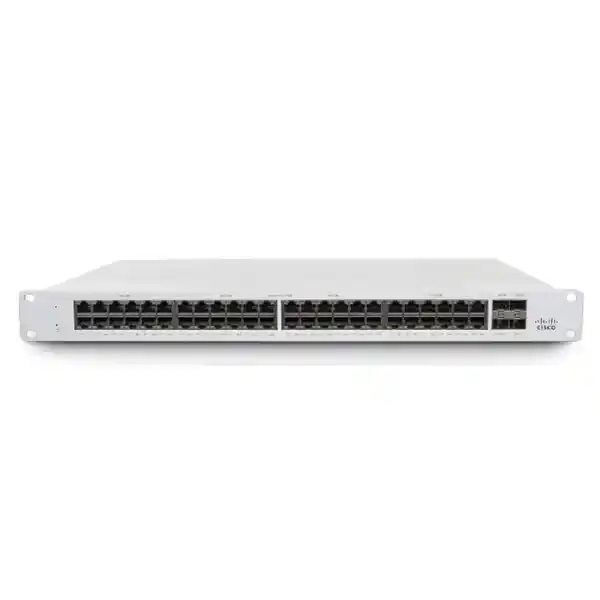
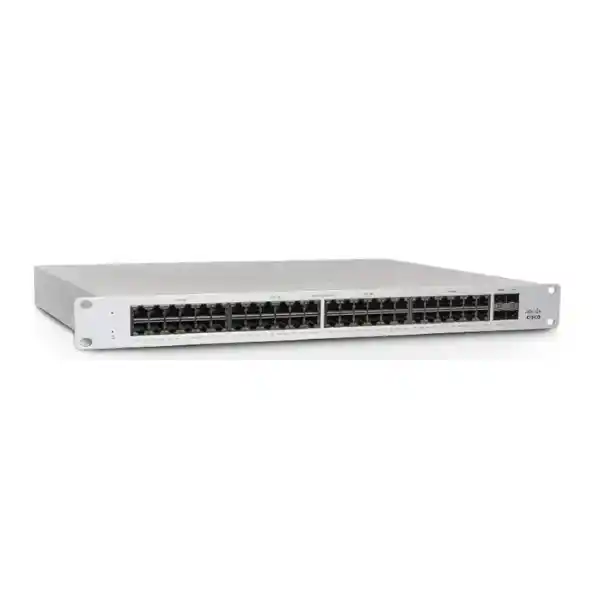
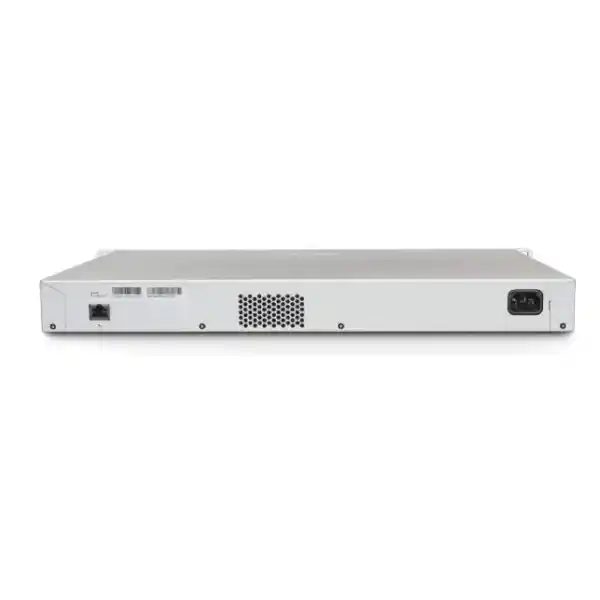
The Cisco Meraki MS130-48P is a full-size, cloud-managed Layer 2 access switch built for organizations that need a high-density Gigabit Ethernet edge with substantial Power over Ethernet capacity. The model provides 48 × 1 GbE RJ45 access ports, four 1 GbE SFP uplinks and a 740 W PoE+ switch budget. It is designed for branch and campus networks where access points, IP phones, surveillance cameras, door controllers, IoT devices and user endpoints need dependable wired connectivity with centralized administration through the Cisco Meraki cloud platform.
For Tanzanian businesses, the practical value of the MS130-48P is not simply the number of ports. The main benefit is the combination of access switching, PoE delivery, centralized configuration, remote visibility and operational consistency. A network team can standardize VLANs, port policies and monitoring across sites while reducing the need to manage each access switch as an isolated appliance. FourTeck Tanzania can help buyers evaluate the switch together with compatible licensing, SFP uplinks, racks, structured cabling, UPS protection, Wi-Fi access points, IP telephony and security infrastructure.
Forty-eight RJ45 access ports for business endpoints, wireless access points, IP phones, cameras and other Ethernet devices.
A high PoE budget for powering many IEEE 802.3at endpoints without individual local power adapters.
Dedicated SFP uplink interfaces support fiber or compatible copper transceivers according to the network design.
Meraki Dashboard provides centralized configuration, visibility, firmware management and remote troubleshooting.
What the Cisco Meraki MS130-48P Solves
Organizations often reach a point where basic unmanaged switching becomes difficult to operate. More access points are added, phones compete with computers for ports, cameras increase PoE demand, guest and corporate traffic need separation, and branch sites need support without an engineer standing in front of the rack. The MS130-48P addresses this access-layer problem with forty-eight managed Gigabit ports, a large PoE budget and centralized cloud management. It is particularly relevant when the network needs to support many powered endpoints while maintaining consistent port settings and visibility.
The switch is intended for Layer 2 access use rather than for replacing every routing function in a network. Cisco documents DHCP relay capability for the MS130 family, while broader routing decisions may remain with the firewall, router or higher-layer switch. This distinction matters during design. A good quotation should therefore account for where inter-VLAN routing, internet security, DHCP services, WAN failover and site-to-site connectivity will live. FourTeck can help map those functions before hardware is selected.
Verified Technical Highlights
| Item | Cisco Meraki MS130-48P |
|---|---|
| Access ports | 48 × 1 GbE RJ45 |
| Uplinks | 4 × 1 GbE SFP |
| PoE standard | IEEE 802.3at PoE+ |
| PoE budget | 740 W switch budget, up to 30 W per supported PoE port subject to total budget |
| Switching role | Layer 2 access switching with cloud management |
| Management | Cisco Meraki Dashboard |
| Operating temperature | 0°C to 45°C |
| Form factor | Full-size 1U rack-mount access switch |
Licensing and Cloud Management
Cisco Meraki switches are managed through the Meraki cloud and require the appropriate Meraki licensing or subscription arrangement for normal managed operation and support. The exact license type and term should be selected according to the customer’s organization, licensing model and desired lifecycle. Buyers with an existing Meraki organization should confirm compatibility with their current licensing approach before ordering. This is especially important in environments where co-termination, per-device licensing or subscription licensing is already in use.
The procurement conversation should therefore include both the hardware and the intended license term instead of treating licensing as an afterthought. For a new deployment, FourTeck can help prepare a bill of materials that includes the switch, correct licensing, required SFP modules, rack and power accessories, UPS sizing, patching and any related wireless or security equipment.
Deployment Planning for PoE, Uplinks and Cabling
The 740 W PoE budget is a major reason to choose the MS130-48P, but a high budget should still be planned carefully. A switch populated with a mixture of access points, phones, cameras and other powered devices may have very different power requirements from one where every port is connected to a low-power endpoint. The right method is to list each powered device, its expected PoE class or maximum draw, any future additions and the number of ports that must remain available. This prevents a design that looks sufficient by port count but becomes constrained by power consumption.
Uplink planning is equally important. The MS130-48P offers four 1 GbE SFP uplinks, so designers should decide whether those links connect to a distribution switch, firewall, router or fiber backbone and whether redundancy or link aggregation is required. Sites expecting sustained traffic above what the uplink design can comfortably handle may need a different model with faster uplinks. Structured cabling quality, fiber type, transceiver compatibility and rack organization should be confirmed before installation.
Cisco Meraki MS130-48P Tanzania
For organizations in Tanzania, the Cisco Meraki MS130-48P fits well in business networks that combine users, wireless access points, IP telephony, CCTV and connected building devices on a managed access layer. Its forty-eight Gigabit Ethernet ports give a single rack unit enough density for a substantial office floor, school block, hospitality zone, retail environment, healthcare department or branch site. The 740 W PoE+ budget can simplify deployment where many endpoints need power from the network, especially when wall or ceiling locations do not have convenient electrical outlets.
A Tanzanian buyer should begin with device count rather than model name alone. Count wired users, access points, cameras, phones, door controllers and spare ports for expansion. Then separate powered from non-powered devices and estimate the PoE demand. If the site has multiple racks or buildings, review fiber distances and uplink capacity. The MS130-48P has four 1 GbE SFP uplinks, so that may suit many access-layer designs, but a project with very high east-west traffic, dense Wi-Fi or aggregation requirements may call for a model with faster uplinks. Choosing the correct model at the planning stage protects the investment from avoidable bottlenecks.
Cloud management is valuable when a Tanzanian organization operates branches across several cities. Port configuration, VLANs, status visibility, firmware scheduling and troubleshooting can be coordinated from the Meraki Dashboard instead of relying entirely on local console access. That does not remove the need for good site preparation. Stable power, appropriate UPS protection, ventilation, rack mounting and documented cabling remain essential. Cisco specifies a 0°C to 45°C operating range for this model, so equipment rooms should be designed to remain inside the manufacturer’s environmental limits.
FourTeck Tanzania can help evaluate the MS130-48P as part of a complete LAN rather than as an isolated switch. See the FourTeck Tanzania technology solutions overview for related networking, Wi-Fi, firewall, telephony and infrastructure planning. For a quotation, provide the switch quantity, required Meraki license term, expected PoE endpoints, fiber or copper uplink requirements, site locations and whether installation, configuration or rack work is part of the project.
Cisco Meraki MS130-48P Dar es Salaam
In Dar es Salaam, businesses often operate from multi-floor offices, retail premises, logistics facilities, hotels, schools, clinics and mixed-use commercial buildings. In these environments, the MS130-48P can serve as a dense access switch where the network edge must support both conventional user connections and a growing number of powered devices. Forty-eight Gigabit ports allow a network designer to consolidate many access connections into one managed platform, while the 740 W PoE+ budget can supply power to access points, IP phones, cameras and other standards-compliant endpoints.
The first Dar es Salaam design question is where the switch sits in the network hierarchy. In a single-floor office it may connect directly upstream to a firewall or router. In a taller building or campus it may act as an access switch connected by fiber to a distribution layer. The four 1 GbE SFP interfaces make fiber uplinks possible, but distance, redundancy and traffic volume should be reviewed. A building with heavy video surveillance traffic, many high-throughput wireless clients or large local file transfers should be designed around actual bandwidth demand rather than assuming every 1 GbE uplink arrangement will be sufficient.
Power and environmental preparation should also be included in the bill of materials. Networking equipment in a poorly ventilated cupboard can exceed recommended conditions, while frequent power interruptions can cause avoidable outages or configuration disruptions. A correctly sized UPS, secure rack, clean patching, cable management and controlled airflow make the switch easier to operate. Cisco’s specified 0°C to 45°C operating range gives a clear engineering boundary for equipment-room planning.
For a Dar es Salaam quotation, it is useful to state whether the project is a new LAN, an expansion or a replacement of older switches. Include the count of Wi-Fi access points, cameras, phones and user ports; expected fiber links; and any Meraki products already in use. FourTeck’s verified Tanzania contact page can be used to share those requirements and request pricing or model-selection guidance.
Cisco Meraki MS130-48P Mwanza
For Mwanza businesses, institutions and distributed operations, the Cisco Meraki MS130-48P can provide a structured way to modernize the access network while keeping remote administration practical. A branch network often grows gradually: first computers and printers, then Wi-Fi, IP phones, CCTV, access control and specialized devices. Without managed switching, these additions can become difficult to document and troubleshoot. The MS130-48P provides a single cloud-managed access platform with enough port density to accommodate many of these endpoint types in one rack.
The 740 W PoE+ budget is especially useful when ceiling-mounted access points, IP cameras and desk phones need network power. During planning, each device should be mapped to a switch port and a realistic power requirement. Spare PoE capacity should be retained for expansion and for replacement devices whose draw may be higher than the original equipment. This approach is safer than simply multiplying the maximum per-port value because the total switch budget is the real system limit.
Mwanza projects may also involve branch connectivity back to another Tanzanian city or a regional head office. The MS130-48P remains an access switch, so WAN, VPN and internet security requirements should be addressed by the appropriate upstream router or firewall. VLANs can be used to organize user, voice, camera and guest networks, while the upstream security architecture controls communication between segments and external resources. Meraki Dashboard visibility can simplify remote monitoring and reduce the need for routine on-site intervention when port status or client information is needed.
A complete procurement list should consider SFP transceivers, fiber patching, rack accessories, UPS capacity, structured cabling, labels and licensing as well as the switch itself. Buyers should also confirm whether four 1 GbE SFP uplinks meet current and future traffic requirements. If the site is expected to become a distribution point for multiple switches or very high-density wireless, a different model may offer a better long-term fit. FourTeck can assist with that model-selection discussion before the order is finalized.
Cisco Meraki MS130-48P Arusha
Arusha has a wide mix of hospitality, tourism, professional services, education, healthcare and administrative environments where network reliability affects both staff operations and customer experience. The Cisco Meraki MS130-48P is suitable as a managed access switch when a site needs forty-eight Gigabit Ethernet ports and significant PoE capacity in a rack-mounted design. It can support the access layer for wireless networks, IP telephony, surveillance and normal business endpoints while giving administrators centralized visibility through the Meraki cloud.
Hospitality and guest-facing sites require particularly careful segmentation. Guest Wi-Fi should not share unrestricted access with business systems, cameras or management interfaces. Staff, voice, surveillance and operational devices may each need different VLANs and upstream security policies. The switch provides the managed port layer needed to implement this structure, but the firewall and overall architecture must still be designed intentionally. Naming conventions and documentation make the network easier to support when staff changes or when external technicians need to understand the environment quickly.
The PoE design should consider not only present devices but planned expansions such as additional wireless coverage, new cameras or upgraded access points. The MS130-48P’s 740 W budget is substantial, yet high-power endpoints can consume it faster than simple device counts suggest. For this reason, the bill of materials should include a PoE worksheet that lists device type, quantity and expected draw. The same planning principle applies to uplinks: the four 1 GbE SFP ports are useful for fiber, but the expected aggregate traffic should be checked against the site’s real applications.
Arusha sites should also provide a proper equipment environment. Cisco specifies operation from 0°C to 45°C, so ventilation and room temperature are relevant. Rack depth, cable routing, UPS runtime and grounding should be reviewed before installation. The resulting network will be easier to maintain if the physical layer is as disciplined as the cloud configuration.
Cisco Meraki MS130-48P Dodoma
In Dodoma, the Cisco Meraki MS130-48P can serve organizations that need a modern access layer for offices, campuses, institutions, service facilities and branch environments. The switch’s forty-eight 1 GbE RJ45 ports offer high endpoint density, while four 1 GbE SFP uplinks provide options for connection to distribution equipment or fiber infrastructure. With a 740 W PoE+ budget, it can support many powered devices from a centralized rack, reducing the need for local power adapters at desks, ceilings and camera locations.
A well-designed Dodoma deployment starts with a port schedule. Each user outlet, access point, phone, camera and infrastructure device should have an intended port, VLAN and PoE requirement. This schedule becomes valuable after installation because it provides a clear reference for troubleshooting and future moves. The Meraki Dashboard adds centralized monitoring, but accurate labels and structured patching still save time when a cable or endpoint has to be physically traced.
For organizations with offices in more than one city, centralized cloud management can support consistent configuration standards. A network team can apply common naming, VLAN, port and monitoring practices across sites instead of creating a different operating model in every branch. That is especially useful when local technical resources vary. However, connectivity to the Meraki cloud, internet resilience and upstream firewall design should be considered as part of the deployment plan rather than assumed.
Procurement should also include licensing, because Meraki switching is designed around cloud-managed operation. The selected licensing model and term should align with the wider Meraki organization. Buyers who already have Meraki hardware should state their organization and current licensing model when requesting a quote. This helps avoid ordering hardware without the required management entitlement or selecting a term that does not fit the existing lifecycle plan.
Cisco Meraki MS130-48P UAE
For companies operating in the UAE, the Cisco Meraki MS130-48P offers a cloud-managed access layer suitable for branch offices, retail environments, hospitality sites and corporate facilities that require many Gigabit and PoE connections. The same forty-eight 1 GbE RJ45 ports and 740 W PoE+ budget that make the switch attractive in Tanzania can support regional standardization where one IT team manages networks in multiple countries.
Regional standardization can reduce support complexity. If Tanzania and UAE branches use the same switch family, administrators can reuse port profiles, VLAN plans, monitoring practices and documentation templates. The physical design may still differ because user counts, building layouts, ISP services and upstream infrastructure vary, but the operational model stays familiar. This is one of the main strengths of a cloud-managed platform for distributed organizations.
UAE deployments should confirm fiber type and uplink topology before selecting optics. The MS130-48P has four 1 GbE SFP uplinks, so a project expecting 10 GbE aggregation should not assume the -48P offers the same uplink capability as the MS130-48X. Cisco’s model naming matters: the -48X provides a different port mix and higher-speed SFP+ uplinks, whereas the -48P is a 48-port 1 GbE access switch with 1 GbE SFP uplinks. Accurate model matching prevents costly procurement mistakes.
For related UAE infrastructure requirements, customers can review FourTeck UAE IT and network solutions. Cross-border buyers should provide the intended deployment country, required license term, switch quantity and any standard configuration they want repeated across sites.
Cisco Meraki MS130-48P Uganda
The Cisco Meraki MS130-48P is relevant to Ugandan organizations that want a high-density managed access switch with centralized visibility. Forty-eight Gigabit Ethernet ports can support offices, schools, hospitality properties, healthcare sites, warehouses and branch locations, while the 740 W PoE+ budget enables a large number of powered endpoints to share the same rack infrastructure. That combination can reduce the number of separate power supplies and simplify centralized backup power planning.
Uganda projects should be assessed for branch-management needs as well as local port count. A cloud-managed switch is especially useful when the main network team is located in another city or country. Administrators can inspect port status, connected clients and configuration remotely, making first-line diagnosis more efficient. Remote management does not eliminate the value of local documentation, however. Patch panels should be labeled, racks should be organized and physical port assignments should match the logical configuration.
The uplink architecture should reflect whether the site is standalone or part of a larger campus. Four 1 GbE SFP interfaces can be used for fiber connections, redundancy or aggregation where supported by the overall design. If the site connects several access switches or carries large volumes of CCTV and wireless traffic, engineers should calculate expected traffic rather than choosing uplinks by habit. A switch with faster uplinks may be more appropriate when aggregate demand is high.
Organizations with requirements across East Africa can also reference FourTeck Uganda IT and networking solutions. When requesting pricing, include whether the switch will power access points, phones or cameras so PoE capacity and UPS sizing can be evaluated together.
Cisco Meraki MS130-48P Kampala
In Kampala, the MS130-48P can be deployed in office buildings, commercial premises, education sites, healthcare networks, call-center environments and branch facilities that need many managed access ports. The model is particularly practical where wireless access points, IP phones and security cameras are concentrated in one building and the network team wants to power them from the access switch. With forty-eight 1 GbE RJ45 ports and a 740 W PoE+ budget, one device can cover a significant access-layer footprint.
Kampala deployments should consider how many endpoint categories share the switch. Voice devices need predictable quality, cameras can create sustained traffic, guest wireless should be segmented, and business users may require access to internal services that IoT devices should not reach. VLAN design and upstream firewall policy create these boundaries. The MS130-48P provides the managed edge where ports can be assigned consistently, but security policy must be coordinated across the whole network.
The Meraki Dashboard can be useful for organizations with multiple Kampala branches because support staff can inspect and modify configuration centrally. Zero-touch-style deployment workflows are also helpful when hardware is staged before arriving at the site. A practical process is to claim the switch into the correct Meraki organization, prepare the intended network configuration, document uplinks and port profiles, and then complete physical installation with verified internet connectivity and licensing.
Power resilience deserves attention. PoE devices depend on the switch, which means a single switch power loss can affect phones, cameras and Wi-Fi at the same time. A UPS should therefore be sized for the switch’s realistic load and the required runtime, not merely the idle draw. Where cameras or communications are critical, this power planning can be as important as the switch specification itself.
Cisco Meraki MS130-48P Arua
For organizations in Arua, the Cisco Meraki MS130-48P offers a way to centralize access switching and reduce dependence on unmanaged or individually configured edge devices. This is useful for growing institutions and branches where the network has accumulated computers, printers, wireless access points, cameras and phones over time. Forty-eight Gigabit ports create room for consolidation, while Meraki cloud management gives a remote IT team better visibility into the state of the access layer.
Arua sites should be designed with remote support in mind. Equipment should be installed in a secure, clearly labeled rack with patch-panel documentation that a local contact can follow under guidance. Port descriptions should identify rooms or endpoints, and spare patch leads, optics and basic replacement components can be planned according to the organization’s maintenance strategy. Cloud visibility helps identify many issues remotely, but clean physical documentation makes the final on-site action faster when a cable or device must be checked.
The 740 W PoE+ budget supports a large number of powered endpoints, yet planners should calculate actual load. A security camera, desk phone and modern wireless access point can have very different power requirements. Future replacements may also draw more than the equipment they replace. A prudent design keeps PoE headroom and does not treat the switch’s total budget as a target that must be fully consumed.
Uplink and WAN resilience should be considered separately. The MS130-48P provides four 1 GbE SFP uplinks, but internet connectivity and site-to-site routing belong to the upstream network. If the branch has multiple WAN circuits or VPN requirements, the firewall or router should be sized and configured accordingly. The goal is to make the switch part of a resilient architecture rather than expecting one device to perform every network role.
Cisco Meraki MS130-48P Mbarara
Mbarara businesses and institutions considering the Cisco Meraki MS130-48P should evaluate it as an access-layer platform for current and future connected devices. The forty-eight 1 GbE ports can support a broad mix of workstations, printers, phones, cameras and wireless access points. Because the switch provides 740 W of PoE+, many of those endpoints can receive both data and power through the Ethernet cable, simplifying ceiling, wall and desk installations where dedicated power outlets would otherwise be required.
The most useful pre-purchase exercise is to create a port and PoE inventory. Start with active devices, add planned expansion and reserve ports for moves and changes. Then identify which devices require PoE and their expected maximum draw. If an installation is replacing older switches, confirm that all existing powered endpoints use compatible standards and that no proprietary power method is involved. This avoids surprises during cutover.
Cloud management can simplify ongoing administration when local IT teams are small. Configuration templates, VLAN assignments, monitoring and firmware scheduling can be handled centrally. Organizations should still define who has administrative access to the Meraki Dashboard and apply appropriate account security practices. Network documentation should include the Meraki organization, switch name, physical rack location, uplink path and support ownership so future technicians can understand the deployment quickly.
Environmental and power preparation also matter. Cisco specifies an operating temperature range of 0°C to 45°C for the MS130-48P. A closed cabinet in a warm room may therefore require better ventilation or cooling. A UPS should be sized around the expected PoE load and desired runtime, because powering many endpoints from the switch concentrates dependency on the switch’s power path.
Cisco Meraki MS130-48P Gulu
In Gulu, the Cisco Meraki MS130-48P can provide a centralized access switch for organizations that want consistent configuration and remote network visibility. The model’s forty-eight Gigabit ports are suitable for sites with a sizable wired footprint, while its high PoE+ budget is valuable for deployments with IP phones, cameras and wireless access points. This can reduce the number of small power injectors and adapters distributed around the site and move power management into the network rack.
For remote or distributed operations, standardization has a strong operational benefit. If the same Meraki switch family is used across several branches, the IT team can apply common naming, VLAN and port-profile practices. Troubleshooting becomes more predictable because engineers know what information is available in the Dashboard and how each branch is structured. This consistency also helps when equipment is replaced or a new site is added.
A Gulu project should pay particular attention to power continuity. A PoE switch may simultaneously support Wi-Fi, telephony and surveillance, so a single power interruption can affect several services. UPS sizing should account for the actual switch load, desired runtime and any upstream equipment such as firewalls or routers. If the site requires longer continuity, generator or other backup-power arrangements may also influence the network design.
The four 1 GbE SFP uplinks are useful for fiber links between racks or buildings, but distance, fiber type and optic compatibility must be confirmed. Where multiple buildings are involved, designers should also consider redundancy and whether the access switch is being asked to aggregate more traffic than its uplinks can comfortably carry. Accurate sizing before purchase is more cost-effective than replacing bottlenecks after deployment.
Cisco Meraki MS130-48P Kenya
Kenyan organizations with branch or campus networks can use the Cisco Meraki MS130-48P as a high-density access switch where cloud management and PoE are priorities. It delivers forty-eight 1 GbE RJ45 ports, four 1 GbE SFP uplinks and a 740 W PoE+ budget. These characteristics make it suitable for user access, wireless infrastructure, IP telephony, cameras and other edge devices, provided the required uplink capacity and Layer 3 functions are handled elsewhere in the architecture.
For companies operating in both Kenya and Tanzania, using the same switch family can make cross-border support easier. The IT team can maintain common port profiles, naming rules, VLAN structures and monitoring procedures while adapting the physical design to each branch. Meraki Dashboard provides a shared management experience, helping engineers compare site status and troubleshoot without maintaining separate local management systems.
Before ordering, Kenyan buyers should confirm whether they need the MS130-48P or the MS130-48X. The -48P is ideal when forty-eight standard Gigabit access ports and 1 GbE SFP uplinks match the requirement. The -48X offers a different mix that includes multigigabit access ports and 10 GbE SFP+ uplinks. A dense modern Wi-Fi deployment or high-throughput aggregation scenario may therefore favor the -48X, while conventional access networks can be well served by the -48P.
For Kenya-specific networking and infrastructure discussions, visit FourTeck Kenya enterprise IT solutions. A useful quotation request includes switch quantity, licensing term, PoE device count, uplink media, current Meraki organization details and whether installation or configuration services are required.
Cisco Meraki MS130-48P Kuwait
For Kuwait deployments, the Cisco Meraki MS130-48P can provide the access-layer density needed in offices, retail branches, education environments, hospitality operations and corporate facilities. Forty-eight Gigabit Ethernet access ports allow many endpoints to be connected in one rack unit, and the 740 W PoE+ budget supports extensive use of powered devices such as phones, cameras and wireless access points. Cloud management makes the switch particularly relevant to organizations whose network team supports more than one site.
The local equipment environment should be treated as part of the technical specification. Cisco lists an operating range of 0°C to 45°C for the MS130-48P, so network rooms must remain within that range. Rack airflow, air-conditioning reliability and dust control can influence long-term stability. High ambient outdoor temperatures do not automatically mean the rack itself will be too hot, but enclosed cabinets and poorly ventilated rooms should be assessed carefully.
A Kuwait network with high-density Wi-Fi or heavy local traffic should verify whether 1 GbE SFP uplinks are enough. The MS130-48P’s four SFP ports are suitable for many traditional access designs, but they are not 10 GbE SFP+ interfaces. If the project requires higher-speed uplinks, a different MS130 variant or another switch family should be considered. This distinction is important when comparing product listings because similarly named models can have materially different interfaces.
The licensing model should also be included in procurement from the beginning. Meraki hardware is designed for cloud-managed operation and requires the appropriate license or subscription. A regional IT team can benefit from aligning license terms across sites so renewal planning, support coverage and asset lifecycle management remain clear.
Cisco Meraki MS130-48P Ghana
Ghanaian businesses looking for a cloud-managed 48-port PoE switch can consider the Cisco Meraki MS130-48P for access-layer deployments. The switch combines forty-eight 1 GbE RJ45 ports with four 1 GbE SFP uplinks and a 740 W PoE+ budget. This is a practical configuration for sites where wired users, cameras, IP phones and wireless access points share the same structured cabling environment and need centrally controlled switching.
When several endpoint types share the switch, segmentation becomes important. Staff computers may need access to internal systems, guest wireless may need internet-only connectivity, cameras should normally be restricted to appropriate recording or management systems, and infrastructure management interfaces should not be broadly accessible. VLANs at the access layer and policy at the upstream firewall or router can create these boundaries. The exact design should be documented before the cutover.
The Meraki Dashboard supports centralized configuration and troubleshooting, which can make multi-site operations easier. A Ghana branch can be managed by the same network team responsible for another African location, provided organizational access is configured appropriately. Common templates and naming reduce variation, but each site should still have an accurate local port map, rack layout and uplink diagram.
A quotation should include the required license term, because the cloud management model depends on valid licensing. Buyers should also specify whether fiber uplinks are required and what distances are involved. This allows suitable SFP transceivers and fiber patching to be included rather than discovered late in the installation. If PoE endpoints are numerous, include model numbers where possible so total power draw can be estimated with useful headroom.
Cisco Meraki MS130-48P Nigeria
For Nigerian offices, campuses and distributed enterprises, the Cisco Meraki MS130-48P provides a managed access layer with enough port density for substantial endpoint deployments. Its forty-eight 1 GbE access ports can connect user devices, phones, access points and cameras, while the 740 W PoE+ budget enables many of those endpoints to receive power over Ethernet. Four 1 GbE SFP interfaces support uplink designs based on compatible fiber or copper transceivers.
Power continuity is a major architectural consideration whenever many devices depend on one PoE switch. If the switch loses power, connected access points, phones and cameras can also go offline. The UPS should therefore be sized around expected PoE load, not only the switch’s idle consumption. For longer outages, the broader site power strategy may need to include generator or other backup arrangements. Network resilience depends on the entire power chain.
Cloud management helps distributed Nigerian organizations avoid treating every branch as a separate island. Network teams can monitor configuration and status through Meraki Dashboard, schedule firmware updates and use remote troubleshooting tools. This model works best when branch internet connectivity, naming, documentation and administrative access are standardized. The switch should be claimed into the correct organization and network before deployment so the configuration is associated with the intended site.
Model selection should also consider future wireless upgrades. The MS130-48P provides standard Gigabit access ports and 1 GbE SFP uplinks. Sites expecting multigigabit access points or high-speed aggregation should compare the MS130-48X or another suitable model instead of assuming every MS130-48 variant has the same interface set. The correct decision depends on actual traffic and lifecycle requirements, not simply port count.
Cisco Meraki MS130-48P Seychelles
In Seychelles, the Cisco Meraki MS130-48P can support hotels, offices, professional services, education sites and other organizations that need centralized access switching with significant PoE capacity. Hospitality environments in particular may combine guest Wi-Fi, staff networks, IP phones, surveillance cameras and operational devices across the same property. A managed access switch helps separate these functions logically while simplifying endpoint power and network administration.
The switch’s forty-eight 1 GbE RJ45 ports provide high access density, while the 740 W PoE+ budget is useful for wireless and camera-heavy properties. Before installation, the design should account for the number and location of access points, camera models, phones and other powered devices. Keeping reserve PoE capacity allows future devices to be added without immediately replacing the switch or installing separate injectors.
Island and hospitality sites may place a premium on remote support. Meraki Dashboard allows an authorized administrator to see switch status and configuration without being physically present. This can reduce diagnosis time when an endpoint goes offline or a port requires review. Physical maintenance still depends on good labeling, spare planning and rack organization, so remote manageability should be paired with clear local documentation.
Fiber uplinks may be useful between building areas or floors, but the MS130-48P provides 1 GbE SFP interfaces. A large resort or campus with significant traffic between access and distribution layers should verify whether this capacity meets peak demand. Where higher-speed uplinks are required, another switch variant may be more suitable. Environmental conditions should also be managed inside the equipment room to remain within Cisco’s specified 0°C to 45°C operating range.
Related Network Planning Resources
The MS130-48P works best when switching, security, wireless, cabling and power are planned together. Tanzania customers can use the FourTeck Tanzania site for integrated technology planning. Organizations with cross-border operations can also reference FourTeck Africa regional IT solutions for broader African requirements. These regional resources are useful when a company wants to standardize network design across several offices while adapting quantities and infrastructure to each site.
Cisco Meraki MS130-48P Buying Checklist
Count present endpoints and leave sensible capacity for expansion.
List every access point, phone, camera and other powered device with expected draw.
Confirm whether four 1 GbE SFP uplinks meet bandwidth, distance and redundancy needs.
Select the appropriate Meraki license or subscription model and term.
Plan rack space, airflow, UPS capacity, patch panels and cable management.
Identify where routing, firewalling, DHCP, VPN and internet services will be handled.
Frequently Asked Questions
How many ports does the Cisco Meraki MS130-48P have?
It provides 48 × 1 GbE RJ45 access ports and four 1 GbE SFP uplink interfaces.
What is the PoE budget of the MS130-48P?
Cisco specifies a 740 W total PoE budget for the MS130-48P, with IEEE 802.3at PoE+ support and up to 30 W per supported port subject to the overall budget.
Does the MS130-48P have 10 GbE uplinks?
No. The MS130-48P provides four 1 GbE SFP uplinks. Buyers who require 10 GbE SFP+ uplinks should compare models such as the MS130-48X or another appropriate switch.
Does Cisco Meraki MS130-48P require licensing?
Yes. Meraki switching is designed for cloud-managed operation with an appropriate Meraki license or subscription. The exact license model and term should match the customer’s organization and lifecycle requirements.
Can the MS130-48P power Wi-Fi access points and IP cameras?
Yes, when the connected devices use compatible PoE standards and the combined device load remains within the switch’s PoE budget. A device-by-device power calculation is recommended.
What temperature range is specified for the MS130-48P?
Cisco specifies an operating range of 0°C to 45°C. The rack and equipment room should be designed to remain within the manufacturer’s environmental limits.
Decision Recap
Choose the Cisco Meraki MS130-48P when you need forty-eight standard Gigabit access ports, a large 740 W PoE+ budget, four 1 GbE SFP uplinks and centralized Meraki cloud management. It is a strong fit for managed branch and campus access networks where many phones, cameras, access points or other PoE devices connect at the edge. Compare a higher-uplink or multigigabit model when the site needs 10 GbE aggregation or 2.5 GbE endpoint connectivity.
Before purchase, confirm port count, PoE demand, uplink bandwidth, licensing, rack conditions, UPS capacity and the upstream routing and firewall design. These details determine whether the switch will meet both current requirements and planned expansion.
Request a Cisco Meraki MS130-48P Quotation
For a more accurate quotation, provide the number of MS130-48P switches required, preferred Meraki license term, approximate count of PoE devices, SFP or fiber requirements, deployment city, existing Meraki environment and whether you need configuration, installation, cabling or UPS support. FourTeck can then evaluate the switch in the context of the complete network rather than pricing a standalone box without the components needed to operate it.




Reviews
There are no reviews yet.