
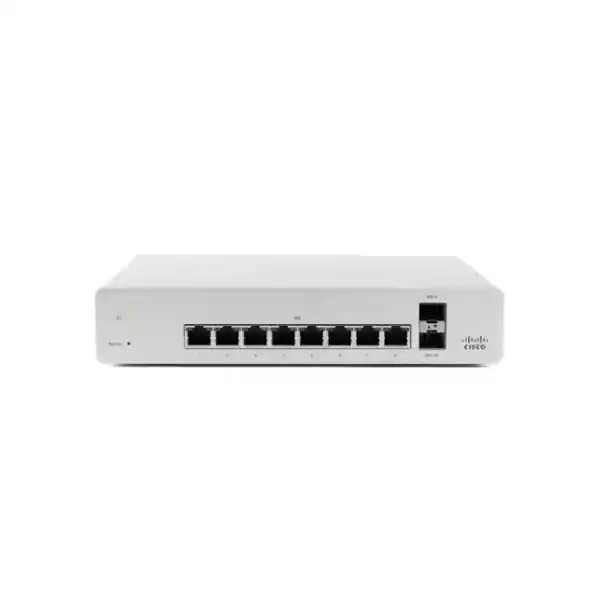
Cisco Meraki MS130-8P-I Tanzania
The Cisco Meraki MS130-8P-I is designed for organizations that want compact access switching with centralized cloud management, PoE power for edge devices and a cleaner installation through an internal power supply. For offices, shops, clinics, schools, hospitality environments and distributed branch networks in Tanzania, it can provide a practical access layer where eight copper ports are sufficient but managed switching, visibility and remote administration are still important. Cisco positions the MS130 family as Layer 2 access switching for branch and campus deployments, and the MS130-8P-I combines eight 1 GbE RJ45 ports, two 1 GbE SFP uplinks, a 120 W PoE switch budget and fanless operation in a small form factor.
Business access ports for wired endpoints such as computers, printers, phones, access points, cameras and other Ethernet devices.
Useful for powering compatible PoE endpoints while reducing the number of local power adapters at the edge.
Flexible fiber or copper uplink options using supported SFP modules for connection to upstream switching or longer-distance links.
Cloud-based administration supports centralized configuration, monitoring, firmware management and remote troubleshooting.
What the Cisco Meraki MS130-8P-I solves
Small sites often face an awkward choice between very simple unmanaged switches and larger enterprise switches that provide more capacity than the site needs. The MS130-8P-I addresses that gap by delivering a compact managed access switch with PoE and centralized cloud operations. A branch office can use the eight Gigabit Ethernet ports for desktops, IP phones, printers, cameras or access points while maintaining visibility over port status, VLAN configuration, authentication and connected devices from the Meraki Dashboard. Remote operations are especially useful when a business has sites in more than one city and does not want every routine troubleshooting task to require an onsite visit.
The internal power supply is an important differentiator within the compact MS130 range. It reduces dependence on an external power brick and can make a small network cabinet or wall-mounted installation neater. The switch is fanless, which is valuable for reception areas, meeting spaces, retail counters, clinics and other environments where equipment noise is undesirable. The 120 W PoE budget can support a practical mix of compatible edge devices, but procurement should still be based on the actual per-device power requirement and total PoE demand rather than simply counting ports.
The MS130 platform also supports operational capabilities such as VLAN tagging, 802.1X authentication, DHCP snooping, IPv4/IPv6 access-control lists, SNMP/syslog integration, automatic firmware upgrades and remote packet capture through Dashboard. These features make the switch suitable for structured business networks where administrators need segmentation, basic access controls and remote visibility rather than a plug-and-forget Ethernet fan-out device.
Verified technical overview
| Model | Cisco Meraki MS130-8P-I |
| Access ports | 8 × 10/100/1000 Mbps RJ45 |
| Uplinks | 2 × 1 GbE SFP |
| PoE switch budget | 120 W |
| Power supply | Internal |
| Switching capacity | 20 Gbps |
| Cooling | Fanless |
| Dimensions | 1.75 × 9 × 8.58 in (4.4 × 23 × 23 cm) |
| Weight | 2.86 lb (1.3 kg) |
Cisco documentation lists the operating range for the compact MS130 models as 0°C to 45°C and 5% to 95% humidity. Environmental suitability should still be checked for the actual cabinet, room, dust conditions, ventilation and expected ambient temperature before deployment.
Cloud management, licensing and deployment planning
Meraki switches are designed around the Meraki Dashboard. Initial deployment normally involves claiming the switch to a Dashboard organization, adding it to the appropriate network, providing connectivity so the switch can reach the cloud and then completing port, VLAN and policy configuration centrally. This architecture is useful for distributed companies because network teams can see multiple sites from one interface, apply consistent configuration and use remote troubleshooting tools without depending entirely on local staff.
Licensing must be included in the procurement conversation. Cisco documents Enterprise and Advanced licensing tiers for the MS130 family, with available term lengths varying by tier. Organizations should confirm the required license model, term and feature tier before ordering. Existing Meraki customers should also confirm how the new switch fits their current organization licensing model because Cisco notes restrictions on mixing MS130 Enterprise and Advanced licensing within the same organization under applicable licensing arrangements.
For installation, review port count, PoE requirement, uplink media, available power socket, grounding, mounting position and connection to the firewall or upstream switch. Cisco notes that region-specific power cords may need to be ordered separately for this model. That detail should be checked at quotation stage so installation is not delayed by an overlooked accessory.
Cisco Meraki MS130-8P-I Tanzania
For customers searching for the Cisco Meraki MS130-8P-I in Tanzania, the model is best evaluated as a compact managed access switch rather than simply an eight-port PoE device. Tanzanian businesses increasingly operate mixed edge environments that combine user computers, IP telephony, wireless access points, CCTV, printers and cloud applications. The practical benefit of the MS130-8P-I is that it can provide a structured access layer for a smaller site while remaining part of the same Meraki operational model used elsewhere in the organization. That is valuable for companies with headquarters, branches, stores, clinics, classrooms or remote offices that need consistent standards across several locations.
A Tanzania deployment should start with a simple device inventory. List every endpoint that requires Ethernet, identify which devices need PoE, document expected growth and confirm whether any uplink needs fiber. Eight copper ports can be sufficient for a focused branch, but a site with several access points, cameras and phones may consume the available ports quickly. PoE should also be calculated in watts, not just device count. The switch provides a 120 W PoE budget, so the installer should total the maximum expected consumption of all powered endpoints and leave operational margin.
Power quality and connectivity are also part of the design. The switch’s internal PSU can simplify physical installation, but business networks should still consider UPS protection where service continuity matters. The Meraki Dashboard requires cloud reachability for centralized management, therefore WAN design and firewall policies should allow the appliance to communicate as required by Cisco. Sites using multiple internet links can combine the switching layer with an appropriately sized security gateway so remote management remains useful during normal operations.
FourTeck Tanzania can help customers frame the complete requirement around switching, Wi-Fi, firewalling and structured cabling rather than purchasing the switch in isolation. Explore the broader FourTeck Tanzania IT and networking portfolio when the project also includes wireless, voice, surveillance or server connectivity.
Cisco Meraki MS130-8P-I Dar es Salaam
Dar es Salaam organizations often need compact managed switching for offices, retail outlets, professional services firms, hospitality locations and distributed branch operations. In these environments, the MS130-8P-I can be a good fit where the edge requirement is modest in port count but high in manageability. A small office may connect employee workstations, an IP phone, printer and one or two access points; a retail site may prioritize point-of-sale devices, wireless coverage and cameras; a customer-facing office may need silent equipment that can be installed close to occupied space. Fanless operation and the internal power supply both support cleaner small-site deployments.
The most important planning step is to determine whether eight Gigabit access ports are enough over the expected life of the site. Buyers should count today’s ports and likely additions such as a second access point, new CCTV cameras, an extra desk, a time-attendance terminal or a new IP phone. Where the requirement will exceed eight ports, moving to a larger MS130 model may be better than installing multiple compact switches without a clear topology. For sites staying within the compact footprint, the two SFP uplinks provide options for fiber or supported SFP connectivity to an upstream device.
PoE planning is equally important in Dar es Salaam office and commercial environments. Access points and cameras can vary significantly in power consumption, especially as radio capability and camera functions increase. The 120 W switch budget should therefore be matched against the actual endpoint datasheets. Voice, Wi-Fi and surveillance traffic can also be segmented with VLANs so each service is easier to manage and secure. Meraki Dashboard visibility can make this arrangement easier to support when IT administrators manage more than one city or branch.
Organizations designing a wider LAN can review FourTeck’s Tanzania networking coverage and related FourTeck enterprise technology portfolio for complementary infrastructure planning across switching, security and communications.
Cisco Meraki MS130-8P-I Mwanza
Businesses in Mwanza considering the Cisco Meraki MS130-8P-I may be looking for a manageable switch for a branch, administrative office, clinic, school, retail environment, small warehouse office or hospitality site. In these scenarios, centralized cloud management can reduce reliance on local configuration tools because approved administrators can review switch status, ports and network information through Dashboard. This is particularly useful when the wider IT team is based elsewhere and the local site needs a consistent configuration rather than ad-hoc changes.
A sensible Mwanza deployment begins with separating business functions. User devices can sit on one VLAN, voice on another, cameras on a dedicated segment and guest or wireless services on appropriate networks. The MS130 platform supports 802.1Q VLAN tagging and access-control functionality that can be incorporated into this design. The switch should then uplink to an appropriate router or firewall that handles inter-VLAN and internet security policy according to the full architecture. This helps avoid the common problem of connecting every device to one flat network simply because the site is small.
Physical conditions matter as well. Compact switches are often installed in wall cabinets or small communications spaces, so ventilation, cable bend radius, power protection and access for maintenance should be considered. Even though the MS130-8P-I is fanless, it still requires an environment within Cisco’s published operating limits. A UPS may be appropriate when the switch powers phones, cameras or access points that must remain online through short power disturbances.
Before requesting a quotation, Mwanza buyers should provide endpoint count, PoE device list, uplink requirement, preferred license term and whether they are joining an existing Meraki organization. That information allows the switch, license and accessories to be quoted as a usable system rather than as an isolated hardware line.
Cisco Meraki MS130-8P-I Arusha
Arusha has a broad mix of business, hospitality, tourism, education and professional-service environments where compact cloud-managed switching can be useful. The Cisco Meraki MS130-8P-I is particularly relevant for sites that need a small access switch but still want enterprise-style visibility and standardized configuration. A reception office, lodge administration area, training room, small branch or customer-service location can use the eight copper ports for a controlled combination of user devices, phones, cameras and access points while retaining centralized oversight through the Meraki platform.
Hospitality and customer-facing locations should think beyond port count. Wi-Fi access points may be the most important endpoints, so PoE headroom, upstream bandwidth and guest traffic separation become central design questions. A switch can provide the physical ports and VLAN boundaries, but the complete experience depends on access-point placement, firewall policy and internet capacity. Where cameras share the same switch, video traffic should be considered in uplink planning and the network should be documented so troubleshooting remains straightforward.
The MS130-8P-I’s internal PSU can simplify installations where space is limited and external power bricks would add clutter. Fanless operation can also help when the switch is mounted close to occupied areas. Nevertheless, installers should still provide a secure mounting position with adequate airflow and organized patching. Fiber uplinks may be useful where buildings or communications rooms are separated beyond standard copper Ethernet distances, using Cisco-supported SFP modules selected for the actual fiber type and distance.
Arusha customers planning wireless deployments can also review regional technology options through the FourTeck Africa solutions network, especially where procurement or architecture spans more than one country.
Cisco Meraki MS130-8P-I Dodoma
Organizations in Dodoma can use the Cisco Meraki MS130-8P-I as a compact access-layer building block for administrative offices, professional workplaces, education sites and distributed branch environments. The key reason to select it is not merely the number of ports; it is the combination of managed access switching, PoE capability and cloud operations. A central IT team can define port settings and VLAN behavior, monitor connected devices and use remote troubleshooting functions without needing to configure the switch exclusively from a local console at the branch.
For government-related contractors, NGOs, institutions and businesses with formal IT policies, consistency can be as important as raw speed. A standard switch model across small branches can make documentation, spares, training and support procedures more predictable. The MS130-8P-I provides Gigabit access connectivity and two 1 GbE SFP uplinks, making it appropriate where local endpoints do not require multigigabit access. If a site expects Wi-Fi 7, very high-density wireless or other multigigabit endpoint requirements, buyers should compare the -X variants or other models rather than assuming the 1 GbE access ports are sufficient.
Licensing should be planned before purchase. The switch is managed through Meraki Dashboard and requires the applicable Meraki licensing approach. New customers should decide an appropriate term based on the expected lifecycle, while organizations already using Meraki should confirm compatibility with their current organization licensing strategy. This is also the right time to decide whether configuration will be standardized through templates or handled per site.
A complete Dodoma quotation should include the switch, correct license, suitable regional power cord when required, SFP modules if fiber is used, patching and installation services if needed. This prevents accessory gaps that can delay commissioning.
Cisco Meraki MS130-8P-I UAE
For UAE deployments, the Cisco Meraki MS130-8P-I is suitable for compact branches, retail locations, reception offices and distributed sites that require cloud-managed access switching with PoE. Companies operating across the UAE and East Africa may value the ability to maintain a consistent Meraki switching standard across countries. A network administrator can monitor devices through one cloud platform while site teams focus on physical connectivity, power and endpoint installation. This is particularly useful for organizations that want repeatable branch architecture rather than separate switch configurations at every location.
The switch provides eight 1 GbE copper ports, two 1 GbE SFP uplinks and a 120 W PoE budget. It is therefore best suited to sites with moderate port counts and endpoint bandwidth requirements. A small UAE retail outlet, for example, could use it for a point-of-sale system, access point, IP phone, printer and cameras, provided that the total port and PoE budgets are appropriate. A high-density office or site with many modern access points may need a larger or multigigabit model.
The internal power supply and fanless design are useful where equipment must be placed in compact cabinets or near working areas. As with any network device, heat, cabinet ventilation and power quality remain important. Businesses with critical voice, Wi-Fi or surveillance services should consider UPS protection and proper labeling so support teams can identify ports and connected devices quickly.
Customers coordinating projects between Tanzania and the Gulf can reference FourTeck UAE technology solutions for related regional procurement, security, networking and infrastructure requirements.
Cisco Meraki MS130-8P-I Uganda
Ugandan organizations evaluating the Cisco Meraki MS130-8P-I can use it as a compact access switch in branch networks where centralized administration is a priority. This can include offices, retail locations, clinics, schools and service businesses that need reliable wired connectivity and PoE for devices such as wireless access points, IP phones or cameras. The model is especially relevant when the organization already uses Meraki and wants smaller branches to follow the same management model as larger sites.
A good Uganda deployment should begin with a topology drawing. Document the internet gateway, firewall, switch, access points, phones, cameras and any server or local storage. Decide which devices share VLANs and which should be isolated. The MS130 family supports VLAN tagging, DHCP snooping and 802.1X authentication, making it possible to build a more controlled access layer than an unmanaged switch can provide. The exact policy design still depends on the organization’s security requirements and upstream routing or firewall architecture.
The 120 W PoE capacity must be checked against real endpoint consumption. A site with several access points and cameras can reach the budget before all eight ports are occupied, while a voice-heavy office may consume much less. The two SFP uplinks offer flexibility for fiber backhaul when required, and supported Cisco SFP modules should be selected according to the fiber and distance.
Cross-border customers can review FourTeck Uganda technology solutions when coordinating networking projects between Tanzania and Uganda or standardizing equipment across regional branches.
Cisco Meraki MS130-8P-I Kampala
Kampala businesses often operate in environments where branch connectivity, Wi-Fi, voice and CCTV converge on the same access network. The Cisco Meraki MS130-8P-I can support a compact version of that design by providing eight Gigabit access ports with PoE and cloud management. A small professional office might connect an access point, two phones, several desktops and a printer, while a retail environment may prioritize point-of-sale terminals, cameras and wireless devices. In either case, the network should be planned around business services rather than simply filling available ports.
Cloud management can be valuable when an organization has several Kampala sites or branches elsewhere in Uganda. Administrators can maintain visibility without relying on a technician at every location for routine status checks. Meraki Dashboard also supports remote troubleshooting tools that can help identify port, cable or client issues. This does not eliminate the need for good local cabling and documentation; instead, it gives the network team more information before deciding whether an onsite visit is required.
Buyers should confirm licensing, power cord requirements and SFP needs when requesting a quote. The internal power supply simplifies the device itself, but installation still requires a suitable AC connection and preferably power protection where downtime would affect operations. When the switch powers cameras or access points, a UPS can preserve network availability during brief interruptions, though runtime depends on total connected load.
For Kampala projects, the strongest design is usually one that sizes switching together with firewall, Wi-Fi and structured cabling. A compact managed switch is most effective when the surrounding network is equally well planned.
Cisco Meraki MS130-8P-I Arua
In Arua, the Cisco Meraki MS130-8P-I may suit organizations that need a compact managed switch at a remote or smaller branch where onsite IT resources are limited. The Meraki cloud model can be particularly useful in that context because configuration and monitoring can be handled centrally once the switch has appropriate internet connectivity. This can help a company enforce the same VLAN and port standards across a head office and smaller branch without introducing a completely different management process for the remote site.
Remote branches benefit from careful pre-deployment preparation. Administrators can plan port roles, VLANs and naming conventions before hardware reaches the site. Cabling should be labeled, endpoint positions documented and uplink requirements confirmed. If fiber is required between buildings or to an upstream network location, the two 1 GbE SFP ports provide an option, but the correct module and optical medium must be selected. If copper uplink is sufficient, supported SFP or RJ45 access arrangements can be considered based on the final design.
Power resilience deserves attention for remote sites. The internal power supply eliminates an external adapter, but the switch, internet equipment and any PoE endpoints remain dependent on available power. A properly sized UPS can help keep essential communication devices online through short interruptions. The switch’s 120 W PoE capacity should be included in UPS load calculations if it powers multiple access points, cameras or phones.
Arua buyers should share a complete endpoint and power list when requesting pricing. That allows suppliers to verify whether the MS130-8P-I is genuinely the right size or whether a larger switch would provide better expansion capacity.
Cisco Meraki MS130-8P-I Mbarara
Mbarara businesses can consider the Cisco Meraki MS130-8P-I where a small managed access layer is required for offices, healthcare facilities, education, hospitality or retail. The switch offers a practical combination of Gigabit connectivity, PoE and centralized administration, but correct sizing is important. Eight access ports may be ideal for a focused area or branch; they may be restrictive if the network is expected to add several cameras, more wireless access points or additional desks over the next few years.
The PoE budget is often more important than buyers expect. A port being PoE-capable does not mean every combination of powered devices can operate at maximum draw simultaneously. The MS130-8P-I provides a 120 W overall switch budget, so the deployment should total each endpoint’s power requirement and allow margin. This helps avoid a situation where new cameras or access points are added later and the power budget becomes the limiting factor even though a free Ethernet port remains.
From an operational perspective, Dashboard management provides a common view of port status, connected clients and network configuration. That can help Mbarara branches align with a central IT standard. Features such as VLAN tagging and authentication can support segmentation between corporate users, guest access, voice and other device groups. Upstream routing and security should be designed on the firewall or router that complements the switch.
For procurement, specify the hardware model exactly as MS130-8P-I, confirm the desired license and term, identify any required SFP modules and request the appropriate regional power cord. Clear ordering details reduce the risk of receiving a different compact MS130 variant with an external PSU or different uplink capability.
Cisco Meraki MS130-8P-I Gulu
For organizations in Gulu, the Cisco Meraki MS130-8P-I can provide manageable switching at sites where IT teams need remote visibility but the local port requirement remains small. A branch office, training center, healthcare location or retail point can connect wired users and PoE endpoints while the wider network team maintains control through Meraki Dashboard. This is a different operating model from an unmanaged switch, where local problems may be difficult to diagnose without physical access.
Remote troubleshooting becomes more useful when the network is properly documented. Each switch port should have a clear purpose and label, VLAN assignments should reflect business functions and endpoints should use consistent naming where possible. Dashboard information can then be matched with physical records, making it easier to identify whether an issue relates to a specific port, cable, endpoint or upstream service. Cisco’s remote packet capture and cloud visibility tools can support deeper diagnosis when needed.
The MS130-8P-I is fanless and compact, but it still deserves a secure installation point. Avoid exposed locations where cables can be disturbed, and keep the switch within its supported temperature and humidity range. When the switch supplies PoE to essential cameras, phones or access points, include power protection in the site plan. An internal PSU improves physical neatness but does not replace a broader resilience strategy.
Gulu customers should also think about growth. If the branch is likely to add several devices, a larger switch may be more economical than an early replacement. If the site remains within eight access ports, the MS130-8P-I offers a compact way to retain Meraki management consistency.
Cisco Meraki MS130-8P-I Kenya
Kenyan organizations operating branches in East Africa can use the Cisco Meraki MS130-8P-I as part of a repeatable small-site network standard. The switch is appropriate for branch offices, stores, clinics and service points where eight Gigabit access ports are enough and where cloud management is preferred. Regional companies can benefit from using the same switch family across sites because administrators can apply consistent naming, VLANs, security settings and firmware practices through the Meraki platform.
When comparing this model for a Kenyan site, examine not only purchase cost but the full operational requirement. Meraki licensing is part of the solution, and the correct term should be budgeted with the hardware. PoE demand, SFP modules, patching, UPS capacity and installation also belong in the project cost. This produces a more realistic comparison than evaluating hardware price alone against an unmanaged or locally configured switch.
The 1 GbE access ports fit common office endpoints, while the SFP uplinks can connect to upstream switching over supported fiber where needed. If the site expects multigigabit wireless or high-throughput edge devices, the MS130-8P-I may not be the best choice because its access interfaces are Gigabit. In that case, buyers should review MS130 X models or another suitable platform before standardizing.
Organizations coordinating East African procurement can explore FourTeck Kenya business technology solutions for related networking and infrastructure requirements in Kenya while maintaining a comparable architecture with Tanzania deployments.
Cisco Meraki MS130-8P-I Kuwait
Kuwait customers looking at the Cisco Meraki MS130-8P-I are typically evaluating a compact cloud-managed switch for a branch, office, shop, kiosk or other low-port-count business environment. The internal PSU can be particularly attractive in compact cabinets because it avoids a separate external power adapter, while fanless operation suits locations where the switch is installed close to users. Centralized Dashboard management also helps companies maintain the same operational procedures across several sites.
Heat and installation quality should receive close attention in Gulf environments. Although indoor business spaces are normally conditioned, communications cabinets can become considerably warmer than the room around them. The switch should be installed within Cisco’s published operating limits with enough airflow around the enclosure. Avoid sealed cabinets that accumulate heat, especially when the switch is powering multiple PoE devices and carrying sustained traffic.
A Kuwait branch should also be assessed for future bandwidth. The MS130-8P-I provides 1 GbE access and 1 GbE SFP uplinks, which is suitable for many small sites. Environments expecting high-density Wi-Fi, rapid local transfers or multigigabit access should compare other MS130 models before purchase. Cloud management does not compensate for an undersized physical interface, so performance planning and management strategy should be handled together.
Procurement teams should request the exact MS130-8P-I model, the correct license, suitable regional power cord and any SFP accessories. They should also confirm how the switch will connect to the local firewall and whether the WAN policies permit the required Meraki cloud communication.
Cisco Meraki MS130-8P-I Ghana
Ghanaian businesses can use the Cisco Meraki MS130-8P-I for compact branch switching where centralized administration and PoE are more important than a large port count. The device can sit at the edge of an office network and serve user computers, phones, cameras or wireless access points, while Meraki Dashboard provides the management plane. This is useful for organizations with dispersed branches because configuration and troubleshooting can be coordinated centrally rather than relying on different local switch interfaces.
A small branch should still be designed as a structured network. Corporate users, guest Wi-Fi, voice and surveillance traffic can have different security and performance needs, so VLAN segmentation can make the environment easier to control. The MS130 supports common access-layer functions including 802.1Q VLAN tagging, 802.1X authentication and DHCP snooping. The upstream firewall or router then applies the broader routing and security policy required by the organization.
PoE planning should consider both current and future endpoints. A 120 W budget can support a useful mix of business devices, but high-power access points and cameras can consume capacity quickly. Listing each endpoint model before purchase allows the total requirement to be checked. The same applies to uplinks: two SFP ports provide flexibility, but the chosen optic must match the network’s fiber type, distance and supported Cisco module list.
For Ghana projects, procurement documentation should include switch hardware, license term, power accessories, SFPs and installation scope. Clear documentation makes it easier to compare quotations fairly and avoids receiving incomplete hardware that cannot be commissioned immediately.
Cisco Meraki MS130-8P-I Nigeria
Nigeria has many multi-site commercial environments where cloud-managed switching can reduce operational complexity. The Cisco Meraki MS130-8P-I can be deployed at a smaller branch while larger sites use other Meraki switches, giving administrators one management approach across different port densities. Retail chains, professional services, healthcare networks and distributed offices can benefit when configuration templates, firmware processes and troubleshooting standards are consistent across locations.
Power design is a major practical consideration for any branch network. The switch itself has an internal PSU and can deliver a 120 W PoE budget, so UPS sizing should include both the switch’s own consumption and the load drawn by powered endpoints. If the switch feeds an access point, phone and CCTV devices, keeping it online can preserve several business services at once. Backup runtime should be calculated from the full communications stack, including firewall, modem or router and any local wireless infrastructure.
The switch’s eight 1 GbE access ports are suited to focused branches rather than high-density environments. Growth planning is therefore important in fast-changing sites. If the branch expects additional cameras, access points, desks or IoT endpoints, moving to a larger model at the outset may reduce future disruption. Conversely, where eight ports remain sufficient, the MS130-8P-I avoids unnecessary rack space and still provides managed features.
Cloud reachability, license selection and accessory compatibility should be verified before shipment. Businesses should also retain a copy of the Dashboard organization details and deployment documentation so future support is not dependent on one individual administrator.
Cisco Meraki MS130-8P-I Seychelles
In Seychelles, compact cloud-managed switching can be useful for hotels, offices, guest-service locations, retail spaces and smaller business sites where network equipment must fit into limited communications areas. The Cisco Meraki MS130-8P-I combines an internal power supply and fanless design with eight Gigabit Ethernet access ports, making it physically convenient for small installations. Dashboard management adds centralized visibility that can be valuable where technical staff manage several properties or locations.
Hospitality-style deployments should pay close attention to Wi-Fi and PoE design. Access points may represent the largest share of the switch’s power budget, and guest traffic can generate sustained bandwidth demand. The 120 W PoE budget needs to be compared against the actual access-point models, and 1 GbE access speed should be checked against expected wireless performance. If future access points require multigigabit Ethernet, a different MS130 variant may provide a better long-term fit.
Environmental planning also matters on island sites. Equipment should be protected from excessive heat, moisture, salt exposure and poor cabinet ventilation. Cisco’s specified operating range should be respected and the switch should be installed in a clean, controlled indoor location. Proper grounding and UPS protection can further improve the stability of the network installation, especially when the switch powers customer-facing connectivity or security devices.
Seychelles customers should include logistics and spare strategy in procurement planning because replacement lead times can matter more on island markets. Standardizing the switch, license and SFP accessories across similar sites can simplify support and reduce the number of different spare items that need to be held.
Use cases and integration guidance
The MS130-8P-I is well suited to small branch access, retail edge networking, compact office deployments, clinic or education access networks and low-density wireless sites. It can power compatible IP phones, access points and cameras while also connecting non-PoE devices. Administrators can use VLANs to separate service groups, then rely on the upstream firewall or router to enforce the organization’s broader routing and security policy.
For CCTV, verify camera wattage, recording topology and uplink utilization. For Wi-Fi, confirm access-point Ethernet speed and PoE demand. For IP telephony, consider voice VLANs, QoS design and UPS protection. For user networks, decide whether 802.1X authentication is required and coordinate it with identity infrastructure. The switch supports these access-layer building blocks, but successful deployment comes from integrating them into the full LAN rather than treating the switch as an isolated appliance.
Buying checklist for Cisco Meraki MS130-8P-I
Confirm current endpoints and at least the next expected wave of growth.
Add the maximum power requirements of phones, cameras and access points and compare them with the 120 W budget.
Choose the applicable Meraki license tier and term and check compatibility with any existing Meraki organization.
Decide whether copper is sufficient or supported SFP modules are required for fiber connectivity.
Check the correct regional power cord, patch leads, SFPs and mounting requirements before shipment.
Prepare the Dashboard organization, network, VLANs, port naming and administrator access in advance.
Frequently asked questions
How many ports does the Cisco Meraki MS130-8P-I have?
It has eight 10/100/1000 Mbps RJ45 access ports and two 1 GbE SFP uplink ports.
What is the PoE budget?
Cisco specifies a 120 W switch PoE budget. The actual deployment should be checked against the power draw of every connected PoE endpoint.
Does the MS130-8P-I use an internal power supply?
Yes. The MS130-8P-I is the compact MS130 variant with an internal power supply, which distinguishes it from the external-adapter MS130-8P.
Is the switch fanless?
Yes. Cisco lists the MS130-8P-I as fanless, making it useful in small offices and other noise-sensitive indoor locations.
Does Cisco Meraki MS130 require a license?
Meraki cloud management uses applicable Meraki licensing. Cisco documents Enterprise and Advanced license options for the MS130 family. The required tier and term should be confirmed as part of the quotation.
Can the MS130-8P-I power wireless access points and IP cameras?
It can power compatible PoE endpoints, subject to individual port requirements and the switch’s 120 W total PoE budget. Endpoint datasheets should be checked before deployment.
Decision recap
Choose the Cisco Meraki MS130-8P-I when you need a compact, fanless eight-port cloud-managed access switch with PoE, two SFP uplinks and an internal power supply. Confirm that eight 1 GbE ports and a 120 W PoE budget are sufficient for the site, then include the correct Meraki license, power cord and uplink accessories. If your project expects higher port density or multigigabit endpoints, compare other MS130 variants before finalizing the purchase.
Consultation and quotation preparation
For a useful quotation, share the number of sites, endpoint list, PoE devices, preferred license term, uplink type, existing Meraki organization status and any installation requirements. FourTeck can then align the switch with related firewall, Wi-Fi, cabling and power-protection requirements rather than quoting an incomplete hardware-only configuration.



Reviews
There are no reviews yet.