
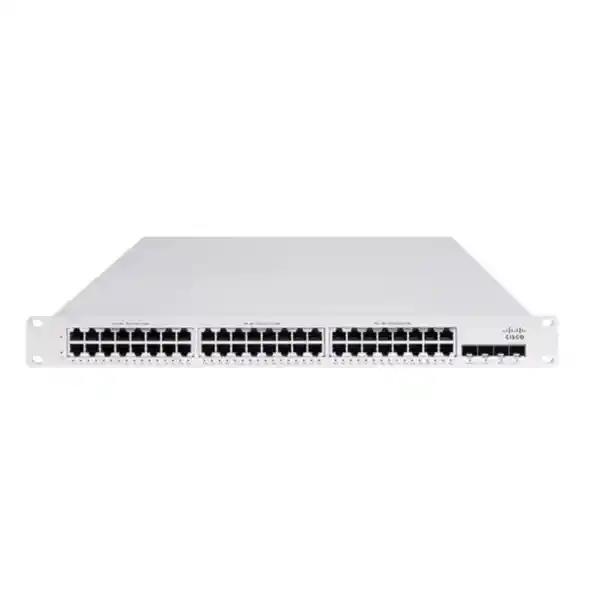
Cisco Meraki MS150-24MP-4X Tanzania
The Cisco Meraki MS150-24MP-4X is a stackable, cloud-managed access switch built for organizations that are modernizing wired access for higher-speed wireless, powered edge devices and distributed operations. The model combines sixteen 1 Gigabit Ethernet access ports with eight 5 Gigabit multigigabit ports, four 10 Gigabit SFP+ uplinks, IEEE 802.3bt PoE capability and a 370 W switch PoE budget. It is especially relevant where Wi-Fi 6E or Wi-Fi 7 access points, cameras, collaboration devices and other powered endpoints are beginning to exceed the practical limits of older 1 GbE access switching.
Choose the MS150-24MP-4X when you need a 24-port Meraki access switch with eight 5GbE ports, 60 W-per-port capability on the multigigabit interfaces, 10GbE uplinks, physical stacking and centralized Meraki Dashboard operations.
What is the Cisco Meraki MS150-24MP-4X?
Cisco positions the MS150 family as cost-effective access switching for branch and campus environments, with the multigigabit MS150-24MP-4X aimed at deployments that need faster copper access and higher-power PoE. The switch provides twenty-four RJ45 access ports in total: sixteen 1GbE interfaces and eight 5GbE multigigabit interfaces. The multigigabit design is useful when an access point, workstation or other endpoint can exceed 1GbE but does not justify a full 10GbE copper edge. Four 10GbE SFP+ uplinks provide higher-capacity connections toward distribution, core, servers or upstream switches, subject to the chosen optics or direct-attach cable and the wider topology.
The switch also includes two dedicated physical stacking ports with 80 Gbps stacking bandwidth. Cisco documents support for stacking up to eight MS150 switches, making the platform suitable for sites that need a larger logical access layer without treating every switch as a completely independent device. Physical stacking can simplify operational management and provide a clearer growth path in network closets where port requirements rise over time. Stacking is not a substitute for resilient design, however; power, uplink redundancy, spanning-tree behavior, upstream capacity and failure domains should still be planned around the business requirement.
Meraki Dashboard is central to the operating model. Administrators can configure, monitor and troubleshoot the switching environment through the cloud management plane, which can be helpful for organizations with multiple offices, distributed branches or limited on-site IT resources. Cloud management does not remove the need for good LAN engineering. VLAN design, access policies, PoE budgets, cabling, uplink sizing, IP addressing, DNS, DHCP, spanning tree and change control still determine whether the network is stable. For buyers in Tanzania, the strongest procurement approach is therefore to treat the MS150-24MP-4X as one part of an end-to-end network design rather than as a standalone 24-port switch.
370 W PoE budget
Plan powered endpoints by actual wattage, not only by port count. The eight multigigabit ports can support up to 60 W per port, subject to total switch budget and endpoint negotiation.
8×5GbE access
Eight multigigabit RJ45 interfaces give high-throughput access points and selected wired devices more headroom than a traditional 1GbE edge.
4×10GbE SFP+
Four fixed SFP+ uplinks support faster connections toward distribution or core infrastructure using supported Meraki optics or direct-attach cables.
Cloud managed
Meraki Dashboard centralizes configuration, monitoring, firmware operations and troubleshooting for distributed switching environments.
Cisco Meraki MS150-24MP-4X verified specifications
| Access interfaces | 16×1GbE RJ45 + 8×5GbE multigigabit RJ45 |
|---|---|
| Uplinks | 4×10GbE SFP+ |
| Dedicated management | 1 dedicated management interface |
| PoE | IEEE 802.3bt; up to 60 W on the multigigabit ports; 370 W total switch PoE budget |
| Stacking | 2 dedicated stacking ports; 80 Gbps stacking bandwidth; MS150 family supports stacks of up to eight switches |
| Switching capacity | 192 Gbps |
| Layer 3 | Static routing and DHCP relay |
| Power input | 100–240 VAC |
| Power load | 43 W idle / 454 W maximum as documented by Cisco |
| Operating temperature | 0°C to 45°C |
| Form factor | Integrated 1U rack mount |
| Management model | Cisco Meraki Dashboard with applicable Meraki licensing |
Specifications above are based on Cisco Meraki’s published MS150 documentation. Final procurement should still verify the current hardware revision, compatible accessories, regulatory requirements and license model at the time of quotation.
Deployment, licensing and network design guidance
The MS150-24MP-4X is most valuable when its multigigabit and PoE capabilities are mapped to real endpoint requirements. A Wi-Fi 7 or Wi-Fi 6E access point may justify a 5GbE port, while a printer, desk phone or general office PC may remain perfectly suitable on 1GbE. Assigning the faster ports strategically keeps the design cost-effective and preserves higher-capacity interfaces for the devices that can use them. Cisco’s own MS150 positioning specifically highlights Wi-Fi 7 and next-generation IoT use cases, but the switch can also power cameras, collaboration endpoints and other standards-based PoE devices within the documented power limits.
PoE planning should use a power worksheet. Record the maximum expected draw of every powered endpoint, identify which devices need 802.3bt power levels, total the expected load, and retain engineering headroom rather than designing permanently at the exact 370 W ceiling. A switch may have enough PoE-capable ports but still run out of aggregate power if too many high-draw devices are attached. UPS sizing must also account for the switch and its powered endpoints because the maximum electrical load can be significantly higher than the switch’s idle consumption.
Uplink design matters just as much. Eight multigigabit access ports can generate more aggregate traffic than a single 10GbE uplink under heavy use, so determine whether one, several or redundant uplinks are appropriate. Fiber type, distance, transceiver choice and the upstream switch must all be compatible. Cisco lists multiple supported 1GbE and 10GbE SFP/SFP+ modules for MS150-4X models, including short-reach and long-reach optics as well as supported direct-attach cables. Do not substitute an unverified optic simply because the connector fits.
Licensing is also part of the architecture. Cisco documents Enterprise and Advanced licensing tiers for the MS150, with terms including 1, 3, 5, 7 and 10 years under the applicable licensing model. In co-term organizations, Cisco notes that switches with both Enterprise and Advanced options must follow tier consistency rules. Advanced licensing adds Adaptive Policy capability. Subscription licensing is also documented for MS150 models. A quotation should therefore identify the customer’s existing Meraki organization, current license model, preferred term and whether Advanced-only capabilities are actually required.
For Tanzania projects, FourTeck can help align the switch with the wider environment. The FourTeck Tanzania technology shop provides the broader procurement context, while the technology services page is relevant when the requirement includes network planning, installation, configuration or lifecycle support. The Cisco Meraki CW9162I-MR, CW9164I-MR, CW9166I-MR, CW9171I Wi-Fi 7 access point and CW9172H Wi-Fi 7 wall-plate access point are useful related pages when the switch is being selected specifically to support newer wireless infrastructure.
Where the MS150-24MP-4X fits
Wi-Fi 6E / Wi-Fi 7 access layer
Use the eight 5GbE ports where newer access points need multigigabit backhaul and higher PoE classes, while retaining sixteen 1GbE ports for conventional devices.
Branch and campus closets
Physical stacking, 10GbE uplinks and centralized Dashboard operations make the platform practical for standardized wiring closets and distributed enterprise sites.
Powered edge consolidation
Combine data and power delivery for selected access points, cameras, phones and other PoE endpoints, subject to endpoint standards and the overall 370 W budget.
Regional procurement and deployment guidance
Cisco Meraki MS150-24MP-4X Tanzania
Organizations evaluating Cisco Meraki MS150-24MP-4X in Tanzania should begin with an endpoint and power inventory rather than simply requesting a 24-port switch. The distinguishing value of this model is that eight access interfaces can operate at up to 5GbE and deliver higher-power PoE, while sixteen additional ports provide conventional Gigabit access. That mix works well when a site is modernizing wireless infrastructure but still has many ordinary 1GbE endpoints. A sensible design identifies which access points, cameras, collaboration devices or specialist workstations genuinely need the multigigabit interfaces and keeps the remaining ports available for standard users and devices.
Tanzania projects should also account for cabling, rack environment, uplinks and power resilience. A 5GbE switch port does not guarantee 5GbE end-to-end performance if the installed cable run, endpoint NIC or upstream network becomes the bottleneck. Existing copper runs should be assessed for category, length, termination quality and test history. The four 10GbE SFP+ interfaces should be mapped to the distribution or core design with the correct supported optics and fiber type. In environments where short power interruptions can disrupt operations, UPS selection should consider the switch plus the load drawn by powered devices.
Meraki licensing deserves equal attention. Confirm whether the organization uses co-term, per-device or subscription licensing, the existing switch license tier, and the term needed for the new hardware. This matters because licensing affects ongoing cloud management and, in some configurations, tier consistency across the Meraki organization. Procurement teams should include the exact model, quantity, license term, required SFP+ modules, stacking cables, power cord requirement and intended deployment city in a quotation request.
For broader architecture planning, FourTeck Tanzania can coordinate the switch with wireless, firewall, structured cabling and rack requirements. The goal should be a documented access layer with predictable port assignments, VLANs, PoE budgets and uplink capacity rather than a collection of individually purchased devices. Availability, price and delivery should be confirmed through a current quotation because they can change with vendor and regional supply conditions.
Cisco Meraki MS150-24MP-4X Dar es Salaam
Dar es Salaam businesses can use the MS150-24MP-4X as an access-layer upgrade for head offices, multi-floor commercial spaces, hospitality environments, education facilities, healthcare operations and branch hubs where wireless and powered-device density is increasing. A head office may have dozens of ordinary Gigabit endpoints but only a smaller group of high-performance Wi-Fi access points that need multigigabit links. The switch’s mixed port layout can fit this pattern well, provided the network team deliberately assigns the eight 5GbE interfaces to the devices that benefit from them instead of using ports randomly.
In a multi-floor office, the four 10GbE SFP+ ports can support higher-capacity uplinks, but the physical topology should be decided before procurement. Determine whether each floor uplinks directly to a distribution layer, whether switches will be physically stacked in one closet, and whether redundant paths are required. Fiber distance and cable type influence optic selection. If a site already has older 1GbE uplinks, simply installing faster edge ports may move congestion upstream. Capacity planning should therefore include peak wireless traffic, video, backups, cloud applications and any local server flows that cross the access-distribution boundary.
PoE demand can also be high in Dar es Salaam offices that combine wireless APs, IP cameras and IP phones. Build a port-by-port power schedule and compare the total against the 370 W switch budget, keeping practical reserve for expansion. The eight multigigabit ports can support higher-power endpoints, but the entire switch still shares the overall PoE budget. UPS and rack cooling should be chosen for the real powered load rather than the idle consumption figure.
For quotation preparation, provide floor count, approximate endpoint numbers, current Meraki organization details, access-point models, expected PoE loads, fiber requirements, stacking plan and preferred license term. This information allows the MS150-24MP-4X to be evaluated as part of a complete Dar es Salaam LAN rather than as a generic 24-port switch.
Cisco Meraki MS150-24MP-4X Mwanza
For Mwanza organizations, the MS150-24MP-4X can be particularly useful where a branch needs enterprise switching capabilities but local IT staff are limited. Meraki Dashboard gives a central team a consistent way to monitor and manage compatible switches across locations, while the hardware provides enough edge flexibility for a mixed environment of desktops, phones, cameras and modern wireless access points. Central management is most effective when the organization creates a repeatable branch template: standard VLANs, port profiles, naming conventions, administrator roles, alerting and change procedures should be defined before multiple sites are rolled out.
The branch design should separate current requirements from future growth. If a Mwanza office has only two multigigabit access points today, the eight 5GbE ports leave room for additional APs or other faster endpoints later. Standard devices can remain on the sixteen 1GbE ports. The four 10GbE SFP+ interfaces can connect the switch to a local aggregation point or provide high-speed fiber uplinks where appropriate. If the site uses a VPN back to a head office, remember that local switch capacity does not overcome a slower WAN, firewall or internet service; user experience depends on every layer in the path.
Power continuity is also a planning item. A PoE switch may support critical phones, Wi-Fi and cameras simultaneously, so a power interruption can affect several services at once. A correctly sized UPS can provide short-duration resilience, but runtime should be calculated from the expected switch and endpoint load. The switch’s operating environment should also remain within Cisco’s published temperature range, with appropriate rack ventilation and protection from dust or uncontrolled heat.
A Mwanza quotation request should list switch quantity, powered devices, expected wattage, uplink media, fiber distance, license duration, existing Meraki organization and whether stacking is required. Clear input helps procurement teams compare the complete solution—including licenses and accessories—rather than comparing hardware part numbers alone.
Cisco Meraki MS150-24MP-4X Arusha
Arusha deployments may include hotels, tourism operations, conference venues, professional offices, training facilities and growing branch networks where user density changes throughout the day. In those environments, the MS150-24MP-4X can provide a useful foundation for wireless access because the eight 5GbE ports are suitable for selected high-throughput APs while the sixteen Gigabit ports support conventional wired endpoints. The decision should be driven by an RF and client-capacity plan: a faster switch port is most valuable when the access point, client population and upstream network can actually use the additional bandwidth.
Hospitality and event-driven networks can also create variable PoE demand. Wireless access points may be the largest continuous load, while cameras, room devices and phones add to the total. The 370 W switch budget should be compared against the maximum expected endpoint load, not average usage. When powered endpoints are operationally important, document which switch ports they use and how they are backed by UPS power. Clear documentation makes it easier to troubleshoot a wireless or camera problem without tracing cables during a busy operational period.
If an Arusha site spans multiple buildings or floors, fiber uplinks may be preferable to long copper runs. The four SFP+ slots support supported Meraki optical modules, so the design should specify fiber type, distance and the matching optic at both ends. Physical stacking is useful when several MS150 switches share a rack, while separate uplinks may be better for distributed closets. There is no single topology that fits every property.
For procurement, include property layout, number and model of access points, camera count, phone count, expected high-power PoE devices, rack locations, inter-building distances and current Meraki licensing. A structured request enables FourTeck to determine whether one MS150-24MP-4X is sufficient or whether additional switches, optics, stacking cables, UPS capacity or related wireless infrastructure should be included.
Cisco Meraki MS150-24MP-4X Dodoma
Dodoma organizations planning office, institutional or branch infrastructure can evaluate the MS150-24MP-4X when they need centralized switching operations with a combination of standard Gigabit and higher-speed multigigabit access. The model is well suited to designs where newer wireless APs or specialized endpoints need faster wired backhaul but most desks and devices remain on 1GbE. This avoids over-provisioning every access port while still creating a practical path for newer edge technology.
Institutional networks should pay close attention to segmentation. Staff systems, guest wireless, cameras, voice devices, servers and operational equipment may require different VLANs and access policies. The MS150 supports cloud-managed switching with static routing and common enterprise access-layer controls, but policy design should be documented before deployment. Meraki Dashboard can simplify administration across multiple locations, yet administrator permissions, configuration templates and change ownership should be agreed so central management does not become a source of uncontrolled changes.
A Dodoma deployment also benefits from an infrastructure check before equipment is ordered. Confirm rack depth, power distribution, UPS load, patch-panel capacity, copper cabling quality and uplink fiber. If 5GbE ports are intended for Wi-Fi 7 access points, make sure the selected AP power requirement fits the switch’s PoE capabilities and that the total 370 W budget remains sufficient. Review the 10GbE uplink path as well; a faster edge can still be constrained by a 1GbE distribution link or undersized firewall.
A useful quotation brief includes the number of users, device categories, AP models, expected PoE wattage, existing switch infrastructure, VLAN requirements, required optics, stacking plan and Meraki license term. By providing that information, procurement teams can receive a proposal that accounts for operating requirements and accessories instead of discovering missing components during installation.
Cisco Meraki MS150-24MP-4X UAE
Organizations operating in both Tanzania and the UAE may standardize on the MS150-24MP-4X for selected branch or campus access closets where multigigabit Wi-Fi and centralized Meraki management are priorities. Standardization can reduce operational variation: the same switch family, port profiles, VLAN naming, monitoring practices and license governance can be applied across sites. However, a standard model does not mean every site has the same requirements. User density, wireless design, rack environment, fiber topology and local procurement rules should be assessed independently.
UAE sites often have access to high-speed WAN and internet services, which makes internal bottlenecks more visible. If Wi-Fi 7 access points use the switch’s 5GbE ports, the upstream design should preserve adequate capacity with suitable 10GbE uplinks, distribution switching and firewall throughput. High-density offices, meeting centers and hospitality sites may also consume substantial PoE. The 370 W budget should be allocated using endpoint power requirements, with reserve for future devices and operational peaks.
Cross-region IT teams should document Meraki organization structure carefully. Licensing tier, license term, administrator access, network naming and renewal responsibility need to be clear. Cisco documents Enterprise and Advanced MS150 tiers and multiple licensing models, so the procurement team should avoid assuming that an existing license arrangement can be mixed freely without checking the organization’s current configuration.
For UAE-side technology context, buyers can review FourTeck UAE IT and network solutions. When requesting a cross-border proposal, separate each site’s hardware quantity, licenses, optics, stacking accessories, power cords and implementation scope. This keeps commercial comparisons clear and helps the technical team avoid moving region-specific assumptions from one project into another.
Cisco Meraki MS150-24MP-4X Uganda
Uganda organizations considering the MS150-24MP-4X can use it as a standardized cloud-managed access switch for offices, education facilities, hotels, distributed branches and other environments that combine ordinary Gigabit devices with a smaller number of multigigabit endpoints. The switch’s mixed access-port design is useful for phased upgrades: existing PCs, printers and phones can stay on 1GbE while newer access points use 5GbE ports and the higher PoE capability where required.
For a multi-site deployment, the real operational advantage comes from consistent configuration. Define VLANs, switch naming, port profiles, management permissions and alerting centrally. Branches can then follow a repeatable standard while still allowing site-specific exceptions for local ISP handoffs, camera networks or guest wireless. Meraki Dashboard supports centralized operations, but documentation remains important so teams understand why a port or policy differs at a given location.
Uganda buyers should also plan the physical layer. Verify whether each site has suitable rack space, stable power, UPS protection and adequate cabling. Where fiber is needed between floors or buildings, specify the distance and fiber type before selecting SFP+ modules. If a branch has only one WAN link, faster access switching will not provide application resilience during an internet outage, so WAN continuity may need to be addressed separately.
The FourTeck Uganda technology site provides broader regional context for networking and business IT requirements. A complete Uganda quotation request should include endpoint counts, AP models, PoE loads, desired license duration, fiber requirements and existing Meraki organization details. This helps procurement compare the whole operating solution rather than hardware cost alone.
Cisco Meraki MS150-24MP-4X Kampala
Kampala offices can use the MS150-24MP-4X as a head-office or regional access switch where collaboration traffic, cloud applications and modern wireless increase the need for faster edge connectivity. A headquarters design should identify high-demand areas such as meeting-room clusters, training spaces and executive floors where newer access points can benefit from 5GbE backhaul. The sixteen Gigabit interfaces can then serve ordinary office devices, avoiding the cost and complexity of giving every endpoint a multigigabit port it will not use.
A Kampala head office may also aggregate traffic from branch systems, so upstream capacity deserves careful attention. Four 10GbE SFP+ ports provide flexible options for uplinks and redundancy, but the distribution layer, firewall and WAN must be capable of handling the planned traffic. If several access points send high-volume cloud or video traffic simultaneously, a single oversubscribed path can become the bottleneck even though the access switch itself has substantial capacity.
Operations teams should create a Meraki governance model before deployment. Decide who owns the organization, who has administrator access, which license tier will be used, how firmware changes are approved and how alerts are escalated. If the switch joins an existing co-term organization, validate tier compatibility before purchasing an Advanced or Enterprise license. That check can prevent avoidable licensing changes after the hardware has arrived.
For physical implementation, audit rack power, UPS capacity, ventilation and patching. The maximum electrical load is materially higher than idle consumption because the switch can power many endpoints. A Kampala quotation should therefore identify every powered device, the required optics, stack count, cabling, power protection and preferred support scope. A clear bill of requirements makes it easier to budget accurately and deploy without last-minute accessory gaps.
Cisco Meraki MS150-24MP-4X Arua
Arua deployments often benefit from network equipment that can be managed centrally because specialist IT staff may not be permanently present at every branch. The MS150-24MP-4X supports that operating model through Meraki Dashboard while providing enough local flexibility for conventional office endpoints, wireless APs, phones and cameras. Central visibility can reduce the need for site visits for routine configuration checks, but the branch should still be documented with clear port mappings, device names, uplink details and power information.
For an Arua branch, WAN reliability may influence user experience more than raw switching speed. A 5GbE access port can provide excellent local backhaul for a modern AP, yet cloud applications still depend on the branch internet link and security gateway. Network planning should therefore distinguish local LAN performance from WAN performance. If business continuity is important, evaluate redundant internet or failover options separately rather than expecting the switch to solve an upstream connectivity problem.
PoE planning is equally important. A branch may want a single switch to power APs, cameras and phones, which reduces individual power adapters but concentrates dependence on the switch and its power source. Add the maximum draw of all endpoints, compare that figure against the 370 W budget, and size UPS protection for the combined load. Also confirm rack ventilation and the published 0°C to 45°C operating range, especially where communications equipment is installed in a small room or cabinet.
Arua procurement requests should list expected users, APs, cameras, phones, fiber or copper uplink needs, preferred license duration and whether the switch will join an existing Meraki organization. If equipment is being standardized across Kampala, Arua and other Ugandan sites, keep a common configuration baseline but allow each location to have different port counts, WAN design and power resilience according to its actual requirements.
Cisco Meraki MS150-24MP-4X Mbarara
Mbarara businesses evaluating the MS150-24MP-4X should consider whether the switch’s multigigabit capability aligns with their next three to five years of edge requirements. If the site is replacing an older 24-port Gigabit PoE switch, the eight 5GbE interfaces create a practical upgrade path for newer wireless access points without forcing every port to a higher speed. The remaining sixteen Gigabit interfaces are still suitable for many business endpoints, making the model a balanced choice where faster edge technology is being introduced gradually.
The uplink path should be reviewed before installation. Four 10GbE SFP+ interfaces provide room for high-speed fiber, direct-attach connections or redundant topology using supported Cisco Meraki modules, but the design should match the existing core or distribution infrastructure. If the upstream switch only supports 1GbE, the immediate value of a 10GbE-capable edge is limited until the rest of the path is upgraded. This is why a network diagram is more useful than a simple list of switch models during quotation.
Mbarara sites should also account for maintenance and remote troubleshooting. Central Dashboard operations can help a Kampala or regional IT team see switch status, port activity and configuration without a local specialist, but physical faults still require good labeling and on-site access. Patch panels, uplinks, stacking cables and UPS feeds should be documented so someone at the site can identify the correct connection when guided remotely.
When requesting pricing, include the intended endpoint mix, high-power devices, fiber distances, stack size, license type and term, and any installation or configuration scope. This information allows a proposal to include essential accessories and avoids comparing a complete solution against a hardware-only quote that omits licensing, optics or power requirements.
Cisco Meraki MS150-24MP-4X Gulu
Gulu organizations can use the MS150-24MP-4X for cloud-managed branch switching where reliable access for staff, wireless users, phones and security devices needs to be administered as part of a wider network. The switch offers a useful combination of ordinary Gigabit ports and eight 5GbE interfaces, so a branch can connect high-performance access points without replacing every wired endpoint or moving the entire edge to 10GbE copper.
A branch-first design should prioritize resilience and supportability. Consider what happens if the local internet circuit fails, if the switch loses power, or if an uplink optic fails. Dashboard management is valuable for visibility, but it cannot replace power protection, documented cabling and sensible spare planning. Where uptime matters, UPS capacity should be calculated from the expected PoE load and required runtime. If a branch depends on wireless for most users, remember that a single powered switch can become a shared point of dependency for multiple APs.
If fiber links are used between racks or buildings, confirm the exact path length and fiber type. Select supported SFP+ modules that match both ends of the link. Avoid choosing optics from distance alone because wavelength, connector type, fiber class and platform compatibility all matter. Where several MS150 switches share one rack, physical stacking can simplify administration and create a larger logical access layer; where devices are distributed, separate uplinks may be more appropriate.
For a Gulu quotation, state the number of staff, expected Wi-Fi APs, cameras and phones, preferred license term, existing Meraki organization, uplink media and whether installation is in scope. A structured requirements list helps ensure that the switch, licenses, optics, stacking cables and power accessories are considered together and reduces the risk of discovering missing dependencies after delivery.
Cisco Meraki MS150-24MP-4X Kenya
Kenya enterprises can consider the MS150-24MP-4X for branch, campus and office environments that need Meraki cloud management with selective multigigabit access. It is a strong fit where a network modernization project includes newer Wi-Fi access points, because eight 5GbE ports can serve higher-throughput APs while sixteen 1GbE ports remain available for conventional wired endpoints. The switch’s value is greatest when the endpoint plan is known in advance, so procurement should map each high-speed or high-power device to a specific port requirement.
In larger Nairobi or multi-site networks, upstream design becomes important. Four 10GbE SFP+ uplinks allow the access layer to connect into faster distribution infrastructure, but traffic engineering should consider aggregation from many APs and users. If multiple MS150 switches are stacked, the overall number of access ports grows quickly, and the network team should calculate whether the planned uplinks are sufficient for peak application demand. Server traffic, video conferencing, backups and cloud workloads can all contribute to congestion.
The Meraki operating model can help regional IT teams maintain consistent configuration across Kenya and Tanzania. Common port profiles, VLAN naming, security policies and monitoring reduce variation, while licensing and administrator ownership should be managed centrally. Before adding the switch to an existing Meraki organization, verify the applicable licensing model and tier requirements.
For regional infrastructure context, the FourTeck Kenya technology site covers business networking and IT requirements. A Kenya quotation should include hardware quantity, license term, SFP+ requirements, stacking cables, power cords, UPS expectations and implementation scope. Price and availability should be confirmed at the time of purchase rather than inferred from listings in other markets.
Cisco Meraki MS150-24MP-4X Kuwait
Kuwait organizations deploying Meraki networks can use the MS150-24MP-4X in offices, branches and campus access closets where high-performance wireless and PoE devices need more capability than a basic Gigabit switch offers. The eight 5GbE interfaces give selected endpoints additional wired capacity, while four 10GbE SFP+ uplinks support connection to faster aggregation or core infrastructure. The mixed-port approach is useful when only part of the edge needs multigigabit performance.
Environmental planning remains important even in well-equipped data and telecom rooms. The switch is designed for operation up to 45°C, but rack airflow and room cooling should be managed so equipment does not sit near its environmental limit. PoE loads add heat and electrical demand, especially when many access points or cameras draw power simultaneously. Power distribution and UPS sizing should therefore use maximum expected operating load rather than the idle figure.
Licensing should be treated as part of total lifecycle cost. Choose a term that aligns with refresh planning and procurement policy, confirm Enterprise versus Advanced requirements, and record renewal ownership. Organizations with existing Meraki estates should check whether the new switch is being added to a co-term, per-device or subscription environment. That review is more reliable than assuming the license used on an older switch can be copied without checking current rules.
A Kuwait request for quotation should specify switch count, license tier and term, required optics, stacking requirements, intended high-power devices, rack and power details, and whether configuration or installation is required. If the Kuwait site is part of a regional estate, include the desired standard for VLANs, naming and monitoring so the hardware arrives as part of a consistent operating design rather than an isolated purchase.
Cisco Meraki MS150-24MP-4X Ghana
Ghana organizations can evaluate the MS150-24MP-4X for modern access-layer deployments where cloud administration, multigigabit Wi-Fi backhaul and PoE are important. The switch can support a mixed device environment: ordinary PCs and printers stay on Gigabit Ethernet, while higher-performance access points use the 5GbE interfaces. This selective approach helps organizations upgrade wireless capability without replacing every endpoint or designing the entire access layer around ports that most devices will not use.
For Accra offices and distributed Ghana branches, central Meraki Dashboard operations can help a small IT team maintain configuration consistency across sites. Standard templates for VLANs, port profiles, alerts and naming improve supportability. The organization should also define local exceptions clearly, such as a branch camera VLAN or a dedicated guest network, so centralized configuration does not hide site-specific requirements.
Infrastructure readiness is another major procurement check. Confirm copper cabling quality for multigigabit runs, select the correct fiber and supported optics for SFP+ uplinks, and calculate PoE demand from the connected endpoints. If the total powered load approaches the 370 W limit, consider redistributing devices or adding another PoE switch rather than leaving no operating headroom. UPS sizing and rack ventilation should be part of the same calculation.
Buyers can review the FourTeck Ghana technology site for wider regional IT context. A complete Ghana quotation should state the exact MS150-24MP-4X quantity, license term, SFP+ modules, stacking cable requirements, powered endpoint list and implementation scope. Current price, availability and delivery conditions should be confirmed through quotation rather than assumed from international reseller listings.
Cisco Meraki MS150-24MP-4X Nigeria
Nigeria enterprises with distributed offices, campus networks or high-density business locations can use the MS150-24MP-4X as part of a standardized Meraki access architecture. The combination of sixteen 1GbE and eight 5GbE access ports is useful where a network needs to support modern wireless while retaining compatibility with a large installed base of Gigabit endpoints. Four 10GbE SFP+ uplinks and physical stacking also make the model appropriate for larger wiring closets when the broader topology is designed to use that capacity.
Power resilience may be a major design consideration. Because the switch can provide PoE to access points, cameras and other devices, a power event can affect many services simultaneously. UPS sizing should account for both switch consumption and endpoint load, and organizations with critical networks may need broader power continuity measures beyond a short-runtime UPS. Network teams should also document recovery priorities so voice, wireless and security services can be restored in a controlled order after an extended outage.
Multi-site Meraki deployments benefit from governance. Define organization ownership, administrator permissions, naming conventions, switch profiles and firmware procedures centrally. Review license tier and term before procurement, particularly if the new switch will join an existing organization with established Enterprise or Advanced licensing. Standardization reduces support complexity, but each Nigerian site should still be sized for its own endpoint count, WAN capacity and physical environment.
A Nigeria quotation should include branch count, switch quantity per site, PoE endpoint requirements, uplink speeds, fiber types, stacking plan and license duration. Regional procurement teams should also separate equipment, licenses, optics and services in the bill of materials so commercial comparisons remain transparent. Availability and shipping conditions should be validated when the order is prepared, not inferred from another country’s stock status.
Cisco Meraki MS150-24MP-4X Seychelles
Seychelles organizations in hospitality, professional services and distributed island operations can evaluate the MS150-24MP-4X where high-quality wireless and centralized management are important. Hotels and guest environments often concentrate many devices on Wi-Fi, so multigigabit access ports can be useful for newer APs if the upstream network and internet service can support the traffic. The switch’s sixteen Gigabit ports remain available for management systems, office equipment, phones and other conventional wired endpoints.
Hospitality deployments should calculate PoE carefully because wireless APs and cameras may share the same switching layer. The 370 W budget must cover all powered devices connected to the switch. High-power 802.3bt endpoints should be identified separately, and expansion capacity should be reserved if more APs or cameras are likely to be installed later. A power design should include UPS protection and any site-specific continuity measures so a single electrical interruption does not unexpectedly disable guest wireless, phones and surveillance together.
Island environments can also make remote management valuable, but physical dependencies still need local planning. Rack ventilation, fiber routing, spare optics, patching and documentation should be prepared so a technician can troubleshoot accurately without relying on memory. If switches are stacked, keep spare-plan and replacement procedures clear because stack members share operational roles. For sites spread across separate buildings, dedicated fiber uplinks may be more appropriate than one physical stack.
A Seychelles quotation should include property layout, switch locations, AP and camera models, expected PoE consumption, fiber distances, required optics, license term and any configuration or installation scope. Where equipment procurement involves regional logistics, validate the exact commercial and delivery terms at quotation time rather than assuming availability from another market. This produces a realistic bill of materials and helps reduce installation delays caused by missing accessories.
Related Cisco Meraki solutions on FourTeck Tanzania
The MS150-24MP-4X is often purchased because the network edge is being upgraded for newer wireless. These verified FourTeck Tanzania pages provide useful adjacent context for access-point selection and help procurement teams match the switch to the client density, radio generation and mounting environment rather than selecting a switch in isolation.
Cisco Meraki CW9164I-MRWi-Fi 6E access point option for organizations building cloud-managed wireless on multigigabit switching.
Cisco Meraki CW9166I-MRHigher-capacity Wi-Fi 6E option to evaluate where dense wireless demand justifies stronger edge switching.
Cisco Meraki CW9171IWi-Fi 7 access-point context for next-generation wireless projects using multigigabit Ethernet and PoE.
Cisco Meraki CW9172HWi-Fi 7 wall-plate form factor relevant to hospitality and room-oriented deployments.
Cisco Meraki CW9163E-MROutdoor Wi-Fi 6E access-point option for designs that extend managed wireless beyond indoor office areas.
Quotation checklist
For an accurate Cisco Meraki MS150-24MP-4X quotation, include enough technical context to price the complete requirement rather than only the switch chassis.
Cisco Meraki MS150-24MP-4X FAQ
How many Ethernet ports does the MS150-24MP-4X have?
It has 24 RJ45 access ports: sixteen 1GbE ports and eight multigigabit ports supporting up to 5GbE. It also has four 10GbE SFP+ uplinks and dedicated physical stacking ports.
Does the MS150-24MP-4X support PoE++?
Yes. Cisco documents IEEE 802.3bt support, with up to 60 W per multigigabit port and a total switch PoE budget of 370 W. Actual endpoint power depends on negotiation and the aggregate load across the switch.
Is the MS150-24MP-4X suitable for Wi-Fi 7?
Yes, Cisco positions the MS150 family for Wi-Fi 7 and next-generation IoT access. The eight 5GbE interfaces and high-power PoE capability are particularly relevant to access points that can exceed 1GbE backhaul. The access-point model, cabling and power requirements still need to be verified.
Does the switch require a Meraki license?
Yes. Cisco documents Enterprise and Advanced licensing for MS150, as well as subscription licensing options. The correct license depends on the organization’s licensing model, desired term and feature requirements.
Can Enterprise and Advanced MS150 licenses be mixed?
Cisco documents restrictions in co-term organizations: devices that support both tiers must follow tier consistency rules. Per-device licensing can allow a mix, although some features can still require Advanced licensing more broadly. Confirm the existing organization before ordering.
How many MS150 switches can be physically stacked?
Cisco states that up to eight MS150 switches can be stacked using the dedicated stacking interfaces. The platform provides 80 Gbps stacking bandwidth.
Which optics can be used in the SFP+ uplinks?
Cisco lists supported Meraki 1GbE and 10GbE optics and direct-attach cables for MS150-4X models. The correct choice depends on fiber type, distance and the device at the other end. Verify the current compatibility list before purchase.
What information should I provide for a Tanzania quotation?
Provide quantity, city, existing Meraki organization, license preference and term, AP and PoE endpoint models, required SFP+ optics, fiber distances, stacking requirement, rack and UPS details, and whether configuration or installation is needed.
Decision recap
The Cisco Meraki MS150-24MP-4X is a strong candidate when your access layer needs a combination of conventional Gigabit connectivity, multigigabit ports for newer wireless or specialist endpoints, 802.3bt PoE, 10GbE uplinks, physical stacking and cloud-based Meraki operations. It is less useful to buy purely for headline specifications if the site still has 1GbE uplinks, insufficient cabling, no high-speed endpoints or an unplanned license model.
The best purchasing decision matches the switch to the complete network: endpoint speeds, PoE demand, cabling, fiber, core capacity, firewall throughput, licensing and power resilience. FourTeck can review these dependencies before quotation so the bill of materials includes the accessories and lifecycle items needed for deployment.
Regional FourTeck network resources
For organizations managing infrastructure across multiple markets, related FourTeck regional sites can provide local technology context. Review FourTeck UAE for UAE IT infrastructure, FourTeck Kenya for Kenyan business networking, FourTeck Uganda for Ugandan networking requirements, FourTeck Africa for broader African technology procurement, and FourTeck Ghana for Ghana-side IT requirements. These links are useful when a single network standard is being planned across several countries.
Plan the switch as part of the network, not as an isolated purchase
Before ordering, confirm which endpoints need 5GbE, which devices require PoE++, how much total PoE power is needed, whether 10GbE uplinks are available upstream, which optics are compatible, how many switches will be stacked and which Meraki license model applies. Those checks can prevent a technically capable switch from being limited by cabling, uplinks, power or licensing after installation.
FourTeck Tanzania can use your site and network details to prepare a more complete bill of materials. Include current switch models, access-point models, fiber distances, rack locations, WAN and firewall information, and planned growth so the recommendation reflects real deployment conditions.




Reviews
There are no reviews yet.