
Cloud-managed branch security • SD-WAN • Integrated Wi-Fi
Cisco Meraki MX67W Tanzania
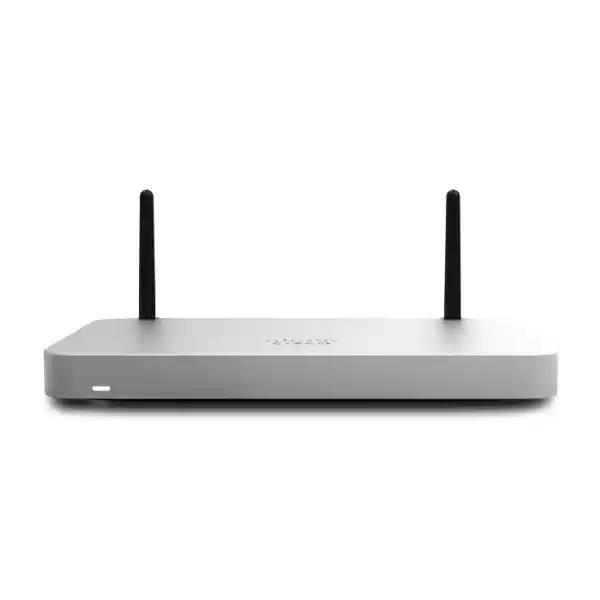
The Cisco Meraki MX67W brings firewalling, SD-WAN, VPN, application-aware control and integrated wireless connectivity into one compact cloud-managed appliance for small branches. Cisco positions the MX67W for up to 50 users and lists 700 Mbps firewall throughput, two WAN-capable Gigabit Ethernet interfaces, four fixed Gigabit Ethernet LAN interfaces and 802.11ac Wave 2 Wi-Fi. For Tanzanian organizations with branch offices, retail outlets, clinics, professional offices, schools or distributed sites, it offers a practical way to standardize edge security while keeping configuration and visibility in the Meraki Dashboard.
Choose the MX67W when you need a compact Meraki security and SD-WAN appliance for a small branch and you value integrated Wi-Fi, centralized cloud administration, secure site connectivity and a simpler operational model.
What the Cisco Meraki MX67W is designed to solve
Small branches often need the same core controls as a larger headquarters but without the complexity of operating multiple independent devices. Internet edge security, site-to-site connectivity, remote access, traffic visibility, wireless access and policy consistency all need to work together. The MX67W is designed around that branch requirement. Cisco describes it as a small-branch security and SD-WAN appliance for up to 50 users, with centralized management through the Meraki cloud platform. That management model is especially useful when an IT team is responsible for several locations because policy, firmware, monitoring and troubleshooting can be coordinated from a common dashboard rather than treated as isolated local tasks.
For procurement teams, the important point is that the MX67W should be selected as part of a complete branch design rather than by headline throughput alone. User count, internet speed, security features, VPN traffic, Wi-Fi expectations, application mix, resilience needs and growth all affect suitability. FourTeck Tanzania can help map those requirements to the appliance, switching, wireless and uplink design so the edge device is not oversized, undersized or deployed without the network components it depends on. See our broader Tanzania IT and network services for the surrounding design, deployment and lifecycle context.
700 Mbps firewall throughput
Cisco lists 700 Mbps firewall throughput for the MX67W, making it a strong fit for appropriately sized small-branch internet connections.
Integrated Wi-Fi
The integrated 802.11ac Wave 2 wireless capability can simplify compact sites where a separate access point is not required for the intended coverage and capacity.
Meraki Dashboard management
Cloud-based administration supports remote visibility, policy management, firmware workflows and consistent configuration across distributed sites.
SD-WAN and VPN
Meraki SD-WAN and Auto VPN are designed to simplify secure branch connectivity and application-aware path handling across multiple locations.
Verified Cisco MX67W technical highlights
| Recommended use case | Small branch, up to 50 users |
| Firewall throughput | 700 Mbps |
| Advanced security services throughput | 400 Mbps in Cisco’s current MX family datasheet |
| Site-to-site VPN throughput | 400 Mbps in Cisco’s current MX family datasheet |
| Maximum site-to-site VPN tunnels | 50 under Cisco’s stated lab-test conditions |
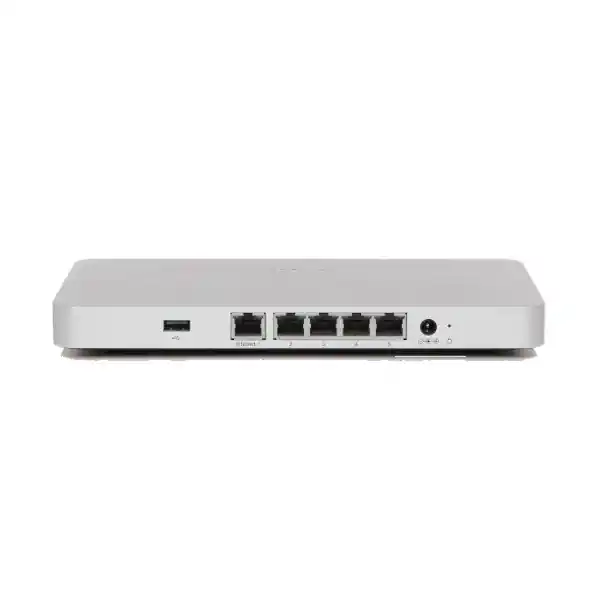
| WAN connectivity | 1 × dedicated GbE RJ45 plus 1 × convertible GbE RJ45 |
| LAN | 4 × fixed GbE RJ45 |
| Wireless | Integrated 802.11ac Wave 2 Wi-Fi |
| Mounting | Desktop or wall mount |
| Operating temperature | 0°C to 45°C |
Performance should be validated against the intended feature set, encrypted traffic, user behavior and future bandwidth. Cisco publishes sizing guidance because real deployments can differ from laboratory maximums.
Cisco Meraki MX67W licensing, integration and deployment guidance
Meraki security appliances are part of a cloud-managed platform, so licensing is a core procurement consideration rather than an afterthought. The exact license model, term and security tier should be confirmed for the intended deployment and purchasing program. Buyers should avoid ordering hardware without confirming the matching licensing requirement, organization-level licensing approach and renewal plan. The best quotation should clearly separate hardware, applicable subscription or license, optional services and deployment work so there is no ambiguity about what is required to operate the appliance.
Integration planning should cover the ISP handoff, IP addressing, VLANs, DHCP, DNS, existing switches, Wi-Fi design, branch-to-head-office VPN, cloud applications and any remote-access requirement. The MX67W can work particularly well in a standardized Meraki environment, but it can also be introduced into mixed-vendor networks when interfaces, routing, authentication and policy dependencies are documented. For a compact office, its integrated Wi-Fi can reduce equipment count. For larger or more demanding wireless areas, dedicated access points may still be the better design. FourTeck’s Tanzania technology shop provides a broader view of complementary network, security and workplace products.
Deployment should also include a rollback plan, configuration documentation and post-installation testing. That means verifying internet access, failover behavior if two uplinks are used, DNS resolution, application reachability, VPN routes, wireless segmentation, guest access, firewall rules and dashboard visibility. A technically correct installation is not complete until users can access the applications they need and restricted systems remain protected.
Cisco Meraki MX67W Tanzania
For organizations evaluating the Cisco Meraki MX67W in Tanzania, the strongest use case is a small office or branch that needs secure internet access, cloud-managed policy control and reliable connectivity to other business locations. Tanzania deployments vary widely, from professional offices and retail branches to clinics, schools, hospitality sites and operational facilities. The right decision therefore begins with the actual site profile: how many active users and devices are present, what applications they run, what internet service is available, whether a second WAN circuit is planned, and how much traffic must travel through a VPN to headquarters, cloud environments or other branches.
The MX67W is particularly attractive when simplicity matters. Integrated Wi-Fi can reduce the number of devices in a compact branch, while centralized Meraki management allows an IT team to work from a common dashboard instead of relying on local console access. This can be useful for businesses expanding beyond one city, because network standards can be repeated across sites. The firewall policy, VLAN structure, WAN preferences, VPN connectivity and monitoring approach can all be designed consistently. At the same time, organizations should not assume that integrated Wi-Fi automatically covers every building. Concrete walls, multiple floors, high client density and large open areas may require dedicated access points and a separate wireless design.
For Tanzania procurement, a useful request for quotation should include the exact MX67W model, expected license term, user count, ISP bandwidth, site count, VPN requirements, wireless coverage expectation and any switching changes. This allows the proposal to address the whole deployment instead of only the appliance. If the branch uses IP phones, cameras or access points, power and PoE requirements on the switch should also be reviewed. If remote workers need access, authentication and client VPN design should be discussed as part of the security policy.
FourTeck Tanzania’s broader network and cybersecurity approach is documented on the FourTeck Tanzania technology solutions site, where firewall, switching, Wi-Fi and infrastructure planning are treated as connected parts of a business network. The practical objective is to deploy the MX67W as a well-sized edge platform that fits the branch rather than as an isolated product purchase.
Cisco Meraki MX67W Dar es Salaam
Dar es Salaam organizations often operate in environments where internet connectivity, cloud applications and branch-to-branch communication are central to daily operations. For a small office, retail outlet, clinic, project office or professional practice, the Cisco Meraki MX67W can provide a compact security edge that combines firewalling, SD-WAN and integrated wireless. A Dar es Salaam deployment should begin by documenting the primary internet circuit and deciding whether business continuity justifies a secondary connection. If two uplinks are used, traffic policy and failover behavior should be tested against critical applications rather than assumed to work from default settings.
The user count is only one sizing input. A branch with thirty users running basic SaaS applications can behave very differently from a site with thirty users transferring large files, conducting video meetings and maintaining continuous VPN sessions. Security inspection also consumes resources, so the intended license tier and features should be factored into performance planning. Cisco’s current MX67W positioning is for up to 50 users, but procurement should still validate bandwidth, application mix and future growth before finalizing the model.
Dar es Salaam sites may also need careful Wi-Fi planning. The MX67W includes 802.11ac Wave 2 Wi-Fi, which can be useful for a compact office with modest coverage requirements. However, multi-room offices, thick walls, multiple floors and high-density meeting areas often benefit from dedicated access points with deliberate placement. Staff, guest and device traffic should be separated where appropriate, and the switching environment should provide the VLAN structure needed by that segmentation. Integrated wireless is a convenience feature, not a substitute for radio design.
For quotations in Dar es Salaam, provide the branch address area, expected users, internet speeds, internal subnets, remote-access needs and any other offices that must connect over VPN. Also identify whether there are servers, IP phones, CCTV systems or cloud workloads that need special policy treatment. This gives the design team enough context to define firewall rules, routing, VPN and wireless segmentation before deployment, reducing rework after the appliance is live.
Cisco Meraki MX67W Mwanza
For businesses in Mwanza, the Cisco Meraki MX67W is well suited to a small branch that needs centralized security management without a large local IT footprint. A branch can be enrolled into the Meraki Dashboard, configured according to a standard policy and monitored alongside other locations. That centralized model can reduce the need for technicians to perform routine configuration directly on site, while still allowing the organization to maintain visibility into uplink status, client activity and security events.
A Mwanza deployment should assess the reliability and characteristics of the available internet service. Cloud-managed infrastructure does not eliminate the need for careful WAN design. Business-critical branches may benefit from a second ISP or alternate connectivity path, with policies that define how traffic should move when the primary link degrades or fails. The branch’s most important applications should be identified in advance so SD-WAN and traffic-prioritization decisions reflect real operational needs. Voice, video meetings, ERP traffic, cloud file access and remote desktop sessions can have different sensitivity to delay and packet loss.
The MX67W’s integrated Wi-Fi can simplify deployments in compact spaces, but larger environments should consider separate Meraki access points or another appropriate wireless design. If the branch includes a warehouse, customer area or multiple separated rooms, coverage and capacity need to be assessed independently from the firewall. Wired devices also matter: the appliance has four fixed Gigabit Ethernet LAN interfaces, so businesses with more endpoints will typically connect it to a managed switch. That switch should be sized for port count, PoE requirements, VLANs and uplink capacity.
When preparing a Mwanza quotation, include whether the site is standalone or part of a larger branch network. If it must connect to Dar es Salaam, another Tanzanian city or an overseas office, document the subnets and services that need to cross the VPN. This helps avoid overlapping IP address ranges and unclear security rules. A good deployment package should also include naming conventions, policy documentation and administrator-role planning so future support remains straightforward.
Cisco Meraki MX67W Arusha
Arusha businesses evaluating the Cisco Meraki MX67W may include hospitality offices, tour operations, education facilities, professional firms, NGOs, healthcare sites and growing branch networks. These environments often depend heavily on cloud tools, secure remote access and stable internet connectivity. The MX67W provides a compact way to combine firewall and SD-WAN functions with centralized management, but the design should reflect the applications that actually keep the site running. Reservation systems, voice, video, cloud accounting, email and VPN traffic can all place different demands on the edge.
For an Arusha office serving guests or visitors, network segmentation is especially important. Staff devices, guest wireless and operational systems should not automatically share the same trust level. The MX67W can participate in a VLAN-based design in which access rules are defined according to business need. Guest users can be given internet-only access, while staff networks reach approved internal or cloud resources. If cameras, access-control systems or other IoT devices are present, those endpoints can also be isolated from general office traffic. The final policy should be documented so future changes do not accidentally weaken the segmentation.
Wireless coverage needs to be considered independently. Integrated 802.11ac Wave 2 Wi-Fi is useful in a compact office, but hospitality or multi-building environments often require purpose-designed access points. In those cases, the MX67W can remain the secure edge while the wireless network is expanded separately. Similarly, more than a handful of wired endpoints will require a switch. Procurement should therefore include the branch architecture, not only the firewall SKU.
For Arusha quotations, state the number of users, expected guest traffic, internet bandwidth, any secondary WAN service, branch VPN relationships and whether dedicated access points are required. Also indicate whether the business needs content controls, intrusion-prevention features or other advanced security functions, because licensing and performance expectations should align with those requirements. The goal is a design that can be operated reliably from day one and scaled as the site changes.
Cisco Meraki MX67W Dodoma
In Dodoma, the Cisco Meraki MX67W can serve small organizational branches that need secure internet access, centralized policy control and simple connectivity to other offices. Administrative offices, professional services, education, health, NGO and project environments often benefit from a repeatable network design because staff and applications must work consistently across more than one location. The Meraki Dashboard model supports that standardization by giving administrators a common place to view and manage branch appliances.
A Dodoma deployment should begin with an application and dependency map. Identify what happens if internet access is unavailable, which services must remain reachable through VPN, and whether users depend mainly on cloud applications or local servers. If the site has a second internet circuit, define how it will be used: pure failover, load sharing or application-aware path selection. Testing should include the actual critical workflows so the organization knows what users will experience during an uplink change.
Because the MX67W is designed for small branches up to 50 users, it can be an efficient option when the site is within that class. However, growth planning is still important. An office expecting more users, faster broadband or additional security services should compare the MX67W against other Meraki MX models before purchase. The firewall is only one part of the design; switching and wireless capacity must also match the branch. A compact site may use integrated Wi-Fi, while a larger floor plan may need multiple access points connected through a managed switch.
For procurement in Dodoma, include the number of current and projected users, ISP speeds, branch links, remote-access requirement, guest-network requirement and any internal systems that must be segmented. If the network will connect to government, enterprise or partner systems, document the required routes and security controls before configuration. Clear requirements make it easier to prepare a quotation that covers hardware, licensing and implementation without relying on assumptions.
Cisco Meraki MX67W UAE
Organizations operating between Tanzania and the UAE can use the Cisco Meraki MX67W as part of a standardized branch-security architecture where smaller sites need the same management approach across countries. The strongest advantage is operational consistency: branch templates, VPN connectivity, traffic policies and monitoring practices can be designed centrally and adapted to each location. This helps regional IT teams avoid maintaining completely different firewall platforms for every small office.
For a UAE branch, the appliance remains subject to the same core sizing considerations as any other market: user count, internet bandwidth, security services, VPN traffic and growth. Cisco positions the MX67W for up to 50 users with 700 Mbps firewall throughput. The exact subscription or license should be selected according to the required security capabilities and organizational licensing model. Buyers should also confirm local regulatory, telecom and data-handling obligations that apply to their own organization rather than treating product capability as legal compliance by itself.
A cross-border branch design should avoid overlapping IP ranges and unclear routing. If Tanzania and UAE offices need to communicate through site-to-site VPN, the subnet plan should be coordinated before the devices are deployed. Application owners should identify which systems need branch-to-branch access and which should remain internet-only. This creates cleaner security policies and makes troubleshooting easier. Where SaaS applications dominate, SD-WAN policy may be used to keep suitable traffic local instead of forcing all traffic through another country unnecessarily.
FourTeck’s broader regional network can support organizations comparing requirements across several markets. For UAE-specific technology planning, see FourTeck UAE. When the same company operates in Tanzania, the value comes from defining one repeatable branch standard while still allowing each site’s ISP, wireless coverage, user density and business applications to drive the final configuration.
Cisco Meraki MX67W Uganda
For organizations with operations in both Tanzania and Uganda, the Cisco Meraki MX67W can provide a consistent small-branch edge platform. This is useful for businesses that want the same basic security, VPN and management approach across countries while keeping the deployment compact. The Meraki Dashboard supports centralized administration, which can help a regional IT team monitor branch connectivity and maintain repeatable policy without relying on a different local interface at every site.
Uganda branch sizing should still be based on the actual local site. A Kampala office with heavier cloud usage may have different throughput needs from a smaller regional branch. The MX67W is positioned for up to 50 users, but organizations should review internet capacity, encrypted traffic, security services and projected growth. If a branch is near the upper end of the model’s intended class or expects a substantial bandwidth increase, it is sensible to compare higher MX models before finalizing the purchase.
Branch-to-branch VPN planning should include all Tanzanian and Ugandan networks that need communication. Address spaces should be unique, and firewall rules should be defined according to business need rather than allowing unrestricted communication between every subnet. Shared systems such as ERP, file services, identity infrastructure or voice platforms may need specific routes and access policies. Guest and device networks can remain isolated where appropriate. The result is a cleaner security posture and simpler troubleshooting.
For country-specific context, organizations can also review FourTeck Uganda IT solutions. A useful regional quotation should state the number of branches, user counts, internet circuits, required VPN relationships, license expectations and whether integrated Wi-Fi is sufficient at each site. That information allows the MX67W to be evaluated as part of a complete multi-country network rather than an isolated appliance.
Cisco Meraki MX67W Kampala
A Kampala branch may need secure connectivity to headquarters, cloud services and other regional locations while keeping local administration simple. The Cisco Meraki MX67W fits this type of use case when the office is within the small-branch class and values centralized cloud management. A regional IT team can define policy, monitor uplinks and maintain site-to-site connectivity without treating the Kampala device as a standalone firewall managed through a separate local process.
When the branch depends on cloud applications and video collaboration, WAN quality matters as much as raw speed. Latency, packet loss and outages can affect user experience even when headline bandwidth is adequate. The design should therefore identify business-critical traffic and decide whether dual internet links are justified. If a second circuit is available, SD-WAN policies can be planned around the applications that need the most stable path. Failover should be tested in practice, including DNS behavior and active VPN sessions.
Integrated Wi-Fi makes the MX67W convenient for a compact Kampala office, but radio conditions should be considered. Dense office areas, multiple rooms or shared buildings may produce interference and coverage gaps. Dedicated access points may be more appropriate if the site needs broader coverage, higher density or newer wireless capabilities. The firewall can then focus on security and routing while the wireless layer is designed separately. Wired devices should connect through a managed switch where port count or PoE requirements exceed the appliance’s direct interfaces.
For procurement, document user count, internet speed, any backup connection, required VPN destinations, guest access, remote workers and planned growth. If the Kampala branch is part of a Tanzania-led network, align its subnet, naming and security standards with the Tanzanian sites before equipment is configured. Standardization at the design stage produces much more value than attempting to normalize different branch configurations after they are already in production.
Cisco Meraki MX67W Arua
For a smaller office or operational branch in Arua, centralized management can be one of the most valuable characteristics of the Cisco Meraki MX67W. Sites outside the main administrative center may not have a dedicated network engineer available every day, so a cloud-managed platform can simplify routine visibility and policy administration. This does not remove the need for good local installation, but it reduces dependence on direct console access for many ongoing tasks.
The WAN plan should account for the connectivity options actually available at the Arua site. If the primary circuit is business critical, procurement should investigate whether a viable backup path exists and how that path will be integrated. The MX67W supports dual WAN-capable Gigabit interfaces, but the failover design must consider ISP equipment, addressing and the behavior of critical applications. A backup link only provides value when the full path has been tested and staff understand what service level to expect during a failover event.
For wireless access, the integrated 802.11ac Wave 2 radio can serve compact spaces when coverage and client demand are suitable. Buildings with thick walls, multiple separated work areas or outdoor requirements will need additional wireless planning. The same principle applies to wired devices: the four fixed LAN ports are useful for a small number of direct connections, but most business sites with phones, cameras, printers and access points should use a managed switch. That switch can also support VLAN separation and PoE where needed.
An Arua quotation should clearly state whether the branch must connect to Kampala, Tanzania or another headquarters location. Provide subnet information if available, user count, expected applications, WAN speeds, wireless coverage area and any devices that require segmentation. The aim is to configure the MX67W around the site’s actual dependencies so remote management is backed by a stable and well-documented local network.
Cisco Meraki MX67W Mbarara
Businesses in Mbarara that need a compact, centrally managed security edge can consider the Cisco Meraki MX67W for small branch deployments. The appliance can combine firewall, SD-WAN, VPN and integrated Wi-Fi functions while being administered through the Meraki Dashboard. This is useful for companies that want a consistent operational model across offices without placing a full-time network administrator at every location.
The first design step is to establish how the Mbarara branch uses the network. A sales office that mainly uses SaaS applications has different requirements from a site that transfers large files or accesses an ERP system hosted in another country. Site-to-site VPN traffic should be estimated separately from general internet traffic, and the effect of security services should be considered when reviewing throughput. Cisco’s product figures provide an important baseline, but real sizing should reflect the enabled features and traffic pattern.
Wireless requirements should also be documented. Integrated Wi-Fi can be a useful all-in-one feature for a small office, yet a branch with public areas or many mobile devices may benefit from dedicated access points and a more structured radio plan. Guest access should be isolated from business systems. Operational devices such as cameras, printers or access-control equipment may also belong in separate network segments. The MX67W can enforce policy between those segments when the VLAN design and switch configuration are planned correctly.
For a Mbarara quote, provide current and expected users, ISP details, branch-to-headquarters requirements, number of wired devices, Wi-Fi coverage expectations and the desired Meraki license term. If the site needs a second WAN, identify the proposed provider or handoff type so interface and addressing details can be considered in advance. A complete quotation should make clear which elements are hardware, licensing, configuration and any related switching or wireless expansion.
Cisco Meraki MX67W Gulu
A Gulu office can use the Cisco Meraki MX67W as a secure branch gateway when the deployment falls within the model’s small-site profile. Its cloud-managed approach is especially relevant for organizations whose central IT team is located elsewhere. Administrators can maintain visibility into uplinks, clients and policy through the Meraki Dashboard, while the local site remains relatively simple. This can support a repeatable operational model for NGOs, distributed businesses, service organizations and project offices.
Connectivity resilience should be treated as a design question rather than a checkbox. If the Gulu branch has only one suitable ISP, the organization should understand the business impact of an outage. If a backup connection is available, the configuration should define whether it is used only for failover or also for normal traffic. Critical applications should be identified so failover testing can confirm that users can still reach the systems they depend on. The WAN design should include upstream modem or router behavior, addressing and any provider-specific constraints.
For security, the branch should use least-privilege access between network segments. Staff devices, guests and operational endpoints do not need unrestricted communication by default. A simple VLAN plan combined with firewall policy can create clearer boundaries. If the branch connects by VPN to Kampala, Tanzania or another headquarters, only the required internal services should be exposed across that link. This reduces unnecessary trust between sites and makes policy easier to audit.
When requesting an MX67W quotation for Gulu, include the site’s role in the wider network, number of users, internet speeds, wireless coverage expectation, required VPN peers and planned growth. If the branch is expected to expand beyond the model’s intended user class or adopt much faster internet, comparing larger MX appliances early can prevent a short replacement cycle. Good procurement looks beyond immediate fit and considers the likely branch profile over the next phase of growth.
Cisco Meraki MX67W Kenya
Companies with Tanzania and Kenya operations often need secure branch connectivity that can be administered consistently across both countries. The Cisco Meraki MX67W can fit smaller Kenyan branches where the user count, security requirements and internet bandwidth align with the model. The value in a regional design is less about having identical hardware everywhere and more about having a repeatable architecture: common VLAN principles, controlled VPN access, standardized monitoring and clearly documented configuration.
Kenyan branch requirements can differ significantly by location and business type, so sizing should be site specific. A busy Nairobi office with frequent video conferencing and cloud workloads may require more capacity than a compact service branch. The MX67W’s 700 Mbps firewall throughput and up-to-50-user positioning provide useful reference points, but advanced security features, VPN usage and growth should also be considered. If the branch is expected to outgrow the appliance quickly, a larger MX model can be evaluated before purchase.
For cross-border VPN, plan address ranges carefully. Tanzania and Kenya sites should not reuse the same internal subnets if they need routed connectivity. Define which applications should cross the VPN and which should use direct internet access. This is particularly important for SaaS-heavy environments, where routing all traffic through headquarters can create unnecessary latency. SD-WAN policy can then be aligned with business applications instead of being configured generically.
For Kenya-specific FourTeck context, visit FourTeck Kenya network and IT solutions. A regional quotation should identify all sites that will participate in the design, the expected Meraki licensing approach and whether each location will rely on integrated Wi-Fi or dedicated access points. This provides a clearer basis for comparing costs and ensures the MX67W is deployed as part of a coherent East African network standard.
Cisco Meraki MX67W Kuwait
For organizations that operate small branches in Kuwait alongside Tanzania or other regional markets, the Cisco Meraki MX67W can support a standardized cloud-managed edge strategy. The key benefit is centralized administration: security policies, VPN connectivity and uplink monitoring can be managed through the same Meraki platform even when branch locations are geographically separated. This can simplify governance for IT teams that support several countries from one operational center.
A Kuwait branch should be sized according to local bandwidth, applications and security requirements rather than copied directly from another country. If the site has high-speed internet or expects rapid growth, validate whether the MX67W remains the appropriate model. Cisco positions it for small branches of up to 50 users. Security inspection, encrypted traffic and site-to-site VPN should be considered when evaluating performance. Licensing must also match the desired feature set and organizational Meraki licensing model.
Cross-country VPN design should be intentional. Some applications may need private connectivity to systems in Tanzania or the UAE, while other SaaS traffic may be better sent directly to the internet from the Kuwait branch. A blanket backhaul policy can increase latency and consume VPN capacity without a business benefit. Document application locations and security requirements first, then decide which traffic belongs on the private branch fabric.
The integrated Wi-Fi feature may be sufficient for a compact branch, but coverage, client density and the building layout should be checked before relying on a single radio. Dedicated access points can be added where needed, while the MX67W remains the security and SD-WAN edge. Procurement should include the expected license term, user count, WAN design, VPN destinations and any switching or wireless expansion so the proposal represents a usable solution rather than only a hardware line item.
Cisco Meraki MX67W Ghana
A Ghana branch can use the Cisco Meraki MX67W when it needs a compact security and SD-WAN platform managed through the Meraki cloud. This approach can be particularly helpful for organizations with regional operations because a central IT team can maintain a common policy framework while allowing the local site to use its own ISP and branch-specific network layout. The MX67W is positioned for small branches up to 50 users, so it should be evaluated against the site’s actual user and traffic profile.
When connecting Ghana and Tanzania locations, address planning should be completed before VPN configuration. Each branch needs unique subnets if routed communication is required. Security policy should then define which systems can communicate across countries. For example, users may need access to shared business applications without giving every endpoint unrestricted access to every remote subnet. Clear rules reduce unnecessary exposure and make troubleshooting much easier.
Internet resilience and application behavior should also be considered. If the Ghana site uses two WAN links, define what happens to cloud services, VPN and voice traffic when one path fails. Meraki SD-WAN can support intelligent path decisions, but the desired behavior should be based on business applications and validated through testing. A backup circuit with very different speed or latency may not provide the same user experience as the primary connection, so expectations should be realistic.
For procurement, list the site’s user count, WAN speeds, remote offices, wireless area, number of wired devices and required security functions. If integrated Wi-Fi is not enough for the space, include dedicated access points and the switch ports or PoE budget needed to support them. This produces a complete branch design and allows the MX67W to be judged in the context of the entire network rather than solely by its firewall specification.
Cisco Meraki MX67W Nigeria
For a small Nigerian branch within a wider regional organization, the Cisco Meraki MX67W can provide centralized security, SD-WAN and VPN capabilities while keeping the appliance footprint compact. The cloud-managed operating model is useful when configuration standards need to be maintained across several offices. IT teams can work from a common dashboard, which can reduce operational variation and make it easier to compare link health and policy across sites.
Nigeria deployments should be designed around actual application demand and connectivity conditions. A branch using heavy cloud services, constant video meetings or large file transfers may require more capacity than a similar-sized office focused on lighter applications. Cisco’s up-to-50-user positioning is a useful reference, but bandwidth and enabled security services remain essential sizing factors. Future growth should also be considered so the organization does not reach the appliance’s practical limits soon after deployment.
If the branch connects to Tanzania, Kenya, the UAE or another headquarters, routing and security policy should be designed before equipment shipment. Avoid duplicate private subnets and define which applications require private branch connectivity. Remote-access users should be handled separately from site-to-site VPN so authentication, access scope and support procedures are clear. Documenting these relationships early reduces configuration changes during deployment.
Wireless and switching requirements must also be part of the quotation. Integrated 802.11ac Wave 2 Wi-Fi can serve compact areas, while larger or higher-density sites may need separate access points. More wired endpoints require a managed switch, and that switch may need PoE for phones, cameras or access points. A complete Nigeria quote should therefore include user count, ISP capacity, expected license term, branch VPN design and local LAN requirements, allowing the MX67W to be evaluated as part of a complete branch architecture.
Cisco Meraki MX67W Seychelles
In Seychelles, small hospitality offices, professional services, retail operations and branch locations may benefit from the Cisco Meraki MX67W where centralized management and compact deployment are priorities. The appliance combines security and SD-WAN functions with integrated Wi-Fi, giving smaller sites an all-in-one starting point. However, island connectivity and site-specific internet options should be understood before finalizing the design because WAN performance can have a direct impact on cloud applications and VPN user experience.
For a branch that depends on cloud services, identify the applications that are most sensitive to latency or outages. If a secondary link is available, decide whether it should be used only when the primary fails or whether both links will carry traffic. Meraki SD-WAN can support application-aware path handling, but the policy should reflect real business priorities. Critical workflows should be tested so the organization understands how the network behaves when one uplink becomes unavailable.
Integrated Wi-Fi can be convenient for a compact office, but hospitality or guest-facing environments often require multiple access points and stronger separation between staff and visitor traffic. The MX67W can remain the firewall and SD-WAN edge while dedicated wireless infrastructure provides the required coverage. Where cameras, access-control systems or phones are also present, VLAN and switch planning become important to keep device classes organized and to ensure sufficient PoE capacity.
For Seychelles procurement, include the exact branch role, number of users, internet circuits, wireless area, site-to-site VPN destinations, remote-access requirement and desired licensing term. If the site is managed from Tanzania or another country, standardize naming, subnets and security policy before deployment. This allows the Meraki cloud-management model to deliver its strongest operational benefit: consistent oversight of a branch that may be physically distant from the central IT team.
How to decide whether the MX67W is the right model
Good fit indicators
Small branch, up to 50 users; need for Meraki cloud management; integrated Wi-Fi useful; branch VPN and SD-WAN required; internet and inspected traffic within an appropriate range.
Reasons to compare larger models
Rapid user growth, substantially faster WAN links, heavier inspection workloads, more LAN ports, higher VPN demand or a need for greater headroom and interface flexibility.
Design checks before ordering
License tier and term, WAN handoff, VLAN plan, switch capacity, wireless coverage, VPN routes, guest access, remote users, configuration ownership and renewal responsibility.
Cisco Meraki MX67W quotation checklist
Frequently asked questions
How many users can the Cisco Meraki MX67W support?
Cisco positions the MX67W for small branches with up to 50 users. Actual suitability depends on internet bandwidth, enabled security services, VPN load, application behavior and expected growth, so user count should not be treated as the only sizing criterion.
Does the MX67W include Wi-Fi?
Yes. Cisco lists integrated 802.11ac Wave 2 Wi-Fi on the MX67W. It can be useful for compact sites, but larger or higher-density environments may require separate access points.
What is the firewall throughput of the MX67W?
Cisco lists 700 Mbps firewall throughput. Cisco’s current MX family datasheet also lists 400 Mbps advanced security services throughput and 400 Mbps site-to-site VPN throughput for the MX67W family row. Deployment performance should be validated against the actual enabled features and traffic mix.
Does Cisco Meraki MX67W require licensing?
Meraki MX appliances are cloud-managed and require an appropriate licensing or subscription arrangement. The correct tier, term and organizational licensing model should be confirmed when requesting a quote so hardware and licensing are aligned.
Can the MX67W connect multiple branches?
Yes. Meraki MX supports site-to-site VPN and SD-WAN capabilities designed for branch connectivity. Address planning, routing and security policy should be defined before deployment, especially when branches operate in different countries.
What information should I provide for an MX67W quote?
Provide the number of users, internet speeds, branch locations, VPN destinations, wireless coverage expectation, wired endpoint count, desired license term, required security features and any installation or configuration scope. This allows the quotation to cover the complete branch requirement.
Decision recap
The Cisco Meraki MX67W is a strong small-branch option when an organization values centralized cloud management, integrated Wi-Fi, secure branch connectivity and an operational model that can be repeated across sites. Cisco positions it for up to 50 users and lists 700 Mbps firewall throughput. The right purchase decision should still consider security-service load, VPN traffic, future bandwidth, switching and wireless requirements.
For FourTeck Tanzania customers, the most useful procurement approach is to request a solution quote that includes hardware, applicable licensing and the deployment context. That makes it possible to confirm whether the MX67W is the correct fit before ordering and to define how it will integrate with the branch network.
Consult FourTeck about Cisco Meraki MX67W
Share your branch size, internet speeds, VPN requirements, Wi-Fi expectations and preferred license term. FourTeck can use those details to structure a business-focused quotation and help you compare the MX67W with other options when additional capacity or interfaces are required.



Reviews
There are no reviews yet.