
Cloud-managed branch security • SD-WAN • Wi-Fi • LTE
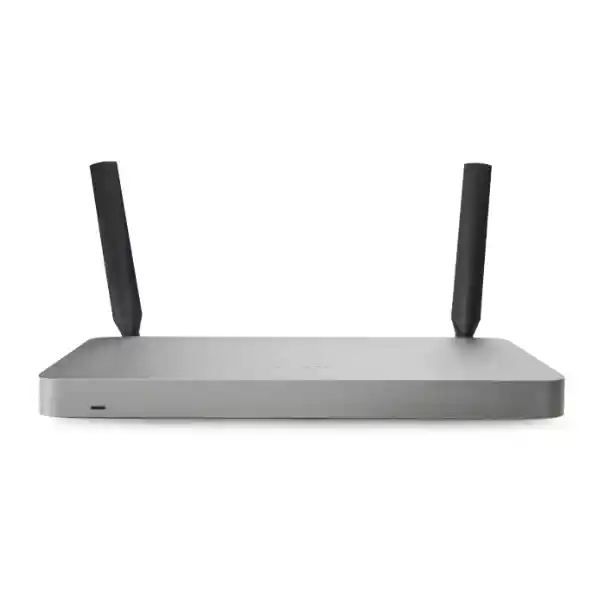
Cisco Meraki MX68CW
The Cisco Meraki MX68CW is an all-in-one branch security and SD-WAN appliance for organizations that want centralized cloud management, wired and wireless access, VPN connectivity and an integrated cellular fallback path in one compact platform. Cisco positions the MX68CW for small branches with up to 50 devices, with 700 Mbps firewall throughput, 400 Mbps maximum site-to-site VPN throughput in the current MX family data sheet, two dedicated Gigabit WAN interfaces, ten Gigabit LAN interfaces including two PoE+ ports, 802.11ac Wave 2 Wi-Fi and an integrated Cat 6 LTE modem.
Cisco announced end-of-sale for the MX68CW, with the last order date set for 27 November 2026 and last date of support scheduled for 30 November 2031. Cisco identifies C8121-CW-G2-MX as the migration product. Procurement teams should therefore compare immediate MX68CW requirements with the newer platform before committing to a new standard.
Cisco Meraki MX68CW overview for business buyers
The MX68CW sits at the intersection of firewall, SD-WAN, branch routing, Wi-Fi and cellular resilience. That combination makes it attractive when a branch is too important for a basic consumer router but small enough that a stack of separate appliances would add cost, power, cabling and administration. The Meraki Dashboard provides centralized configuration and monitoring, while features such as automatic WAN failover, WAN link balancing, Auto VPN, VLANs, DHCP, static routing, application visibility, traffic shaping, content policies and remote troubleshooting tools help administrators manage multiple sites from a consistent interface.
For procurement, the important point is that the MX68CW should be evaluated as a licensed cloud-managed security platform rather than hardware alone. Meraki MX licensing is tied to the appliance and feature tier. Enterprise, Advanced Security and Secure SD-WAN Plus options address different needs, and organizations should confirm the licensing model, term and feature set before ordering. Advanced inspection, content filtering, malware protection, IDS/IPS and related security capabilities depend on the selected license edition and current Cisco feature policy.
FourTeck Tanzania can help structure a requirement around user count, internet bandwidth, VPN topology, number of branches, Wi-Fi expectations, LTE carrier compatibility, PoE needs, security services, current Meraki organization design and lifecycle. For broader technology planning, review the FourTeck Tanzania technology shop, which explains how firewall, switching, wireless, voice and infrastructure choices fit together, and the FourTeck Tanzania services overview for integrated planning, deployment and support context.
Verified MX68CW technical highlights
700 Mbps firewall
Cisco’s current MX family information lists 700 Mbps firewall throughput for the MX68CW, suitable for a small-branch design when real security-service and traffic requirements are validated.
Integrated Cat 6 LTE
The built-in Cat 6 cellular modem supports LTE failover or cellular connectivity without requiring a separate external LTE gateway. Carrier and band compatibility must be confirmed for the deployment country.
802.11ac Wave 2 Wi-Fi
Integrated dual-band wireless uses 2×2 MU-MIMO with two spatial streams and up to 1.3 Gbps aggregate data rate, providing local Wi-Fi capability for compact branch environments.
10 Gigabit LAN ports
The MX68CW provides ten fixed Gigabit Ethernet LAN interfaces, including two PoE+ ports, reducing the need for an additional switch in very small edge deployments.
Meraki Dashboard
Cloud management supports centralized policy, firmware, alerts, monitoring, client visibility, VPN configuration and remote diagnostics across distributed Meraki networks.
SD-WAN and Auto VPN
Meraki Auto VPN and SD-WAN capabilities can simplify multi-site connectivity, uplink failover and policy-based path selection when deployed within a properly licensed Meraki environment.
Interfaces, security and deployment considerations
| Area | Verified MX68CW capability | Buying implication |
|---|---|---|
| Branch sizing | Small branch, up to 50 devices/users in Cisco guidance | Validate device count, application mix and security inspection before standardizing. |
| WAN | 2 dedicated GbE RJ45 plus integrated Cat 6 LTE | Useful for dual fixed links plus cellular resilience. |
| LAN | 10 GbE RJ45, 2 PoE+ | Can directly serve a small set of endpoints; larger sites still need managed switching. |
| Wireless | 802.11ac Wave 2, 2×2 MU-MIMO | Appropriate for compact coverage; larger floors should use dedicated AP design. |
| VPN | Auto VPN/IPsec endpoint; current family sheet lists 400 Mbps maximum site-to-site VPN throughput | Confirm tunnel count, encryption load and real traffic profile. |
| Licensing | Enterprise, Advanced Security, Secure SD-WAN Plus options | Choose edition by security and analytics requirements, not price alone. |
A well-designed branch uses the MX68CW as part of a complete architecture. If the site has many wired endpoints, cameras, access points or phones, a managed switch should carry the access layer while the MX68CW remains the security and WAN edge. For additional context on LAN planning, the FourTeck Tanzania home solution guide explains switching, Wi-Fi, firewalls, cabling and UPS dependencies in one integrated view.
MX68CW licensing, renewal and lifecycle planning
Meraki hardware requires cloud licensing for management. Cisco documents multiple MX license editions, including Enterprise, Advanced Security and Secure SD-WAN Plus. The correct choice depends on whether the branch primarily needs firewall and Auto VPN functions, fuller unified threat management capabilities, or additional SD-WAN analytics and application-experience features. Organizations using co-termination should also pay attention to Cisco’s rule that the MX license edition is uniform across the organization. Subscription licensing follows different operational rules, so the existing Dashboard licensing model should be identified before purchasing a renewal or adding another appliance.
The lifecycle announcement is now a central buying factor. Cisco announced the MX67C and MX68CW end-of-sale and end-of-life program on 27 August 2026. The last day to order affected hardware through Cisco point-of-sale mechanisms is 27 November 2026, with last ship date 27 February 2027. Cisco lists the end of software maintenance releases as 27 November 2027, end of vulnerability and security support as 30 November 2031, and last date of support as 30 November 2031. These milestones do not mean every installed unit immediately stops functioning at end-of-sale, but they do change the long-term procurement decision.
For a new standard that must remain current for many years, buyers should compare the MX68CW with Cisco’s migration product, C8121-CW-G2-MX, which adds a newer secure-router platform with embedded Wi-Fi 6 and 5G capability. For an existing Meraki estate where MX68CW compatibility, identical branch templates or a specific replacement need outweighs the lifecycle issue, an MX68CW may still be considered while orderability and licensing remain available. The quotation should clearly state hardware SKU, regional variant, license edition, license term, required support and migration assumptions.
Cisco Meraki MX68CW Tanzania
For organizations evaluating the Cisco Meraki MX68CW in Tanzania, the strongest use case is a small branch that needs security, wired LAN, local Wi-Fi and a resilient backup path without building a large equipment stack. A compact office, retail branch, clinic, professional-services location, education office, logistics point or distributed enterprise branch can place the MX68CW at the internet edge, connect one or two fixed WAN services, and use the integrated Cat 6 LTE modem as a cellular fallback when carrier compatibility and SIM service are confirmed. The model’s ten Gigabit LAN ports and two PoE+ ports can support a compact deployment directly, while larger sites can connect a managed switch for broader access-port and PoE capacity.
Tanzania buyers should begin with a requirements sheet rather than only asking for the appliance price. Confirm the number of users and devices, primary and secondary internet speeds, VPN traffic, SaaS dependence, guest Wi-Fi requirements, internal VLANs, security inspection needs, public services, remote-user access and branch-to-head-office connectivity. If the branch is expected to grow beyond the small-site profile, the MX68CW may become a constraint even when its headline throughput appears sufficient. Security inspection, VPN encryption, traffic shaping and multiple simultaneous applications can alter the real load. A stronger design therefore compares the projected three-to-five-year branch profile with the available appliance family rather than sizing only for today.
Cellular planning matters as much as firewall sizing. Cisco publishes worldwide LTE bands for the MX68CW, but a practical Tanzania deployment should still verify the exact hardware regional SKU, SIM form factor, carrier frequencies, APN requirements, signal quality and the physical placement of the unit. The integrated LTE feature is particularly useful as a contingency path for sites that cannot justify a separate cellular router. However, cellular failover should be tested under real conditions. Administrators should define what traffic is allowed during failover, because a backup mobile service may have different capacity, cost and latency characteristics from the primary fixed circuit.
For local project planning, FourTeck’s Tanzania IT and network services page explains how firewall, switching, Wi-Fi, cabling and support can be considered as one environment. Buyers should also review the MX68CW lifecycle notice before standardization because Cisco’s end-of-sale date is approaching. A new project should document whether the goal is to match an existing Meraki fleet, replace a failed peer unit, complete a rollout already based on MX68CW, or establish a brand-new long-term branch platform. That distinction determines whether MX68CW or the newer Cisco migration platform is the more defensible purchase.
Cisco Meraki MX68CW Dar es Salaam
A Dar es Salaam branch often needs to connect cloud applications, voice services, Wi-Fi users, office computers and remote corporate resources over a busy internet edge. The Cisco Meraki MX68CW can suit a smaller office where administrators want one cloud-managed platform for firewall policy, SD-WAN, VPN, wired access, local wireless and LTE contingency. Dual dedicated Gigabit WAN ports make it possible to design around two fixed internet circuits, while the integrated cellular modem provides another resilience option. The useful design question is not how many WAN choices are available, but how the organization wants applications to behave when a path becomes slow or unavailable.
For a headquarters satellite office, retail location, professional-services branch or logistics administration point in Dar es Salaam, the Meraki Dashboard can simplify remote operations. IT teams can view clients, traffic and uplink status, apply configuration templates and troubleshoot without sending a technician for every policy change. Auto VPN can also simplify connectivity back to a central Meraki location. That can be valuable for organizations with several branches, but the VPN topology should be planned around business applications, data flow and failover behavior. Internet breakout, central security inspection and SaaS traffic may each need a different approach.
Local branch design should also consider power and heat. The MX68CW is specified for operation from 0°C to 45°C, so the device should be placed in a ventilated, protected environment rather than treated like a consumer router that can be hidden in an unconditioned corner. UPS planning matters because the firewall, ISP termination equipment, switch and any cellular dependency must remain powered for failover to deliver real continuity. If the site uses the two built-in PoE+ ports for a phone or access point, those endpoints also become part of the power budget and resilience plan.
Dar es Salaam procurement teams should request the exact global or applicable regional hardware SKU, the chosen license edition and term, compatible SIM planning, any separate managed switches or access points, rack or wall placement requirements, UPS requirements, installation scope and configuration tasks. Because MX68CW enters end-of-sale on 27 November 2026, a new long-lived branch standard should include a side-by-side lifecycle comparison with the C8121-CW-G2-MX migration product. That comparison protects the business from choosing a technically suitable device whose procurement window is closing.
Cisco Meraki MX68CW Mwanza
For a Mwanza office or branch, the Cisco Meraki MX68CW can provide a practical combination of secure WAN edge, local switching, Wi-Fi and cellular resilience. This can be useful where an organization wants centralized control from another city or country and does not want branch staff to manage complex network equipment locally. Once the unit is connected and claimed in the appropriate Meraki Dashboard organization, policies, monitoring and troubleshooting can be handled remotely. That cloud-managed operating model is often more important than the hardware specification for companies running several small sites with limited local IT presence.
The network should still be designed around the branch workload. A small administration office with routine cloud applications, voice and limited local services is very different from a site carrying continuous surveillance video, large data synchronization, guest traffic and heavy VPN use. Cisco’s small-branch guidance of up to 50 devices is a planning reference rather than a promise that every 50-device workload behaves the same. Buyers should list the endpoints and applications expected at the busiest hour, then check firewall, VPN and security-service capacity against that real profile.
Mwanza deployments that value cellular backup should test the LTE path during commissioning. The appliance’s integrated Cat 6 modem reduces external hardware, but the branch still needs a compatible SIM service, usable signal and a policy for failover traffic. Administrators may choose to allow essential business applications while limiting noncritical software updates, backups or entertainment traffic when the cellular link is active. This helps protect capacity and makes the backup path behave as a continuity mechanism rather than an unrestricted copy of the primary connection.
The two PoE+ ports can be convenient for a compact site, for example powering a compatible access point or business phone without adding a separate PoE injector. If more powered endpoints are required, use a properly sized managed PoE switch instead of overloading the appliance’s role. FourTeck Tanzania’s business technology buying guide explains how firewall, switching, wireless and power dependencies should be checked together. For a 2026 purchase, add lifecycle planning to that checklist because the MX68CW’s end-of-sale window is already defined by Cisco.
Cisco Meraki MX68CW Arusha
Arusha organizations in hospitality administration, tourism services, education, professional services, NGOs, logistics and distributed commercial operations may need a branch edge that is simple to manage but resilient enough for cloud-based work. The MX68CW can combine security, SD-WAN, two wired WAN links, LTE fallback and local Wi-Fi in a single desktop or wall-mount platform. That makes it especially relevant to a compact site where space is limited and central IT prefers consistent remote control through the Meraki Dashboard.
A hospitality back office, reservations unit or administrative branch may depend heavily on SaaS applications, internet calling, online payments and remote corporate systems. In that environment, WAN failover is not merely a convenience. The organization should identify which services must remain available if the primary provider fails and how much traffic the backup path can realistically carry. The integrated LTE modem is valuable because it avoids an extra external gateway, but a site survey should still check cellular signal at the installation point. Placement inside a dense cabinet or shielded room can reduce radio performance, so physical installation and antenna behavior need practical validation.
Wi-Fi capability is integrated, but that does not mean one MX68CW should be expected to cover an entire hotel, campus or multi-floor office. The 802.11ac Wave 2 radio is appropriate for localized branch coverage, while larger spaces should use dedicated access points designed from a coverage and capacity survey. The firewall can then segment staff, guest and device networks using VLANs and policy. Similarly, the ten LAN ports are helpful in a compact location, but a larger wired environment should use managed switching with sufficient PoE and uplink capacity.
Arusha buyers should also separate an immediate requirement from a long-term platform decision. If an existing Meraki deployment already uses MX68CW templates and spare policies, purchasing a matching unit before end-of-sale may simplify continuity. If the project is a brand-new branch standard expected to run well into the next decade, Cisco’s newer C8121-CW-G2-MX deserves serious comparison. The quotation process should therefore include user count, WAN design, LTE carrier, Wi-Fi area, VPN architecture, security license edition, desired support term and a documented lifecycle recommendation.
Cisco Meraki MX68CW Dodoma
The Cisco Meraki MX68CW can suit a Dodoma office, institutional branch, professional-services site or distributed enterprise location where centralized network control is more important than maintaining complex local infrastructure. Its cloud-managed model allows policies, firmware, VPNs, traffic visibility and diagnostics to be handled from the Meraki Dashboard. For organizations with a main IT team elsewhere, this can simplify routine administration and make branch standards easier to repeat across locations.
Security design should begin with segmentation. A branch may have employee PCs, printers, IP phones, wireless users, guest devices, surveillance equipment and building systems on the same physical network. Placing all of those endpoints in one flat subnet makes policy and troubleshooting harder. The MX68CW supports VLANs and firewall rules that can separate business systems from guests and other devices. The exact rule set should be driven by application dependencies. A printer may need access from an employee network but not from guests; a camera network may need access to a recorder but not broad internet exposure; voice endpoints may need controlled access to a PBX or SIP service.
Dodoma deployments should also define continuity requirements. Dual wired WAN can support provider diversity, while the integrated LTE modem creates an additional backup option. The failover design needs testing, including DNS behavior, VPN recovery, public IP dependencies and critical application sessions. If remote access or site-to-site tunnels are essential, administrators should document how those connections behave during an uplink change. A backup connection has limited value if the most important application cannot re-establish correctly after failover.
From a procurement perspective, licensing and lifecycle are inseparable from hardware. Choose the Meraki license edition based on actual firewall, threat-management and analytics requirements, and verify whether the existing Dashboard organization uses co-termination or another licensing model. Because Cisco has announced MX68CW end-of-sale for 27 November 2026, buyers establishing a fresh standard should compare the migration platform rather than focusing only on immediate hardware price. A detailed quotation should identify hardware SKU, license term, deployment scope, LTE requirements, configuration assumptions and future replacement path.
Cisco Meraki MX68CW UAE
UAE organizations evaluating the Cisco Meraki MX68CW may be standardizing small retail outlets, service offices, clinics, satellite branches or remote operational locations that need a repeatable cloud-managed edge. The appliance can combine firewall, SD-WAN, dual wired WAN, LTE backup, 802.11ac wireless and limited PoE switching in one platform. Multi-country organizations with operations in Tanzania and the UAE can also use a consistent Meraki policy model across regions, subject to the correct regional hardware, carrier compatibility, licensing and regulatory requirements.
The UAE branch design should account for internet service quality and application dependence. Businesses using Microsoft 365, cloud ERP, hosted voice, SaaS CRM, remote desktops and site-to-site corporate services may benefit from dual uplinks and application-aware path decisions. The Meraki Dashboard provides centralized visibility into uplink performance and client behavior, while Auto VPN can simplify connectivity among Meraki sites. Secure SD-WAN Plus may add analytics capabilities for organizations that need deeper insight into application experience, but license selection should be based on a formal requirements list rather than simply choosing the highest tier.
For UAE projects, FourTeck’s regional network provides additional context through FourTeck UAE integrated IT solutions, FourTeck UAE IT services and the specialist firewall and network security resource. These resources are useful when the MX68CW is part of a broader branch build that includes managed switching, structured cabling, Wi-Fi, telephony or security services rather than a stand-alone hardware purchase.
Lifecycle requires particular attention in late 2026. Cisco’s last order date of 27 November 2026 means a company rolling out dozens of future branches should question whether the MX68CW is the right standard even if it works technically today. Cisco’s migration product, C8121-CW-G2-MX, brings embedded Wi-Fi 6 and 5G to the replacement path. Existing MX68CW estates may still justify like-for-like additions or spares, but new platform decisions should compare support horizon, wireless generation, cellular generation, licensing, operational consistency and the cost of a later migration.
Cisco Meraki MX68CW Uganda
Ugandan businesses can consider the Cisco Meraki MX68CW for small branches that need centralized security management and multiple connectivity options. The combination of two wired WAN ports and integrated LTE can be useful for organizations that want a primary fixed internet service with a cellular safety net, or two fixed services with an additional contingency path. Because the platform is cloud managed, a central IT team can maintain policies across multiple Ugandan sites without requiring specialist firewall administration at every branch.
A practical Uganda deployment should start by classifying applications according to business importance. Payments, ERP, email, cloud productivity, voice, remote access and branch-to-head-office systems may require higher continuity than guest browsing, software downloads or media traffic. This distinction can inform SD-WAN policy and failover behavior. During a cellular event, for example, the organization may prefer to preserve critical applications while limiting bandwidth-intensive nonessential traffic. Meraki traffic shaping and application visibility can support that operational design when configured carefully.
The built-in Wi-Fi can serve a compact branch, but organizations should not assume one integrated radio will cover larger offices, multi-floor buildings or high-density spaces. A dedicated wireless design may use separate access points while retaining the MX68CW as the security and WAN edge. The same principle applies to PoE. Two PoE+ LAN ports are useful for a small number of powered endpoints, but a branch with several access points, cameras or phones should use a managed PoE switch sized for total power budget and future growth.
For country-specific technology planning, buyers can review FourTeck Uganda IT, networking and security solutions. Organizations coordinating Tanzania and Uganda branches can use a common branch architecture while still adapting carrier, power, cabling and support arrangements to each site. The MX68CW lifecycle should be documented in any 2026 tender or quotation: if the goal is long-term standardization, compare the replacement platform; if the goal is compatibility with an installed Meraki estate, explain why a like-for-like MX68CW remains operationally preferable.
Cisco Meraki MX68CW Kampala
Kampala offices often combine cloud applications, VoIP, Wi-Fi, CCTV, guest access and remote connectivity on the same branch internet edge. The Cisco Meraki MX68CW can serve as the policy and connectivity point for a smaller site, giving administrators a unified view of WAN status, security rules, users, applications and VPN connections. This consolidation can reduce the number of independent appliances at the branch and simplify support when the IT team manages many sites from one location.
Branch segmentation should be defined before deployment. Employee devices, guest wireless, phones, cameras and infrastructure management should not necessarily share the same trust level. VLANs and firewall policies can isolate traffic while still allowing the required business flows. If IP phones are used, Quality of Service and WAN congestion should be considered. If cloud video or CCTV traffic is heavy, switching and uplink capacity must be checked. The firewall can only deliver stable service when the rest of the LAN is designed to avoid hidden bottlenecks.
Kampala buyers interested in cellular failover should confirm carrier compatibility and real signal quality at the intended installation point. The MX68CW’s integrated LTE design is convenient because cellular status is visible in the Meraki management environment, but the branch should still conduct a failover test. That test should include key SaaS sessions, VPN reconnection, DNS resolution and remote-management access. Administrators should also decide whether the LTE service will be permitted to carry all traffic or only essential classes during an outage.
A 2026 procurement review should include the Cisco end-of-sale schedule and the migration path to C8121-CW-G2-MX. If a Kampala organization is replacing a failed MX68CW in an existing standardized network, staying with the same model may reduce configuration and training change. If the project is a new long-term deployment, newer Wi-Fi and cellular generations may justify moving directly to the successor. The decision should be recorded alongside license term, support expectations, internet design and expected branch growth.
Cisco Meraki MX68CW Arua
For an Arua branch, the MX68CW can be attractive because it combines several edge functions in one remotely managed appliance. A distributed organization may not have a network specialist permanently onsite, so centralized dashboard management, configuration templates, automatic firmware handling and remote diagnostics can reduce the need for hands-on intervention. The integrated LTE modem can also add a backup path without installing a separate cellular gateway, provided the selected carrier and bands are compatible with the exact unit.
Small branches should still receive the same design discipline as larger offices. The number of users is only one sizing input. A 20-person site that synchronizes large files, runs continuous cloud backup and carries encrypted VPN traffic can place more demand on the edge than a 40-person site using light web and email. Procurement should therefore document peak internet use, VPN requirement, local servers, voice, cameras, guest traffic and any advanced security features that will be enabled. This gives a more realistic basis for deciding whether the MX68CW is appropriately sized.
Power continuity can be especially important for remote branch operations. A UPS should normally protect the firewall, ISP equipment and any core switch required to keep critical users online during a brief interruption. If the branch relies on LTE failover, the MX68CW must remain powered when the fixed internet termination equipment fails or utility power fluctuates. The same logic applies to PoE endpoints connected directly to the two PoE+ ports. Backup connectivity is only useful when the complete path remains operational.
Arua buyers should ask for a quotation that clearly separates appliance, license, configuration, cabling or switch work, UPS and any cellular service dependency. This avoids the common mistake of comparing a hardware-only price against a complete deployed solution. Since the MX68CW is approaching Cisco end-of-sale, the proposal should also explain whether the requirement is tactical—such as matching an existing fleet—or strategic, such as creating a new branch standard. A strategic standard deserves comparison with the current migration product before purchase approval.
Cisco Meraki MX68CW Mbarara
Mbarara businesses and institutions that operate a small office, service branch, clinic, education site, warehouse administration point or regional hub may need a security appliance that can be managed without a large local IT footprint. The MX68CW addresses that requirement by combining cloud-managed security and SD-WAN with local Ethernet, Wi-Fi and cellular connectivity. A central administrator can monitor the branch through the Meraki Dashboard, while the local site benefits from a compact appliance rather than multiple independent network boxes.
When sizing the branch, consider the number of client devices rather than only employee headcount. Laptops, phones, printers, cameras, access points, IoT devices and servers all generate sessions and traffic. Cisco’s recommended small-branch profile of up to 50 devices should be interpreted as a design guideline. Heavy encrypted traffic, security inspection and VPN use can affect capacity, so the intended application mix should be documented. If the business expects rapid growth, a larger or newer platform can be more economical than replacing an undersized appliance soon after deployment.
The integrated Cat 6 LTE modem is useful for continuity where a fixed circuit is not fully reliable, but organizations should define how failover is governed. A cellular service may have data limits or different performance, so prioritizing business-critical traffic can be important. The branch can also use dual fixed WAN services for additional redundancy, with cellular retained as another backup option. During commissioning, failover should be tested rather than assumed. Remote administrators should verify that cloud management, site-to-site VPN and essential applications recover as designed.
Mbarara procurement teams should combine technical and lifecycle questions. Which Meraki license tier is required? Is the organization using co-termination or subscription licensing? Does the selected unit match the right worldwide hardware variant? What is the expected replacement year? With Cisco’s MX68CW last order date set for 27 November 2026, a new long-term rollout may be better aligned with the successor platform. A like-for-like MX68CW remains easier to justify when it supports an existing standard and the customer understands the support horizon.
Cisco Meraki MX68CW Gulu
The Cisco Meraki MX68CW can serve a Gulu branch where a business needs secure connectivity, cloud administration and resilient internet without deploying a large rack of appliances. Its dual WAN, integrated LTE, Wi-Fi and PoE features are particularly useful in a compact branch where one platform can cover several edge requirements. However, integrated features should not be mistaken for unlimited scale. Larger wireless areas, many PoE endpoints or heavy switching requirements should still use dedicated infrastructure behind the MX68CW.
A strong Gulu design begins with the WAN. Identify the primary internet service, any secondary fixed service, available cellular carrier and the applications that must survive an outage. If the organization uses Meraki Auto VPN to connect to another site, test tunnel recovery when the active uplink changes. If users rely on cloud ERP, hosted PBX or remote desktops, validate those sessions over the backup link. Cellular failover is most valuable when it has been treated as an operational mode with defined priorities rather than an emergency feature nobody has tested.
Security policy should be equally deliberate. Employee, guest, phone and camera networks can be separated into VLANs and controlled by firewall rules. Advanced security features may require the appropriate license edition, so the proposed license should match the desired filtering, malware protection, IDS/IPS and analytics capabilities. Procurement documents should not say only “Meraki license”; they should specify edition, duration and the licensing model used by the customer’s Dashboard organization.
Because this model now has an announced end-of-sale, Gulu buyers should distinguish operational continuity from new architecture. An organization already running MX68CW across several branches may value standard spares and identical configuration. A first-time Meraki buyer or business starting a new five-year branch program should compare the newer Cisco secure-router migration platform before ordering. Including that lifecycle discussion in the quotation provides a clearer basis for approval and reduces the chance of beginning a new standard immediately before a product leaves normal sale.
Cisco Meraki MX68CW Kenya
Kenyan organizations may evaluate the Cisco Meraki MX68CW for distributed retail, professional-services branches, clinics, offices and other small sites where cloud management and connectivity resilience are priorities. The appliance’s centralized Meraki Dashboard can help a Nairobi-based or regional IT team manage multiple branches consistently. Auto VPN supports simplified site-to-site connectivity among Meraki locations, while dual WAN and integrated LTE offer multiple paths for internet continuity.
The branch should be sized according to application profile. Users may access cloud productivity platforms, ERP, CRM, video meetings, hosted voice, payment systems and remote corporate applications, each with different latency and throughput sensitivity. Meraki SD-WAN policy can help steer traffic, but a firewall cannot create bandwidth that the underlying access circuits do not provide. Procurement should therefore consider ISP speeds, contention, backup-link performance and expected growth together with the appliance specification.
For regional planning, FourTeck Kenya IT and network security solutions provides a country-focused route for businesses coordinating projects across Kenya and Tanzania. Multi-country organizations can standardize VLAN structure, firewall naming, VPN topology, alerting and configuration templates while still adapting carrier, cabling, power and support arrangements by location. This repeatability is one of the main advantages of a cloud-managed branch platform.
Kenya buyers should not ignore product age. Cisco announced end-of-sale for the MX68CW with the final order date of 27 November 2026. For an existing estate, that may trigger a planned last-time buy or a controlled migration schedule. For a brand-new rollout, the successor C8121-CW-G2-MX should be compared on wireless generation, cellular capability, licensing, support horizon and long-term standardization. The right answer depends on whether operational consistency with installed MX68CW units is more valuable than moving immediately to the newer platform.
Cisco Meraki MX68CW Kuwait
In Kuwait, the Cisco Meraki MX68CW can fit smaller offices and branches that need a secure cloud-managed edge with integrated wireless and a cellular fallback option. The design is particularly useful where central IT wants common policy across many locations, because configuration, monitoring, alerts and remote diagnostics are available through the Meraki Dashboard. For organizations operating across the GCC and Africa, a consistent Meraki branch architecture can simplify training and troubleshooting while each site retains its own WAN and local network settings.
A Kuwait branch may have fast fixed internet, so it is important to evaluate the full security-service performance and long-term bandwidth roadmap rather than selecting the appliance only because today’s circuit fits. Cisco currently lists 700 Mbps firewall throughput and 400 Mbps maximum site-to-site VPN throughput in the family data sheet, while security inspection can change usable performance. A business planning faster broadband, more cloud traffic or growing user count should decide whether MX68CW has enough margin for the full intended life.
The integrated LTE modem can be configured as a contingency path, but the exact carrier and band support should be validated before deployment. The branch should also consider whether cellular will carry all applications or only critical services during failover. For country-specific procurement context, FourTeck Kuwait business IT and network security solutions covers networking, Wi-Fi, firewalls and related infrastructure that may sit around the Meraki appliance.
The end-of-sale announcement changes the decision for new Kuwait projects. A business that needs a matching appliance for an existing Meraki template may still choose MX68CW while orderability remains. A greenfield branch standard should compare C8121-CW-G2-MX because Cisco names it as the migration product and the newer platform improves the technology baseline. The quotation should make lifecycle explicit so decision-makers understand whether they are buying for compatibility, short-term expansion or a new long-term standard.
Cisco Meraki MX68CW Ghana
Ghanaian businesses with distributed branches may consider the MX68CW when centralized security and connectivity management is a priority. The appliance is aimed at smaller sites and can consolidate firewall, SD-WAN, local wireless and cellular failover. A central administrator can apply consistent network policy through the Meraki Dashboard while individual branches use local WAN services. This model can be useful for retail, professional services, clinics, education administration, logistics offices and other organizations that need repeatable branch architecture.
Resilience planning should combine dual WAN and LTE with application priority. If the primary circuit fails, the branch may have enough cellular capacity for email, ERP, payment processing and voice but not for large backups or unrestricted guest traffic. Traffic shaping and segmentation can help administrators decide what continues during failover. The site should also test remote management and VPN recovery so a connectivity event does not leave administrators blind when they most need control.
FourTeck’s Ghana IT and technology solution portal can support regional conversations around branch networking, switching, firewall integration and business infrastructure. A Ghana project coordinated with Tanzania can benefit from shared standards for addressing, VLANs, VPNs, naming, monitoring and documentation. The physical realities—local carrier, UPS, cabling and coverage—should still be assessed separately at each site.
As with every late-2026 MX68CW purchase, lifecycle belongs in the technical recommendation. Cisco’s end-of-sale date of 27 November 2026 means procurement should ask whether the branch needs an MX68CW specifically or simply needs the capabilities it provides. If compatibility with an installed fleet is the objective, the model may remain suitable under the published support timeline. If the objective is a new long-duration standard, the newer migration product may offer better longevity. The final bill of materials should state the chosen strategy so future teams understand the decision.
Cisco Meraki MX68CW Nigeria
Nigeria’s large and distributed business environment can make centralized branch management especially valuable. For a small office or branch, the Cisco Meraki MX68CW can combine firewall, SD-WAN, Wi-Fi, dual WAN and LTE backup in a single platform. Organizations with many sites can use Meraki Dashboard templates and monitoring to create a more consistent operational model, reducing the amount of unique configuration at each branch and giving central IT a common troubleshooting interface.
Connectivity diversity should be designed deliberately. A branch may use one fiber provider, a second broadband service and the integrated LTE modem as an additional backup. The business should map each uplink to expected performance and cost. During failover, critical traffic may need priority over software updates, streaming or large synchronization tasks. Auto VPN and SD-WAN can support multi-site connectivity, but administrators should test path changes and understand how public-IP-dependent services behave when the active uplink changes.
For Nigeria-focused projects, FourTeck Nigeria IT and network solutions provides additional regional context. Companies running branches in Nigeria, Ghana, Kenya, Uganda and Tanzania can standardize high-level architecture while still adapting to local internet, power and deployment conditions. The MX68CW’s cloud-managed model is well suited to that pattern because central policy can be shared without requiring each branch to operate as an independent firewall environment.
Nigeria buyers should check the product lifecycle before placing a long-term order. The MX68CW remains supported under Cisco’s published timeline after end-of-sale, but the last normal order date is 27 November 2026. A business already invested in MX68CW may intentionally continue with the model for standardization. A new deployment program should compare the successor platform and calculate whether a later forced migration would outweigh the short-term benefit of adopting MX68CW now. The procurement record should document license edition, support expectations and migration plan.
Cisco Meraki MX68CW Seychelles
Seychelles organizations may value the Cisco Meraki MX68CW for compact offices, hospitality administration, service businesses and branch environments where reliable remote management is important. The appliance combines multiple edge functions in one device, which can be useful where equipment space is limited and technical support is centralized elsewhere. Dual wired WAN and integrated LTE provide several options for connectivity resilience, while the Meraki Dashboard gives administrators a cloud-based interface for policy, alerts, client visibility and troubleshooting.
A hospitality or island branch environment should treat internet continuity as an application design issue. Reservation systems, payment services, corporate VPN, cloud email and voice may need to survive an outage, while guest traffic can be restricted during failover. The MX68CW can separate networks and apply traffic policy, but a backup link still needs sufficient capacity and signal. If cellular is intended as the emergency path, test it from the actual device location and verify the carrier’s supported bands and service conditions before relying on it operationally.
Integrated Wi-Fi can serve a small local area, but larger guest or staff coverage should use purpose-designed access points. Similarly, two PoE+ ports can power a limited number of endpoints, yet a hotel, office floor or multi-room facility usually needs a dedicated PoE switch. The security appliance should therefore be viewed as the WAN and policy edge, not a replacement for every network component. A clean architecture makes later expansion easier and reduces the chance that one compact appliance becomes overloaded with access-layer tasks.
For a Seychelles procurement decision in 2026, lifecycle should be part of the recommendation. Cisco has named a successor and published the MX68CW end-of-sale schedule. If the organization already runs a common Meraki MX68CW template across regional branches, a matching unit may minimize operational change. If the Seychelles site is the first branch of a new program, a newer platform may provide better longevity. Procurement should compare hardware generation, cellular roadmap, Wi-Fi requirements, license term, expected support horizon and the cost of future migration before approving the model.
Compatibility, switching, Wi-Fi and branch endpoint planning
The MX68CW should be selected as part of the branch architecture, not in isolation. If the site uses only a handful of wired devices, the ten LAN interfaces may be enough. As soon as the design includes many phones, cameras, access points or workstations, a dedicated managed switch becomes more appropriate. This separates the security edge from access-layer expansion and creates clearer PoE budgeting, VLAN management and cable organization. The MX68CW’s two built-in PoE+ interfaces remain useful for selected endpoints but should not be treated as a substitute for a properly sized PoE switch.
For example, a business voice deployment may attach PoE phones to a managed access switch behind the MX. FourTeck Tanzania currently lists products such as the Dinstar C60SP PoE business IP phone and Dinstar C62UP PoE business IP phone. These are examples of downstream endpoints whose power, VLAN and QoS requirements should be considered when sizing branch switching. Non-PoE devices such as the Dinstar C60S business IP phone and Dinstar C63G business IP phone illustrate why endpoint power method and Ethernet speed belong in network planning rather than being left to the final installation day.
The same principle applies to wireless. The integrated 802.11ac Wave 2 radio can support a compact branch, but a building with multiple rooms, floors, dense users or difficult materials should use dedicated access points. Survey coverage, client density, roaming, guest isolation, PoE and channel design. The firewall can then focus on segmentation, WAN policy and security while a purpose-built wireless layer provides coverage. This separation makes expansion easier when user density grows beyond what a single integrated radio can serve comfortably.
How to decide whether MX68CW is still the right purchase
MX68CW can still make sense when
You already run an MX68CW fleet, need a like-for-like replacement, require an identical template for a rollout already committed to this platform, understand the remaining support timeline, and can source the correct hardware and license before end-of-sale.
A successor is usually stronger when
You are defining a new multi-year branch standard, need newer Wi-Fi or cellular technology, expect growth beyond the MX68CW profile, or want the longest current product lifecycle. Cisco explicitly identifies C8121-CW-G2-MX as the migration product.
Decision-makers should therefore ask a simple question: are we buying the MX68CW because this exact model is operationally necessary, or because we need its general capabilities? If the exact model is necessary, document the reason and lifecycle dates. If the capability is what matters, compare the current successor before committing. This keeps the purchase aligned with business continuity rather than allowing a familiar model number to drive the decision automatically.
Quotation checklist for Cisco Meraki MX68CW
A complete quotation should distinguish supply-only from configuration, installation, migration, testing and documentation. For a replacement project, include the existing MX model, Dashboard organization, current license edition, firmware, VLANs, VPN topology and whether configuration will be cloned or redesigned. For a greenfield project, include a simple branch diagram so WAN, LTE, switching, Wi-Fi and critical applications can be reviewed together.
Related FourTeck regional resources
Organizations coordinating more than one country can use FourTeck’s regional network as a planning reference. Explore FourTeck Africa for broader multi-country IT context, FourTeck Kenya for Kenya-focused networking and security requirements, FourTeck Uganda for Uganda branch projects, FourTeck Ghana for Ghana enquiries, FourTeck Nigeria for Nigeria technology projects and FourTeck Kuwait for Kuwait network and security planning.
For Tanzania projects, the About FourTeck Tanzania page explains the integrated business-technology approach, while the Tanzania contact page is the verified route for quotation and project enquiries.
Cisco Meraki MX68CW FAQs
What is the Cisco Meraki MX68CW designed for?
It is designed as a small-branch cloud-managed security and SD-WAN appliance. Cisco positions it for up to 50 devices/users and combines firewall, VPN, dual WAN, integrated Wi-Fi, ten Gigabit LAN interfaces, two PoE+ ports and Cat 6 LTE cellular connectivity.
Does the MX68CW have built-in LTE?
Yes. The MX68CW includes an integrated Cat 6 LTE modem. The exact hardware variant, supported frequency bands, carrier compatibility, SIM and signal quality should be verified for the country and carrier used at the branch.
Does the MX68CW include Wi-Fi?
Yes. It includes 802.11ac Wave 2 wireless with 2×2 MU-MIMO. This is useful for compact branch coverage, but larger or more demanding spaces should use dedicated access points designed for coverage and client capacity.
How many LAN ports does the MX68CW provide?
Cisco lists ten fixed Gigabit Ethernet LAN interfaces, with two PoE+ ports. Larger branch networks should still use managed switching when they need more ports, a larger PoE budget, higher access-layer resilience or broader VLAN control.
What license does the MX68CW need?
Meraki hardware requires cloud licensing. Cisco documents Enterprise, Advanced Security and Secure SD-WAN Plus editions for MX. The correct tier depends on the security and analytics features required, and the customer’s current Meraki licensing model should be checked before ordering.
Is the Cisco Meraki MX68CW end-of-sale?
Cisco announced the MX68CW end-of-sale program in August 2026. The last day to order affected hardware through Cisco point-of-sale mechanisms is 27 November 2026. Cisco lists the last date of support as 30 November 2031, subject to the applicable warranty or support terms.
What replaces the MX68CW?
Cisco names C8121-CW-G2-MX as the migration product for MX68CW. Buyers creating a new long-term branch standard should compare the successor before committing to MX68CW, while existing estates may still value like-for-like compatibility.
Can I use the MX68CW for dual-WAN failover?
Yes. The platform supports multiple uplinks, automatic failover and WAN link balancing. A production design should define link priority, traffic policies, VPN behavior and how business applications recover when the active WAN changes.
Should I buy MX68CW for a new 2026 branch rollout?
Only after comparing the lifecycle and successor. If you need compatibility with an installed MX68CW estate, it may still be appropriate. If you are defining a brand-new multi-year standard, Cisco’s migration product is generally the more important comparison because the MX68CW order window is closing.
Decision recap and consultation
Choose the Cisco Meraki MX68CW when you have a clear small-branch requirement, value Meraki Dashboard management, need integrated LTE and Wi-Fi, and understand the product’s current lifecycle position. Do not select it only because it combines many features in one box. Confirm branch sizing, WAN capacity, security license, VPN needs, LTE compatibility, wireless coverage, PoE requirements, power continuity and future growth. Most importantly, decide whether the business needs this exact model or simply needs a modern Meraki branch platform.
FourTeck can help prepare a requirement-led quotation for Tanzania and coordinate broader regional discussions through the FourTeck network. Share the number of locations, users and devices, internet services, current Meraki environment, VPN topology, preferred license term, LTE requirement and whether the request is a replacement, expansion or greenfield project. This information allows the proposal to include a lifecycle-aware comparison rather than a hardware-only quote.




Reviews
There are no reviews yet.