
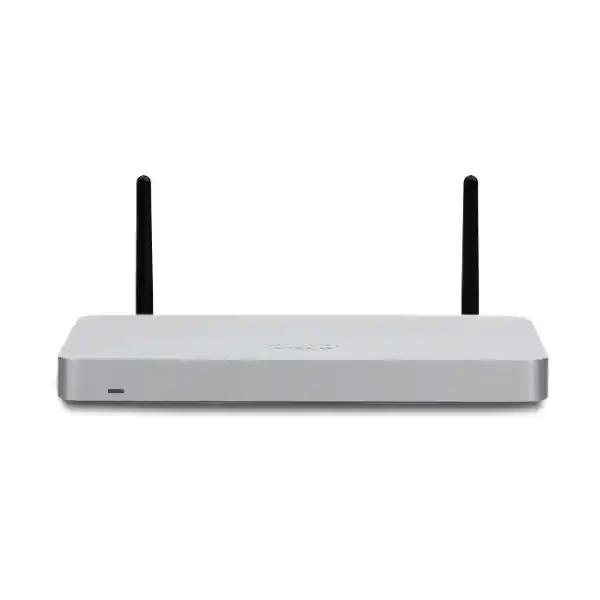
Cisco Meraki MX68W Tanzania
The Cisco Meraki MX68W is a compact security and SD-WAN appliance designed for small branches and distributed business locations that need secure internet access, centralized cloud management, built-in wireless connectivity and practical branch networking in one desktop or wall-mountable platform. Cisco positions the MX68W for up to 50 users, with two Gigabit Ethernet WAN interfaces, ten Gigabit Ethernet LAN interfaces including two PoE+ ports, integrated 802.11ac Wave 2 Wi-Fi and a 700 Mbps firewall-throughput rating.
For buyers in Tanzania, the most important question is not simply whether the MX68W has enough ports. A successful deployment also depends on Meraki licensing, internet bandwidth, VPN requirements, segmentation, wireless coverage, switching, PoE demand, application traffic and the way remote administration will be handled. FourTeck Tanzania can help structure these inputs before quotation so the appliance is evaluated as part of a complete branch-network design rather than as an isolated firewall.
What is the Cisco Meraki MX68W?
The MX68W is part of Cisco Meraki’s MX security and SD-WAN family. It combines branch-edge routing, Layer 3 and Layer 7 firewall functions, Meraki Auto VPN, WAN failover and load balancing, traffic shaping, content-control capabilities, security services where licensed, and a cloud-based management model. The integrated wireless radio supports 802.11a/b/g/n/ac Wave 2 operation with 2×2 MU-MIMO and an aggregate maximum data rate listed by Cisco at 1.3 Gbps. Cisco documentation also states that MX68W supports up to four SSIDs, allowing administrators to create distinct wireless networks for use cases such as corporate, guest or device access.
The hardware layout makes the unit particularly relevant to small offices that want to reduce the number of separate edge devices. Two dedicated Gigabit Ethernet WAN ports can support two internet connections, while eight dedicated Gigabit Ethernet LAN ports and two Gigabit Ethernet PoE+ LAN ports provide local connectivity. Each PoE+ port can supply power to compatible devices within Cisco’s stated limits, which can be useful for selected access points, phones or other powered endpoints. The design does not eliminate the need for a switch in larger sites, but it can simplify smaller branch environments.
Centralized management is a major part of the Meraki value proposition. Configuration, monitoring, security policies, VPN, traffic analytics and firmware management are handled through the Meraki Dashboard. This can be attractive for organizations that operate several small branches because administrators can apply common policies and view multiple locations without relying on separate locally managed interfaces at every site. Buyers should plan the corresponding Meraki license term and feature tier as part of the procurement process.
Dual WAN
Two dedicated Gigabit WAN interfaces support resilient branch designs with automatic WAN failover and link balancing where configured.
Integrated Wi-Fi
802.11ac Wave 2 wireless with 2×2 MU-MIMO can serve compact offices where an integrated wireless capability is operationally appropriate.
Cloud management
The Meraki Dashboard centralizes configuration, monitoring, firmware updates, traffic visibility and policy administration across locations.
PoE+ LAN
Two of the ten Gigabit LAN ports provide PoE+, adding flexibility for selected powered endpoints without immediately requiring a separate PoE switch.
Cisco Meraki MX68W specifications and buying checkpoints
| Recommended use | Small branch, up to 50 users/devices according to Cisco guidance |
| Firewall throughput | 700 Mbps |
| WAN | 2 × Gigabit Ethernet RJ45 |
| LAN | 10 × Gigabit Ethernet RJ45, including 2 × PoE+ |
| Wireless | 802.11ac Wave 2, 2×2 MU-MIMO, up to 1.3 Gbps aggregate radio data rate |
| Management | Cisco Meraki Dashboard cloud management |
| Mounting | Desktop or wall mount |
| Dimensions | Approximately 284 × 172 × 27 mm |
| Operating temperature | 0°C to 45°C |
Throughput figures should be interpreted together with the security features, VPN profile, internet service, traffic mix and licensing that will be used in production. Procurement teams should also verify the exact license edition, subscription term, power-cord requirement, accessories and deployment scope on the quotation rather than assuming these are included in a hardware-only line item.
Where MX68W fits in a branch network
A typical MX68W deployment places the appliance at the internet edge of a branch office. One or two ISP circuits connect to the WAN interfaces, and the LAN side connects users, switches, wireless clients, phones and other business systems. In a very small office the built-in LAN ports and integrated Wi-Fi may cover a meaningful portion of the requirement. In larger or more segmented sites, the MX68W usually works with managed switches and additional access points so the network can scale beyond the built-in port and radio capacity.
Meraki Auto VPN can simplify branch-to-branch or branch-to-head-office VPN configuration when other compatible Meraki MX appliances are used. Native IPsec and remote-client VPN options can also be relevant depending on the design. Organizations should define which applications must traverse the VPN, how much simultaneous traffic is expected, whether the branch depends on central services, and what should happen if the primary WAN link fails. These answers affect sizing more than a simple user count.
For a broader network project, review FourTeck Tanzania’s technology services, business technology shop, networking and security overview, solution-led approach, and quotation contact page. These verified pages help buyers connect the appliance to switching, wireless, security, infrastructure and implementation requirements without relying on invented category URLs.
Licensing, security services and lifecycle planning
Meraki appliances are designed around cloud-managed licensing. Buyers should confirm the selected MX license tier and term at quotation stage because the feature set and subscription commitment are part of the operational model. Cisco documentation describes Enterprise, Advanced Security and Secure SD-WAN Plus licensing approaches in the MX family. Advanced security functions such as IDS/IPS, malware protection and content filtering depend on the applicable license and current Cisco licensing rules.
A procurement comparison should therefore include more than the hardware line. Ask for the appliance part number, license SKU or subscription, term length, support entitlement, power requirements and any professional services required for migration. If replacing an existing firewall, include the current WAN addressing, VLANs, DHCP ranges, static routes, VPN peers, firewall rules, public services, remote-access requirements and any authentication dependencies. This reduces the risk of purchasing the correct appliance but under-scoping the migration effort.
Lifecycle planning should also cover firmware management, administrator access, configuration documentation, monitoring responsibilities and renewal dates. Meraki’s centralized model can reduce local-management complexity, but it works best when organizations have clear ownership of the Dashboard organization, administrator accounts and renewal process.
Regional procurement and deployment guidance
Cisco Meraki MX68W Tanzania
Businesses evaluating Cisco Meraki MX68W in Tanzania often need a branch platform that brings internet security, SD-WAN, VPN and wireless management into one operational view. The model is most relevant when the intended site is within Cisco’s small-branch sizing guidance and when the organization values cloud-based administration. For a Tanzania deployment, begin with the number of active client devices, not only employee headcount. Laptops, phones, printers, cameras, access points, servers and guest devices can all influence the real client count and traffic profile. Internet bandwidth should be documented for both primary and secondary providers if dual-WAN resilience is required.
Power and environmental planning matter as well. The MX68W is specified for operation from 0°C to 45°C, so equipment rooms should have appropriate ventilation and should avoid heat accumulation. A UPS can help maintain the appliance, upstream modem or ONT, and any downstream switch during short power interruptions, but UPS sizing should consider the full load rather than the firewall alone. If the integrated Wi-Fi will be used, survey the office layout, walls, user density and required coverage. The built-in radio can be useful for compact spaces, while larger premises may be better served by dedicated managed access points.
Procurement teams in Tanzania should request a quotation that clearly separates hardware, Meraki licensing, optional services, accessories and any migration work. For organizations standardizing multiple branches, agree on VLAN numbering, DHCP conventions, WAN templates, security policies, VPN topology and monitoring responsibilities before rolling out the first site. FourTeck Tanzania’s integrated IT and network services page explains how switching, Wi-Fi, firewalling and infrastructure are considered together. This approach is important because the MX68W can be the control point for many network services, but it does not remove the need for good switching, cabling, identity practices and endpoint security.
A useful Tanzania quotation request should therefore include the current ISP handoff, expected internet speed, number of users and devices, branch count, VPN destinations, Wi-Fi coverage requirement, any PoE endpoints, preferred license term and desired implementation date. Avoid assuming stock, delivery time or local inventory until it is confirmed in a formal quotation.
Cisco Meraki MX68W Dar es Salaam
For an office in Dar es Salaam, the MX68W can suit small corporate branches, professional-service offices, retail back offices, clinics, education administration sites and other locations that require centrally managed security with integrated wireless. Dense commercial buildings often create practical network-design issues that product specifications do not show: multiple neighboring Wi-Fi networks, shared building pathways, varying ISP handoffs and limited equipment-room space. Before relying on the integrated MX68W radio, check whether the office is a single compact floor or whether users extend across separated rooms, reinforced walls or multiple levels.
Dual WAN can be particularly useful when business applications, cloud services or VoIP require continued internet availability. The MX68W provides two dedicated Gigabit WAN interfaces and supports failover and load-balancing functions. However, true resilience requires physically and logically diverse upstream services where possible. Two services that share the same last-mile dependency may fail together. During design, document which applications must remain available during an ISP outage and decide whether all traffic, only critical traffic or selected VPN services should use the secondary link.
The ten Gigabit LAN ports can cover a small office, but port count should be considered together with PoE demand and network growth. Only two LAN ports are PoE+, so a site with several IP phones, cameras and access points may still need a dedicated PoE switch. Segment employee, guest, voice, surveillance and server traffic using VLANs where appropriate, and map firewall rules to actual business communication flows rather than allowing broad any-to-any access between networks.
For Dar es Salaam procurement, provide a simple network diagram with current devices and desired changes. Include public-IP requirements, existing VPN peers, Wi-Fi usage, internet speeds and the number of branches to be connected. This enables a quotation to address the appliance and its dependencies. The FourTeck Tanzania technology shop highlights compatibility, capacity, infrastructure and lifecycle checks that are useful when comparing branch-security quotations.
Cisco Meraki MX68W Mwanza
Organizations considering the Cisco Meraki MX68W in Mwanza should assess the branch as a complete operating environment. A small office may have fewer than 50 employees yet still exceed the expected device count once smartphones, printers, IP phones, cameras and guest devices are included. Cisco’s small-branch guidance is therefore a starting point rather than a substitute for traffic analysis. Record peak internet utilization, VPN traffic, cloud applications and any large file transfers that occur between Mwanza and another office.
If the site connects to a head office, warehouse, cloud workload or another branch, define the VPN topology before purchase. Meraki Auto VPN can make MX-to-MX connectivity easier to administer, while native IPsec may be needed for third-party peers. The design should identify which subnets are advertised, which networks can communicate, whether guest traffic is excluded from VPN, and what happens if the primary WAN fails. This creates a clear basis for firewall policy and troubleshooting after go-live.
Wireless planning deserves separate attention. The MX68W’s integrated 802.11ac Wave 2 radio can be a practical fit for a compact single-site branch, but coverage depends on layout and construction. Do not assume one appliance can cover a large warehouse, multi-storey building or long office simply because it includes Wi-Fi. If coverage or client density is beyond the built-in radio’s practical role, plan separate access points and use the MX68W as the security edge. Likewise, the two PoE+ ports can power selected endpoints but should not be mistaken for a high-capacity PoE switching system.
A Mwanza quotation request should include branch layout, expected wired and wireless endpoints, the ISP demarcation point, power conditions, available rack or wall space, and the desired Meraki license term. Where the branch is part of a wider East African operation, also document the standard security policies that must be consistent across locations so the Dashboard configuration can support common administration.
Cisco Meraki MX68W Arusha
For Arusha businesses, hospitality operators, professional offices and branch sites, the MX68W can be evaluated as an all-in-one edge platform where a compact form factor and centralized administration are useful. Hospitality and visitor-facing environments frequently need clear separation between staff systems and guest internet access. The MX68W supports multiple SSIDs and VLAN-based segmentation, but the wireless design should reflect the building rather than the firewall location. Guest rooms, conference spaces, outdoor areas and multi-building compounds usually require dedicated access points even when the firewall itself includes Wi-Fi.
A strong design separates traffic according to trust and operational need. Staff laptops may require access to internal applications, while guest Wi-Fi should generally be isolated from internal systems. Payment devices, cameras, IP phones and building systems may each justify dedicated segments. Firewall rules can then allow only the communications required between these networks. This makes troubleshooting clearer and reduces the risks associated with a flat network where every device can reach every other device.
Arusha sites that depend on cloud booking systems, email, VoIP or remote management should also evaluate WAN resilience. With two GbE WAN ports, the MX68W can support dual-provider configurations, but redundancy should be designed end to end. Verify whether each provider uses distinct infrastructure, how public IP addresses are assigned, and whether inbound services or VPN peers need changes when failover occurs. If a branch depends heavily on a head-office VPN, test application behavior under failover rather than considering connectivity alone.
When requesting an Arusha quote, provide the number of staff, peak guest-device estimate, internet speeds, existing switches and access points, intended VPN connections, and whether PoE devices will connect directly to the appliance. FourTeck can then evaluate the MX68W within the wider network rather than quoting only the hardware. For additional Wi-Fi and network planning context, the FourTeck Tanzania solutions overview explains how wireless, switching and firewall requirements interact.
Cisco Meraki MX68W Dodoma
Organizations in Dodoma evaluating the Cisco Meraki MX68W may include professional offices, institutions, project offices and distributed administrative sites. For these environments, standardized configuration can be as important as raw throughput. A cloud-managed platform allows administrators to apply repeatable firewall, VLAN, VPN and monitoring practices across branches, reducing the need for unique local configuration at every site. This is particularly valuable when branch IT support is centralized.
Before standardizing on the MX68W, compare the site’s expected client count, internet bandwidth and VPN demand with Cisco’s small-branch positioning. Count non-user devices and future growth. An office with 35 staff may still operate 60 or more network clients once phones, printers, cameras, tablets and infrastructure devices are considered. If the branch is expected to grow materially, choosing the next appliance size at the planning stage can avoid premature replacement.
The built-in Wi-Fi is useful but should not dictate where the firewall is installed. Firewalls often belong near the ISP handoff, UPS and network rack, while the optimal access-point position may be closer to users. If these locations differ, use dedicated access points rather than placing the security appliance in a poor infrastructure location simply to improve wireless coverage. The same principle applies to the PoE+ ports: they add convenience, but a managed PoE switch may be a better foundation where many powered devices are involved.
For Dodoma procurement, prepare a bill-of-requirements rather than only asking for a model price. Include license duration, number of WAN providers, public IP needs, VLAN count, existing firewall migration details, VPN peers, wireless coverage, switching, UPS and implementation support. This allows technical and procurement stakeholders to compare complete solutions on equal assumptions and avoids hidden omissions after hardware has been ordered.
Cisco Meraki MX68W UAE
Businesses with operations between Tanzania and the UAE may use the MX68W as part of a standardized branch architecture. The main advantage of a common Meraki platform is consistent policy and visibility: administrators can use one Dashboard organization or an agreed management structure to monitor uplinks, clients, VPN status and security settings across locations. Before replicating a Tanzania design in the UAE, verify internet handoff, local regulatory requirements, wireless domain requirements, licensing availability and the physical site environment for the specific deployment.
Multi-country deployments benefit from a configuration standard that separates what must stay identical from what is site-specific. VLAN names, security policy, logging, VPN design and administrator roles may be standardized, while WAN addressing, ISP details, DHCP ranges and wireless channel behavior may vary. The MX68W can support this model because centralized templates and Dashboard workflows reduce the need to create every branch from scratch, but governance remains important. Define who can make changes, how changes are reviewed and how configuration is documented.
For UAE procurement, the same lifecycle questions apply: hardware part number, license tier, term, support and any deployment services must be clearly identified. Do not compare a hardware-only price with a complete licensed and configured solution without normalizing the scope. If the branch uses voice, video conferencing or cloud applications, include those traffic priorities in the SD-WAN and traffic-shaping design.
FourTeck’s regional resources can support cross-market planning. See FourTeck UAE for the wider UAE technology context. A shared procurement template between Tanzania and UAE branches can simplify comparison, renewal planning and technical handover while still allowing each location to use the ISP, cabling and site design that fits local conditions.
Cisco Meraki MX68W Uganda
For Uganda deployments, the Cisco Meraki MX68W can be considered for small branches that need integrated security, VPN, SD-WAN and Wi-Fi in a cloud-managed platform. When Tanzania and Uganda sites belong to the same organization, design consistency is valuable: common VLAN naming, firewall policy, device inventory and VPN architecture can reduce support complexity. However, each branch should still be sized independently because user count, internet bandwidth, application usage and wireless coverage may differ substantially.
If Uganda branches connect to Tanzania or another regional hub, identify which applications are centralized and how much traffic they generate. ERP, file services, backup, voice and video can have very different latency and bandwidth sensitivity. Meraki Auto VPN can simplify compatible MX-to-MX connectivity, but the topology should be intentional. A full-mesh design may not be necessary for every branch, and guest or high-volume internet traffic may be better sent directly to the internet rather than through a remote hub.
The appliance’s dual WAN capability can support provider redundancy, but procurement should verify the physical handoff for each circuit and any required modem or optical equipment. If the site depends on cloud management, internet continuity is operationally important even though local forwarding behavior can continue according to configuration. Administrators should also define how alerts are received and who is responsible for responding to link or security events.
Regional buyers can review FourTeck Uganda for Uganda-specific technology context. When requesting a quotation, provide the branch address, expected client count, two ISP details if applicable, required license term, VPN destinations and whether additional switching or access points are needed. This creates a clearer total solution than a simple request for an MX68W hardware price.
Cisco Meraki MX68W Kampala
Kampala offices often operate in dense commercial environments where internet resilience, Wi-Fi congestion and centralized management are important. The MX68W can serve as a compact branch edge for organizations that fit its user and throughput profile. Begin by checking the primary business applications, peak internet demand and the number of devices that will connect through the appliance. Cloud productivity, video meetings, backups and software updates can create short high-bandwidth periods even in offices with modest staff numbers.
If built-in Wi-Fi is planned, review surrounding wireless activity and the office floor plan. The MX68W supports 802.11ac Wave 2 with dual-band operation, but an integrated access point cannot overcome difficult building materials or poor placement. A firewall placed in a cabinet near the ISP handoff may not be the ideal radio location. In such cases, use one or more dedicated access points connected through appropriate PoE switching while keeping the MX68W in the secure network location.
Security segmentation is another key design area. Separate guest users from corporate endpoints, and consider distinct VLANs for voice, cameras, printers or IoT devices where operationally useful. The firewall policy should be based on required communication flows. For example, guest networks generally need internet access without access to internal systems, while voice devices may need specific services and QoS treatment. Clear segmentation makes policy easier to audit and maintain.
A Kampala quotation should specify whether the requirement is hardware-only replacement or a managed migration from an existing firewall. For migration, include current rules, NAT, public services, VPN settings, DHCP and routes. If dual WAN is required, state expected failover behavior. If multiple branches are being rolled out, request consistent configuration and documentation standards so each site is easier to support from a central team.
Cisco Meraki MX68W Arua
Arua branches that depend on centralized business applications can benefit from careful WAN and VPN planning before an MX68W is purchased. The appliance supports dual WAN and Meraki SD-WAN functions, but the practical design depends on available service providers and the organization’s tolerance for downtime. If only one reliable fixed circuit is available, procurement should discuss what secondary connectivity options are feasible and how much traffic the backup link must carry. A backup path intended only for critical applications can have different capacity requirements from a full-performance secondary circuit.
For small remote branches, cloud management can reduce the need for specialist configuration at the site. Devices can be pre-associated with the correct Meraki organization and network, while configuration is prepared centrally. That said, deployment still requires accurate information about WAN addressing, local VLANs, DHCP, DNS, switch connections and any local services. Zero-touch concepts work best when the physical and logical requirements are documented before equipment arrives.
The MX68W’s integrated wireless capability may suit compact offices, but branch managers should not assume it replaces all access points. If users work across several rooms, floors or an outdoor operational area, additional APs may be required. Likewise, the two PoE+ ports are convenient for a small number of powered endpoints but are not a substitute for a properly sized PoE switch when phones, cameras or multiple APs are present.
For an Arua quotation, share a simple branch inventory: users, laptops, phones, printers, cameras, APs and switches, plus primary/secondary internet details and VPN destinations. State the desired license term and whether deployment assistance is needed. This gives the supplier enough information to identify missing dependencies and reduces the chance that installation is delayed by overlooked power, cabling, license or configuration requirements.
Cisco Meraki MX68W Mbarara
For Mbarara offices and branch operations, the MX68W is best evaluated against the site’s real network behavior. Start with user and device counts, then document application categories: web and cloud productivity, voice, video meetings, ERP, file transfer, CCTV remote viewing and any specialized business platforms. This matters because two branches with the same number of employees can create very different traffic patterns. Cisco’s 700 Mbps firewall rating provides a capacity reference, but usable performance should be assessed with the security features and VPN traffic expected in production.
If the organization operates several Ugandan branches, standardization can simplify support. Use a consistent IP addressing plan, VLAN purpose, naming convention and security-policy structure so administrators can understand any site quickly. Centralized Meraki Dashboard management supports this approach, but governance should define administrator permissions, change records and renewal ownership. A standardized platform is most valuable when operational processes are standardized as well.
Mbarara deployments should also consider power continuity for the entire connectivity chain. Keeping only the firewall on a UPS will not preserve service if the ISP device, switch or access point loses power. Map the critical path from carrier handoff to users and protect the components required to maintain connectivity for the intended period. Where dual WAN is used, verify that both upstream devices are powered and that failover has been tested.
When requesting a quote, identify whether Wi-Fi from the MX68W is expected to serve staff, guests or both, and describe the physical layout. Include any planned cameras, IP phones or access points that need PoE. This lets the proposal determine whether the appliance’s two PoE+ ports are enough or whether a dedicated PoE switch should be included. Clear requirements make the final branch design easier to approve and easier to operate.
Cisco Meraki MX68W Gulu
A Gulu branch may use the Cisco Meraki MX68W as a secure edge for internet access, branch VPN and local Wi-Fi where the site’s scale aligns with Cisco’s small-branch guidance. The strongest reason to select this model is often operational simplicity: routing, security, SD-WAN and wireless visibility can be managed from the same Meraki Dashboard. This can reduce the number of independent management interfaces that a central IT team must maintain across distributed sites.
Operational simplicity should not be confused with zero planning. The network still needs a deliberate IP plan, VLAN design, firewall policy and VPN scope. Identify which users or devices require access to internal resources and which should be internet-only. If CCTV, voice and guest Wi-Fi share the same physical switching infrastructure, logical separation can help contain broadcast traffic and reduce unnecessary cross-network access. Administrators should document exceptions so future rule changes do not become guesswork.
Connectivity resilience is also important for cloud-managed branches. The MX68W supports two WAN connections, but a backup link has value only if it is tested under realistic conditions. Confirm DNS behavior, VPN recovery, cloud application sessions and any inbound services after failover. Monitor how much bandwidth the secondary circuit can provide and whether traffic shaping should prioritize critical services during degraded operation.
For Gulu procurement, request a complete scope containing hardware, license, required accessories and migration or configuration services. Include the current firewall export or configuration summary if replacing an existing device. If the branch is new, provide a floor plan, user/device estimate, ISP information and planned switch/AP quantities. These inputs allow the MX68W to be quoted as one component of a functioning network rather than as a standalone box.
Cisco Meraki MX68W Kenya
Kenya is a common regional reference point for organizations operating across East Africa, and the MX68W can be useful where businesses want a consistent branch-security platform between Kenya and Tanzania. A shared Meraki architecture can make it easier to compare branch health, VPN status and policy from one management plane. When standardizing, use a branch template that defines naming, VLANs, security zones, DHCP, logging and VPN behavior while leaving site-specific ISP settings and addressing flexible.
For Kenyan offices, verify how many clients will connect and how much of the 700 Mbps firewall capacity is realistically needed. If internet circuits are being upgraded, size for the planned service rather than the current bandwidth alone. Consider the traffic generated by cloud backups, video conferencing, SaaS applications and centralized security services. If a branch requires higher throughput, more users or more complex resilience, compare larger MX models instead of forcing the MX68W into a role beyond its intended branch profile.
Integrated Wi-Fi can reduce equipment count in compact offices, yet the optimal firewall position and access-point position are not always the same. A multi-room office, warehouse or hospitality environment should generally be assessed for dedicated wireless coverage. The two built-in PoE+ ports can support selected endpoints, while a larger PoE deployment should use a switch with a suitable total PoE budget and uplink capacity.
For Kenya-specific regional support and related technology planning, visit FourTeck Kenya. Procurement teams comparing Kenya and Tanzania sites should keep hardware, license tier, term, configuration and deployment scope consistent in the quote format. This makes regional cost and capability comparisons more meaningful and simplifies renewal planning across multiple branches.
Cisco Meraki MX68W Kuwait
For a Kuwait branch connected to operations in Tanzania or other markets, the MX68W can provide a common cloud-managed security and SD-WAN platform. International businesses should focus on policy consistency and local connectivity differences at the same time. A standard firewall template may define segmentation, VPN, logging and administrator roles, while WAN addressing, ISP handoff, DNS and wireless radio settings are adapted to the local site.
Remote administration is valuable for geographically distributed sites because a central team can monitor devices without maintaining separate local management systems. Use role-based administrator access, named accounts and a clear change process. Decide whether local staff need any administrative capability and document escalation procedures for WAN outages or hardware events. A cloud-managed platform reduces configuration friction, but responsibility for security policy and change control still belongs to the organization.
Kuwait branches should also validate environmental placement. Although the MX68W is specified for 0°C to 45°C operation, network cabinets can run hotter than the room, especially when installed with switches, UPS units and other equipment. Provide ventilation and avoid locating the appliance where heat, dust or physical access could create avoidable risk. Protect the ISP handoff and downstream network equipment with suitable power planning if business continuity is important.
Regional buyers can consult FourTeck Kuwait for Kuwait-market context. A Kuwait quotation should identify the license term, user/device count, internet speeds, VPN peers, required Wi-Fi coverage and the relationship to other regional offices. When the same Meraki family is deployed in several countries, maintain an inventory of serial numbers, license dates, site contacts and configuration ownership to improve lifecycle management.
Cisco Meraki MX68W Ghana
Ghana branches evaluating the Cisco Meraki MX68W should begin with business continuity and management requirements. A branch that depends heavily on cloud services or centralized applications may benefit from the dual-WAN capability and Meraki SD-WAN features, but the design should specify what resilience actually means. Is the secondary circuit expected to carry the full workload, or only email, ERP and critical VPN traffic? The answer influences bandwidth selection, traffic shaping and the type of secondary service required.
For centralized administration, agree on a consistent branch policy. Separate trusted employee devices, guest networks and infrastructure where practical. Use descriptive VLAN and network names, document DHCP ranges and maintain a clear firewall rule set. Avoid broad rules added for temporary troubleshooting unless they are reviewed and removed. Meraki Dashboard visibility can make branch policy easier to manage, but good naming and documentation still determine how quickly administrators can interpret what they see.
The integrated Wi-Fi capability may be appropriate for a small office, but client density and building layout should be reviewed before making it the sole wireless solution. If a branch has meeting rooms, reception, warehouses or multiple floors, dedicated access points may provide better placement and scalability. The MX68W can remain the security edge while managed APs and switches handle the access layer.
For Ghana procurement, ensure that the quotation states the exact hardware model, license tier and term and any required implementation services. If the branch will connect to Tanzania, Kenya, UAE or another regional office, include all VPN endpoints and expected traffic paths. This makes it possible to assess not only whether the MX68W is suitable, but whether the complete regional topology is logical, resilient and supportable.
Cisco Meraki MX68W Nigeria
Nigeria deployments can vary widely in branch size and connectivity profile, so the MX68W should be selected only after confirming that the intended location fits its small-branch role. A compact professional office may be an excellent fit, while a high-density site with hundreds of endpoints or large internet circuits may require a larger platform. Count all networked devices, estimate peak traffic and identify security services that will be enabled before finalizing the model.
Dual WAN can support better continuity when two suitable internet services are available. Configure failover with an understanding of application behavior. Long-lived sessions may reset when the public IP changes, and some VPN or hosted services may need additional design attention. Test the actual business workflows rather than only verifying that a browser can open a website after failover. For critical branches, document the recovery sequence and alerting process so support teams know when the primary circuit has failed and when it returns.
Security policy should be designed around business roles and device categories. Guest Wi-Fi should not automatically share access with internal users. Cameras, printers, voice systems and building devices may each require limited communication. The MX68W provides a policy enforcement point, while managed switching and access points help carry segmentation through the LAN. A complete branch architecture should therefore include these layers in the design discussion.
For Nigeria, provide a procurement brief containing site size, device count, internet circuits, license duration, VPN requirements, wireless coverage and expected growth. If the MX68W is one of many regional deployments, request consistent configuration templates and documentation. This helps central IT teams manage changes and renewals without relying on undocumented site-specific knowledge.
Cisco Meraki MX68W Seychelles
For Seychelles organizations, island connectivity and distributed operations can make branch-network resilience especially important. The MX68W offers dual WAN, SD-WAN functions and centralized cloud management that can help small offices standardize security and connectivity. A deployment should start by identifying available ISP options and the applications that depend on continuous external connectivity. When secondary links have different latency or bandwidth characteristics, traffic policies may need to prioritize essential services rather than treating both circuits as identical.
Hospitality and customer-facing environments should separate guest wireless from operational systems. Although the MX68W includes Wi-Fi and supports multiple SSIDs, resorts, larger offices and multi-building properties typically require dedicated wireless design because radio coverage follows physical space rather than firewall capacity. Use the built-in radio where it suits the local coverage objective, and extend the network with managed access points where users, walls or outdoor areas demand broader coverage.
Remote management can be valuable where on-site technical resources are limited. Meraki Dashboard provides centralized visibility, but administrators should still document local contact details, ISP account information, device serial numbers, WAN addressing and physical connection diagrams. This information becomes especially useful when troubleshooting must be coordinated remotely. A UPS strategy should include the firewall, ISP equipment and any switch or access point required to keep critical users connected.
For a Seychelles quotation, include the number of users and devices, site type, WAN options, VPN destinations, Wi-Fi coverage expectations, license term and any required migration support. If the branch is part of a Tanzania-led regional network, define common security and VPN standards so the Seychelles site can be monitored and supported consistently while still reflecting its local connectivity conditions.
How to choose the MX68W versus another branch appliance
MX68W may fit when
The branch is small, centralized cloud management is desirable, two WAN links are useful, up to ten local Ethernet connections provide meaningful value, integrated 802.11ac Wi-Fi suits the physical space, and the expected traffic remains within the appliance’s intended performance profile.
Consider a larger design when
The branch is expected to exceed the recommended user/device range, needs materially higher throughput, has many VPN tunnels, requires broader LAN or PoE capacity, or serves a complex environment where separate enterprise switching and wireless infrastructure are already necessary.
Related network and security resources
A firewall is only one layer of the branch architecture. FourTeck Tanzania’s verified pages explain broader networking, cybersecurity and infrastructure solutions, deployment and lifecycle services, and business technology procurement guidance. The FourTeck Tanzania approach outlines how network, security, communication and infrastructure dependencies are considered together, while the contact page provides the verified route for quotation requests.
For multi-country projects, regional FourTeck sites can help align procurement and support context across UAE, Kenya, Uganda and Kuwait, while FourTeck Africa provides wider regional context. These links are intended for related planning rather than as claims of local stock or guaranteed service coverage.
Quotation checklist for Cisco Meraki MX68W
Cisco Meraki MX68W FAQs
How many users is the Cisco Meraki MX68W designed for?
Cisco positions the MX68W as a small-branch appliance for up to 50 users. Actual suitability should also consider total client devices, internet bandwidth, VPN use, enabled security services and growth.
Does the MX68W include Wi-Fi?
Yes. The MX68W includes 802.11ac Wave 2 Wi-Fi with 2×2 MU-MIMO. Cisco documentation lists support for up to four SSIDs. Larger or more complex sites may still need dedicated access points.
How many Ethernet ports does MX68W have?
It has two dedicated Gigabit Ethernet WAN ports and ten Gigabit Ethernet LAN ports. Two of the LAN ports support PoE+.
Does Cisco Meraki MX68W require a license?
Meraki MX appliances operate within Cisco’s cloud-managed licensing model. Buyers should include the appropriate license tier and term in the procurement plan and confirm current licensing rules on the quotation.
Can MX68W use two internet connections?
Yes. It has two dedicated WAN interfaces and supports WAN failover and load-balancing functions. The resilience achieved depends on the upstream ISP design and how failover is configured.
Can the MX68W connect branches by VPN?
Yes. Meraki Auto VPN supports connectivity between compatible Meraki MX networks, while native IPsec can be relevant for third-party peers. The final design should consider topology, bandwidth and required subnets.
Is MX68W suitable for a large warehouse or multi-floor office Wi-Fi deployment?
The integrated Wi-Fi is useful for compact spaces, but physical coverage and client density should be assessed. Large, multi-floor or difficult RF environments typically require dedicated access points placed according to a wireless design.
What should I send FourTeck for an accurate quote?
Send the user/device count, internet speeds, number of WAN providers, VPN requirements, current firewall details, VLANs, Wi-Fi coverage, PoE needs, license term and whether migration or configuration services are required.
Decision recap
The Cisco Meraki MX68W is a strong candidate for small branches that want cloud-managed security, SD-WAN, dual WAN, integrated 802.11ac Wi-Fi and a useful set of local Gigabit Ethernet interfaces in one compact appliance. Its value is highest when the organization is comfortable with the Meraki Dashboard operating model and plans licensing, network segmentation, VPN, wireless coverage and renewal as part of the deployment.
Before ordering, validate the site against the appliance’s intended user scale, confirm internet and VPN throughput needs, decide whether two PoE+ ports are sufficient, and determine whether the integrated Wi-Fi can cover the actual space. For larger or growing branches, compare the next MX size rather than optimizing only for today’s minimum requirement.
Talk to FourTeck Tanzania about your branch design
Share your user count, internet circuits, VPN destinations, wireless coverage, switch and PoE requirements, and preferred Meraki license term. FourTeck can use those inputs to prepare a more complete product and deployment quotation without making unsupported assumptions about stock, delivery time or site conditions.




Reviews
There are no reviews yet.