
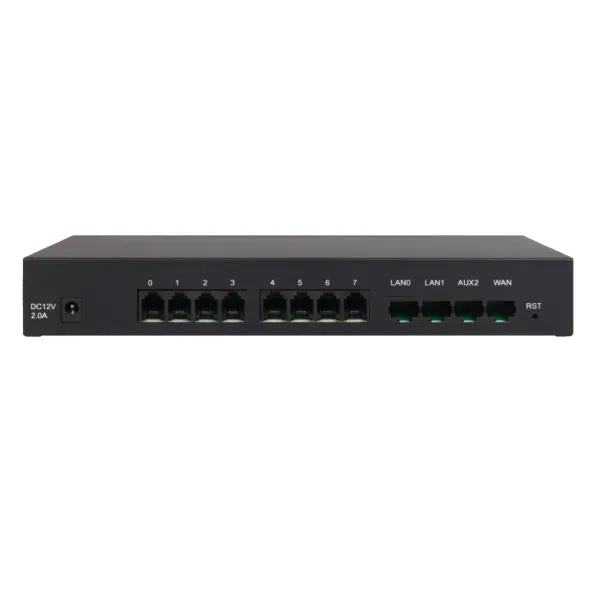
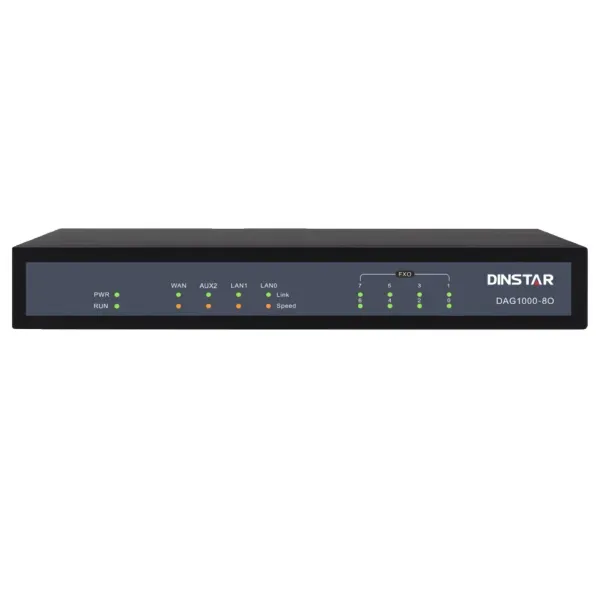
Dinstar DAG1000-8O FXO VoIP Gateway
The Dinstar DAG1000-8O is an 8-port FXO analog VoIP gateway built for organizations that need to bridge traditional PSTN telephone lines or analog PBX trunks into a modern SIP-based communications environment. It gives businesses a practical migration path when existing copper lines still matter, while the call-control platform, extensions and branch communications are moving to IP. The gateway can sit between telecom operator analog lines and an IP PBX, softswitch or SIP server, converting signaling and media so organizations can continue using valuable legacy connectivity without keeping the entire phone system on legacy architecture.
What the DAG1000-8O does
An FXO gateway is used where external analog telephone lines need to be presented to an IP-based telephone system. On the DAG1000-8O, eight FXO interfaces can connect to traditional PSTN lines or suitable analog PBX trunk interfaces. The IP side communicates using standard SIP, allowing the gateway to participate in IP PBX, IMS, NGN and SIP-server environments. This is different from an FXS gateway, which is typically used to connect analog endpoint devices such as telephones. Buyers should therefore confirm whether their requirement is to bring analog carrier lines into an IP phone system, which is an FXO use case, or to attach analog handsets to an IP network, which normally requires FXS ports.
For businesses planning a staged migration, the DAG1000-8O can reduce disruption. A company may already have PSTN numbers, analog trunks or branch connectivity that cannot be replaced immediately, yet still want centralized call routing, SIP extensions and an IP PBX. Rather than replacing every external line on the same day, the gateway creates an interface between the old and new layers. It is also relevant for backup-line designs, branch offices, contact centers and mixed environments where public telephone network access remains necessary alongside VoIP.
Verified connectivity
Dinstar lists eight FXO interfaces for the DAG1000-8O and positions the model for connecting analog PBX or telecom-carrier PSTN lines to IP telephony. The manufacturer also lists WAN/LAN Ethernet interfaces for the network side; buyers should check the current hardware revision and official datasheet when exact port layout is material to a deployment.
Voice and fax
SIP/IMS support, T.38 fax and pass-through options, call waiting, transfer, forwarding, three-way conference, voicemail-related signaling, MWI and routing functions make the unit suitable for business telephony workflows where analog trunks must participate in IP-based call handling.
Security and management
Dinstar specifies SIP over UDP/TCP/TLS, SRTP security, web administration, automated provisioning, configuration backup and restore, SNMP and TR-069 support. These tools are useful when administrators need repeatable configuration and visibility across more than one gateway or branch.
Key features and technical capabilities
| Area | DAG1000-8O capability | Why it matters |
|---|---|---|
| Analog interface | 8 FXO ports | Connects multiple PSTN or analog trunk circuits to IP telephony. |
| Signaling | SIP v2.0, SIP/IMS | Supports integration with SIP-based IP PBXs, softswitches and compatible platforms. |
| Fax | T.38 and pass-through | Helps preserve fax workflows where fax over IP is required. |
| Network | IPv4/IPv6, VLAN, QoS | Supports structured voice-network integration and traffic prioritization. |
| Security | TLS and SRTP | Adds signaling and media protection when supported end to end. |
| Operations | Web GUI, SNMP, TR-069, provisioning, logs/CDR | Useful for administration, troubleshooting, audit and distributed deployments. |
Integration and deployment guidance
The gateway should be planned as part of the complete voice path rather than as a standalone box. Start by documenting the number and type of PSTN circuits, the expected concurrent-call pattern, the existing IP PBX or SIP server, the desired inbound and outbound routes, caller-ID behavior, fax requirements and failover objectives. Then confirm how each analog line will map to FXO ports and how the SIP side will register or peer with the call-control platform. Flexible routing and dial-plan rules are valuable only when the numbering plan and call flow are clearly defined before configuration.
Voice quality also depends on the LAN. The gateway should connect to a stable switched network with suitable addressing, VLAN and QoS policy. If the IP PBX is remote or cloud-hosted, internet stability, firewall policy, NAT behavior and latency become important. TLS and SRTP can strengthen security where the wider platform supports them, but security also depends on strong administration credentials, restricted management access, firmware maintenance and careful exposure of SIP services. For businesses that already use managed switching, structured cabling and UPS-backed network equipment, the gateway can be incorporated into the same operational standards.
For related infrastructure planning, review the Fourteck Tanzania business technology shop when the project also requires IP phones, IP PBX hardware, switches or supporting equipment, and the Fourteck Tanzania services page when installation, configuration, documentation or wider network integration is part of the requirement. Multi-country organizations can also review Fourteck Uganda, Fourteck Kenya and Fourteck Africa for regional technology requirements.
Dinstar DAG1000-8O FXO VoIP Gateway Tanzania
For organizations in Tanzania, the Dinstar DAG1000-8O addresses a common migration problem: the business may still depend on analog PSTN lines while its internal telephony strategy is moving toward SIP, IP phones and centralized call control. The eight FXO interfaces provide a practical bridge between those worlds. This is useful for companies that want to retain existing carrier circuits, published telephone numbers or analog PBX trunks while introducing an IP PBX, branch SIP architecture or more flexible call-routing environment. Instead of treating the migration as an all-or-nothing project, the gateway allows the analog access layer to remain in service while the IP layer is modernized around it.
A Tanzania deployment should begin with circuit discovery. Procurement teams should list how many analog lines are active, how many simultaneous incoming and outgoing calls are expected, whether fax still forms part of business processes, and whether there are after-hours, failover or branch-routing requirements. Technical teams should then verify the target PBX, SIP-registration method, dial plan, caller-ID presentation and security policy. The DAG1000-8O supports flexible routing, SIP/IMS, T.38 fax, IPv4/IPv6, VLAN/QoS and management features, but those capabilities should be mapped to a documented design rather than enabled without a purpose.
Infrastructure conditions also matter. Stable Ethernet switching, reliable power and appropriate UPS protection can improve continuity for voice equipment. If the PBX sits in another site or in the cloud, internet reliability, firewall configuration and network quality become part of the voice solution. For multi-branch organizations, standardizing gateway naming, port mapping, SIP credentials, routing rules and configuration backups can make support easier when the same design is repeated. Tanzania buyers requesting a quotation should therefore include the number of PSTN lines, PBX make/model or hosted platform, expected call volumes, site count, network details and whether installation or configuration assistance is required.
Dinstar DAG1000-8O FXO VoIP Gateway Dar es Salaam
Dar es Salaam businesses often operate dense office environments where reception, sales, customer service and branch coordination depend on predictable inbound calling. The DAG1000-8O can be relevant when a company has several analog carrier lines that need to feed an IP PBX without abandoning those circuits immediately. An eight-port FXO design gives the administrator room to map multiple PSTN lines into one SIP environment, create inbound routes for departments, define outbound line selection and maintain structured call handling through the PBX. This approach can support offices modernizing from a legacy PBX, contact-oriented teams that still receive calls on established analog numbers, and companies combining traditional access with IP extensions.
For a Dar es Salaam deployment, the key planning task is to understand the current telecom handoff. Each analog line should be tested and labeled before it reaches the gateway. The IP PBX should have clear route rules so that a call arriving on one FXO port reaches the intended receptionist, IVR, ring group or queue. Outbound routing should also define which calls use which line and what happens when a circuit is busy. Where fax remains important, T.38 or pass-through behavior should be validated with the actual PBX and carrier path rather than assumed.
Network readiness is equally important in a busy city office. Voice traffic should not compete unpredictably with backups, CCTV streams or guest Wi-Fi. VLAN and QoS design can help create a cleaner voice path, while UPS-backed switching and gateway power can protect short interruptions. Buyers should provide floor or rack location, PBX details, switch availability, internet topology and expected concurrent calls when requesting a Dar es Salaam quotation. That information allows the gateway to be evaluated as part of a working telephone system rather than as an isolated hardware purchase.
Dinstar DAG1000-8O FXO VoIP Gateway Mwanza
In Mwanza, organizations with branch offices, hospitality operations, trading businesses, education sites or service desks may have a mixture of legacy telephone circuits and newer IP networking. The DAG1000-8O is suited to the point where those two systems meet. Its eight FXO ports allow several analog PSTN lines or compatible analog PBX trunks to be converted into SIP sessions for an IP PBX. That can be useful when the internal phone system is being upgraded but external analogue access is still operational, contracted or familiar to customers. Keeping the carrier-facing side stable while changing the internal system can reduce migration risk.
A Mwanza project should document which lines are business-critical and what each line currently does. One number may feed reception, another may be published for sales, another may be used for a fax process, and others may provide outbound capacity. Once that role is known, administrators can plan routing rules, FXO port groups and SIP-side behavior. The DAG1000-8O includes flexible dial-plan and routing features, but a good deployment avoids unnecessarily complicated rules. Simpler, documented call paths are easier to test and maintain.
Where remote IT support is expected, management design becomes important. Web administration, logs, CDR, SNMP and TR-069 can support monitoring and configuration processes, while configuration backup provides an additional operational safeguard. Management access should be restricted to trusted networks or secure administration paths. Procurement teams in Mwanza should request the exact gateway model, quantities, power accessories, installation scope and configuration deliverables in writing. They should also state the PBX platform and number of PSTN circuits so compatibility and sizing can be checked before purchase.
Dinstar DAG1000-8O FXO VoIP Gateway Arusha
Arusha has businesses whose communication requirements can include front-desk calling, reservations, administration, branch coordination and customer service across offices and hospitality-oriented operations. Where those sites retain analog telecom lines but want to centralize calling on an IP PBX, the Dinstar DAG1000-8O provides eight FXO interfaces to connect those circuits to SIP. The value is not simply converting analog to IP; it is enabling the existing external lines to participate in structured IP-PBX workflows such as IVR, ring groups, office-hour routing, queues or centralized extensions, subject to the features of the selected PBX.
Before deploying the gateway in Arusha, confirm whether the existing lines use standard analog PSTN presentation and how caller ID is delivered. Telecom behavior can vary, and FXO gateways need correct regional line settings, disconnect detection and signaling configuration to avoid stuck calls or incorrect caller identification. Testing should include inbound answer, hang-up detection, outbound dialing, DTMF, caller ID and fax if required. The gateway’s web tools and logs can help technicians validate these behaviors during commissioning.
The physical environment should also be considered. Install the gateway in a secure, ventilated location near structured network and telephony termination points. Label each analog circuit and corresponding FXO port. Connect the Ethernet side to a managed, documented LAN when possible, and protect critical voice equipment with suitable power backup. For Arusha buyers comparing quotations, the lower hardware price is not the only decision point; installation quality, configuration scope, testing, documentation and future support can determine whether the gateway delivers predictable business calling over its service life.
Dinstar DAG1000-8O FXO VoIP Gateway Dodoma
Organizations in Dodoma that are modernizing office communications can use an FXO gateway to retain analog carrier access while introducing SIP-based call control. The DAG1000-8O provides eight FXO ports, making it appropriate where more than a small number of external analog lines must connect to an IP PBX or SIP server. Government-facing suppliers, professional offices, NGOs, education organizations and growing enterprises may all encounter a phased transition in which existing telephone numbers and PSTN circuits remain useful while internal extensions, call routing and administration move to IP.
Good design starts with the call flow. A technical team should map every incoming number to the intended destination and decide how callers are handled during business hours, after hours and when the main destination is busy. Outbound policy can also be designed by department or line group. The DAG1000-8O offers routing and dial-plan functions that support these choices, while its SIP compatibility allows the IP PBX to become the central control point. Where continuity is important, planners should also decide whether PSTN lines are part of a backup strategy and how calls will be handled during internet or SIP-service interruptions.
For procurement in Dodoma, ask for clear scope boundaries. Hardware supply, PBX-side configuration, gateway configuration, analog-line testing, LAN changes and user changes are different tasks and may not all be included in a basic equipment quotation. Provide the current PBX, expected SIP server, number of PSTN circuits, any fax requirement and whether remote management is needed. A structured handover should include port labels, IP information, route descriptions and configuration backup so future troubleshooting does not depend on undocumented settings.
Dinstar DAG1000-8O FXO VoIP Gateway UAE
In the UAE, the DAG1000-8O can serve organizations that operate mixed telephony environments or maintain analog trunk connectivity while moving office users to SIP-based extensions. The same core design principle applies: the gateway connects eight FXO circuits on one side to an IP telephony platform on the other. For regional groups with headquarters or branches in the UAE and East Africa, this can support a more standardized approach to voice architecture while allowing each site to keep locally appropriate carrier connectivity. Standardized models, naming and configuration templates can reduce the operational differences between branches.
UAE deployments should be designed around the exact telecom service presented at the customer premises and any relevant service-provider requirements. Buyers should not assume that every analog service behaves identically. During commissioning, test line seizure, caller ID, DTMF, disconnect detection, inbound and outbound routing and fax if required. On the IP side, confirm SIP registration or peer mode, firewall rules, NAT behavior and codec policy with the IP PBX or hosted system. TLS/SRTP support can strengthen security when the complete call path supports secure signaling and media.
For businesses managing multiple regions from a UAE IT team, remote management and consistent documentation are especially useful. SNMP, TR-069, web configuration, logs and configuration backup can fit into a wider operational model. However, management interfaces should not be exposed directly without proper controls. Procurement teams should specify whether the requirement is hardware only, preconfiguration, on-site installation or full integration with the PBX. This distinction helps compare quotations fairly and avoids discovering after delivery that necessary call-routing or network tasks were outside the original scope.
Dinstar DAG1000-8O FXO VoIP Gateway Uganda
Ugandan organizations moving from conventional business telephony to SIP can use the DAG1000-8O to connect existing analog PSTN lines into the new platform. Eight FXO ports provide capacity for offices that have several external circuits and do not want to abandon those connections simply because the internal phone system is changing. The gateway can support a staged migration, preserving current numbers and carrier lines while an IP PBX introduces centralized extensions, call routing, reporting and branch communications.
A successful Uganda deployment needs both telephony and network planning. Each analog line should be validated for dialing, caller-ID behavior and disconnect signaling. The IP PBX should be configured with clear inbound and outbound routes. If the PBX is hosted or at another site, WAN quality becomes part of the call path. Where the gateway sits on a shared office LAN, voice VLAN and QoS policy may improve traffic organization, while appropriate firewall controls protect the SIP environment. The gateway supports IPv4/IPv6, VLAN/QoS, SIP/IMS and TLS/SRTP, but the overall security and performance depend on the wider infrastructure.
For companies with sites in Kampala or regional towns, standardization can simplify support. Use consistent port labels, IP-addressing conventions, configuration backups and route documentation. Remote-management functions such as SNMP and TR-069 can be useful, but access should be limited to authorized administrators. A quotation request should state the number of lines, current PBX, target SIP platform, branch count, fax requirements and whether installation is needed. Clear inputs produce a more accurate bill of materials and reduce configuration surprises during rollout.
Dinstar DAG1000-8O FXO VoIP Gateway Kampala
Kampala offices often need to combine customer-facing telephone numbers, reception workflows and branch communications with increasingly IP-based IT infrastructure. The Dinstar DAG1000-8O can bridge eight analog PSTN lines into a SIP PBX, allowing those external circuits to feed modern call flows. A receptionist can continue to receive calls on established numbers while the PBX manages extensions, groups, queues and onward routing. This can be attractive for organizations that want to modernize internal telephony without forcing an immediate change to every carrier-facing line.
The gateway should be commissioned with careful analog-line testing. Each FXO port should be associated with a labeled line and a known inbound number. Technicians should confirm caller ID, dial tone detection, answer supervision, hang-up behavior, DTMF and outbound dialing. These checks are important because a problem at the analog interface can appear to users as a PBX problem even when the SIP side is correctly configured. Logs and CDR can assist diagnosis after routes are built.
Kampala businesses with high voice dependence should also consider redundancy beyond the gateway itself. UPS protection for switches, PBX and gateway can protect short power events. Internet-dependent SIP services may need alternate connectivity. Configuration backups and documented credentials can reduce recovery time after changes. When requesting pricing, buyers should identify whether the requirement includes only the Dinstar hardware or also installation, PBX integration, routing design and test calls. Comparing complete scope rather than unit price alone gives a clearer view of project value.
Dinstar DAG1000-8O FXO VoIP Gateway Arua
In Arua, an FXO gateway can be useful for branch offices and organizations that want the management benefits of IP telephony while retaining practical access to traditional analog lines. The DAG1000-8O provides eight FXO interfaces, giving enough capacity for sites with several PSTN circuits or analog PBX trunks. Rather than replacing external connectivity immediately, the organization can connect those lines to a SIP-based PBX and move internal users to IP phones or software extensions in a controlled sequence.
Remote-site planning deserves special attention. The gateway, switch and PBX components should be installed where power, ventilation and cabling are dependable. If central IT staff administer the branch from another city, the management path should be secure and documented. SNMP, TR-069, web administration and configuration backup can support ongoing operations, while logs and CDR provide information when troubleshooting call failures. Remote management should never substitute for basic labeling and local documentation: every line and port should have an identifiable purpose.
For Arua procurement, include the current telephone-line count and how those lines are used today. Specify whether calls must go to a local IP PBX, a central PBX in another branch or a hosted SIP platform. State whether fax, emergency outbound lines, after-hours routing or failover matters. These operational details influence configuration even when the hardware model remains the same. A good quotation should make it clear what is supplied, what is configured, what existing equipment is assumed and what the customer must provide at the site.
Dinstar DAG1000-8O FXO VoIP Gateway Mbarara
Businesses in Mbarara that are upgrading communications can use the DAG1000-8O where analog PSTN access remains part of the telephone environment. Its eight FXO ports can take multiple carrier lines into a SIP-enabled IP PBX, supporting a gradual modernization strategy. This is particularly relevant when customer-facing phone numbers are already established or when traditional lines are retained as part of a continuity plan. The gateway allows the organization to improve internal call management without automatically discarding existing external circuits.
The most important design question is not simply whether eight ports are enough; it is how many simultaneous calls the site expects and how those calls should be routed. Administrators should map line groups, departments, reception behavior and outbound policies before programming the gateway. If several branches use the same PBX, decide whether local PSTN calls should break out locally or be centralized. Fax, DTMF and caller-ID requirements should be tested with the actual network and carrier conditions.
Mbarara deployments can benefit from simple operational standards: gateway naming, reserved IP addresses, consistent firmware policy, secure passwords, configuration backups and a written port map. Voice traffic should be placed on a stable LAN and protected from unnecessary broadcast or guest-network exposure. Where remote PBX access crosses the internet, security and WAN resilience become part of the design. Buyers requesting a quotation should provide the existing network and PBX details so that accessories, switch capacity and configuration effort can be assessed before equipment is ordered.
Dinstar DAG1000-8O FXO VoIP Gateway Gulu
For Gulu organizations, the DAG1000-8O provides a bridge between analog telephone services and an IP-based voice platform. Eight FXO interfaces allow a site to bring several PSTN lines into a SIP PBX, supporting modern extension management while maintaining the carrier-facing circuits already used by staff and customers. A branch can therefore adopt IP phones, centralized administration or inter-branch dialing while still receiving calls through existing analog numbers.
Planning should focus on resilience and maintainability. Install the gateway near the telephone demarcation and network rack where possible, and label each circuit. Protect the voice stack with appropriate UPS capacity. If the SIP server is remote, check WAN performance and firewall policy so the analog side is not blamed for an IP-side connectivity problem. The gateway’s QoS, VLAN and secure-SIP capabilities can contribute to a structured design when the switch, router and PBX are configured consistently.
Support teams should also preserve a baseline configuration after commissioning. Backup and restore functions make it easier to recover from accidental changes, and system logs/CDR provide evidence when analyzing call behavior. For a Gulu project, procurement should ask whether configuration, installation, PBX integration and testing are included. The bill of materials may also require network switching, patching, a UPS, rack space or IP phones depending on the broader migration. Treating the gateway as one component of the telephony solution results in fewer overlooked dependencies.
Dinstar DAG1000-8O FXO VoIP Gateway Kenya
Kenyan businesses with analog PSTN trunks and SIP-based telephone systems can use the DAG1000-8O as a conversion and routing point between those environments. The eight FXO ports suit offices that need more than a small two- or four-line gateway and want room for several external circuits. In a branch architecture, the unit can keep local PSTN breakout available while internal extensions communicate through an IP PBX. This allows organizations to modernize in stages and maintain established local calling routes where they remain useful.
A Kenya deployment should evaluate the carrier-line behavior and the SIP platform together. Confirm how caller ID is presented, what dialing format is used, how disconnect signaling works and whether fax is required. On the SIP side, confirm registration, authentication, codecs, routing and network security. The DAG1000-8O supports SIP/IMS, T.38, IPv4/IPv6, VLAN/QoS, TLS/SRTP and management tools, but interoperability testing with the intended PBX remains good practice for a business-critical deployment.
For groups that operate in both Kenya and Tanzania, a common gateway model and documentation format can simplify cross-border IT support. Standard templates can define port labels, IP settings, security controls and backup procedures while leaving local line settings and dialing rules site-specific. Procurement should include the expected number of concurrent calls, target PBX, existing switches, rack and power arrangements and any requirement for on-site assistance. A complete scope helps buyers compare offers on engineering value rather than on the hardware price alone.
Dinstar DAG1000-8O FXO VoIP Gateway Kuwait
In Kuwait, the Dinstar DAG1000-8O can support enterprises and branch sites that retain analog telephone lines while standardizing internal communications on SIP. Eight FXO ports provide a practical concentration point for traditional external circuits, while the IP side can register or peer with a compatible PBX or SIP server. This is useful during migrations, for local breakout or in designs where analog services remain important for particular numbers or operational workflows.
The gateway should be specified according to the existing telecom service rather than purchased solely by port count. Technical teams need to confirm line signaling, caller-ID behavior, dialing requirements and whether any fax process must continue. The PBX design should then determine inbound destinations, outbound line selection, user permissions and failover. If the PBX is hosted, WAN quality and firewall traversal become part of the telephony design. TLS and SRTP support can help protect signaling and media where the other endpoints and PBX are configured compatibly.
Kuwait-based IT teams managing sites across the Gulf and Africa may value standardized remote administration. Web management, TR-069, SNMP, logs and backup/restore can contribute to repeatable operations, provided access controls are strong. A procurement request should separate device supply from engineering services and clearly state whether preconfiguration, installation, testing and documentation are expected. That clarity helps ensure the delivered gateway is ready for the actual phone-system architecture rather than arriving as unconfigured hardware with unresolved integration work.
Dinstar DAG1000-8O FXO VoIP Gateway Ghana
Ghanaian businesses that are moving from conventional PBX infrastructure to IP telephony can use the DAG1000-8O to keep analog trunk access available during the transition. The gateway converts up to eight FXO-connected lines into SIP connectivity for a compatible IP PBX or softswitch. This allows established numbers and carrier circuits to remain active while users gain the benefits of centralized extension management, flexible routing and IP-based branch communications.
A good Ghana deployment should define the role of each analog line before configuration. Some lines may be dedicated to inbound reception, others to outbound calling or specific departments. The PBX may also need office-hour routing, overflow behavior or queueing. Mapping these requirements in advance leads to simpler and more predictable gateway rules. If fax remains in use, T.38 and pass-through should be tested with the chosen PBX, codec settings and carrier path.
The network side should be treated as business infrastructure. Use controlled management access, appropriate VLAN and QoS design, documented IP addressing and firmware management. Secure SIP functions such as TLS/SRTP are useful when supported across the complete system. For companies that operate several sites, configuration backups and consistent documentation make support easier. Ghana buyers seeking a quote should provide the number of PSTN lines, PBX or hosted voice platform, expected call volume, network environment and service scope so the gateway can be proposed as part of a coherent solution.
Dinstar DAG1000-8O FXO VoIP Gateway Nigeria
In Nigeria, organizations frequently manage complex voice environments with headquarters, branches, customer-service functions and different telecom access methods. The DAG1000-8O is relevant where analog PSTN lines must remain connected to a SIP-based PBX. With eight FXO interfaces, one gateway can consolidate several external analog circuits and route them into an IP telephony platform. This can support phased migration, local branch breakout or the continued use of established public numbers while the internal extension network becomes IP based.
Capacity planning should consider the busiest period rather than only the total number of lines. If most calls occur at the same time, route design and PBX resources must support the concurrent load. Administrators should define inbound destinations, outbound dialing policies, port groups and failover behavior. Because analog line characteristics can vary, commissioning should include tests for caller ID, answer, disconnect, DTMF, busy tone and any fax requirement. The gateway’s logs and CDR can assist when tuning or troubleshooting those settings.
Power and network resilience can be particularly important for business voice. A UPS-backed gateway, switch and PBX can preserve service through brief interruptions, while alternative WAN connectivity may be considered if the SIP server is remote. Management access should be protected and configuration backups stored securely. Nigerian procurement teams should ask suppliers to state clearly whether the quote covers only hardware or also configuration, installation, PBX integration, remote support and documentation. These service elements can materially affect deployment success even when the same gateway model is supplied.
Dinstar DAG1000-8O FXO VoIP Gateway Seychelles
For organizations in Seychelles, especially hospitality, professional services and multi-site businesses, maintaining dependable telephone access can be important even as internal communications move to IP. The DAG1000-8O allows up to eight analog PSTN lines to connect to a SIP-based PBX, helping businesses preserve existing external circuits while adopting IP extensions, centralized call routing and more structured administration. This staged approach can reduce migration pressure where carrier changes and internal system changes cannot happen at the same time.
A Seychelles deployment should pay attention to supportability because replacement or on-site technical access may require planning. Gateway configuration should therefore be documented, backed up and kept reasonably simple. Each FXO port should be labeled to the physical line, and the PBX route should be described in a handover record. Remote management via web tools, SNMP or TR-069 can be valuable, but secure access practices are essential. Firmware and configuration changes should be controlled so a working analog interface is not disrupted unnecessarily.
If the IP PBX is cloud-hosted or located on another island or country network, WAN quality and firewall policy become important to voice quality. QoS and VLAN features can support local traffic organization, while TLS/SRTP can protect supported SIP paths. Procurement teams should provide line count, PBX platform, expected calling patterns, fax needs, site network details and installation scope. Planning these dependencies before delivery helps ensure the gateway is not only technically compatible but operationally suitable for the site.
Selection, sizing and buying guidance
Choose the DAG1000-8O when the requirement is specifically for up to eight FXO connections between analog PSTN or PBX trunk lines and a SIP environment. If fewer lines are required, a smaller FXO model may be more economical. If the requirement is to connect analog telephones or fax machines as endpoints, an FXS gateway is usually the correct category instead. Hybrid gateways are relevant when both FXS and FXO interfaces are required in the same device. Defining the interface type correctly is the first and most important purchasing check.
Next, confirm interoperability with the intended IP PBX, softswitch or SIP service. Standard SIP provides broad compatibility, but production deployments should still validate authentication, codecs, DTMF, caller ID, fax and routing behavior. Consider how administrators will manage the device and whether remote provisioning, SNMP or TR-069 fits the organization’s operating model. Finally, include the supporting network: switch ports, VLANs, firewall policy, UPS, rack or shelf space, patching and any telephone-line termination work.
Quotation checklist
Provide: quantity of DAG1000-8O units; number of analog PSTN lines; current PBX or SIP platform; inbound and outbound call-flow requirements; fax requirement; branch count; network topology; firewall/NAT details where relevant; need for VLAN/QoS; remote-management requirement; desired installation location; UPS availability; and whether the quotation should include configuration, installation, testing, documentation and post-deployment support.
Frequently asked questions
What is the Dinstar DAG1000-8O used for?
It is an 8-port FXO analog VoIP gateway used to connect analog PSTN lines or suitable analog PBX trunks to SIP-based IP telephony systems.
Does the DAG1000-8O support SIP?
Yes. Dinstar lists SIP/IMS and SIP v2.0 support, including UDP/TCP/TLS transport options.
Can it be used for fax?
Dinstar specifies T.38 fax and pass-through support. End-to-end fax reliability still depends on PBX, codec, carrier and network conditions, so testing is recommended.
What is the difference between FXO and FXS?
FXO ports generally connect to analog telephone lines or PBX station/trunk interfaces that provide line service. FXS ports provide analog station service to endpoint devices such as analog phones. The DAG1000-8O is an FXO gateway.
Can the gateway be managed remotely?
The manufacturer lists web management, SNMP, TR-069, automated provisioning, logs and configuration backup/restore. Remote access should be secured and limited to trusted administration paths.
Does it support secure VoIP?
Dinstar lists TLS and SRTP support. Security benefits require compatible configuration across the gateway, PBX and any intervening SIP infrastructure.
Decision recap
The Dinstar DAG1000-8O is a strong fit when a business specifically needs to bring as many as eight analog PSTN or PBX trunk lines into a SIP-based telephone environment. Its value comes from preserving legacy connectivity while enabling modern IP call control. SIP/IMS, T.38 fax, flexible routing, IPv4/IPv6, VLAN/QoS, TLS/SRTP, SNMP/TR-069 and web management give administrators the tools needed for business deployment, but the final result depends on correct analog-line settings, PBX interoperability, network quality and disciplined configuration.
For a purchase decision, verify the interface requirement first, then confirm line count, PBX compatibility, call flows, network readiness and service scope. Request configuration and installation support when internal teams do not already manage FXO/SIP integration. A properly documented deployment can support future troubleshooting and make branch expansion easier.
Talk to Fourteck about your VoIP gateway requirement
Share your number of analog lines, PBX platform, branch locations, expected call traffic and installation scope. Fourteck can use those details to help structure the gateway, network and telephony requirements around the actual environment rather than treating the device as a standalone purchase.




Reviews
There are no reviews yet.