
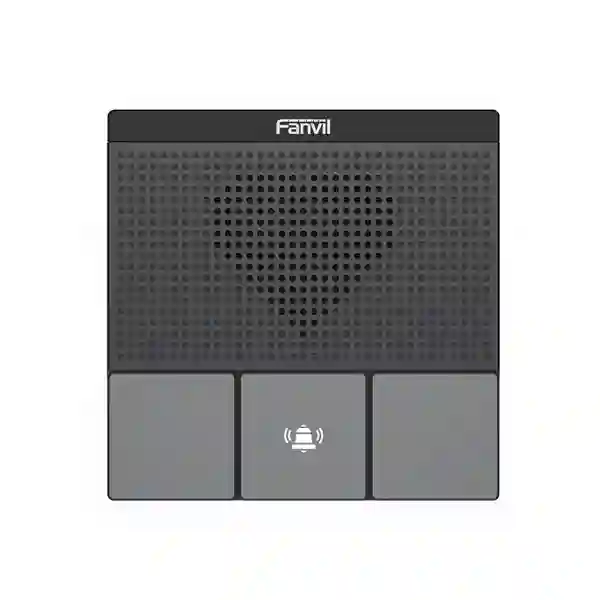
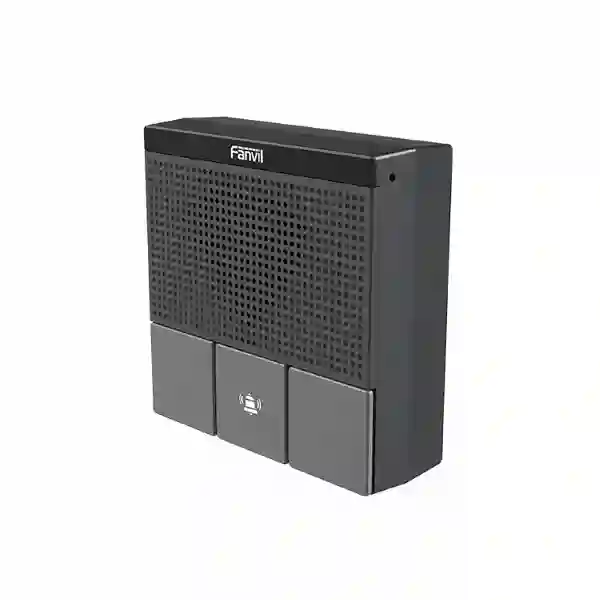
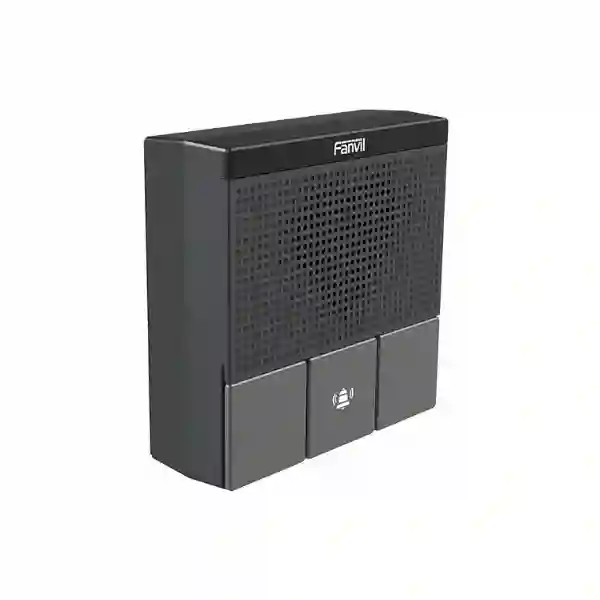
Fanvil A10 SIP Mini Intercom
The Fanvil A10 SIP Mini Intercom is a compact indoor audio endpoint designed for security communication, internal calling and broadcasting. The A10 family combines two SIP accounts, three detachable programmable function buttons, HD audio, a 2W speaker with acoustic echo cancellation, 10/100 Mbps Ethernet, Power over Ethernet and IP54 protection. FourTeck Tanzania helps organisations evaluate the exact A10 variant, IP PBX compatibility, LAN design, PoE capacity, mounting method and integration requirements before procurement.
Choose the base A10 when you need a wall-mounted wired SIP mini intercom with PoE. Choose A10W only when dual-band Wi-Fi is required. Embedded 86-box installation belongs to the A10-E/A10W-E variants, so model suffixes should be confirmed before ordering.
What the Fanvil A10 is designed to do
Fanvil positions the A10 Series as an indoor SIP mini intercom family for security, intercom and broadcasting scenarios. It is intended for places where a conventional desk phone is unnecessary but a simple, durable and centrally managed voice endpoint is useful. Typical projects can include reception-to-office calling, staff assistance points, service counters, internal help points, controlled-door communication, back-office paging or a compact extension attached to a SIP PBX. Because the device is SIP-based, it should be considered part of the business voice and network architecture rather than treated as an isolated buzzer or analog intercom.
The family provides two SIP accounts and three detachable function buttons that can be assigned for practical actions such as calling a reception extension, security desk or service team. Fanvil specifies HD audio using G.722 and Opus, a built-in 2W speaker and acoustic echo cancellation for duplex intercom use. The Ethernet interface is 10/100 Mbps, and the wired A10 can be powered through PoE, reducing the need for a separate local power supply when suitable PoE switching is available. Fanvil also lists one short-circuit input/output interface, which can be useful when a project requires linkage with another low-voltage system, subject to careful design and confirmation of the exact integration method.
2 SIP accounts
Supports two SIP registrations for flexible intercom identities, extension planning or redundancy according to the PBX design.
HD audio
Wideband G.722 and Opus support, a 2W speaker and AEC are designed to improve clarity in full-duplex voice communication.
PoE enabled
Power and data can share the network cable where the connected switch or injector provides compatible PoE.
IP54 housing
Fanvil rates the A10 Series IP54 for dust and water protection, while still positioning the product primarily for indoor application scenarios.
Verified Fanvil A10 technical highlights
| SIP | 2 SIP lines/accounts; SIP 2.0 over UDP/TCP/TLS |
| Audio | G.722, Opus and common narrowband codecs; full-duplex intercom with Acoustic Echo Canceller |
| Buttons | 3 detachable/customizable function buttons |
| Speaker | Built-in 2W speaker |
| Ethernet | 10/100 Mbps |
| Power | PoE; optional external power supply |
| Protection | IP54 |
| Wi-Fi | Only A10W/A10W-E: 2.4 GHz and 5 GHz Wi-Fi |
| Mounting | A10/A10W wall mount; A10-E/A10W-E standard 86-box embedded installation |
A10 versus A10W versus embedded variants
The A10 family names are close enough that procurement mistakes are easy. The base A10 is the wired wall-mounted model. A10W adds 2.4 GHz and 5 GHz Wi-Fi. The A10-E and A10W-E are intended for standard 86-box embedded installation, with the W-E variant combining embedded mounting with Wi-Fi. All four share the core mini-intercom idea, but connectivity and mounting are not interchangeable assumptions. A quotation should therefore state the full model suffix, required mounting style and whether wireless connectivity is truly necessary. For many managed business deployments, wired Ethernet and PoE can simplify power continuity, VLAN assignment and troubleshooting; Wi-Fi can be useful where new data cabling is impractical, but RF coverage and security then become part of the deployment plan.
SIP, PBX and network integration
A successful A10 deployment begins with the PBX. The device supports SIP 2.0 and should be provisioned with an extension, authentication credentials, server address, codec preferences and any required transport security. The PBX must then be configured so button actions and call flows do what the business expects. For example, a service button may ring a reception group rather than one person, while a security button may reach a dedicated extension. Auto answer, paging or broadcast behavior should be tested on the exact PBX and firmware combination rather than assumed from basic SIP registration.
The LAN also matters. The A10 supports VLAN, LLDP and QoS capabilities, so voice traffic can be incorporated into a managed network design. When PoE is used, the access switch should have enough available power budget and should be protected by a UPS if intercom availability during short power interruptions is important. Where several A10 units are installed, administrators should plan IP addressing, device naming, extension numbering, switch-port configuration and provisioning before installation. For related network and telephony planning, review the FourTeck Tanzania technology shop, the technology services page and the Tanzania quotation contact page.
Related telephony products on FourTeck Tanzania
An intercom deployment often shares infrastructure with desk telephony, so related SIP endpoints can be useful when standardizing a branch or office. The Dinstar C60S Business IP Phone is a two-account desk endpoint for ordinary users, while the Dinstar C60SP PoE Business IP Phone adds centralized PoE power for desk-phone environments. For projects needing additional feature capacity, compare the Dinstar C62UP PoE Business IP Phone, Dinstar C63GP PoE Business IP Phone and Dinstar C64GP PoE Business IP Phone. These are not substitutes for the wall-mounted A10 intercom; they are complementary SIP endpoints that can share PBX, switching, VLAN and provisioning architecture in a broader voice project.
Fanvil A10 SIP Mini Intercom Tanzania
For organizations evaluating the Fanvil A10 SIP Mini Intercom in Tanzania, the most useful starting point is to define exactly where the intercom will sit and who it should reach. The A10 is well suited to indoor locations that need a compact SIP voice point rather than a full desk handset: internal reception counters, guarded entrances, service desks, staff-only access areas, corridors, warehouses, back offices and facility help points are typical examples. Two SIP accounts provide flexibility for registering the unit within an existing IP PBX environment, while three detachable function buttons allow a simple user experience in which each button can represent a clearly understood action. That simplicity is valuable in shared spaces because occasional users do not need to navigate a phone menu.
Tanzania buyers should confirm whether the project requires the wired A10, the Wi-Fi A10W, or one of the embedded variants. In a structured office or institutional LAN, wired Ethernet with PoE is often the easier option to document and support because the network path and power source are controlled from the switch. If Wi-Fi is required, coverage, security settings and RF conditions must be reviewed at the intended installation point. IP54 protection adds resilience against dust and incidental water exposure, but Fanvil describes the A10 Series for indoor scenarios, so it should not automatically be treated as an outdoor weatherproof door station.
A Tanzania quotation should include quantity, exact model suffix, mounting method, PBX platform, required SIP extension behavior, switch model, available PoE budget, cabling distance, VLAN design and any planned connection to other low-voltage systems. Buyers replacing an older analog intercom should also confirm whether Ethernet cabling is already present and whether the existing call logic can be reproduced through the PBX. FourTeck Tanzania’s broader IT, telecom and security solution portfolio can help connect the intercom requirement to switching, voice, access control and supporting infrastructure rather than treating it as a standalone box.
Fanvil A10 SIP Mini Intercom Dar es Salaam
Dar es Salaam organizations often operate multi-floor offices, logistics facilities, hospitality properties, clinics, schools, commercial buildings and service environments where staff need a quick way to communicate between controlled points. The Fanvil A10 can fit these projects when the requirement is voice-first internal communication through a SIP PBX. A unit at a staff entrance, reception back door, storeroom, loading area or support point can call a predefined extension or group, while its compact format avoids installing a complete desk phone where users only need one or two actions. The three detachable buttons are especially useful when the labeling and call flow are designed around simple roles such as Reception, Security or Assistance.
For Dar es Salaam sites, network design deserves as much attention as the intercom. Offices may already combine IP phones, Wi-Fi access points, cameras and ordinary data traffic on shared switches. PoE budgets should be checked before adding intercom endpoints, and voice traffic may benefit from VLAN and QoS policies where network utilization is high. If a unit will be installed far from the communications rack, copper Ethernet distance and cabling quality should be validated. The base A10 uses Fast Ethernet, which is adequate for its voice application, but switch configuration, power stability and PBX reachability determine whether the endpoint remains dependable.
If Wi-Fi is being considered to avoid new cabling, buyers should specify A10W rather than A10 and confirm signal quality at the exact wall position. Dense buildings, reinforced walls and neighboring wireless networks can affect real performance even when general office Wi-Fi seems strong. The A10W supports both 2.4 GHz and 5 GHz bands, but choosing the right band and access point remains a site-design decision. Procurement teams should request the exact quantity, mounting type, PBX make/version, extension destinations, network switch details and any I/O integration requirement. These details help distinguish a straightforward endpoint supply from a project that also needs cabling, PoE expansion, PBX configuration or access-control coordination.
Fanvil A10 SIP Mini Intercom Mwanza
In Mwanza, the Fanvil A10 can serve businesses and institutions that need a compact SIP communication point across offices, warehouses, educational facilities, healthcare administration, retail back rooms and operational sites. The strongest use case is not general telephony; it is controlled, repeatable communication from a fixed location. A wall-mounted unit can offer staff a direct route to reception, a supervisor or security team without requiring a handset, keypad or complex user interface. Because the device supports two SIP accounts, the project designer has flexibility in how identities and call paths are arranged within the PBX.
For distributed organizations with a Mwanza branch and a central IT team elsewhere, provisioning and documentation become important. Each unit should have a clear device name, MAC-address record, switch-port assignment, IP plan, extension number and purpose. Test calls should confirm audio in both directions, transfer behavior where applicable, auto-answer or paging functions, time synchronization and any TLS/SRTP settings chosen by the voice platform. Wideband codecs such as G.722 or Opus can improve audio quality when both ends and the network support them, but a codec specification alone cannot compensate for packet loss, congestion or poor switching design.
Power continuity should also be considered. PoE allows the A10 to receive power from the access switch, which can simplify deployment and make centralized UPS protection possible when the switch itself is UPS backed. That can be attractive for security or operational communication points that should remain available during brief utility interruptions. If an organization instead selects A10W for wireless connectivity, PoE can still be relevant for power depending on the exact deployment, but the radio path becomes another dependency that must be monitored. A Mwanza quotation request should therefore describe the site, purpose of each intercom, number of units, model variant, switch and PBX environment, cabling availability and expected call flow so the bill of materials matches the operational requirement.
Fanvil A10 SIP Mini Intercom Arusha
Arusha hospitality, tourism administration, education, offices and service businesses can use the Fanvil A10 where staff need a simple SIP intercom point without the complexity of a full desktop telephone. Examples include staff entrances, back-office service counters, housekeeping or maintenance coordination points, reception support positions and restricted operational areas. The three programmable buttons can be mapped to practical destinations that users recognize immediately, reducing training needs in locations where many people may use the same device across different shifts. HD audio and acoustic echo cancellation are useful where the intercom must be operated hands-free.
The correct mounting variant matters in finished interiors. A10 and A10W are wall-mounted models, whereas A10-E and A10W-E are intended for standard 86-box embedded installation. Hotels, offices or renovated buildings in Arusha may prefer an embedded appearance where compatible boxes and wall preparation already exist, while retrofit projects may favor surface wall mounting to avoid unnecessary construction. These choices should be decided before ordering because the model suffix affects installation, not merely aesthetics. Likewise, Wi-Fi belongs only to W variants and should not be assumed on the standard A10.
Hospitality and guest-facing environments also require careful call-flow planning. An intercom should reach a staffed destination during the hours it is expected to be used. Ring groups, time conditions, alternate destinations and voicemail behavior are functions of the PBX and need to be designed around staffing patterns. Where an A10 is part of a physical-security workflow, its short-circuit input/output capability may provide an integration path, but the electrical interface and connected equipment should be validated before wiring. Arusha buyers should include the building type, exact installation points, wall/box condition, PBX platform, button actions, VLAN/PoE environment and any need for after-hours routing when requesting a quotation.
Fanvil A10 SIP Mini Intercom Dodoma
Dodoma offices, institutions, administrative facilities and growing organizations may consider the Fanvil A10 for secure internal communication points that need to work as extensions of an IP PBX. The device is particularly suitable when the interaction should be fast and predictable: a user presses a clearly labeled button and reaches a defined person, group or service desk. Two SIP registrations support flexible voice architecture, while three detachable function buttons allow the physical interface to remain simple. For public-sector, education or formal office environments, that simplicity can make shared endpoints easier to operate than a standard telephone with many unused keys.
Network governance is important in structured environments. The A10 supports SIP over UDP, TCP and TLS along with SRTP capability, VLAN, LLDP and QoS features. Organizations with defined security policies should decide which of these are required and ensure the PBX, certificates, switches and firewall rules support the chosen configuration. Secure SIP should be implemented as a complete system policy rather than enabled on one endpoint in isolation. Administrators should also control firmware and configuration backups so replacement or expansion units can be introduced consistently.
For Dodoma deployments, PoE can simplify installation because a single network cable carries power and data. The switch power budget, UPS strategy and number of spare ports must be checked before quantities are finalized. If the building uses existing 86 electrical boxes and a flush appearance is required, A10-E or A10W-E should be evaluated rather than the standard wall-mounted model. Wi-Fi should only be specified when its operational benefit is clear. A detailed quotation request should provide unit count, room or door purpose, exact model preference, PBX make/version, switch models, available PoE, cabling condition, required button destinations and whether the solution needs installation, PBX programming or low-voltage integration assistance.
Fanvil A10 SIP Mini Intercom UAE
Organizations operating in both Tanzania and the UAE may use the Fanvil A10 as part of a standardized SIP endpoint strategy across offices, branches, warehouses or service locations. The benefit of standardization is not merely purchasing the same model; it is creating repeatable extension templates, button functions, VLAN rules, firmware policies and support documentation. When an A10 at one site follows the same logical configuration as a device in another country, troubleshooting and replacement can become more predictable even though telecom services and local infrastructure differ.
UAE deployments commonly use structured PoE switching and managed network segmentation, which aligns well with the wired A10. A PoE endpoint can be centrally powered and monitored, and a rack UPS can protect the switch and PBX infrastructure during brief power interruptions. In buildings where running new Ethernet is difficult, the A10W may provide an alternative through dual-band Wi-Fi, but wireless coverage, authentication and roaming policies must be assessed at the mounting location. The product remains positioned by Fanvil as an indoor mini intercom, so projects needing exposed outdoor door stations should compare a model specifically designed for that environment rather than assuming the A10’s IP54 rating makes it an outdoor substitute.
Regional technology planning can be coordinated through FourTeck UAE IT and telecom solutions. A useful UAE quotation request should state exact model suffix, quantity, purpose of each unit, SIP PBX platform, PoE switch availability, network security requirements, wall/embedded mounting preference and any intended connection to access-control or building systems. Multi-country procurement teams should also define whether configurations must be standardized with Tanzania and other branches, because the value of a common endpoint increases when documentation, naming and support processes are standardized as well.
Fanvil A10 SIP Mini Intercom Uganda
Ugandan organizations can use the Fanvil A10 in branch offices, institutions, warehouses, service facilities and commercial premises where a fixed SIP voice point is preferable to a full desk phone. The unit’s two SIP accounts and three programmable buttons allow an installer to create straightforward communication paths to reception, security, facilities or another operational team. That makes the A10 suitable for shared spaces where users should not have to know extension numbers or navigate menus. The device can also participate in broadcast or intercom workflows supported by the surrounding SIP platform.
For branch networks, manageability is central. IT teams should document the extension, IP address strategy, PoE switch port, VLAN, device label and intended call destination for every unit. If several Uganda sites are connected to a central PBX, WAN quality and firewall rules can affect voice performance as much as the endpoint itself. G.722 and Opus provide wideband audio options, while AEC assists full-duplex conversation, but delay, jitter and packet loss still need to be controlled across the path. A local test should therefore be completed before a larger rollout.
Projects requiring wireless connectivity should specify A10W or A10W-E, not the base A10. The decision should be based on cabling feasibility and support requirements rather than convenience alone. A managed wired PoE connection is often easier to troubleshoot, while Wi-Fi avoids new cable pulls in selected locations. Organizations planning voice infrastructure across Uganda can also review FourTeck Uganda IP PBX, VoIP and networking solutions. For quotation accuracy, provide the number of units, sites, PBX platform, switch/PoE details, mounting requirement, wireless requirement, button actions and any need for integration with low-voltage security systems.
Fanvil A10 SIP Mini Intercom Kampala
Kampala offices and commercial buildings often combine voice, Wi-Fi, CCTV, access control and ordinary user data on shared network infrastructure. The Fanvil A10 can become a useful fixed voice endpoint in that environment when it is planned with the LAN rather than connected as an afterthought. A reception back entrance, facilities desk, staff-only door, loading area or customer assistance point can use the device to reach a defined extension or ring group. Three programmable buttons allow the user interface to stay task focused, which is useful in environments where many staff or visitors may interact with the same intercom.
The access switch should be checked for spare PoE capacity and port availability. If voice traffic shares a busy LAN with cloud applications or camera streams, VLAN and QoS design can improve predictability. A10 traffic is modest compared with video, but voice is sensitive to delay and packet loss. The PBX call flow should also account for staff availability: a button that rings only one desk becomes ineffective when that employee leaves, whereas a ring group or time-based destination can improve response coverage. These are PBX design decisions rather than endpoint specifications.
In Kampala buildings where drilling or cable installation is difficult, A10W may be considered, but wireless signal measurements should be taken at the actual mounting location. A wall that is acceptable for a laptop in the room may still be a poor position for a fixed intercom if the antenna environment is obstructed. If the project uses standard 86 boxes and requires an embedded finish, select an E variant. A quotation should therefore include site type, quantity, desired call destinations, working hours, PBX platform, switch models, Wi-Fi environment if applicable, mounting style and any integration requirement. This information enables a fit-for-purpose recommendation instead of a simple model-price response.
Fanvil A10 SIP Mini Intercom Arua
Arua organizations may benefit from the Fanvil A10 where a small number of fixed intercom points need to be operated and supported without unnecessary complexity. Branch offices, educational sites, clinics, stores, depots and service facilities can place the unit at a defined location and use the programmable buttons to call reception, a supervisor or another support destination. The absence of a full handset and large display keeps the interaction simple, while SIP connectivity allows the endpoint to become part of the same extension plan as desk phones and other voice devices.
For organizations with centralized IT support, the practical priority is repeatability. Before deployment, create a standard configuration that defines SIP server, extension naming, codec policy, button actions, time settings, VLAN information and security transport. Test that template on one unit, document the result and then apply it to additional devices. The A10 supports common management and network capabilities that can help integrate it into a structured deployment, but operational consistency comes from the organization’s process rather than from the hardware alone.
Arua sites should also decide how the endpoint will be powered and connected during network or utility interruptions. PoE from a UPS-backed switch can centralize continuity for the intercom and simplify local wall installation. If an A10W is selected because Ethernet cabling is unavailable, wireless stability and access-point power still become critical. Buyers should avoid selecting the W variant solely because it sounds more flexible; wired PoE may be the more maintainable option where cabling already exists. For an accurate quotation, provide unit quantity, exact installation areas, preferred model variant, PBX details, cabling availability, PoE capacity, expected call destinations and any requirement for remote configuration or multi-branch standardization.
Fanvil A10 SIP Mini Intercom Mbarara
Mbarara businesses, institutions and operational facilities can use the Fanvil A10 as a compact communication endpoint where a user only needs a few clearly defined call actions. In a warehouse or back-office area, one button might reach a supervisor; in a reception environment, another might reach security or facilities. The three detachable function buttons can be labeled according to the actual workflow, helping occasional users understand the endpoint immediately. Two SIP accounts provide flexibility for how the device registers and participates in the organization’s IP voice system.
Installation planning should begin with the physical wall position and network path. The standard A10 and A10W are wall-mounted devices, while the A10-E and A10W-E are designed for standard 86-box embedded installation. Cabling routes, PoE availability, wall finish and maintenance access should therefore be checked before a model is ordered. If a device is placed near a door or service opening, installers should also consider microphone and speaker positioning so users can communicate naturally without standing too far from the unit. IP54 protection can help in challenging indoor conditions, but it should not be used as justification for exposing the A10 to outdoor weather.
A broader Mbarara voice project should also address PBX routing, extension numbering, quality of service and support ownership. An intercom is most effective when its destinations are kept current as staff roles change. Ring groups or departmental extensions can often be more resilient than calling one individual. Network and PBX teams should agree on who maintains button mappings, firmware and device records. A quotation request should include the exact use case at each location, quantity, PBX platform, switch infrastructure, preferred wired or wireless model, mounting method and any planned I/O connection so the solution can be designed around operational use rather than product specifications alone.
Fanvil A10 SIP Mini Intercom Gulu
Gulu organizations considering the Fanvil A10 can use it to extend SIP communication into places where a desk telephone would be impractical or unnecessary. Shared entry points, internal service areas, storage zones, administrative counters and security posts can benefit from a wall-mounted voice endpoint with only the buttons users actually need. The A10’s two SIP registrations and programmable keys give the PBX designer enough flexibility for common business workflows without turning the device into a complicated phone. This makes it especially useful for repeatable branch designs where every site uses the same labels and destinations.
Branch connectivity should be tested under real conditions. If the PBX is hosted centrally or in the cloud, WAN performance, DNS, firewall policy and SIP traversal can influence call reliability. The A10 supports SIP over UDP/TCP/TLS and SRTP, but each option should be aligned with the PBX and security policy. Administrators should test inbound and outbound calls, two-way audio, button programming, recovery after power interruption and any remote provisioning process before scaling to multiple units. A small pilot often exposes network or call-flow assumptions that are easier to correct before a large rollout.
For Gulu sites where network cabling is already available, the base A10 with PoE is usually the simplest architecture to evaluate. Where cabling cannot be added economically, the A10W may be suitable if dual-band Wi-Fi coverage is verified. Embedded versions may fit new construction or renovation projects that use 86 boxes. Buyers should include site count, number of endpoints per site, exact model suffix, PBX location, switch and PoE capacity, wireless design if applicable, mounting method and responsible support team in the quotation brief. This gives procurement and IT a shared record of what is being purchased and how it is expected to operate.
Fanvil A10 SIP Mini Intercom Kenya
Kenyan businesses can deploy the Fanvil A10 in offices, warehouses, schools, clinics, hospitality administration and commercial facilities where compact SIP intercom points are needed. The device sits between traditional door-intercom simplicity and full IP telephony: it offers SIP registration and network management, but its user-facing controls can remain limited to a few clear functions. That makes it appropriate for shared points where an employee or visitor should press a labeled key and reach a destination without knowing an extension number.
Kenya’s active VoIP and networking market means buyers may see several A10-family offers with different suffixes. Procurement teams should compare like with like. A10 is not the same as A10W, and wall-mounted versions are not the same as E embedded variants. A10W adds 2.4 GHz and 5 GHz Wi-Fi; A10-E/A10W-E support standard 86-box embedded installation. All projects should also confirm included accessories, power method and firmware rather than relying on abbreviated marketplace descriptions. The safest quotation uses the full model name and describes the intended installation method.
Organizations coordinating projects in Kenya can review FourTeck Kenya VoIP and networking solutions for regional context. A well-designed deployment should document PBX registration, button call flows, PoE switch port, VLAN, extension name and physical location for each unit. If Wi-Fi is used, document SSID, security method and access-point dependency without exposing passwords in ordinary records. For quotations, include quantities, sites, PBX platform, power preference, mounting format, expected destination for every button and whether installation or PBX programming is required. These details make it easier to compare proposals on total deployment fit rather than headline device price alone.
Fanvil A10 SIP Mini Intercom Kuwait
Kuwait businesses and multi-country organizations can use the Fanvil A10 in indoor commercial environments requiring compact, fixed SIP communication points. The device is particularly useful where a traditional phone would be oversized for the task: service entrances, staff-only areas, reception support points, stores, facility stations and internal help locations. Two SIP accounts permit flexible registration, while three programmable buttons can be mapped to common destinations. The call experience can therefore be reduced to a simple action even though the endpoint is integrated into a standards-based IP PBX environment.
Building infrastructure should guide the model decision. If Ethernet and PoE are available at the mounting point, the wired A10 offers a simple controlled path for connectivity and centralized power. If no data cable exists, the A10W may be considered, but indoor RF coverage, access-point resilience and wireless security need to be assessed. An embedded finish requires A10-E or A10W-E and a suitable 86 box. These model differences should appear explicitly in the bill of materials to prevent an installer arriving with the wrong enclosure or connectivity option.
In multi-site environments, the PBX design should define extension naming, button templates, codec policy and security settings centrally. The endpoint supports G.722 and Opus for HD voice and can use SIP TLS/SRTP where the system is configured accordingly. Call quality still depends on network engineering, so QoS and VLAN strategy should be aligned with the wider LAN. Kuwait buyers should request a quotation that states quantity, building and room type, exact A10 variant, PBX platform, PoE switch information, cabling availability, call destinations and any interface integration. If the product is part of a regional standard, include the desired configuration template so the deployment can remain consistent with Tanzania, UAE or other branch locations.
Fanvil A10 SIP Mini Intercom Ghana
Ghanaian organizations can use the Fanvil A10 as a compact SIP extension in locations where fast, hands-free communication is more important than a full telephone interface. Offices, schools, clinics, warehouses, commercial facilities and security-conscious workplaces can position the device at staff entrances, service points or operational areas and use the programmable buttons to connect users with a known destination. Because the endpoint is SIP based, it can form part of the same voice architecture used by desk phones, reception consoles and other extensions, provided compatibility and call behavior are tested on the chosen PBX.
A reliable deployment requires disciplined network planning. PoE can remove the need for local power adapters and makes it possible to centralize power protection at the switch. VLAN, LLDP and QoS functions can help integrate the device into managed business networks. Where the A10W is selected, wireless coverage should be validated at the exact installation point and the Wi-Fi network should be designed for business reliability rather than convenience. The A10W/A10W-E support both 2.4 GHz and 5 GHz; the ordinary A10/A10-E do not include that wireless capability.
For broader regional technology requirements, FourTeck Ghana IT solutions can provide additional context. Procurement teams should resist comparing quotes solely on the device line item. Include exact model suffix, mounting option, network switch availability, PBX licensing or extension capacity, configuration labor, cabling, labels and any planned I/O integration. A Ghana deployment brief should also state who will answer each button destination and how calls should behave outside normal hours. These operational details are what turn a SIP mini intercom from a piece of hardware into a useful communication point that remains understandable as staff and sites change.
Fanvil A10 SIP Mini Intercom Nigeria
Nigerian enterprises, branch networks, warehouses, education sites, clinics, hospitality facilities and service organizations can use the Fanvil A10 where they need a small wall-mounted SIP communication point. The product is not intended to replace a feature-rich business desk phone; its strength is providing simple voice access from fixed locations. Three programmable buttons can be aligned with clear operational roles, while two SIP accounts allow the PBX team to decide how the device participates in the extension plan. HD codecs, a 2W speaker and acoustic echo cancellation support intelligible hands-free communication when the surrounding network performs well.
Large or distributed Nigerian deployments should standardize configuration. Each intercom should have a documented physical location, device name, extension number, switch port, VLAN, PoE source and button map. Central templates can reduce configuration errors when multiple sites are involved. Where a cloud or central PBX is used, test WAN conditions from each branch rather than assuming all locations will behave identically. SIP signaling security and SRTP can be considered when supported end to end, but network and certificate policies must be coordinated.
Businesses coordinating technology projects in Nigeria can review FourTeck Nigeria IT services. The base A10 is a wired model; A10W adds Wi-Fi, and E variants change the mounting approach. That distinction should be written into procurement documents so quotes remain comparable. A complete request should include quantity, number of sites, PBX and firmware environment, switch/PoE design, preferred mounting, wireless requirement, call destinations and any need for configuration or integration. Buyers should also specify whether endpoints must remain available during short power interruptions, because that requirement may influence UPS and PoE architecture more than the choice of SIP intercom itself.
Fanvil A10 SIP Mini Intercom Seychelles
Seychelles organizations in hospitality, offices, retail administration, clinics and service facilities can use the Fanvil A10 where compact indoor SIP communication is needed between defined points. Resort or hotel back-of-house operations, service counters, staff access points and facility areas can benefit from a device that offers only the call actions relevant to that location. The programmable buttons can be labeled for departments such as Reception, Security or Maintenance, while the PBX determines how those calls are routed. That separation keeps the wall endpoint simple while allowing call logic to be adjusted centrally.
Hospitality environments should pay particular attention to physical installation and support. The IP54 rating provides a level of protection against dust and water, but Fanvil positions the A10 Series for indoor scenarios. Areas exposed directly to rain, salt spray or harsh outdoor conditions should be evaluated for a purpose-built outdoor intercom instead. Within indoor service areas, the standard wall-mounted A10 can be convenient where Ethernet cabling is available. A10W may help in selected retrofit locations, but Wi-Fi performance should be measured rather than assumed, especially in buildings with thick walls or complex layouts.
Because island operations may place additional importance on maintainability and spare planning, IT teams should keep configuration backups, firmware information and a clear device inventory. If multiple properties use the same model, standardizing button labels, extension ranges and PoE network design can simplify support. A Seychelles quotation should state property or site count, units per location, exact A10 variant, PBX platform, mounting requirement, cabling status, PoE availability, desired button destinations and whether installation or remote configuration is needed. For multi-country hospitality or business groups, those details can also be aligned with Tanzania or other regional sites to create one supportable voice standard.
Buying and deployment checklist
Specify A10, A10W, A10-E or A10W-E. Do not treat the suffix as optional.
Provide the IP PBX brand, version, SIP transport, extension plan and required call behavior.
Confirm switch ports, PoE budget, VLAN, QoS, cabling distance and UPS requirements.
Choose wall-mounted or 86-box embedded installation before procurement.
Define who or what each function button should call and the after-hours behavior.
Describe any intended short-circuit I/O connection and validate electrical/interface requirements.
Frequently asked questions
Does the Fanvil A10 have Wi-Fi?
The base A10 does not. Built-in 2.4 GHz and 5 GHz Wi-Fi is listed for the A10W and A10W-E variants. If wireless connectivity is required, specify the W model explicitly.
Can the Fanvil A10 use PoE?
Yes. Fanvil lists PoE support for the A10 Series. The connected switch or injector must provide compatible PoE and have sufficient available power budget.
Is the Fanvil A10 an outdoor door phone?
Fanvil describes the A10 Series as designed for indoor scenarios and lists IP54 protection. Projects needing direct outdoor exposure should evaluate a model specifically designed for that environment rather than assuming IP54 alone makes the A10 suitable.
How many SIP accounts does the A10 support?
Fanvil specifies two SIP lines/accounts. How those accounts are used depends on the PBX, extension architecture and required call behavior.
Can it be installed flush in a wall?
The A10-E and A10W-E variants are designed for standard 86-box embedded installation. The A10 and A10W are wall-mounted models.
What information should I send for a quotation?
Send the exact model variant if known, quantity, site/location, mounting method, PBX platform, switch and PoE details, cabling availability, required button destinations, Wi-Fi requirement and any planned I/O integration.
Decision recap
The Fanvil A10 is a strong fit when the requirement is a compact indoor SIP mini intercom with two SIP accounts, three programmable buttons, HD audio, PoE and straightforward wall installation. Select A10W for Wi-Fi, or an E variant for 86-box embedded installation. Before purchase, validate PBX call flow, network/PoE capacity, mounting, button destinations and any security-system integration. For regional projects, FourTeck’s network includes UAE, Kenya, Uganda, Ghana and Nigeria resources that can support broader multi-country technology planning.
Talk to FourTeck about your A10 deployment
For the most useful recommendation, share where each intercom will be installed, the number of units, your current IP PBX, required button actions, existing network switches, PoE availability and whether you prefer wall-mounted, embedded or Wi-Fi variants. This lets the discussion focus on compatibility and deployment readiness rather than only the unit price.



Reviews
There are no reviews yet.