
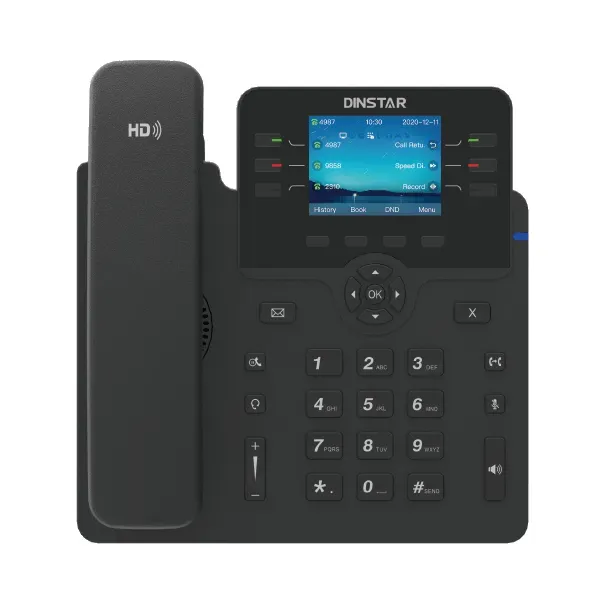
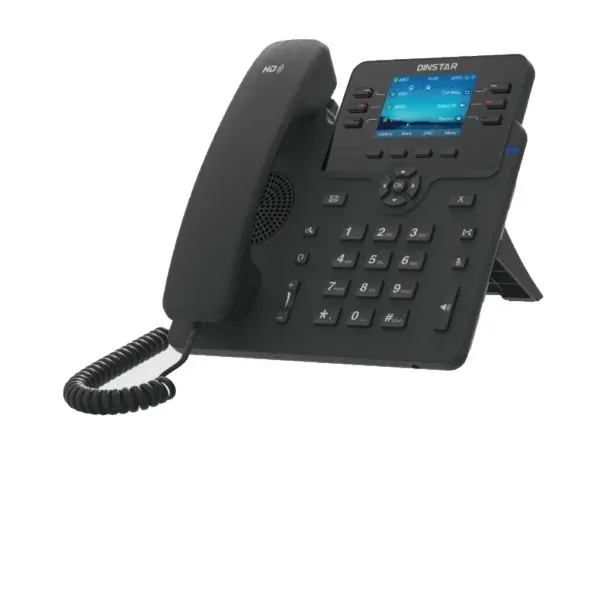
Dinstar C63GP PoE Business IP Phone
The Dinstar C63GP is a color-screen SIP desk phone designed for small and medium businesses, call-handling teams and other organizations that want business calling features in a familiar desktop format. Dinstar specifies a 2.8-inch 240 × 320 graphical LCD with backlight, six SIP accounts, five-way audio conferencing, HD voice, dual 10/100/1000 Mbps Ethernet ports and IEEE 802.3af Power over Ethernet for the C63GP variant. These capabilities make it useful for offices that want to standardize on a network-powered handset while preserving Gigabit desktop connectivity and flexible call handling.
What is the Dinstar C63GP?
The C63GP is the PoE-enabled member of Dinstar’s C63G/C63GP IP phone family. It combines a color display with SIP telephony, programmable calling functions and Gigabit Ethernet in a device intended for everyday business use. Dinstar positions the C63 family for SMEs, call centers and industry users, and lists integration with IP PBX systems as a core use case. The phone supports six SIP registrations, which can be useful when a desk must handle more than one extension, department identity or service profile. Five-way conferencing lets the organizer bring multiple participants into a direct audio conference from the handset, while full-duplex speakerphone operation supports hands-free conversations.
For procurement teams, the model suffix matters. Dinstar documents the C63GP with PoE support, while C63G is the non-PoE counterpart. The C63GP can therefore be powered from a compatible IEEE 802.3af network switch, reducing the need for a separate desk-side power adapter. That does not eliminate power planning: the PoE switch itself still requires adequate capacity and should be considered together with UPS protection where call continuity during short power interruptions is important. The handset is best selected as part of a complete voice design that includes the IP PBX or SIP platform, switch infrastructure, VLAN and QoS policies, internet or WAN quality, extension plan, headset requirements and provisioning method.
Color desktop interface
A 2.8-inch graphical LCD with 240 × 320 resolution and backlight provides a clear interface for call status, menus, contacts and programmable functions.
Six SIP accounts
Multiple SIP registrations support users who need several identities, service profiles or extension roles on one handset, subject to PBX configuration.
PoE and Gigabit Ethernet
The C63GP uses IEEE 802.3af PoE and has two 10/100/1000 Mbps Ethernet ports, supporting practical desk deployments where phone and PC may share one network drop.
HD voice
Dinstar specifies full-duplex speaker and microphone operation, DSP processing and wideband codecs including G.722 and OPUS-WB for supported call paths.
Five-way conferencing
The phone supports five-party audio conferencing, allowing a user to assemble a small multi-party discussion directly from the desk endpoint.
Headset flexibility
Dinstar lists EHS wireless-headset support for compatible Plantronics, Jabra and Sennheiser environments, useful for users who spend long periods on calls.
Verified technical and management capabilities
| Display | 2.8-inch 240 × 320 color graphical LCD with backlight |
| SIP accounts | Up to 6 SIP accounts |
| Conferencing | 5-way audio conference |
| Ethernet | 2 × RJ45 10/100/1000 Mbps Ethernet ports |
| Power | IEEE 802.3af PoE; Dinstar documentation also identifies 5 VDC adapter capability depending on package and deployment |
| Voice | HD voice, full-duplex speakerphone, DSP, G.722 and OPUS-WB plus listed narrowband codecs |
| Security | SIP over TLS, SRTP, 802.1X and OpenVPN are listed in Dinstar documentation |
| Provisioning | FTP, TFTP, HTTP, HTTPS and PnP auto-provisioning methods |
| Administration | Web configuration, device-button configuration, TR-069, SNMP, network capture, firmware upgrade and Dinstar NMS options |
| Directories | Local phonebook capacity and remote phonebook support are provided in the C63 documentation; LDAP is also listed |
Feature interoperability depends on the exact PBX, firmware, SIP provider and configuration. A successful SIP registration does not automatically guarantee every BLF, directory, encryption, transfer or provisioning behavior. For larger deployments, test the required features with the intended PBX before mass rollout.
Deployment, IP PBX integration and buying guidance
A business phone performs only as well as the network and voice platform behind it. Before ordering the C63GP, identify the IP PBX or hosted SIP system, the number of extensions, calling roles, reception requirements, voicemail behavior, transfer workflows, branch connectivity, headset needs and whether users will share the phone’s second Ethernet port with a workstation. The phone’s dual Gigabit ports can simplify desk cabling, but network security policy, VLAN tagging and PC pass-through behavior should be validated before standardizing on that topology.
PoE planning should include both port compatibility and total switch power budget. One PoE-capable port does not guarantee that a switch can power every connected phone, access point and camera at the same time. For sites where communication is operationally important, consider UPS protection for the switch, router, firewall, PBX and internet termination equipment. Keeping only the handset powered is not enough if upstream network components fail.
For multi-phone projects, build a standard configuration template. Document extension numbering, SIP server, VLAN, QoS, DNS, NTP, administrator credentials, firmware policy, directory source and programmable-key conventions. Pilot the configuration with several user profiles before broad deployment. Reception staff and heavy call handlers should be included because they tend to expose transfer, BLF, conference and headset requirements that simple single-line tests may miss. This staged method reduces installation surprises and creates a repeatable support baseline.
Related FourTeck Tanzania products and voice infrastructure
If a user needs a higher-capacity desk phone with more accounts and programmable keys, compare the Dinstar C66G Business IP Phone and the PoE-enabled Dinstar C66GP. These are different endpoint tiers rather than direct equivalents, so select by real user role instead of simply choosing the model with the most features.
Organizations migrating from analog equipment can review the Dinstar DAG1000-1S Analog Telephone Adapter for a single FXS requirement, the DAG1000-1S1O hybrid gateway where one FXS and one FXO interface are needed, and the DAG1000-2O FXO gateway for two analog trunk interfaces. For two analog station ports, see the DAG1000-2S ATA; mixed two-FXS/two-FXO projects can assess the DAG1000-2S2O hybrid gateway. These gateway products serve migration and analog-integration roles around a SIP environment; they do not replace the C63GP desk phone.
For broader purchasing guidance, the FourTeck Tanzania technology shop provides business buying context across phones, IP PBX, networking and supporting infrastructure.
Dinstar C63GP PoE Business IP Phone Tanzania
Tanzanian organizations evaluating the Dinstar C63GP are often doing more than replacing one desk telephone. They may be moving from analog extensions to SIP, standardizing phones across a head office and branches, building a new IP PBX environment, or trying to reduce the number of separate power adapters at desks by using PoE. The C63GP fits these requirements when six SIP accounts, Gigabit pass-through networking, a color display, five-way conferencing and a familiar desk-phone interface are appropriate for the user role. It is particularly relevant for standard business users, supervisors, administrative desks and call-handling staff who need programmable functions but do not require the larger displays or much higher key capacity of premium executive models.
For a Tanzania deployment, start with the network. Confirm that access switches provide IEEE 802.3af-compatible PoE and enough total PoE budget for the quantity of phones plus any access points, cameras or other powered devices sharing the same switches. Review voice VLAN design, QoS, DHCP, DNS, NTP and firewall behavior. If branches rely on a central or cloud PBX, examine WAN reliability and what happens during an internet outage. The C63GP’s dual Gigabit ports can be useful where one wall outlet serves both phone and PC, but this design should be tested with the organization’s VLAN and security policy rather than assumed.
Procurement requests should identify the exact C63GP model, required quantity, site locations, PBX or SIP service, headset requirements, expected programmable functions and whether configuration assistance is needed. Avoid specifying only “Dinstar C63” because power arrangements differ between variants. Also confirm the quoted package contents and accessory requirements. Dinstar’s quick-start material notes that the C63GP is PoE-capable and power-adapter supply can differ from non-PoE variants, so buyers should not assume every box contains the same power accessory.
FourTeck Tanzania can be approached for a product and project quotation that considers the handset alongside switching, IP PBX, cabling, UPS and related voice requirements. A useful RFQ states the number of users, desk locations, current phone system, desired extension plan, branch topology and any legacy analog devices that must remain. This makes it easier to distinguish a simple phone supply request from a broader telephony migration and reduces the risk of ordering endpoints before the supporting network is ready.
Dinstar C63GP PoE Business IP Phone Dar es Salaam
Businesses in Dar es Salaam frequently combine voice, data, Wi-Fi, surveillance and cloud applications on the same office network, which makes handset selection only one part of a dependable IP telephony rollout. The Dinstar C63GP can suit offices that want a PoE-powered SIP phone with six accounts and Gigabit Ethernet, especially where a desk computer may share the phone’s network path. Before deployment, the IT team should map switch ports, available PoE capacity, VLANs and uplinks, then determine whether the phone system is hosted, installed on site or reached through a regional data center. Voice traffic is sensitive to delay, jitter and packet loss, so the local LAN and WAN should be assessed before judging call quality by the phone specification alone.
Dar es Salaam sites can range from compact professional offices to multi-floor corporate premises, retail operations, logistics businesses, hospitality properties and contact-handling teams. User profiles differ across those environments. A finance or general-office user may need only one extension and basic transfer functions, while a reception or customer-service desk may need several SIP identities, speed dials, monitored extensions and a headset. The C63GP’s programmable key capability and EHS headset support can help these roles, subject to compatibility with the selected PBX and headset. A short user-role assessment can prevent overbuying premium handsets for simple desks or under-specifying the phones used by heavy call handlers.
Power design is another practical consideration. PoE can simplify desk installations by placing handset power under centralized switch control. Where the PoE switches, router, firewall and PBX are connected to appropriate UPS capacity, this architecture can also improve continuity during short utility interruptions. However, the design must include the entire voice path. A powered phone cannot complete external calls if the SIP trunk, WAN edge or PBX has lost power. Businesses that consider calling mission critical should therefore document which infrastructure components need backup and how long they must operate.
When requesting a Dar es Salaam quotation, provide building or site count, number of phones, PBX brand and version where known, SIP provider, switch model, desired VLAN arrangement and whether phones will connect PCs through the second Ethernet port. Also state whether installation, extension provisioning, handset labeling, user training and post-deployment documentation are required. This allows the quotation to address the complete deployment instead of treating the C63GP as an isolated device.
Dinstar C63GP PoE Business IP Phone Mwanza
Organizations in Mwanza considering the Dinstar C63GP may be equipping a branch office, hospitality operation, trading business, clinic, school, warehouse, support desk or professional services team. A common goal is to create a consistent extension system that is easier to manage than disconnected analog lines or individual mobile phones. The C63GP can participate in that design as a SIP endpoint with six accounts, five-way conferencing, HD voice and PoE. The key selection question is whether those capabilities match the people using the desk. Standard employees, supervisors and administrative staff can benefit from programmable functions and a color display, while very high-volume reception roles may need a larger key count or expansion capability from a different model.
For branch deployments, connectivity architecture deserves careful attention. If a Mwanza site connects to a centralized PBX in Dar es Salaam, another country or a cloud platform, call quality depends on the branch WAN as well as the local Ethernet network. Measure actual link stability, not only advertised bandwidth. QoS can prioritize real-time voice within the LAN and WAN where supported, but it cannot repair an unstable upstream circuit. Businesses with operationally important voice may need an outage plan such as a secondary internet service, mobile fallback or local survivability method supported by their PBX design.
PoE simplifies local installation when phones are spread across desks because power can be delivered through structured cabling. Check switch port quantity and total power budget before the handsets are ordered. If the same switch also powers wireless access points or IP cameras, calculate the combined requirement with sensible headroom. In buildings where network equipment is exposed to heat, dust or inconsistent power, rack placement, ventilation, grounding and UPS protection can have as much effect on reliability as handset choice.
A Mwanza RFQ should list phone quantity, site layout, existing PBX, internet arrangement, switch model, headset users, required call functions and any analog devices that must remain. If the organization is migrating in phases, identify which analog lines, fax interfaces or legacy handsets still need gateways. FourTeck Tanzania’s related Dinstar gateway pages can help frame those requirements separately from the desk-phone request, avoiding a common mistake where migration interfaces are assumed to be included in an IP phone project.
Dinstar C63GP PoE Business IP Phone Arusha
Arusha businesses may use IP telephony across hotels, tour operations, professional offices, NGOs, education, healthcare, retail and regional administrative functions. These environments often need extensions that can be moved or reconfigured more easily than traditional fixed analog wiring. The Dinstar C63GP provides a SIP-based desk endpoint with PoE, dual Gigabit Ethernet, six SIP accounts and five-way conferencing, allowing it to fit into an IP PBX deployment where desk users require dependable core calling functions and administrators want repeatable provisioning. Its color display and programmable functions support daily usability without moving into a large executive-phone footprint.
Hospitality and service organizations should pay particular attention to call flows rather than choosing handsets by feature count alone. Reception, reservations, accounts, managers, back office and shared operational desks may all need different key assignments. The C63GP can register several SIP identities, but the PBX determines how queues, hunt groups, caller ID, voicemail, transfer and after-hours routing behave. Before deployment, document who should receive incoming calls, where unanswered calls go, which staff monitor other extensions and which users need headsets. This process produces a clearer configuration template and makes training easier.
For the network, consider whether phone and PC traffic will share the handset’s two Gigabit ports. That arrangement can be efficient where only one Ethernet outlet reaches a desk, but voice and data should still be logically separated according to the organization’s security and quality policies. A voice VLAN, appropriate QoS and clean switch configuration can reduce troubleshooting. Because C63GP is the PoE model, confirm IEEE 802.3af availability on the access switches and reserve enough PoE budget for every planned endpoint.
An Arusha quotation is more useful when it includes site count, number of extensions, PBX platform, expected call volume, headset needs and deployment scope. If the site is part of a multi-branch organization, also provide the numbering plan and WAN relationship with other offices. Standardizing extension ranges, firmware, provisioning templates and naming conventions across branches can reduce ongoing support effort. FourTeck can then quote the handset as one component of a documented voice architecture rather than as an isolated purchase.
Dinstar C63GP PoE Business IP Phone Dodoma
Organizations in Dodoma may evaluate the Dinstar C63GP for administrative offices, institutions, service desks, branch operations and businesses that want to move internal calling onto an IP network. The phone’s six SIP accounts are useful where one desk handles several identities or services, while five-way conferencing can support quick internal or supplier discussions without requiring a separate conference platform for every small meeting. The 2.8-inch color screen and programmable key functions make the handset suitable for routine business operation, and the C63GP variant’s PoE capability can simplify power distribution at desk locations.
For government-adjacent, institutional or larger administrative environments, manageability may be more important than individual handset features. Dinstar lists auto-provisioning over FTP, TFTP, HTTP, HTTPS and PnP, plus web administration, TR-069, SNMP and NMS-related management options. These capabilities can help administrators standardize configurations, but the chosen management method should match the organization’s security policy. Provisioning files, administrator credentials and firmware sources should be controlled, and configuration traffic should use secure methods where the surrounding platform supports them.
Network readiness includes PoE budget, switch port count, VLAN separation, DNS and NTP access, firewall policy and WAN quality. If the PBX is hosted outside the site, make sure the internet path is stable enough for the anticipated concurrent calls. If the PBX is on premises, include its own power, backup and network requirements. The handset’s support for SIP over TLS and SRTP can form part of a secure voice design, but encryption only works as intended when the PBX, certificates, time synchronization and firewall rules are configured consistently end to end.
For procurement in Dodoma, specify the exact C63GP model and intended quantity, and ask the supplier to confirm package contents, compatible accessories and deployment services. State whether users need wall mounting, headsets, centralized directories or custom programmable keys. If an existing analog estate is being retained during migration, list those devices separately so the correct gateway interfaces can be planned. A complete requirement produces a more accurate quotation and a smoother handover than simply requesting a unit price for “IP phones.”
Dinstar C63GP PoE Business IP Phone UAE
Companies with operations in both Tanzania and the UAE often want a common phone standard, extension plan and provisioning approach across offices. The Dinstar C63GP can be considered for that type of multi-market endpoint standard when its six SIP accounts, PoE, dual Gigabit Ethernet, color display and programmable features match user needs. Standardization can simplify support because the same firmware policy, key layout, VLAN expectations and troubleshooting steps can be documented for multiple sites. It can also help procurement teams compare like-for-like endpoint requirements while still allowing each location to use the PBX or carrier arrangement appropriate to its operation.
A UAE deployment should still be engineered locally. SIP trunk regulations, provider services, internet topology and enterprise security policies can differ from a Tanzania office. Do not assume that a PBX configuration or carrier feature available in one country will behave identically in another. Instead, define what must be common at the handset layer—extension numbering, display language, directory, call keys, headset behavior, security settings and provisioning—then document the site-specific elements separately. This approach preserves operational consistency without forcing unsuitable infrastructure choices.
PoE is particularly useful in structured office environments because it centralizes phone power at the access switch. For large deployments, calculate total switch power budget and consider UPS runtime for the voice network. If a desk PC connects through the second Gigabit port, confirm VLAN behavior, switch configuration and endpoint security policy. Dinstar’s support for SIP over TLS and SRTP can be included in the security design when the PBX and service provider support compatible encryption.
For UAE requirements, the verified FourTeck UAE site provides a regional technology and telecom starting point. Multi-country customers can share a common bill of materials and user-role matrix while requesting each site’s quantity, PBX information, switch infrastructure and deployment scope separately. That produces clearer comparisons and makes future branch expansion easier to plan.
Dinstar C63GP PoE Business IP Phone Uganda
Ugandan organizations looking for a business SIP handset can evaluate the Dinstar C63GP when they need PoE, six SIP accounts, a color display and Gigabit Ethernet in an everyday desk-phone format. The device can be used with an IP PBX environment for branch calling, reception support, internal extensions and general office communication. As with any SIP endpoint, successful deployment depends on compatibility between the phone firmware, PBX, call features and local network. Buyers should identify required features—BLF, transfer behavior, voicemail indication, directories, conferencing, TLS/SRTP and headset control—then test them against the exact platform rather than relying on generic SIP compatibility alone.
A Uganda rollout may include a main office and multiple remote sites. In that scenario, the value of the C63GP is not just the handset itself but the ability to apply consistent provisioning. Create one base template and controlled site-specific parameters for SIP server, VLAN, NTP, language and directory settings. If extensions register across the internet or a private WAN, review latency, jitter, packet loss and firewall traversal. A stable voice path matters more than raw bandwidth numbers. Where connectivity is variable, the PBX architecture should define what users can still do during a WAN interruption.
PoE planning should account for every powered endpoint on the access switch. Voice phones may share the same switch with wireless access points and CCTV cameras, so total power budget and UPS capacity can become a limiting factor before port count does. Documentation should show which phone connects to which switch port, user, extension and VLAN. That level of organization reduces troubleshooting time and simplifies replacements.
For region-specific support and broader telecom planning, customers can also review the FourTeck Uganda technology site, which covers IP PBX, VoIP and networking themes. A quotation request should state city, quantity, PBX type, current switch model, call-flow requirements, headset users and installation scope. This enables a more complete assessment than requesting the handset price alone.
Dinstar C63GP PoE Business IP Phone Kampala
Kampala businesses often operate dense office networks where IP phones, computers, Wi-Fi access points and cameras share switching infrastructure. The Dinstar C63GP is relevant to these environments because it combines PoE and two Gigabit Ethernet ports with six SIP accounts and business call functions. A phone can sit at the desk and, where policy permits, pass network connectivity to a workstation. The architecture saves cabling but requires careful VLAN design so voice and data remain manageable. Switch QoS can prioritize voice frames within the local network, while PBX and WAN configuration determine the quality of calls beyond the office.
Kampala deployments should classify users before purchasing. General staff may need a simple extension, transfer and voicemail access. Customer-service or administrative users may use several SIP identities and programmable keys. Managers may value conferencing and headset support. Receptionists with very high monitored-extension counts may be better served by a model with more programmable keys. Matching endpoints to roles can reduce project cost while giving heavy users the features they actually need.
The C63GP supports centralized provisioning methods, which is useful for organizations installing many devices. Rather than manually programming each phone, administrators can create controlled templates for SIP credentials, server addresses, time settings, key layouts and firmware. Secure provisioning and credential handling should be part of the design, particularly if phones are deployed across multiple sites or the configuration service is reachable over routed networks.
When sourcing the Dinstar C63GP for Kampala, specify quantity, exact model suffix, PBX platform, SIP trunk or hosted service, switch model and whether PoE is already available. Include the number of headset users and whether PCs will connect through the phone. If the project also includes analog lines or legacy devices, describe them separately so the correct gateway interfaces can be selected. Customers planning multiple Ugandan branches can use the FourTeck Uganda site for regional IP PBX and VoIP context while maintaining the same handset standard across locations where appropriate.
Dinstar C63GP PoE Business IP Phone Arua
Arua organizations planning IP telephony may place greater emphasis on branch connectivity, manageable deployment and resilience than on advanced executive-phone features. The Dinstar C63GP offers a practical business feature set with six SIP accounts, five-way conferencing, HD voice, PoE and Gigabit Ethernet. It can suit branch administrators, office teams, service counters and supervisors who need a full SIP desk phone without the larger footprint of higher-end models. The phone’s capabilities should be mapped to the PBX functions actually used at the site so that provisioning remains simple and supportable.
For an Arua branch connected to a centralized PBX, the WAN is part of the phone system. Test the real connection for stability during business hours, and consider how voice competes with backups, cloud applications, video and other traffic. QoS can help manage congestion where the network supports it, but redundancy may be needed if losing the primary internet circuit would stop important calls. Some organizations may prefer a local PBX or survivability arrangement; others may accept a fully hosted model with mobile fallback. The correct design depends on business impact rather than a single technology preference.
PoE can simplify phone power and reduce dependence on individual adapters, but the access switch and upstream network equipment should be protected as a system. Verify PoE budget and UPS runtime, especially if the same switch powers Wi-Fi or cameras. Label switch ports and phones so a remote support team can identify the affected endpoint quickly. Centralized provisioning also becomes more valuable in a location where technician visits may be less frequent, provided configuration services are secured and documented.
An Arua quotation request should include the number of phones, user roles, branch connectivity, PBX location, switch model and any local analog lines that need integration. If the branch is part of a wider Ugandan network, standardize extension naming, firmware, directory format and security settings where practical. Regional planning resources are available through the FourTeck Uganda site, while the C63GP bill of materials should remain specific to the actual Arua site conditions.
Dinstar C63GP PoE Business IP Phone Mbarara
Businesses in Mbarara can use the Dinstar C63GP as part of an IP PBX rollout where business users need multiple SIP registrations, programmable functions, a color display and PoE. The handset can support common office workflows such as hold, transfer, call forwarding, voicemail indication and conferencing when the connected PBX provides the corresponding services. The practical value is strongest when those functions are configured around user roles. A sales desk, operations coordinator and general administrator may all use the same hardware but require different line keys, call permissions and directory access.
Network design is especially important when a site has limited structured cabling. The C63GP’s second Gigabit Ethernet port can allow a PC to connect behind the phone, reducing the need for a separate network outlet at each desk. Before adopting this design, verify VLAN tagging, switch configuration, throughput expectations and endpoint security. Voice traffic should be protected from avoidable congestion, and the branch router or firewall should be configured to support the chosen SIP architecture without exposing management interfaces unnecessarily.
For PoE, calculate the total demand of all connected devices and leave room for growth. If a switch is already close to its power limit because it supplies access points or cameras, adding phones may require a switch upgrade even when free Ethernet ports remain. UPS-backed PoE can improve continuity, but the PBX, firewall and internet device must also remain available. Include those dependencies in the branch resilience plan.
Mbarara procurement teams should request the C63GP by exact model, quantity and intended site. Provide PBX details, required SIP accounts per user, headset count, extension plan and whether installation or remote provisioning is needed. If existing analog equipment will remain, list the number and type of analog interfaces separately so an appropriate ATA or gateway can be chosen. Customers working across Uganda can also coordinate broader VoIP requirements through the FourTeck Uganda site while keeping the phone configuration aligned with organization-wide standards.
Dinstar C63GP PoE Business IP Phone Gulu
Gulu offices and branch operations evaluating SIP telephony can consider the Dinstar C63GP where a conventional business desk phone is preferred over a softphone-only approach. The handset provides tactile call controls, a color display, six SIP accounts, five-way conferencing, PoE and dual Gigabit Ethernet. These attributes are useful for staff who spend much of the day at a fixed workstation and need reliable access to call transfer, hold, conferencing and directory functions without keeping a PC application in the foreground.
Branch communications should be planned around failure scenarios as well as normal operation. If the Gulu site registers phones to a remote PBX, document what happens when internet connectivity is lost. Can internal extensions still call each other? Is there a secondary link? Are mobile numbers available for critical contacts? Does the PBX support any local survivability mechanism? These are system-level questions rather than C63GP features, but they determine whether the finished phone service meets business expectations. The phone itself supports standard SIP and secure signaling/media options, yet resilience comes from the architecture around it.
For administration, centralized provisioning can reduce manual work and configuration drift. Use consistent naming and record each handset’s extension, user, location, switch port and firmware version. If staff move desks, update that record rather than allowing extensions to become detached from documentation. Headset users should be included in pilot testing because EHS behavior depends on the specific headset and configuration.
A Gulu RFQ should state how many handsets are needed now and expected later, which users require more than one SIP identity, whether PoE switching is already installed and how the branch connects to the PBX. Include any need for installation, configuration, testing and handover documentation. The FourTeck Uganda site can provide a regional starting point for IP PBX and network discussions where the Gulu branch is part of a larger Ugandan rollout.
Dinstar C63GP PoE Business IP Phone Kenya
Kenyan organizations standardizing business voice endpoints can evaluate the Dinstar C63GP as a mid-range desk phone for general office, supervisory and customer-facing roles. Six SIP accounts give one handset flexibility across several identities, while PoE and dual Gigabit Ethernet support modern structured office networks. Five-way conferencing and HD voice add practical collaboration features without requiring an executive-class device. For a multi-country company, using the same handset in Kenya and Tanzania can simplify training, spares and provisioning when the same PBX functions are required.
Cross-border standardization should focus on endpoint configuration rather than assuming identical telecom services. Kenyan SIP trunks, hosted voice platforms and network providers may differ from those used elsewhere. Define a common handset baseline—firmware, display settings, directory format, programmable-key conventions, security settings and admin policy—then use site-specific profiles for SIP server, number plan, VLAN and carrier details. This separation helps IT teams support a consistent user experience without creating unnecessary dependencies between countries.
For office networks, confirm PoE availability and total budget before choosing the quantity. If PCs share the phone’s second Ethernet port, make sure the design preserves required performance and segmentation. QoS should be applied where congestion can occur, and voice traffic should be monitored during peak periods. Secure provisioning and restricted web administration are important in larger rollouts so handset configuration cannot be changed casually by users.
Customers sourcing for Kenya can review the verified FourTeck Kenya site, which covers IP PBX, VoIP business phones and enterprise networking. A useful quotation request includes quantity, city, PBX platform, SIP provider, switch model, headset count and desired deployment services. If the same project covers Tanzania, ask for the bill of materials to distinguish common handset items from country-specific telecom and installation requirements.
Dinstar C63GP PoE Business IP Phone Kuwait
Businesses in Kuwait evaluating a new SIP phone estate may consider the Dinstar C63GP when they need PoE, six SIP accounts and dual Gigabit Ethernet in a compact color-screen handset. The phone can serve standard business users, administrative teams and moderate call-handling roles. A company with sites across the Gulf and East Africa may also use the same hardware family to simplify user training and endpoint support, provided each country’s PBX and carrier configuration is validated separately.
In a centrally managed deployment, the C63GP’s provisioning capabilities are particularly useful. Administrators can define SIP server settings, extension credentials, firmware policies, directories and programmable keys in templates rather than configuring every phone by hand. Management systems should be protected with strong credentials and network access controls. If HTTPS provisioning, SIP over TLS or SRTP are required, certificate handling and time synchronization should be planned as part of the complete voice security architecture.
PoE allows the handset to receive power over Ethernet from a compatible access switch. For new office projects, this can reduce adapter clutter and centralize power under the network rack. Confirm total PoE budget, UPS runtime and switch redundancy according to the business importance of calling. The phone’s dual Gigabit ports can support a workstation behind the handset, but the design should be tested with voice VLAN and security policies before deployment at scale.
A Kuwait quotation should specify the exact C63GP model, quantities by user role, PBX platform, SIP trunk or hosted service, headset requirements and whether the organization wants pre-provisioning, installation or post-deployment support. For multi-country procurement, maintain a master handset specification but let each site define its own carrier and network assumptions. This keeps purchasing consistent without hiding local dependencies that can affect rollout success.
Dinstar C63GP PoE Business IP Phone Ghana
Ghanaian businesses moving toward SIP-based office communication can consider the Dinstar C63GP for users who need more than a basic single-line phone but do not require a large executive endpoint. The combination of six SIP accounts, PoE, dual Gigabit Ethernet, HD voice and five-way conferencing makes the phone adaptable across general office, supervisory and customer-facing roles. The programmable functions can reduce dependence on memorized feature codes by placing commonly used actions such as transfer or speed dial within easier reach, subject to the PBX’s supported capabilities.
For organizations with multiple Ghana locations, standardization can simplify support. Use a repeatable provisioning template and record which settings are global versus site-specific. Global settings may include firmware policy, admin access, language, key conventions and directory format. Site-specific settings can include SIP proxy addresses, VLAN IDs, time parameters and extension ranges. A controlled template also reduces the chance of inconsistent configurations appearing as more phones are added over time.
Network and power planning should be completed before procurement. Verify that existing switches have Gigabit ports and enough IEEE 802.3af PoE capacity, especially if access points or cameras share the same switches. Consider UPS protection and the dependency on the router, firewall, PBX and internet connection. If the phone is used as a pass-through for a workstation, confirm data VLAN behavior and verify that moving the PC behind the phone does not violate endpoint-security standards.
The FourTeck Ghana site provides a regional FourTeck contact point for broader technology requirements. When requesting the C63GP, include quantity, city, user profiles, PBX information, current switching, headset requirements and deployment scope. For companies also operating in Tanzania, the same endpoint model can form part of a common communications standard while country-specific SIP and network details remain separately documented.
Dinstar C63GP PoE Business IP Phone Nigeria
Nigerian organizations with distributed offices, service teams or growing internal extension requirements can evaluate the Dinstar C63GP as a SIP desk endpoint with six accounts, PoE and Gigabit Ethernet. A multi-account phone can be useful where staff handle departmental identities, branch lines or separate service registrations. Five-way conferencing supports small multi-party calls directly from the desk, while HD voice and full-duplex speakerphone functions can improve everyday usability when the connected network and codec path support the same capabilities.
For large or distributed deployments, the phone should be treated as a managed endpoint. Define firmware control, administrator credentials, provisioning, directories and key layout centrally. Record each phone against its user, extension and location. This becomes particularly important when branches have different local IT staff, because consistent documentation prevents configuration drift. Test the template on a few representative users before deploying dozens or hundreds of phones.
Power and connectivity resilience may be major design considerations. PoE reduces the number of local adapters and can allow UPS-backed switches to keep phones powered, but the PBX, WAN edge and carrier path must also remain available. If a branch depends on a single internet circuit for hosted voice, the business should decide whether a secondary link or mobile fallback is warranted. QoS should protect voice when local bandwidth is congested, and monitoring should be used to identify jitter or loss rather than assuming every call issue originates at the handset.
For Nigerian procurement and wider IT requirements, customers can reference the verified FourTeck Nigeria site. A C63GP RFQ should provide quantity, office locations, PBX or hosted voice platform, SIP provider, switch details, required user features and deployment services. Multi-country organizations can keep a common handset standard across Nigeria and Tanzania while preserving country-specific telecom, numbering and support arrangements.
Dinstar C63GP PoE Business IP Phone Seychelles
Organizations in Seychelles may need business telephony for hospitality, professional services, government-related functions, retail, administration and multi-site operations. The Dinstar C63GP can serve as a wired SIP desk phone where reliable fixed calling is preferred for reception, back-office and operational desks. Six SIP accounts provide flexibility for multiple identities, while PoE and dual Gigabit Ethernet simplify structured desk connectivity. Five-way conferencing is suitable for quick internal coordination or supplier discussions without requiring a separate meeting-room system for every call.
Island and multi-property deployments should pay close attention to network architecture and supportability. If phones register to a centralized or cloud PBX, document the internet dependencies of each site and the expected behavior during an outage. If several properties share one numbering plan, use standardized extension ranges and device naming. Centralized provisioning can help administrators maintain consistent firmware, SIP settings and keys even when the phones are distributed across different physical locations.
PoE can be helpful in hospitality and office environments because phone power is controlled from the switch room rather than from many individual adapters. The design should include total power budget, UPS runtime and any other PoE devices on the switch. If the phone’s second Ethernet port is used for a workstation, check whether voice and data segmentation is appropriate for the site. Secure management, SIP over TLS and SRTP can be considered when supported by the PBX and network, but certificates and policies must be configured consistently.
For procurement, provide exact quantities by site, PBX platform, user roles, switch infrastructure and whether pre-configuration or on-site assistance is required. Hospitality projects should also identify reception, reservations, administration and back-office profiles because those desks may need different key assignments. Companies with a broader regional footprint can use a common C63GP endpoint standard while documenting Seychelles-specific internet, numbering and operational requirements separately.
Frequently asked questions about the Dinstar C63GP
Does the Dinstar C63GP support PoE?
Yes. Dinstar specifies the C63GP as the PoE-enabled C63 variant and lists IEEE 802.3af. Confirm that the access switch has compatible PoE and enough total power budget for the planned number of phones and other powered devices.
How many SIP accounts does the C63GP support?
Dinstar’s current C63 product material lists six SIP accounts. How those accounts are used depends on the PBX and the organization’s extension design.
Can I connect a PC through the phone?
The C63GP has two Gigabit Ethernet ports, which can support a phone-and-PC desk topology. Confirm VLAN, security and switch configuration before using this design throughout an office.
Does it support secure SIP?
Dinstar documentation lists SIP over TLS and SRTP. Effective encryption depends on compatible PBX settings, certificates, time synchronization and network policy.
Can the C63GP be centrally provisioned?
Yes. Dinstar lists auto-provisioning via FTP, TFTP, HTTP, HTTPS and PnP, along with web administration, TR-069, SNMP and NMS-related management capabilities. Choose methods that match your security policy.
What information should I send for a quotation?
Provide quantity, delivery or deployment city, PBX platform, SIP provider, switch model, PoE availability, user roles, headset quantity, required call features, and whether you need configuration, installation or migration support.
Quotation checklist
For a faster and more useful C63GP quotation, include the following information in your request:
✓ Quantity and user roles
✓ Exact city and number of sites
✓ Existing or planned IP PBX
✓ SIP trunk or hosted voice provider
✓ PoE switch make/model and available ports
✓ Headset requirements
✓ Desired key functions or monitored extensions
✓ PC pass-through requirement
✓ Analog devices or lines that must remain
✓ Need for provisioning, installation, testing or documentation
Decision recap
Choose the Dinstar C63GP when a user needs a PoE-powered business SIP phone with six SIP accounts, a 2.8-inch color display, dual Gigabit Ethernet, five-way conferencing, programmable functions and HD voice. Confirm the PBX feature set, headset compatibility, provisioning method and complete network design before standardizing it across many desks.
If the requirement is for many more SIP accounts or programmable keys, compare a higher-tier model such as the C66 series. If analog phones or PSTN interfaces must remain, plan the appropriate Dinstar gateway separately rather than expecting the IP phone to provide those interfaces.
Consult FourTeck for a complete voice deployment
A C63GP project can include the phones, IP PBX, PoE switching, voice VLANs, structured cabling, UPS planning, analog gateways, headsets, provisioning and user rollout. FourTeck’s Tanzania site can help frame the local requirement, while the wider regional network supports customers with operations in more than one market. Relevant regional resources include FourTeck Kenya, FourTeck Uganda, FourTeck UAE, FourTeck Ghana and FourTeck Nigeria.
Use the Tanzania contact page for a quotation with your quantity, deployment location and voice-system details. Availability, pricing, warranty terms, delivery schedule and project scope should be confirmed in the specific quotation rather than assumed from general product information.



Reviews
There are no reviews yet.