
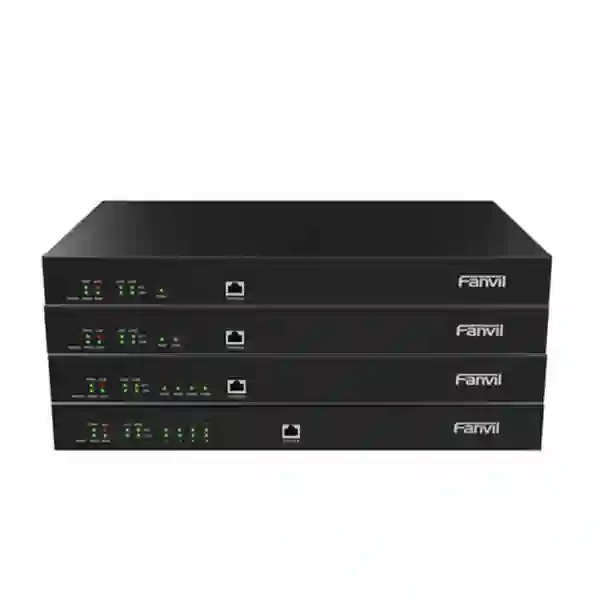
Fanvil GA200 Series Digital VoIP Gateway Tanzania
The Fanvil GA200 Series is a 1U rack-mounted digital VoIP gateway family designed to interconnect traditional PSTN or enterprise switch infrastructure with modern IP networks and IP PBX platforms. For Tanzanian organisations modernising E1/T1 voice trunks, building high-capacity contact centres, consolidating branch telephony or extending the useful life of existing carrier and PBX investments, the GA200 family provides a practical bridge between digital telephony and SIP-based communications.
Models: GA200-1E, GA200-2E, GA200-4E, GA200-8E
Digital ports: 1, 2, 4 or 8 E1/T1
Interface: RJ48
Form factor: 1U rack mount
E1/T1 Migration
Bridge established digital trunks into an IP PBX or SIP voice architecture without treating the migration as an all-at-once replacement project.
Contact Centre Capacity
Choose from one to eight E1/T1 interfaces so the gateway can be aligned to channel demand, inbound queues, outbound calling and growth plans.
Enterprise Management
SNMPv1/v2/v3 and TR-069 support help administrators integrate gateway monitoring and lifecycle operations into established IT practices.
Resilient Power Design
Fanvil lists power redundancy across the GA200 family, useful when the voice gateway is part of business-critical calling infrastructure.
What the Fanvil GA200 Series solves
Many businesses still depend on E1/T1 carrier circuits, legacy PBX interfaces, digital trunks or established call-routing systems while newer applications, contact-centre platforms and branch communications increasingly use SIP. Replacing every legacy component at once can create cost, downtime and operational risk. A digital VoIP gateway provides a controlled migration point: one side connects to the digital telephony environment and the other side connects into the IP voice network. The GA200 Series is positioned by Fanvil for this interconnection role, helping organisations link PSTN services, enterprise switches and IP PBX platforms in a single appliance family.
For procurement teams, the main decision is not simply whether a digital gateway is required, but how many E1/T1 spans must be supported today, how much capacity is expected during busy periods, which signalling is used, what IP PBX or softswitch sits on the SIP side, and how the gateway will be monitored. Choosing the correct GA200 model therefore starts with the telephony design rather than a generic device count. A single-span branch or migration test may suit GA200-1E, while higher-capacity call-centre, head-office or carrier-interconnect scenarios may require GA200-4E or GA200-8E.
Verified Fanvil GA200 Series specifications
| Specification | GA200-1E | GA200-2E | GA200-4E | GA200-8E |
|---|---|---|---|---|
| E1/T1 | 1 | 2 | 4 | 8 |
| Digital interface | RJ48 | |||
| Service network | 10/100/1000 Mbps | |||
| Management network | 10/100/1000 Mbps | |||
| Signalling | ISDN PRI and SS7 listed by Fanvil | |||
| Codecs | G.711A, G.711U, G.723, G.729, G.722, iLBC, AMR, SILK, Opus | |||
| Fax | T.30, T.38 | |||
| Management | SNMPv1/v2/v3, TR-069 | |||
| Power | <9W | <10W | <12W | <20W |
| Power supply | 100-240VAC; power redundancy listed across the family | |||
| Rack mount | Yes, 1U | |||
Specifications above are based on Fanvil’s published GA200 Series product information. Final project design should confirm software version, carrier requirements, signalling, channel count and IP PBX interoperability before purchase.
How to choose the right GA200 model
Start with the number of live E1/T1 spans and the peak simultaneous-call requirement rather than choosing the largest unit by default. Document every incoming and outgoing digital circuit, its signalling method, the current PBX or carrier handoff, and whether PSTN-to-PSTN routing is needed. Then map the SIP side: IP PBX, softswitch, contact-centre platform, branch voice core or hosted telephony service. The GA200-1E can be suitable where a project needs one E1/T1 interface; GA200-2E adds a second span; GA200-4E supports four; and GA200-8E supports eight. A sensible design also includes spare capacity where growth, failover or migration overlap is expected.
Capacity is only one part of the decision. Confirm codec policy, fax requirements, IP addressing, VLAN design, firewall rules, NTP, monitoring, management access, SIP security policy and operational ownership. Voice gateways often sit at a critical boundary between carrier telephony and the corporate network, so they should be placed in a controlled rack environment with labelled cabling, UPS-backed power, documented configuration and restricted administrative access. If the project is part of a wider telephony refresh, Fourteck Tanzania can also help buyers define IP PBX, IP phone, switching and firewall dependencies through its Tanzania IT and telecom solutions overview.
Fanvil GA200 Series Tanzania
For organisations in Tanzania, the Fanvil GA200 Series addresses a common transition problem: business telephony may still depend on E1/T1 circuits, digital PBX trunks or carrier-side interfaces while new applications increasingly run on SIP. A gateway allows a company to modernise the IP side without immediately discarding established digital connectivity. That can be useful for corporate headquarters, banks, insurers, hospitality groups, government-related organisations, education networks, healthcare providers, utilities, logistics companies and contact centres that need a controlled migration plan rather than a disruptive replacement.
A Tanzanian buyer should begin by documenting the present telephony environment. Record the number of E1/T1 spans, whether they terminate directly from the operator or through another PBX, what signalling is used, how many channels are active, peak concurrent calls, inbound DID requirements, outbound routing rules and fax dependency. On the IP side, identify the PBX or softswitch, SIP trunk design, codec policy, network segmentation and firewall path. These details determine whether GA200-1E, GA200-2E, GA200-4E or GA200-8E is the right fit. They also reduce the risk of ordering excess capacity or missing an essential interface.
Power and network resilience deserve equal attention. The GA200 Series uses a 1U rack format and Fanvil lists redundant power support, so it belongs in a properly managed communications rack with reliable UPS protection, controlled cooling and clear cable labelling. Separate service and management network interfaces can be useful when administrators want operational traffic and device management handled through different network paths. SNMP and TR-069 support also give IT teams options for ongoing monitoring and management.
For procurement, request a quotation that identifies the exact GA200 model, quantity, required accessories, deployment scope and testing responsibilities. Avoid treating “GA200” as a single specification because the family spans one to eight E1/T1 interfaces. For Tanzania projects that include wider network, firewall, IP PBX or endpoint requirements, use Fourteck’s Tanzania platform to align the gateway with the rest of the communications stack rather than buying it in isolation.
Fanvil GA200 Series Digital VoIP Gateway Dar es Salaam
Dar es Salaam organisations often operate their most communication-intensive functions from head offices, service centres, hotel properties, financial offices, logistics hubs, hospitals, educational institutions and customer-facing operations. In these environments, telephony migration can involve both older digital trunks and newer SIP systems. The Fanvil GA200 Series can serve as the handoff point when a business needs to retain E1/T1 connectivity while integrating an IP PBX, consolidating branch calling or moving contact-centre functions onto an IP architecture.
For a Dar es Salaam head-office project, capacity planning should consider more than ordinary extension count. A contact centre may have fewer desk phones than total peak calls because of trunks, queues, IVR paths, recordings, outbound campaigns and inter-branch traffic. A hotel may have many room extensions but a different external concurrency profile. A logistics or trading company may rely heavily on inbound reception and outbound customer coordination. The correct GA200 variant should therefore be selected from measured trunk utilisation and growth plans. One E1/T1 interface may be sufficient for a smaller migration, while four or eight spans may be justified where multiple digital circuits converge.
Installation should be treated as a voice-core project. Place the gateway in a protected rack, use stable UPS power, document every RJ48 circuit, isolate administrative access and define the management subnet. The dual Gigabit service and management network interfaces listed by Fanvil can support clean operational design when network teams want to separate voice service traffic from administration. Test inbound calling, outbound routes, caller identification, DTMF, codec negotiation, fax if used, failover behaviour and busy-hour load before the migration is accepted.
Dar es Salaam buyers can also combine the gateway quotation with IP PBX, IP phones, switches, firewall policy and structured cabling requirements. Fourteck Tanzania’s contact process specifically asks telephony customers to provide extension counts, reception needs, queues, existing telephone lines and branch requirements. Supplying those details together with the E1/T1 inventory creates a clearer quotation and a more reliable migration plan.
Fanvil GA200 Series Digital VoIP Gateway Mwanza
Businesses in Mwanza may need digital voice integration for regional offices, hospitality properties, healthcare, education, distribution, financial services and multi-site operations connected back to a larger headquarters. The GA200 Series is relevant where local or central telephony still uses E1/T1 interfaces but the organisation wants SIP-based call control, unified extension numbering or more flexible routing between Mwanza and other business locations.
A branch-oriented design should first establish where the gateway belongs. In some networks, E1/T1 circuits terminate in Mwanza and the local GA200 converts them to SIP for a local PBX. In others, a gateway at the main communications hub may serve several branches over private WAN or VPN links. These designs have different dependency and resilience requirements. If the Mwanza site must continue making local calls when the WAN is unavailable, local survivability and routing become important design questions. If all call control is centralised, WAN quality, latency, packet loss and QoS deserve greater attention.
The GA200 family provides four capacity choices, allowing procurement to match the gateway to actual span count. Do not size only from employee numbers. Review daily and peak call concurrency, any seasonal traffic, customer-service queues, business-hours routing and planned expansion. Confirm whether ISDN PRI or SS7 applies, since Fanvil lists both protocols for the GA200 family. Fax-dependent departments should also validate the intended T.30 or T.38 workflow as part of acceptance testing rather than assuming all fax traffic will behave identically after an IP migration.
For operational reliability, use a controlled rack, clean power and a documented support process. Management through SNMP can be useful for monitoring availability and alarm conditions alongside routers, switches and other network infrastructure. Procurement teams in Mwanza should include the exact GA200 model, quantity, E1/T1 count, PBX platform, carrier interface, deployment location and desired support scope in the request for quotation.
Fanvil GA200 Series Digital VoIP Gateway Arusha
Arusha has a broad mix of hospitality, tourism, international organisations, education, professional services and regional business operations, many of which depend on dependable voice communication across reception, reservations, customer support, administration and branch teams. Where an existing digital trunk or PBX must connect to a newer SIP environment, the Fanvil GA200 Series provides a dedicated digital-to-IP gateway layer that can reduce the pressure for an immediate end-to-end replacement.
Hospitality and service environments should pay particular attention to call routing and business continuity. A hotel or travel operation may have critical public numbers, after-hours routing, reception groups and reservation lines that cannot simply disappear during a migration. Before moving traffic through a GA200, create a call-flow map that records each inbound number, destination, overflow path, outbound route and emergency fallback. Test DTMF behaviour for IVR systems and confirm codec choices across the complete path. If fax is still used for supplier, government or administrative workflows, include T.30/T.38 validation in the migration plan.
Model selection should follow the digital-trunk inventory. GA200-1E handles one E1/T1, GA200-2E two, GA200-4E four and GA200-8E eight. Organisations with one live circuit but a planned second carrier or migration overlap may choose to allow headroom, while a stable single-span environment may not need a larger chassis. Because all models are 1U rack mountable, the physical footprint remains suitable for managed communications rooms; the more important differences are port capacity and associated power consumption.
Arusha procurement teams should also evaluate the surrounding IP network. Voice quality depends on routing, switching, QoS, firewall policy and stable connectivity, not just the gateway. If the project includes branch telephony or a centralised PBX, document WAN design and backup connectivity before cutover. Fourteck Tanzania can use these inputs to prepare a more relevant product and project discussion.
Fanvil GA200 Series Digital VoIP Gateway Dodoma
Dodoma organisations considering the Fanvil GA200 Series may include administrative offices, public-sector environments, education, healthcare, finance, service providers and companies expanding their national branch networks. Digital voice gateways are most useful when the current telephony estate and the target IP architecture need to coexist. Instead of forcing a complete replacement of digital trunks, PBX interfaces and calling workflows, the GA200 can create a bridge while the organisation changes call control, endpoints or network infrastructure in stages.
For formal procurement, prepare a technical schedule before requesting price. State the required model or provide the number of E1/T1 spans so the supplier can recommend one. Add the carrier and signalling information, IP PBX platform, expected SIP connection method, channel requirement, rack location, power arrangement, network addressing, management protocol needs and acceptance criteria. This makes vendor comparisons more meaningful because each quotation is based on the same operational requirement rather than just a product family name.
Security and administration should be part of the design. The gateway’s management plane should not be exposed broadly to user networks. Use an appropriate management VLAN or restricted subnet, control administrator access, maintain configuration backups and document firmware procedures. SNMPv1/v2/v3 and TR-069 are listed by Fanvil, but the organisation should choose the management method that aligns with its policies. Where SNMPv3 is supported and practical, it can form part of a more secure monitoring approach than older community-string methods.
A Dodoma deployment should also define what happens if the IP PBX, WAN, carrier circuit or power source fails. Redundant power capability on the GA200 family is valuable only when the upstream power design, UPS and connected network devices are also resilient. By treating the gateway as one element of the voice chain, organisations can build a more dependable service and avoid troubleshooting problems that actually originate elsewhere in the network.
Fanvil GA200 Series Digital VoIP Gateway UAE
UAE businesses with legacy PRI, digital PBX infrastructure, contact centres or regional headquarters can use the Fanvil GA200 family as a transition point between established E1/T1 services and SIP-based communications. The decision is especially relevant for organisations modernising multi-site voice systems, migrating to an IP PBX, consolidating telecom platforms after mergers or keeping selected carrier services while introducing new SIP applications.
A UAE head office often supports branches, service desks and international calling, so busy-hour capacity and resilience may be more important than simple extension count. Gather traffic reports from the existing PBX or carrier if available, identify each E1/T1 span and confirm whether all circuits need to be carried forward. The GA200-8E can aggregate up to eight E1/T1 interfaces, but a smaller model may be more appropriate where only one, two or four spans remain after migration. Right-sizing reduces unnecessary hardware while still allowing sensible growth margin.
Integration planning should cover SIP routing, codecs, DTMF, fax, caller ID, dial plan, number normalisation and failover. Where a regional call centre uses IVR or outbound campaign tools, test high-volume conditions and application-specific behaviour before production cutover. Network architects should keep voice service and management traffic organised through appropriate VLANs and firewall controls. Because Fanvil provides separate Gigabit service and management interfaces, the physical design can support a clean separation strategy.
For organisations coordinating UAE and East Africa infrastructure, Fourteck’s global technology platform offers a wider route for cross-regional IT and telecom planning. The important purchasing step remains the same: confirm exact span count, signalling and PBX compatibility before ordering any GA200 model.
Fanvil GA200 Series Digital VoIP Gateway Uganda
Uganda businesses and organisations can use the Fanvil GA200 Series where digital E1/T1 telephony needs to interoperate with an IP PBX, SIP trunking platform, softswitch or regional voice network. This can apply to financial institutions, hotels, universities, healthcare providers, NGOs, customer-service centres and distributed companies that are modernising communications while keeping selected existing circuits in service.
The right architecture depends on whether the gateway is serving one location or acting as part of a multi-branch voice core. For a single Kampala office, the GA200 may sit between the carrier’s digital handoff and the local IP PBX. For a distributed organisation, the gateway may be installed at a central site and branches reach the PBX across secure WAN connectivity. In the second design, internet or private-WAN stability, QoS and failover become critical because branch voice traffic depends on the link to the core.
Procurement should compare the GA200-1E, 2E, 4E and 8E against actual digital-trunk capacity. Each model uses RJ48 for E1/T1 and offers Gigabit service and management networking. Fanvil also lists ISDN PRI and SS7, T.30/T.38 fax, SNMP and TR-069 across the family. Those specifications should be checked against the live carrier service and PBX configuration before implementation. If the current environment has undocumented routes or ageing PBX programming, discovery work may take longer than physical gateway installation.
Organisations working across Tanzania and Uganda can also use Fourteck Uganda as a regional reference point for broader PBX, VoIP and network requirements. The objective is to keep the gateway selection aligned with the entire communications stack, including power, switching, firewall and support procedures.
Fanvil GA200 Series Digital VoIP Gateway Kampala
Kampala is likely to be the primary voice hub for many Uganda organisations, making digital gateway design particularly important for head offices, service desks, financial operations, hospitality groups, large campuses and contact centres. The Fanvil GA200 Series can help a Kampala site retain E1/T1 connectivity while moving call control toward SIP, enabling a phased transformation instead of a single high-risk cutover.
A contact-centre project should review inbound and outbound channel utilisation separately. Inbound queues may generate intense peaks around campaign, billing or support events, while outbound sales or reminder calls can create a different traffic pattern. If the existing PBX shows frequent trunk saturation, replacing the interface without changing capacity will reproduce the same problem. A better plan is to measure peak use, decide what concurrency is needed after migration, and then choose the number of E1/T1 spans. GA200-4E and GA200-8E are relevant where several digital trunks converge, while smaller sites may use GA200-1E or GA200-2E.
The migration plan should include test calls through every important route: mobile networks, fixed destinations, toll-free or service numbers where applicable, branch extensions and any external call centre carrier paths. Validate caller-ID presentation, call transfer, DTMF, IVR navigation, audio quality and disconnect supervision. Where recording or compliance systems sit behind the IP PBX, include them in end-to-end testing rather than validating only basic dial tone.
For long-term operations, document the gateway’s IP addresses, admin access, monitoring configuration, E1/T1 port mapping and backup procedure. A clean handover makes fault isolation easier when the issue could be on the carrier, gateway, PBX, network or endpoint side. Kampala teams should treat this documentation as part of the deployment deliverable, not an optional afterthought.
Fanvil GA200 Series Digital VoIP Gateway Arua
Arua-based branches, institutions and service organisations may need to connect local voice services to a central IP PBX or standardise communications with offices elsewhere in Uganda. The Fanvil GA200 Series can support that objective when the local or central telephony environment includes E1/T1 digital circuits. The key question is whether conversion should happen at the branch or at a central hub, since each approach changes the network and resilience requirements.
If the E1/T1 service terminates in Arua, installing the gateway locally keeps the digital carrier handoff close to the branch. SIP traffic can then pass to a local or remote PBX. If the PBX is remote, assess WAN latency, jitter, packet loss and available bandwidth, and design QoS so voice is not degraded by backups, cloud traffic or file transfers. If the branch must maintain calling during WAN failure, discuss survivability and alternate routing before deciding on a fully centralised architecture.
A smaller branch may need only one or two E1/T1 interfaces, making GA200-1E or GA200-2E practical candidates. However, model choice should still be based on the real digital-trunk map and expected growth. Confirm the signalling in use and test compatibility with the carrier and PBX. The gateway supports a broad codec set, but the project should define which codecs are preferred and avoid unnecessary transcoding when the end-to-end path can use a consistent format.
For maintenance, use a documented remote-management process and ensure the communications rack has appropriate power protection. If support teams are located elsewhere, clear cable labels and port maps can help local staff assist with physical checks without changing configuration. This is especially useful for distributed operations where travel time to a branch may be significant.
Fanvil GA200 Series Digital VoIP Gateway Mbarara
Mbarara businesses with regional operations can use a GA200 digital VoIP gateway when existing E1/T1 telephony must connect with SIP-based call control, branch extension plans or a central communications platform. This may be relevant to healthcare, education, hospitality, retail distribution, financial services and corporate branches that need to preserve trusted carrier connections while modernising internal telephony.
Planning should start with a service inventory. List active digital trunks, the operator, signalling, allocated number ranges, current PBX interfaces, call volumes and any dependencies such as fax or alarm dialling. Then decide the target architecture: local IP PBX, central PBX, hosted system or softswitch. The gateway belongs at the point where digital and IP telephony meet, so its location must be chosen from the call path rather than simply where rack space is available.
GA200 model sizing is straightforward in principle—one, two, four or eight E1/T1 interfaces—but practical design must include spare capacity and failure scenarios. If two circuits are normally active and a third may be introduced for growth, a four-span model may make more sense than a two-span model. Conversely, a branch with a stable single circuit should not automatically buy higher capacity without a business reason. Power consumption increases with larger models, though all remain low relative to many network appliances.
After installation, perform structured acceptance testing and keep results. Include incoming and outgoing calls, busy conditions, DTMF, transfer, call hold, conferencing through the PBX, caller-ID presentation and fax where required. Test monitoring and alerting so administrators know how gateway faults appear. These operational checks turn the GA200 from a simple hardware purchase into a maintainable component of the business voice environment.
Fanvil GA200 Series Digital VoIP Gateway Gulu
Gulu organisations planning IP telephony can encounter a mixed environment where older digital services and newer SIP platforms must operate together for a period. The Fanvil GA200 Series is designed for that interconnection role. It can help a branch, campus or regional office migrate call control without requiring the organisation to abandon every existing E1/T1 link on the first day of the project.
The implementation team should define ownership across carrier, gateway, network and PBX. When a call fails, support staff need to know which team checks the E1/T1 circuit, which team manages SIP routing, and how to distinguish a carrier alarm from a network or PBX problem. SNMP support can help central IT include the gateway in a broader monitoring environment, while clear escalation procedures reduce the time spent passing incidents between teams.
For branch connectivity, network quality is especially important. SIP media may remain local or traverse a WAN depending on the PBX design. If media crosses the WAN, configure QoS and reserve enough bandwidth for peak calls while accounting for other applications. Consider secondary connectivity if voice availability is business critical. The gateway’s redundant power feature should be paired with UPS-protected switches, routers and PBX infrastructure; otherwise the overall voice path can still fail even if the GA200 itself has resilient power.
Gulu buyers should ask for the precise model number in the quotation and verify that it matches the intended number of E1/T1 interfaces. Include commissioning scope, configuration backup, documentation and handover in the project requirements. This makes later support easier and helps the organisation expand the same design to additional branches with consistent standards.
Fanvil GA200 Series Digital VoIP Gateway Kenya
Kenya organisations moving from legacy digital telephony toward SIP can use the Fanvil GA200 Series as an integration layer between E1/T1 services and modern IP PBX or softswitch infrastructure. The family is suitable for designs ranging from a single digital span to eight, making it useful for branch migration, head-office consolidation and higher-capacity contact-centre projects.
Nairobi-based headquarters may aggregate calls from multiple offices, while branches in other cities may use local carrier services. Decide early whether gateways will be decentralised per branch or concentrated at a core site. A distributed design can preserve local breakout and improve survivability, while a centralised design can simplify administration and trunk management. The best architecture depends on carrier availability, WAN resilience, operational support and business-continuity priorities.
The Fanvil specification set includes ISDN PRI and SS7 support, a wide range of audio codecs, T.30/T.38 fax, SNMP and TR-069 management, Gigabit networking and power redundancy. These capabilities are valuable, but compatibility should be validated with the intended carrier and IP PBX before rollout. Large multi-site deployments should begin with a pilot or controlled migration window so dial plans, caller ID, DTMF and failover can be tested before traffic is moved at scale.
Businesses coordinating East Africa projects can reference Fourteck Kenya for local technology planning while keeping a common product and documentation standard across Tanzania, Kenya and Uganda. Cross-border consistency can simplify spares, training, monitoring and configuration templates even when carrier services differ by country.
Fanvil GA200 Series Digital VoIP Gateway Kuwait
Kuwait enterprises with PRI-based services, legacy PBX environments or high-volume business telephony can evaluate the Fanvil GA200 Series when introducing SIP without immediately retiring the digital side. The gateway can bridge established E1/T1 infrastructure to an IP PBX, allowing a phased migration of extensions, applications and branch services while maintaining existing telecom connectivity where required.
For larger corporate or contact-centre deployments, traffic engineering is central to model selection. Review the number of live spans, average and peak call usage, seasonal peaks, inbound queue depth, outbound campaign requirements and planned branch consolidation. A GA200-8E provides the greatest span count in the family, but the correct model is the smallest one that meets current and reasonably forecast requirements with appropriate resilience. Oversizing without a design reason adds cost; undersizing can cause busy signals and future replacement work.
Network and security teams should define where SIP signalling and RTP media travel, how voice is segmented, what firewall policies apply and how administration is restricted. If the gateway interfaces with a cloud or remote PBX, NAT, routing and WAN stability become part of voice quality. Codec planning should balance bandwidth and interoperability, and the selected codec should be supported end to end wherever possible. Fax testing is essential if business processes still depend on it.
Operational handover should include a port map, IP plan, admin credentials under company policy, configuration backup and monitoring settings. The goal is to ensure future support staff can understand the complete digital-to-SIP path without rediscovering the architecture during an outage.
Fanvil GA200 Series Digital VoIP Gateway Ghana
Ghana businesses that still use digital telecom trunks can modernise their communications architecture incrementally with a digital VoIP gateway. The Fanvil GA200 Series provides one, two, four or eight E1/T1 interfaces in a 1U form factor, allowing Accra head offices, service organisations, hospitality groups, financial institutions, education networks and multi-branch companies to connect established digital telephony to an IP PBX or SIP platform.
Before choosing a model, audit the telephony estate. Confirm which circuits are active, which numbers terminate on each span, whether all channels are still needed, and whether any circuits are scheduled for retirement. Businesses often discover that historical trunk capacity no longer matches current calling behaviour. A migration is a good opportunity to right-size rather than blindly reproduce the old environment. Keep enough headroom for growth and maintenance, but base the purchase on measurable requirements.
The IP design should address voice VLANs, QoS, routing and firewall policy. Where branch traffic flows through a central gateway, WAN capacity and resilience should be tested under busy conditions. Fanvil’s separate Gigabit service and management networking can support a clean design for organisations that prefer to keep device administration away from normal voice traffic. SNMP and TR-069 can also be incorporated into monitoring and lifecycle management according to IT policy.
Procurement teams should ask for clear scope around configuration, integration and testing. A hardware-only quote may not include carrier coordination, PBX changes, dial-plan work or after-hours cutover support. Defining responsibilities before purchase avoids confusion when the gateway is ready but the surrounding systems still need work.
Fanvil GA200 Series Digital VoIP Gateway Nigeria
Nigeria’s large enterprise and contact-centre environments can have complex voice architectures involving digital carrier links, multiple PBX systems, branch offices and newer SIP applications. The Fanvil GA200 Series is suited to projects where E1/T1 connectivity must remain part of the design while call control is migrated or integrated with an IP PBX. With models supporting one to eight digital spans, the family can address both limited branch interconnects and larger central gateways.
Large deployments should use call data wherever possible. Measure peak simultaneous calls by direction, failed or blocked calls, average holding time and growth trends. Contact centres should include campaign peaks and queue overflow in the model. If trunks are shared by several business units, document how routing and numbering are divided. This information helps determine whether the correct choice is GA200-2E, GA200-4E, GA200-8E or multiple gateways for architectural or resilience reasons.
Power and environmental design are also important. Install the gateway in a secure rack with conditioned power and UPS support, and design redundant power paths where the facility infrastructure permits. Because business voice depends on switches, routers, firewalls and PBX servers as well as the gateway, resilience should be assessed end to end. A dual-powered gateway cannot preserve service if the access switch or WAN router has a single unprotected power source.
During commissioning, test multiple call types and failure scenarios. Simulate a carrier loss, a SIP-side interruption and restoration. Verify alarms and monitoring. Confirm that support teams know how to interpret E1/T1 status and SIP symptoms. For enterprises with several branches, standardised configuration and documentation can reduce troubleshooting time and make future expansion more predictable.
Fanvil GA200 Series Digital VoIP Gateway Seychelles
Seychelles businesses in hospitality, tourism, government, finance and service industries may need to preserve existing digital telecom connections while modernising PBX and internal communications. The Fanvil GA200 Series provides a compact 1U way to convert between E1/T1 digital telephony and IP-based voice systems, helping organisations phase upgrades around operational windows and budget cycles.
Island environments can place extra emphasis on reliability, spare planning and remote support. If the gateway is business critical, procurement should consider how quickly replacement hardware could be sourced, what configuration backups are retained, and whether the IT team can diagnose the device remotely. Standardising monitoring through SNMP and maintaining clear rack documentation can help support teams identify faults before arranging on-site intervention.
Model selection should be conservative but evidence based. A hotel group may have many internal extensions but only one or two external digital trunks, while a central reservations or service centre may require more. Count spans and channels, review busy-hour traffic, and decide whether future expansion warrants spare interfaces. Since GA200-1E through GA200-8E share a 1U rack approach, capacity can be increased within the same product family without changing the overall deployment concept.
Before cutover, validate the complete call path with the local carrier and IP PBX provider. Test inbound DIDs, outbound caller ID, IVR DTMF, transfer, hold, conference, voicemail, after-hours routing and fax if applicable. A well-designed gateway project is not complete when the cables are connected; it is complete when the important business call flows have been tested and documented.
Compatibility, deployment and integration checklist
Carrier side
Confirm E1/T1 span count, signalling, framing and numbering with the carrier or existing PBX documentation. Do not assume all digital circuits are configured identically.
SIP side
Identify the IP PBX or softswitch, SIP transport, authentication method, codec policy, number format, DTMF method and routing logic.
Network
Plan service and management addressing, VLANs, QoS, firewall rules, NTP, DNS where required and remote administration restrictions.
Operations
Create configuration backups, port maps, alarm-monitoring procedures, escalation contacts and a rollback plan before migration.
Quotation checklist for Fanvil GA200 Series
For a useful quotation, provide the exact model if already selected, or provide enough information to size it correctly. Include: number of E1/T1 spans, current PBX or carrier, signalling type, number ranges or routing requirements, expected concurrent calls, IP PBX platform, deployment city, rack and power environment, need for installation or configuration, migration window, testing expectations, and whether the project also includes IP phones, switches, firewall changes or structured cabling. For contact centres, add agent count, queue design and peak inbound/outbound calling profile.
Do not request price using only the phrase “Fanvil GA200” if the model is unknown. GA200-1E, 2E, 4E and 8E differ in digital capacity. A precise requirement lets procurement compare equivalent offers and reduces the risk of receiving a quote that cannot support the intended number of trunks.
Related Fourteck resources
Fanvil GA200 Series FAQs
What is the Fanvil GA200 Series used for?
It is a digital VoIP gateway family designed to interconnect PSTN or enterprise digital telephony infrastructure with IP networks and IP PBX systems. It is particularly relevant where E1/T1 services need to coexist with SIP-based communications.
What is the difference between GA200-1E, GA200-2E, GA200-4E and GA200-8E?
The primary published difference is the number of E1/T1 interfaces: one, two, four and eight respectively. All four models use RJ48 digital interfaces and are listed as 1U rack-mountable gateways.
Does the GA200 Series support ISDN PRI?
Yes. Fanvil lists ISDN PRI support across the GA200-1E, GA200-2E, GA200-4E and GA200-8E models. The actual deployment should still confirm carrier signalling and configuration before cutover.
Does Fanvil GA200 support SS7?
Fanvil’s current GA200 Series product information lists SS7 support across the family. Compatibility and deployment specifics should be checked against the intended network and carrier implementation.
Can the GA200 Series be used with fax?
Fanvil lists T.30 and T.38 fax support. Because fax over IP can be sensitive to network conditions and configuration, test the exact fax workflow during commissioning if it remains business critical.
How is the GA200 Series managed?
Fanvil lists SNMPv1/v2/v3 and TR-069 management. The organisation should select management methods that align with its monitoring, security and lifecycle policies.
Does the GA200 have redundant power?
Yes. Fanvil lists power redundancy for all four GA200 models. End-to-end voice resilience still depends on UPS, switches, routers, PBX infrastructure and carrier availability.
Which GA200 model should I buy for Tanzania?
Choose according to the number of E1/T1 spans required: one, two, four or eight. Also confirm signalling, PBX compatibility, peak call capacity, future growth, management and resilience requirements before ordering.
Decision recap
Choose the Fanvil GA200 Series when the project specifically requires a digital E1/T1-to-IP interconnection layer. Use GA200-1E for one span, GA200-2E for two, GA200-4E for four and GA200-8E for eight. Confirm ISDN PRI or SS7 requirements, codec and fax behaviour, PBX compatibility, network design and monitoring before purchase. Treat the gateway as part of a complete voice architecture: carrier circuit, gateway, IP network, firewall, PBX, endpoints, power and support procedures all contribute to service quality.
For Tanzania buyers, the most useful quotation request includes the exact current telephony environment and the target state. Share your existing carrier interface, number of spans, current PBX, proposed IP PBX, site location, call volume and migration goal. That information helps determine whether the GA200 Series is a suitable fit and which model should be quoted.
Plan your Fanvil GA200 migration with Fourteck Tanzania
A successful digital-to-SIP migration depends on accurate trunk inventory, compatibility, capacity planning and careful testing. Share the number of E1/T1 circuits, your current PBX or carrier connection, the target IP PBX, deployment city and expected project scope. Fourteck can use that information to guide model selection and prepare a practical quotation discussion.




Reviews
There are no reviews yet.