

Hospitality VoIP • Tanzania
Fanvil H4 Hotel IP Phone
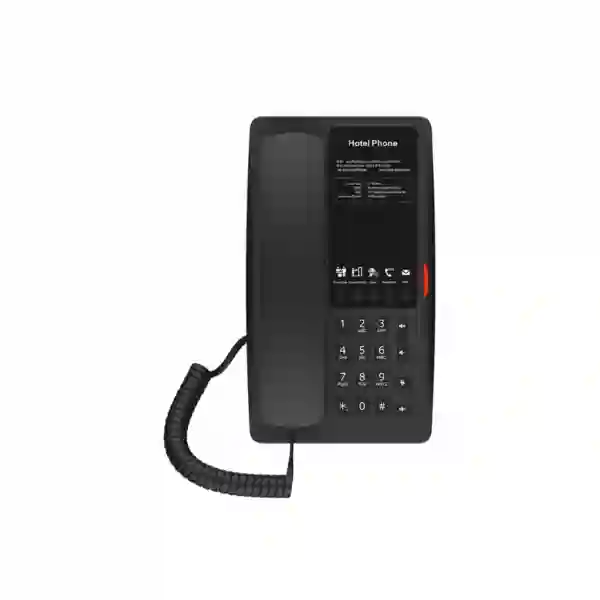
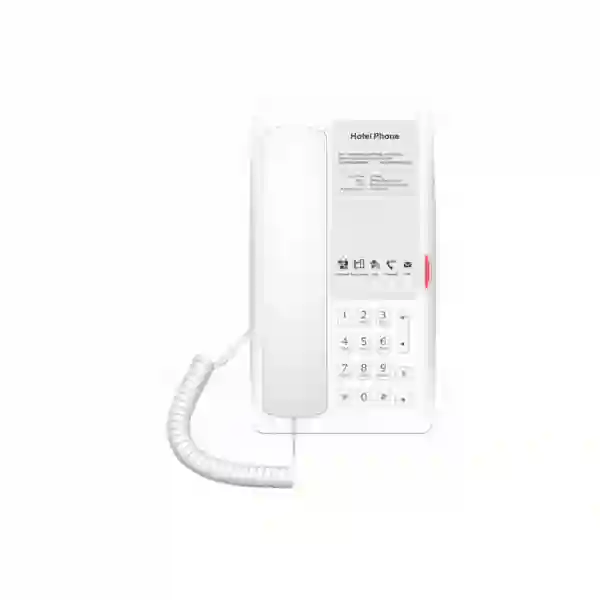
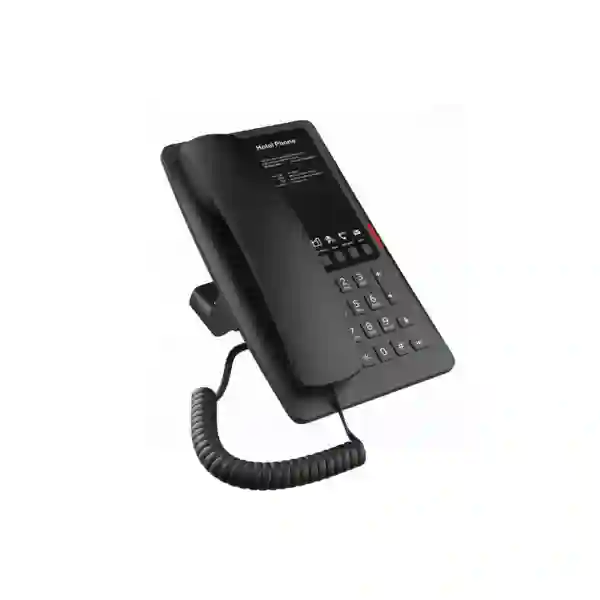
The Fanvil H4 is a purpose-built, screenless hotel IP phone for guest rooms and service-oriented environments that require clear calling, simple controls and straightforward network deployment. It combines two SIP lines, HD voice, 10/100 Mbps Ethernet, integrated Power over Ethernet and five programmable service keys that can be assigned to reception, housekeeping, room service, security or other frequently used destinations. Its customizable faceplate gives hospitality operators a practical way to label service functions while keeping the bedside experience intuitive for guests.
What the Fanvil H4 solves for hotels and service environments
A guest-room telephone has a different job from an executive desk phone. Guests usually need fast access to a small number of services, not a complex display with dozens of menu options. The H4 addresses that requirement with a clean screenless design and programmable keys that can direct calls to the hotel functions that matter most. This can simplify the guest experience while also helping the property standardize room telephony around SIP and Ethernet infrastructure.
For IT teams, the H4 fits into IP-based voice deployments rather than requiring a separate analogue-only telephony layer. The phone supports SIP, standard network addressing options, VLAN and Quality of Service features, and provisioning methods intended to make multi-room deployment more manageable. PoE can allow network and power to travel over the same Ethernet connection when the switch infrastructure is designed accordingly. That is useful in properties where reducing individual power adapters and keeping bedside cabling organized are important operational goals.
The device is not restricted to hotels. Fanvil also positions the H4 for hospitals, shopping malls and supermarkets, where a compact phone with a small number of predictable calling functions can be more appropriate than a feature-heavy business handset. Buyers should still validate PBX interoperability, call-flow requirements, switch PoE capacity, VLAN design, provisioning approach and the exact accessories needed before ordering quantities for a site.
Five programmable service keys
Configure direct access to common service destinations such as reception, housekeeping, room service or security. The icons and hotel service numbers can be customized to match the intended guest workflow.
HD voice and speakerphone
Wideband codecs including G.722 and Opus support clear voice reproduction, while full-duplex hands-free operation with echo cancellation supports convenient calling without lifting the handset.
PoE-ready Ethernet
The H4 supports 10/100 Mbps Ethernet and PoE, helping properties simplify endpoint cabling when compatible PoE switching is available and correctly sized for the room count.
Guest charging convenience
A USB-A charging interface gives the bedside device an additional practical function for environments where guests or users may need a convenient charging point.
Verified Fanvil H4 technical highlights
| Area | Fanvil H4 detail |
|---|---|
| SIP | 2 SIP lines; SIP v1/v2 over UDP, TCP or TLS |
| Voice | HD voice; G.722 and Opus wideband codecs plus common narrowband codecs |
| Network | 10/100 Mbps Ethernet; IPv4, IPv6 and dual-stack mode |
| Power | PoE; optional external power supply for H4 depending on deployment needs |
| Service controls | 5 programmable soft keys for service hotlines; customizable service icons and numbers |
| User interface | Screenless design; handset and hands-free operation |
| Network features | 802.1X network access control, VLAN 802.1P/Q, QoS, LLDP, L2TP and OpenVPN support |
| Charging | USB-A charging interface |
The H4 should not be confused with the H4W. The H4W adds built-in dual-band Wi-Fi 6, while the standard H4 is the wired Ethernet model described on this page.
Compatibility, PBX integration and deployment planning
The H4 is a SIP endpoint, so the most important compatibility question is whether the selected IP PBX or hosted voice platform supports the SIP functions and provisioning workflow required by the property. Before a bulk purchase, test a sample unit with the real PBX, extension plan, dial plan, voicemail behavior, emergency dialing policy and service-key destinations. A successful lab test should then be repeated on the same VLAN, switch type and WAN conditions expected in the property.
Hotels commonly use voice VLANs to isolate telephony traffic from guest and administrative networks. The H4 supports VLAN and QoS features, but the switch, router and PBX must also be configured consistently. Where PoE is used, calculate the total power budget for all endpoints and leave sensible capacity for growth or device changes. If the network switches are backed by UPS power, the telephony environment may remain operational through short power disturbances, subject to the PBX, gateways, routers and internet services also being protected.
Provisioning is another major consideration at hotel scale. A few rooms can be configured manually, but larger properties benefit from a repeatable template for SIP credentials, time settings, service keys, VLAN values, firmware and labeling. Maintain a room-to-MAC or room-to-extension record so failed handsets can be replaced without losing track of configuration. Change control is important because a small dial-plan change can affect every guest room if provisioning is centralized.
For broader buying guidance, the FourTeck Tanzania technology shop explains how IP phones, PoE switching, cabling and PBX planning fit together. Businesses comparing endpoint types can also review the Dinstar C60SP PoE business IP phone and the Dinstar C60U-W Wi-Fi IP phone as examples of more office-oriented endpoint categories with different user and connectivity requirements.
Buying checklist before requesting a Fanvil H4 quotation
Count guest rooms, suites, reception points, service desks and any spare units required for maintenance replacement.
Provide the make, model, software version or hosted service details so SIP registration and feature compatibility can be checked.
Confirm whether each room outlet connects to a PoE-capable switch and whether the available power budget supports the planned phone count.
Define the five most useful destinations and the labels or icons guests should see on the customized faceplate.
Document VLAN, IP addressing, QoS, DHCP, DNS, firewall and provisioning requirements before mass rollout.
State whether PoE will be used or whether external power supplies are required, and confirm the exact accessories included in the quotation.
Regional availability and procurement guidance
The sections below address the search and purchasing questions commonly associated with the Fanvil H4 across Tanzania and other markets. They are intended as procurement guidance rather than claims of local stock, local offices or guaranteed service coverage. Availability, lead time, warranty scope, tax, freight, PBX compatibility and deployment services should be confirmed in the quotation for the specific destination.
Fanvil H4 Hotel IP Phone Tanzania
For hotels and serviced properties in Tanzania, the Fanvil H4 is most relevant when the objective is to standardize guest-room telephony around a simple SIP endpoint rather than place a full business desk phone in every room. Procurement teams should begin with the property call flow: which calls must reach reception, housekeeping, room service, security and external destinations, and which of those functions deserve a dedicated programmable key. Mapping those workflows before ordering allows the customizable faceplate to become part of the guest-service design instead of an afterthought.
The wired H4 is well suited to properties that already provide Ethernet to rooms or are renovating cabling. PoE can reduce the need for separate bedside power adapters when compatible switching is available, but the network must be sized for the total endpoint count. In a multi-floor hotel, voice VLANs, switch uplinks, DHCP, QoS and rack power protection should be reviewed as one system. A phone can be technically functional while still delivering poor voice quality if the LAN or internet path is congested, incorrectly prioritized or unstable. That is why room counts, switch models, uplink capacity and PBX location belong in the same planning discussion as handset quantity.
Tanzania buyers should also separate hardware price from the complete deployed cost. The quotation may need to account for patching, PoE switching, PBX licenses or subscriptions, SIP trunks, configuration, faceplate customization, testing, spare units and any on-site work. Hotels replacing analogue phones should verify whether existing room cabling can be reused or whether Ethernet work is required. New properties can plan voice cabling together with Wi-Fi, CCTV, access control and guest-network infrastructure to avoid duplicate installation effort.
For a reliable purchase decision, share the room schedule, extension plan, intended PBX, desired service keys and network drawing where available. FourTeck can then help frame the requirement around the phone and the infrastructure it depends on, without assuming that every property has the same cabling or voice architecture.
Fanvil H4 Hotel IP Phone Dar es Salaam
Dar es Salaam hospitality projects often involve a mix of new buildings, refurbishments and operating hotels that cannot tolerate disruptive communications changes. For a Fanvil H4 rollout, the safest approach is to divide the project into network readiness, PBX readiness, room configuration and cutover stages. Start by confirming Ethernet availability at each room, the condition of patch panels and switches, and whether PoE capacity exists. Where analogue handsets are being replaced, do not assume the old telephone socket is Ethernet-ready; the physical path, cable type and termination must be verified.
The H4’s five programmable service keys can be valuable in busy urban hotels because they place the most important guest services one press away. A practical configuration might reserve keys for reception, housekeeping, food service, concierge or security, but the final map should reflect the property’s departments and operating model. If calls are handled through queues or ring groups, confirm how unanswered calls are escalated after hours. The phone itself is only the endpoint; the PBX logic behind those keys determines whether the guest reaches the right team quickly.
Voice quality should be tested during normal business load rather than only on an empty network. Dar es Salaam properties may carry guest Wi-Fi, CCTV, office traffic, cloud applications and VoIP across shared switching and internet connections. VLAN segmentation and QoS can help organize that traffic, but configurations must be consistent end to end. If the PBX or SIP trunk is remote, WAN stability becomes part of the voice design. UPS-backed switching, firewall and PBX infrastructure can also reduce the impact of short power interruptions, depending on the wider site architecture.
Before requesting a quotation, provide the total room count, spare percentage, required faceplate labeling, PBX details, preferred power method and whether installation or provisioning assistance is needed. That gives suppliers enough information to quote the complete scope rather than only a handset unit price.
Fanvil H4 Hotel IP Phone Mwanza
Hotels, lodges, healthcare environments and other service properties in Mwanza can use the Fanvil H4 where simple room-to-service communication is more important than a graphical display. For procurement, begin by deciding whether the phone will be used only for internal extensions or also for external calls through a SIP trunk or gateway. That decision affects dial-plan design, permissions, emergency calling rules and the way guest calls are billed or restricted. The two SIP lines give the endpoint flexibility, but the PBX configuration determines how those lines are actually used.
Infrastructure planning should consider both the room edge and the central communications rack. At the room, check the Ethernet outlet, patching and handset location. At the rack, confirm switch port availability, PoE budget, VLAN configuration and UPS capacity. At the PBX, confirm extension numbering, service destinations and provisioning. This layered checklist is particularly useful for properties expanding in phases because it prevents a later room block from being added without corresponding switch or PBX capacity.
The USB-A charging interface can add convenience at a bedside or desk, but it should be treated as an auxiliary charging feature rather than the reason for selecting the phone. The core purchasing value remains the hospitality-focused key layout, SIP connectivity, HD voice and PoE deployment model. Faceplate customization deserves early attention because the artwork, icon language and service naming should match the property’s guest communication style. If the hotel serves international travelers, clear icons and concise labels can reduce confusion.
Mwanza buyers comparing quotations should ask every supplier to state what is included: handset quantity, power method, configuration, PBX work, network work, faceplate customization, freight, taxes, warranty terms and support scope. A lower unit price can become misleading when essential deployment components are omitted from the initial offer.
Fanvil H4 Hotel IP Phone Arusha
Arusha has a strong hospitality and travel-service context, making guest-room communication a practical use case for a focused hotel handset such as the Fanvil H4. Properties serving tour groups, business travelers and international guests often benefit from predictable, easy-to-understand room controls. The five programmable keys can be aligned with the property’s real service workflow, for example front desk, housekeeping, restaurant, transport desk or security. The final choices should be based on actual guest call patterns and staffing rather than generic labels.
For lodges or properties with separate buildings, network topology can be more important than the phone specification itself. The H4 uses wired Ethernet, so each installation point requires a suitable data path back to switching infrastructure. Where buildings are separated, fiber uplinks, protected outdoor pathways or distributed switches may be involved. Designers should avoid treating a large site as if every room were directly connected to a single nearby rack. Voice VLANs and QoS can still be used across the architecture, but uplink resilience and power protection deserve additional attention.
The H4 can also fit staff or service positions that need a limited set of calling functions. In such cases, provisioning should differentiate guest-room profiles from operational phones so permissions and speed-dial destinations are appropriate. A hotel may want guest phones to reach selected services while staff phones have broader internal or external calling rights. The PBX should enforce those policies rather than relying on users to follow them manually.
For Arusha procurement, prepare a room and building schedule, identify the location of network cabinets, list existing PBX or SIP services and define the desired service-key labels. If the property is under construction, coordinate telephony outlets with furniture plans so bedside phones are not left with awkward cable routes. If the property is already operating, plan a staged cutover that protects front-desk communication and gives staff time to verify each room after migration.
Fanvil H4 Hotel IP Phone Dodoma
In Dodoma, the Fanvil H4 can suit hotels, guest houses, institutional accommodation and other facilities where users need dependable access to a few key services without navigating a complex phone interface. Its screenless design makes the service-key strategy especially important: the faceplate and programmable buttons effectively become the user interface. Buyers should therefore involve both IT and operations when defining the layout, because a technically correct extension number is not useful if the label does not make sense to the guest.
A good deployment plan starts with a pilot. Configure one or two H4 units against the target PBX, place test calls between rooms and reception, verify transfer behavior, test voicemail if used, confirm caller ID and check any external dialing restrictions. Then test PoE, VLAN and DHCP behavior through the real switch infrastructure. This catches interoperability issues before dozens or hundreds of devices are staged. Record the working configuration so it can become the baseline template for the remaining phones.
For multi-floor properties, document switch ports and room extensions together. When a phone fails, support staff should be able to identify the corresponding port, VLAN and extension without tracing cables manually. Keeping a small spare pool can also shorten replacement time, but the exact spare quantity should be based on property size and support strategy rather than a fixed percentage. Firmware management should be controlled so rooms do not end up on inconsistent versions after ad-hoc changes.
Quotation requests from Dodoma should clearly state whether the requirement is hardware-only or includes PBX configuration, network preparation, faceplate customization, testing and handover. Separating those line items makes it easier for procurement teams to compare offers on a like-for-like basis and reduces the risk of discovering missing work during installation.
Fanvil H4 Hotel IP Phone UAE
For UAE hospitality projects, the Fanvil H4 is relevant where operators want a streamlined SIP room phone with programmable guest-service access and wired PoE connectivity. Large hotel portfolios should evaluate the handset as part of a repeatable room technology standard rather than as a standalone purchase. That standard can define the PBX platform, extension scheme, voice VLAN, firmware baseline, service-key mapping, faceplate artwork, network switch profile and replacement process so different properties can be supported consistently.
The H4’s screenless interface can be an advantage in rooms where ease of use and visual simplicity matter. However, properties with requirements for on-screen directories, branding, menus or advanced guest applications may need a different hotel-phone class. Procurement teams should therefore compare the desired guest experience before committing to one model across every room type. Suites, executive floors or service apartments may have different expectations from standard rooms, even within the same property.
Integration testing should include the exact SIP trunk, PBX firmware and network security policies used in the destination property. TLS and SRTP capabilities can contribute to a more secure voice environment where supported and correctly configured by the complete system. VLAN and 802.1X support may also be relevant in managed enterprise networks, but those features require coordination between telephony and network teams. The handset cannot compensate for an incomplete certificate, authentication or switch configuration.
Organizations operating across the Gulf and East Africa may benefit from common endpoint templates while still adapting dial plans and service numbers to each property. A standardized configuration reduces training and support variation, but regional telecom services, emergency calling requirements and PBX integrations still need local validation. For broader multi-country IT planning, FourTeck’s regional network can be used alongside the Tanzania project discussion without assuming that pricing or availability is identical in every market.
Fanvil H4 Hotel IP Phone Uganda
Uganda buyers considering the Fanvil H4 should focus first on the property’s voice architecture and room network readiness. A hotel phone rollout is easiest when extension numbering, SIP registration, room cabling and service-key destinations are defined before hardware staging begins. The H4 can then be provisioned with a consistent template and assigned to rooms systematically. For an operating hotel, this reduces the chance that individual rooms are configured differently during a hurried migration.
PoE is particularly useful when the room Ethernet network is already designed for powered endpoints, but the overall switch budget must be checked. Each access switch should have enough powered ports and adequate capacity for the connected phones, while uplinks and UPS support should be considered for the whole voice path. If some rooms do not have Ethernet, the standard H4 should not be assumed to work wirelessly; Fanvil’s H4W is the related variant with integrated Wi-Fi 6, and it should be evaluated separately if wireless connectivity is specifically required.
The five service keys give hotel operators an opportunity to improve call routing for guests, but the PBX must be configured so those destinations remain available during staff changes or departmental reorganization. Using stable hunt groups or service extensions can be better than programming a person’s individual extension into hundreds of rooms. That way, staffing changes happen at the PBX without requiring every handset to be reconfigured.
For Uganda regional planning, the FourTeck Uganda IT solutions site provides broader context around VoIP and IP PBX systems. When requesting a specific H4 quotation, include quantity, city, PBX platform, network details, required customization and whether installation support is needed so the commercial offer can reflect the real project scope.
Fanvil H4 Hotel IP Phone Kampala
Kampala hotels and serviced accommodation operators may choose the Fanvil H4 when guest-room simplicity, SIP integration and centralized administration are higher priorities than a graphical display. In urban properties with multiple services and busy reception desks, direct service keys can help reduce wrong transfers because guests begin with a clearly labeled destination. The design should nevertheless be tested with real guests and staff, particularly where multiple languages or unfamiliar icons could make a label ambiguous.
From an IT perspective, the phone should be treated as part of the managed network. The voice VLAN, DHCP scope, DNS, NTP, PBX address, security settings and firmware source should be documented. If the property uses centralized provisioning, protect configuration files and credentials appropriately. If each phone is configured locally, maintain a controlled checklist so service keys and network settings do not drift between rooms. Large properties should avoid relying solely on handwritten room notes for device tracking.
Kampala buyers upgrading an existing analogue room system should confirm whether the current PBX will be replaced, integrated through gateways or retained for selected services. Hybrid migration can be practical, but it adds operational complexity because two telephony environments may need to coexist during the transition. A phased floor-by-floor rollout should include clear rollback steps and a way to keep reception reachable while each group of rooms is cut over.
The most useful quotation request states the number of rooms, whether PoE is available, the existing PBX model, external calling requirements, desired service keys, installation timing and any customization expectations. That information helps avoid generic pricing that excludes important network or configuration tasks. It also gives procurement a clearer basis for comparing suppliers beyond the handset price alone.
Fanvil H4 Hotel IP Phone Arua
For hotels, clinics and service facilities in Arua, a straightforward wired SIP phone such as the Fanvil H4 can support internal calling and guest-service access without introducing an unnecessarily complex user interface. The first question should be whether the site already has a dependable Ethernet network to every intended phone location. If not, cabling may represent a larger part of the project than the handset itself. A pre-deployment survey can identify where new outlets, patch-panel capacity or access switches are required.
Where connectivity between buildings or wings is limited, voice design should account for the complete route from the room to the PBX. Fiber links, wireless bridges or intermediate switches can introduce additional dependencies that must be powered and monitored. The H4 can support VLAN and QoS settings, but consistent network design is required across every hop. If the PBX is hosted remotely, internet resilience may also influence call continuity for external and even internal calls depending on the architecture.
Service-key planning is an operational opportunity. A smaller property may not have separate departments for concierge, housekeeping and room service, so programming all five keys with generic hotel labels would be wasteful. Instead, the buttons can be aligned to the real organization, perhaps reception, restaurant, security, transport coordination or another service. The customizable faceplate allows those choices to be presented clearly to users.
Arua procurement teams should request a bill of materials that makes infrastructure dependencies visible. Ask whether the offer assumes existing PoE, includes external power adapters, includes PBX configuration, includes travel or installation, and covers any required faceplate customization. This prevents a handset quote from being mistaken for a complete room-telephony project and makes budgeting more realistic from the beginning.
Fanvil H4 Hotel IP Phone Mbarara
Mbarara properties evaluating the Fanvil H4 should consider how a simple hotel endpoint can fit into their wider communications lifecycle. The phone may stay in a room for years, while PBX software, staff processes and network switches change around it. Choosing a repeatable configuration and documenting it from the beginning makes those future changes easier. Record the phone model, firmware baseline, extension, room number, switch port and service-key mapping in a central inventory rather than relying on memory.
The H4 supports standard SIP and a range of network protocols that can work well in managed VoIP environments, but compatibility should still be verified with the specific PBX. Test transfer behavior, DTMF interaction with IVR systems, voicemail indications, caller ID and any hotel-management integrations that depend on PBX features. The fact that two devices both support SIP does not guarantee that every vendor-specific function will behave identically.
For new hotel construction, room telephony should be coordinated with structured cabling and electrical design. Place outlets where the phone will actually sit, allow clean cable routing and confirm whether PoE will be the standard power method. For existing properties, check cable quality and switch availability before setting an installation date. If rooms are occupied, stage and preconfigure devices in advance so the physical swap can be completed with minimal disruption.
Mbarara buyers can strengthen a quotation request by including floor plans or room schedules, current PBX details, desired calling permissions, number of service departments and any branding requirements for the faceplate. Also ask for clear statements on lead time, warranty terms and support scope rather than assuming they are the same across suppliers or regions. Those commercial details are project-specific and should be confirmed in writing.
Fanvil H4 Hotel IP Phone Gulu
In Gulu, the Fanvil H4 can be considered for hospitality, healthcare and institutional environments that need uncomplicated SIP calling at rooms or service points. The screenless form factor keeps the device focused, but it also means the physical keys and faceplate carry more responsibility for user guidance. Before ordering customized artwork, test the proposed labels with the staff who will receive those calls and make sure each destination remains valid across shifts and after-hours operation.
If the site uses PoE, network switch selection matters because a phone deployment adds both port demand and power demand. Count the endpoints per switch, verify the available power budget and review uplink capacity. Voice packets use comparatively little bandwidth, but call quality can still suffer from congestion, packet loss, latency or poorly designed WAN links. QoS can help prioritize traffic when configured end to end, while VLAN separation can simplify security and troubleshooting.
For sites with intermittent power concerns, discuss the broader continuity plan. PoE does not eliminate dependence on electricity; it moves the power source from the room to the network switch. If continuity is important, the switches, PBX, router, firewall and relevant gateways may all need appropriate UPS protection. The runtime target should be based on the property’s operational requirement and actual equipment load rather than a generic figure.
Gulu procurement should also include a plan for spare and replacement units, especially where rapid sourcing may be difficult. Spare quantity, however, should be determined by fleet size, support response expectations and failure strategy. Ask the supplier to identify what can be preconfigured before shipment and what must be completed on site. A well-prepared device inventory and configuration template can significantly reduce the effort required when a room phone is replaced.
Fanvil H4 Hotel IP Phone Kenya
Kenya has a broad hospitality market ranging from city hotels and serviced apartments to coastal resorts and safari properties, so Fanvil H4 deployment requirements can vary significantly by site. The common starting point is a room communications map: identify every extension, service department, external calling permission and emergency path before programming phones. The H4’s two SIP lines and five programmable keys provide flexibility, but the PBX should remain the central source of call-routing logic so room handsets stay simple.
Properties with existing structured cabling can take advantage of the wired Ethernet design and PoE support, while remote lodges may need more careful assessment of network distribution between buildings. If Wi-Fi is the only practical room connectivity, buyers should evaluate a wireless-capable model such as the H4W rather than assuming the wired H4 includes Wi-Fi. That model distinction is important when comparing reseller listings because the names are similar but the connectivity options differ.
Hotel groups with multiple Kenyan properties can standardize service-key icons and extension conventions while allowing local numbers and departments to vary. A central provisioning approach can make firmware and configuration management more consistent. Still, each site should be validated for PBX version, switch model, VLAN scheme and internet architecture. Standardization works best when it defines the method and configuration baseline, not when it ignores legitimate differences between properties.
For buyers coordinating Tanzania and Kenya projects, the FourTeck Kenya IT solutions site provides regional context for VoIP phones and IP PBX planning. When comparing H4 offers, request exact model identification, included accessories, power method, tax treatment, freight, warranty and deployment scope so that superficially similar quotations can be evaluated on equivalent terms.
Fanvil H4 Hotel IP Phone Kuwait
Kuwait hospitality buyers may evaluate the Fanvil H4 as a compact SIP room phone for hotels, serviced apartments and institutional accommodation. The model’s most important design choice is simplicity: there is no display, so guests interact through the keypad, handset, speakerphone and programmable service keys. This can suit properties that want a familiar phone experience and direct service access, while properties seeking digital directories or screen-based branding may need to compare alternative hotel phone models.
In centrally managed properties, the H4 can be integrated into a structured voice network using Ethernet, PoE, VLAN and QoS. Network teams should verify 802.1X or other access-control requirements if the property enforces authenticated switch ports. SIP over TLS and SRTP support may be relevant to security design where the PBX and certificates are configured accordingly. Security should be planned across the whole voice system, because enabling a protocol on the handset alone does not secure gateways, trunks or management interfaces.
Large deployments should include staging and asset labeling. Phones can be preassigned to rooms, configured with service-key templates and tested before delivery to the floor. A controlled acceptance checklist can verify registration, internal calls, service keys, external access policy, speakerphone operation and time synchronization. This process is more reliable than discovering configuration errors after guests occupy the rooms.
For procurement, Kuwait buyers should clarify whether a quotation covers hardware only or a complete deployment including configuration, PBX integration, switch changes and handover. Also confirm the exact H4 model, color if relevant, power accessories and warranty terms. Regional taxes, freight and lead times are commercial variables that can change, so they should be validated in the current offer rather than inferred from listings in another country.
Fanvil H4 Hotel IP Phone Ghana
Ghana hotels and service organizations can consider the Fanvil H4 where a practical wired SIP endpoint is needed for guest rooms, bedside positions or service points. The phone’s five programmable keys can support direct access to frequently used functions, but a deployment should begin with operational design rather than a generic key template. Properties with one combined service desk may need fewer distinct destinations than larger hotels with separate concierge, housekeeping, restaurant and security teams.
The H4’s 10/100 Mbps Ethernet interface is more than sufficient for voice traffic, yet overall call quality still depends on network health. Switch congestion, unstable uplinks, packet loss and WAN issues can affect voice regardless of handset capability. Managed VLAN and QoS policies help create a predictable environment, and PoE can simplify endpoint power when the switching infrastructure is suitable. If a site is being renovated, cable tests and outlet mapping should be completed before phones are staged.
For organizations that operate several hotels, configuration discipline becomes a major benefit. Define naming conventions, extension ranges, PBX templates, firmware versions and escalation procedures. Keep guest-room phones separate from staff and administration profiles where different permissions are required. A centrally documented approach makes troubleshooting faster when support staff need to identify whether a problem sits with the handset, switch port, VLAN, PBX extension or upstream carrier.
Ghana procurement teams should ask suppliers to provide the model number and all included accessories clearly, especially where reseller descriptions combine H4 and H4W features. The standard H4 should be treated as the wired model; Wi-Fi belongs to the H4W variant. Confirm current availability, lead time, warranty and support terms in the quotation, since these conditions are commercial and region-specific rather than fixed technical specifications.
Fanvil H4 Hotel IP Phone Nigeria
Nigeria hospitality deployments can range from small boutique properties to large multi-building hotels, making capacity planning an important part of any Fanvil H4 project. Start with extension quantity and switch-port capacity, then map the PBX architecture and service departments. The handset itself supports two SIP lines, but the real scale of the solution is determined by the PBX, trunks, network and operational call flows. A property with hundreds of rooms should confirm registration capacity and concurrent call requirements rather than simply multiply a handset unit price by room count.
Power design deserves equal attention. Using PoE can keep room installations cleaner, but the access switches become critical power sources. Confirm their PoE budget and UPS strategy, especially where continuous reception and guest-service calling are important. If the PBX is on premises, include it in the backup-power design. If it is cloud-hosted, router, firewall and internet continuity become equally important. Redundancy choices should be based on the property’s tolerance for downtime and budget.
Operational teams should be involved in service-key naming. The most effective configuration sends callers to stable service groups rather than individual staff extensions. That allows shift changes without reprogramming every room. If the hotel reorganizes departments later, centralized provisioning can distribute an updated profile more efficiently. Documentation should include who is authorized to change global templates so accidental edits do not propagate to the entire fleet.
Nigeria buyers comparing offers should request an itemized scope covering phones, power, PBX work, network changes, customization, freight, tax and installation. Also ask whether any compatibility testing is included. An inexpensive hardware-only quote may still be appropriate for an experienced in-house IT team, while a turnkey property may need a broader deployment package. The right choice depends on internal capability rather than on handset cost alone.
Fanvil H4 Hotel IP Phone Seychelles
Seychelles hospitality properties often place a high value on guest experience and operational simplicity, which makes the Fanvil H4’s focused hotel interface worth considering. The absence of a display keeps the bedside appearance clean, while customizable service keys can be matched to the property’s most important guest contacts. Resorts should choose labels and icons carefully for an international audience, potentially using universally understood symbols alongside short text where the faceplate design allows.
Island and resort environments can make logistics and replacement planning more significant than in dense urban markets. Before rollout, decide how many preconfigured spares are appropriate and where they will be stored. A replacement unit should be easy to assign to a room using documented provisioning and asset records. The exact spare level should reflect property size, supplier lead time and operational tolerance rather than a generic rule.
Network architecture across villas, separate blocks or large resort grounds may also be distributed. The H4 needs wired Ethernet, so each room must have a suitable connection to the voice network. Fiber backbones or intermediate switches may connect different buildings, and those components should be included in continuity and monitoring plans. Voice VLANs, QoS and PoE can be used within that architecture, but the design must consider every link between the room and the PBX or hosted service.
Seychelles buyers should request quotes that identify freight, import-related scope, warranty handling and replacement processes clearly. If faceplates are customized, confirm artwork approval and lead time before the deployment date. Testing one sample phone with the actual PBX and network is especially useful when replacement logistics are complex, because it reduces the risk of discovering an interoperability issue only after the full shipment arrives.
Hospitality deployment use cases
Guest rooms
Use programmed service keys to give guests fast access to the departments they call most often while keeping the bedside interface familiar and uncluttered.
Hospitals and clinics
Place a simple SIP endpoint at suitable bedside or service positions where direct calling and a limited set of known contacts are more useful than advanced desk-phone features.
Retail and malls
Deploy at information points, security desks or back-office locations that need reliable internal calling and quick access to specific services.
Serviced apartments
Standardize resident-to-reception communication using SIP extensions while keeping the in-room handset visually simple and easy to explain.
How to decide if the H4 is the right model
Choose the Fanvil H4 when you want a wired Ethernet hotel phone, PoE support, two SIP lines, HD voice and direct programmable service keys in a screenless form factor. It is especially suitable when the property wants the guest interaction to remain focused on calling rather than screen navigation. It also makes sense when structured cabling and PoE switching are already part of the hotel network strategy.
Consider the H4W instead when Wi-Fi is specifically required and wired Ethernet is not practical at the intended location. Consider a different hotel or business phone when the use case requires a display, richer directories, advanced line handling or user functions beyond the H4’s hospitality-focused interface. The correct endpoint is the one that fits the user role and infrastructure rather than the one with the longest feature list.
For mixed environments, it is normal to deploy different endpoint classes. Guest rooms may use H4 phones, reception may require a higher-feature business handset, and managers may use devices with displays, headsets or wireless features. A single PBX can often support those different roles if interoperability is validated. This role-based approach is more practical than forcing every person and room to use the same model.
Fanvil H4 FAQs
Does the Fanvil H4 have Wi-Fi?
No. The standard H4 is the wired Ethernet model. The related H4W variant adds built-in dual-band Wi-Fi 6. Buyers should verify the exact model name on every quotation to avoid mixing the two variants.
How many SIP lines does the H4 support?
Fanvil specifies two SIP lines for the H4. The PBX or hosted voice service must still be configured to use them appropriately for the property’s call flow.
Can the H4 be powered by PoE?
Yes. The H4 supports Power over Ethernet. The connected switch must provide compatible PoE and have adequate power budget for the planned number of phones.
Does the Fanvil H4 have a screen?
No. The H4 is a screenless hotel IP phone. This is part of its simplified guest-room design. Buyers who require a display should evaluate another model.
What are the programmable keys used for?
The five programmable service keys can be assigned to hotel service numbers and customized with corresponding icons or labels. Typical destinations may include reception, housekeeping, restaurant services or security, depending on the property.
Can the H4 work with any IP PBX?
The H4 is SIP-based, but buyers should not assume universal feature compatibility with every PBX. Test registration, calls, transfers, DTMF, voicemail behavior, provisioning and any required hotel functions with the exact PBX version before bulk deployment.
Does the H4 support secure SIP?
Fanvil lists SIP over TLS and SRTP among the supported protocols. Effective secure deployment depends on the PBX, certificates, configuration and the wider network architecture.
What information should I provide for a quotation?
Provide the destination, quantity, PBX platform, room count, PoE availability, service-key requirements, customization needs and whether configuration, installation or network work is required. This helps produce a quotation that reflects the complete project scope.
Quotation checklist
A strong quotation request reduces ambiguity for both procurement and technical teams. Include the exact model name “Fanvil H4 Hotel IP Phone,” destination country and city, required quantity, planned spare quantity, PBX make and version, number of SIP extensions, desired service keys, faceplate artwork requirements, PoE availability and any external power-adapter needs.
Also specify whether the supplier should provide only hardware or include staging, provisioning, PBX configuration, VLAN setup, switch configuration, cabling, installation, testing, documentation and handover. If the hotel is already operating, mention the preferred migration window and whether a floor-by-floor cutover is required. For new construction, provide the project schedule and network-readiness milestones.
Finally, ask the quotation to state exact included accessories, warranty terms, support scope, tax treatment, freight, estimated lead time and commercial validity. These items are not fixed product specifications and may differ by destination or supplier, so they should be confirmed rather than assumed.
Decision recap
The Fanvil H4 is a strong fit for buyers who need a screenless hospitality SIP phone with two SIP lines, HD voice, 10/100 Mbps Ethernet, PoE and five programmable service keys. Its customizable faceplate can make common hotel services easier to reach, while wired IP connectivity allows it to be managed as part of the property network and PBX environment.
The most important buying questions are not only about the handset. Confirm whether rooms have suitable Ethernet, whether switches provide enough PoE, whether the PBX supports the required SIP behavior, how service keys will map to departments, how devices will be provisioned and how the network will be protected and maintained. For larger sites, configuration consistency and documentation are essential.
Do not select the H4 if Wi-Fi is a mandatory requirement without cabling; evaluate the H4W or another suitable model instead. Do not assume listed prices, stock or warranty from another country apply to Tanzania. Request a current project-specific quotation with the exact model and scope.
Consultation for Fanvil H4 hotel deployments
FourTeck can help structure a Fanvil H4 requirement around room quantity, PBX compatibility, service-key design, network readiness, PoE, VLANs and deployment scope. The objective is to make the phone work as part of the guest-service environment rather than treat it as an isolated device purchase.
When contacting sales, include your property location, quantity, PBX details and whether you need hardware only or a broader telephony deployment. This enables a more accurate technical and commercial discussion from the first response.


Reviews
There are no reviews yet.