
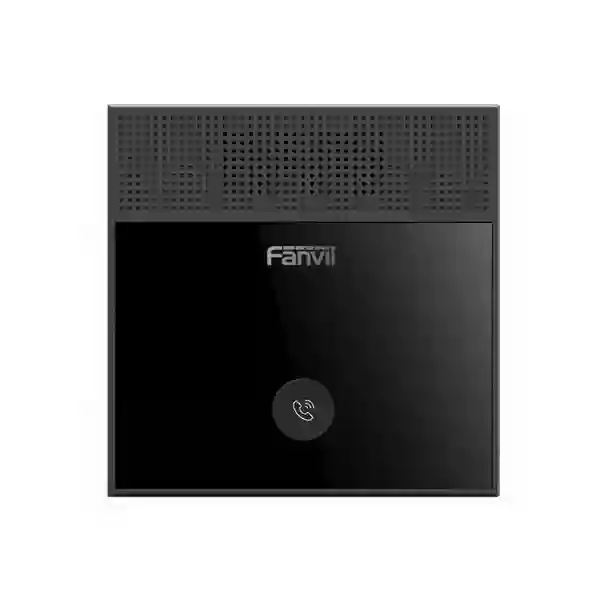
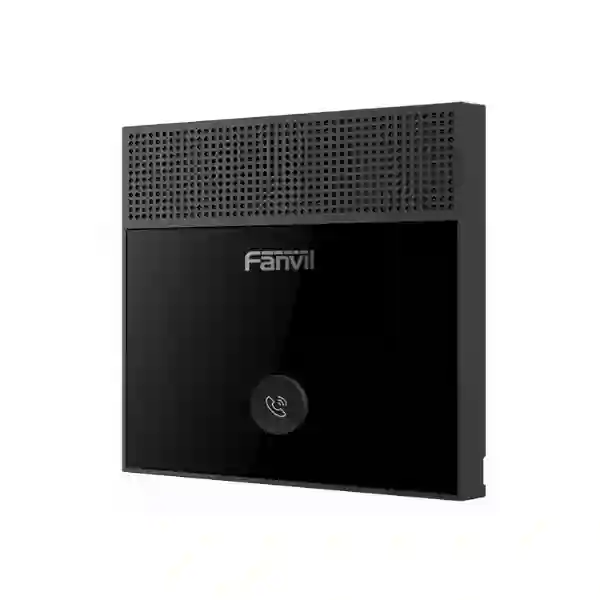
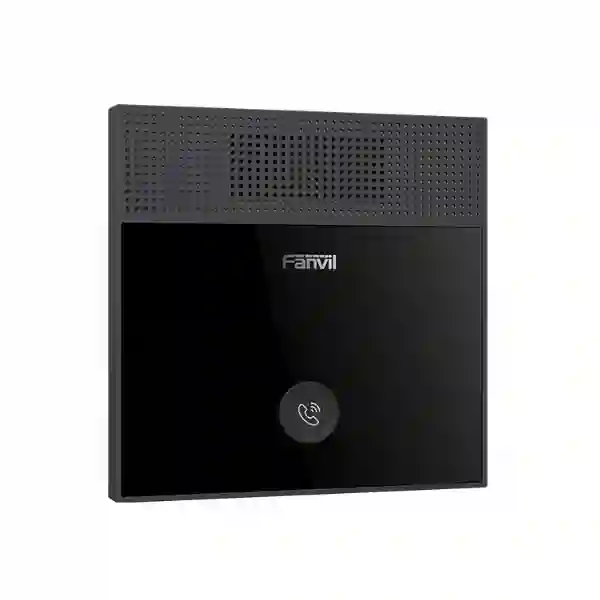
Fanvil H501 Mini SIP Intercom
The Fanvil H501 Mini SIP Intercom is a compact, flush-mounted indoor SIP endpoint built for fast one-touch communication in hotels, residences, villas, serviced apartments and other indoor environments. It combines SIP 2.0 interoperability, full-duplex HD voice, a five-metre pickup range, PoE or 12V DC power, and a clean 86-box installation format. The related H501W variant adds 2.4 GHz Wi-Fi 6 for projects where wireless network access can simplify cabling.
Choose the H501 when you need a discreet wired indoor SIP intercom with Ethernet and PoE. Consider the H501W when the same compact format is required with built-in 2.4 GHz Wi-Fi 6. Both are intended for indoor use and fit standard 86-type mounting boxes with a depth of at least 45 mm.
What the Fanvil H501 is designed to do
Fanvil positions the H501 series as a compact embedded SIP intercom for indoor environments where users need immediate voice contact without the size or interface complexity of a desk phone or video door station. The typical workflow is simple: a resident, guest, staff member or occupant presses the single function key and the intercom calls a preconfigured destination such as reception, concierge, a service desk, security point or support extension. The result is an endpoint that can be placed where communication needs to be obvious and uncomplicated.
The design is especially suited to hospitality and residential interiors. Fanvil specifies an 86 × 86 × 30.9 mm panel, flush installation in an 86-type box with at least 45 mm depth, and approximately 1 cm wall protrusion after mounting. That allows the intercom to sit cleanly in a finished wall rather than appearing as a large surface-mounted device. The enclosure uses ABS plastic in an iron-gray finish, and Fanvil also promotes panel customization options for projects where interior appearance matters.
For communication quality, the H501 series supports full-duplex HD voice with G.722 and Opus wideband codecs. Fanvil states a pickup range of up to five metres and includes audio processing functions such as acoustic echo cancellation, voice activity detection, comfort-noise generation, background-noise estimation and packet-loss concealment. Those features are valuable in rooms and corridors where the user should be able to speak naturally without holding a handset close to the mouth.
The H501 series supports two SIP accounts, giving administrators flexibility for primary and secondary registration profiles or alternative service routing.
A single programmable function key can be configured for speed dial, creating a straightforward call path for guests, residents or staff.
IEEE 802.3af Class 3 PoE can simplify wired deployment, while 12V/1A DC is available when PoE is not being used.
The H501W variant adds 2.4 GHz Wi-Fi 6, which can reduce the need for a dedicated data cable in suitable wireless environments.
Verified technical specifications
| Application | Indoor intercom for hotels, buildings, villas and similar environments |
| SIP | SIP 2.0 over UDP, TCP or TLS; two SIP accounts |
| Network | 10/100 Mbps Ethernet; Static IP, DHCP or PPPoE |
| Wireless | 2.4 GHz Wi-Fi 6 on H501W only |
| Power | 12V/1A DC or IEEE 802.3af Class 3 PoE |
| Audio | Full-duplex HD voice; G.722 and Opus wideband codecs; up to 5 m pickup range |
| Audio processing | AEC, VAD, CNG, BNE and PLC |
| Dimensions | 86 × 86 × 30.9 mm |
| Installation | 86-box flush mounting; box depth at least 45 mm |
| Operating temperature | -10 °C to +50 °C |
H501 or H501W: which version fits the project?
Fanvil H501
The H501 is the natural choice when a structured Ethernet cable reaches the mounting location and the project can use PoE. A single cable can carry both network connectivity and power from a compatible PoE switch, simplifying power planning at the wall. Wired Ethernet also gives administrators a predictable physical connection for SIP traffic and management. For hotel rooms, apartments, villas or building service points that already have structured cabling, this is often the cleanest design.
Fanvil H501W
The H501W adds 2.4 GHz Wi-Fi 6 while retaining PoE support. It is useful when pulling a network cable to every wall point is difficult, disruptive or expensive, provided the intended location has stable and secure wireless coverage. Power still needs to be planned: Wi-Fi removes the Ethernet data cable requirement but does not remove the need for electrical power. Site testing should therefore confirm signal quality, interference, roaming behavior and local power availability before a quantity rollout.
Installation, SIP integration and deployment planning
A successful H501 project begins with three practical checks: the wall box, the network and the call destination. The device is designed for an 86-type flush-mounting box with at least 45 mm depth, so builders and installers should confirm the actual back-box dimensions before finishing walls. Where Ethernet is used, the cable route and PoE switch capacity should be validated. Fanvil specifies 10/100 Mbps Ethernet, which is more than adequate for the device’s voice function, but the switch port still needs correct VLAN, DHCP and security settings.
The intercom can obtain an address through DHCP, static addressing or PPPoE and registers using SIP 2.0 over UDP, TCP or TLS. In business deployments, the exact IP PBX or SIP platform should be tested for registration, call routing, codec negotiation, transfer behavior where relevant, and any secure-signaling requirements. Fanvil firmware is actively published for the H501/H501W family, so administrators should also define a firmware baseline and maintenance process rather than leaving devices unmanaged after installation.
The call button should be programmed around the real service workflow. A hotel room may dial reception; a serviced apartment may call a concierge or security desk; a residential development may connect to a management office; and a villa could call a gatehouse or internal extension. The destination should have overflow and after-hours logic at the PBX level so the user is not left pressing a button that rings an unattended extension. This is why endpoint selection, PBX configuration and operational workflow should be planned together.
Related FourTeck Tanzania products and solution pages
The H501 is one endpoint in a larger SIP environment. Buyers planning a complete communication system can compare related phones and infrastructure on the Tanzania site. The FourTeck Tanzania technology shop provides broader product discovery across IP telephony, networking, security and infrastructure. For desk users who need conventional handsets alongside wall intercom points, the Dinstar C60S Business IP Phone is an entry-level SIP desk endpoint, while the Dinstar C60SP PoE Business IP Phone adds centralized PoE power for voice-ready networks.
Wireless and branch-phone requirements can be explored with the Dinstar C60U-W Wi-Fi IP Phone, which is relevant where desktop users also need wireless voice connectivity. The Dinstar C62U Business IP Phone and Dinstar C62UP PoE Business IP Phone provide further options for office roles needing more SIP capacity. For users who need Gigabit desktop connectivity, the Dinstar C63G Business IP Phone is another related comparison point. These links help procurement teams plan the intercom together with reception, management and staff endpoints rather than buying isolated devices.
For project scoping, the FourTeck Tanzania contact page is the correct place to share device quantities, intended call destinations, PBX platform, network details, mounting conditions and whether the wired H501 or Wi-Fi-enabled H501W is preferred.
Regional buying and deployment guidance
Fanvil H501 Mini SIP Intercom Tanzania
Organizations evaluating the Fanvil H501 Mini SIP Intercom in Tanzania are usually solving a specific communication problem rather than looking for another desk telephone. The requirement may be a hotel guest who needs one-touch access to reception, a residential occupant who needs to reach security, a serviced-apartment resident who needs concierge assistance, or a building user who needs a clearly identified service point. The H501 fits these scenarios because it reduces the interface to one programmable key while retaining standards-based SIP connectivity behind the wall. For procurement teams, that simplicity should be matched with careful planning of the PBX, network, wall boxes and power method.
For a wired Tanzania deployment, the most efficient architecture is often an Ethernet run from a managed PoE switch to each H501. IEEE 802.3af Class 3 support means the network can provide both connectivity and power, reducing the need for separate adapters at finished wall points. The switch should still be sized for total PoE demand and connected to suitable power protection if continuity is important. Voice VLANs, DHCP scope, SIP server reachability, firewall rules and Quality of Service should be documented. Where pulling Ethernet is difficult, the H501W can use 2.4 GHz Wi-Fi 6, but wireless coverage should be surveyed at the exact mounting position rather than assumed from a nearby phone or laptop.
A Tanzania quotation should therefore include the number of intercom points, whether each location has an 86-type box of sufficient depth, the selected PBX or SIP platform, the extension or destination each button should dial, network-switch information, available PoE budget, Wi-Fi coverage where H501W is considered, and any after-hours routing requirement. Because the H501 is an indoor product, environmental exposure should also be reviewed. If the required endpoint is for an outdoor gate, exposed entrance or weather-facing security point, a purpose-built outdoor intercom or door-phone family may be more appropriate. Providing these details allows the project to be designed around a working service workflow rather than a model number alone.
Fanvil H501 Mini SIP Intercom Dar es Salaam
Dar es Salaam has a wide range of hospitality, commercial, residential and mixed-use properties where compact one-touch SIP communication can be valuable. In hotels and serviced apartments, an H501 can be installed at guest-room or service locations so a user reaches reception without navigating a directory. In apartment developments, the same architecture can connect residents to security or property management. Corporate facilities may use compact intercom points in controlled indoor areas where a full desk phone would be unnecessary. The device’s flush-mounted 86-box format is especially useful when architects and interior designers want communications hardware to remain visually discreet.
The network design deserves particular attention in larger Dar es Salaam buildings because voice endpoints may share switching infrastructure with access points, cameras, computers, televisions and building systems. The H501 only requires Fast Ethernet, but stable latency and predictable routing still matter. A managed access switch can place intercoms on a dedicated voice or building-services VLAN and provide PoE, while the PBX controls destination routing. Administrators should decide whether the one-touch destination rings one extension, a ring group, a queue or a failover list. A hotel reception desk may need overflow to another team during busy periods, while a residential security call may need a different after-hours path.
Before ordering for Dar es Salaam, survey representative rooms or mounting points. Confirm the depth and location of the 86 box, cable path, PoE availability, acoustic conditions and whether the five-metre pickup range suits the intended user position. If Wi-Fi is being considered through the H501W, test 2.4 GHz coverage during realistic occupancy because neighboring access points and dense wireless use can change performance. For multi-floor sites, standardize naming, switch-port descriptions, SIP extension ranges and firmware so troubleshooting does not depend on local memory. A well-prepared bill of materials should include the intercoms, PoE switching where required, patching, UPS capacity, PBX licensing if applicable and configuration scope.
Fanvil H501 Mini SIP Intercom Mwanza
Mwanza organizations can use the Fanvil H501 where simple indoor voice access is more useful than a feature-heavy endpoint. Hotels, lodges, apartment properties, clinics, offices and institutional buildings can create direct communication points to reception, administration, security or service teams. The strongest reason to consider the H501 is operational clarity: the user does not need to remember an extension or navigate a handset menu. The button can be programmed to call the destination that makes sense for that location, while the PBX handles the wider call-routing logic.
For projects outside a central IT room, maintainability becomes important. A PoE design can make remote support easier because power and network connectivity are visible from the switch and can be backed by the same UPS infrastructure. The H501 supports DHCP or static addressing, and administrators can maintain consistent IP or reservation policies across many units. Two SIP accounts give additional flexibility if the project needs a secondary registration path or separate service identity, but that should be designed intentionally rather than enabled without a use case. Firmware versions should also be controlled across the fleet so behavior remains consistent.
Mwanza buyers should distinguish clearly between H501 and H501W before quotation. The standard H501 is appropriate where structured cabling reaches each wall point. The H501W adds 2.4 GHz Wi-Fi 6 for locations where data cabling is difficult, but it still requires power and dependable wireless coverage. When Wi-Fi is used, include access-point location, SSID security, VLAN mapping and signal quality in the design. If the site has intermittent utility power, decide whether the intercom service is considered critical and size UPS support for the switch, PBX and network accordingly. Sharing floor plans, quantities, PBX details and the intended call destination for each group of units will make the procurement discussion far more accurate.
Fanvil H501 Mini SIP Intercom Arusha
Arusha’s hospitality and tourism-related properties create a particularly natural use case for a compact SIP intercom. Guest rooms, villas, serviced residences, reception-adjacent spaces and staff-service points often need fast communication without exposing a complex telephone interface. The H501 can be configured so a single button reaches front desk, concierge, housekeeping coordination or another service destination defined by the property. Full-duplex audio allows a natural hands-free conversation, while G.722 and Opus provide wideband codec options when the PBX and remote endpoint support them.
The physical design also matters in hospitality interiors. The H501 is intended for an 86-type recessed box and has a compact 86 × 86 mm face, allowing it to integrate more cleanly into room design than a conventional phone mounted on a wall. During renovation or new construction, the back box and cable conduit should be coordinated before finishing. If PoE is planned, the structured cabling contractor should test each run and the network team should verify switch power budget. If the H501W is chosen to reduce data cabling, Wi-Fi coverage should be tested in finished rooms because doors, furniture and construction materials can influence 2.4 GHz performance.
For Arusha procurement, define the service workflow as carefully as the hardware. Decide what happens when reception does not answer, how calls are handled overnight, whether different wings or properties should call different groups, and how administrators will identify a faulty device. A naming convention such as property-floor-room can be reflected in PBX extensions, DHCP reservations and switch descriptions. Where a hospitality group operates several sites, standardized profiles can simplify support. The quotation request should include property type, room count, number of intercom points, PBX platform, PoE availability, Wi-Fi requirements, mounting readiness and whether configuration and commissioning are included.
Fanvil H501 Mini SIP Intercom Dodoma
Dodoma offices, residential projects, institutions and hospitality properties can deploy the Fanvil H501 as a controlled indoor communication point where users need an immediate link to a known destination. The device is especially relevant in facilities where a standard desk phone would be excessive: corridor service points, accommodation units, waiting areas, internal checkpoints or residential spaces. The one-key design reduces user training and can be mapped to a PBX extension, ring group or service queue according to the operational process.
Organizations with formal IT policies should treat the H501 as a managed network endpoint. SIP over TLS is supported, but secure signaling only delivers value when certificates, PBX settings and firewall policy are coordinated correctly. The device also supports static IP, DHCP and PPPoE, though most managed enterprise deployments will normally use an internal LAN with DHCP reservations or documented static addressing. Administrators should record MAC addresses, assigned extensions, physical locations and firmware versions so a device can be replaced or troubleshot without reconstructing the environment from scratch.
Power continuity can be particularly important for communication points used for security or guest assistance. A PoE-connected H501 can remain powered through a centrally protected switch if the switch and upstream PBX/network equipment are connected to UPS infrastructure. The H501W can offer wireless flexibility but still needs local power, so it should not be selected purely to avoid infrastructure planning. For Dodoma quotations, provide a site list, number of endpoints, back-box readiness, chosen H501 or H501W variant, network and PBX details, desired call destinations and any need for UPS-backed operation. This makes it possible to distinguish a straightforward endpoint supply from a complete SIP intercom deployment project.
Fanvil H501 Mini SIP Intercom UAE
UAE projects often combine structured building networks with hospitality, residential and commercial communication requirements, making the H501 series relevant for indoor one-touch service points. Hotels, serviced residences, villas and managed buildings can use the intercom to connect occupants directly to reception, concierge, security or facility teams. The compact flush-mounted format is useful where interior finish and consistent room design are priorities, while standards-based SIP makes the endpoint suitable for integration with compatible IP PBX platforms rather than a closed proprietary calling system.
In new-build UAE projects, the wired H501 can be designed into the structured cabling plan from the beginning. Each unit requires an 86-type box with sufficient depth, Ethernet cabling and either PoE or 12V DC. Central PoE is usually attractive because it keeps local wall hardware simple and allows power protection at the rack. In retrofit environments, the H501W can reduce network-cabling requirements by using 2.4 GHz Wi-Fi 6, though the wireless design must still be validated at every representative room type. High-density hospitality environments can have many neighboring radios, so channel planning and access-point capacity matter.
Organizations operating in both Tanzania and the UAE may benefit from a common SIP endpoint profile, extension naming scheme and provisioning standard. Regional project context is available through FourTeck UAE IT and telecom solutions. For a UAE H501 quotation, share quantities, property type, PBX platform, room or service-point layout, PoE switching, wireless requirements and the desired button destination. If the endpoint will be exposed to outdoor heat, dust or rain, specify that separately because the H501 is positioned for indoor use and a different Fanvil door-phone or outdoor intercom family may be required.
Fanvil H501 Mini SIP Intercom Uganda
Ugandan organizations can use the Fanvil H501 as a small indoor SIP endpoint for hotels, apartments, villas, offices and service locations that need a clearly defined one-touch call path. Rather than placing a full phone in every location, the H501 can register to a compatible PBX and dial the configured reception, security or support destination when its button is pressed. This makes it useful in environments where the communication purpose is fixed and simplicity improves the user experience.
For multi-site Uganda deployments, standardization is one of the most important benefits. A common H501 profile can define SIP server, codec policy, time settings, button destination patterns, VLAN and firmware level. Site-specific details such as room numbers and extension assignments can then be layered on top. PoE can simplify branch infrastructure because the same managed switch that provides connectivity can power the intercom. When the network is UPS-backed, this architecture can also support continuity during short electrical interruptions, subject to the capacity of the UPS and all upstream equipment.
The H501W is useful where Ethernet cabling is difficult, but buyers should remember that wireless deployment shifts rather than removes infrastructure requirements. Access-point placement, 2.4 GHz interference, security settings and local power must all be confirmed. Organizations coordinating projects across Uganda can also review FourTeck Uganda IP PBX and communication solutions for broader regional context. A complete Uganda quotation should include endpoint count, intended applications, mounting readiness, PBX details, power method, switch or Wi-Fi environment, call destinations and the support model for remote sites. Those inputs help determine whether the H501 or H501W is the stronger fit and what supporting network components are required.
Fanvil H501 Mini SIP Intercom Kampala
Kampala hotels, office buildings, apartments and managed residences may need indoor communication points that are simpler than traditional phones. The H501 offers a practical answer when every location has a known service destination: reception, concierge, security, facilities or another SIP extension. The single button helps reduce confusion for guests or visitors, while full-duplex audio and a five-metre pickup range allow users to speak hands-free from a natural position near the installed unit.
Dense Kampala sites should plan the voice path across the full network. Intercom audio traffic is light compared with video, but call quality can still be affected by unstable LAN links, overloaded internet paths where the PBX is remote, or poorly configured firewalls. If the PBX is on premises, voice VLANs and managed switching can isolate and prioritize endpoint traffic. If it is hosted, internet resilience and DNS availability become more important. SIP over TLS can be considered where the wider platform supports certificate-based secure signaling, but it should be tested as part of the complete system rather than enabled as an isolated checkbox.
For Kampala installations in finished properties, compare the cost of running Ethernet against using the H501W. Wi-Fi may reduce building work, but a weak or congested 2.4 GHz signal can create a support problem that costs more later. A small pilot across several representative room types is often more useful than making assumptions from a floor plan. Procurement teams should therefore request pricing with a clear quantity, installation environment, H501 versus H501W split, PBX information, call-routing requirement, PoE availability and any configuration scope. Where the deployment includes conventional desk phones, switch ports and PBX capacity should be sized for both intercom and handset endpoints.
Fanvil H501 Mini SIP Intercom Arua
Arua deployments may prioritize maintainability and straightforward operation, particularly in hospitality, institutional and branch environments where specialist IT staff are not always present on site. The Fanvil H501 suits that requirement because the user interface is intentionally minimal: press the programmed key and speak. Behind that simplicity, the IT team can register the device to a SIP platform, assign a known extension and standardize configuration across multiple rooms or buildings.
Remote support should be considered from the design stage. Each endpoint should have a documented physical label, IP address or DHCP reservation, SIP extension and switch port. If a unit stops calling, the support team can then determine whether the problem is power, network, registration or call routing without requiring a technician to trace an undocumented cable. PoE is helpful in this respect because the network switch provides visibility into link state and power delivery. If the H501W is used, remote monitoring of wireless infrastructure becomes equally important because the endpoint depends on the local access point and RF conditions.
For Arua procurement, include spare-capacity planning. A property installing twenty units today may later expand rooms or service areas, so PBX extension capacity, switch ports and PoE budget should leave practical growth room. The H501’s two SIP accounts can support flexible registration strategies, but expansion is generally better handled by a clear PBX numbering plan than by improvised per-device changes. Confirm the 86-box dimensions before equipment arrives and identify whether every location has cabling or reliable Wi-Fi. A quotation that covers endpoints, switching, PBX configuration, UPS requirements and commissioning will be easier to compare than a device-only price that leaves important infrastructure undefined.
Fanvil H501 Mini SIP Intercom Mbarara
Mbarara hotels, residences, clinics, campuses and business properties can deploy the H501 where a dedicated indoor help or service call point is useful. The strongest applications are those with predictable routing: a room calls reception, a resident calls security, a waiting area calls administration, or an internal service location calls a designated team. By keeping the user interaction to one button, the endpoint reduces training and makes the communication purpose immediately understandable.
The technical design should separate what is fixed from what may change. The wall hardware and cabling are relatively permanent, so box depth, Ethernet path and power method should be confirmed carefully. Call destinations are more flexible because they can be changed through the PBX or endpoint configuration as staffing changes. It can therefore be useful to route calls to PBX groups rather than hard-code a single person who may not always be available. Hotels may use different routing during day and night shifts; institutions may direct calls to a central service desk; residential developments may have a security group with escalation.
Mbarara buyers considering H501W should test wireless coverage at the wall height and exact installation locations. A smartphone speed test in the middle of the room is not the same as checking a fixed embedded endpoint near construction materials or electrical infrastructure. For wired H501 units, test cabling and PoE before final wall finishing if possible. The quotation request should state the number of buildings, number of endpoints, PBX platform, desired destination logic, available PoE switches, wireless environment, UPS expectations and whether devices need to be preconfigured. This level of detail makes it easier to estimate a complete working solution and avoids last-minute changes after equipment has been delivered.
Fanvil H501 Mini SIP Intercom Gulu
Gulu organizations can use the Fanvil H501 to create simple SIP communication points inside hotels, residences, offices, healthcare administration areas and other buildings. The endpoint is most effective when users need immediate access to one service rather than general telephone functionality. Because the device registers to a SIP platform, the back-end call logic can remain sophisticated even while the front-end experience stays simple. A single press can reach a reception group, security desk or help line with PBX-based fallback if the first destination does not answer.
When a project spans several floors or buildings, network documentation becomes as important as the product itself. Each H501 should map to a known switch port, VLAN and SIP identity. Administrators should keep a list of physical locations, MAC addresses, assigned extension names and firmware versions. This creates a repeatable troubleshooting process and helps replacement units be configured quickly. Fanvil’s current support site publishes H501/H501W firmware, so the project should establish an update policy rather than mixing versions unpredictably across the property.
Gulu sites with existing structured cabling will usually find the wired H501 and PoE combination easiest to manage. Where cabling is unavailable, H501W can use 2.4 GHz Wi-Fi 6, but the access point and local power source become part of the endpoint’s availability. A pilot phase can confirm audio pickup, Wi-Fi stability, button routing and user experience before full rollout. Procurement teams should provide endpoint quantities, room or area categories, back-box readiness, network information, PBX type, desired call routing and any requirement for installation or remote support. This allows the system to be sized as a complete communication service rather than a collection of individual wall devices.
Fanvil H501 Mini SIP Intercom Kenya
Kenyan hotels, serviced apartments, residential developments, offices and institutional facilities can use the Fanvil H501 where indoor one-touch SIP communication is preferred over a traditional telephone. The device’s compact face and flush mounting suit guest-facing or residential interiors, while the programmable key can call a known service destination. The H501 is particularly useful in standardized properties where every room or unit follows the same communication workflow and the PBX can map groups of endpoints to reception, concierge, security or facilities teams.
For new construction, plan the 86-type back box and Ethernet cabling early. PoE is usually the most elegant power method because the endpoint can be supplied from a managed switch without a visible local adapter. Network engineers should include the intercoms in port counts and PoE budgets alongside access points, cameras and desk phones. If the design uses H501W, wireless capacity should be calculated alongside guest and staff Wi-Fi rather than treated as free spectrum. The unit uses 2.4 GHz Wi-Fi 6, so channel utilization and interference in high-density properties deserve testing.
Multi-country businesses can align Kenya and Tanzania deployments around common extension ranges, SIP security settings and firmware policy. The FourTeck Kenya IT and VoIP solutions site provides regional communication context for Kenyan projects. A strong Kenya quotation request should state the number of H501 or H501W units, the property type, PBX brand and version, call destination logic, PoE switching, Wi-Fi design, UPS requirements and whether installation is part of the scope. If outdoor communication is required at gates or exposed entrances, separate that requirement so an outdoor-rated intercom family can be evaluated instead of placing an indoor H501 in the wrong environment.
Fanvil H501 Mini SIP Intercom Kuwait
Kuwait hospitality, residential and commercial projects can use the Fanvil H501 as a discreet indoor SIP intercom where occupants need immediate communication with reception, concierge, security or facility staff. The minimal interface can be particularly useful in guestrooms, serviced residences and villas where a single predictable service button is preferable to a complete phone interface. Because it is SIP-based, the H501 can be integrated into a compatible IP PBX and managed as part of the wider voice environment rather than a standalone analog system.
Project designers should coordinate the device with interior and MEP planning. The flush-mounted format requires a standard 86-type box with at least 45 mm depth. If wired Ethernet is available, PoE can reduce local power hardware and keep endpoints connected to centrally managed switching. For retrofit environments, H501W provides 2.4 GHz Wi-Fi 6, but local power and wireless signal remain essential. High-density residential or hospitality buildings can have substantial 2.4 GHz utilization, so a predictive wireless plan should be confirmed with on-site testing before full deployment.
Kuwait procurement teams should also identify any PBX licensing or extension-capacity implications. Two SIP accounts are supported, but the main design question is how many intercom registrations the PBX will host and what routing rules each group requires. Call queues, overflow and after-hours destinations should be planned so the button always reaches an attended service where possible. Include unit quantities, building count, room or apartment categories, PBX details, switch and PoE information, Wi-Fi coverage if applicable, and desired commissioning scope in the quotation. That enables a comparison based on the complete installed communication path rather than only the device unit cost.
Fanvil H501 Mini SIP Intercom Ghana
Ghanaian properties can use the H501 series to modernize indoor service communication with a standards-based SIP endpoint that remains simple for guests and residents. In hotels, a wall intercom can provide direct reception contact without requiring a full telephone on a desk. In apartments and managed residences, it can create an internal assistance point to security or management. Offices and institutions can also use the device in indoor service areas where a known destination is more useful than general dial capability.
A practical Ghana deployment should decide early whether the project is wired or wireless. H501 with PoE is attractive where Cat5e/Cat6 cabling is present because one connection can provide data and power. H501W is helpful where data cabling is difficult, but wireless coverage should be treated as an engineering input. The access point serving the intercom should have enough signal margin and capacity, and the 2.4 GHz SSID should be secured and mapped to the correct network segment. Device addresses, SIP extensions and physical locations should be documented for ongoing support.
For businesses coordinating procurement across West Africa, regional IT planning can also be explored through FourTeck Ghana business technology solutions. A Ghana H501 quotation should include the number of units, installation type, PBX or hosted SIP platform, button destination, PoE switch model and available budget, Wi-Fi environment if H501W is selected, and any need for UPS, configuration or testing. Hotels and residential developments should also define whether different floors, buildings or wings require different destinations. A short pilot can confirm acoustic pickup and call routing before hundreds of units are installed.
Fanvil H501 Mini SIP Intercom Nigeria
Nigeria has many hospitality, residential, commercial and institutional environments where a compact indoor SIP intercom can reduce communication friction. The Fanvil H501 is relevant when a guest, resident or staff member only needs to reach one predefined service destination. Instead of placing a full handset at every location, the project can use a small wall endpoint and let the PBX provide routing, overflow and reporting. This architecture can be especially effective in properties with many repeatable rooms or apartments because the user experience stays consistent across the site.
Power resilience should be part of the Nigerian design discussion. A wired H501 powered from a PoE switch can be supported by centralized UPS infrastructure, but the complete path also includes the PBX, router, firewall and any upstream connectivity required for hosted services. Keeping only the endpoint powered will not preserve calls if the rest of the network is unavailable. For H501W, local power and access-point uptime are additional dependencies. The project should therefore classify which intercom points are operationally critical and size backup accordingly.
Network and telephony teams should standardize device profiles, VLANs, SIP credentials and firmware before large-scale rollout. Regional project information is available through FourTeck Nigeria IT and communication solutions. For a Nigeria quotation, provide endpoint quantities by site, mounting readiness, network topology, PBX brand and version, call destination policy, power-continuity requirement and any need for installation. The H501 is intended for indoor deployment, so gatehouses or outdoor entrances should be scoped separately. Clear separation of indoor and outdoor requirements prevents an unsuitable product from being chosen simply because the calling features appear similar.
Fanvil H501 Mini SIP Intercom Seychelles
Seychelles hospitality properties, villas and serviced residences can benefit from the H501’s combination of discreet design and direct SIP calling. In guest-facing spaces, a small flush-mounted endpoint can be easier to understand than a multifunction telephone: the guest presses one button to reach reception or another defined service. Resort or villa operators can use PBX routing to send that call to a desk phone, softphone, ring group or queue without changing the wall hardware. The full-duplex audio design supports natural conversation, while wideband G.722 and Opus codecs can improve clarity where supported end to end.
Island and resort environments can make infrastructure planning particularly important because support visits may be less convenient than in a central office. Wired H501 units on managed PoE switching provide useful remote visibility into port status and can simplify power distribution. H501W may be attractive in retrofits, but strong wireless coverage should be verified in guest rooms, villas and service buildings. Construction materials, room layout and access-point placement can create unexpected weak zones. The network should also distinguish operational devices from guest Wi-Fi traffic so service endpoints are not dependent on the same uncontrolled access policy.
For Seychelles procurement, create a room-by-room or building-by-building schedule showing endpoint type, mounting location, power method, network connection and call destination. This schedule can become the basis for PBX extension numbering, switch configuration and commissioning tests. Include spare units and future capacity where appropriate because expanding a standardized environment is easier when the original design leaves room for growth. A quotation should cover H501/H501W quantities, PoE switching, PBX requirements, Wi-Fi validation where needed, UPS expectations and configuration scope. For exposed beachfront or outdoor points, request an outdoor-rated Fanvil alternative rather than assuming the indoor H501 can tolerate weather simply because the property is hospitality-focused.
Buying checklist for a Fanvil H501 project
List every room, apartment, service point or indoor location and identify whether it needs an H501 or H501W.
Verify 86-type back boxes and at least 45 mm depth before walls are completed or equipment is ordered.
Document the destination, overflow and after-hours behavior for each endpoint group.
Validate Ethernet, PoE budget, VLANs, Wi-Fi coverage for H501W and UPS requirements.
Frequently asked questions
What is the difference between Fanvil H501 and H501W?
Both are compact indoor SIP intercoms with one-touch calling, PoE, 10/100 Ethernet and HD voice. The H501W additionally supports 2.4 GHz Wi-Fi 6, giving installers a wireless network option where Ethernet data cabling is difficult.
Does the Fanvil H501 support PoE?
Yes. Fanvil specifies IEEE 802.3af Class 3 PoE. The device can also use 12V/1A DC when PoE is not used.
Can the H501 work with an IP PBX?
The H501 uses SIP 2.0 over UDP, TCP or TLS, so it is designed for SIP-based environments. Exact PBX compatibility and desired features should still be tested against the specific platform and software version before a large deployment.
Is the Fanvil H501 suitable for outdoor gates?
The H501 series is positioned for indoor use. Outdoor or exposed gate applications should be evaluated with an appropriate outdoor-rated Fanvil intercom or door-phone model.
How far can the H501 pick up a voice?
Fanvil specifies a pickup range of up to five metres. Actual results can vary with room acoustics, background noise and installation position, so representative testing is recommended for demanding environments.
What information should be provided for a quotation?
Provide H501/H501W quantities, property type, installation locations, back-box readiness, IP PBX details, call destinations, Ethernet and PoE availability, Wi-Fi environment where applicable, UPS expectations and whether configuration or installation is required.
Decision recap
The Fanvil H501 Mini SIP Intercom is a strong fit when the requirement is a compact indoor wall endpoint with a single obvious call action, SIP interoperability and clean flush mounting. Choose the wired H501 when Ethernet and PoE are available. Evaluate H501W when Wi-Fi 6 can simplify retrofit cabling and reliable 2.4 GHz coverage is confirmed. In either case, the endpoint should be designed together with the PBX, switching, power continuity and service workflow.
For cross-border organizations, FourTeck’s regional sites can support related project discovery in the UAE, Kenya, Uganda, Ghana and Nigeria. For Tanzania, the next step is to share the number of endpoints and the communication workflow that each button needs to support.
Plan the H501 around your property, PBX and network
A useful quotation is more than a device price. Send the number of H501 or H501W units, the intended locations, your PBX platform, PoE or Wi-Fi environment and the destination each call button should reach. FourTeck can then help identify the supporting network and configuration requirements that should be considered before deployment.



Reviews
There are no reviews yet.