
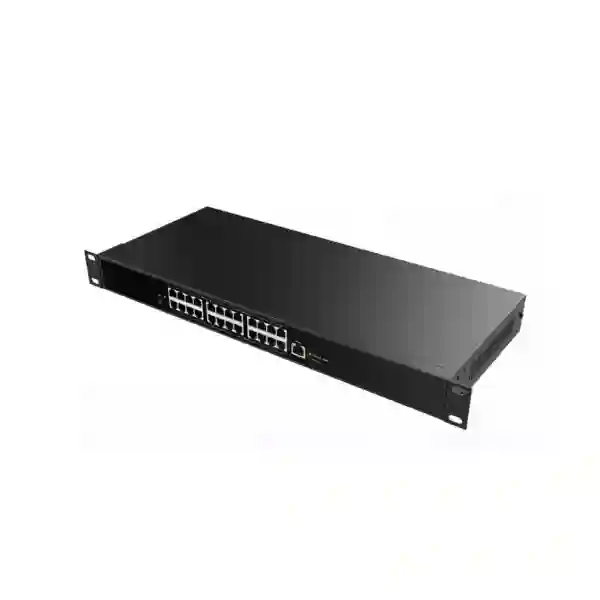
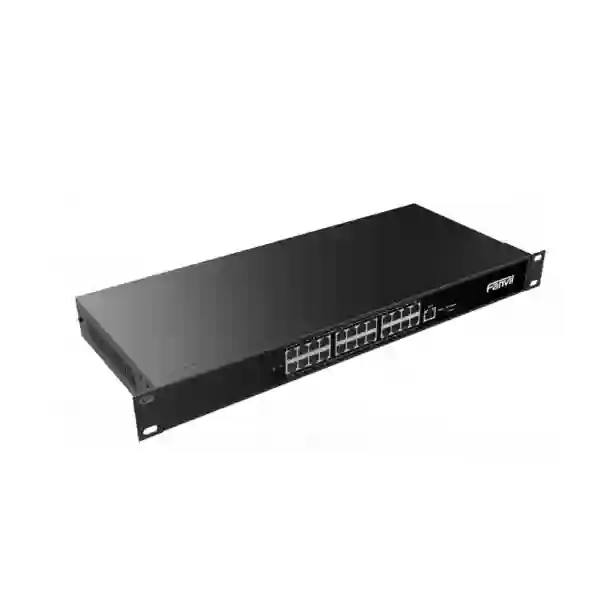
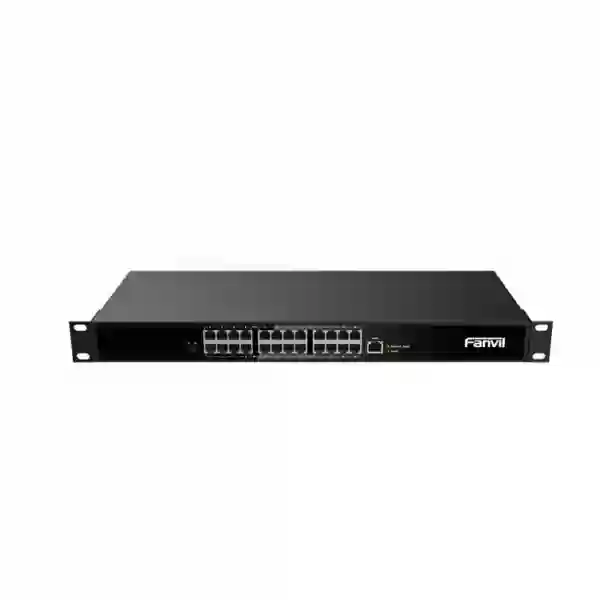
Fanvil PN24 2-Wire PoE Switch
The Fanvil PN24 is built for retrofit projects where an organization wants to move from legacy cabling toward IP communications without treating complete rewiring as the only option. Fanvil specifies one RJ45 uplink, twenty-four RJ11 2-wire interfaces, network and power delivery to compatible Fanvil 2-wire devices, transmission up to 300 metres under the stated cable conditions, a built-in 100–240 V power supply and maximum 160 W output. For offices, hotels, residential communities and older-building renovation, that combination can turn existing two-wire routes into a practical migration path toward modern IP endpoints while reducing invasive cabling work.
Two-wire interfaces for network and power delivery to compatible Fanvil 2-wire devices.
Ethernet uplink to connect the PN24 into the wider IP network.
Fanvil-rated 2-wire network-and-power transmission distance under specified cabling conditions.
Maximum output stated in Fanvil’s PN24 datasheet, with 100–240 V AC input.
What the Fanvil PN24 solves
Many communication upgrades fail to move forward because the endpoint purchase is only a small part of the real project. The larger obstacle may be the building itself: buried telephone cable, inaccessible conduits, decorated hotel rooms, occupied offices, apartment risers, old walls or long routes where replacing cable would interrupt operations. Fanvil developed its 2-wire portfolio around this retrofit problem. The PN24 acts as the centralized 24-interface switch in that architecture, carrying network connectivity and power over suitable existing two-wire runs to compatible devices. This makes it especially useful when the commercial objective is to introduce IP endpoints while controlling rewiring scope, site disturbance and labour.
The PN24 should not be treated as a generic 24-port Ethernet switch. Its access side is purpose-built around Fanvil’s 2-wire ecosystem. The twenty-four RJ11 connections are intended for compatible two-wire devices, while the RJ45 interface provides the uplink into the ordinary Ethernet network. Fanvil documentation shows PN24 working with 2-wire phones such as the X303-2 Wire and H1-2 Wire, and with the PN1 converter when an RJ45 device needs to be connected at the far end of a two-wire link. Correct compatibility planning is therefore more important than simply counting ports.
For a Tanzanian customer evaluating an old-building upgrade, the practical starting point is a cable survey. Existing pairs should be mapped, labelled and checked for continuity, condition, route length, splices and interference risks. The device count should then be matched to the 24 available 2-wire interfaces and the overall power budget. A working design also needs an upstream LAN, IP addressing, any required voice VLAN or QoS policy, PBX or SIP platform where phones are involved, and suitable rack or mounting space. The strongest benefit comes when PN24 is specified as one component of a complete migration plan rather than purchased as an isolated box.
Verified Fanvil PN24 specifications
| Use scenarios | Office, community, hotel and old-building renovation |
| Housing | Galvanized steel, gunmetal finish |
| Network uplink | 1 × RJ45 |
| 2-wire interfaces | 24 × RJ11 for network and power to compatible Fanvil 2-wire devices |
| Power | 100–240 V input; maximum 160 W output |
| Transmission distance | Up to 300 m under Fanvil’s stated cable conditions |
| Working temperature | -20°C to +50°C |
| Storage temperature | -20°C to +70°C |
| Size | 440 × 189.85 × 44 mm |
| Weight | 13.62 kg |
Deployment and compatibility guidance
A PN24 project should begin by separating three questions: what cable exists, what endpoint is required, and what IP service the endpoint must reach. Fanvil’s system can reuse two-wire paths, but the condition and geometry of those paths still matter. Cable gauge, distance, joints and physical quality can influence the result, so an installer should verify the actual route rather than assume every legacy pair will perform identically. The 300-metre figure is a product capability under specified cabling conditions, not a promise that any unknown wire in a building will deliver the same result without testing.
Endpoint compatibility is equally important. Fanvil documents direct two-wire operation with devices in its 2-wire family and shows PN1 as a conversion option when ordinary RJ45 equipment needs to be reached through a two-wire segment. Procurement teams should therefore list every intended endpoint before ordering. If the goal is twenty-four hotel-room phones, the bill of materials differs from a mixed design that includes phones, door communication devices or converted Ethernet endpoints. Power demand should be assessed across the entire connected design so that the PN24’s maximum output is not treated as an unlimited per-port allowance.
The IP side also needs normal network engineering. The PN24 uplink ultimately connects the 2-wire segment to the organization’s Ethernet environment. Where voice is involved, VLAN design, DHCP options, DNS, PBX reachability, SIP security, quality of service and firewall policy may all affect the outcome. For multi-floor or multi-building projects, planners may need more than one PN24 and should think about switch placement, cable pathways, equipment-room power, UPS runtime and uplink resilience. Fanvil also notes Ethernet cascading as part of the 2-wire solution approach. A documented architecture makes future moves, faults and expansion easier to manage.
Related FourTeck Tanzania resources
These links help buyers connect the PN24 conversation to the wider LAN, telephony and infrastructure decision. The PN24 may solve a cabling constraint, but the project still has to account for endpoint selection, upstream switching, PBX requirements, structured cabling, power and support. Reviewing related phone and infrastructure options before finalizing quantities can prevent a retrofit design from solving the wire problem while overlooking the application requirements.
Fanvil PN24 2-Wire PoE Switch Tanzania
For Tanzania, the Fanvil PN24 is most compelling when the building already has extensive two-wire infrastructure and the cost, disruption or practical difficulty of replacing that infrastructure is significant. This can apply to established offices, hotels, apartment-style properties, institutional buildings and renovation projects where cable routes are concealed inside walls or distributed across many rooms. Instead of assuming that every IP migration requires new Ethernet to every endpoint, the PN24 gives project teams another architecture to evaluate. Its twenty-four 2-wire RJ11 interfaces allow a substantial group of compatible endpoints to be served from a centralized unit, while the RJ45 uplink connects the solution back into the normal IP network.
Tanzania deployments should begin with an inventory of the existing cable plant. Mark the origin and destination of each pair, record approximate route lengths, note any joints or shared termination points, and identify cables that have been exposed to moisture, heat or physical damage. This is especially important in older facilities where drawings may no longer match reality. A successful retrofit depends on knowing what is present. Fanvil states transmission up to 300 metres under its documented cable conditions, but the sensible engineering approach is to test representative links before a large-scale installation and keep records of the links that pass.
Power planning is another Tanzania-specific consideration because a centralized communications upgrade often aims to improve resilience as well as features. The PN24 has a built-in wide-range 100–240 V input and up to 160 W output. Project planners should calculate the connected load, decide whether the switch and upstream networking equipment require UPS protection, and provide adequate ventilation and physical security around the mounting location. A central UPS can be useful, but its runtime must be based on the complete load rather than the switch alone.
For quotation preparation, list the number and type of endpoints, existing cable information, PBX or application platform, building floors, required uplink path, rack or wall-mount location, power source, UPS expectations and whether installation will occur while the site remains operational. FourTeck Tanzania can then frame the PN24 as part of a working migration design rather than simply quote a switch without validating the surrounding dependencies.
Fanvil PN24 2-Wire PoE Switch Dar es Salaam
Dar es Salaam contains many commercial environments where technology has been added in layers over time: an original telephone system, later internet connectivity, additional Wi-Fi, CCTV, access control and eventually VoIP. In such sites, the obstacle to a cleaner IP communications platform may be the last cable run to individual rooms rather than the core network. The Fanvil PN24 is relevant to this scenario because it can concentrate twenty-four compatible 2-wire endpoints and connect them to the wider LAN through a single RJ45 uplink. The value proposition is strongest where retaining usable two-wire routes can reduce drilling, trunking changes, ceiling access and disruption to occupied areas.
Hotels and serviced properties in Dar es Salaam are an obvious example. Guest rooms may already have telephone wiring but replacing every run with new Ethernet can affect rooms, corridors and finishes. A PN24-based design can be evaluated as part of a room-phone modernization plan, provided the existing pairs are suitable and the selected endpoints are compatible with Fanvil’s 2-wire architecture. The same logic can apply to multi-room offices, compounds or residential communities where rewiring would be intrusive. The switch does not remove the need for careful survey work; it shifts the project from “replace everything” toward “test, retain and upgrade where practical.”
Network integration should be designed with the same care as the physical retrofit. If the PN24 carries voice endpoints, the upstream network should provide dependable IP addressing, PBX reachability, DNS and appropriate quality-of-service policy. The project team should decide whether voice traffic is separated by VLAN, how the switch uplink reaches the PBX, and what happens during internet or utility-power interruptions. Where the PBX is cloud-hosted, WAN resilience becomes part of voice availability. Where the PBX is on premises, local network resilience and UPS design may be more important.
Dar es Salaam buyers should request a quotation using site facts rather than only a model number: endpoint quantity, floor count, approximate cable lengths, cable condition, planned Fanvil 2-wire devices, rack location, available AC power, upstream switch model and required implementation window. That information helps determine whether one PN24 is enough, whether multiple units are needed, and whether additional converters, endpoints, UPS equipment or network configuration should be included.
Fanvil PN24 2-Wire PoE Switch Mwanza
In Mwanza, a PN24 project can make sense for organizations that want to upgrade communications at an existing facility while avoiding unnecessary reconstruction of cabling pathways. An institution may have functional copper pairs reaching offices, rooms or service points even though the original analog system is outdated. The Fanvil approach allows those pairs to be assessed as part of a modern IP design. With twenty-four RJ11 2-wire interfaces, the PN24 is suited to sites where endpoints are numerous enough to justify centralization but where a conventional new-Cat6-to-every-desk project would be difficult or disruptive.
The first task in Mwanza should be mapping. Legacy cable records can be incomplete, especially after years of extensions and maintenance. Technicians should trace each pair, identify any intermediate joints, verify whether routes are dedicated, and check that the physical medium is appropriate for the planned distance. Fanvil’s published maximum of 300 metres is useful during design, but a route that appears short on a floor plan can become longer after risers and indirect pathways are considered. Field testing is therefore more valuable than estimating by straight-line distance.
A second task is deciding what remains centralized and what stays distributed. The PN24 can become a focal point for the 2-wire side, but the upstream LAN, router or firewall and PBX may sit elsewhere. If the building has several wings or floors, locating multiple switches near cable concentration points may create a cleaner design than stretching every legacy pair back to one distant room. Power availability, ventilation, physical access and maintenance convenience should influence the placement. The 13.62 kg unit should be mounted using a method appropriate to the installation and supporting structure.
For procurement, Mwanza organizations should specify the desired user experience as well as hardware quantity. Identify whether endpoints are hotel-style phones, office phones or converted RJ45 devices through PN1, and document whether users require internal extensions, external SIP calling, voicemail or centralized provisioning. Include the condition of the upstream network and any UPS requirement. A detailed request helps FourTeck distinguish between a straightforward PN24 supply and a complete migration that includes endpoint selection, cable testing, network preparation, configuration and handover documentation.
Fanvil PN24 2-Wire PoE Switch Arusha
Arusha has hospitality, tourism, education, professional-service and institutional environments where a communications upgrade may need to respect an already finished building. The Fanvil PN24 is particularly relevant when existing two-wire telephone runs reach guest rooms, offices or service spaces and replacing them would create avoidable civil work. Fanvil positions the PN24 for offices, communities, hotels and old-building renovation, which aligns well with projects where continuity of operations and preservation of finished interiors are important purchasing factors.
A hospitality retrofit illustrates the planning process. Start by counting rooms and back-office endpoints, then group them by cable termination area. A single PN24 provides twenty-four 2-wire interfaces, so room count and spare-capacity policy determine how many units are required. Next, validate cable condition and distance. The installation team should identify cross-connects, split pairs or undocumented repairs that could undermine performance. Compatible 2-wire phones can connect directly, while Fanvil’s PN1 converter can be considered for supported scenarios where an RJ45 endpoint must be reached through a two-wire segment. Endpoint compatibility should be confirmed before bulk purchasing.
Arusha organizations should also think about service continuity. Reusing cabling may reduce installation disturbance, but the new IP service still depends on the switch uplink, PBX, LAN and power. If guest or business calling is operationally important, the PN24, upstream switch, firewall and PBX should be evaluated together for UPS support and recovery procedures. IT staff should know which rooms map to which PN24 ports, and a labelled patching schedule should be handed over after commissioning.
Quotation requests should include room or extension count, building layout, cable termination locations, estimated longest runs, chosen endpoint model, existing PBX or replacement PBX plan, network switch and firewall information, and expected implementation phases. Phased rollout may be especially useful in hospitality so rooms or departments can be migrated in controlled groups. FourTeck can then help structure a bill of materials and deployment plan that uses PN24 for the specific problem it solves: moving suitable existing two-wire infrastructure into an IP communication architecture without unnecessary rewiring.
Fanvil PN24 2-Wire PoE Switch Dodoma
Dodoma organizations evaluating older administrative, institutional or commercial facilities may find the PN24 useful when modernization goals conflict with the practical limitations of legacy buildings. A conventional VoIP deployment normally assumes Ethernet to each endpoint, but many established sites have widespread telephone pairs and limited spare pathways for new data cable. The PN24 creates an alternative design path: twenty-four RJ11 2-wire ports provide network and power to compatible Fanvil two-wire devices, while the switch itself connects into the IP network through its RJ45 uplink.
For public-facing offices or institutions, minimizing disruption can be as important as minimizing material cost. Closing rooms, opening ceilings or drilling finished walls can interrupt service and create secondary repair work. A cable-reuse strategy can reduce those impacts when the existing wiring tests successfully. However, procurement should not interpret “reuse” as “no survey required.” Each pair should be traced, tested and labelled, and any route that is damaged or unsuitable should be replaced rather than forced into the design. The migration plan should distinguish reusable cable from cable that must be renewed.
Dodoma deployments may also benefit from formal documentation. Create a port schedule linking each PN24 RJ11 interface to a room, department or endpoint. Record the device model, MAC address where applicable, extension number, cable length estimate and test status. On the network side, document the RJ45 uplink, VLAN assignment, IP addressing method and PBX target. This information is valuable during future troubleshooting because support teams can identify whether a problem is at the endpoint, two-wire link, PN24, upstream LAN or telephony platform.
Before requesting a quote, provide the exact desired outcome. A buyer replacing an analog office phone system needs different supporting equipment from a customer extending IP connectivity to selected legacy-wire locations. Include user count, endpoint types, building zones, existing cable details, power and UPS requirements, network topology and whether installation, testing or configuration services are required. That scope allows the Fanvil PN24 to be evaluated as an engineering component inside a complete communications project rather than as a standalone switch chosen only because it has twenty-four ports.
Fanvil PN24 2-Wire PoE Switch UAE
UAE projects often include hotels, apartment buildings, offices and mixed-use facilities where renovation schedules are tightly controlled and existing finishes must be protected. The Fanvil PN24 can be relevant when legacy two-wire cabling is already distributed to many rooms and an IP communications upgrade is desired without a complete recabling exercise. Its 24 RJ11 interfaces, single RJ45 uplink and ability to deliver network connectivity and power over compatible two-wire links make it a purpose-built retrofit product rather than a conventional office Ethernet switch.
For a UAE consultant or integrator, the key design decision is whether cable reuse produces a better total project outcome than fresh structured cabling. New Cat6 may still be preferable during a major refurbishment where walls and ceilings are already open. PN24 becomes more attractive when spaces are occupied, cable access is restricted, or the program needs to reduce room downtime. The comparison should include labour, access, making good, fire stopping, testing, operational disruption and future maintainability, not only cable cost. Where the old pairs are suitable, retaining them may shorten the physical phase of the upgrade.
The network side should remain enterprise-grade. The PN24 uplink must connect into the appropriate LAN segment, and voice deployments should be coordinated with PBX, SIP trunk, QoS, security and redundancy policies. If several PN24 units serve many rooms, planners should calculate aggregate traffic and establish a clear switching hierarchy rather than treating each switch independently. The built-in 100–240 V power supply simplifies input requirements, but the full connected load and upstream equipment should be considered in UPS calculations.
Organizations operating in both Tanzania and the Gulf can keep a common project methodology while adapting site details. FourTeck UAE IT and telecom solutions provides regional context for UAE projects. For quotation, include property type, endpoint quantity, current cabling, existing PBX, renovation constraints, rack locations and required cutover sequence. That information supports a decision on whether PN24 should be used throughout, only in selected legacy zones, or combined with conventional Ethernet in a hybrid retrofit.
Fanvil PN24 2-Wire PoE Switch Uganda
Ugandan organizations may evaluate the Fanvil PN24 when expanding VoIP or IP communications into a facility that already has usable telephone pairs but limited structured Ethernet. This is common in older offices, schools, hospitality properties and branch environments where the original cabling still reaches the correct rooms even though the analog platform is no longer adequate. The PN24 offers a way to preserve part of that physical investment by converting suitable two-wire paths into connections for compatible Fanvil 2-wire devices.
The engineering focus should be on repeatability. If several branches are being upgraded, the organization can create a standard survey sheet covering pair condition, approximate distance, termination point, endpoint type, port number and test result. A standard PN24 installation drawing can then show the RJ45 uplink, power feed, UPS, rack or wall position and relationship to the PBX network. This discipline is valuable for distributed sites because remote support becomes easier when every branch follows the same naming and documentation rules.
Power resilience should be considered in the context of the entire communication path. The PN24 can centralize endpoint power over the 2-wire segment, but calls still depend on the upstream LAN and PBX. A UPS that supports only the PN24 while the router or network switch shuts down will not preserve service. Calculate loads across the relevant equipment and decide which services must remain available during short interruptions. The maximum 160 W PN24 output should also be respected when planning connected devices.
For regional coordination, FourTeck Uganda communication and networking solutions can support Uganda-focused project discussions. A useful quote request should state whether the requirement is a hotel-room phone refresh, office migration, branch standardization or mixed endpoint project. Include the number of cable pairs, intended Fanvil devices, longest estimated runs, PBX platform, upstream switching, required installation services and expansion expectations. These details make it possible to assess PN24 quantity and supporting components accurately.
Fanvil PN24 2-Wire PoE Switch Kampala
Kampala businesses often operate from buildings that have been adapted repeatedly as teams grow, tenants change and new systems are added. Telephone pairs may already reach desks, offices or rooms even where Ethernet coverage is inconsistent. The Fanvil PN24 can be considered when the objective is to modernize voice or selected network endpoints while reusing those existing pairs. Because the switch supports twenty-four RJ11 2-wire connections, it can serve as a concentrated retrofit point for a floor or building zone rather than requiring a separate active device for every legacy run.
Before selecting the product, Kampala IT teams should identify which endpoints genuinely belong on the 2-wire system. A compatible Fanvil 2-wire phone may connect directly, while an RJ45 endpoint may require the PN1 conversion approach documented in Fanvil’s solution material. It is better to build an endpoint matrix first than to discover after purchase that a device expects ordinary Ethernet. The matrix should list room, endpoint model, required service, approximate cable length, expected power source and any special function such as door intercom or hotel calling.
The uplink side should be placed on a stable network. For voice, packet loss, congestion and unstable WAN connectivity can affect call quality even when the local two-wire link is functioning properly. Managed switches and sensible QoS can help keep voice predictable where data, CCTV and Wi-Fi also share the site network. If the PBX is remote or cloud-hosted, dual-WAN or other internet resilience may be more relevant than adding redundancy only to the access device.
A Kampala procurement team should compare the complete installed cost of two approaches: replacing all endpoint cabling versus reusing verified pairs with PN24. Include access labour, containment, wall repairs, testing, endpoint replacement, switch hardware, converters where needed and downtime. The lowest equipment cost is not always the lowest project cost. A properly scoped PN24 design can be attractive precisely because it reduces work in occupied spaces while still moving users onto an IP-based platform.
Fanvil PN24 2-Wire PoE Switch Arua
For Arua sites, the Fanvil PN24 can be especially useful when technical support resources are centralized elsewhere and the local building already contains functional two-wire runs. A retrofit that reuses known cabling can reduce the amount of new physical work required at the branch, but the deployment should be prepared carefully before equipment is sent. Survey information, port allocation and endpoint configuration should be documented so installation can follow a clear plan rather than depend on discovery during the cutover.
A practical preparation process starts with photographs and cable records from the site. Identify the communications room, existing telephone distribution point, power outlet, rack or wall space and the path of each pair. If possible, test representative links for continuity and confirm approximate lengths. Fanvil rates the PN24 for up to 300 metres under specified cabling conditions, but branch projects should verify real cable quality rather than rely only on maximum figures. Pairs with corrosion, damaged insulation or uncertain parallel connections should be repaired or replaced.
The 24-interface capacity can simplify branch growth planning. An Arua location with fewer than twenty-four endpoints may reserve unused interfaces for expansion, while a larger facility can distribute several PN24 units by building zone. Expansion should be planned with the 160 W maximum output and upstream network capacity in mind. If a new endpoint is added later, support staff should be able to identify the physical pair and logical service from the documentation without re-tracing the whole building.
When requesting a quotation for Arua, state whether devices should be preconfigured, whether the branch has an existing IP PBX or reaches a central PBX over WAN, and whether remote management procedures are required. Include cable counts, switch quantities, endpoint models, UPS expectations and installation responsibilities. This level of preparation is particularly helpful for distant or distributed sites because it reduces the risk of missing accessories, incompatible endpoints or undocumented cabling conditions causing avoidable delays during deployment.
Fanvil PN24 2-Wire PoE Switch Mbarara
Mbarara businesses, institutions, hospitality properties and branch offices may use PN24 as part of a controlled transition from older telephone infrastructure to IP communications. The product’s role is specific: it provides a central 2-wire PoE switching point with twenty-four RJ11 interfaces and an Ethernet uplink. It is therefore most valuable where a building’s existing two-wire routes still reach the right locations and can be tested for reuse, while the organization wants modern IP endpoints or a unified PBX architecture.
The buying decision should consider the lifecycle of the building. If a major refurbishment is already planned, installing new structured cabling may offer broader long-term flexibility. If the building will remain occupied and the legacy cable is sound, PN24 can reduce unnecessary work and speed the migration of specific services. A hybrid design is also possible: new Ethernet for renovated areas and Fanvil 2-wire for zones where access is difficult. This can prevent the project from being forced into an all-or-nothing choice.
Operational handover matters. Each RJ11 interface should be labelled consistently at the PN24 and at the far endpoint. The upstream RJ45 connection should be recorded with switch port, VLAN and IP information. If connected phones register to a PBX, extension numbers and device identities should also be mapped. A simple spreadsheet or rack diagram can save significant troubleshooting time later. Staff should know where the PN24 is powered from and how to distinguish a local endpoint issue from an upstream network or PBX problem.
For Mbarara quotations, provide building drawings if available, endpoint count, pair count, longest cable routes, proposed Fanvil devices, existing network details, PBX information and growth expectations. If installation must occur outside business hours or in phases, state that in the scope. FourTeck can then help evaluate the number of PN24 units, compatible endpoints, conversion accessories, switching, UPS and implementation tasks as one bill of materials rather than leaving critical dependencies to be discovered after the hardware arrives.
Fanvil PN24 2-Wire PoE Switch Gulu
Gulu organizations can use the Fanvil PN24 when the key upgrade challenge is not the IP application but the physical path to existing rooms or work areas. Legacy pairs may already connect administrative offices, accommodation rooms, service counters or campus spaces. If those cables are suitable, PN24 allows the project to retain them and deliver network plus power to compatible Fanvil two-wire endpoints. This is particularly useful where installing new structured cable would involve long runs, difficult access or disruption to normal operations.
A campus or institutional site should decide how to distribute PN24 units geographically. Centralizing every pair into one room can be inefficient if buildings are far apart. It may be better to locate switches near existing cable concentration points and use the IP network for backbone connectivity between zones. This approach can shorten legacy-wire runs, simplify fault isolation and make future expansion clearer. Equipment locations should still provide secure mounting, appropriate environmental conditions and reliable AC power within Fanvil’s specified operating range.
Where voice is the main application, users care about call reliability rather than the transport technology behind it. The design should therefore include the PBX, SIP service and upstream WAN alongside the PN24. Extension provisioning, emergency calling policies, voicemail, reception routing and branch dialing need to be planned at the application layer. A strong cable-reuse design can still produce a poor user experience if call routing or WAN quality is neglected.
Gulu buyers should request an engineering review when the existing wiring is undocumented or when multiple buildings are involved. Provide the known cable topology, number of endpoints per building, existing racks, power availability and network backbone. Ask for a quotation that separates equipment from optional survey, installation, configuration and testing services so procurement can compare scope clearly. The PN24 can reduce the need for new endpoint cabling, but its full value is realized when cable reuse is combined with accurate network planning and a documented handover.
Fanvil PN24 2-Wire PoE Switch Kenya
Kenyan businesses evaluating voice modernization in established properties may find the Fanvil PN24 useful as a retrofit alternative to complete horizontal recabling. Hotels, offices, schools, clinics and multi-tenant buildings can contain extensive telephone pairs that still follow useful routes. When those pairs are technically suitable, the PN24 allows compatible Fanvil devices to receive both network connectivity and power over two wires, with the switch connecting back to the conventional LAN through its RJ45 uplink.
The financial comparison should focus on total project cost rather than the switch price alone. Rewiring can involve cable, containment, labour, ceiling access, drilling, reinstatement, room downtime and retesting. A PN24 design adds specialized hardware but can remove some of those physical tasks. The right choice depends on the building and intended lifecycle. New structured cabling may still be the best investment in a major renovation, while cable reuse can be superior in an occupied hotel or office where disruption carries a real operational cost.
Kenya projects should validate cable and endpoint compatibility before committing to quantity. A proof-of-concept using representative long and short cable runs can demonstrate whether the existing infrastructure behaves as expected. The pilot should also test the actual application: phone registration, call quality, device boot behavior, power stability and any PN1-converted endpoint. Once the design is validated, the team can standardize labeling and installation methods for the broader rollout.
For Kenya-focused project support, FourTeck Kenya IT and VoIP solutions provides a regional route for related requirements. A quotation request should include property type, endpoint count, existing pairs, estimated cable lengths, PBX platform, upstream network, required UPS and cutover plan. Businesses operating in both Kenya and Tanzania can use the same technical template across sites while allowing each building’s cable condition and network architecture to determine the final bill of materials.
Fanvil PN24 2-Wire PoE Switch Kuwait
Kuwait properties undergoing communications upgrades can consider the Fanvil PN24 where existing two-wire infrastructure remains usable and access to finished rooms is restricted or expensive. The device is suited to retrofit logic: preserve the physical pair where appropriate, use the PN24 as the central two-wire PoE switch, and integrate the resulting endpoints into the modern IP network. This can be particularly attractive in hotels, office buildings or residential-style developments where the cost of opening walls and ceilings outweighs the benefit of installing new cable everywhere.
Environmental and equipment-room planning still matter. The PN24’s published operating range is -20°C to +50°C, but installers should place it in an appropriate indoor technical area rather than expose it to uncontrolled heat, dust or mechanical risk. Secure mounting, clear labeling and accessible maintenance space should be part of the installation. Its built-in 100–240 V supply simplifies compatibility with normal facility power, while a UPS can be considered where voice continuity is important.
For hotel or multi-room applications, planners should create a room-to-port schedule before migration. Each room’s cable pair, endpoint and extension should be identified. During cutover, this enables technicians to move services methodically and test each location. If some rooms require devices outside the native Fanvil 2-wire family, the PN1 conversion approach can be evaluated rather than assuming direct RJ11 compatibility. This distinction should be reflected in the bill of materials.
Regional procurement teams can use FourTeck Kuwait IT and communication solutions for Kuwait-specific project coordination. A strong request for quotation includes cable survey findings, room or extension count, PBX details, network topology, endpoint models, UPS requirement and implementation timetable. That creates a realistic basis for comparing a PN24-based retrofit with conventional recabling and helps avoid purchasing decisions driven only by headline port count.
Fanvil PN24 2-Wire PoE Switch Ghana
Ghanaian organizations can evaluate PN24 when established telephone cabling is widespread but the communication platform needs to move toward IP. The switch provides a centralized route for up to twenty-four compatible two-wire connections, reducing the need to place powered conversion hardware at every source point. Its single Ethernet uplink joins the two-wire access layer to the normal network, allowing the physical reuse decision to remain separate from the wider PBX and LAN architecture.
This separation is useful for phased modernization. A property can upgrade one floor, wing or department while leaving other areas unchanged until budget or operational timing allows. Each phase should be documented so the final architecture remains coherent. If multiple PN24 units are introduced over time, establish a naming convention and port map from the beginning. The organization should know which unit serves which building area and how its uplink reaches the core network.
Cable quality must be verified in the Ghana deployment just as in any other market. Existing telephone pairs may have been altered, bridged or repaired over many years. Those conditions can affect a high-frequency IP-over-pair application differently from analog voice. A pilot link should therefore use representative cable, preferably including one of the longer or more complex routes. Successful testing provides better evidence than assuming all pairs are equivalent because they previously carried dial tone.
For Ghana requirements, FourTeck Ghana business IT solutions can be used for regional planning. Buyers should submit endpoint quantity, desired services, current cabling map, PBX or SIP platform, upstream switches, rack locations and power resilience goals. A quotation can then distinguish the PN24 hardware from compatible endpoints, PN1 converters where required, network changes, UPS capacity, installation labour and testing. That scope gives management a clearer view of total migration cost and the operational benefit of minimizing disruptive recabling.
Fanvil PN24 2-Wire PoE Switch Nigeria
Nigeria has many large commercial, hospitality and institutional properties where legacy telephone cable remains in place long after the original PBX has become obsolete. The Fanvil PN24 is designed for exactly the architectural question such sites face: can those existing pairs be reused to support an IP-based endpoint layer instead of being abandoned? With twenty-four two-wire RJ11 interfaces and an Ethernet uplink, the PN24 can form a bridge between the established physical cabling and a modern LAN-based communications system.
For large Nigerian sites, scale should be considered early. A hotel with hundreds of rooms or a campus with several buildings may require multiple PN24 units. The design should define how those switches aggregate into the LAN, what IP addressing and VLAN strategy they use, and how power protection is distributed. It may be useful to align one switch or switch group with each cable riser or building zone. This creates clearer fault boundaries and avoids pulling every legacy pair back to a single distant location.
Power quality and continuity can be central operational concerns. The PN24 accepts 100–240 V AC and has a built-in supply, but an installation should still protect the complete communication chain appropriately. UPS sizing should include PN24 units, upstream switches, router or firewall and any local PBX that must remain functional. If the PBX is hosted elsewhere, WAN equipment becomes equally important. The objective is to prevent a situation where endpoint power remains available but the network path required for calls is down.
Nigeria-focused buyers can refer to FourTeck Nigeria IT services and infrastructure for regional project context. Provide the number of buildings, rooms or extensions, existing cable topology, target Fanvil endpoints, PBX architecture, required resilience and rollout schedule when requesting pricing. A phased pilot on one representative zone can be a sensible step before committing to a larger multi-switch deployment, especially where the quality of old cabling varies across the property.
Fanvil PN24 2-Wire PoE Switch Seychelles
Seychelles hospitality and commercial sites may place a particularly high value on retrofit solutions that reduce intrusive work in finished guest or customer spaces. Resort rooms, villas, offices and service buildings can have existing telephone pairs that remain physically usable even when the communication platform needs modernization. The Fanvil PN24 allows those cable routes to be evaluated for network-and-power delivery to compatible 2-wire devices, helping project teams avoid unnecessary replacement of concealed cabling where the existing pair passes technical checks.
Hospitality projects should pay close attention to rollout sequencing. Closing many rooms at once can have a direct operational cost, so the installation plan may migrate a floor or room block at a time. Pre-labeling cables, preconfiguring endpoints and preparing port schedules can shorten the work inside each room. The PN24’s 24-interface format is convenient for grouping room sets, but the exact grouping should follow the property’s riser and distribution layout rather than an arbitrary port-count target.
Environmental conditions also deserve attention. The PN24 should be installed in an appropriate technical area with controlled exposure and secure mounting. Legacy cable routes near humid or coastal environments should be inspected carefully for corrosion at joints and terminations. Reusing cable makes sense only when the cable is reliable; compromised pairs should be replaced rather than retained for the sake of avoiding new work. A sample test from each building zone can identify whether conditions differ across the property.
Seychelles buyers should prepare a quotation package containing room counts, building maps, cable termination points, intended phone or endpoint models, existing PBX details, LAN topology, rack and UPS locations and preferred migration phases. Where the property operates across several islands or remote facilities, support planning should include spare hardware, clear labeling and configuration backups. The PN24 can reduce physical deployment complexity, but predictable long-term operation depends on disciplined documentation and an architecture that links the two-wire access layer cleanly to the organization’s IP network.
Selection, sizing and quotation checklist
Before ordering the Fanvil PN24, count the required two-wire endpoints and include sensible growth rather than filling every interface on day one without a capacity plan. Confirm the exact Fanvil endpoint model for each location and identify any device that would need PN1 conversion. Map the existing two-wire cabling, record approximate distances and test representative links. Verify where the PN24 will be mounted, how the RJ45 uplink reaches the LAN, and whether the installation location has appropriate power, ventilation and physical security.
For voice projects, add the PBX platform, SIP trunk architecture, VLAN, DHCP, DNS and QoS expectations. For hotel or multi-room sites, prepare a room-to-port schedule. For multi-building deployments, decide whether multiple PN24 units should be distributed near cable concentration points. Calculate the connected device power against the maximum 160 W output and size any UPS for the complete communication path. Include installation, testing, labeling and documentation requirements in the request for quotation so supplier comparisons cover the same scope.
A useful procurement package should therefore include: PN24 quantity, endpoint quantity and exact model, PN1 quantity if applicable, cable survey status, longest estimated run, existing network-switch details, PBX details, rack or wall-mount preference, UPS requirement, implementation phases, configuration responsibility and post-installation support expectations. This prevents a box-only quote from hiding the real dependencies that determine whether the system will work on site.
Frequently asked questions
What is the Fanvil PN24?
The PN24 is a Fanvil 2-wire PoE switch designed for retrofit networking. It has one RJ45 uplink and twenty-four RJ11 2-wire interfaces that can provide network connectivity and power to compatible Fanvil 2-wire devices.
Can the PN24 reuse existing telephone wire?
Reusing suitable existing two-wire infrastructure is a core purpose of Fanvil’s solution. The actual cable should still be inspected and tested because condition, distance, joints and cable characteristics can affect performance.
How far can a PN24 two-wire link reach?
Fanvil specifies network-and-power transmission up to 300 metres under its stated cabling conditions. Designers should not assume that every unknown legacy pair will achieve the maximum without testing.
Is PN24 a normal 24-port Ethernet PoE switch?
No. The access interfaces are RJ11 two-wire connections for Fanvil’s compatible 2-wire ecosystem. It has one RJ45 network uplink. Buyers should verify endpoint compatibility rather than treating the unit like a standard 24-port RJ45 LAN switch.
What is the PN24 power specification?
Fanvil lists a built-in 100–240 V input power supply and maximum 160 W output. A project should calculate the total connected device load and any UPS requirement before deployment.
Which Fanvil devices are used with the two-wire solution?
Fanvil documentation includes two-wire phones such as X303-2 Wire and H1-2 Wire and shows the PN1 converter for scenarios where an RJ45 device is reached over a two-wire segment. The exact bill of materials should be validated against the intended endpoint.
Is PN24 suitable for hotels?
Fanvil explicitly lists hotel use among PN24 scenarios. It can be attractive where room telephone wiring already exists and the property wants to introduce compatible IP endpoints while minimizing room disruption. Cable testing and a room-to-port migration plan are recommended.
What should I provide for a quotation?
Provide endpoint quantity, intended endpoint models, building layout, cable condition and approximate distances, PBX or application requirements, network topology, rack or mounting location, UPS requirements, installation scope and expected future growth.
Decision recap
Choose the Fanvil PN24 when the project has a clear retrofit requirement: suitable two-wire cabling is already installed, the intended endpoints are compatible with Fanvil’s 2-wire architecture, and avoiding full recabling creates meaningful savings in time, disruption or building work. Do not choose it merely because “24 ports” sounds similar to a standard Ethernet switch. Its value comes from the specialized two-wire transport model.
The most successful deployments combine a cable survey, endpoint matrix, power budget, IP network design and migration schedule. They also document the installation so every RJ11 port can be traced to a room or device. If a site is already undergoing a complete refurbishment with open pathways, new structured cabling may still be the better long-term choice. If spaces are occupied and legacy pairs are good, PN24 can provide a highly practical bridge to modern IP services.
Plan the PN24 as a complete retrofit solution
Share the number of rooms or endpoints, existing cable details, intended Fanvil 2-wire devices, PBX requirements, network layout and power-resilience goals. FourTeck can help organize the discussion around cable reuse, endpoint compatibility, switch quantity, converters, upstream networking and deployment scope so the quotation reflects the working system rather than a single hardware line item.




Reviews
There are no reviews yet.