
FANVIL SIP PAGING & CONTROL CONSOLE
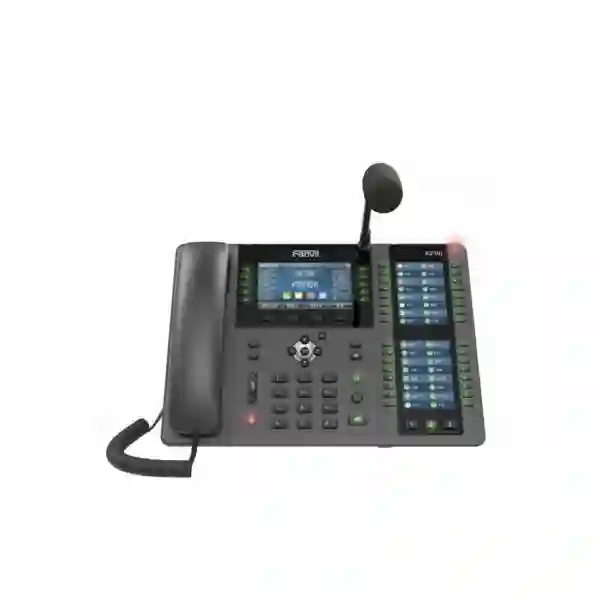
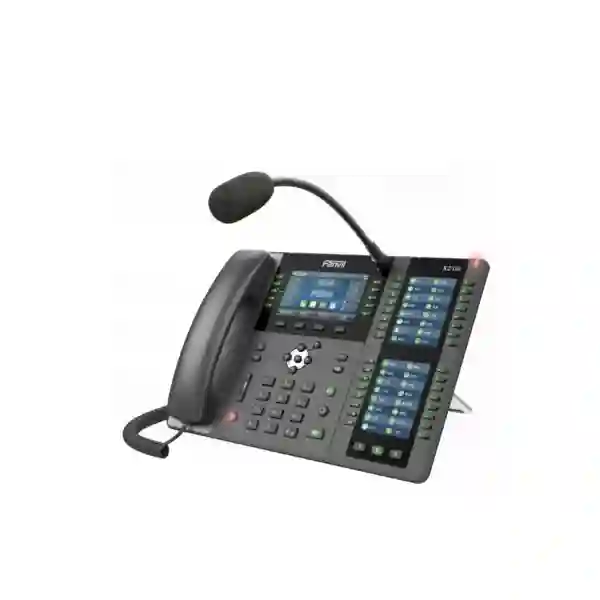
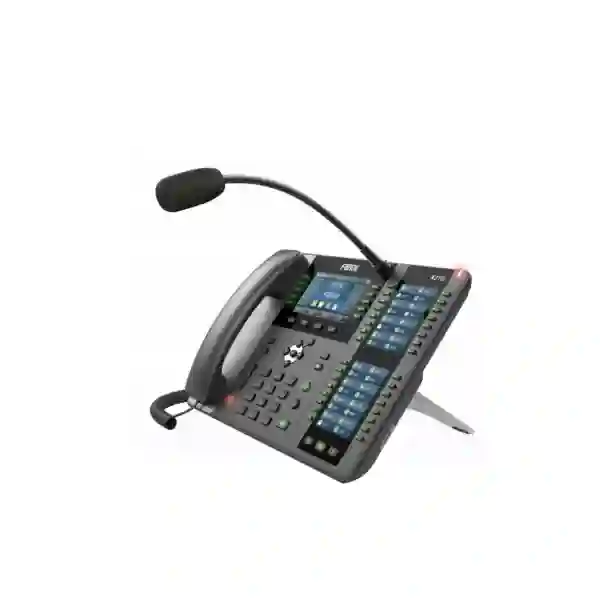
Fanvil X210i Paging Console Phone
The Fanvil X210i is a visualization paging console phone built for organizations that need a dedicated communications position for frequent calling, paging, intercom activity, monitoring workflows and fast access to many extensions. Its combination of a directional gooseneck microphone, HD audio, a 4.3-inch main color display, two 3.5-inch DSS mapping displays and up to 106 programmable DSS keys makes it especially relevant for reception desks, security rooms, facility management teams, industrial control points and coordination desks.
What the Fanvil X210i solves
A standard desk phone can become inefficient when one operator must watch many extensions, call groups, doors, departments or response teams. The X210i addresses that operational problem by presenting a large number of programmable DSS functions in a dedicated console format. Instead of repeatedly entering extensions or navigating through menus, an administrator can assign keys for speed dial, BLF-style status use where supported by the PBX, paging destinations, intercom targets or other programmable functions. This can shorten the path between an event and the communication action that follows it.
Fanvil positions the X210i for industry customers and monitoring or management use. In practice, it can be considered for security desks, reception counters, warehouses, factories, transport coordination points, campuses, hospitals, hospitality operations and office management stations. The exact workflow depends on the connected SIP platform, network design and any integrated door-phone, paging or monitoring system. Procurement should therefore start with the intended call flow rather than with the phone alone.
Fast operator access
Up to 106 DSS keys provide a broad surface for frequently used contacts and functions, while 42 physical DSS keys use tri-color indicators and three page-switch keys to extend the available assignments.
Paging-oriented audio
A directional gooseneck microphone is supplied for a console-style operating position, complemented by HD audio on handset and hands-free modes plus wideband codecs including G.722 and Opus.
Business-network readiness
Dual 10/100/1000 Mbps Ethernet, integrated PoE, VLAN, LLDP, 802.1X, QoS and SIP over UDP, TCP or TLS support allow the console to fit into structured voice-network deployments.
Verified X210i technical highlights
| SIP capacity | 20 SIP lines |
| Displays | One 4.3-inch 480×272 color LCD plus two 3.5-inch 320×480 DSS key-mapping color LCDs |
| Programmable keys | Up to 106 DSS keys; 42 physical DSS keys with tri-color LED indicators |
| Audio | HD handset and hands-free audio; codecs include G.711a/u, G.723.1, G.726-32K, G.729A/B, AMR, iLBC, G.722, AMR-WB and Opus |
| Video | H.264 video codec support for receiving video calls, with supported resolutions including QCIF, QVGA, CIF, VGA, 4CIF, 720P and 1080P in the current Fanvil datasheet |
| Network | Dual bridged Gigabit Ethernet ports; IPv4/IPv6; VLAN; LLDP; QoS; 802.1X; L2TP and OpenVPN |
| Connectivity | Built-in Bluetooth; Wi-Fi connectivity via supported USB Wi-Fi dongle; USB 2.0 port |
| Power | Integrated PoE; 5V/2A DC power input available for optional external power arrangements |
| Management | Web management, provisioning via FTP/TFTP/HTTP/HTTPS/DHCP Option 66/SIP PnP/TR-069, configuration import/export, firmware upgrade and syslog |
Specifications should be confirmed against the current Fanvil documentation and the exact shipped hardware/firmware at the time of quotation, because manufacturers may revise implementation details.
Compatibility, PBX planning and deployment
The X210i uses the standard SIP 2.0 protocol and supports SIP signaling over UDP, TCP and TLS. That makes it suitable for evaluation with many SIP-based IP PBX and unified-communications environments, but protocol support by itself does not guarantee that every programmable-key behavior will work identically on every platform. Before purchase, confirm the PBX version, account quantity, registration method, BLF or presence requirements, paging method, intercom behavior, multicast requirements if applicable, codec policy and any door-phone or video integration expectations.
Network readiness is equally important. The console can use PoE, which can simplify desk cabling when the access switch has sufficient PoE budget. VLAN and LLDP features can support voice-network segmentation, while QoS can help protect real-time traffic when the data network is busy. For a mission-sensitive control position, consider UPS-backed switching and firewall infrastructure so that the phone is not the only protected component. If the console receives video from compatible SIP endpoints, verify LAN capacity, endpoint interoperability and the intended display workflow during commissioning.
For organizations planning a broader voice environment, FourTeck Tanzania’s business technology solutions overview explains how voice endpoints fit with switching, Wi-Fi, security and supporting infrastructure. Buyers can also review the FourTeck Tanzania technology shop when comparing related devices and categories. For voice-specialist regional context, the FourTeck IP phone specialist site provides broader IP-telephony orientation, while FourTeck Uganda and FourTeck Kenya support regional procurement research for organizations operating across East Africa.
Fanvil X210i Paging Console Phone Tanzania
For buyers in Tanzania, the Fanvil X210i is most relevant where one communication point must coordinate a larger operational environment. Security operations, industrial facilities, logistics teams, property management desks, reception areas and multi-department offices often need to contact many internal users quickly. In such environments, the value of the X210i is not simply that it is a SIP phone; its purpose is to put a large number of programmable actions in front of an operator so that routine communication can happen with fewer steps. The 20 SIP-line capacity is useful when a desk must participate in multiple line or account contexts, while the physical DSS keys and dedicated side displays provide a clearer overview than a conventional small-screen handset.
A Tanzania deployment should begin with the existing or planned PBX. Buyers should identify whether the system uses on-premises SIP, a hosted PBX, a branch voice platform or another architecture. The required SIP accounts, paging groups, intercom destinations, door phones and monitored extensions should be mapped before the console is programmed. Where the X210i is intended for a security or emergency coordination role, it is particularly useful to prepare a key plan that gives the most important contacts priority positions and uses consistent naming across shifts. This reduces dependence on one operator’s memory and makes handover between users easier.
The network should be assessed with the same care. PoE can simplify installation, but the switch must have adequate power budget and should ideally be connected to backup power when voice availability is important. VLAN segmentation can separate voice traffic from general workstation traffic, and QoS policy can help preserve call quality during periods of heavy network use. Where sites depend on internet-connected SIP services, internet resilience and firewall configuration become part of the telephony design. The X210i itself supports Gigabit Ethernet, IPv4/IPv6, VLAN, LLDP, 802.1X and VPN features, giving network administrators several tools for a managed deployment.
When requesting a quotation in Tanzania, provide the number of consoles required, PBX brand and version, approximate extension count, whether PoE is available, whether a Bluetooth or USB headset is needed, whether Wi-Fi is required through a supported dongle, and whether the desk needs to view video from SIP door phones or other supported endpoints. This information makes it easier to evaluate the complete requirement rather than treating the X210i as an isolated device.
Fanvil X210i Paging Console Phone Dar es Salaam
In Dar es Salaam, organizations with busy front desks, security rooms, logistics operations, warehouses, commercial buildings and multi-floor offices can use the Fanvil X210i as a central SIP communications position. A typical requirement may involve calling departments, contacting guards, paging teams, responding to visitor requests or coordinating facilities staff. The console format is particularly useful when a standard phone would force the operator to search through directories repeatedly. By assigning important extensions and functions to the DSS system, the operator gains a visible and repeatable workflow.
Dar es Salaam deployments can range from single-building offices to sites with multiple network segments or branch connectivity. Before installation, the voice VLAN, switch ports, PoE availability, IP addressing and PBX registration details should be documented. For a reception desk, attention may focus on extension visibility, call transfer and access-control coordination. For a security control room, the priority may shift toward intercom, paging, video call reception and rapid contact with response groups. Because the X210i supports H.264 receiving, it can be considered in workflows where a compatible SIP video endpoint such as a door phone sends a video call to the operator, subject to interoperability verification.
The console’s directional gooseneck microphone can also suit fixed operator stations where the user needs to speak hands-free while watching other systems. However, acoustic conditions still matter. A noisy control room, warehouse office or shared reception area may require headset use or a carefully positioned console. Bluetooth support and EHS-related headset compatibility options can therefore be relevant, but the exact headset model and cable requirements should be checked before procurement.
For quotation planning in Dar es Salaam, include the intended desk role, required SIP accounts, key destinations, paging groups, integration targets and network readiness. If the site will run the phone over PoE, confirm the switch standard and available budget. If the operator desk is expected to remain functional during short power interruptions, ensure the upstream switch, PBX and router or firewall are also protected by suitable UPS infrastructure. A well-planned deployment focuses on the complete communication path, not just the handset.
Fanvil X210i Paging Console Phone Mwanza
Businesses and institutions in Mwanza evaluating the Fanvil X210i should look first at operational coordination. The device is best suited to users who repeatedly interact with a large number of extensions or who need a console-like layout for paging, monitoring and intercom functions. A warehouse supervisor may need one-touch contacts for receiving, dispatch, security and administration. A hotel or property desk may need groups for housekeeping, engineering and access points. An industrial site may need departments, gatehouses and response teams. The X210i can bring those targets onto programmable DSS positions rather than leaving them buried in a phonebook.
Its three-display layout supports this operator model. The main 4.3-inch screen handles normal phone information while two side color displays map DSS functions. This separation helps the user distinguish ordinary call activity from the larger programmable control surface. The 42 physical DSS keys can be extended across pages for up to 106 programmable positions. The actual labels and behavior should be designed around the connected PBX and user role, and a printed or documented key plan is useful for training and future support.
For Mwanza sites, network design should account for the physical environment and topology. Voice traffic benefits from stable switching, appropriate VLAN design, correct DHCP or static addressing strategy and QoS where congestion is possible. Dual Gigabit Ethernet allows the console to share a network drop with a PC in suitable designs, but the network administrator should confirm whether that approach aligns with segmentation and security policy. The built-in PoE capability can reduce local power adapters, although backup power for the switch remains important where continuity matters.
When obtaining a quote, define whether the project is a replacement, an expansion or a new IP telephony deployment. Replacement projects should identify the existing PBX, old console functions and any features that must be preserved. New deployments should include total phone count, switch readiness, SIP trunk or service design, internal dialing plan and any intercom or door-phone requirements. The X210i is powerful when configured as part of a coherent workflow, so the configuration brief should be treated as a key project document.
Fanvil X210i Paging Console Phone Arusha
In Arusha, the Fanvil X210i can fit hospitality properties, tour and transport coordination offices, business campuses, security desks, institutions and operational control points where one user must reach many contacts quickly. The programmable DSS architecture is especially useful for teams whose contacts are predictable: reception may need rooms or departments, transport coordinators may need dispatch contacts, and property staff may need maintenance, security and management groups. By presenting these actions directly on the console, the X210i can reduce the friction of navigating directories during busy periods.
For hospitality and visitor-facing environments, the phone’s call-handling functions should be mapped carefully to front-desk processes. Call transfer, hold, speed dial, intercom and paging behavior can depend on PBX configuration. A hotel or lodge might also use SIP door phones at controlled entrances; in that case, H.264 video-call receiving support may be relevant if the endpoint and PBX support a compatible flow. It is important to test the complete chain rather than assuming every SIP video device will interoperate automatically.
The X210i supports HD voice on handset and speakerphone plus a directional gooseneck microphone. That can be helpful for a desk that combines telephony with other work, but ambient noise and privacy still influence the preferred audio mode. A headset may be better for a busy shared office, while speakerphone operation may suit a quieter control room. Bluetooth support broadens headset options, and the USB port can support selected accessories or storage functions according to Fanvil documentation.
Arusha procurement teams should request configuration information alongside hardware pricing. The quotation conversation should cover the number of SIP accounts, number of DSS destinations, PBX brand, whether the phone will use PoE, required headset type, VLAN and network settings, and whether remote provisioning is expected. If a site has branch links or relies on hosted voice, connectivity quality should also be reviewed. This keeps the purchasing decision tied to the real communication outcome: reliable, fast operator access to the people and systems that matter.
Fanvil X210i Paging Console Phone Dodoma
Organizations in Dodoma that operate administrative centers, institutions, government-related offices, campuses, security stations or multi-department facilities can consider the Fanvil X210i when a conventional IP phone does not provide enough direct keys or operational visibility. The X210i’s strength is the combination of SIP calling with a large DSS control surface. For an administrative desk, keys can be organized around departments and officials. For a security station, they can be grouped around entrances, guards, emergency contacts and paging zones. For facilities teams, they can represent maintenance, engineering and operational groups.
The design phase should identify which calls are routine and which are critical. Critical functions should be placed where they are obvious and consistently labeled. If multiple operators rotate through the desk, use a standardized DSS layout and record it in the site documentation. The console can store a large local and remote phonebook environment as well, but the DSS keys are most effective when reserved for actions that need to be immediate. Features such as auto-answer, intercom, hotline, call forwarding and conference behavior should be configured in line with organizational policy and PBX capabilities.
From an infrastructure perspective, Dodoma deployments should assess Ethernet cabling, PoE switching, VLAN assignment, DHCP options and firewall policy before installation. The X210i supports provisioning methods including FTP, TFTP, HTTP, HTTPS, DHCP Option 66, SIP PnP and TR-069, which can help administrators standardize configuration. For a single phone, web management may be adequate; for multiple units or a broader Fanvil deployment, centralized provisioning can reduce manual work and improve consistency.
A quotation request should separate hardware needs from implementation needs. Specify whether the requirement is supply only, configuration support, PBX integration, network preparation or a broader telephony project. Also identify whether the console will participate in paging, door-phone, video-call or monitoring workflows. These details influence testing and acceptance criteria. The objective should be a console that is fully integrated into the organization’s communication process rather than simply registered as another SIP extension.
Fanvil X210i Paging Console Phone UAE
For UAE organizations operating security control rooms, facilities management desks, reception centers, logistics hubs, warehouses, hospitality properties and multi-site offices, the Fanvil X210i offers a SIP console format that can support rapid communication with many internal destinations. Its up to 106 DSS keys are well suited to operations where staff must react quickly to events and cannot afford to search through contacts repeatedly. The three-display arrangement gives the operator a dedicated visual area for programmable assignments while preserving a main screen for everyday telephony activity.
UAE deployments often involve structured enterprise networks and multiple integrated systems, so interoperability planning is important. The phone supports SIP 2.0, TLS transport, SRTP media security, VLAN, LLDP, 802.1X and QoS-related features. These capabilities can fit established network policies, but the actual configuration should follow the organization’s standards. If a security desk needs to interact with SIP intercoms or video door phones, create a test plan that verifies calling, video display, DTMF or access-control actions and failover behavior before full rollout.
The X210i’s dual Gigabit Ethernet ports and PoE support can make physical deployment straightforward at a desk, but the upstream environment determines overall resilience. Control-room telephony may need UPS-backed access switches, redundant internet links for hosted voice, or local PBX continuity depending on the architecture. For organizations with many branches, provisioning and configuration templates can help keep DSS layouts and security settings consistent across locations while still allowing local contact differences.
Procurement teams should ask for a quote based on complete scope: number of consoles, PBX or SIP service, required account count, DSS plan, accessories, cabling, switching and any integration testing. The Fanvil X210i is not a generic office handset; it is best treated as an operator endpoint whose value depends on correct workflow design. Regional buyers can also consult the wider FourTeck network when coordinating cross-border projects, while ensuring local telecom and procurement requirements are confirmed for each site.
Fanvil X210i Paging Console Phone Uganda
Uganda-based enterprises can evaluate the Fanvil X210i for centralized communications at security desks, reception points, industrial facilities, healthcare operations, campuses, hotels, logistics centers and multi-branch businesses. The console becomes especially useful when an operator must see and access many frequently used destinations. By assigning DSS keys to extensions and functions, the phone can help create an operational map of the organization, giving staff a faster way to reach departments or groups than repeatedly dialing or searching a directory.
A Uganda deployment should define the PBX relationship first. Determine how many SIP accounts the console will register, what the paging or intercom method is, whether BLF or presence monitoring is required and how calls should be transferred. If the organization uses hosted voice, WAN stability and firewall settings are part of the design. If the PBX is on premises, local LAN resilience and UPS protection become especially important for availability. The X210i’s support for SIP over TLS and SRTP can also be considered where the wider voice platform is configured for encrypted signaling and media.
The 4.3-inch main display and twin 3.5-inch side screens give the operator a larger control surface than a normal desk phone. This is useful for shift-based roles because keys can be labeled consistently and grouped logically. Teams should document the assigned key pages so that configuration changes remain controlled. The built-in Bluetooth capability can support a compatible headset strategy, while the directional gooseneck microphone is appropriate for fixed-console hands-free use in quieter operational spaces.
When preparing a Uganda quotation, list the console quantity, city or site count, extension plan, PBX make and version, PoE availability, network VLAN requirements, desired headset connectivity and any integration with intercom or door systems. Avoid making purchasing decisions based only on the key count. The correct choice depends on the operator’s daily workflow and the system around it. FourTeck’s Uganda site can provide regional context for wider IT and telecom projects where organizations operate across more than one East African market.
Fanvil X210i Paging Console Phone Kampala
In Kampala, the Fanvil X210i can support organizations with dense communication requirements at one desk. Corporate receptions, security rooms, property-management centers, hospitals, universities, hotels and logistics operations may need immediate access to dozens of internal contacts. The up-to-106-DSS-key design lets administrators create a structured console that reflects the organization’s own layout: departments on one page, security or facilities contacts on another, and frequently used external or emergency numbers in protected positions.
The planning process should include user interviews. Reception staff may prioritize transfer, hold and directory functions; security teams may prioritize intercom and paging; facilities teams may want rapid access to maintenance groups and building zones. The hardware can support many functions, but the value comes from mapping those functions to a simple operator experience. Avoid filling every programmable position merely because it is available. A smaller, logically grouped key plan is often easier to learn and maintain than a crowded configuration.
Network administrators should also decide whether the phone will be placed on a dedicated voice VLAN, whether LLDP will be used to assign voice-network information, and whether 802.1X authentication applies at the access layer. QoS policy should be checked on switching and routing devices if voice shares bandwidth with other applications. Dual Gigabit Ethernet allows connection of a nearby PC in suitable topologies, though organizations with strict segmentation may prefer separate ports. PoE can simplify power, especially at reception or security desks where clean cabling is desirable.
For Kampala procurement, include the functional requirements in the RFQ rather than requesting only “one Fanvil X210i.” State the SIP environment, key use cases, required accessories, number of endpoints to monitor, any video door-phone integration and expected installation scope. This allows the supplier or integrator to validate compatibility and identify any additional switching, cabling or PBX configuration work before the console reaches the desk.
Fanvil X210i Paging Console Phone Arua
For organizations in Arua, the Fanvil X210i is worth considering when centralized calling and paging is more important than general-purpose desktop telephony. Sites such as hospitals, institutions, transport operators, warehouses, compounds and multi-building facilities can benefit from a dedicated operator endpoint with many programmable destinations. The console can register up to 20 SIP lines and exposes up to 106 DSS key assignments, making it possible to arrange important departments, teams or zones in a way that is visible to the operator.
A reliable deployment begins with the network path. If the phone registers to a remote or hosted PBX, confirm internet stability, firewall traversal and any VPN requirement. The X210i supports L2TP and OpenVPN features, but the preferred method should match the organization’s security architecture rather than being selected only because the phone supports it. Where local infrastructure is used, check switch capacity, VLAN configuration, PoE budget and backup power. Voice service depends on every component between the handset and PBX, so troubleshooting should not focus on the phone alone.
The directional gooseneck microphone can help an operator use the console as a fixed station while keeping both hands available for other systems. In a busier or noisier room, a compatible headset may be more appropriate. The phone supports Bluetooth and selected EHS headset arrangements described by Fanvil. Where accessories are needed, confirm the exact headset and cable combination before purchase to avoid assumptions about compatibility.
Arua buyers should also think about maintainability. The X210i provides web management, configuration import/export, firmware upgrade options and several auto-provisioning methods. Even for a small deployment, keeping a configuration backup and a simple key-map document can reduce recovery time after changes. For multi-site rollouts, standardized templates can help ensure consistent SIP, VLAN and feature settings while allowing location-specific extensions to vary.
Fanvil X210i Paging Console Phone Mbarara
Mbarara businesses and institutions can use the Fanvil X210i as a central point for communications where many departments or operational roles need to be reached quickly. In an office campus, the console can support reception and administration. In a logistics or industrial site, it can give an operator direct access to gates, stores, supervisors and response teams. In a healthcare environment, it can help organize key internal contacts. These use cases share one requirement: reducing the number of steps needed to reach the right person or group.
The X210i’s up to 106 DSS positions should be configured intentionally. For example, the first page can hold the most frequent extensions, the next can contain operational groups, and another can be reserved for secondary contacts. Tri-color indicators on the physical DSS keys can provide visual information for supported features. Because BLF and related monitoring behavior may depend on PBX implementation, administrators should test the intended function with the actual server before assuming a specific LED behavior.
The phone includes HD audio capabilities, wideband codec support and advanced audio-processing features such as echo cancellation, noise reduction and packet-loss concealment. These help improve voice quality, but the underlying LAN and WAN remain important. A congested or poorly configured network can still degrade calls. Voice VLANs, QoS, stable switches and appropriate firewall rules should therefore be treated as part of the phone project. Where PoE is used, confirm power capacity and UPS coverage if continuity is important.
When requesting pricing in Mbarara, state whether the X210i will be integrated into an existing system or supplied with a new PBX. Include the count of SIP extensions, paging or intercom requirements, network infrastructure status, accessories and any need for configuration support. If the organization expects to expand later, define future key and account needs so the console can be deployed with a layout that remains logical as departments or sites are added.
Fanvil X210i Paging Console Phone Gulu
In Gulu, the Fanvil X210i can be considered by institutions, NGOs, healthcare facilities, security operations, logistics teams, hotels and administrative offices that require a high-visibility SIP operator console. The device is most useful when a staff member repeatedly needs to place internal calls, use intercom functions, access paging groups or monitor a defined set of contacts. Its physical DSS keys and side displays can be arranged to mirror the organization’s structure, helping users move from an event to a communication action quickly.
For sites with multiple buildings or remote facilities, the IP voice architecture should be documented before rollout. This includes where the PBX is located, how extensions register, whether voice crosses VPN or internet links, and what happens when connectivity fails. The X210i offers common enterprise network functions including IPv4/IPv6, VLAN, LLDP, 802.1X and QoS, along with L2TP and OpenVPN capabilities. These should be used according to an overall network policy rather than configured independently at the handset.
The console may also be part of a broader security or facility-management station. If a compatible SIP video door phone calls the X210i, H.264 receiving can allow visual verification on the main display. This can be useful at gates or controlled entrances, but interoperability must be tested with the selected endpoints and PBX. If access release is part of the workflow, confirm the exact signaling method, DTMF behavior and access-control design rather than assuming the phone itself provides door-control hardware.
Gulu buyers should prepare a simple acceptance checklist: SIP registration works, internal and external calling behaves correctly, each DSS key performs the intended function, paging and intercom paths are tested, audio quality is acceptable, any video-call workflow is confirmed and configuration backups are stored. A structured acceptance process is particularly valuable for operational desks because problems discovered during an incident are far more disruptive than issues found during commissioning.
Fanvil X210i Paging Console Phone Kenya
Kenyan organizations can deploy the Fanvil X210i in reception, dispatch, security, industrial, logistics, healthcare and property-management roles where many extensions or functional groups must be accessible from one desk. Compared with a normal business handset, the key advantage is the scale of programmable DSS access. The console supports up to 106 DSS assignments, giving an operator room to organize departments, supervisors, entrances, paging zones and frequently used external numbers into a predictable visual layout.
For deployments in Nairobi and other Kenyan business centers, the X210i should be evaluated as part of the full SIP environment. Compatibility questions include the PBX model, software version, supported BLF behavior, paging method, SIP security settings and any video intercom integration. The phone supports standard SIP signaling and includes enterprise features such as TLS, SRTP, VLAN, LLDP and 802.1X, but organizations should confirm that their PBX and network security policies are configured to use these features consistently.
The physical desk design also matters. The X210i is a substantial console with a handset, gooseneck microphone, main screen and two side displays. It suits a fixed operating position rather than a minimalist hot-desk environment. The included desktop stand supports two viewing angles, helping the operator position the screens for visibility. Where staff spend long periods handling calls, a compatible headset may improve comfort; Bluetooth and selected EHS options are available, subject to accessory verification.
Kenya procurement teams should request a quote that identifies whether installation and programming are included. If the project spans several sites, it is useful to define a common base configuration and a per-site DSS map. Central provisioning can then be used where the PBX or management process supports it. Organizations working across Tanzania and Kenya can use FourTeck’s regional network links to coordinate technology planning while keeping each location’s telecom, network and procurement requirements distinct.
Fanvil X210i Paging Console Phone Kuwait
For Kuwait businesses, industrial sites, hospitality operations, facilities teams and security control points, the Fanvil X210i provides a dedicated SIP console for rapid access to many contacts and communication functions. Its 20 SIP-line capability can accommodate complex operator requirements, while the up-to-106 DSS layout helps reduce reliance on manual dialing. This is particularly valuable at posts where staff must coordinate people while simultaneously monitoring building, security or operational systems.
Enterprise deployments in Kuwait should consider security and manageability from the start. SIP over TLS and SRTP are available for environments that use encrypted signaling and media. Network access control through 802.1X, VLAN support, LLDP and QoS can help integrate the endpoint with managed corporate switching. The exact policies should be determined by the organization’s IT team, and certificate or authentication requirements should be tested with the chosen PBX and network infrastructure.
For security-focused roles, H.264 video-call reception can be useful when the console is paired with compatible SIP video intercoms or door phones. The operator can potentially see the caller while using the same station for audio communication. Any door-release or access-control sequence should be verified end to end with the specific intercom and access platform. The X210i should be considered one component of that workflow, not a substitute for access-control logic or safety design.
A Kuwait RFQ should include console quantity, SIP account requirements, PBX details, number of programmable destinations, network standards, required accessories and any installation or configuration scope. If the console will be used in a 24/7 position, ask how configuration backup, spare-unit strategy and firmware management will be handled. Operational continuity depends on more than the endpoint, so switching, power protection, PBX resilience and internet redundancy should be addressed according to the criticality of the site.
Fanvil X210i Paging Console Phone Ghana
Ghanaian enterprises can consider the Fanvil X210i where an operator needs a larger communication surface than a conventional desk phone provides. Reception desks, security posts, factories, warehouses, educational institutions, healthcare facilities and multi-tenant properties can all have situations where dozens of extensions or functional groups must be reached repeatedly. The programmable DSS architecture allows the phone to become a structured directory of actions rather than simply a keypad and handset.
The phone’s 20 SIP lines can support complex registration or line requirements, while the main and side color displays help separate normal call information from DSS assignments. A good Ghana deployment should begin with a user-role study: what calls occur most often, what groups need paging, which contacts are critical, what door or intercom devices must be reached and what happens after hours. That information can then be translated into SIP account settings and a logical DSS plan.
Network quality remains central to user experience. The X210i supports dual Gigabit Ethernet, PoE, VLAN, LLDP, QoS and multiple IP configuration methods. For a new site, these features can be incorporated into a structured voice network. For an existing site, the switch and cabling should be reviewed before rollout, particularly if older infrastructure or unmanaged switches are present. If the device registers to a cloud or remote PBX, internet performance and firewall behavior should be included in testing.
Ghana procurement teams should avoid comparing offers only on unit price. Ask whether the quote includes power accessories if PoE is unavailable, provisioning, PBX configuration, headset requirements, DSS programming and acceptance testing. For a mission-sensitive control desk, consider keeping configuration backups and a documented recovery process. The goal is a maintainable communication position whose behavior remains predictable even when staff change or the broader system grows.
Fanvil X210i Paging Console Phone Nigeria
In Nigeria, the Fanvil X210i can serve high-activity communication desks in corporate offices, estates, hotels, industrial plants, warehouses, hospitals, campuses and security operations. These environments often involve many internal endpoints and require quick coordination across departments. A traditional phone may technically be able to call the same destinations, but the X210i’s large DSS environment makes those destinations easier to reach consistently. That can matter during peak activity or incident response when operators need a clear and familiar control surface.
The console’s 42 physical DSS keys with tri-color indicators can be used across pages to reach up to 106 programmable positions. Administrators should group keys by purpose and avoid overloading the layout. For example, core departments can occupy the first section, emergency or security functions another, and less frequent contacts a secondary page. If the PBX supports BLF and related monitoring, status information may be available through programmed keys, but exact behavior should be verified with the deployed platform.
Nigeria deployments should also address power and connectivity resilience according to business criticality. PoE can centralize power at the switch, which is useful when the switch itself is protected by UPS or another resilient power design. Hosted PBX users should consider internet availability and failover strategy. The X210i supports L2TP and OpenVPN, but those are tools within a wider security architecture and should be configured by qualified administrators when needed.
A procurement brief should include the PBX vendor, account count, extension count, intended DSS functions, access-control or intercom integrations, headset requirements, network readiness and support expectations. For larger Nigerian deployments, standardized provisioning templates can reduce manual configuration and improve support. Configuration export/import, web administration, syslog and firmware upgrade capabilities can help administrators maintain the endpoint throughout its lifecycle.
Fanvil X210i Paging Console Phone Seychelles
For businesses and hospitality operations in Seychelles, the Fanvil X210i can be useful at reception, security, facilities and coordination desks where many internal contacts must remain visible and easy to reach. Resorts, hotels, offices and multi-building properties often have predictable communication patterns involving front desk, housekeeping, engineering, security, transport and management. The X210i’s programmable DSS environment can translate these repeated contacts into direct console actions, helping staff respond without repeatedly searching a directory.
Hospitality deployments should pay close attention to the PBX and property workflow. The phone can support standard SIP communications and common call functions, but integration with hotel applications, PMS platforms or specialized PBX features depends on the wider system and should not be assumed from SIP compatibility alone. If the console is expected to receive calls from gate or door intercoms, compatibility testing should include audio, video reception where required, transfer behavior and any DTMF control sequence.
Because island sites may place high value on maintainability and minimizing avoidable service calls, documentation is especially useful. Keep a record of SIP accounts, firmware version, network settings, DSS layout, accessory models and configuration backups. If a spare unit strategy is justified by the criticality of the front desk or security function, ensure the spare can be provisioned quickly with the same configuration. Auto-provisioning can be valuable in multi-property environments because it reduces dependence on manual re-entry of settings.
When requesting a Seychelles quotation, specify whether the scope is supply only or includes PBX setup, network configuration, endpoint programming and testing. Include the quantity, site count, PoE availability, headset needs, Wi-Fi requirements and any SIP video integration. This helps distinguish a straightforward product purchase from a complete operator-console deployment and supports more accurate planning for accessories and implementation effort.
Buying and quotation checklist
PBX details: provide the PBX brand, software version, on-premises or hosted architecture, SIP registration method and any specific paging or BLF requirements.
Operator workflow: list the extensions, departments, paging groups, intercoms or entrances that require one-touch access and identify critical functions.
Network readiness: confirm Ethernet cabling, PoE availability, voice VLAN, DHCP or static IP policy, QoS and any 802.1X requirements.
Accessories: specify whether Bluetooth, EHS headset connectivity, Wi-Fi via dongle or local USB recording functions are part of the requirement.
Integration: identify compatible SIP door phones, video intercoms, paging systems or access workflows that need testing with the console.
Support scope: state whether the project requires supply only, configuration, PBX integration, network setup, user handover or ongoing maintenance.
Frequently asked questions
How many SIP lines does the Fanvil X210i support?
The Fanvil X210i supports 20 SIP lines. The way those accounts are registered and used depends on the connected PBX or SIP service, so the account plan should be confirmed during configuration.
How many DSS keys are available?
The X210i supports up to 106 DSS keys in total. It includes 42 physical DSS keys with tri-color LEDs and page-switch controls, with the side color displays used for DSS mapping and labels.
Does the Fanvil X210i support PoE?
Yes. The X210i supports integrated Power over Ethernet, which can simplify installation when it is connected to a compatible PoE switch with sufficient power budget. The wider voice infrastructure may also need UPS protection where continuity is important.
Can the X210i connect to Wi-Fi?
Fanvil documents Wi-Fi connectivity through a supported Wi-Fi USB dongle rather than as the primary built-in wireless interface. Confirm the supported accessory before ordering if Wi-Fi operation is required.
Can it receive video calls?
Yes. The X210i supports H.264 video codec reception. Actual interoperability with a SIP video door phone or another endpoint depends on the PBX, codec negotiation and endpoint behavior, so a test is recommended for security or access-control workflows.
Is the X210i suitable for a normal office user?
It can operate as an IP phone, but its real advantage is the console-style DSS environment and gooseneck microphone. General office users with only a few extensions may be better served by a simpler phone, while reception, security, dispatch and management desks can benefit more from the X210i layout.
Does it work with every SIP PBX?
The X210i uses SIP 2.0 and supports common SIP transports, but feature behavior can vary between PBX platforms. Registration, calling and basic SIP interoperability are only part of the evaluation; BLF, paging, video, intercom, provisioning and special key functions should be verified with the exact PBX version.
Decision recap
Choose the Fanvil X210i when the user needs a true operator-style SIP console rather than a basic desk phone. Its strongest characteristics are the large DSS capacity, three-display arrangement, directional gooseneck microphone, HD audio, 20 SIP lines, H.264 video receiving capability, dual Gigabit Ethernet and PoE. These features suit reception, monitoring, paging, security and control-room roles where quick one-touch access to many communication targets matters.
The purchase decision should still be tied to the PBX and workflow. Confirm SIP feature compatibility, key mapping, paging behavior, video requirements, headset accessories, PoE, network segmentation and provisioning before rollout. A carefully planned console delivers far more value than a device that is simply registered and placed on the desk with default settings.
Plan your Fanvil X210i deployment with FourTeck Tanzania
When contacting FourTeck, include the number of X210i consoles required, your PBX or SIP platform, intended DSS functions, network and PoE status, headset requirements and any paging, intercom or video door-phone integration. This allows the requirement to be reviewed as a complete operator-console deployment. For broader network design, the FourTeck Tanzania portfolio also covers switching, Wi-Fi, firewall, cabling and supporting infrastructure that can affect voice quality and reliability.


Reviews
There are no reviews yet.