
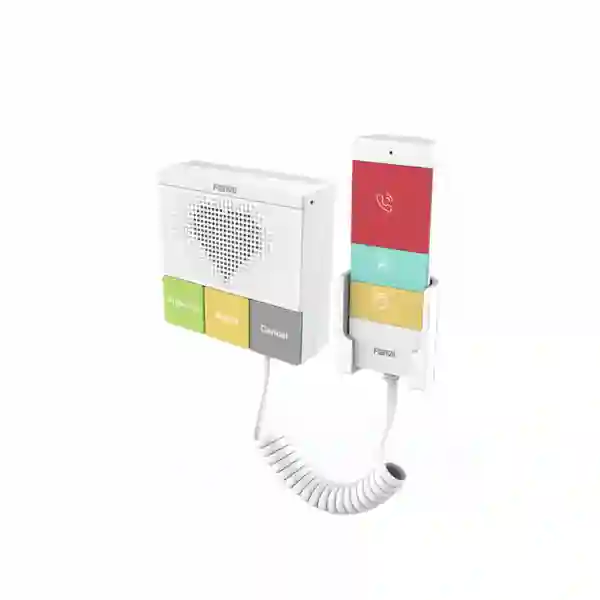
Fanvil Y501W-Y-E Wi-Fi Healthcare Intercom
The Fanvil Y501W-Y-E Wi-Fi Healthcare Intercom is an indoor SIP communication endpoint built for environments where a patient, resident, caregiver or staff member needs a simple and clearly identifiable way to place or receive calls. The embedded Y501W-Y-E variant combines two SIP lines, six healthcare-oriented detachable function buttons, HD audio, dual-band 2.4 GHz and 5 GHz Wi-Fi, PoE, IP54 dust and splash protection, and support for connected alarm or sensor workflows through one short-circuit input and one relay output. Its standard 86-box embedded installation format is especially useful when a clean, low-profile wall installation is preferred.
For healthcare and assisted-care projects in Tanzania, the practical buying question is not only whether an intercom can make a SIP call. It is whether the device fits the room, the PBX, the network, the call-flow design and the operational response process. FourTeck can help buyers evaluate the Y501W-Y-E as part of an IP telephony, Wi-Fi, PoE and healthcare communication solution, including network readiness, SIP compatibility, call-button planning and integration requirements.
Supports two SIP accounts for flexible registration and healthcare call-routing designs.
Built-in 2.4 GHz and 5 GHz Wi-Fi gives projects an alternative to relying only on wired network connectivity.
The Y501W-Y-E supports PoE and standard 86-box embedded installation for a neat indoor deployment.
Six detachable antibacterial-material function buttons support role-specific call and assistance workflows.
What the Fanvil Y501W-Y-E is designed to solve
Healthcare communication endpoints have to be easy to recognize and easy to use while still fitting into the technical architecture used by the facility. The Y501W-Y-E is designed for indoor healthcare and elderly-care communication, where an endpoint may be installed in a patient room, assisted-living room, nursing area or similar care environment. Its six function buttons can be assigned around common healthcare call types, while the handset and intercom functions support direct staff-to-patient or staff-to-room voice communication.
The model supports HD audio using G.722 and Opus wideband codecs and also supports narrowband codecs including G.711a/u, G.729AB, G.723.1, G.726 and iLBC. Full-duplex intercom operation incorporates acoustic echo cancellation together with voice-activity and packet-loss handling features. For a healthcare project, these capabilities matter because clear two-way speech can reduce repetition and confusion when staff are responding to a room call or checking on a patient remotely.
The device can participate in standard SIP infrastructures using SIP 2.0 over UDP, TCP or TLS, with RTP/RTCP and SRTP support. Network options include IPv4 and IPv6, static addressing, DHCP, PPPoE, VLAN, LLDP and QoS. The Wi-Fi-equipped Y501W-Y-E adds 2.4 GHz 802.11 b/g/n and 5 GHz 802.11 a/n connectivity. This gives system designers additional flexibility in buildings where installing a new data cable to every room is difficult, although final Wi-Fi suitability still depends on coverage, interference, security policy and the reliability expectations of the facility.
Verified Fanvil Y501W-Y-E features
Healthcare call functions
Fanvil documents healthcare call types including Nurse Call Normal, Nurse Call Emergency, Toilet Emergency Call, Staff Assistance Call, Staff Emergency Call, Code Blue Call and Staff Presence. The six detachable buttons can be configured to fit the intended workflow.
Optional wireless call button
The series supports a specific optional 433 MHz wireless button, and Fanvil documentation states support for up to ten wireless buttons. This can extend call initiation beyond the wall-mounted device when the correct accessory and deployment design are used.
External alert integration
One short-circuit input and one relay output allow the endpoint to participate in broader alerting designs involving compatible sensors, emergency buttons or alarm indicators. Integration scope should be checked against the exact third-party device and electrical requirements.
IP54 indoor protection
The device carries an IP54 rating and is intended for indoor installation. This can be useful in care environments that require improved resistance to dust and incidental splashes, but it should not be treated as an outdoor weatherproof endpoint.
Technical specification guide
| Model | Fanvil Y501W-Y-E |
| Installation | Standard 86-box embedded, indoor |
| SIP | 2 SIP lines; SIP 2.0 over UDP/TCP/TLS |
| Audio | HD audio; G.722 and Opus wideband codecs; multiple narrowband codecs |
| Network | 10/100 Mbps Ethernet; IPv4/IPv6; VLAN; LLDP; QoS |
| Wi-Fi | 2.4 GHz 802.11 b/g/n and 5 GHz 802.11 a/n |
| Power | PoE or 12 V DC / 1 A |
| Buttons | 6 detachable healthcare function buttons |
| Wireless accessory | Specific optional 433 MHz wireless button; up to 10 supported |
| I/O | 1 short-circuit input; 1 relay output |
| Protection | IP54 |
| Working temperature | -10°C to 50°C |
| Management | Web portal, provisioning by FTP/TFTP/HTTP/HTTPS, DHCP option 66, SIP PnP and TR-069 |
Specifications should be checked against the current Fanvil datasheet and final shipped hardware before procurement, especially when a project depends on a particular firmware feature, third-party platform or electrical interface.
Compatibility, PBX and network planning
The Y501W-Y-E is a SIP endpoint, so a buyer should identify the PBX, hosted voice platform or SIP server that will register the device. It is useful to confirm extension registration, codec policy, TLS or SRTP requirements, dial plans, call groups, auto-answer behavior and any event-driven actions before purchase. For larger deployments, centralized provisioning and a naming convention for room extensions can reduce configuration effort and simplify support.
FourTeck Tanzania’s IP PBX and IP phone solution context helps buyers consider the healthcare intercom as one endpoint in the wider voice environment. The FourTeck Tanzania technology shop also provides a practical route for related business telephony, switching and wireless requirements, while the technology services page explains the broader design, installation and support approach for integrated systems.
On the LAN, treat the intercom as a business voice and safety-related endpoint. Confirm switch-port availability, PoE power budget, VLAN assignment, DHCP or static addressing strategy, QoS rules and secure management access. For Wi-Fi deployments, carry out coverage checks in the actual patient or resident rooms rather than assuming hallway signal strength represents bedside performance. Walls, doors, medical equipment, room layout and neighboring wireless networks can change signal conditions. Where the application is operationally critical, organizations should define how they will respond to LAN, Wi-Fi, PBX or power outages and whether redundant design is required.
Buying checklist for a healthcare intercom project
Before requesting a quotation, record the number of rooms or call points, the intended function of each button, the PBX or SIP platform, whether Ethernet or Wi-Fi will be used, whether PoE is available, and whether a 433 MHz wireless button is needed. Also identify any relay-controlled light, external sensor, nurse-call interface or other third-party integration that may be required.
For embedded installation, confirm that the wall construction and 86-box arrangement suit the Y501W-Y-E. For brownfield sites, check whether existing conduit, cabling or Wi-Fi coverage can be reused. For multi-room deployments, define extension numbering, location labels, emergency escalation and staff response groups before installation. The intercom can only support a care workflow effectively when the communication process behind the button press is clear.
Procurement teams should ask for the exact model suffix in the quotation because the Y501-Y family contains wall-mounted and embedded variants as well as Wi-Fi and non-Wi-Fi versions. The requested model here is specifically Y501W-Y-E: the Wi-Fi-equipped, six-button, embedded version. Accessories, external power supply and optional wireless buttons should be listed separately when required so that the final scope is unambiguous.
Fanvil Y501W-Y-E Wi-Fi Healthcare Intercom Tanzania
Organizations searching for the Fanvil Y501W-Y-E Wi-Fi Healthcare Intercom in Tanzania are typically evaluating more than a conventional room telephone. Hospitals, care providers, assisted-living projects, senior-care facilities, clinics and institutional accommodation may need a dedicated endpoint that makes calling simple for residents or patients while remaining compatible with SIP-based communications. The Y501W-Y-E fits that requirement by combining familiar call controls with network voice, dual-band Wi-Fi and PoE. For projects spread across several wards or rooms, its two SIP accounts and centralized provisioning options can also make extension administration more structured.
Tanzania deployments should begin with the facility workflow. Determine who receives a normal patient call, how an emergency call is prioritized, whether staff assistance needs a separate button, and what happens if the primary response group does not answer. The six configurable healthcare function buttons provide a user-facing interface, but the PBX dial plan and response procedure determine what actually happens after each button is pressed. Where the optional 433 MHz wireless call button is planned, define which residents or rooms need it and how accessory pairing will be documented.
Connectivity needs equal attention. The built-in dual-band Wi-Fi can help where new data cabling is difficult, but healthcare buyers should validate signal strength and roaming conditions at the exact installed position. Wired Ethernet with PoE can simplify centralized power and network management when cabling is available. In either approach, voice VLANs, QoS, secure SIP signaling, firmware management and backup power for the switching or wireless infrastructure should be considered according to the criticality of the service.
For Tanzania procurement, FourTeck can help match the intercom to the existing PBX, network, PoE and Wi-Fi environment and prepare a quotation based on the actual room count and accessory scope. Buyers can also review broader connectivity options through FourTeck’s regional East Africa technology network when a project spans neighboring markets, while Tanzania remains the primary deployment focus for this page.
Fanvil Y501W-Y-E Wi-Fi Healthcare Intercom Dar es Salaam
In Dar es Salaam, the Y501W-Y-E is relevant to hospitals, private clinics, retirement-care environments, serviced residences with assisted-care functions and projects that are modernizing from analogue room calling to IP-based communications. Dense urban sites can have a mix of existing Ethernet, structured cabling, wireless networks and legacy PBX equipment, so the first task is to map the current infrastructure before choosing how the healthcare intercom will connect.
A hospital wing with managed PoE switching may choose wired deployment because it centralizes power and makes the endpoint easier to place on a dedicated voice VLAN. An existing building with limited cabling pathways may find the Y501W-Y-E’s Wi-Fi capability helpful, provided a wireless survey confirms reliable coverage in rooms, bathrooms, corridors and any other intended call locations. Five-gigahertz Wi-Fi may offer cleaner spectrum in some environments, while 2.4 GHz can provide broader reach through walls; the correct band depends on the actual radio environment and access-point design.
Dar es Salaam buyers should also plan for operational resilience. If the intercom is part of a care response process, the PBX, switches, access points and internet or SIP connectivity used by the design should be included in the facility’s power and continuity planning. A UPS-backed PoE switch may keep endpoints online during short power interruptions, but the right approach depends on the wider site architecture. Staff should know what to do if network service is unavailable, rather than assuming the intercom itself provides system-level redundancy.
When requesting a quotation, provide the number of embedded call points, preferred button labels, PBX platform, network topology, Wi-Fi access-point information, PoE availability and any external alarm-light or sensor integration. This produces a more useful Dar es Salaam proposal than requesting only a unit price, because installation materials, network preparation and accessories can materially affect the finished solution.
Fanvil Y501W-Y-E Wi-Fi Healthcare Intercom Mwanza
For healthcare and assisted-care facilities in Mwanza, the Fanvil Y501W-Y-E can be considered when the project requires a compact embedded SIP call point that supports both wired networking and dual-band Wi-Fi. This flexibility is useful when different parts of a building have different infrastructure conditions. A newer wing may have structured cabling and PoE at every room, while an older section may have stronger wireless coverage than physical network cabling. The same model can therefore fit more than one network strategy, subject to proper design.
Mwanza procurement teams should distinguish between the physical endpoint and the communication workflow. The Y501W-Y-E provides buttons, voice, SIP registration and I/O interfaces, but the PBX configuration controls routing and escalation. A normal call might ring a nurses’ station group, while a staff-assistance or emergency button may need a different destination. The facility should document these choices room by room and test every defined function before handover.
Where wireless accessories are required, the optional 433 MHz button can extend the user’s ability to call for assistance without reaching the wall intercom. The project should confirm how many wireless buttons are needed, who will carry or use them, how batteries and pairing will be managed, and how lost accessories will be replaced. Fanvil states support for up to ten wireless buttons, but the practical quantity and placement should follow the care workflow rather than simply the maximum supported number.
For a Mwanza quotation, include the required quantity, the embedded installation condition, room numbering plan, PBX details and the desired accessory list. If Wi-Fi will be used, include access-point locations and any known coverage issues. This allows the design to address communication reliability, not just device supply, and makes it easier to plan configuration, testing and future maintenance.
Fanvil Y501W-Y-E Wi-Fi Healthcare Intercom Arusha
Arusha healthcare, hospitality-adjacent care and institutional projects may use IP communications across buildings that vary substantially in age and layout. The Y501W-Y-E is well suited to projects where a low-profile embedded healthcare endpoint is wanted and where the network may need a choice between Ethernet and Wi-Fi. Before deployment, the project team should determine whether the installation positions already have 86 boxes, whether a new back box is required, and whether power will come from PoE or a local 12 V supply.
The endpoint’s IP54 rating supports indoor use with improved resistance to dust and splashes, which can be useful in patient and care environments. However, procurement teams should still place the intercom according to Fanvil’s indoor-use guidance and avoid treating IP54 as permission for exposed outdoor installation. Cleaning procedures should also be coordinated with the facility’s infection-control policy and the manufacturer’s material guidance.
For voice quality, the network should prioritize predictable latency and packet delivery. VLAN and QoS support can help separate and prioritize voice traffic when the same LAN carries business data, cameras, Wi-Fi users and other applications. If the site uses wireless connectivity, access-point capacity matters as much as signal bars. A crowded network with weak channel planning can produce inconsistent call quality even when the endpoint appears connected. A simple test call from every final installation position is therefore an important commissioning step.
Arusha buyers comparing healthcare intercom quotations should check whether configuration, button mapping, SIP registration, network preparation, mounting hardware, optional wireless buttons and commissioning are included. The lowest hardware-only price may not represent the complete installed scope. A clearer procurement process separates the intercom units from accessories and services, then validates the entire call flow before acceptance.
Fanvil Y501W-Y-E Wi-Fi Healthcare Intercom Dodoma
In Dodoma, organizations planning healthcare communication for hospitals, institutional care facilities or assisted-living projects can evaluate the Fanvil Y501W-Y-E as an IP-based room call endpoint. Its embedded form factor can suit planned construction or renovation projects where room devices are intended to sit flush within a standard 86-box arrangement. Early coordination with the electrical and low-voltage contractor helps ensure the back-box position, cable route and power method are ready before finishes are completed.
For a new build, PoE is often attractive because one data cable can carry network connectivity and power, reducing the need for individual adapters at each call point. The switch design must still include enough PoE ports and total power budget for every device, plus realistic growth. Where Wi-Fi is selected instead, the network team should design for coverage at the exact wall location and ensure security settings are compatible with the endpoint’s supported Wi-Fi options.
The Y501W-Y-E supports one short-circuit input and one relay output, which can be valuable in projects that want to coordinate the intercom with a compatible external call button, sensor, alarm indicator or other low-voltage interface. Electrical characteristics and behavior should be reviewed carefully before connecting third-party devices. Healthcare projects should avoid assumptions about interoperability simply because two devices both use relay contacts; the event logic and safe wiring still need to be defined.
A Dodoma procurement request should include architectural and operational information together. Room count, intended mounting height, staff response destinations, PBX details, network plan and accessory requirements all influence the final bill of materials. This approach supports more accurate budgeting and reduces the risk of discovering infrastructure gaps after the intercoms have been ordered.
Fanvil Y501W-Y-E Wi-Fi Healthcare Intercom UAE
UAE healthcare and senior-care projects often place strong emphasis on structured low-voltage design, system integration and documented commissioning. The Fanvil Y501W-Y-E can be considered where a SIP-based healthcare call point is required within an IP telephony architecture and a clean embedded finish is preferred. The dual-band Wi-Fi option can also support retrofit situations, although wired PoE remains attractive when the project has structured cabling available.
For UAE deployments, system designers should define the relationship between the healthcare intercom, nurse station, PBX, voice VLAN, wireless LAN and any external alarm indicators. SIP registration can provide flexible routing, but each call type should have a documented destination and escalation rule. Button labels and configuration should be appropriate to the facility’s operating procedure and user population. Multilingual signage may also be relevant in facilities with diverse staff and residents.
Cybersecurity should be included in the commissioning plan. TLS for SIP signaling and SRTP for media are supported, while HTTPS-based management and provisioning options can be incorporated into a hardened configuration according to the PBX and network design. Default credentials should be changed, management access should be limited, and firmware should be managed as part of the device lifecycle. These controls are not unique to healthcare intercoms, but they are particularly important for any endpoint connected to a managed facility network.
Projects extending between Tanzania and the Gulf can use the wider FourTeck UAE technology network for regional coordination. Quotations should still specify the exact Y501W-Y-E suffix, quantity, accessory scope, PBX requirements and installation conditions so that the commercial proposal matches the intended healthcare workflow.
Fanvil Y501W-Y-E Wi-Fi Healthcare Intercom Uganda
For Uganda healthcare and care-facility projects, the Y501W-Y-E offers a practical way to add SIP communication to patient or resident rooms while preserving a simple physical interface. Two SIP lines allow flexible registration, while the six detachable healthcare buttons can be aligned with locally defined response functions. The correct use of those buttons should be agreed with nursing or care staff before configuration because a technically correct installation can still fail operationally if users do not understand what each call option does.
Network planning should account for the variability of building infrastructure. Sites with managed PoE switches can use Ethernet and centralize endpoint power. Sites where new cabling is difficult can consider the Y501W-Y-E’s dual-band Wi-Fi, but should validate the radio environment at each room. If the facility relies on wireless calling for a critical workflow, access-point redundancy, controller behavior and power backup may be worth evaluating.
The optional 433 MHz call-button capability can extend access to assistance for users who cannot easily reach the wall endpoint. Accessory management becomes part of operations: devices need to be paired correctly, assigned to the correct room or user, checked periodically and replaced when damaged or lost. These processes should be incorporated into the facility’s maintenance routine rather than treated as a one-time installation task.
Uganda projects can also coordinate through the FourTeck Uganda technology site when regional support or cross-border project planning is needed. A useful quotation request lists room count, networking method, PBX or SIP server, desired call groups, accessory quantities and any third-party alarm or relay integration.
Fanvil Y501W-Y-E Wi-Fi Healthcare Intercom Kampala
Kampala hospitals, clinics and care facilities often operate mixed IT environments where voice, wireless, CCTV and business data share switching and internet infrastructure. The Y501W-Y-E should therefore be introduced as part of the network architecture rather than as an isolated appliance. A dedicated voice VLAN, suitable QoS, secure management and a documented IP-addressing plan can make troubleshooting and future expansion easier.
The embedded model is especially appropriate where the project wants a fixed bedside or room-call position that does not protrude unnecessarily into the space. Contractors should confirm the 86-box depth and finishing requirements before deployment. Where the device will be installed next to beds or in care rooms, cable routing, mounting height and accessibility should be coordinated with the facility designer so patients and staff can operate the buttons comfortably.
Kampala buyers should ask their PBX team to confirm SIP registration, codec settings, DTMF method, auto-answer behavior and any TLS or SRTP policy. The Y501W-Y-E supports common SIP and media security protocols, but the full solution depends on the server and network configuration. If the device will call a central nurse station or console, test simultaneous call scenarios and unanswered-call escalation during acceptance, not just one basic call.
Commercially, separate the bill of materials into intercom units, optional wireless call buttons, PoE switching or power requirements, configuration and installation. This makes quotations easier to compare. It also helps healthcare managers see which parts of the budget are reusable infrastructure and which are endpoint-specific costs.
Fanvil Y501W-Y-E Wi-Fi Healthcare Intercom Arua
Arua healthcare projects may place particular value on simple, maintainable communication systems that can be expanded room by room. The Fanvil Y501W-Y-E supports this type of IP approach because each endpoint can be registered as a SIP extension and managed through web configuration or centralized provisioning methods. A facility can create a room-numbering convention that mirrors the physical layout, making it easier for staff and IT personnel to identify the source of a call.
Where network cabling exists, PoE can keep installation straightforward and reduce reliance on local adapters. If Wi-Fi is used, the project should avoid assuming that a general office WLAN will automatically meet healthcare calling needs. Coverage, authentication, interference, device density and access-point power all influence availability. A survey from the final wall location can reveal weak spots that are not obvious from corridor testing.
The device’s one input and one relay output can support integration with compatible external devices, but the design should be intentionally documented. For example, a project may want a call to activate a corridor light or an external button to trigger a SIP action. The electrical limits, wiring and software behavior should be validated before installation. This reduces the risk of damaging hardware or creating an alert sequence that does not match staff expectations.
For Arua procurement, define the first deployment phase and the expected future room count. Even if only a small number of intercoms are installed initially, it can be useful to size switch ports, VLANs, PBX extensions and Wi-Fi capacity for planned growth. A staged project is easier to expand when the addressing and call-flow structure is designed from the beginning.
Fanvil Y501W-Y-E Wi-Fi Healthcare Intercom Mbarara
Mbarara buyers looking at healthcare communication upgrades can use the Y501W-Y-E to bridge patient-room calling and a modern SIP environment. The device’s familiar hardware buttons reduce the need for a touchscreen-driven user experience, which can be useful for residents or patients who need direct, obvious call actions. The Y501-Y family’s healthcare-specific button functions also give designers a clearer starting point than adapting a conventional office phone to a care scenario.
The first design decision is how calls will be received. Some facilities may route calls to a nurse console, others to SIP desk phones, and others to ring groups that include several staff endpoints. The intercom supports standard SIP, so the final workflow depends on the PBX. Response time, unanswered-call behavior, after-hours routing and emergency escalation should be defined as part of the solution specification.
A second decision is how the endpoint will connect. Wired PoE offers centralized power and often easier network control, while the integrated 2.4 GHz and 5 GHz Wi-Fi can reduce cabling requirements. In either case, the network should be monitored and documented. A healthcare endpoint that disappears from the network should be visible to the support team, and firmware or configuration changes should be controlled so that button behavior remains consistent across rooms.
Mbarara quotations should identify whether the project requires only product supply or also configuration, testing and installation coordination. Buyers should also specify whether optional wireless buttons are required and whether external relay integration forms part of the scope. Clear separation of these items helps avoid hidden assumptions and simplifies approval by procurement and clinical stakeholders.
Fanvil Y501W-Y-E Wi-Fi Healthcare Intercom Gulu
For Gulu hospitals and care facilities, the Y501W-Y-E can support a structured IP healthcare communication design without requiring a large user interface at the room. Its compact embedded form and six function buttons make it suitable for fixed call points where residents or patients need clear access to assistance. Because the device uses SIP, it can fit into broader IP telephony planning rather than requiring a completely separate voice transport network.
When planning a Gulu deployment, begin with extension and call-group design. Assign every room or device a logical name and number, then define which destination receives each call. If the project uses normal, emergency, staff-assistance or code-blue style buttons, ensure the PBX treatment of those calls matches the facility’s operational response. Test the complete process with staff present so that technical commissioning and real-world workflow validation happen together.
The Wi-Fi capability is useful for sites where running new cable is disruptive, but any wireless healthcare communication system should be engineered rather than improvised. Access points should have stable power, suitable backhaul and adequate capacity. The intercom should be placed on an appropriate secure SSID and VLAN where possible. If a site already has congested Wi-Fi, adding more endpoints without improving the wireless design may create avoidable reliability issues.
Gulu procurement teams can simplify future maintenance by standardizing configuration templates, keeping a record of firmware versions and documenting any accessory pairing. A room-by-room handover sheet that lists extension, IP method, button functions and optional wireless button ID can save considerable troubleshooting time later.
Fanvil Y501W-Y-E Wi-Fi Healthcare Intercom Kenya
Kenya healthcare and assisted-living projects increasingly use IP networking as a common foundation for voice, wireless, security and building systems. The Fanvil Y501W-Y-E can fit this approach as a SIP healthcare endpoint with both Ethernet and dual-band Wi-Fi connectivity. The model is especially relevant where a compact embedded room interface is preferred and where six direct healthcare function buttons are more appropriate than a conventional office-phone keypad.
For multi-site groups, standardization can be valuable. Using consistent extension naming, button mapping and provisioning templates across facilities can reduce training and support effort. The Y501W-Y-E supports web management and several automatic provisioning methods, so organizations can build repeatable deployment procedures. Centralized configuration should still be tested against the exact PBX and firmware version used by the organization.
Kenya buyers should also plan for the supporting LAN. PoE switching, VLANs and QoS are relevant for wired deployments; access-point density and RF design are central to Wi-Fi deployments. Where voice and surveillance share infrastructure, uplink capacity and switch resilience become part of the healthcare communication conversation. Backup power can also be important because an IP endpoint is only available while the device and its network path remain powered.
Regional procurement can be coordinated through FourTeck Kenya when projects extend into that market. A quotation request should specify exact model, quantity, installation type, PBX platform, accessories and network method so that pricing reflects a workable solution rather than a generic device list.
Fanvil Y501W-Y-E Wi-Fi Healthcare Intercom Kuwait
Kuwait healthcare projects often require structured ELV coordination, clearly defined integration responsibilities and formal testing. The Fanvil Y501W-Y-E can be positioned as a SIP room-call endpoint within that architecture. Its embedded 86-box form can support a tidy room finish, while PoE or dual-band Wi-Fi offers two practical connectivity models depending on the building design.
Before specification, the consultant or integrator should decide whether the device is being used as a standalone SIP intercom endpoint or as part of a wider nurse-call workflow. If external alarm lamps, buttons or sensors are connected through the short-circuit input or relay output, responsibility for electrical design and event logic should be clearly assigned. The interface capabilities are useful, but they do not remove the need for system-level engineering.
Kuwait projects may also have strict network segmentation and security policies. The Y501W-Y-E’s support for VLAN, TLS, SRTP, HTTPS management and enterprise-oriented provisioning methods can help it fit controlled IP environments when configured appropriately. IT teams should define permitted management sources, credential standards, firmware process and logging requirements. If Wi-Fi is used, wireless encryption and authentication need to align with the facility network.
For regional commercial coordination, buyers can refer to FourTeck Kuwait. The most useful quotation package includes room schedules, device quantities, PBX information, proposed VLAN or SSID, power method, button functions and accessory quantities, allowing technical and commercial review to proceed from the same documented assumptions.
Fanvil Y501W-Y-E Wi-Fi Healthcare Intercom Ghana
Ghana healthcare facilities and care institutions evaluating IP room communication can consider the Fanvil Y501W-Y-E when they need a simple patient-facing endpoint that registers to a SIP system. Its six healthcare-oriented buttons can support differentiated call types, and the built-in handset/intercom design gives staff a direct voice path back to the room. Two SIP accounts add flexibility for registration and routing strategies.
A good deployment begins with the human workflow. Decide which call types are meaningful to the facility, how staff distinguish them, who is responsible for each response and what should happen if a call is not answered. The physical buttons should then be labeled and configured to mirror that process. Staff training should cover both normal operation and failure scenarios so that people understand when to use alternative communication methods.
From the network perspective, the choice between wired PoE and Wi-Fi should be based on reliability, infrastructure and maintenance. PoE may be preferable where structured cabling exists; Wi-Fi may reduce installation work in retrofits. Both methods require planning for IP addressing, security, QoS and power continuity. The endpoint’s IP54 rating supports indoor care settings but does not make it an outdoor product.
For projects that span West Africa, the FourTeck regional network can support coordination through appropriate country channels. A Ghana quotation should list exact quantities, optional wireless-button requirements, intended external I/O integrations, PBX details and whether installation or configuration services are required. This creates a transparent scope that is easier for procurement teams to compare and approve.
Fanvil Y501W-Y-E Wi-Fi Healthcare Intercom Nigeria
Nigeria healthcare, elderly-care and institutional projects can use the Y501W-Y-E as part of a scalable SIP-based room communication system. Because the device is an IP endpoint, new rooms can be added through the network and PBX architecture rather than through a proprietary analogue voice loop alone. This can simplify integration with existing VoIP environments, although healthcare call workflows still require careful design and testing.
Power continuity is an important project consideration. A PoE-connected intercom depends on the upstream switch and its power source, while a Wi-Fi-connected endpoint depends on the access point and the endpoint power method. Facilities should determine whether critical switching, wireless and PBX infrastructure is protected by UPS or generator-backed power according to operational requirements. The device itself should not be assumed to provide resilience beyond its stated power options.
The Y501W-Y-E also supports standard network management and provisioning methods, which can help with larger deployments. Administrators can maintain consistent settings, but configuration governance remains important. A mistaken bulk change to button mappings or SIP destinations can affect many rooms at once, so templates should be validated on a small number of devices before full rollout.
Nigeria buyers planning multi-site rollouts should create a common room-extension scheme, standard button definitions and a repeatable commissioning checklist. The FourTeck Nigeria site can support regional coordination for projects in that market. Quotations should remain model-specific and separate endpoint hardware, accessories, network requirements and implementation services for clarity.
Fanvil Y501W-Y-E Wi-Fi Healthcare Intercom Seychelles
Seychelles healthcare and care-facility projects may need compact communications solutions for sites where building size, room layout and connectivity vary substantially. The Fanvil Y501W-Y-E provides an embedded SIP call point that can use Ethernet or dual-band Wi-Fi and therefore gives system designers flexibility when planning new rooms or upgrading existing facilities. Its six function buttons can be configured around the actual care workflow rather than forcing staff to use a generic office-phone interface.
For island environments, project planning should give additional attention to spares, documentation and remote support readiness. Keeping a documented configuration template, spare accessories and clear replacement procedures can reduce downtime if hardware needs to be swapped. The device’s web management and provisioning capabilities can also support remote technical assistance when secure administrative access is available.
Wi-Fi can be attractive in buildings where cabling work is disruptive, but healthcare voice quality depends on the actual RF environment. Site surveys should consider walls, room density, access-point placement and interference. Where PoE cabling is available, the wired approach can reduce wireless dependence and centralize power. Either design should include network monitoring so support teams can identify registration or connectivity issues promptly.
Seychelles procurement teams should request the exact Y501W-Y-E variant and confirm the intended 86-box installation. The quotation should identify optional 433 MHz call buttons, any external alarm-light integration, PBX configuration scope and commissioning requirements. A small deployment can still benefit from disciplined documentation because healthcare communication is operationally important even when only a few rooms are involved.
Frequently asked questions
Does the Fanvil Y501W-Y-E have Wi-Fi?
Yes. The Y501W-Y-E includes built-in 2.4 GHz and 5 GHz Wi-Fi. Fanvil lists 802.11 b/g/n for 2.4 GHz and 802.11 a/n for 5 GHz. Wi-Fi suitability for a healthcare project should still be validated through coverage and capacity testing at the final installation point.
What is the difference between Y501W-Y and Y501W-Y-E?
Both are Wi-Fi models in the six-button Y501-Y series. The Y501W-Y is intended for wall-mounted installation, while the Y501W-Y-E is the standard 86-box embedded version.
Does it support PoE?
Yes. The Y501W-Y-E supports Power over Ethernet. It can also use 12 V DC / 1 A power. Confirm the selected power method and installation accessories in the project scope.
Can it connect to a SIP PBX?
The device supports SIP 2.0 over UDP, TCP and TLS and provides two SIP lines. Compatibility with a specific PBX, hosted platform or nurse-call integration should be validated against the required features, firmware and configuration.
Can a wireless emergency button be used?
Fanvil documents support for a specific optional 433 MHz wireless button and states support for up to ten wireless buttons. The accessory should be specified separately and tested as part of the room workflow.
Is the Y501W-Y-E suitable for outdoor use?
No. Fanvil identifies the Y501-Y series as intended for indoor installation. The IP54 rating provides dust and splash resistance, but it should not be treated as an outdoor weatherproof rating.
Quotation checklist
To prepare a useful quotation, provide the quantity of Y501W-Y-E units, number of rooms, existing PBX or SIP platform, preferred Ethernet or Wi-Fi connection, PoE availability, 86-box installation readiness, required button functions, optional 433 MHz wireless-button quantity and any external I/O integration.
For larger deployments, also provide floor plans or room schedules, current switch and access-point information, VLAN requirements, extension-numbering preferences and any security policy that affects TLS, SRTP, Wi-Fi authentication or management access. If the project is a retrofit, note any restrictions on cabling or wall work.
This information helps separate hardware, accessories, network preparation and implementation services. It also gives technical teams enough context to identify compatibility questions before procurement rather than during installation.
Decision recap
Choose the Fanvil Y501W-Y-E when the project needs an indoor embedded SIP healthcare intercom with six healthcare function buttons, two SIP accounts, HD voice, dual-band Wi-Fi, PoE, IP54 protection and optional 433 MHz wireless call-button support. It is particularly suitable when a care facility wants a dedicated room-call interface that can participate in a modern IP telephony network.
Before ordering, confirm PBX compatibility, installation box, network method, power method, button mapping, accessory quantities and the complete staff response workflow. FourTeck Tanzania can help turn those requirements into a model-specific quotation and deployment scope.
Talk to FourTeck Tanzania about your healthcare intercom requirement
If you are planning a new healthcare facility, replacing legacy room calling or adding SIP communication to an existing building, share the room count, PBX platform and network details. FourTeck can review the Y501W-Y-E together with switching, Wi-Fi, PoE and IP telephony requirements so the intercom is evaluated as part of the complete communication path.




Reviews
There are no reviews yet.