
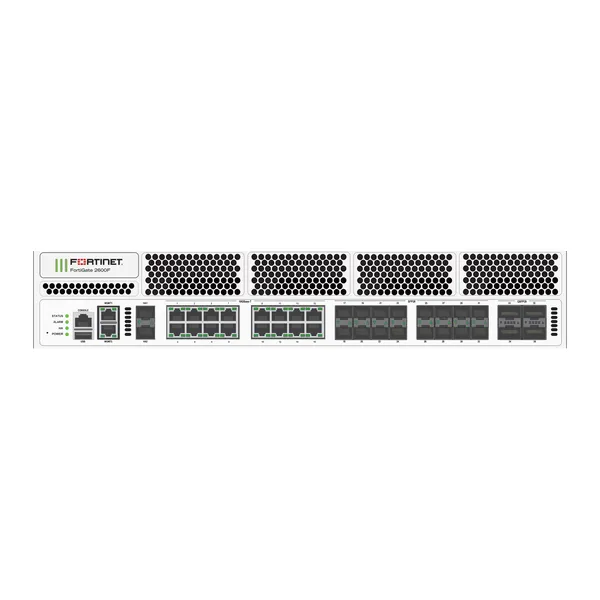
FortiGate 2601F (FG-2601F) Tanzania
FortiGate 2601F is a high-performance Fortinet next-generation firewall designed for large enterprises, service providers, data centers, high-capacity internet edges and internal segmentation projects. For Tanzanian organizations planning faster uplinks, dense network consolidation, encrypted connectivity and security inspection at scale, the FG-2601F provides a platform with high-speed interfaces, purpose-built Fortinet security processing and integrated local storage. FourTeck can help buyers structure a technically meaningful quotation around the appliance, optics, subscriptions, support requirements, high availability, routing, VPN and deployment objectives rather than treating the firewall as an isolated hardware purchase.
FortiGate 2601F Overview
Fortinet positions the FortiGate 2600F Series for high-performance next-generation firewall use in large enterprise and service-provider networks, including enterprise edge, hybrid and hyperscale data-center core and internal segmentation scenarios. The FG-2601F is the storage-equipped member of the family. Official Fortinet documentation identifies four 100 GE/40 GE QSFP28 slots, sixteen 25 GE/10 GE SFP28-family slots, sixteen hardware-accelerated 10 GE/GE RJ45 ports, two dedicated 10 GE SFP+ HA slots, two GE RJ45 management ports, USB and console connectivity, purpose-built NP7 and CP9 acceleration, dual AC power supplies and onboard NVMe storage. These characteristics make the platform relevant where interface density, east-west traffic, north-south security and operational resilience need to be planned together.
100 GE, 25 GE and 10 GE interface options support demanding aggregation, core and edge designs.
The FG-2601F differentiates itself from the FG-2600F through onboard NVMe storage, useful for designs requiring local logging and storage capability.
Dedicated HA interfaces and dual hot-swappable AC power supplies support resilient architecture planning.
Verified FortiGate 2601F Specifications
| Form factor | 2RU rack mount |
| 100 GE / 40 GE | 4 × QSFP28/QSFP+ slots |
| 25 GE / 10 GE / GE | 16 × SFP28/SFP+/SFP slots |
| RJ45 data ports | 16 × hardware-accelerated 10 GE / GE RJ45 |
| HA | 2 × 10 GE SFP+ / GE SFP HA slots |
| Management | 2 × GE RJ45 management ports |
| Storage | 2 × 960 GB NVMe SSD in current Fortinet datasheet |
| IPS throughput | 31 Gbps enterprise traffic mix |
| NGFW throughput | 27 Gbps enterprise traffic mix |
| Threat protection throughput | 25 Gbps enterprise traffic mix |
Performance values are vendor test figures and should not be interpreted as guaranteed application throughput. Real results depend on traffic profile, enabled security services, inspection policy, packet size, encryption, topology and software configuration.
FortiGate 2601F for Enterprise Security Architecture
The most useful way to evaluate the FG-2601F is to start with architecture. A large organization may need to secure internet connectivity, private WAN links, cloud connectivity, server networks, user networks and partner zones while maintaining clear separation between trust domains. The appliance can be considered for edge firewalling, segmentation and VPN use, but the correct policy design depends on business flows rather than port count alone. Buyers should document peak and average traffic, encrypted traffic percentage, expected concurrent sessions, new-session rates, application mix, inspection requirements, routing protocols, HA objectives and future growth before selecting a final configuration.
Fortinet’s Security Processing Unit architecture is relevant because security inspection and networking functions are designed to use purpose-built acceleration. The 2600F family incorporates NP7 and CP9 processors. That does not remove the need for sizing: IPS, SSL inspection, application control, web filtering, malware protection and other controls impose different workloads. A sound procurement process therefore maps the desired security profile to the published enterprise traffic mix metrics and leaves reasonable capacity for growth and operational events.
Connectivity, High Availability and Storage Planning
The mix of 100 GE, 25 GE and 10 GE interfaces allows the FG-2601F to sit in networks that have moved beyond conventional 1 GE firewall designs. QSFP28 uplinks can be relevant for data-center fabrics and high-capacity aggregation, while SFP28 and RJ45 connectivity provide flexibility for downstream networks and existing infrastructure. Procurement teams should specify required transceiver types, fiber standards, cable distances, switch-side optics and breakout requirements before ordering. An interface being physically available does not by itself guarantee that a particular optical design is correct.
For resilience, the appliance provides dedicated HA connectivity and dual AC power supplies. High availability should be designed as an end-to-end service rather than only as a pair of firewalls. Diverse power feeds, switch connectivity, upstream circuits, routing convergence, state synchronization, monitoring and maintenance procedures all matter. The FG-2601F’s onboard NVMe storage is also important for organizations that want local storage capacity, although log retention targets should be calculated from event volume and compliance needs. Larger environments may additionally use centralized Fortinet management and logging platforms.
FortiGuard, FortiCare and Licensing Considerations
The base appliance and the security-service subscription are separate procurement considerations. FortiGuard services can add threat intelligence and security capabilities, while FortiCare provides support-related entitlements according to the purchased service level and term. Available bundles and service names can change, so a quotation should identify the exact Fortinet part numbers, service term and included capabilities instead of relying on a generic phrase such as “licensed firewall.” Organizations should decide which security functions are required, how long the initial subscription should run, and how renewals will be managed before approval.
For lifecycle planning, align subscription renewal dates with budgeting cycles and record appliance serial numbers, entitlement owners and support contacts. Review FourTeck Tanzania technology solutions for the broader local portfolio, and use specialist resources such as FourTeck Fortinet solutions when planning related Fortinet security requirements. Regional customers can also consult FourTeck Africa for cross-market technology planning.
FortiGate 2601F Tanzania
For Tanzania, the FortiGate 2601F is best evaluated as an enterprise infrastructure platform rather than a small-office firewall. Potential projects include headquarters internet edges, large campus cores, data-center security zones, financial-service networks, telecom environments, government and public-sector infrastructure, large hospitality groups, industrial networks and organizations consolidating multiple security gateways. The key question is whether the traffic scale and interface requirements justify a platform in the 2600F class. Start with measured traffic and business growth, then add the inspection policies that will be enabled. This produces a more defensible design than sizing from internet-circuit speed alone.
Tanzanian procurement teams should prepare a bill of requirements covering appliance quantity, HA topology, AC power design, transceivers, rack space, uplink speeds, FortiGuard services, FortiCare term, management, logging, VPN needs and implementation scope. Where the firewall will connect multiple carriers or WAN providers, document routing and failover expectations. Where it protects servers, document east-west segmentation and application dependencies. Where remote users or branches are involved, identify tunnel counts, authentication requirements and address plans. This information helps translate “FG-2601F Tanzania price” searches into an accurate quotation rather than an incomplete hardware-only figure.
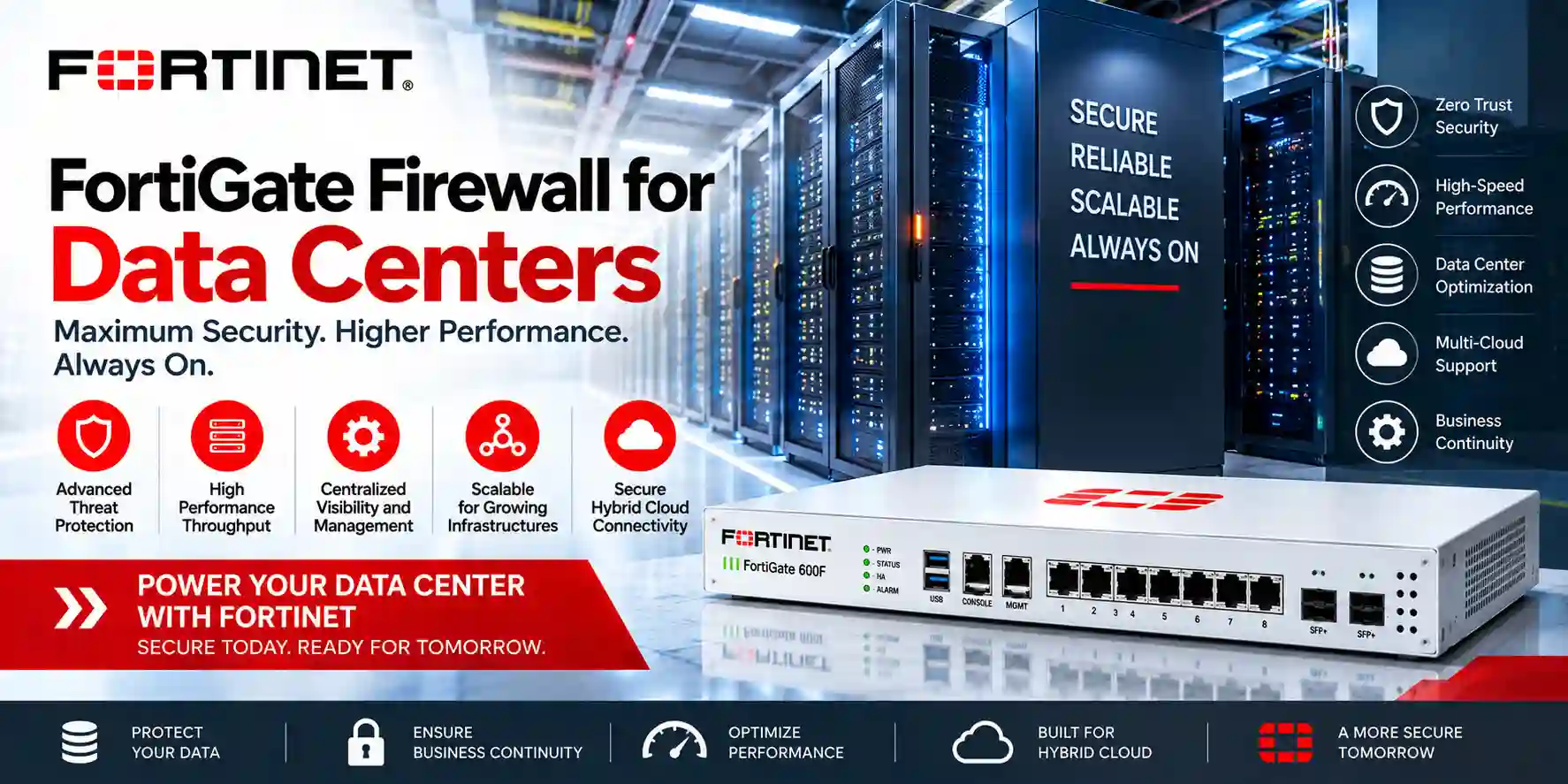
The appliance is 2RU and uses front-to-back airflow, so data-center teams should verify rack depth, airflow, power feeds and thermal planning. Its high-speed interfaces also make optics selection important. For organizations modernizing a data center, review the supplied FourTeck guidance around FortiGate data-center firewall planning visual as a contextual reference. For broader regional coordination, FourTeck Kenya and FourTeck Uganda provide related regional technology context.
FortiGate 2601F Dar es Salaam
Dar es Salaam organizations considering the FG-2601F often have requirements associated with concentrated enterprise connectivity: headquarters networks, data centers, service providers, logistics businesses, financial institutions, multi-site organizations and large campuses. In these environments, firewall selection should account for more than WAN bandwidth. Inter-VLAN segmentation, server traffic, cloud connectivity, partner links, encrypted applications and backup circuits can produce substantial aggregate load even when a single internet link appears modest. The 2601F’s interface density provides design flexibility, but that flexibility should be converted into a documented port and transceiver plan before procurement.
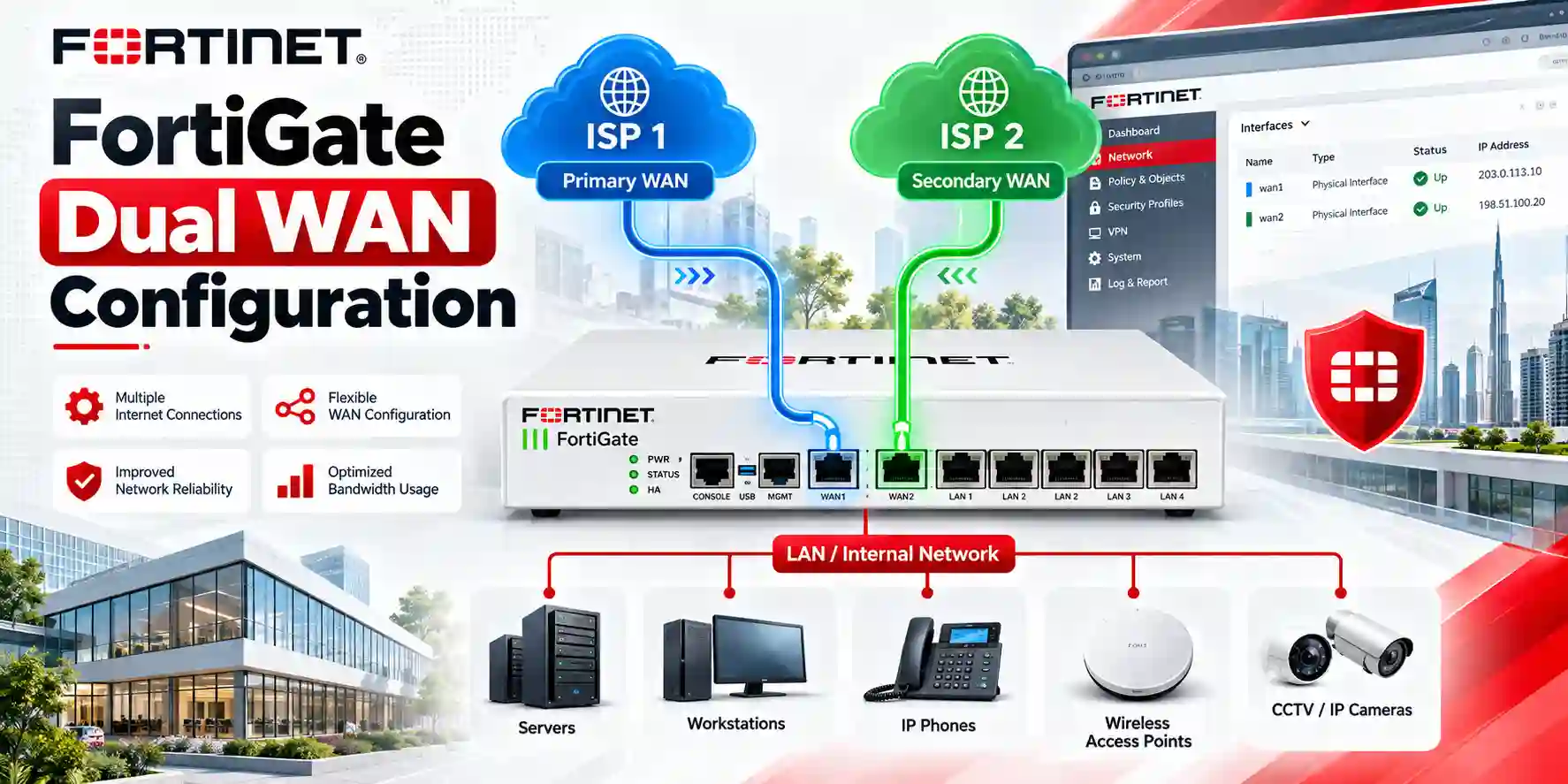
A Dar es Salaam deployment may use redundant internet services or private WAN links. If dual-WAN resilience is required, define whether the objective is simple failover, active-active load sharing, application steering or SD-WAN policy. Also define how inbound services behave during carrier failure and whether public IP addressing changes. FourTeck’s supplied FortiGate dual-WAN failover reference can help frame the operational discussion, while the actual configuration must reflect the customer topology and ISP design.
For a quotation, provide current and planned circuit speeds, switch uplinks, fiber types, security subscriptions, HA requirement, number of sites and VPN requirements. If SSL inspection is part of the security policy, include it explicitly in sizing discussions because encrypted traffic inspection changes the workload. If local log storage is important, define retention expectations rather than assuming the onboard NVMe capacity will meet every compliance requirement. This level of preparation helps Dar es Salaam IT teams compare solutions on architecture, lifecycle cost and security capability instead of focusing only on the appliance model number.
FortiGate 2601F Mwanza
In Mwanza, the FG-2601F may be relevant for organizations operating regional headquarters, large institutions, industrial facilities, healthcare networks, education campuses, distribution operations or centralized IT serving multiple branches. The design process should begin by identifying which traffic actually crosses the firewall. A perimeter-only deployment has different capacity characteristics from an internal-segmentation deployment where user, server, voice, wireless and operational networks communicate through inspected security zones. When internal traffic is included, aggregate throughput can be much higher than the external internet service.
Branch connectivity is another important consideration. If Mwanza is a regional hub for multiple remote sites, IPsec VPN, SD-WAN, dynamic routing and centralized policy may form part of the project. Teams should document primary and backup circuits at each site, addressing, routing domains, critical applications and acceptable failover behavior. The official FG-2601F includes high-capacity networking interfaces that can support substantial aggregation, but the chosen design should still avoid unnecessary complexity. Use 100 GE or 25 GE where the surrounding switching architecture and traffic justify it; otherwise, select interfaces based on measured need and a realistic growth horizon.
Power and environmental planning should be included in the procurement checklist. The appliance uses dual AC power supplies and is designed for rack installation. Redundant feeds are most useful when connected to appropriately designed UPS and power infrastructure. For organizations with limited local technical staffing, operational simplicity, remote management, configuration backup, monitoring and escalation procedures deserve as much attention as raw throughput. A well-scoped Mwanza quotation should therefore combine hardware, licensing, optics, implementation requirements, documentation and support expectations into one procurement specification.
FortiGate 2601F Arusha
Arusha businesses and institutions evaluating the FortiGate 2601F may include hospitality groups, tourism operators, regional headquarters, NGOs, large campuses and enterprises with distributed sites. These environments can have a diverse application mix: guest access, corporate applications, cloud services, voice, video, payment systems, branch links and administrative systems. A security architecture should separate these trust zones and define which flows require inspection. The FG-2601F can provide substantial segmentation capacity, but good policy design remains essential; high-performance hardware does not replace a clear network-security model.
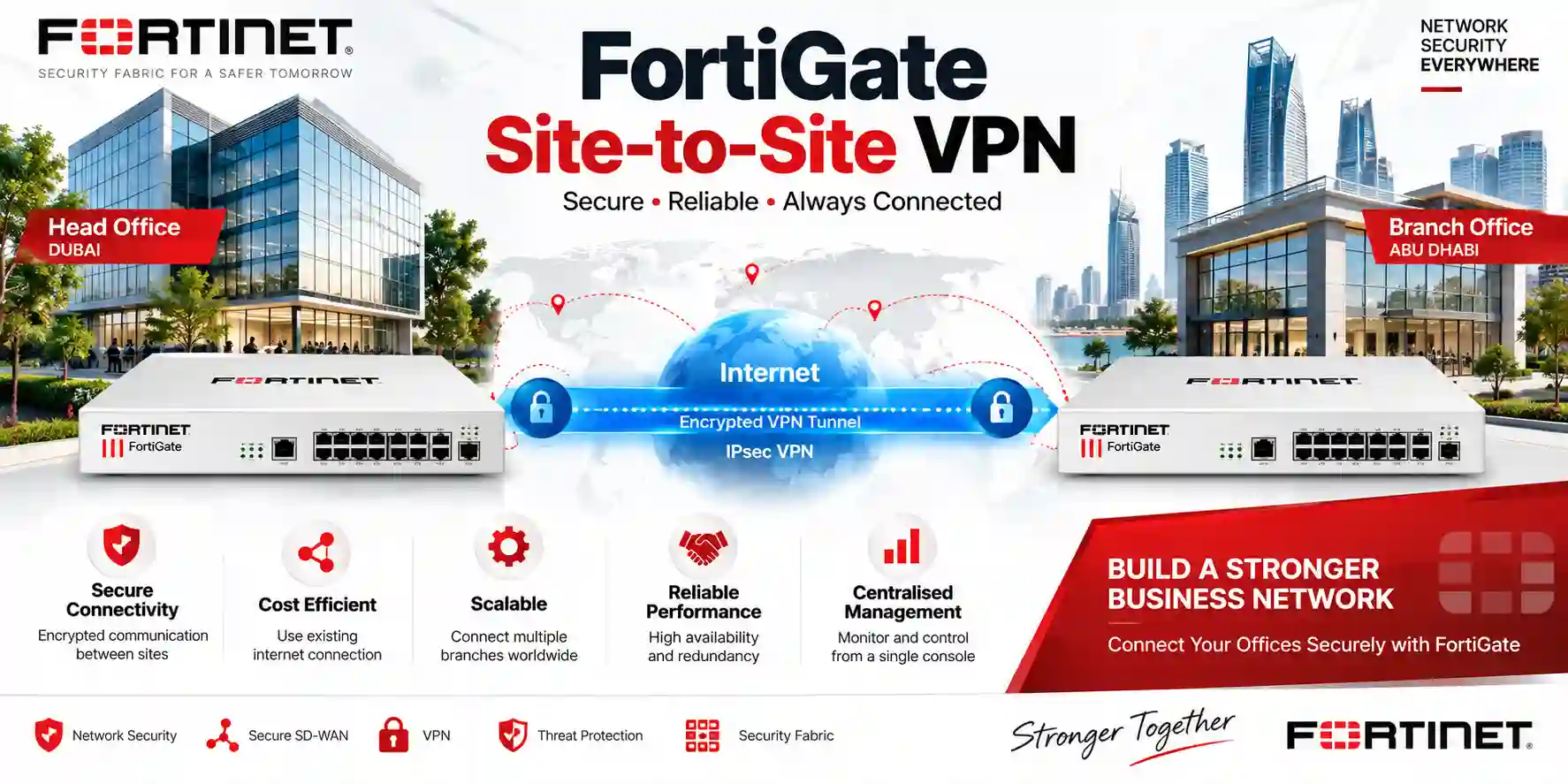
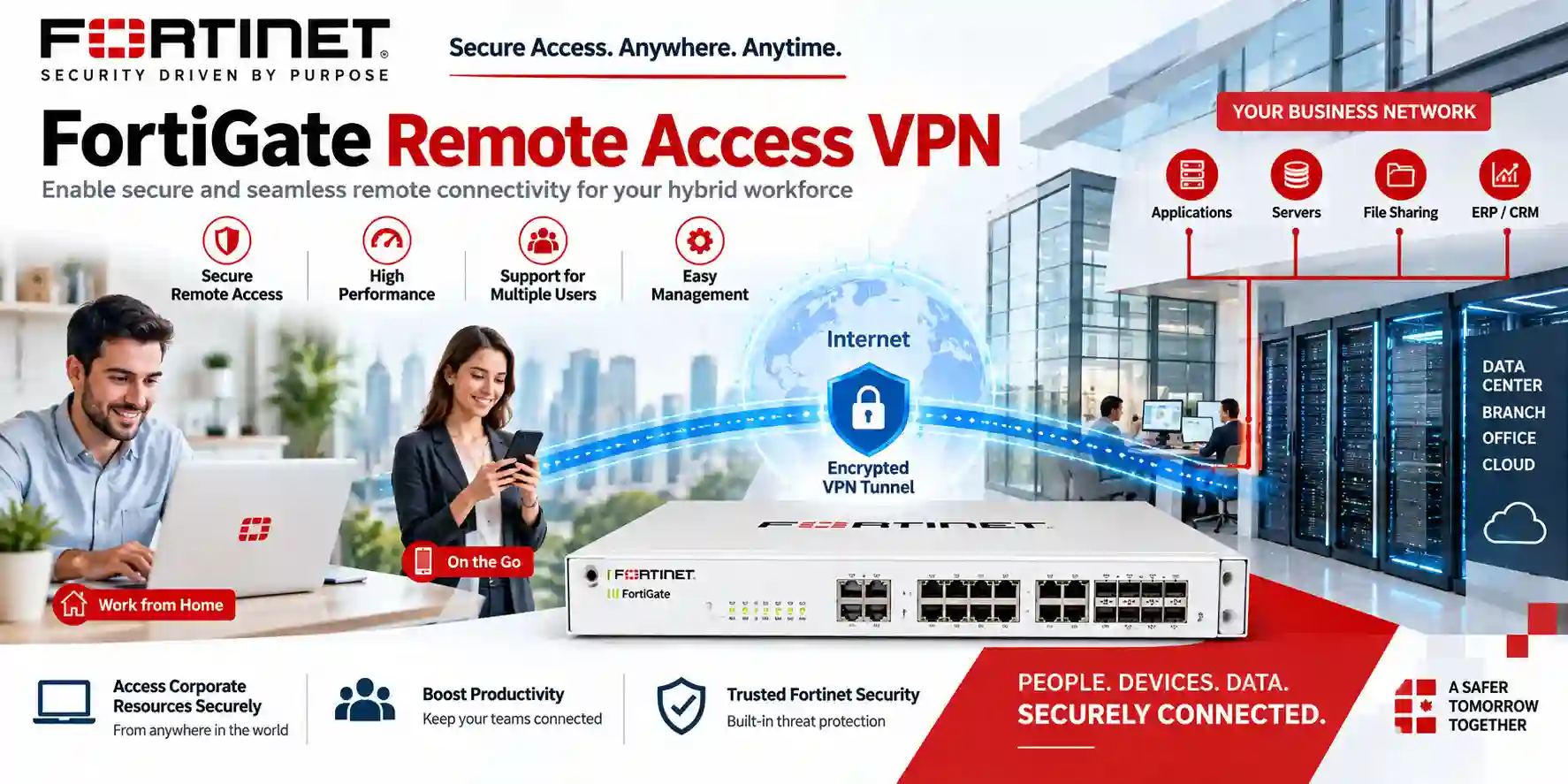
Organizations with multiple lodges, offices or remote operations should document site-to-site VPN and WAN resilience requirements. A useful design workshop maps each location, circuit type, critical application, expected traffic and failure scenario. If remote access is needed for administrators or employees, identity and authentication requirements should be defined separately from branch VPN. FourTeck’s supplied site-to-site VPN reference and remote-access VPN reference illustrate the two different use cases.
For Arusha procurement, ask for an itemized quote that identifies the exact FG-2601F appliance, subscription term, support service, required transceivers and any implementation scope. Avoid assuming that a base hardware price includes the security services your policy requires. Also document renewal ownership so subscriptions do not become an afterthought. For hospitality and multi-site operations, include maintenance windows, change control and fallback procedures in the implementation plan, particularly when the firewall is replacing an existing production gateway.
FortiGate 2601F Dodoma
Dodoma organizations considering FG-2601F may have requirements spanning government, public institutions, education, enterprise headquarters and large multi-department networks. Security procurement in these environments benefits from a requirements-led process. Define security zones, internet and private-WAN capacity, user and device populations, data-center interfaces, required VPNs, authentication systems, logging objectives and change-management constraints. These details allow technical teams to decide whether the 2601F’s performance and port density are appropriate and how much capacity should be reserved for future growth.
Segmentation can be particularly valuable in large institutional networks. Instead of treating the internal network as one trust zone, architects can separate departments, servers, administrative systems, guest access, building systems and other device groups, then permit only required communication. The firewall may participate in that design, but the exact placement should be coordinated with the switching and routing architecture. High-speed 25 GE and 100 GE options can reduce the risk of creating a bottleneck at major aggregation points when the rest of the network operates at similar speeds.
Procurement documentation should distinguish mandatory requirements from optional services. For example, identify whether FortiGuard security subscriptions, centralized logging, centralized management, high availability, premium support, professional configuration or knowledge transfer are required. Where formal tendering is used, specifying measurable requirements makes bids easier to compare. Do not use unverified stock or delivery assumptions in project schedules; request current availability and lead-time information during quotation. This approach gives Dodoma buyers a clearer path from technical need to an auditable bill of materials.
FortiGate 2601F UAE
UAE enterprises evaluating the FortiGate 2601F commonly operate high-bandwidth campuses, data centers, cloud-connected environments and multi-site networks where 10/25/100 GE interfaces can be relevant. The appliance can be assessed for enterprise edge, data-center core security and internal segmentation, but sizing should be tied to the enabled inspection profile. Organizations using high-speed internet, private cloud connectivity or dense east-west application traffic should measure peak utilization and identify encrypted traffic levels before finalizing a platform.
Data-center deployments should also consider optics, rack power, airflow, HA topology and integration with existing switches and routing. The FG-2601F includes dual AC power supplies and dedicated HA interfaces, which can support resilient designs when the surrounding infrastructure is similarly redundant. Where compliance or operational policy requires longer log retention, evaluate centralized logging in addition to onboard storage. For UAE-specific Fortinet context, visit FourTeck’s Fortinet UAE resource, and for broader infrastructure services review FourTeck IT services.
A UAE quotation request should identify exact subscription duration, support level, HA quantity, optical modules, management and logging requirements. Because enterprise Fortinet bundles can differ by security-service package and term, comparing quotes only by headline price can be misleading. Compare exact part numbers and included services. For cross-border groups operating in Tanzania and the UAE, standardizing policy frameworks and management practices can simplify operations, while local circuit, regulatory and deployment requirements should still be documented separately.
FortiGate 2601F Uganda
Ugandan enterprises considering the FortiGate 2601F may be planning a high-capacity headquarters, data center, service-provider edge or centralized security platform for multiple branches. The platform’s high-speed interface mix is most valuable when the surrounding architecture can use it. Before procurement, map internet links, private WAN services, data-center uplinks, server networks and expected growth. If traffic from many branches terminates at the central firewall, include that aggregate traffic in sizing rather than considering only the headquarters user count.
Security subscriptions should be chosen from policy requirements. Teams may need IPS, application visibility, web controls, malware protection and other services, but the exact bundle and term should be confirmed in the quotation. Likewise, HA should include redundant upstream and downstream paths where practical. A firewall pair connected to a single switch or single carrier can still leave major failure points. For Uganda-focused technology sourcing, FourTeck Uganda provides regional context while the Tanzania page remains useful for organizations coordinating East African infrastructure standards.
For distributed Ugandan networks, document branch tunnel requirements, routing, identity, application priorities and failover. Where connectivity varies by site, SD-WAN policies may be part of the design discussion. The correct goal is not simply to “use all firewall features,” but to select controls that improve security and operational outcomes without unnecessary complexity. A structured bill of materials should capture the appliance, support, security services, optics, implementation and any centralized management or logging components required.
FortiGate 2601F Kampala
Kampala is a likely concentration point for large corporate headquarters, financial organizations, service providers, institutions and data-center workloads. In these networks, the FG-2601F can be evaluated where multiple high-speed links need to be secured without forcing all traffic through low-capacity interfaces. The design should identify whether the firewall sits at the internet edge, between data-center zones, between campus segments or across several roles. Combining roles can simplify hardware count but also concentrates traffic and policy dependencies, so architects should model failure domains and maintenance impact.
When replacing an existing firewall, collect real telemetry: interface utilization, session counts, CPU trends, VPN usage, top applications and growth history. This is more reliable than sizing from employee count. Migration planning should include policy cleanup, NAT rules, routing, VPN conversion, certificates, authentication, DNS dependencies, logging and rollback. If a pair is deployed in HA, test failover before production acceptance. The dedicated HA ports on the FG-2601F support cluster connectivity, but surrounding network design determines whether failover is truly seamless for business services.
Kampala procurement teams should request exact Fortinet SKUs for hardware and subscriptions and confirm what is included in each term. Where optics are required, specify vendor compatibility and link standard rather than simply requesting “SFPs.” For regional enterprises that also operate in Tanzania, Kenya or other East African markets, a common security policy model can improve consistency while allowing each site to retain its own carrier and topology details.
FortiGate 2601F Arua
Arua organizations may approach FG-2601F projects differently from capital-city data centers. The model is likely to make sense where a regional hub aggregates substantial traffic, supports many remote locations, hosts centralized applications or forms part of a wider enterprise standard. The first task is therefore to validate scale. If requirements are much smaller, a different FortiGate model may be more economical and operationally appropriate. If the 2601F is justified, document why: interface speed, session scale, inspection workload, segmentation density, VPN aggregation or growth expectations.
Connectivity resilience deserves particular attention for regional hubs. Multiple WAN paths can improve availability, but failover behavior depends on routing, addressing, DNS and application architecture. A second link is not automatically a complete continuity plan. Identify which services must survive a carrier failure, how quickly routing should converge, and whether remote sites need alternative tunnel endpoints. The firewall configuration can then be aligned with the actual business continuity objective.
For procurement, separate core requirements from optional enhancements. The core may include appliance hardware, a defined FortiGuard bundle, FortiCare, HA, optics and implementation. Optional elements may include centralized management, logging expansion or additional professional services. This makes budgeting clearer and helps stakeholders understand lifecycle costs. It also avoids underestimating renewals, which are important for maintaining subscribed security services. An Arua quotation should be based on the final technical bill of materials and current availability rather than generic online pricing from another country.
FortiGate 2601F Mbarara
For Mbarara enterprises, institutions and regional operations, the FG-2601F can serve as a candidate for centralized security when the network requires high throughput, dense segmentation or aggregation of many remote connections. A design review should determine whether traffic is predominantly internet-bound or whether significant east-west traffic will traverse the firewall. Internal segmentation can dramatically increase the amount of inspected traffic, especially where server, user, wireless, guest and operational networks are separated into security zones.
The 2601F’s onboard storage can be useful, but logging strategy should be designed around retention, search and reporting needs. Security teams should decide which events must be retained, for how long, and whether centralized analytics is required. Similarly, subscription selection should follow the threat controls that the organization intends to operate. Buying a bundle without assigning ownership for monitoring and response can leave value unused. Operational procedures should define alert review, configuration backup, firmware management and escalation.
Mbarara buyers planning branch connectivity should document IPsec requirements, address spaces and routing before implementation. Overlapping private networks between sites can complicate migration, so discovery is important. If the firewall replaces another vendor, plan policy translation carefully instead of automatically reproducing every legacy rule. The migration is an opportunity to remove obsolete access and simplify network objects. A final quote should reflect hardware, services, optics and implementation needs, with current lead times confirmed separately.
FortiGate 2601F Gulu
Gulu organizations assessing the FortiGate 2601F should begin with business-critical applications and connectivity rather than product specifications. Identify the services that must remain available, where users and servers are located, which sites communicate with each other, and what security inspection is required. This creates a traffic-flow model that can be compared with the platform’s published performance. If the organization has a regional data center or aggregates many branch tunnels, include those flows in the capacity plan.
For resilience, consider power, switching and WAN dependencies around the firewall. Dual power supplies support redundant power architecture, but they should be connected to appropriate independent feeds where the facility supports that design. HA pairs should use redundant network paths where practical. Configuration backups and documented recovery procedures are also part of resilience; availability is not only a hardware feature. Teams should schedule firmware and security-policy maintenance through a controlled change process.
Gulu procurement can be simplified by issuing a clear quotation checklist: FG-2601F quantity, HA requirement, FortiGuard package, FortiCare level and duration, optics, cables, rack requirements, implementation, VPN migration, management, logging and training or handover. Suppliers can then quote against the same scope. If the project is part of a national network, standard naming, policy templates and monitoring practices can reduce support complexity across sites while allowing local WAN differences.
FortiGate 2601F Kenya
Kenyan enterprises and data-center operators evaluating the FG-2601F may have high-speed connectivity and multi-site requirements similar to other large East African deployments. The platform’s 100 GE, 25 GE and 10 GE options are particularly relevant where core switching and internet or private connectivity already exceed traditional gigabit speeds. The correct sizing process should compare expected security-inspected traffic against Fortinet’s enterprise traffic mix figures rather than using raw firewall throughput as the only metric.
For data centers, define north-south and east-west security zones, virtual network boundaries, routing, HA and maintenance procedures. For enterprise edges, define carrier diversity, BGP or other routing requirements where applicable, inbound publishing, NAT and DDoS dependencies. For multi-site networks, define VPN and SD-WAN policy. Each use case places different demands on the appliance, so a technical discovery session should precede the final bill of materials.
Kenya-focused customers can review FourTeck Kenya for regional technology context. Cross-border groups should avoid assuming that one country’s exact carrier or support arrangement applies in another market. Standardize the security architecture where beneficial, but confirm local circuit availability, implementation scope and procurement terms separately. Request a quotation that lists exact hardware and subscription SKUs, term lengths and optical requirements so competing proposals can be compared accurately.
FortiGate 2601F Kuwait
Kuwait organizations looking at the FortiGate 2601F may be planning enterprise edge, data-center, oil-and-gas, financial, government or large-campus security projects. High-capacity interfaces can be valuable in environments with substantial server traffic, high-speed WAN links and multiple security zones. The selection process should identify how much traffic will be subject to IPS, application control, SSL inspection and other security services, because those controls are more representative of real operational load than basic Layer-3 forwarding alone.
Facilities teams should verify 2RU rack space, airflow, AC power and cooling. Network teams should verify optics and switch compatibility. Security teams should define subscriptions, logging and policy. Operations teams should define HA, monitoring, firmware maintenance and incident escalation. Bringing these groups into the design early reduces the risk of a technically capable appliance being delayed by missing transceivers, power assumptions or undocumented dependencies.
For Kuwait-focused technology sourcing, visit FourTeck Kuwait. When requesting pricing, provide the desired FortiCare and FortiGuard duration and ask for exact part numbers. Avoid comparing a hardware-only quote with a multi-year security bundle as though they were equivalent. For multinational projects, use a common technical requirements template across Kuwait, Tanzania and other markets, while validating local commercial and deployment details individually.
FortiGate 2601F Ghana
Ghanaian enterprises considering FG-2601F can evaluate it for high-capacity perimeter security, data-center segmentation and centralized multi-site connectivity. Organizations with multiple internet links, cloud connectivity or large internal networks should model traffic paths before choosing the firewall role. If a single appliance pair is expected to protect both internet and internal segmentation traffic, aggregate capacity and maintenance impact should be examined carefully. Separating roles can sometimes improve operational isolation, while consolidation can reduce hardware count; the right choice depends on architecture.
High availability should be tested as a business service. Validate cluster behavior, upstream routing, downstream switching, VPN continuity and critical application recovery. The FG-2601F provides dedicated HA connectivity and redundant power capability, but end-to-end availability still depends on external systems. Logging and monitoring should also be planned before go-live so administrators can establish baselines and investigate events effectively.
For Ghana-related technology context, see FourTeck Ghana. A procurement request should specify exact firewall quantity, subscription package and duration, support service, optics, implementation, migration and management requirements. If the project is replacing an existing firewall, include configuration discovery and rule review in scope. A clean migration plan should preserve necessary access while removing obsolete rules rather than carrying historical complexity indefinitely.
FortiGate 2601F Nigeria
Nigeria’s large enterprise, financial, telecom, energy and service-provider environments can generate the kind of traffic scale where a FortiGate 2601F evaluation is appropriate. The platform’s high-speed interface density supports architectures that need 100 GE or 25 GE connectivity alongside numerous 10 GE links. However, interface capability should not be confused with security throughput. Project teams should size using the intended security profile and measured traffic, allowing capacity for peaks, growth and failover scenarios.
For organizations with multiple branches, the central firewall may terminate substantial VPN traffic and enforce application policy for distributed users. Document the number of sites, tunnel topology, routing, link speeds and critical applications. For data centers, document server segments, cloud interconnects, north-south and east-west flows. For internet edges, document carrier routing, public services and inspection requirements. These details help determine whether the 2601F should serve one consolidated role or be part of a more distributed firewall architecture.
Nigeria-focused customers can visit FourTeck Nigeria. Quotation requests should identify subscription and support terms explicitly and confirm current commercial availability rather than relying on public marketplace pricing. Where uptime requirements are strict, include HA appliances, redundant optics and implementation testing in the bill of materials. Also plan lifecycle ownership for renewals, firmware and policy reviews so the security platform remains operationally maintained after deployment.
FortiGate 2601F Seychelles
Seychelles organizations considering the FG-2601F may include large hospitality groups, financial institutions, government environments, service providers and enterprises that centralize services for multiple sites. The platform should be selected when traffic scale, interface speed, segmentation or VPN aggregation justifies an enterprise-class appliance. In island environments where connectivity design can be particularly important to continuity, teams should document primary and secondary WAN paths, critical cloud dependencies and the applications that must remain reachable during circuit disruption.
A resilient design should consider more than the firewall pair. Power, switching, carrier paths, DNS, authentication and remote-management access all contribute to recovery. If centralized services are hosted behind the FG-2601F, plan how administrators reach the environment during partial outages. For remote sites, test tunnel failover and routing behavior. Where local logging is used, define retention targets; where longer retention or broader analytics is needed, consider centralized logging architecture.
Procurement should account for logistics without making assumptions about stock or delivery. Request current lead time as part of the quote and identify all transceivers, cables and licenses required for a complete deployment. For a multinational hospitality or enterprise group, standardizing FortiGate policy structures can simplify administration, but each Seychelles site should still have a topology-specific implementation plan. The result should be a bill of materials that reflects actual connectivity, security services, support and implementation rather than only the FG-2601F base appliance.
Integration and Deployment Checklist
Network discovery
Record WAN circuits, VLANs, routing, IP addressing, public services, switch uplinks, optical standards, VPN peers and cloud connections. Capture real traffic statistics wherever possible.
Security policy
Define IPS, malware, application, web, DNS, SSL inspection and segmentation requirements. Identify exceptions and certificate dependencies before migration.
Operations
Plan HA tests, backups, monitoring, logging, firmware maintenance, administrator access, renewal ownership, documentation and escalation procedures.
FortiGate 2601F Quotation Checklist
A useful quote request should state the exact appliance model, quantity, whether an HA pair is required, desired FortiGuard security bundle, FortiCare service and term, AC power requirements, optical modules, fiber type, rack environment, WAN and LAN interface speeds, VPN requirements, management and logging requirements, migration scope and target implementation window. Include existing firewall information if this is a replacement. Where possible, provide traffic graphs and topology diagrams. This enables a supplier to identify missing dependencies before commercial approval.
Do not assume that online prices from unrelated markets reflect Tanzania pricing, tax, logistics, subscriptions or support. Enterprise firewall configurations can differ substantially depending on license term and services. Request an itemized bill of materials and compare exact part numbers. For broader firewall-focused information, FourTeck firewall solutions offers specialist network-security context, while FourTeck provides the wider company technology portfolio.
Frequently Asked Questions
What is the difference between FortiGate 2600F and 2601F?
The key published difference is onboard storage: the FG-2601F includes NVMe SSD storage while the FG-2600F does not include onboard storage in the current Fortinet 2600F-series datasheet. Other design details should be checked against the current vendor datasheet when ordering.
Is FortiGate 2601F suitable for a data center?
Fortinet positions the 2600F series for large enterprises and service providers, including enterprise edge, hybrid and hyperscale data-center core and internal segmentation use cases. Suitability for a specific data center depends on traffic, security services, interface standards, HA and growth requirements.
Does FG-2601F support 100 GE?
Yes. Fortinet lists four hardware-accelerated 100 GE QSFP28 / 40 GE QSFP+ slots for the 2600F series. Optics and cabling must be selected for the specific link design.
What subscriptions should be ordered?
The answer depends on the security controls and support level required. Request an itemized proposal showing the exact FortiGuard and FortiCare package, included services and duration. Avoid treating every FortiGate bundle as equivalent.
Can FG-2601F be deployed in high availability?
The appliance includes dedicated HA interfaces and dual power supplies suitable for resilient architecture planning. A complete HA design must also account for switches, circuits, routing, power and operational testing.
How should a Tanzania buyer request an FG-2601F quote?
Provide appliance quantity, HA requirement, subscription and support term, optics, circuit speeds, VPN needs, logging and management requirements, current topology and implementation scope. This produces a more useful quote than requesting hardware price alone.
Decision Recap
Choose the FortiGate 2601F for evaluation when your project genuinely needs enterprise-class security capacity, dense 10/25/100 GE connectivity, integrated storage and resilient deployment options. Validate the decision against measured traffic, inspection requirements, interface standards, HA architecture and expected growth. The best procurement outcome is a complete design with hardware, subscriptions, optics, management, logging and implementation clearly identified.
Consult FourTeck Tanzania
Share your topology, circuit speeds, security requirements, preferred subscription term and HA objectives with FourTeck Tanzania to build a project-specific FG-2601F quotation. Current availability, commercial terms and delivery expectations should be confirmed at quotation time.




Reviews
There are no reviews yet.