
FortiGate 601F (FG-601F) Tanzania
FortiGate 601F is a high-performance 1RU next-generation firewall for organizations that need strong perimeter security, high-speed east-west and north-south connectivity, secure SD-WAN, VPN services and integrated threat protection. The FG-601F combines Fortinet NP7 and CP9 security processors with 480GB onboard SSD storage and dual AC power supplies. It is suited to enterprise headquarters, larger campuses, data-center edges, service-provider environments and consolidation projects where security inspection and network performance must be planned together.
FortiGate 601F overview and verified hardware
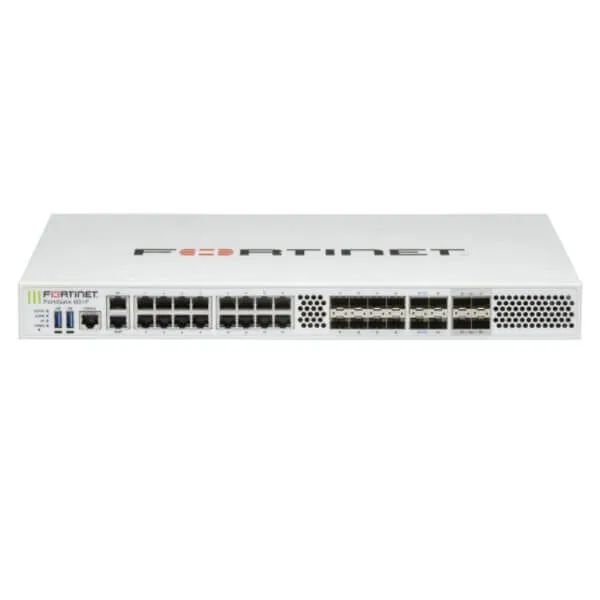
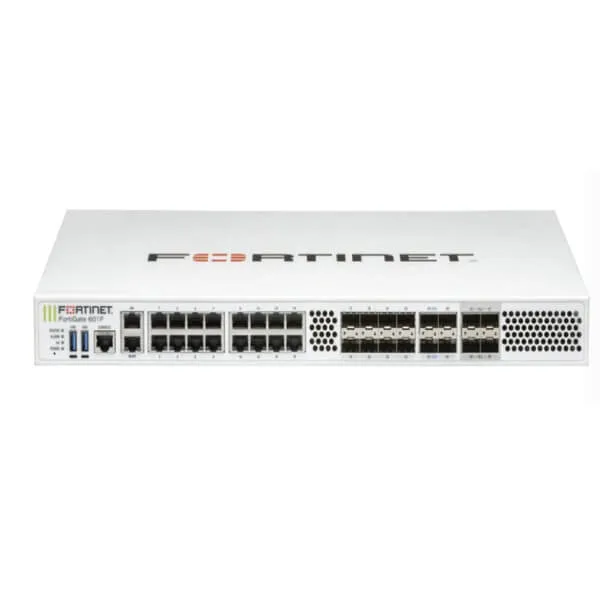
Fortinet positions the FortiGate 600F Series as an enterprise NGFW platform combining secure networking, AI/ML-supported FortiGuard security services and Security Fabric integration. The FG-601F model includes four 25GE SFP28 slots, four 10GE SFP+ slots, sixteen hardware-accelerated GE RJ45 switch interfaces, eight GE SFP slots, dedicated GE management and HA ports, two USB ports and an RJ45 console port. Unlike the FG-600F, the FG-601F includes 480GB onboard SSD storage. Its 1RU chassis is supplied with two hot-swappable redundant AC power supplies.
25GE SFP28, 10GE SFP+, GE SFP and GE RJ45 connectivity supports flexible uplink, core, WAN and segmented network designs.
NP7 and CP9 hardware acceleration helps FortiOS deliver networking and security functions on a purpose-built platform.
Dual hot-swappable power supplies and dedicated HA connectivity support resilient enterprise deployment designs.
FG-601F performance and capacity
Published Fortinet 600F-series specifications list IPv4 firewall throughput of 139/137.5/70 Gbps for 1518/512/64-byte UDP traffic, 105 Mpps firewall throughput, 8 million concurrent TCP sessions and 550,000 new TCP sessions per second. Fortinet also publishes 55 Gbps IPsec VPN throughput, 14 Gbps IPS throughput, 11.5 Gbps NGFW throughput and 10.5 Gbps threat-protection throughput under its stated test conditions. These are laboratory datasheet figures rather than guarantees for every production environment; real sizing should account for enabled inspection profiles, traffic mix, encryption, logging, VPN use, application behavior, redundancy and growth.
| Metric | Fortinet published figure |
|---|---|
| IPS throughput | 14 Gbps |
| NGFW throughput | 11.5 Gbps |
| Threat protection | 10.5 Gbps |
| IPsec VPN | 55 Gbps |
| Concurrent TCP sessions | 8 million |
Security, SD-WAN, VPN and integration
FortiOS converges firewalling and networking functions on the same platform. Depending on the selected software release, subscriptions and deployment design, organizations can use FortiGate for application control, intrusion prevention, web and DNS security, malware protection, SSL inspection, IPsec VPN, remote access, segmentation, SD-WAN and zero-trust access use cases. FortiGuard subscriptions should be selected according to the threat-inspection services required by the organization rather than treated as a generic add-on.
The FG-601F can also participate in the broader Fortinet Security Fabric. Projects may involve FortiManager for centralized administration, FortiAnalyzer for analytics and logging, FortiSwitch for secure switching and FortiAP for wireless access. Compatibility, licenses, optics and software versions should be checked during design. For related regional technology sourcing, customers can review FourTeck Africa solutions, Fortinet UAE solutions, FourTeck Uganda, FourTeck Kenya and FourTeck UAE.
Selecting and sizing the FortiGate 601F
A firewall should be sized against inspected traffic rather than only the internet circuit headline speed. A useful procurement brief identifies current and expected WAN bandwidth, east-west traffic, the percentage of encrypted traffic, required IPS and malware inspection, remote-access users, site-to-site VPNs, application-control policies, segmentation requirements, high-availability objectives, logging retention and expected growth. Interface requirements also matter: confirm whether the design needs copper GE access, GE fiber, 10GE or 25GE uplinks and identify the exact transceiver types before ordering.
The 480GB SSD distinguishes the FG-601F from the FG-600F and can be relevant where local storage is part of the intended operational design. It should not replace a deliberate centralized logging and retention strategy where compliance, long-term analytics or multi-device visibility is required. Buyers should also determine the required FortiCare support level and FortiGuard service bundle, subscription term and renewal plan before comparing quotations.
FortiGate 601F Tanzania
Tanzanian organizations evaluating the FortiGate 601F commonly need to balance internet-edge protection, inter-site connectivity, cloud access and internal segmentation within one enterprise security architecture. The FG-601F is most relevant when the project requires significantly more capacity and interface flexibility than a small-branch firewall. Headquarters, large campuses, data centers, financial environments, hospitality groups, healthcare networks, education institutions, industrial sites and multi-branch organizations can evaluate it for high-throughput perimeter and aggregation roles.
For a Tanzania quotation, document the number and speed of ISP links, expected inspected throughput, VPN topology, number of users and devices, public services, VLANs, high-availability requirement, required optics and subscription term. If dual internet links are planned, the design can use FortiOS SD-WAN policies to steer applications according to defined business rules and link health. For private inter-site connectivity, IPsec VPN design should account for route architecture, overlapping networks, encryption requirements and failover behavior.
Procurement teams should request a bill of materials that clearly separates the FG-601F appliance, FortiGuard/FortiCare subscriptions, transceivers, rack and power considerations, management or analytics products where required, and professional deployment scope. This makes competing proposals easier to compare. FourTeck Tanzania can use that project information to prepare a solution-focused quotation without assuming that every buyer needs the same license bundle or accessory set.
FortiGate 601F Dar es Salaam
In Dar es Salaam, the FG-601F is a candidate for organizations consolidating security at a major office, data-center edge or multi-site WAN hub. A deployment may need to protect business applications while supporting cloud services, remote users, branch VPNs and multiple internet connections. Because the appliance provides a mix of copper GE, fiber GE, 10GE and 25GE interfaces, architects can map firewall zones to existing switching, WAN and server infrastructure without assuming that every connection uses the same media or speed.
Before purchase, the network team should measure peak traffic and distinguish plain firewall forwarding from traffic that will receive IPS, application control, web filtering or other inspection. SSL inspection can materially affect sizing and operational planning, especially where large numbers of encrypted sessions are involved. High availability should be considered where the firewall is a critical gateway; this includes switch connectivity, ISP handoff, routing, session behavior and power design rather than simply buying two appliances.
A Dar es Salaam project brief should also state whether local SSD storage is expected to support logs and whether centralized analytics is required. For regulated or security-sensitive environments, define retention and reporting objectives before deployment. This creates a clearer design for FortiAnalyzer or other approved logging architecture and helps prevent storage assumptions from becoming a post-deployment constraint.
FortiGate 601F Mwanza
Organizations in Mwanza can evaluate the FortiGate 601F where a regional hub needs to secure substantial user traffic, site-to-site connectivity and business applications. The selection decision should start with topology: identify whether Mwanza is the main internet breakout, a regional aggregation point or one node in a centrally managed network. That distinction affects interface use, VPN design, routing, logging and the FortiGuard services required.
For multi-site operations, secure SD-WAN can help combine connectivity choices under policy-based application steering, but the benefits depend on correct SLA definitions and resilient underlay links. Project teams should identify critical applications, acceptable latency and packet-loss thresholds, preferred links and failover behavior. Where IPsec connects branches, confirm tunnel scale and routing design while leaving capacity for growth.
Procurement should include optics and cabling in the technical review. The presence of SFP, SFP+ and SFP28 slots does not mean every optical module is interchangeable. Exact Fortinet-supported transceiver choices and link requirements should be validated against the intended distance, fiber type and switch or carrier handoff. A complete quote should therefore capture the firewall, subscriptions, support, optics and deployment services as separate but coordinated components.
FortiGate 601F Arusha
Arusha enterprises considering FG-601F may include hospitality groups, institutions, headquarters operations and organizations linking several sites or cloud services. In these environments, availability and policy consistency can matter as much as raw throughput. The firewall design should separate guest, corporate, server, voice, management and other trust zones where appropriate, then apply policies according to business requirements rather than allowing broad lateral access.
Remote administration should be designed securely, with management access restricted to trusted paths and administrators. Organizations using remote-access VPN or zero-trust access approaches should define identity, authentication and endpoint requirements before rollout. FortiGate can form part of a broader identity-aware access strategy, but licensing and companion components must be checked for the selected architecture.
For an Arusha quotation, provide current firewall model if replacing an existing device, internet link speeds, interface inventory, VLAN count, VPN requirements, public IP services, expected users, inspection requirements and preferred support term. Migration planning should include configuration review, object cleanup, routing validation, maintenance windows, testing and rollback. This reduces the risk of treating a firewall replacement as a simple hardware swap.
FortiGate 601F Dodoma
For Dodoma organizations, the FG-601F can be evaluated for central-office and institutional networks that require strong segmentation, encrypted connectivity and high-capacity security inspection. Procurement teams should translate policy objectives into measurable technical requirements: how many networks need separation, which applications cross zones, what traffic must be inspected, which sites connect through VPN and what level of service continuity is expected.
Where a firewall protects externally published applications, architecture should include server segmentation, restricted inbound rules, logging and monitoring rather than relying on a single perimeter policy. Where the device is used as an SD-WAN hub, routing and link-health design should be tested for both normal and degraded conditions. High availability similarly requires testing of physical links, routing convergence and upstream/downstream dependencies.
FortiGuard and FortiCare choices should be documented in procurement records with their term and service scope. Renewal dates should be tracked so security services do not lapse unexpectedly. Organizations with multiple FortiGate devices may also evaluate centralized policy administration and analytics to reduce configuration drift and improve operational visibility.
FortiGate 601F UAE
UAE buyers evaluating the FG-601F often focus on data-center edge, enterprise campus, regional headquarters and multi-site SD-WAN roles. The platform’s 25GE and 10GE interfaces can suit networks where firewall uplinks must integrate with higher-speed switching and server environments. Buyers should confirm optics, subscription bundles and support requirements rather than comparing appliance-only pricing with bundled quotations.
For regional architectures spanning the Gulf and Africa, a FortiGate hub can terminate IPsec connectivity and enforce consistent security policy, subject to correct sizing and design. Application steering, redundant WAN links and centralized management can simplify operations, but only when route ownership, failure modes and change control are clearly defined. Security teams should establish which traffic requires deep inspection and how exceptions will be governed.
A UAE project request should include appliance quantity, HA requirement, subscription term, FortiGuard service needs, transceivers, centralized management, analytics and implementation scope. Visit FourTeck Fortinet UAE for region-specific Fortinet sourcing context.
FortiGate 601F Uganda
Uganda deployments can use the FG-601F as a high-capacity security gateway where headquarters or data-center traffic, branch VPNs and multiple WAN links converge. The buying process should separate current throughput from projected growth and identify which security services will inspect the traffic. This avoids sizing solely on firewall throughput when the real requirement is threat-protected application traffic.
Multi-branch organizations should document the number of remote sites, tunnel architecture, routing protocol choices, address plans and failover expectations. Secure SD-WAN may help prioritize business applications across available links, while IPsec protects inter-site traffic. Centralized management can become increasingly valuable as device count grows because policy consistency, firmware planning and configuration governance become operational concerns.
Procurement teams can coordinate Uganda requirements through FourTeck Uganda while keeping the bill of materials aligned with the exact FG-601F design.
FortiGate 601F Kampala
Kampala enterprises considering the FortiGate 601F should begin with a traffic and application inventory. Headquarters environments often mix internet browsing, SaaS, private cloud, public cloud, voice, branch traffic, remote users and externally published services. Segmentation and policy design should reflect these distinct risk profiles. The FG-601F’s interface density and high-speed ports give architects options for connecting multiple zones and upstream systems.
Where business continuity is important, an HA design should address more than the firewall pair. ISP diversity, switch redundancy, power, routing and DNS dependencies can all determine whether services remain reachable during a failure. Operational procedures should include configuration backup, monitored failover testing, firmware lifecycle planning and subscription renewal tracking.
For quotation accuracy, specify whether the requirement is appliance-only or a complete security bundle. Include the desired support duration and any FortiManager, FortiAnalyzer, FortiSwitch or FortiAP integration expected in the project.
FortiGate 601F Arua
For Arua networks, the FG-601F is most appropriate when the site acts as a substantial regional hub or requires enterprise-class capacity rather than a small branch appliance. The correct model should be justified by inspected throughput, VPN load, interface requirements, session scale and resilience goals. Oversizing without an architecture need can add unnecessary cost, while undersizing can constrain future inspection and encrypted traffic growth.
Connectivity quality should be incorporated into SD-WAN planning. Link health checks and business rules can help applications choose suitable paths, but no firewall can compensate for every underlay limitation. Critical applications should have defined performance objectives and tested failover behavior. VPN encryption settings, route propagation and MTU considerations should also be validated during deployment.
Arua procurement briefs should list required interfaces and optics, subscription services, support term, HA needs and remote management approach. This produces a clearer technical and commercial comparison between proposals.
FortiGate 601F Mbarara
Mbarara organizations with distributed operations can assess the FG-601F for central security and WAN aggregation. A strong design maps business services to security zones, identifies permitted flows and applies inspection according to risk. This is preferable to using the firewall only as a high-speed internet gateway because segmentation, visibility and policy control are core parts of an enterprise NGFW deployment.
Where many remote sites connect to the hub, teams should estimate simultaneous tunnel use and aggregate encrypted traffic. Fortinet publishes substantial IPsec capacity for the platform, but production performance remains dependent on configuration and traffic conditions. Remote-access requirements should be considered separately from site-to-site VPNs because user authentication, endpoint posture and support processes differ.
Before ordering, validate the required FortiOS release, subscription package and supported optics against the final network design. Include migration and acceptance testing in the implementation plan so routing, NAT, security policies, VPNs and monitoring are verified before cutover is considered complete.
FortiGate 601F Gulu
Gulu deployments should evaluate whether the FG-601F will operate as an internet edge, WAN hub, segmentation firewall or combined role. Each pattern places different demands on interfaces, routing and inspection. If the device connects a core switch at 10GE or 25GE, confirm that the wider network can support the selected speed and optics and that redundant paths are designed consistently.
Security policy should be developed from application requirements and least-privilege principles. Logging needs should be identified early, particularly where investigations, audit or compliance reporting require longer retention. The onboard SSD is a model feature, but organizations should decide whether centralized logging and analytics are needed for their operational objectives.
A complete Gulu quotation request can include expected bandwidth, users, sites, VPNs, security services, HA, optics, support term and implementation requirements. This gives suppliers enough information to propose a relevant configuration rather than simply quote a base appliance.
FortiGate 601F Kenya
Kenyan enterprises can evaluate the FG-601F for data-center, campus and headquarters security where high-speed links and substantial inspected traffic are expected. Projects should distinguish between internet edge capacity and internal segmentation capacity, especially when server, user and cloud traffic crosses the firewall. The combination of 25GE, 10GE and GE interfaces allows flexible placement in mixed-speed environments.
Organizations with branches can integrate IPsec VPN and SD-WAN policies into a common FortiOS architecture. Centralized management and analytics may be useful where the environment contains multiple FortiGate devices. Licensing should be reviewed at the design stage because the value of advanced security functions depends on the appropriate FortiGuard services and support coverage.
For Kenya-specific sourcing and related infrastructure planning, see FourTeck Kenya. Provide the target topology and subscription duration when requesting a quotation so hardware, licenses and accessories can be aligned.
FortiGate 601F Kuwait
Kuwait buyers considering FG-601F can assess it for high-capacity enterprise perimeter security, hybrid cloud connectivity, VPN aggregation and internal segmentation. The model’s 1RU format and redundant power design suit rack-based enterprise environments, while the high-speed optical interfaces provide options for integration with modern switching infrastructure.
Sizing should use the expected security profile rather than maximum firewall forwarding alone. Teams should model threat inspection, SSL inspection, VPN and session load, then preserve growth headroom. Where high availability is required, validate upstream and downstream redundancy and test actual failure scenarios. Subscription and support terms should be compared on equal duration and service scope.
For regional sourcing context, customers can review FourTeck Kuwait. A detailed bill of materials should include transceivers and management or analytics components when they form part of the architecture.
FortiGate 601F Ghana
Ghana enterprises planning a firewall refresh can consider the FG-601F where current or future inspected traffic, VPN demand and interface requirements justify a high-capacity appliance. Migration should begin with an inventory of rules, NAT, routes, VPNs, objects and dependencies. Old configurations often contain unused objects or overly broad access, so a refresh can be an opportunity to improve policy hygiene rather than duplicate legacy settings.
For organizations linking offices, SD-WAN and IPsec can be designed together to provide encrypted connectivity and policy-based path selection. The operational model should also address monitoring, alerting, firmware maintenance, backups and subscription renewals. Centralized tools may improve consistency across larger Fortinet estates.
See FourTeck Ghana for related regional sourcing context. Quotations should state whether optics, licenses, support and deployment are included so commercial comparisons remain meaningful.
FortiGate 601F Nigeria
Nigeria deployments may require a firewall to handle large user populations, multiple internet circuits, cloud applications and numerous branch connections. The FG-601F can be evaluated for these enterprise roles using measured traffic and security requirements. Published performance figures are useful for initial comparison, but final sizing should reflect enabled services, encrypted traffic, application behavior and redundancy.
A resilient design may combine HA firewalls with diverse WAN paths and redundant switching. Secure SD-WAN can apply business policies across links, while IPsec can protect inter-site connectivity. Security teams should define segmentation, inspection and logging requirements alongside networking requirements so the appliance is not deployed as a simple router with unused security capability.
For Nigeria-focused sourcing, visit FourTeck Nigeria. Include expected growth and subscription term in the quotation request to support a more complete lifecycle cost discussion.
FortiGate 601F Seychelles
Seychelles organizations evaluating FG-601F should focus on the role the appliance will play in business continuity, secure internet access and inter-site connectivity. Hospitality, enterprise and institutional networks may have distinct guest, staff, server, voice, IoT and management segments. A deliberate segmentation design can reduce unnecessary lateral exposure while allowing required services to communicate under controlled policies.
Where connectivity options are constrained or costly, SD-WAN policy should be designed around application priority and measured link quality. VPN connectivity to remote sites or cloud environments should include route, encryption and failover planning. The firewall can enforce policy, but the complete service depends on reliable upstream connectivity and sound network architecture.
Procurement should verify hardware, subscription, optics, support and implementation scope. For multi-country organizations, centralized management and logging may simplify governance across locations while maintaining locally appropriate network policies.
Related Fortinet planning resources
FourTeck Tanzania content can support adjacent planning topics such as enterprise technology solutions in Tanzania. Relevant project discussions can also cover FortiGate dual-WAN design, internet load balancing, IPsec VPN configuration, remote-access VPN, FortiGuard subscription renewal, data-center firewall design and head-office firewall integration. Because individual indexed Tanzania product URLs could not be reliably verified during this research pass, unverified paths have not been fabricated.
FortiGate 601F quotation checklist
For a useful quotation, provide the required quantity, current and future WAN bandwidth, expected inspected throughput, user/device count, number of sites and VPNs, required 10GE/25GE links, HA requirement, FortiGuard services, FortiCare term, transceivers, centralized management or analytics needs, migration scope and desired deployment window. Avoid relying on an appliance-only part number when the project requires subscriptions, optics or professional services.
FortiGate 601F FAQs
What is the difference between FG-600F and FG-601F?
The key published hardware difference is onboard storage: Fortinet lists no onboard storage for FG-600F and 2 x 240GB SSD, totaling 480GB, for FG-601F. Core interface and published performance specifications are otherwise presented together for the 600F series.
Does FortiGate 601F support 25GbE?
Yes. Fortinet specifies four hardware-accelerated 25GE SFP28/10GE SFP+ ultra-low-latency slots, plus four 10GE SFP+/GE SFP slots and additional GE interfaces.
Can FG-601F be used for SD-WAN?
Yes. FortiOS provides secure SD-WAN capabilities. The actual design should define link health, application steering, routing and failover requirements.
Which FortiGuard license should I buy?
The appropriate bundle depends on the security services, support level and term required. Compare bundles by included services and duration, and align them with the organization’s inspection and operational needs.
Is FG-601F suitable for high availability?
Fortinet provides dedicated HA connectivity and dual hot-swappable power supplies. A complete HA architecture should also consider switches, ISP links, routing, power and testing procedures.
Decision recap and consultation
FortiGate 601F is a high-capacity enterprise NGFW with 480GB SSD, 25GE and 10GE interfaces, purpose-built Fortinet security processors, redundant power and substantial published firewall, VPN and threat-inspection capacity. It is best evaluated through a project-specific sizing exercise that accounts for inspected traffic, encrypted sessions, VPNs, interfaces, resilience, logging and subscriptions. FourTeck Tanzania can prepare a quotation based on those requirements and help organize the appliance, licenses, optics and related Fortinet components into a coherent bill of materials.


Reviews
There are no reviews yet.