
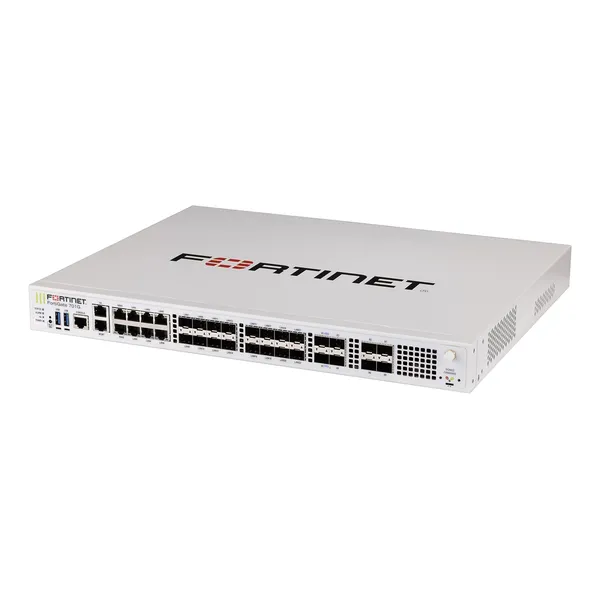
FortiGate 700G (FG-700G) Tanzania
FortiGate 700G is a high-performance next-generation firewall designed for modern campus networks, enterprise perimeters and distributed organizations that need strong security inspection without turning the security gateway into a network bottleneck. Fortinet positions the 700G series around converged networking and security, FortiOS, FortiGuard AI-powered security services and purpose-built acceleration. For Tanzania buyers, the practical question is not simply how large the headline firewall number is; it is whether the platform can support the real mix of encrypted internet traffic, business applications, site-to-site VPN, cloud access, branch connectivity, segmentation, logging and security inspection expected over the deployment lifecycle.

FortiGate 700G Overview and Verified Performance
Fortinet introduced the FortiGate 700G series for high-performance enterprise and campus security. Published Fortinet figures include up to 164 Gbps firewall throughput, 55 Gbps IPsec VPN throughput, 26 Gbps threat protection, and high session capacity. The platform uses Fortinet purpose-built processing and FortiOS to converge firewall policy, secure networking, SD-WAN, VPN and security services. Interface flexibility spans multi-gigabit and higher-speed connectivity, allowing architects to map ISP handoffs, server or aggregation links and future network upgrades without treating the firewall as an isolated box.
Performance sizing should always use the security functions that will actually be enabled. A project that needs SSL inspection, IPS, application control, malware protection and extensive logging should not be sized only from raw firewall throughput. FourTeck can help procurement and IT teams document bandwidth, encrypted-traffic percentage, user and device counts, application mix, VPN requirements, interface needs, HA design and FortiGuard subscription scope before quotation.
Published firewall throughput for high-speed routing and perimeter workloads under Fortinet test conditions.
Published IPsec VPN throughput for secure inter-site connectivity and encrypted network designs.
Published threat-protection throughput with key security functions enabled under stated test methodology.
What the FG-700G Solves
Enterprise networks increasingly carry cloud applications, voice, video, SaaS, ERP traffic, remote-user sessions, branch VPNs, guest access, surveillance systems and operational workloads through shared infrastructure. The FG-700G gives architects a consolidated enforcement point for segmentation, application-aware policy, intrusion prevention, secure internet access, VPN and SD-WAN. That consolidation can simplify policy operations compared with maintaining separate routing and security devices, while Fortinet Security Fabric integration can support broader visibility when the organization also uses compatible Fortinet management, logging, endpoint, access or security products.
The model is especially relevant when a smaller branch-class firewall would leave insufficient inspected-throughput headroom, when multiple high-speed links must be protected, or when a headquarters or campus needs a stronger aggregation point for remote locations. It should still be selected through workload analysis rather than model-name assumptions.
Connectivity, Security and Deployment Planning
Fortinet describes the 700G series with flexible interfaces from 5GE through 25GE. That matters for organizations moving beyond traditional 1 GbE firewall designs. Faster interfaces can be assigned to upstream providers, distribution switches, server zones or high-capacity internal segments according to the final architecture. Network teams should validate transceiver requirements, cabling, switch compatibility, routing design and redundancy before ordering accessories.
Security planning should also cover FortiGuard services and FortiCare rather than treating subscriptions as an afterthought. Required services vary by risk profile and procurement policy. Organizations should document IPS, malware protection, web and DNS security, application control, sandboxing or other service requirements, plus the support term and renewal process. Where centralized administration or reporting is required, FortiManager and FortiAnalyzer options can be assessed separately. High availability should be considered for sites where firewall downtime would interrupt critical business services.
FortiGate 700G Tanzania
For Tanzania enterprises, FortiGate 700G fits procurement discussions around headquarters security, campus networks, data-center adjacency, multi-branch connectivity and secure internet gateways. Buyers may be consolidating several ISP circuits, upgrading from an older firewall generation, increasing encrypted inspection, or connecting distributed offices through IPsec and SD-WAN. A useful Tanzania sizing exercise begins with measured peak and average traffic, the speed of every WAN circuit, expected growth, the proportion of traffic that needs deep inspection, and the number of internal security zones. This prevents both under-sizing and paying for capacity that the architecture cannot use.
Tanzania organizations also need to consider operational continuity. If the firewall is a single point through which ERP, cloud services, email, voice and branch links pass, high availability, dual upstream design and change-management procedures deserve attention. FortiGate supports enterprise routing and secure networking functions that can be integrated into a resilient design, but HA outcomes depend on topology, switch redundancy, addressing, routing and testing. Procurement teams should therefore request a bill of materials that distinguishes hardware, subscriptions, support, optics or transceivers, implementation tasks and any centralized management or logging components.
FourTeck can help structure the requirement before a quote. Buyers can review related Tanzania FourTeck technology solutions and use the consultation process to define bandwidth, VPN, SD-WAN, segmentation and subscription needs. The goal is to procure the FG-700G as part of a workable security architecture rather than as an isolated appliance.
FortiGate 700G Dar es Salaam
Dar es Salaam businesses often operate dense headquarters networks with cloud applications, multiple internet providers, customer-facing systems, Wi-Fi, voice, CCTV and branch connectivity sharing the same perimeter. In that environment, FG-700G planning should start with traffic classification. Critical corporate applications, guest access, surveillance and public services can be segmented into separate zones with policies appropriate to their risk. High-speed interfaces provide room for modern distribution and ISP connectivity, while FortiOS can bring routing, firewall policy, VPN and SD-WAN controls into a consistent operating environment.
A Dar es Salaam procurement team should ask whether the firewall will terminate site-to-site VPNs, remote access, SD-WAN overlays or all three; whether SSL inspection is required; and whether logs must be retained centrally. These answers affect subscription, management and reporting choices. The team should also confirm how maintenance windows and failover will work if the firewall protects revenue-critical or customer-facing services. For demanding sites, two appropriately licensed appliances may be evaluated for HA rather than relying on a single device.
Organizations replacing an existing firewall should prepare an inventory of interfaces, VLANs, routes, NAT rules, VPN peers, authentication dependencies and published services before migration. A controlled policy-cleanup exercise is preferable to copying years of obsolete rules into a new platform. FourTeck can use this information to frame the product and deployment discussion, including the correct subscription term and related network components.
FortiGate 700G Mwanza
Mwanza organizations evaluating FG-700G may be connecting a principal office with warehouses, branches, service locations or cloud platforms. The firewall can be considered as an aggregation and policy point where multiple secure links converge. Rather than selecting it from user count alone, architects should examine aggregate WAN capacity, inter-site VPN traffic, security inspection load, number of concurrent connections and the expected three-to-five-year growth profile. This is particularly important when business systems are becoming more cloud dependent and the amount of encrypted traffic rises each year.
Multi-provider connectivity is another practical consideration. Secure SD-WAN can be used to define path selection and performance objectives across available links, but the project must still account for ISP addressing, routing, SLA measurements and failover behavior. The firewall cannot compensate for an undocumented WAN design. A clear network diagram showing provider circuits, internal VLANs, server segments, wireless networks and remote sites gives the deployment team a better foundation for policy and routing decisions.
For procurement, request separate visibility into appliance hardware, FortiGuard services, FortiCare, optics and professional services. If centralized logs are needed for audit or troubleshooting, include that requirement at the quotation stage. This produces a more realistic total solution than comparing only bare-appliance prices.
FortiGate 700G Arusha
Arusha enterprises in hospitality, education, services, logistics and multi-site operations can evaluate the FG-700G where the network edge must protect large volumes of user and application traffic. Hospitality and campus environments can create high session counts and diverse device populations, while corporate environments may prioritize VPN, SaaS and ERP connectivity. The 700G’s performance class provides substantial capacity, but final suitability depends on which security services are enabled and how traffic is distributed across zones and interfaces.
Segmentation is particularly valuable when guest users, staff systems, payment environments, IoT devices and operational equipment coexist. FortiGate policy can enforce boundaries between these groups, but good segmentation begins with network design: VLAN structure, addressing, identity sources and allowed application flows must be documented. For a migration, teams should test DNS, authentication, VPN, cloud applications and critical business services through the new policy set before completing cutover.
Arusha buyers should also plan renewals from day one. FortiGuard security subscriptions and support are lifecycle items, so procurement records should retain the device details, contract term and renewal owner. This avoids discovering near expiry that the organization no longer knows which services are attached to the firewall. FourTeck can help frame these requirements during the quotation discussion.
FortiGate 700G Dodoma
Dodoma organizations assessing enterprise perimeter security may need controlled access for staff, branch offices, cloud applications and public-facing services. FG-700G can be evaluated where a high-performance firewall must combine secure networking with threat inspection. Government, education and large institutional environments should pay particular attention to policy governance: administrative roles, change approval, logging, configuration backups and separation of duties are as important as the appliance specification.
A strong design maps each security zone and business service before policies are created. Internet egress, server publishing, branch VPNs, administrator access, guest networks and third-party connections should have explicit owners and review processes. Where uptime requirements are high, an HA architecture and redundant switching or WAN design can reduce single points of failure, but redundancy must be tested periodically rather than assumed to work.
When requesting a Dodoma quotation, provide WAN speeds, required interfaces, approximate device and session scale, VPN topology, desired inspection services, support term and whether centralized management or analytics is required. That information allows the FG-700G proposal to be tied to the real deployment rather than a generic hardware list.
FortiGate 700G UAE
UAE organizations can use the FortiGate 700G for high-capacity campus and enterprise edge designs where secure internet access, SD-WAN, VPN and application inspection converge. FourTeck already maintains a dedicated FortiGate 700G UAE product resource, useful for regional buyers comparing licensing, deployment scope and enterprise firewall planning. Cross-region organizations with Tanzania and UAE operations can standardize policy concepts while still adapting routing, ISP and compliance requirements to each site.
For a UAE headquarters or regional hub, capacity planning should include inter-branch IPsec, cloud traffic, internet breakout, SSL inspection and internal segmentation. High-speed interface options allow connection to modern switching and provider infrastructure. Procurement should verify exact optics, subscriptions and support services rather than assuming they are included with the appliance.
Organizations linking UAE and East African sites should also document latency-sensitive applications and failover paths. SD-WAN policy can help steer traffic, but application performance ultimately depends on provider quality and topology. A phased deployment with validation of critical applications, VPN failover and logging reduces migration risk.
FortiGate 700G Uganda
Uganda enterprises can evaluate the FG-700G as a central firewall for headquarters, campuses or aggregation points serving multiple branches. The design should distinguish local internet breakout from traffic that must traverse private or encrypted links. If branches use smaller FortiGate models, consistent FortiOS policy concepts can simplify operations, while centralized management can be considered for larger estates. FourTeck’s Uganda technology portal provides a regional route for related product discussions.
The right firewall size depends on inspected traffic rather than the nominal speed of one circuit. Teams should aggregate ISP capacity, VPN load and internal routed traffic that will cross security zones. They should then apply growth and security-service requirements. High availability, backup connectivity and configuration recovery should be included when the firewall supports critical services.
Uganda procurement teams should request clarity on the hardware model, FortiGuard bundle, FortiCare term, accessories and deployment services. This makes commercial comparisons more meaningful and reduces surprises at renewal time.
FortiGate 700G Kampala
Kampala headquarters commonly combine large user populations, SaaS traffic, voice, wireless access, remote branches and public services. FG-700G can serve as a high-performance security gateway where those workloads require substantial inspection capacity. A campus design should separate user, server, guest, voice, CCTV and management networks according to risk, then define permitted application flows. This makes the firewall policy easier to audit than a flat network with broad rules.
For multi-branch organizations, VPN and SD-WAN planning should include primary and backup paths, routing convergence, application priorities and monitoring. The published 55 Gbps IPsec figure demonstrates significant platform capacity under Fortinet test conditions, but actual design must account for enabled features and traffic patterns. Teams should test representative workloads before final production cutover.
Kampala buyers moving from an older firewall should also review unused rules, obsolete VPNs and legacy objects before migration. Cleaning the configuration improves security and makes future administration easier.
FortiGate 700G Arua
Arua deployments may focus on secure regional connectivity, branch aggregation or protecting a large institutional site. When WAN links differ in capacity or quality, the firewall and SD-WAN design should be built around measured performance rather than assumptions. Critical applications can be identified and assigned appropriate path and security policies, while less-sensitive traffic can use alternate links according to the organization’s design.
Because the FG-700G is a high-capacity platform, organizations should confirm that surrounding infrastructure can use its interface capabilities. Distribution switches, optics, cabling and upstream circuits must be compatible with the intended speeds. There is little value in purchasing high-speed firewall ports if every adjacent component is constrained by an older architecture.
Arua procurement should therefore combine security sizing with network modernization planning. Document current and future circuits, VLANs, VPNs, server zones, security services and support expectations before requesting the final bill of materials.
FortiGate 700G Mbarara
Mbarara businesses with expanding branch, education, healthcare, hospitality or commercial networks can consider FG-700G when perimeter and internal segmentation requirements have outgrown smaller appliances. Security architecture should start with assets and traffic flows. Identify which systems need internet access, which services are published externally, which branches require private connectivity and which user groups need restricted access. Firewall rules can then reflect business requirements instead of accumulating broad exceptions.
Encrypted traffic inspection can materially affect sizing and user experience, so organizations should decide where inspection is appropriate and ensure certificate deployment and privacy policies are addressed. The Fortinet platform offers substantial performance, but operational planning remains essential. Logging, alerts, administrator authentication and configuration backup should be defined before go-live.
For quotation, Mbarara buyers should provide a concise network profile and required support term. This helps distinguish the correct appliance and subscription package from generic online listings.
FortiGate 700G Gulu
Gulu organizations can evaluate FortiGate 700G where secure connectivity must support a large site or multiple connected locations. A central firewall may terminate branch VPNs, control internet access and separate sensitive server networks from general users. The design should avoid making every internal flow traverse the firewall unnecessarily; instead, route and inspect traffic according to security requirements and architecture goals.
Continuity planning should include backup WAN, firewall HA where justified, configuration backups and documented recovery procedures. Teams should know how critical applications behave when a provider fails or a firewall node is unavailable. Regular testing is more reliable than assuming redundancy will work during an incident.
Gulu procurement can also plan a consistent Fortinet lifecycle across branch devices, security subscriptions and centralized tools. Standardization may simplify operations, but every site still needs right-sized hardware and interface planning.
FortiGate 700G Kenya
Kenya organizations with headquarters, campuses and regional branches can evaluate the FG-700G as a high-performance enterprise edge platform. FourTeck’s FortiGate firewall Kenya resource provides additional regional context for model selection. For cross-border companies operating in Kenya and Tanzania, a common Fortinet platform can support consistent policy and VPN standards while each site retains its own ISP and network design.
Kenya deployments should size for inspected traffic, not raw routing alone. Cloud services, video meetings, application updates and encrypted browsing can drive bandwidth quickly. Teams should forecast growth, identify critical SaaS and private applications, and decide whether internet breakout is centralized or distributed. These choices influence both firewall capacity and WAN design.
A procurement package should clearly state hardware, subscriptions, support, optics and implementation. Where logs need long retention or centralized analytics, include appropriate management and reporting components rather than discovering the requirement after deployment.
FortiGate 700G Kuwait
Kuwait enterprise buyers can consider the FG-700G for high-speed perimeter protection, campus segmentation and secure connectivity between offices or regional operations. The platform’s interface range is useful where networks are adopting multi-gigabit distribution or high-speed provider links. Before purchase, validate whether 25GE, 10GE, 5GE or 1GE connections are needed at each edge and include compatible optics and cabling in the bill of materials.
Security subscriptions should be mapped to policy requirements. An organization focused on intrusion prevention, malware defense, web security and application control needs a different operational plan from a deployment using the firewall primarily for routing and VPN. Renewal ownership, support escalation and configuration backup should be documented as part of lifecycle management.
For Tanzania-linked organizations with Kuwait operations, consistent firewall standards can simplify site-to-site VPN and administrative procedures, while regional WAN and compliance requirements remain site specific.
FortiGate 700G Ghana
Ghana organizations can assess the FortiGate 700G for enterprise edge, campus and multi-site security projects where inspection capacity and VPN scale are important. A useful evaluation compares the expected security workload with Fortinet’s published threat-protection and VPN figures rather than relying only on firewall throughput. The network team should model peak traffic, branch tunnels, user sessions, cloud usage and future bandwidth upgrades.
Segmentation can separate corporate users, servers, guest access, IoT, voice and management systems, reducing the exposure created by flat networks. The firewall policy should be based on required flows and reviewed periodically. Logging and alerting need clear operational ownership so that security events are not merely collected but acted upon.
Procurement should request a complete solution view, including subscriptions and support. This makes it easier to compare offers on equivalent scope and to budget for future renewals.
FortiGate 700G Nigeria
Nigeria enterprises with large offices, campuses, financial environments, logistics networks or distributed operations can evaluate FG-700G when the security gateway must sustain high traffic while enforcing advanced controls. The model can be part of a secure SD-WAN architecture, a headquarters perimeter or an aggregation point for branch VPNs. Selection should account for inspected throughput, interface speed, session scale and the number of security zones.
Where multiple providers are used, teams should define failover and application-routing objectives before configuration. Critical business traffic may need different path rules from general browsing or software updates. Monitoring must show whether links meet the intended performance targets. The firewall provides the policy engine, but good outcomes depend on measurable WAN design.
Nigeria procurement teams should also distinguish hardware availability from subscription entitlement. Confirm the exact model, service bundle, FortiCare term and implementation scope in writing before purchase, and retain those records for renewal planning.
FortiGate 700G Seychelles
Seychelles organizations may prioritize resilient connectivity because island networks can depend heavily on provider diversity and reliable access to cloud services. FG-700G can be considered for larger enterprise or institutional environments that require strong firewall, VPN and segmentation capacity. The architecture should identify critical applications and determine how they behave during WAN degradation or failover.
Secure SD-WAN can help use multiple available links according to policy, while IPsec VPN can protect connectivity to remote sites or regional resources. However, the design should include DNS behavior, public addressing, routing and application dependencies. Security inspection must also be sized with realistic encrypted traffic volumes.
For procurement, include support, subscription, optics and any HA requirements in the initial request. This produces a more complete lifecycle budget and reduces delays during deployment.
Related Fortinet and FourTeck Resources
Fortinet UAE
Review the regional Fortinet UAE resource when planning Fortinet products and security projects across UAE operations.
FourTeck Africa
Use the FourTeck Africa technology portal for broader regional technology and infrastructure discussions.
Tanzania Security Planning
Explore FourTeck Tanzania for related network, security and business technology requirements.
FG-700G Buying and Sizing Checklist
Before requesting a final quote, document the following: current and planned ISP speeds; peak and average traffic; encrypted-traffic percentage; number of sites and VPN tunnels; remote-access requirements; VLANs and security zones; server-publishing requirements; expected user and device counts; interface speeds; optics and cabling; high-availability requirements; FortiGuard services; FortiCare term; centralized management; logging and retention; authentication integration; implementation scope; migration requirements; and the desired support model. This information turns a model inquiry into an actionable security design.
For existing FortiGate migrations, also export and review objects, routes, policies, VIPs, VPN definitions and administrative settings. Remove obsolete entries instead of automatically carrying them forward. Schedule testing for DNS, DHCP dependencies, authentication, SaaS, ERP, voice, remote access, site-to-site VPN and published applications. A rollback plan should be documented before the production change window.
FortiGate 700G FAQs
What is the FortiGate 700G firewall throughput?
Fortinet publishes up to 164 Gbps firewall throughput for the FortiGate 700G series under its stated test conditions. Real deployment sizing should also consider security inspection, traffic profile and enabled services.
What is the published IPsec VPN throughput?
Fortinet publishes up to 55 Gbps IPsec VPN throughput for the 700G series. Actual results depend on configuration, packet sizes, enabled features and environment.
What is threat-protection throughput?
Fortinet publishes 26 Gbps threat-protection throughput with firewall, IPS, application control, malware protection and logging enabled under its defined test methodology.
Is FortiGate 700G suitable for a campus?
Fortinet specifically positions the 700G series for modern campus and distributed enterprise security. Suitability for a particular campus still requires sizing against real traffic, inspection and interface requirements.
Does FG-700G support high-speed interfaces?
Yes. Fortinet describes connectivity across 5GE to 25GE classes for the 700G series. Exact port mapping and transceiver requirements should be verified in the current official hardware documentation and quotation.
How should I choose a FortiGuard bundle?
Start from required security outcomes and services, then map them to the current FortiGuard offerings and support term. FourTeck can help align the subscription with the deployment rather than choosing only by bundle name.
Decision Recap
FortiGate 700G is a high-performance Fortinet NGFW for organizations that need substantial firewall, VPN and threat-inspection capacity with modern interface options and FortiOS-based secure networking. It is most compelling when the project is sized around real inspected traffic, segmentation, VPN, SD-WAN, subscriptions, management and lifecycle requirements. Tanzania buyers should request a solution-level quotation that clearly identifies hardware, services, support and deployment scope.
Consult FourTeck for FG-700G Planning
Share your ISP bandwidth, number of sites, VPN requirements, security services, interface needs, HA expectations and preferred support term. FourTeck can use that information to prepare a more accurate FortiGate 700G discussion for Tanzania and connected regional operations. Availability, price, lead time and exact licensing should be confirmed at quotation time rather than assumed from public listings.



Reviews
There are no reviews yet.